
If there’s one key takeaway that we got from 2018, it was that the car-buying public are increasingly shying away from regular passenger cars and gravitating in ever-swelling numbers toward SUVs.
But that doesn’t mean the flow of passenger car product is about to stop. Not by a long shot. There are more than a few new non-SUVs entering the fray in 2019 that are worth a look-in, and there are more than a few that would make a very attractive alternative to an SUV – provided you’re okay with going against the tide, that is!
Do any of these 2019 passenger cars have your attention? Let us know in the comments.
Audi A1
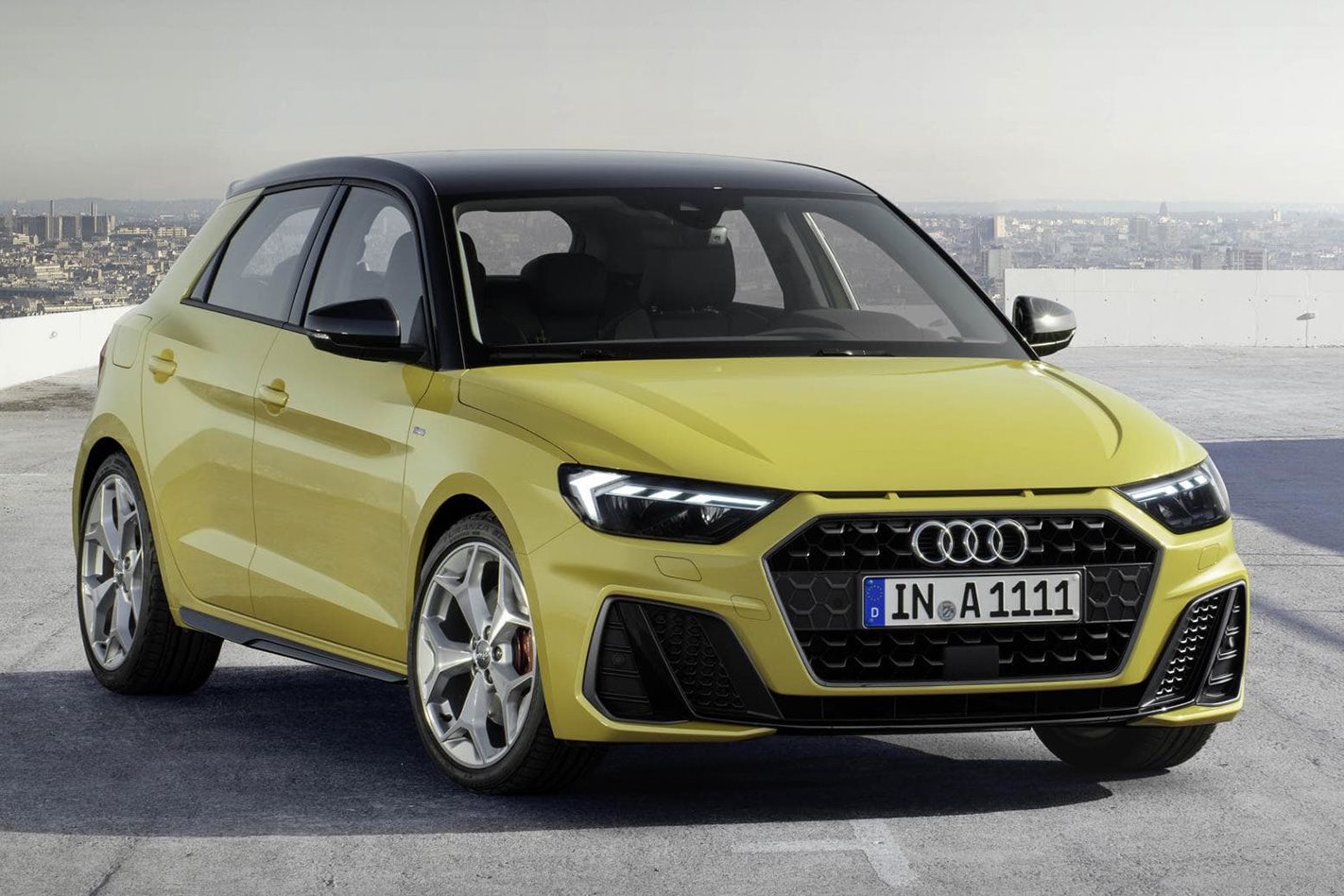
An all-new iteration of Audi’s gateway hatchback.
Price range: $30-40K
Rivals: Mini Cooper, Fiat 500
Due Date: March/April 2019
Spun-off from the new Volkswagen Polo’s platform, Audi’s box-fresh second-generation A1 city hatch promises to inject a great deal more sophistication into the bottom end of the German brand’s product portfolio. Now measuring over four metres long it’s physically bigger than before, but a range of new powertrains – including a 1.5-litre turbo four with cylinder deactivation – move the mechanical game along as well.
Inside there’s a greater sense of maturity in the cabin furnishings, plus plenty of infotainment tech.
Audi A6

Another all-new Audi, this time in executive-grade large sedan form.
Price range: $80-120K (sub-Audi Sport variants)
Rivals: Mercedes-Benz E-Class, BMW 5 Series, Volvo S90, Lexus GS
Due Date: First quarter of 2019
Evolutionary styling might make the 2019 Audi A6 look broadly similar to the current model, but get up close (and perhaps take a peek underneath) and the differences become pretty stark.
Sure, there’s still a quasi-hexagonal grille, sharply-creased sheetmetal and a generally broad-shouldered look to Audi’s upcoming E-Class fighter, however Audi claims it’s a much sportier-feeling car to drive while the adoption of mild-hybrid tech in every model helps curb the big sedan’s thirst.
Additionally, rear-wheel steering, active rear differentials, heaps of aluminium and a brace of muscular turbo diesel and petrol V6s amp up the A6’s driver appeal, while all occupants will benefit from the latest generation of the company’s ever-evolving infotainment system.
BMW 8 Series
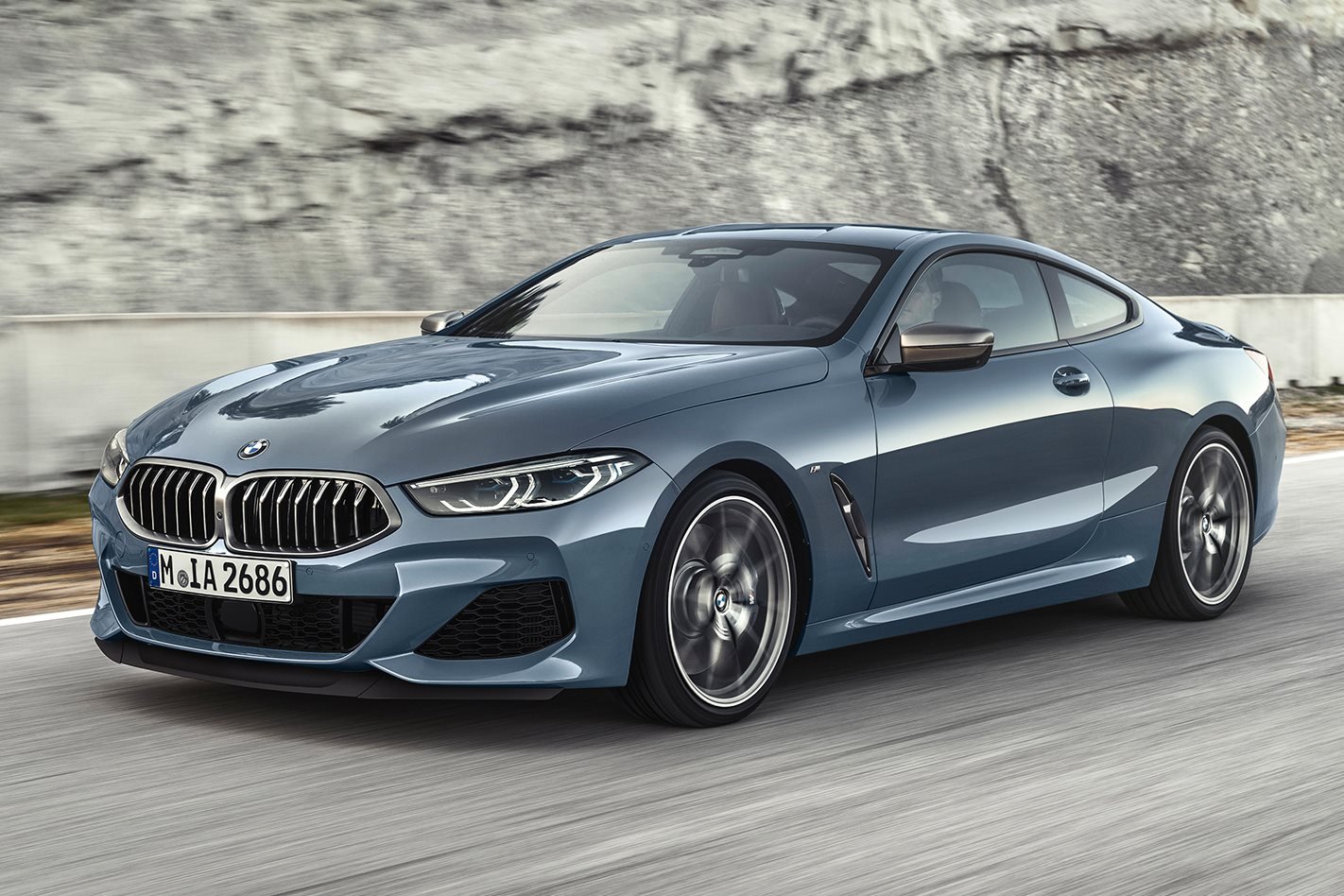
The return of one of BMW’s most-missed nameplates
Price range: $180-250K (non-M variants)
Rivals: Bentley Continental GT, Maserati GranTurismo
Due Date: First quarter, 2019
The BMW 6 Series has bowed out to make way for the long-awaited return of a legend – the 8 Series. Exciting, right? But don’t let the change in numbers fool you, for the 8 Series doesn’t necessarily represent any great increase in size, spec or sportiness. Generally speaking, the anticipated three-variant 8 Series family (two-door coupe, convertible and a low-slung four-door) will mirror that of the departed 6 Series range quite closely, and we expect their pricetags will too.
The M850i coupe will be the first out of the blocks in the first quarter, packing a V8 wallop to the tune of 390kW and 750Nm. Performance should be mega, but expect an M8 performance flagship to arrive later and turn the wick up even higher.
Ford Fiesta
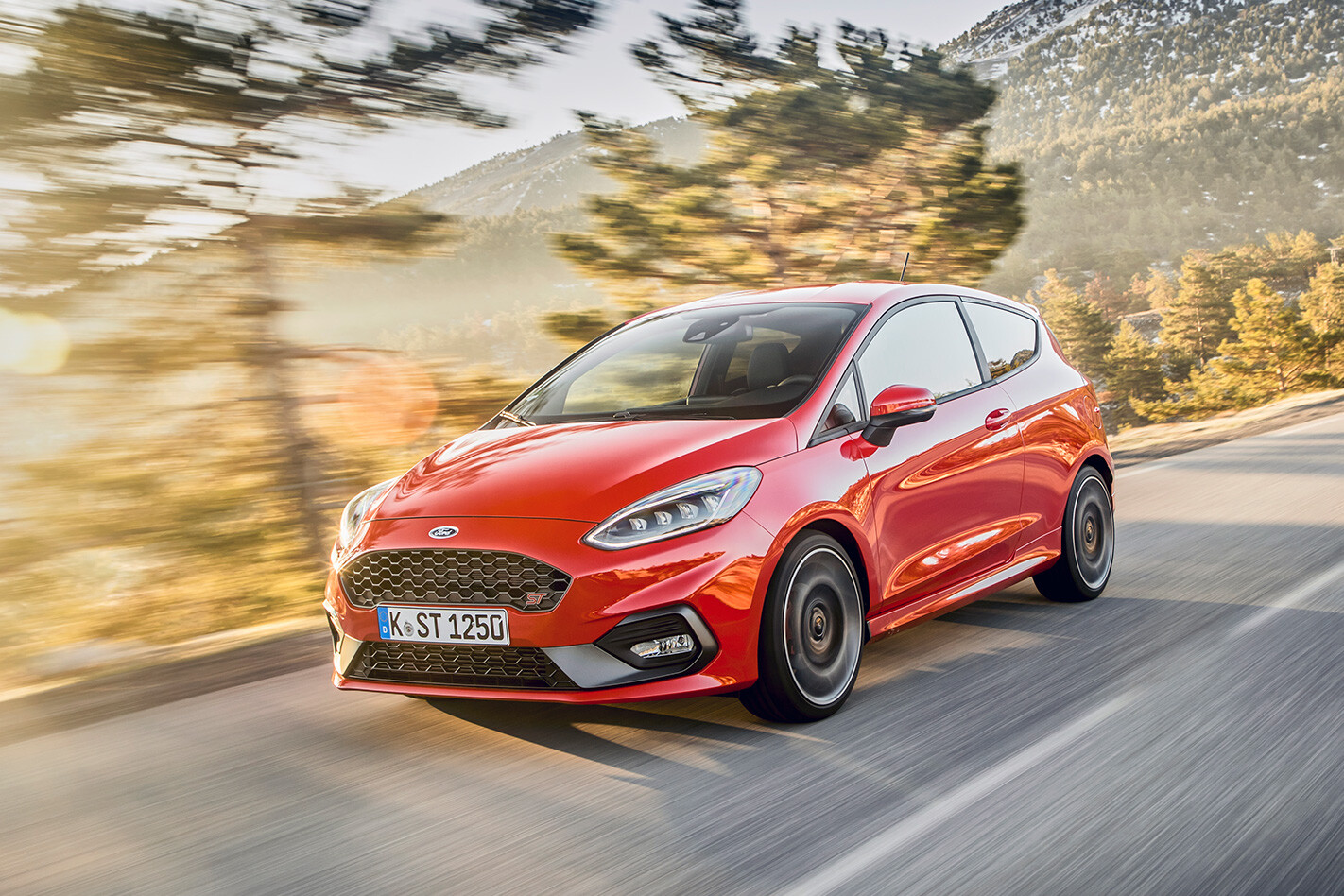
The Fiesta returns for another generation – but only as a hot hatch
Price range: $28K-$30K
Rivals: Volkswagen Polo GTI, Suzuki Swift Sport, Renault Clio RS
Due Date: Second quarter 2019
The Fiesta has long been a dynamic darling of the compact hatch set, and Ford will be cranking up the athletic ability of its next-generation Fiesta next year with the Fiesta ST hot hatch.
However, the ST will be the only way you’ll get to put a new-gen Fiesta in your driveway, for Ford Australia has declined to bring lesser models in the range to local showrooms due to unfavourable exchange rates putting the squeeze on pricing.
As for the ST, we’ve already driven it and declared it to be one of the best hot hatch options at its expected high-$20K price point. Expect to see it land sometime in the second quarter.
Ford Focus Active
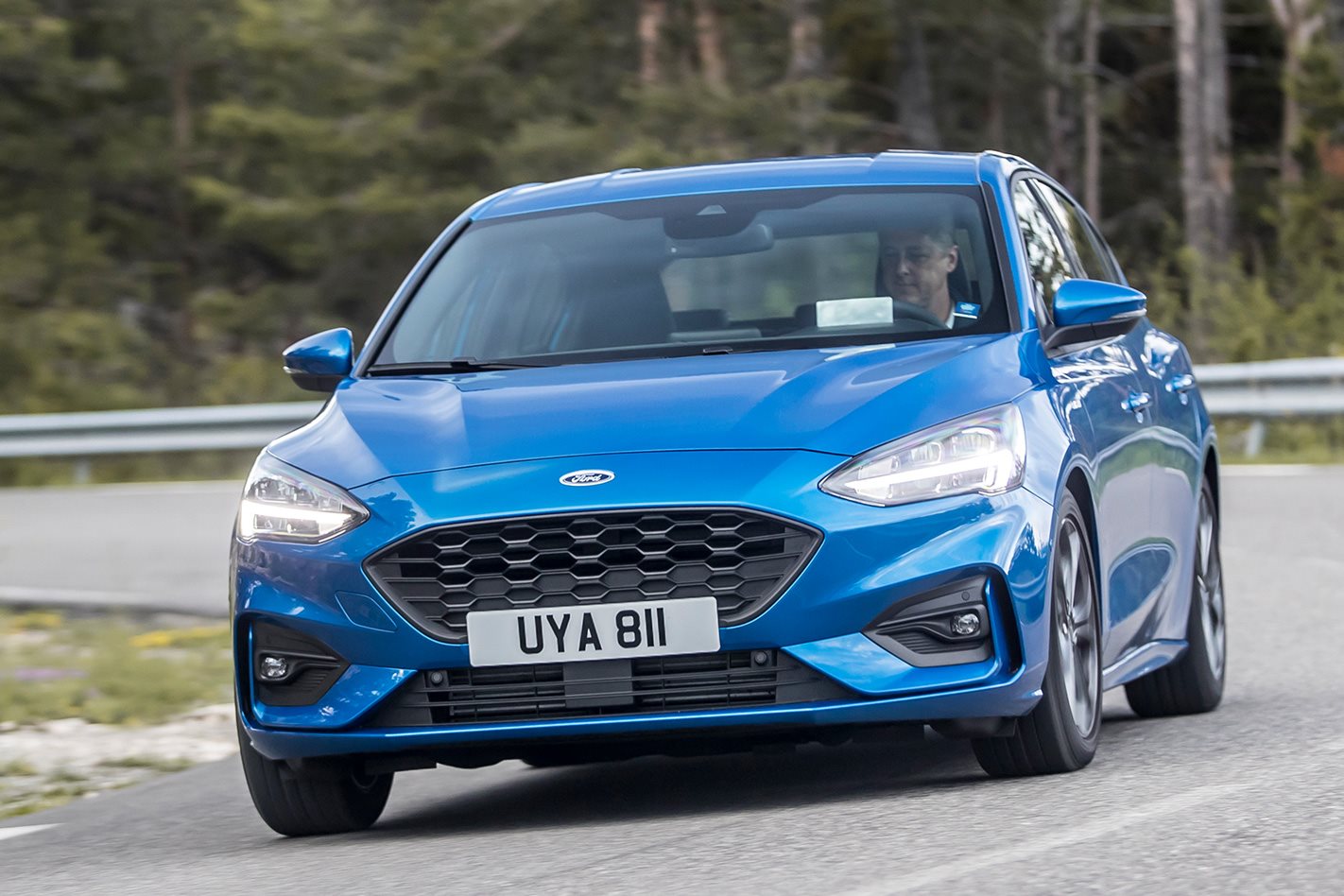
A jacked-up version of the Focus for those with an outdoorsy bent
Price range: $29,990
Rivals: Subaru Impreza XV, Fiat 500X, Citroen C4 Cactus
Due Date: second-quarter
The Focus hatch has already received its full model changeover by now, but the family will grow when the Focus Active rolls into Ford showrooms in 2019.
Following a similar format to the Impreza-based Subaru XV but described by Ford as a passenger car rather than an SUV, the Focus Active will bridge the gap between the regular Focus hatchback and Ford’s bona-fide SUV line-up. The ‘missing link’, if you will.
Only one engine, a 134kW 1.5-litre turbo petrol, will be offered, and the Focus Active is strictly front-wheel drive with an eight-speed automatic.
Honda Accord
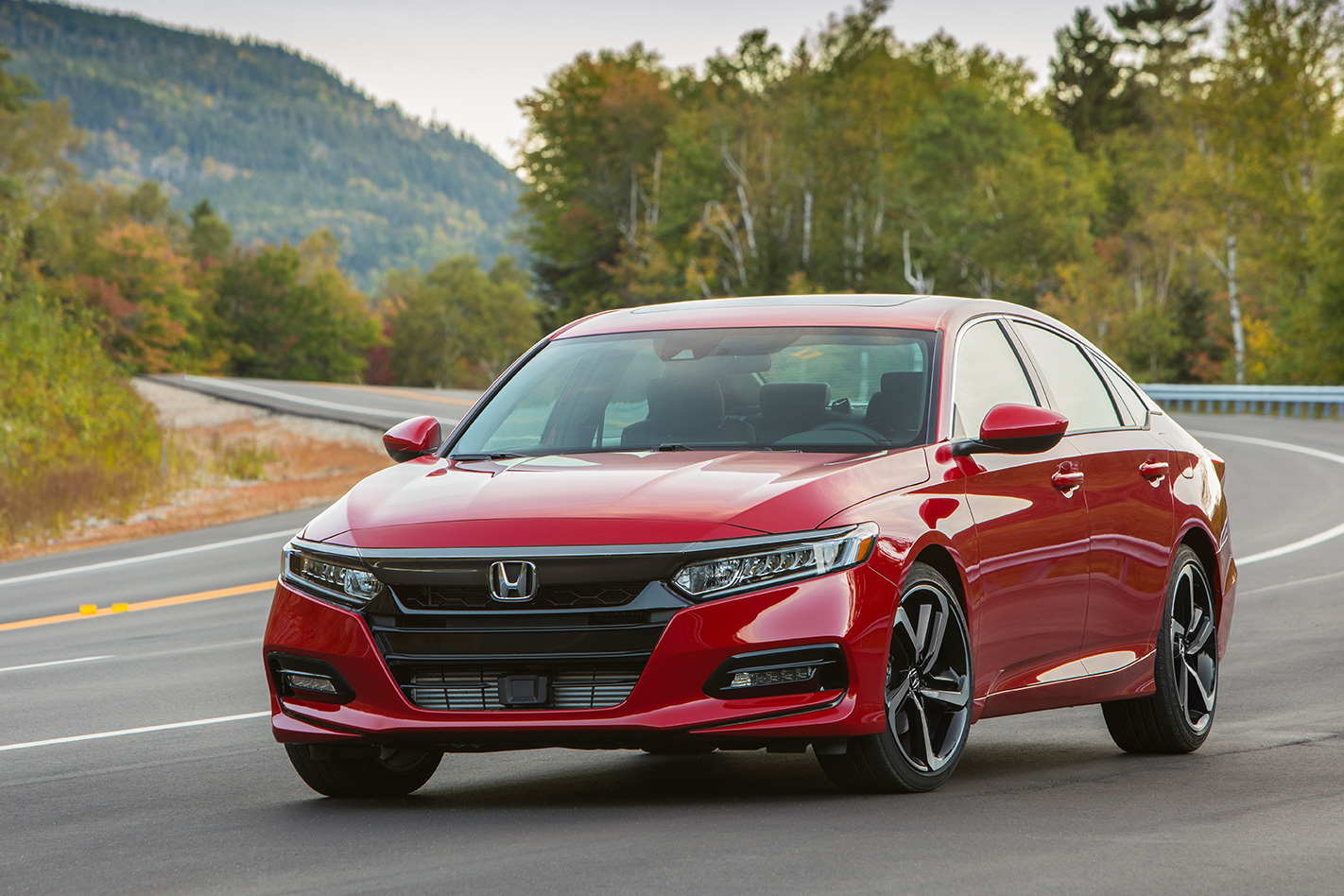
The Accord returns for a tenth time, and with a tech focus
Price range: Expected to be high $40K, low $50K
Rivals: Holden Commodore, Toyota Camry, Skoda Superb
Due Date: December 2019
Honda celebrates its 50th year of selling cars in Australia in 2019, and the biggest news on its car launch calendar is the arrival of the tenth-generation Accord at the end of the year.
Already on sale in the USA since mid-2017 the Accord will be something of a latecomer to Australia, however Honda’s hands have been tied due to delays in right-hand drive production. Rapidly declining demand in the mid-size car segment – where the Accord will sit – might temper sales somewhat, but Honda Australia says it won’t be gunning for big volumes with its next Accord. Rather, the family-sized sedan will instead be pitched into the market as a high-specification technological flagship to give it a point of difference.
Details are still under wraps, but don’t be surprised if the high-end strategy sees the Accord’s price of entry head north of $50,000.
Hyundai i30 N Fastback
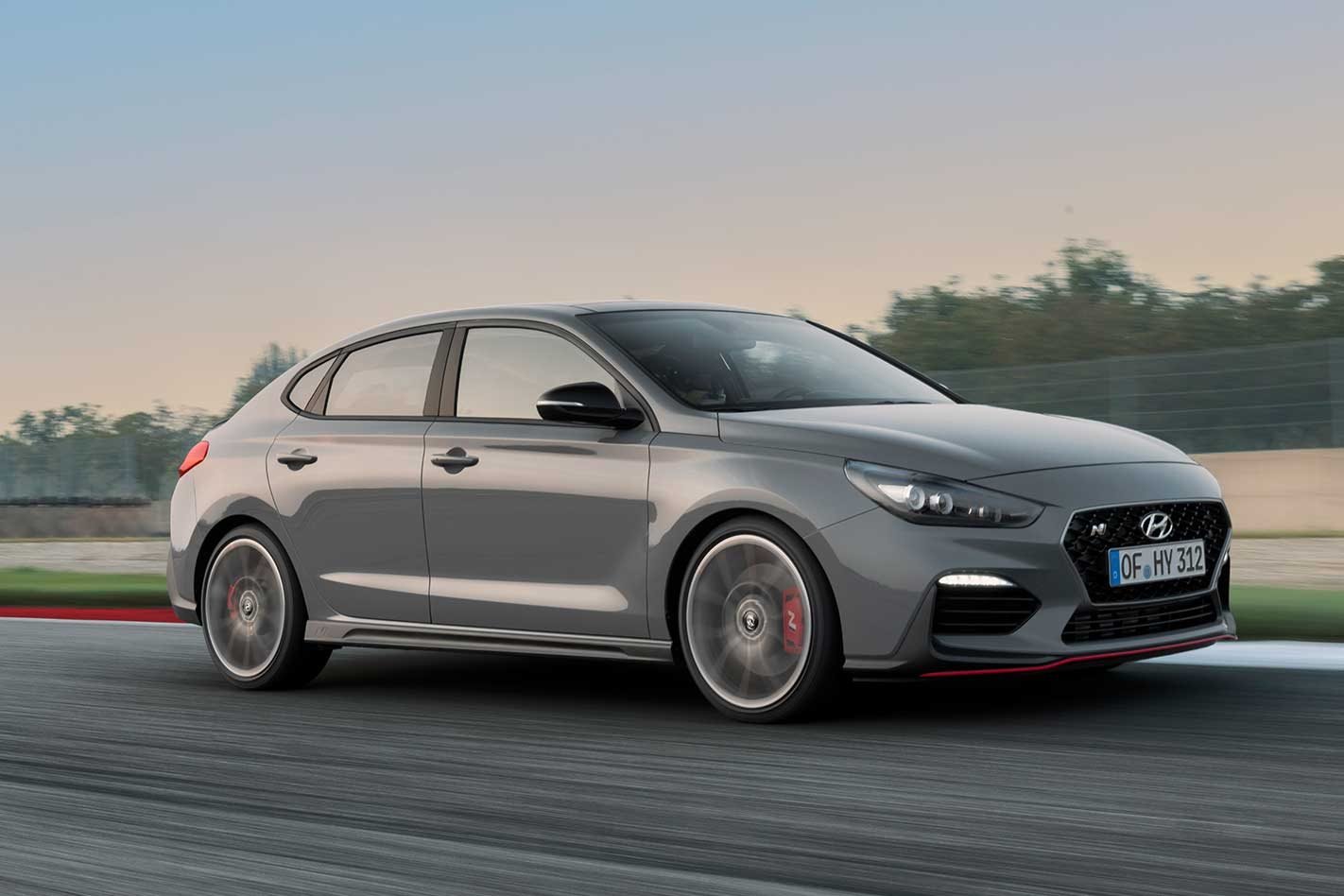
The only way you can buy an i30 that isn’t a hatchback
Price range: $40,000
Rivals: Subaru WRX, Renault Megane RS, Honda Civic Type R
Due Date: Unknown
While some overseas markets enjoy the ability to buy an i30 in a more mature ‘four-door coupe’ bodystyle, Hyundai Australia says the i30 Fastback is not coming our way… unless you spend big on the high-performance N variant.
Fatter profit margins at the circa-$40k mark mean the European-built i30 N Fastback actually makes economic sense for Hyundai to sell in cost-sensitive Australia, even though lesser variants aren’t. For buyers looking at the existing i30 N, the impending option of a grown-up looking Fastback may prove quite alluring, especially as it retains all of the go-fast mechanicals of its hatchback brother.
Exact launch timing has yet to be settled, but the i30 N Fastback’s price should only wear a very modest premium over that of the hatch.
Mazda 3 – mid-2019
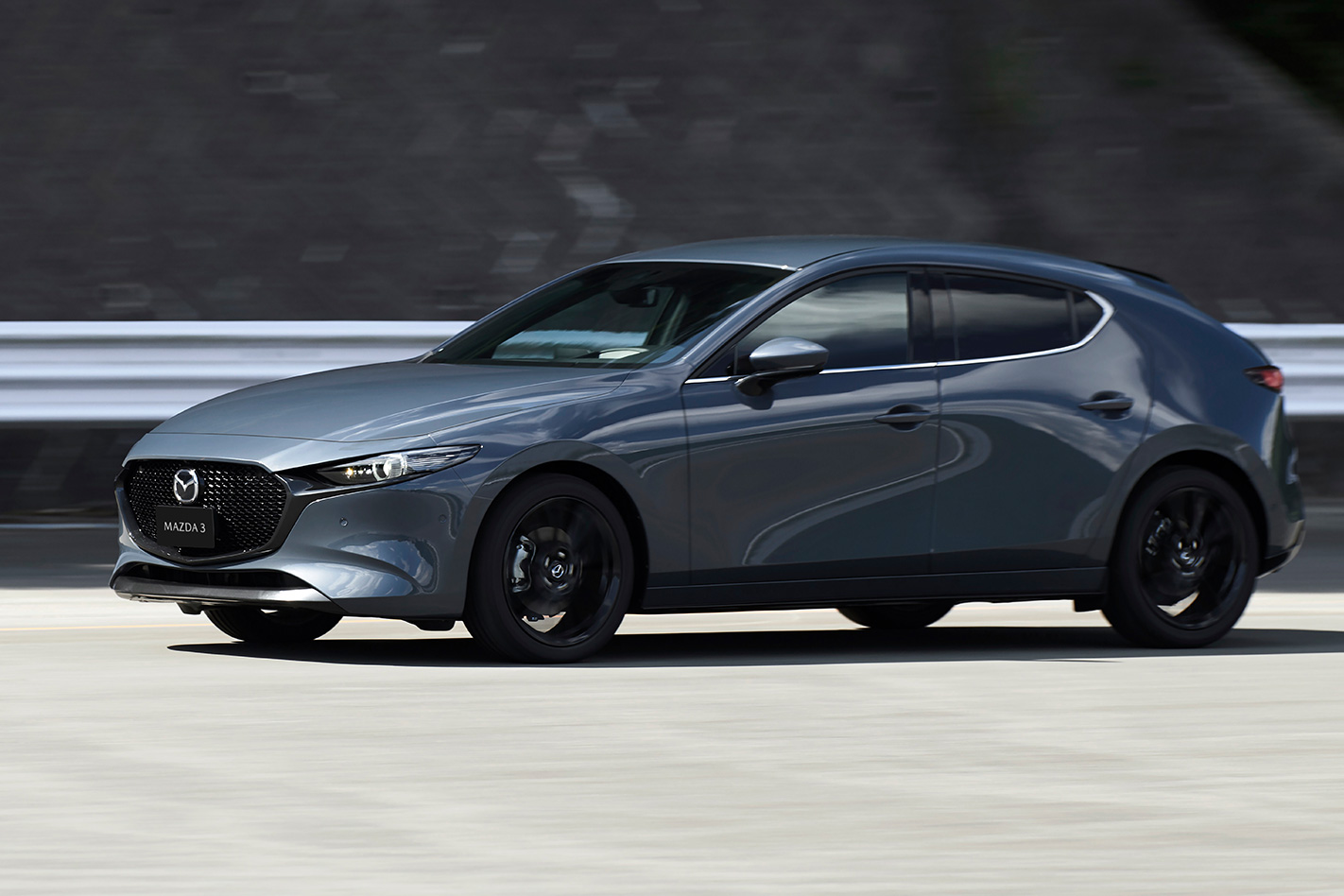
In the middle of the year Mazda Australia will change over its popular Mazda 3 range with an all-new generation hatch and sedan, and while local details such as range structure and pricing are still far from ironed out, the design of the new 3 shows that Mazda’s mainstay small car is set to be a real looker. The hatch and sedan will be quite visually distinct from the B-pillar rearward – certainly more so than the current generation – and the local powertrain lineup is likely to include Mazda’s innovative and ultra-efficient SkyActiv-X supercharged compression-ignition engine.
Nissan Leaf
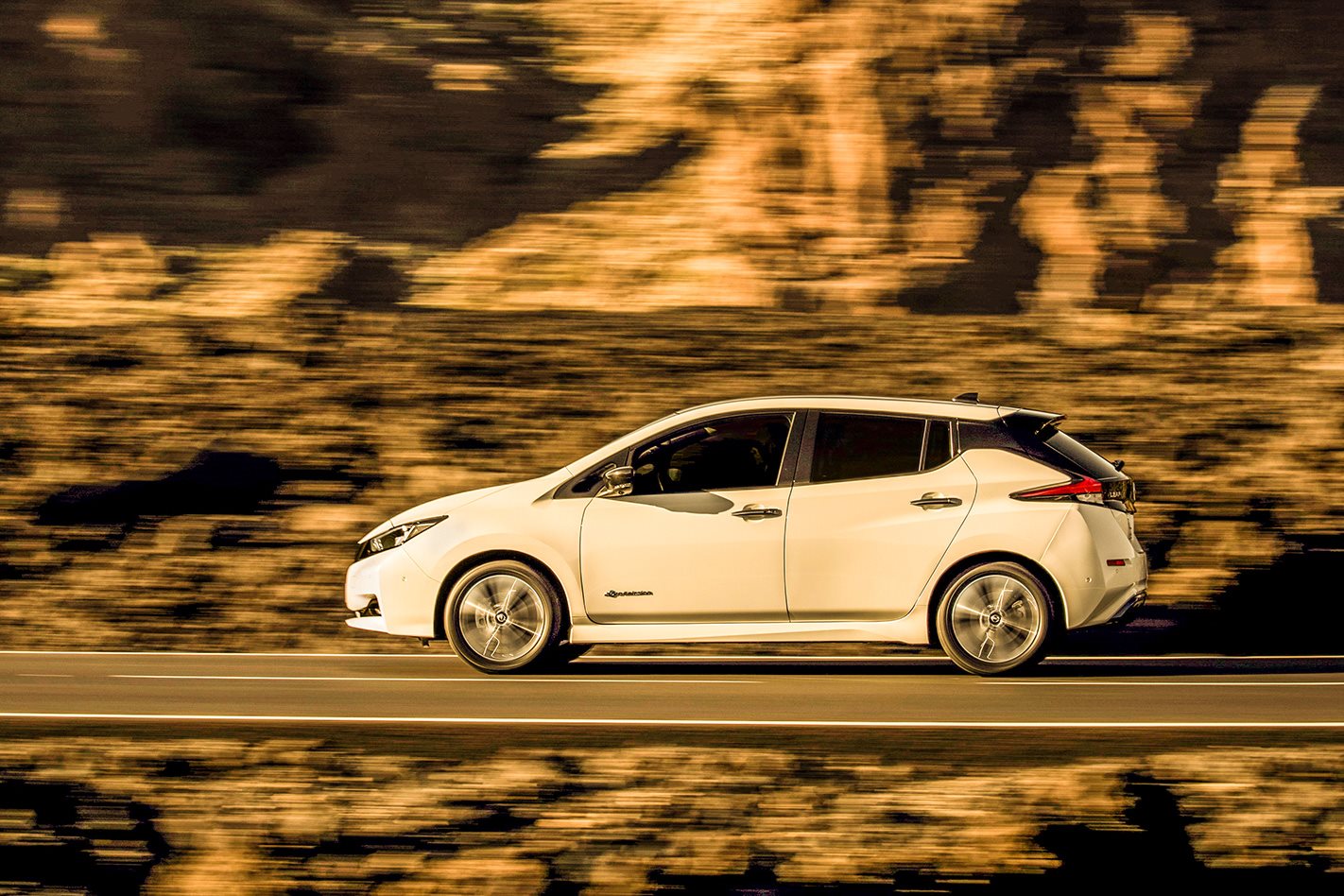
Nissan’s all-electric hatch returns
Price range: $50-60K
Rivals: Hyundai Ioniq EV, BMW i3
Due Date: March 2019
The Nissan Leaf electric car will return for its second generation in March, following the same format (and built on the same architecture) as its predecessor, but packing in greater energy storage and more power than before. The styling has also been dialled back to take the Leaf in a more conservative direction, and there’s a greater emphasis on driver-assistance technology, giving the new Leaf some limited self-driving capabilities.
Car-to-grid charging technology also unlocks some interesting new avenues for the Leaf, potentially making it a part of an interconnected smart power grid and giving it the ability to passively earn its owner money while it’s parked. Try doing that with a combustion-engined vehicle!
Peugeot 508
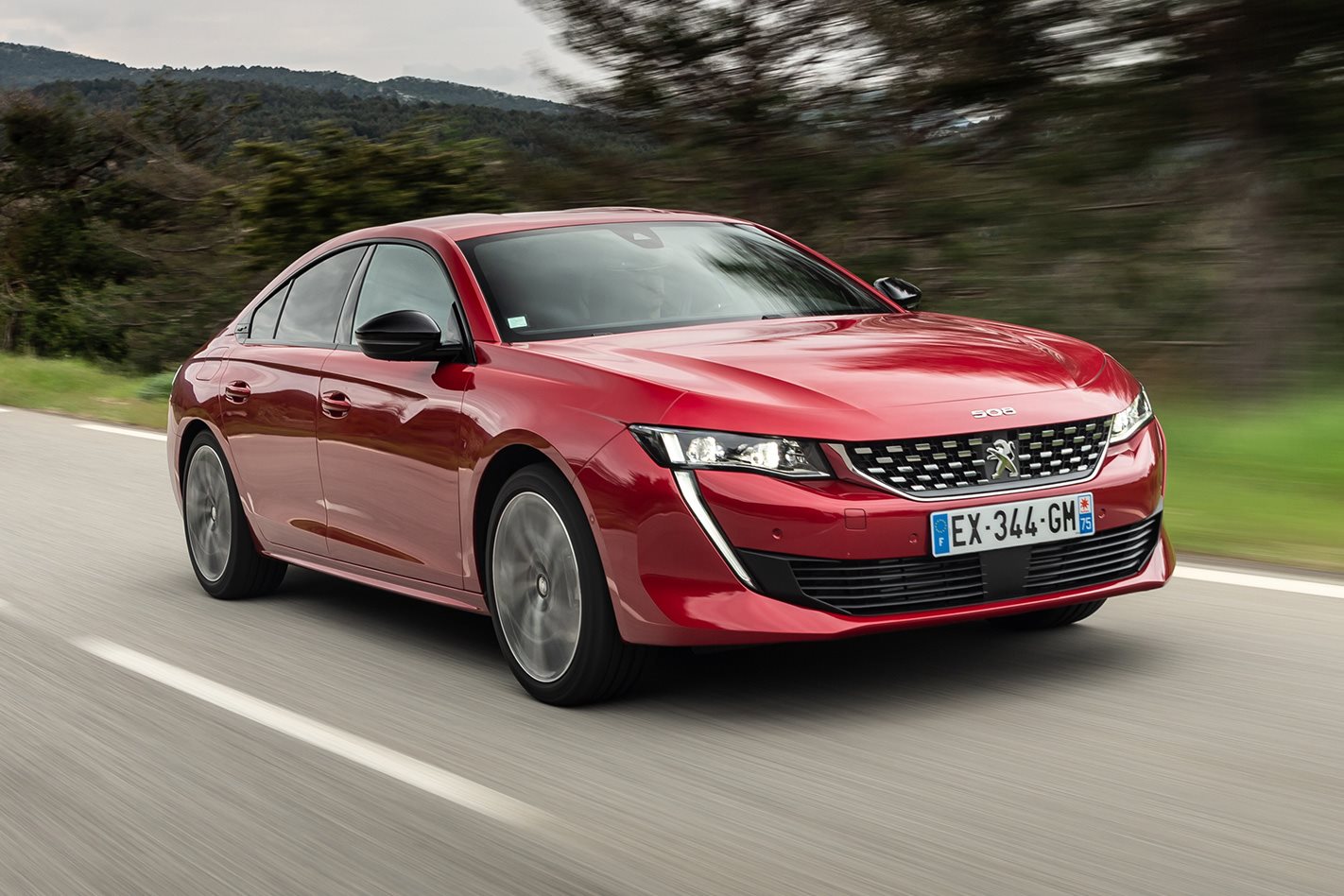
Ooh la la – who knew a midsize sedan could look this good?
Price range: $40K+
Rivals: Volkswagen Passat, Toyota Camry, Mazda 6
Due Date: June 2019
After a couple of generations of extraordinarily soporific 508s, Peugeot has shaken off whatever ailment afflicted its design department and released a stunning mid-size pair in the form of the 2019 Peugeot 508 sedan and wagon.
Strong visual links with the 3008 and 5008 are in evidence both inside and out (a very good thing), and the new 508 looks modern, dignified and flaunts a far more premium aura than most would expect of the French brand. Lightweight engineering also promises more than a skerrick of dynamic aptitude as well. Translation: it’ll drive like a dream when it gets here in mid-2019.
Tesla Model 3
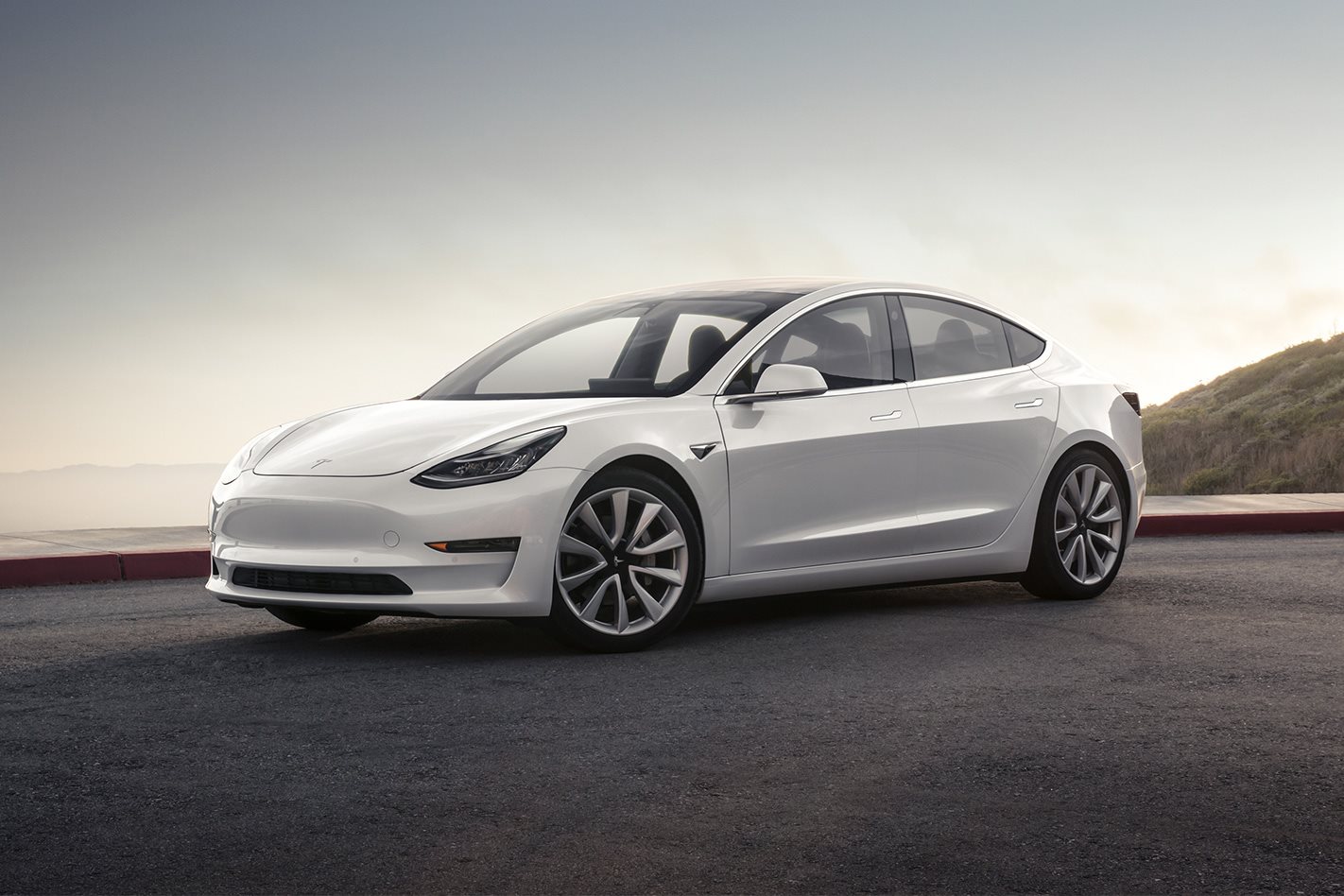
Tesla’s long-awaited ‘affordable’ EV, but is it really?
Price range: $60K+
Rivals: Nothing, really
Due Date: Mid-2019
Few cars are more heavily hyped than the Tesla Model 3, and the most affordable model from the American auto maker has endured an interesting start to its life. Production difficulties have crimped supply and Tesla is still working through fulfilling the huge number of pre-orders. Right-hand drive markets like Australia have been a low priority thus far.
The first deposits by would-be Australian owners were put down in March 2016, but Elon Musk himself says deliveries to Australia aren’t expected to begin until “around mid-2019”. A long time to hold out for a car that will, by the time it reaches here, already be halfway through its lifespan, but for some people the promise of a comparatively affordable premium electric car is too enticing to ignore.
Volvo S60
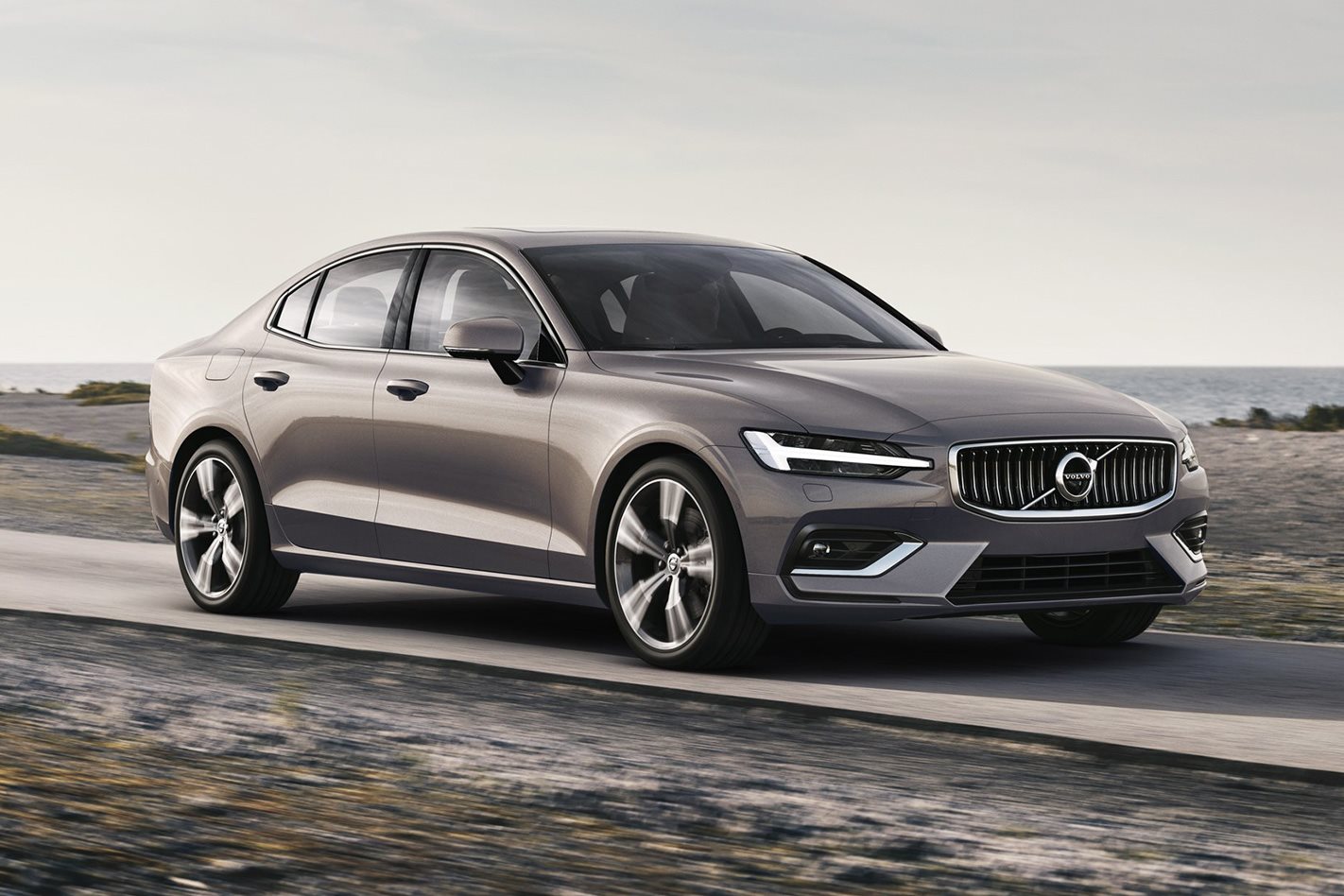
Volvo’s product renaissance continues with an intelligently-designed sedan
Price range: Unknown
Rivals: Mercedes-Benz C-Class, BMW 3 Series, Audi A4, Lexus IS, Jaguar XE
Due Date: Early 2019
Volvo plays to its Scandinavian strengths with the new S60, which takes the elegant design language introduced by the XC90, S90, XC60 and XC40, and wraps it in an incredibly handsome four-door bodystyle – with an interior that wouldn’t look out of place in a high-end interior design mag.
A V60 wagon equivalent will join it too, and between them they’ll take on the dominant Germans in the mid-size premium market with a range of 2.0-litre petrol and diesel powerplants – some with extensive electrification and a fuel-saving plug-in hybrid capability. If the rest of the modern Volvo line-up is anything to go by, the Germans will have some very stiff Swedish competition on their hands.
Do any of these 2019 passenger cars have your attention? Let us know in the comments.
It’s not the start BMW are hoping for. “Lost two yesterday,” reports a glum PR minder. “Out at the track.”
This review was originally published in MOTOR’s July 2006 issue
The items ‘lost’ are brand spanking new BMW Z4 M Coupes, the track is the fearsome Circuit de Estoril in Portugal, and the losers of said items are a pair of European journalists who’ve gone out too hard, too early with both, funnily enough, firing off at the same tightish closing-radius left hander. No names, no pack drill, sadly.
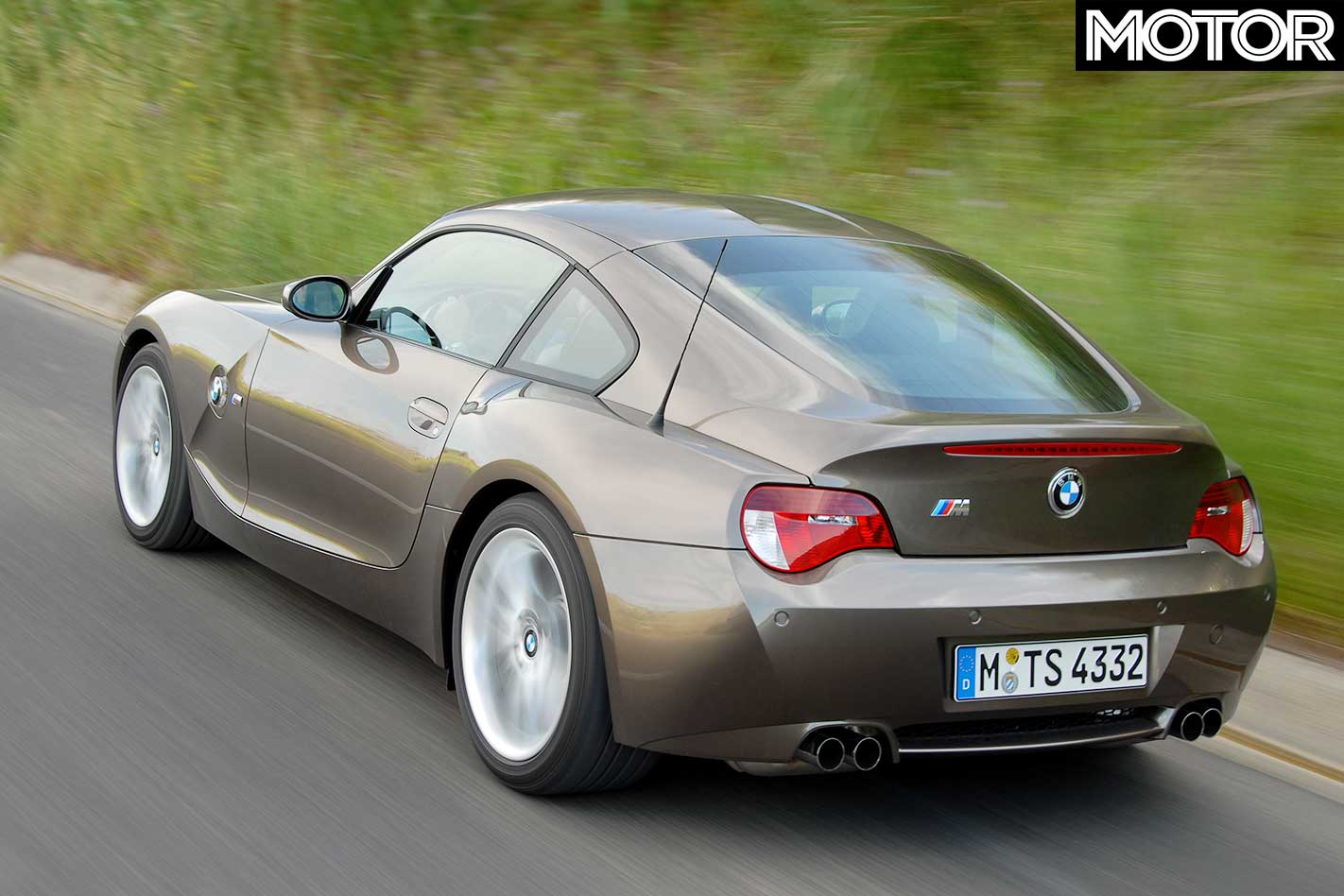
From a concept at Frankfurt to a full model in Portugal, it’s been a wild 17-month ride for the M Coupe. Designed from the get-go as a high end complement to the Z4 Roadster, its initial concept included both the M and civilian three litre derivatives. Given the green light from Munich in November 2004, Professor Ulrich Brunkhe, the president of the M division and a car nut if ever there was one.
“From development this is the fastest car we have ever done,” he notes, “but it’s still an M car. We always want to keep the spirit of an M car clean – they have to have the DNA of an M. We will never just re-label things.”
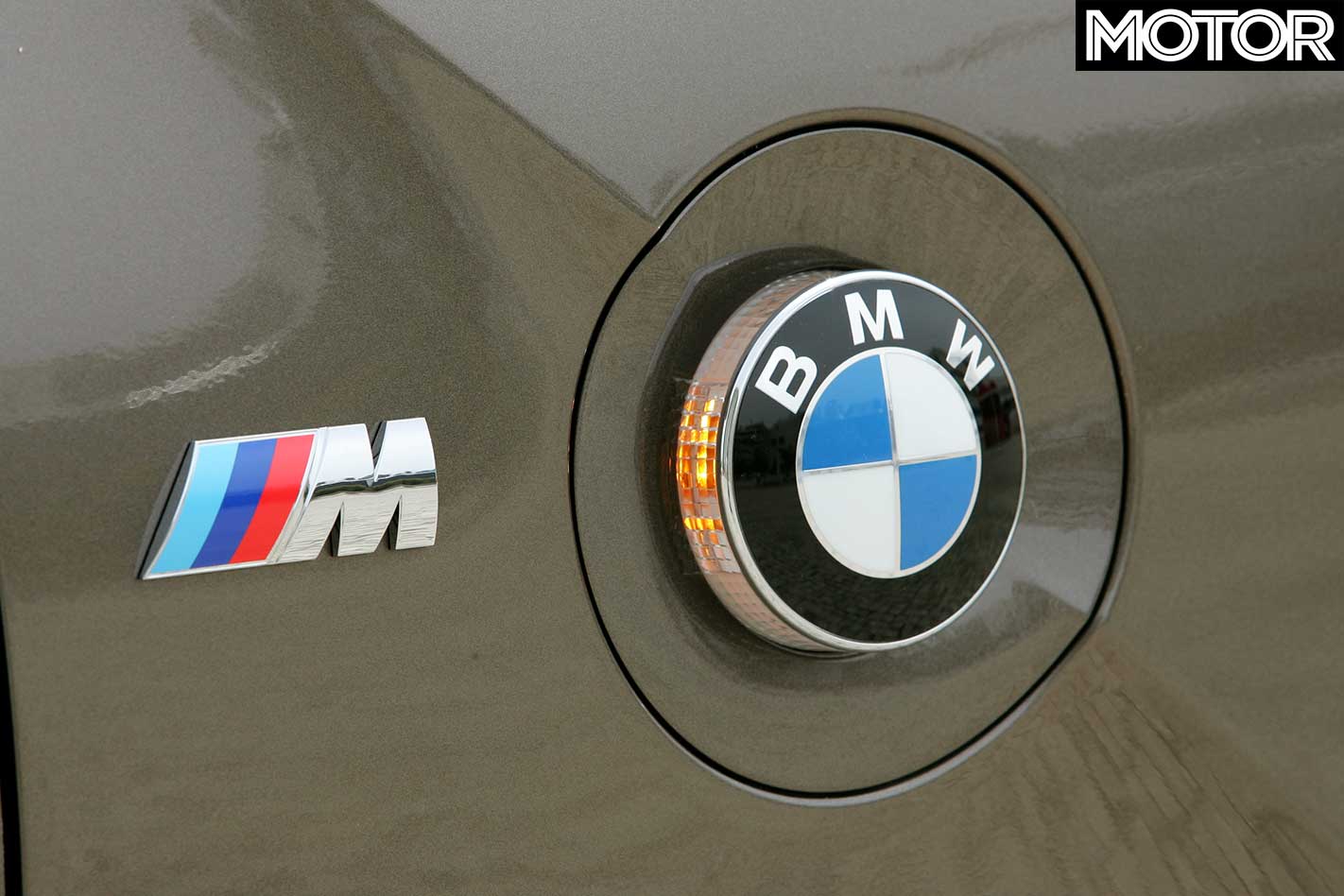
In many ways, though, the new M Coupe is about as M as M gets. The most accomplished engine in the range is slung into the stiffest chassis structure it’s possible to devise and is matched with serious brakes, a manual six-speed gearbox, one of the best limited slip diffs in the business and proper hydraulic steering.
It’s reasonably light at 1495kg, it sits low to the road, it’s only got two seats, it’s got a tiny wheelbase but a chunky track – and, according to its parents, is designed to go out hunting Porsche 911s. Big call…
As with its older sibling, the Z3-based M Coupe, the first topic of conversation is its, ahem, unique visage. Love it? Hate it? It’s almost impossible not to form an opinion one way or the other right from the get-go. Carrying over the Z4 open-top’s distinctive flank scallops, the roof scores a similar treatment right down the centre, blending into the fastback hatch.
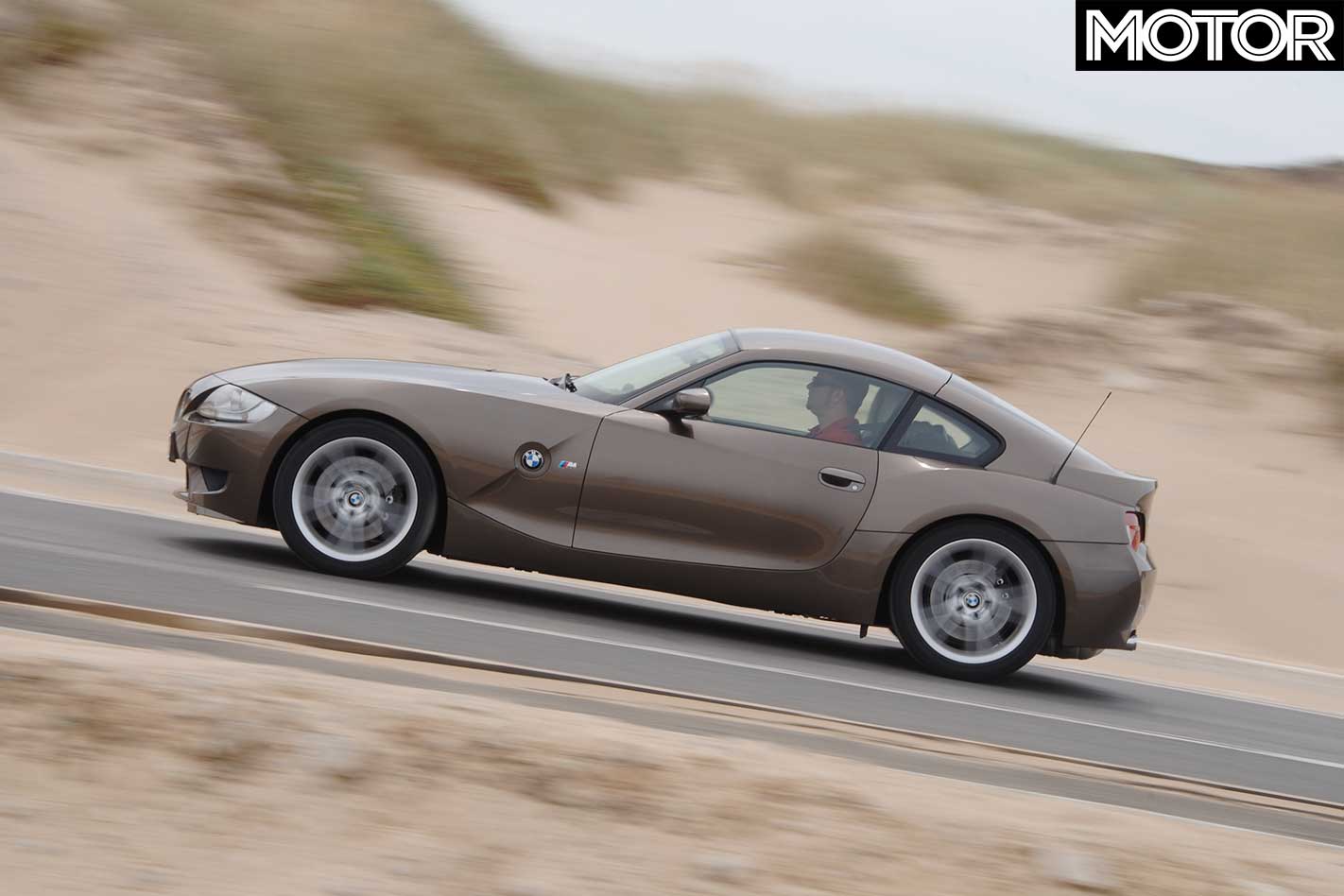
Its most flattering angle is revealed from behind and high, accentuating the muscled-up rear guards. It’s an awkward look in side profile, though, with the long, lithe front contrasting markedly with the stubby, aggressive rear end. Our Sepang Bronze example – a hue unique to the M range – looks the goods, setting off the M’s tough front bonnet and lower front bar makeover.
Be warned, though; the splitter’s lower vestiges will cop a hammering over driveways.
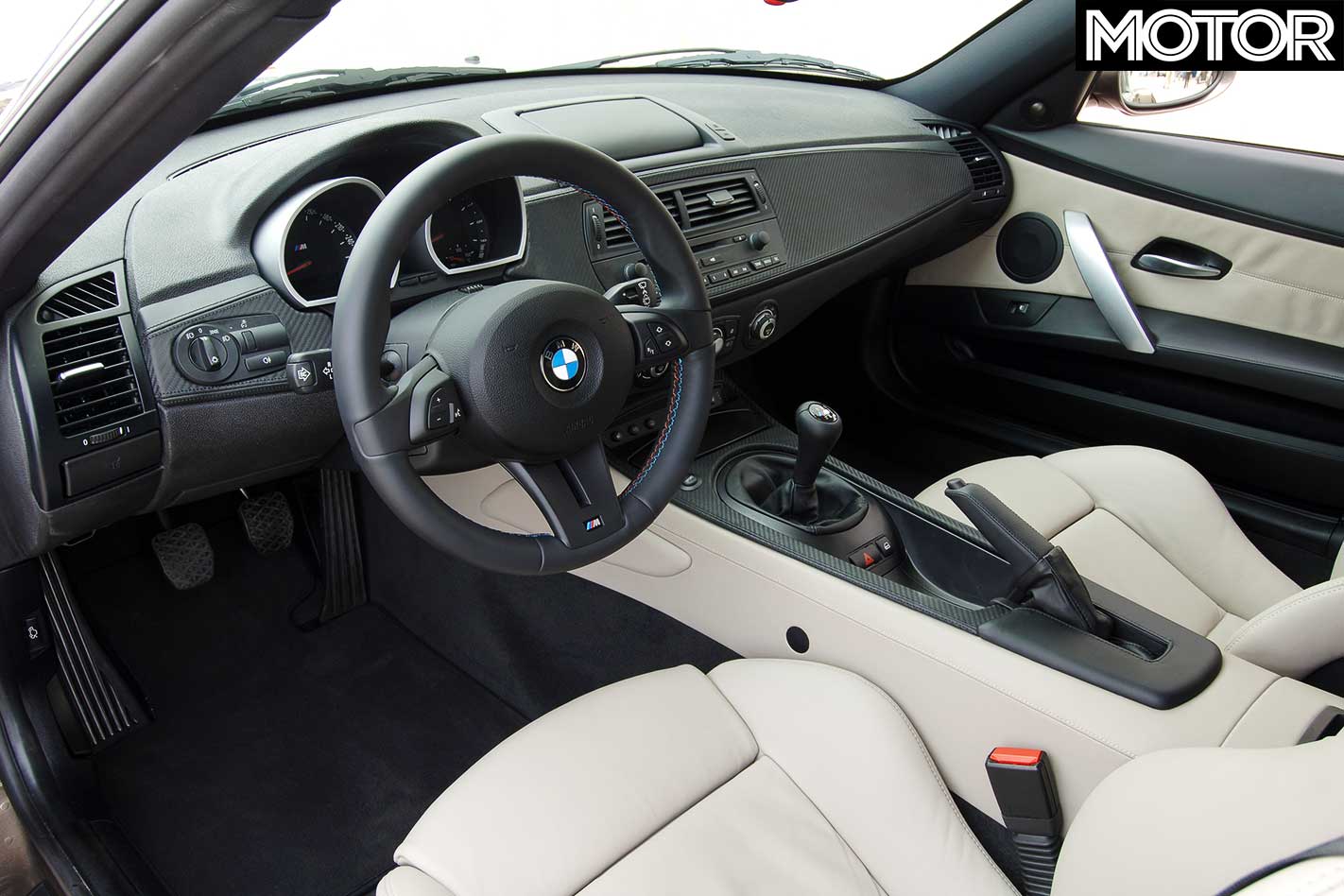
Inside, it’s all Z4, and it’s all but identical to the M Roadster we drove last month. Controls fall easily to hand, though storage for odds and sods in the centre console isn’t ideal. The new-design M wheel is a treat, though; small in diameter, generous in rim thickness and a delight to twirl. The seats, too are supportive and adjustable though, as with the M Roadster, lacking the inflatable side bolsters that grace models like the 130i.
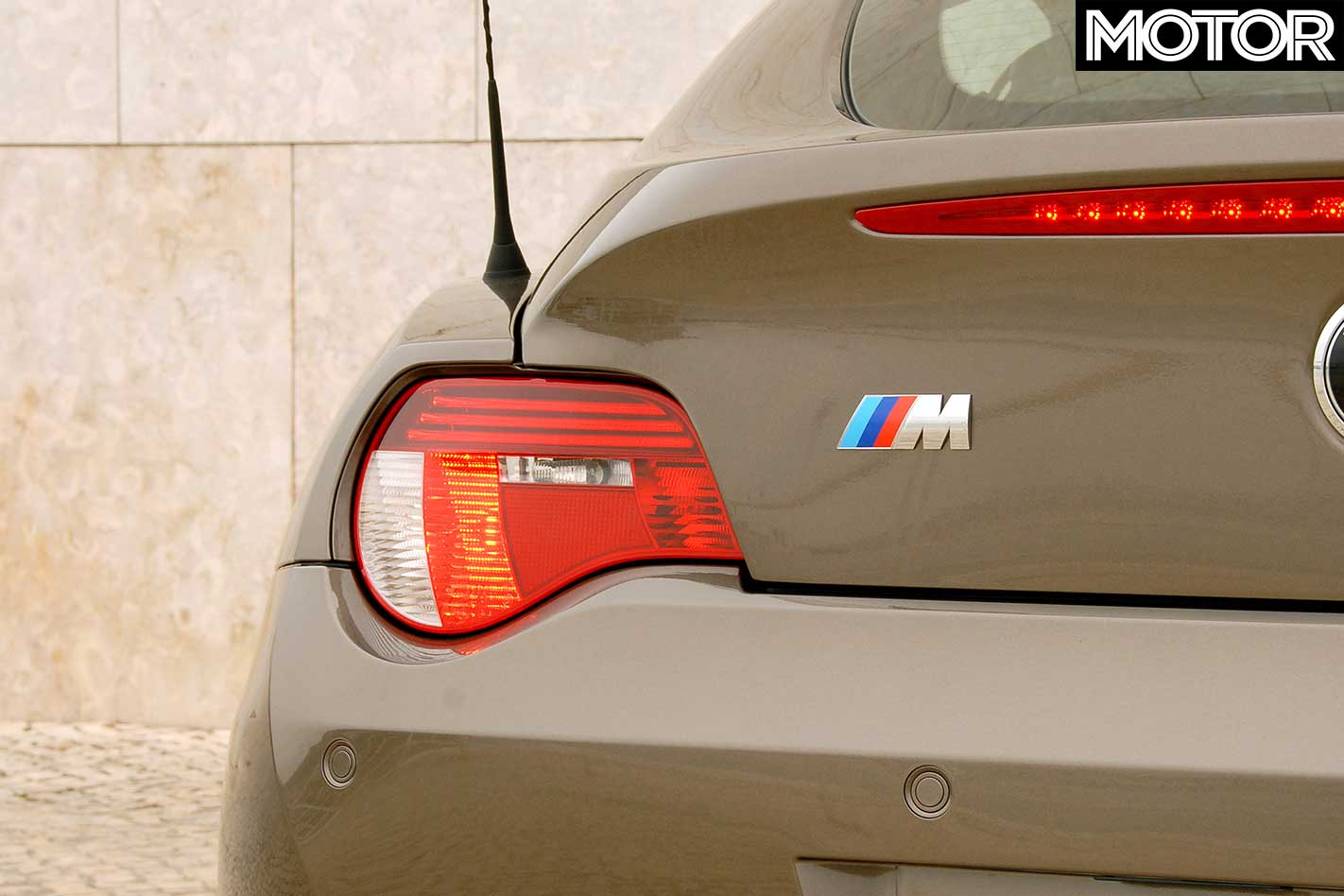
The large hatch access, complete with a cargo cover, means it’s a genuine weekender of a sports car, though its capacity and convenience is compromised somewhat by the inclusion of a large box sitting on the left of the boot floor containing the battery and the car’s tyre repair gubbins. Stashed under the floor of the cooking model Coupe, the M’s four-branch exhaust system is the culprit here, forcing the migration upwards.
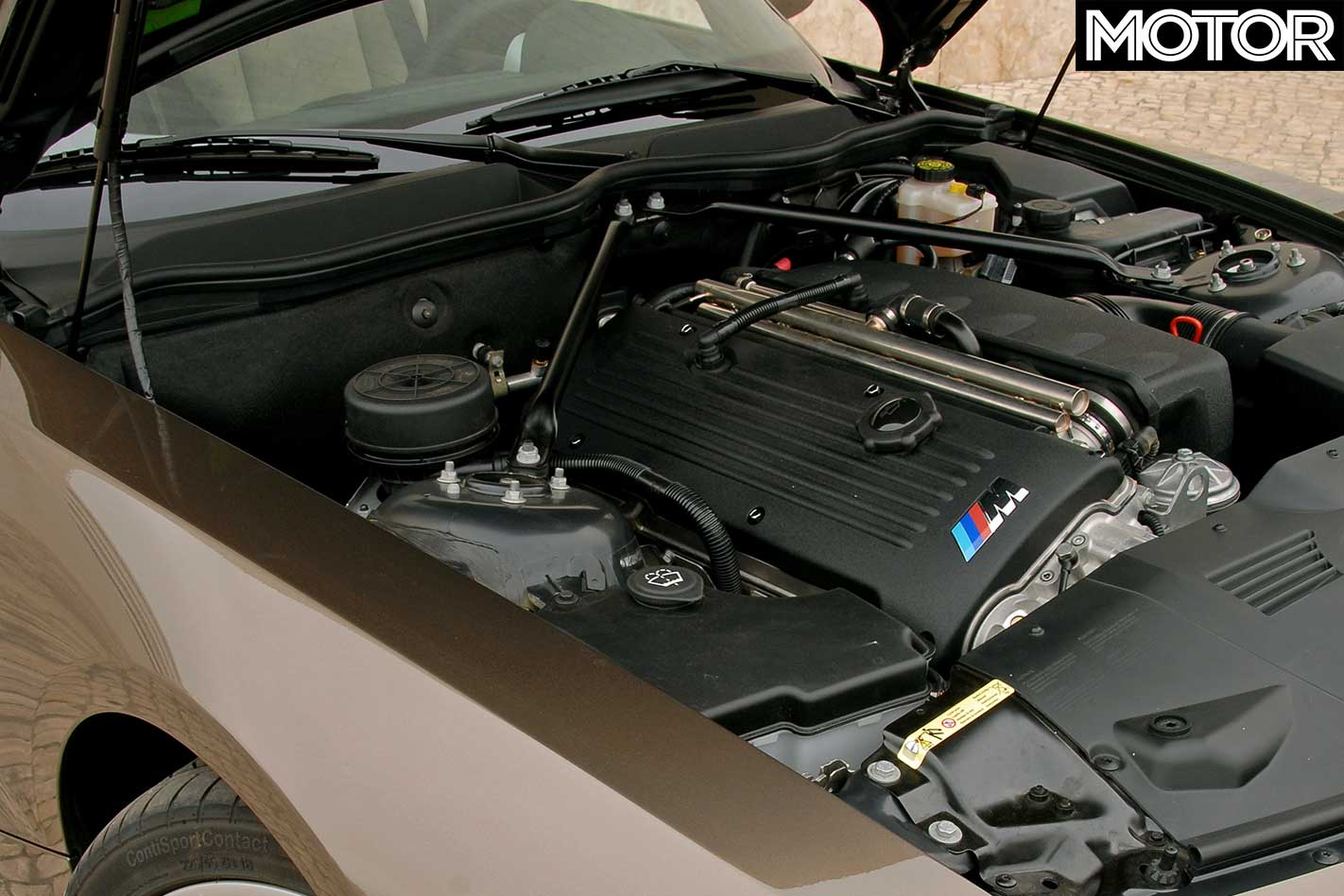
Not much to report from the engine room, the legendary six-pot, six-throttle body 3.2-litre straight six screamer sitting low and rearward in the chassis rails to give the little two-door a 50:50 axle weight distribution figure. Looking at the fit under the lid, it’s a lot of engine for a little car.
More progressive and aggressive throttle control is just a tap of the Sport button away, though with the stiffly sprung chassis it’s often easier to tool around town in regular mode.
Gotta be honest with you – it’s really nice to be able to start a sports car on the key for a change. The exhaust is surprisingly vocal inside, adding to the impression that you’re in something a bit different than your average bear. It’s quickly apparent that a decisive yet relaxed hand (and throttle foot) is de rigueur to pilot the M Coupe – and brother, is it stiffly sprung at low speeds.
Begat from the already impressively stiff Z4 open top, the lidded iteration adds a whole other dimension to the concept of torsional and twisting rigidity. Let it off the leash on a linking freeway en route to the back blocks of Lisbon and the M Coupe feels busy and alive, pulsing on its 18-inch rims and straining to have a crack.
Stir the six-speeder and get motoring down a reasonably B-spec road, though, and the taut suspension tune – in stark contrast to the supple and sinuous M Roadster – sees you on the defensive almost straight away. It’s tough to make it heed your commands to take a set; you’re fighting the springs to keep it settled in its travel and make it stick as it rebounds back at you, exaggerating a hint of lateral roll across the back end to the point of making things a little uncomfortable.
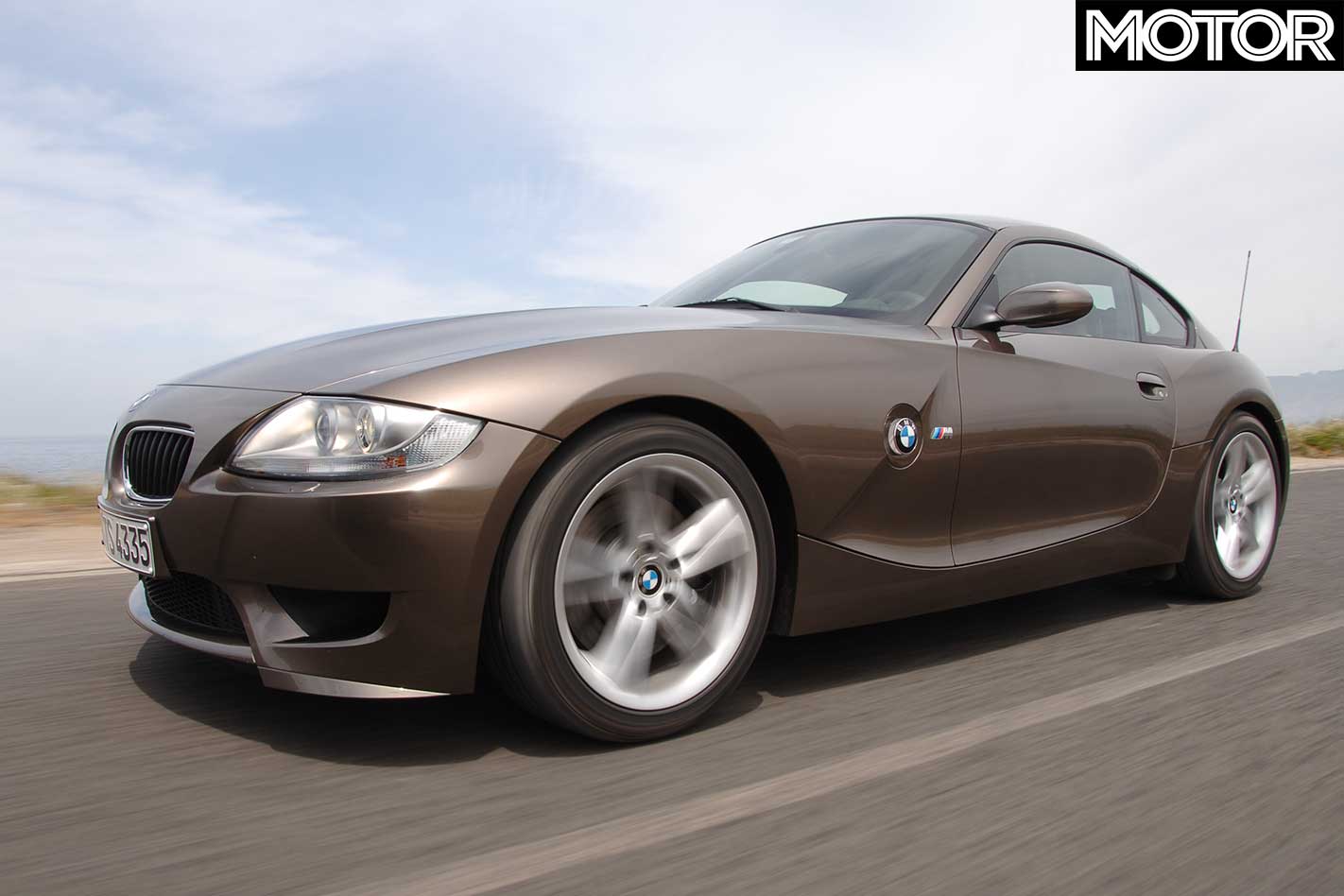
The DSC system has been set with quite a low threshold for loss of grip, retarding spark firmly as soon as slip is sensed. Across a patch of bumpy, dappled tarmac not unlike many of MOTOR’s favourite stretches, the M Coupe bucks, shimmies and kicks your heart right square into your mouth if you stay on the noise.
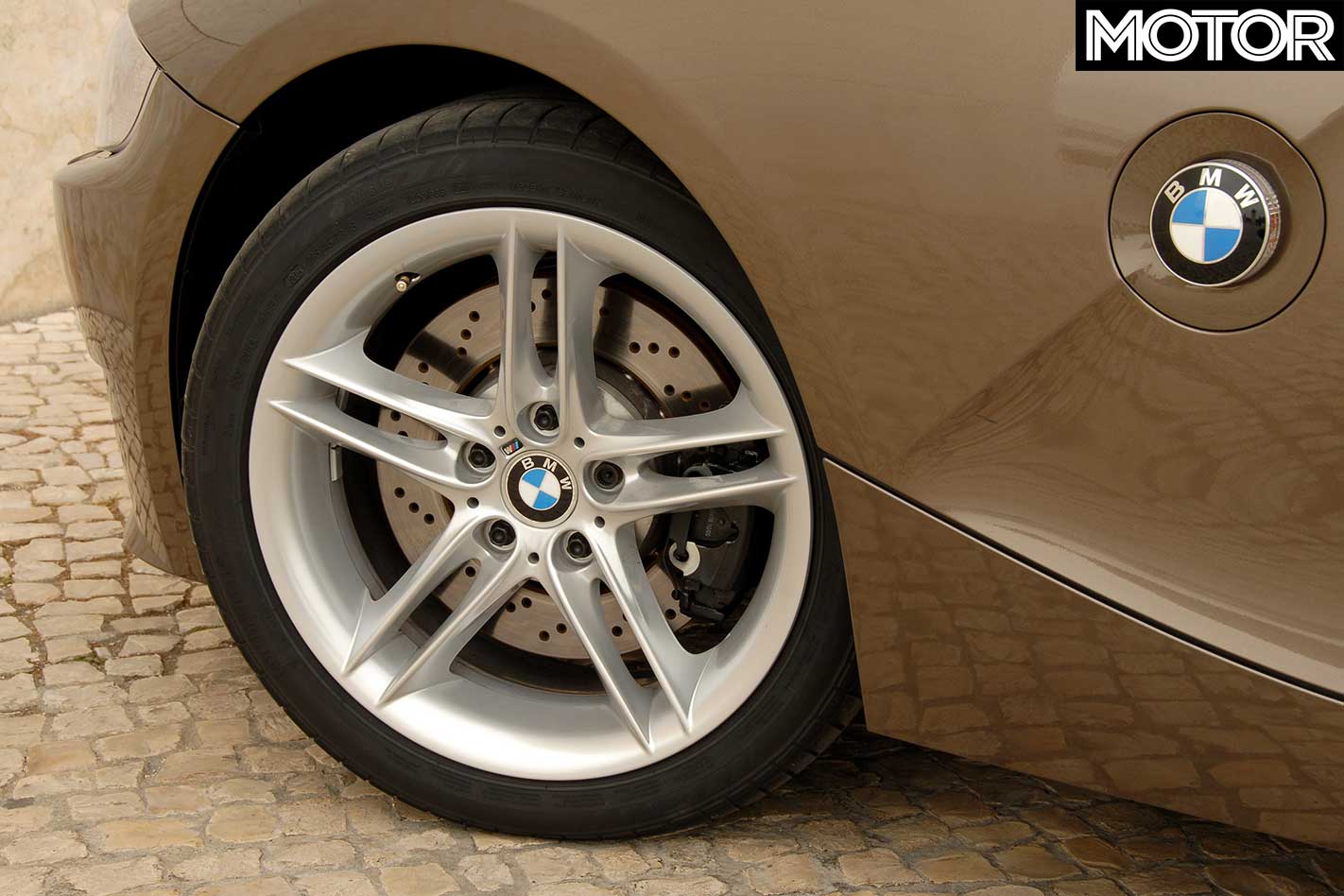
When the road smooths out and the bends come in rapid succession, the Coupe steps up a notch, with great front-to-rear balance and lots of mechanical grip from its bespoke Continentals. There’s no doubting the underlying strengths of the chassis tune; the CSL-spec brakes are firm, feelsome and immensely capable, the M diff can almost read your mind when it comes time to allocate torque and the steering, while muted, chips in for a modicum of feel not felt in other Bimmers.
It’s just too stiffly sprung for back roads – and let’s face it, that’s where the chunk of your miles will be spent in a jigger such as this.
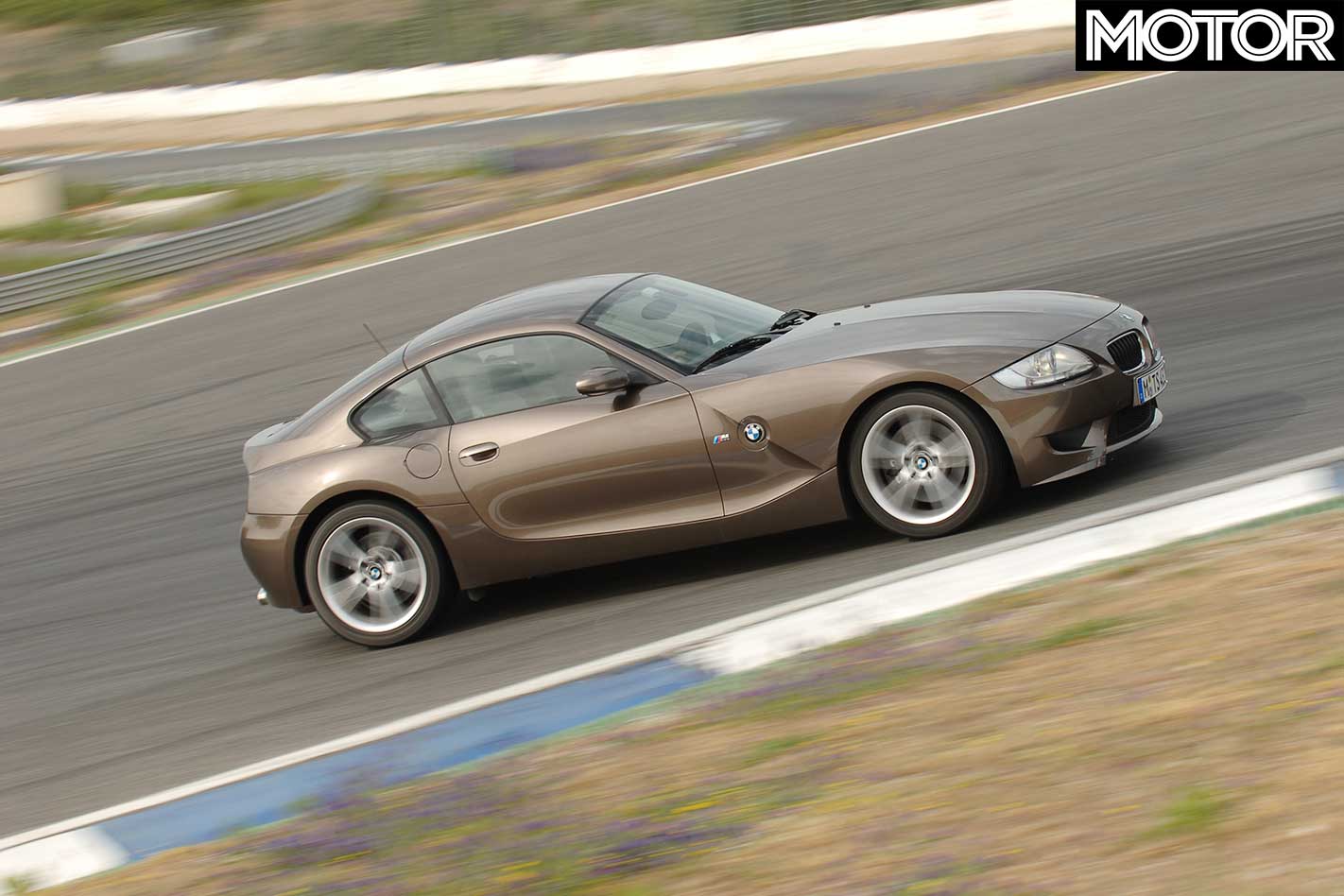
Of course, if ’twas mine, I’d have it out on a race track on the odd occasion. BMW seems to think many potential owners would be of the same mindset, too. Circuito Estoril, in Lisbon’s outskirts, is a tricky devil of a thing, and a great car tester; think Winton with a couple of dirty great straights built in.
On the smooth confines of a circuit, the M Coupe is a ripper of a toy, the empathetic, entertaining character that has so endeared me to the M Roadster revealing itself in spades. Turn off the fun police control – as with M Roadster, traction control can be turned all the way off with a single push on the button – and it’s quick, pointy and turny in all the right places.
With a couple of big stops a lap, the two piece rotors and sliding calipers do start to complain, but not before a non-stop 40 minutes of work. And they don’t stop working; they just get noisy and, eventually, grindy, as we discover.
There’s absolutely nothing wrong with the way the Z4 M produces power; stuffing a big old motor into a little car is a surefire recipe for success. With a weight-to-power-ratio of 5.6kg/kW, the M Coupe should be good for a flat five second 0-100km/h. It laps the Nordschliefe quicker than an M3, we’re told, too.
Is, as BMW hopes, the M Coupe a 911 beater? Based on its rough road performance on the slippery, streets of Portugal’s capital, no. Is it a thrilling, exhilerating experience that’s worthy of wearing an M badge? No doubt. Next stage is to have a red hot go of the Coupe in local terrain, and against its natural predators.
Might have to see if we can find a 911, too.
FAST FACTS 2006 BMW Z4 M Coupe
BODY: 2-door, 2-seat coupe DRIVE: rear-wheel ENGINE: 3.2-litre 24-valve inline six-cylinder BORE/STROKE: 91.0mm x 87.0mm POWER: 252kW @ 7900rpm TORQUE: 365Nm @ 4900rpm WEIGHT: 1495kg (approx.) POWER-TO-WEIGHT: 169kW/tonne TRANSMISSION: six-speed manual SUSPENSION: MacPherson strut, coil springs, lower control arms, anti-roll bar (f); multi-link, coil springs, anti-roll bar (r) BRAKES: 345mm ventilated two-piece discs, sliding calipers (f); 345mm ventilated two-piece discs, sliding calipers (r), ABS WHEELS: 18 x 8.0-inch (f); 18 x 9.0-inch (r), alloy TYRES: Continental ContiSports 225/45ZR18 (f); 255/40ZR18 (r) PRICE: $127,200
So, no SMG, eh?
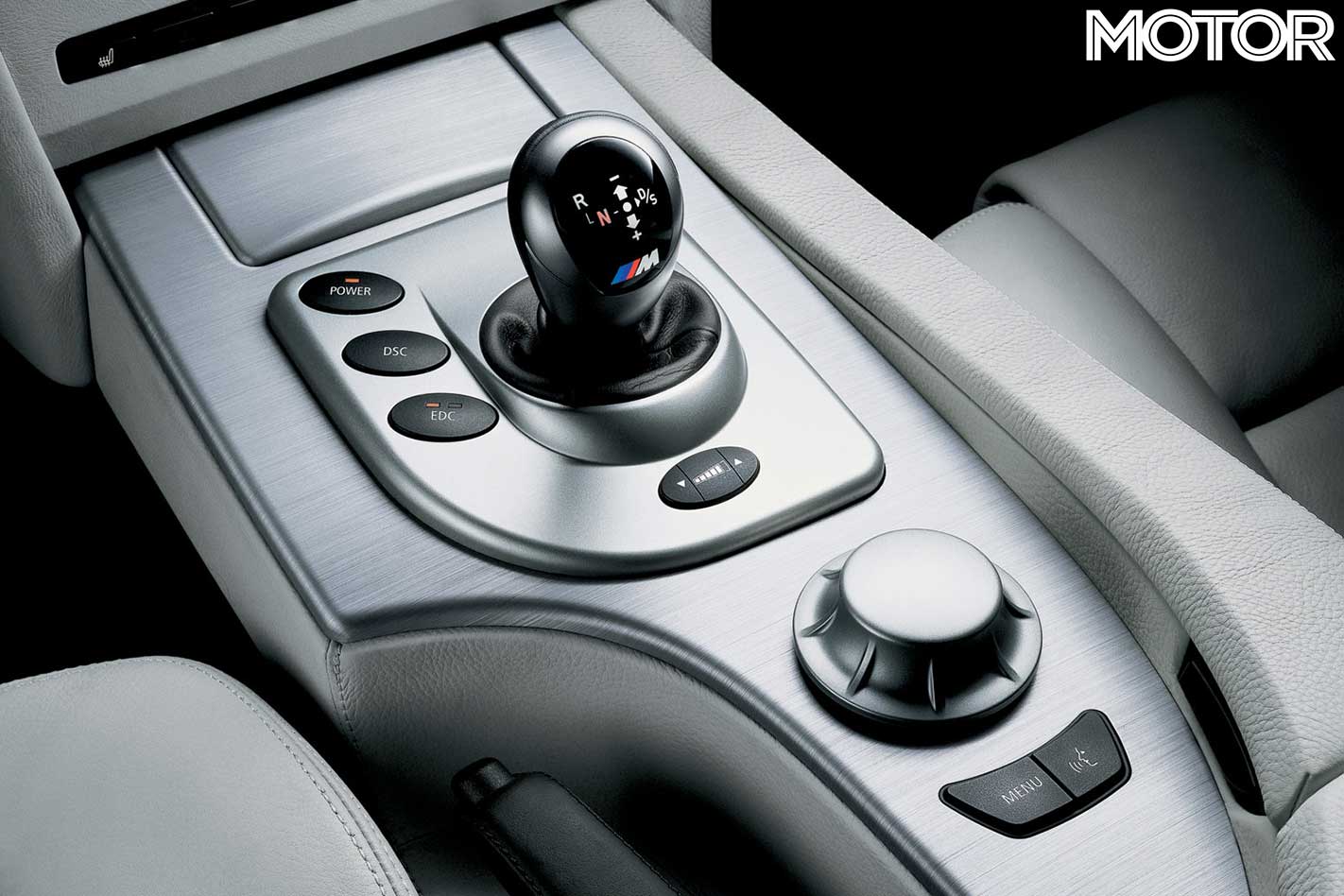
With impressively high take-up rates for BMW’s SMG sequential manual gearboxes why is there no SMG option for the Z4? On one hand it’s a simple matter of size; the smaller transmission casing of the Z4’s six-speed ZF manual tranny simply can’t accommodate the additional servos and hydraulics that are part and parcel of the SMG’s architecture. But there’s another reason, according to the boss of M.
“We have new SMG gearboxes for both M5 and M6, and our customers like the seven speeds and the fantastic short shift time,” says Prof Brunkhe, “but we have no new ’box for the Z4. We won’t offer the last generation of M3 SMG to our customers on a new car.”
He reckons though, that “SMG would suit the Z4 very well.” Watch this space…
In figures that surprised no-one, Toyota has sold eleventy gazillion Hiluxes so far this year. In September, Hilux alone sold only slightly fewer units than all of Honda’s range put together. You might have seen this statistic: if Hilux was its own car company, instead of part of Toyota, it would be the 11th-biggest car company in Australia by sales.
But why stop the comparisons there? Over the past decade (I’m counting since 2008, and assuming the 2018 total will be on par with the 2017 number – in fact, it’s on track to exceed it) Toyota has sold 447,494 Hiluxes in Australia. (Or is it Hilii?)

If everyone in Australia who bought a Hilux in the past 10 years lived in the same place it would be the eighth biggest city in Australia. In fact, the total population of Hilux City would be 37 people larger than the population of the Canberra-Queanbeyan metro area. This is a bizarrely true fact. Is it coincidence that a decade’s worth of Hilux owners almost exactly matches the population of our nation’s capital? And is it wrong to want to see a fight between the two?
Hilux City would be bigger than Hobart and Darwin combined. On the other hand, there’s not much that isn’t bigger than Hobart and Darwin combined. I think the 7.23am Sydney North Shore train has more people than Hobart and Darwin combined. Peak hour in Darwin is when one car gets stuck behind the other car.
So maybe that’s underselling the Hilux clan. Maybe the people of Hilux City should aim bigger again. If Hilux City seceded, Hutt River Province style, it would be the 169th biggest country in the world. It would have roughly the population of Brunei. It would have about as many people as Iceland and Tonga combined.

And the Hiluxians could give seceding a red hot go: with 447,494 people, the newly declared Sovereign Nation of Hilux would eclipse the total Australian Defence Force by more than 367,000 people. Even if the ADF drafted the entire population of Townsville and Cairns, they’d still be outmanned. Especially since half their draftees would be drunk – and the other half would already be living in the Republic of Hilux.
Would the world be better if nations were based on what we drove instead of where we were born? As John Lennon once mused, “Imagine there’s no countries/It isn’t hard to do/Nothing to kill or die for/And cheaper spare parts too.”
The Hiluxians would live in a quasi-utopian land of mostly dual-cab harmony, as long as they didn’t want to use Apple CarPlay or carry as much as a BT-50, and carry on a friendly Aussie-Kiwi-style rivalry with the slightly smaller United State Of Ford Ranger next door.
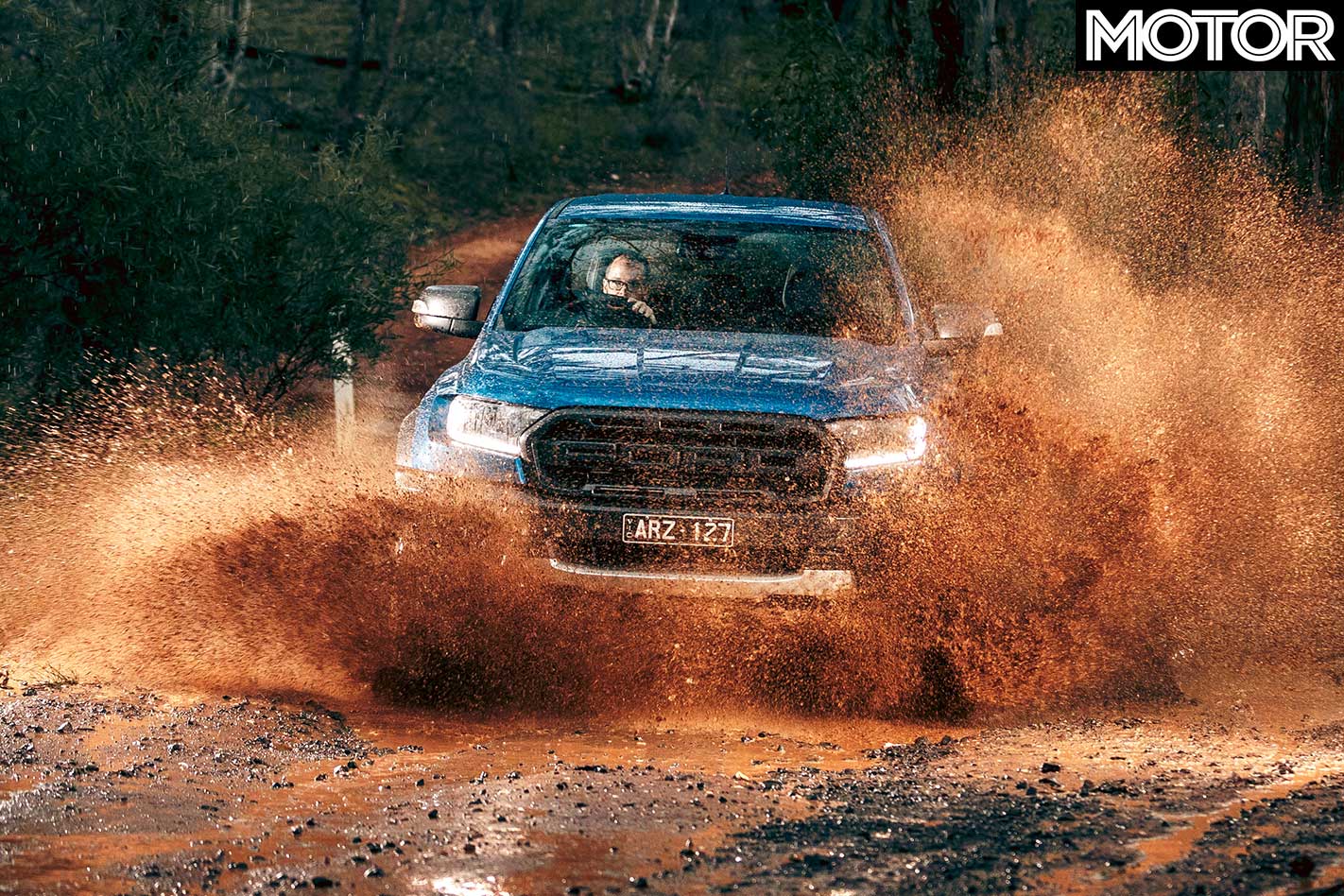
The Democratic Empire of Corolla and the Principality of Mazda3 would both be designed as supermarket carparks that stretch as far as the eye can see, with herds of shopping carts being stalked by trolley tractors as they gathered at watering holes. And the leaders of the two nations would argue at the United Automotive Nations about which country is bigger, depending on whether you include fleet sales or just private vehicles.
The Federated States of Hot Hatch would occupy the mountains, all winding roads and snaking tarmac that looks suspiciously like it was copied from early chapters of Initial D. Down below, the Confederation Of V8s would be a vast series of two-lane traffic lights followed by quarter-mile straights, and a nation-wide ban on speed cameras.
And in the distance, concealed from view in a blue smoky haze, the Kingdom Of Summernats would carry out their arcane barbarian rituals accompanied by the ancient rhythmic incantation, “Tits out, tits out, tits out for the boys…”
Anyway, that’s what the world looks like to me when I look at the VFACTS numbers. Especially if I’ve had one of those special brownies while watching Game Of Thrones beforehand.
ONLY now, three years after Akio Toyoda launched TNGA – Toyota New Global Architecture – do we really understand the complexity and cost benefits of what is a multi-architecture strategy.
First perceptions suggested TNGA was one highly adaptable architecture, suitable for use for small and large vehicles – and everything in between – and capable of supporting front, rear and all-wheel drive layouts.
Instead, TNGA is four entire separate platforms. Effectively, Toyota is now split into four separate business units, each sustaining its own architecture. What they share is the same engineering and design philosophy: “lower centre of gravity, attractive low-stance designs, responsive handling, a high-quality drive feel, and collision performance that offers safety and peace of mind”.
RAV4 chief engineer Yoshikazu Saeki’s business card reveals the true complexity of the system: “Chief Engineer ZD, MS Product planning, Mid-size Vehicle Company”.

Only by breaking down this Toyota-speak can we begin to appreciate what TNGA sets out to achieve. Z indicates Product Planning; D the specific architecture; MS mid-sized products.
According to Saeki, the business units are: ZE – compact models like the Corolla, C-HR and Prius and their variants. ZD – comprises sedans, SUVs and MPVs: RAV4, the next Kluger (Highlander in the USA) and Sienna, and the Japanese Harrier, plus Camry, Avalon and the Lexus ES. The next generation Yaris and other small, mostly Japan-only, models are expected to be built on the new ZB architecture, while body-on-frame Commercials, like the LandCruiser, Prado 4Runner and Sequoia, are designated CV.
To further complicate the naming classifications each business group uses TNGA followed by a letter that indicates the architecture. ZD becomes TNGA-K; while TNGA-C is Corolla and Prius; Yaris is predicted to be TNGA-B.
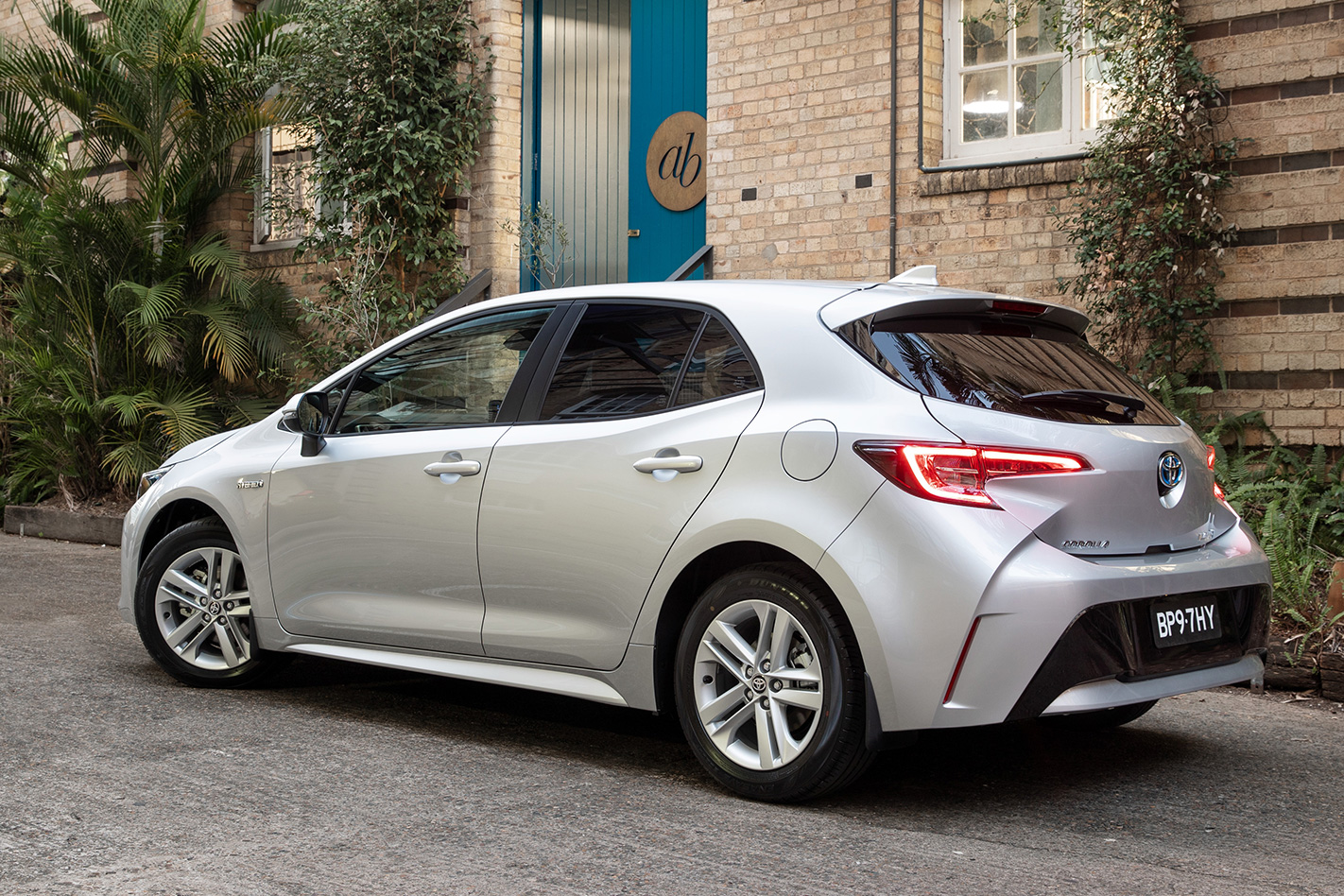
Toyota chairman Akio Toyoda says Toyota’s aim is to reduce development costs of any new model by around 50 percent compared with 2008 levels. He wants to ensure that Toyota remains among the top car makers, not only in terms of volume but profitability, too.
Saeki says the major cost saving comes through the sharing of the most important engineering ‘hardpoints’: the engine compartment, on an architecture by architecture basis. The engine compartment includes the front crash structure and firewall, and the width of the side body frames are essentially identical for all TNGA-K models. According to Saeki, what changes from one architecture to the others is the width of the engine compartment. Otherwise, wherever possible they share the same steering rack and electric power steering and front MacPherson strut suspension, both tuned to best suit each particular model.
Using Camry as the starting point for all TNGA-K models, creating what Toyota calls a “progressive data base”, allows the engineers to accurately forecast the entire crash structure for future models.
“Crash testing takes the longest,” says Saeki. “For Camry we had to make prototypes and crash them. From this data we can get stimulation to forecast the crash data for all the other (TNGA-K) models.
“For the RAV4 the body structure – the longitudinal side beams – rear of the engine compartment is raised (compared to Camry) to increase ground clearance”. The benefits “allows us to focus on the upper body and our aggressive design.”
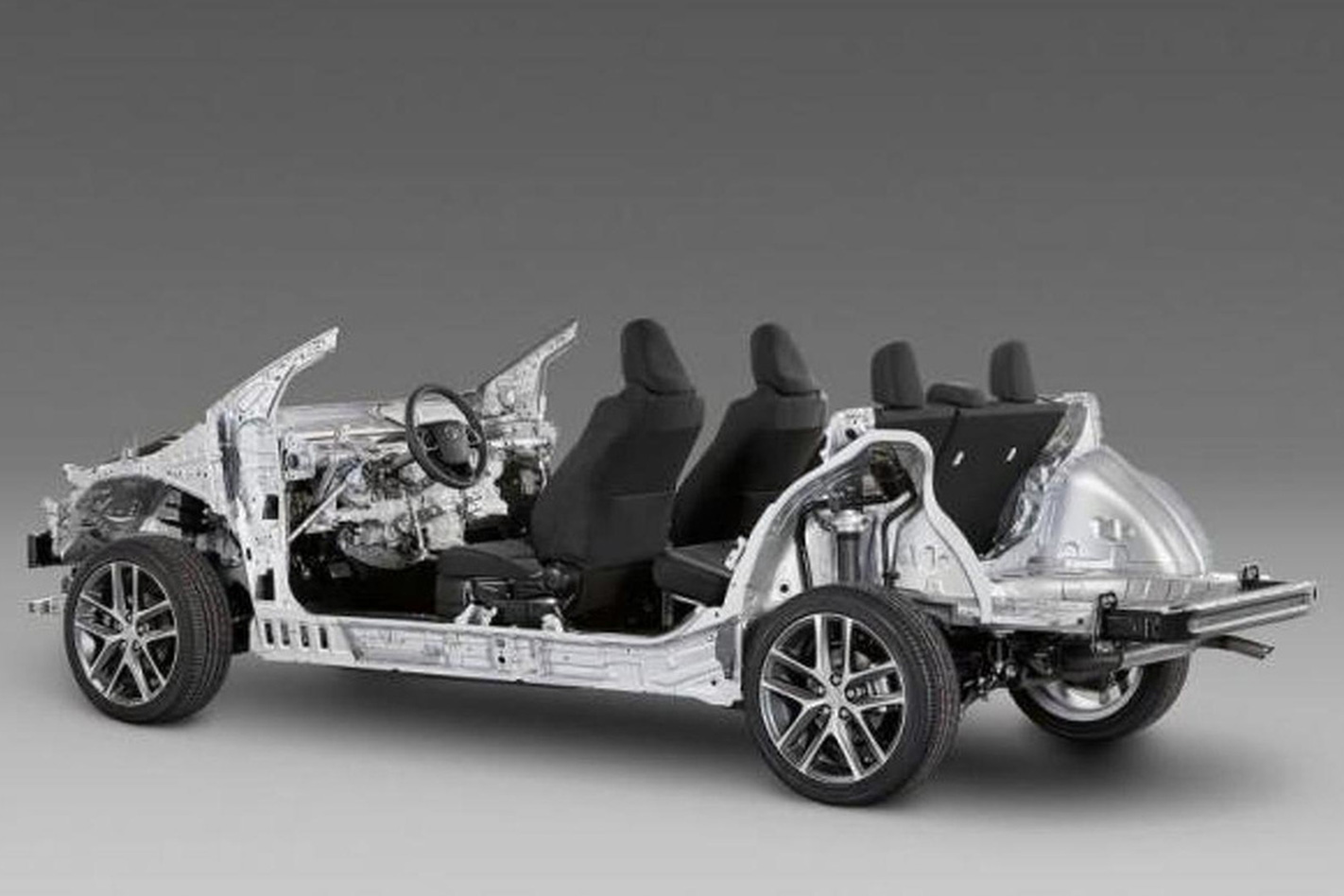
However, if needed, there are significant differences in the rear suspensions of the Camry and RAV4. Where the Camry adopts double wishbones, the soft-roader gets a so-far unique trailing wishbone, multi-link rear suspension that better copes with different weight transfers.
“We are in the middle of the process (of changeover), says Saeki, “it might look complicated, but the new Highlander (Kluger) is like a big RAV4. The RAV4 is the entry (SUV) offering and the Highlander is an upgraded version. The saving is in the budget, rather than in time.”
For the RAV4, Toyota shortened the Camry’s 2825mm wheelbase by 135mm to 2690mm. “It’s possible to go more (than Camry),” says Saeki, “Rather than that, the rigidity of the side (body) components is the limiting factor. It’s possible we need to add strengthening.”
“The Highlander is longer (in wheelbase) than the Camry and, with the RAV4, sets the coverage range (of TNGA-K).
Do the new architectures bring weight savings? Not according to Saeki, who blames coping with recent changes to crash regulations and coping with future crash regulations. “It’s a constant struggle with the changing regs, so there is no given weight reduction.”
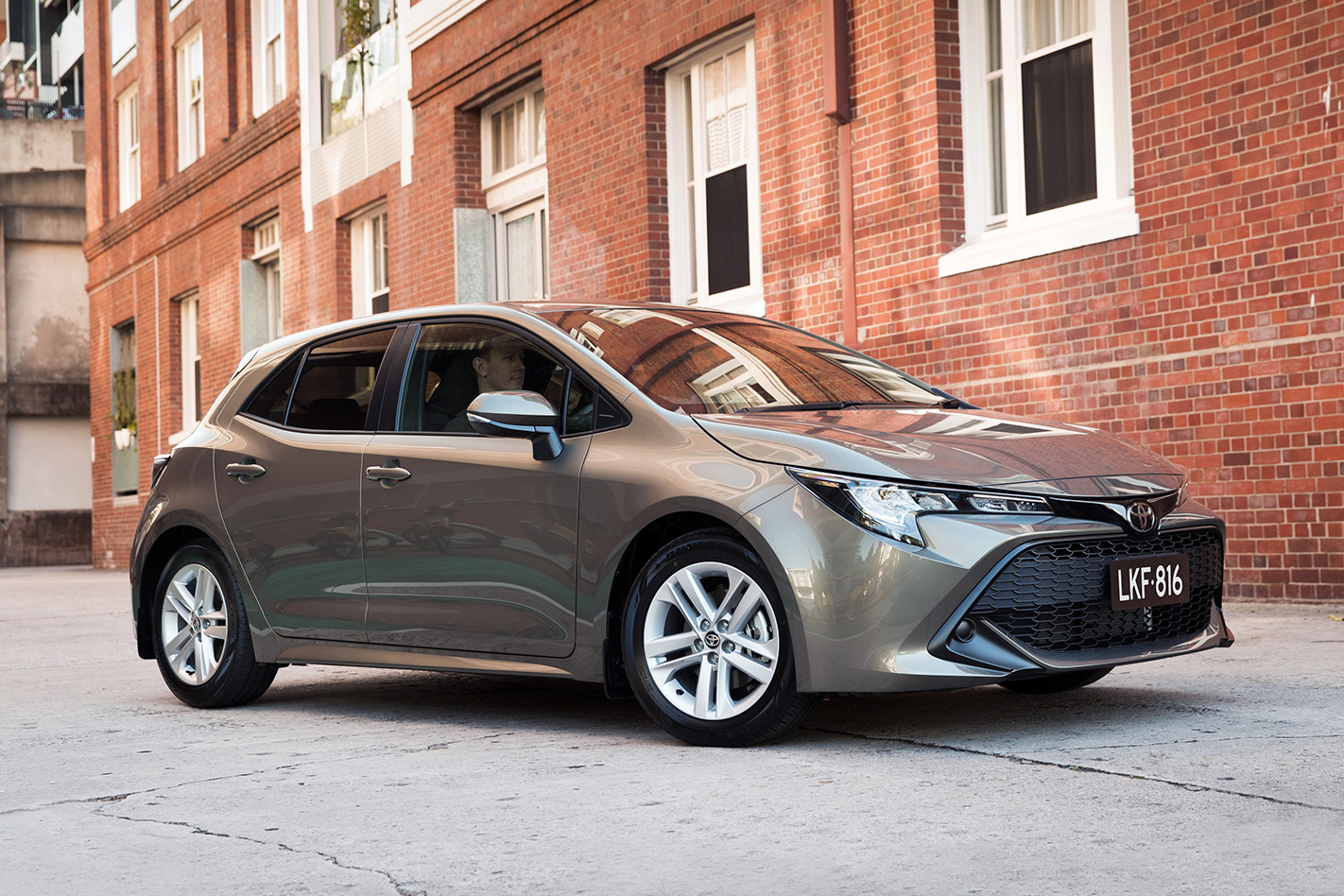
Will the next Kluger follow the trend to smaller capacity engines? Apparently not. The current model is available in V6 and, in the USA, as a hybrid. Expect Australia to pick-up both versions when the new model goes on sale in late 2019 or 2020.
What of electric plug-in versions of TNGA-K?
“Plug-in is easy to do,” claims Saeki. “But it is expensive and we have to give maximum value. Price is the big factor.”
Two high-profile Toyota models are not integrated into TNGA. Both jointly developed with other manufacturers: the 2012 86 was a part of a project with Subaru – because it retains its Subaru-boxer engine it’s believed the replacement model comes from the same blueprint – and the new Supra, a co-operative development with BMW.
Our conclusions: a better appreciation of the TNGA confirms that it is far closer in philosophy and practice to the VW Group’s MQB, MLB, MHB and the new MEB architectures than originally believed. On the evidence of the Corolla, Camry and RAV4 TNGA is quickly changing our perception of Toyota. No more boring cars.
Okay, I seriously underestimated the Corvette Z06…just because it’s American.
This review was originally published in MOTOR’s April 2007 issue
Nothing against our US brethren, mind you, but supercar recipes are served on Italian and German menus, and I’ve had my fill of late. Plus I’d not been keeping up on the hype that this is a Porsche beater.
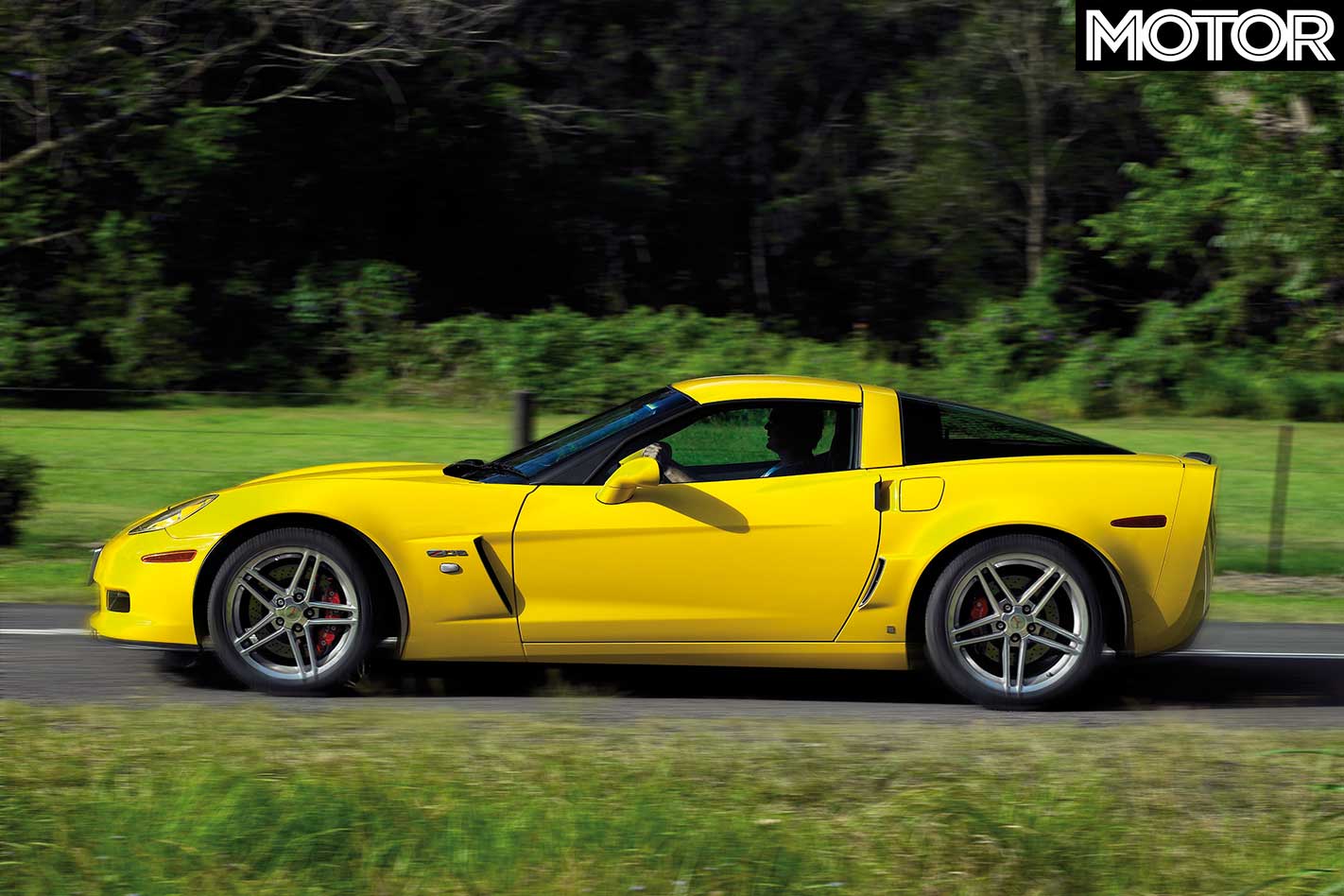
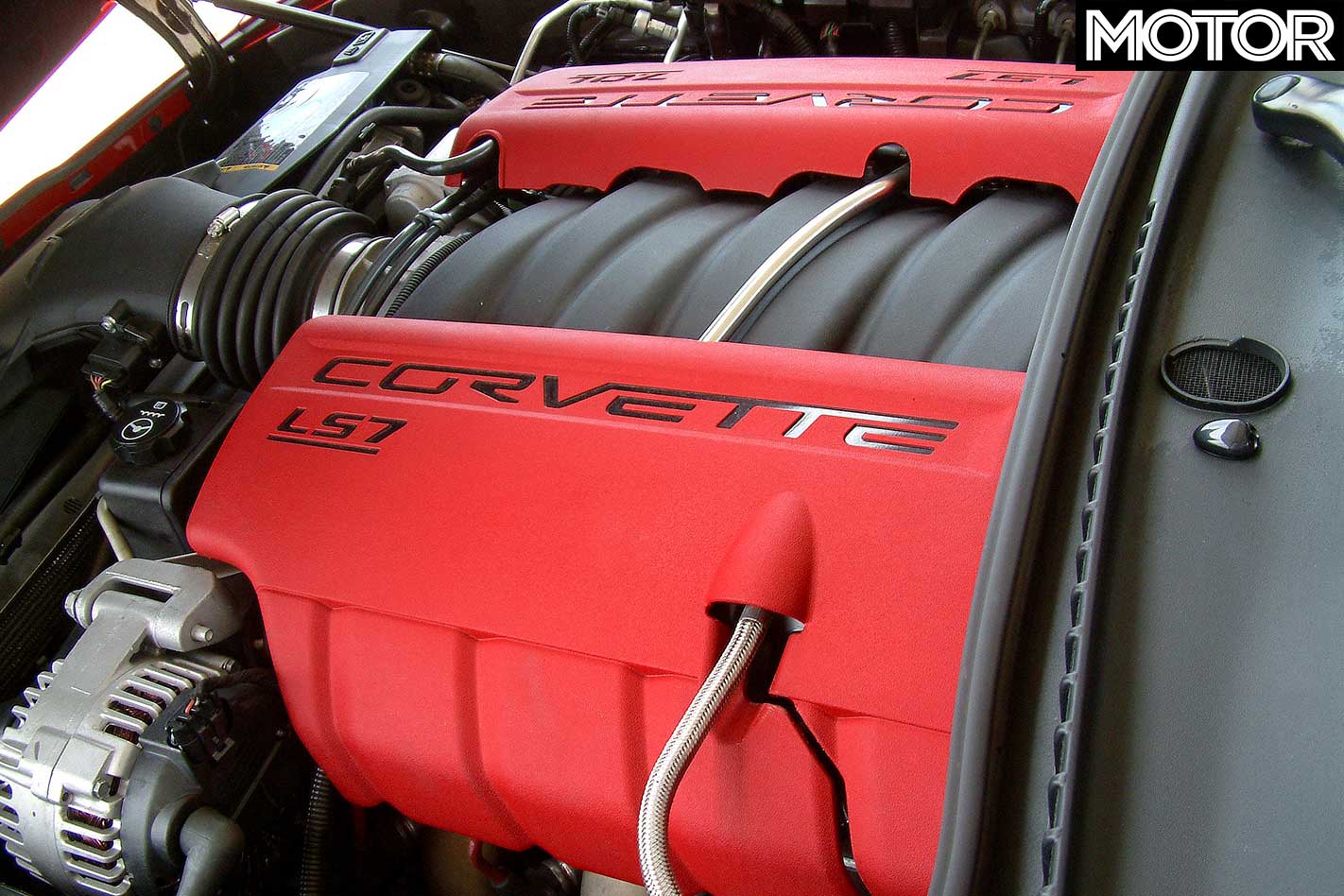
Look at the specs and it’s easy to see why. The high-revving, hand-built, dry-sumped, titanium con-rodded 7.0-litre LS7 V8 produces 377kW and 637Nm – that’s a GM small-block landmark. The aluminium/magnesium structure and composite carbonfibre bodywork keeps kerb weight down to 1421kg for a 997 911 Turbo-crushing 265.3kW per tonne. This is the fastest and most powerful ’Vette ever built, and best of all, it’s now available here.
Queensland’s Performax International has managed to do what GM/H hasn’t: land brand-spanking right-hook Z06s on Aussie roads. With supercar performance, though, comes supercar cost. PI’s OE-quality steering conversion alone could buy you a Commodore SS, with change. Add import duty, GST, and luxury tax, and Chevrolet’s bargain basement $US75k domestic giant killer instantly becomes a $AU240,000 imported extravagance.
But while the handsome coupe sits broad and low spread-eagled across Queensland Raceway’s pit lane, it hardly looks the value. Less so inside. Cheap rep-mobile plastics, too-shiny leather, the push-button fetish (including doorhandles) and jetfighter-like head-up display are a bit Miami Vice, and mask an otherwise top driving position and ergonomics.
The muted exhaust note and HSV GTS-like docile tractability at a dawdle hints at nothing special, but press the loud pedal and Z06 gets very serious, very quickly.
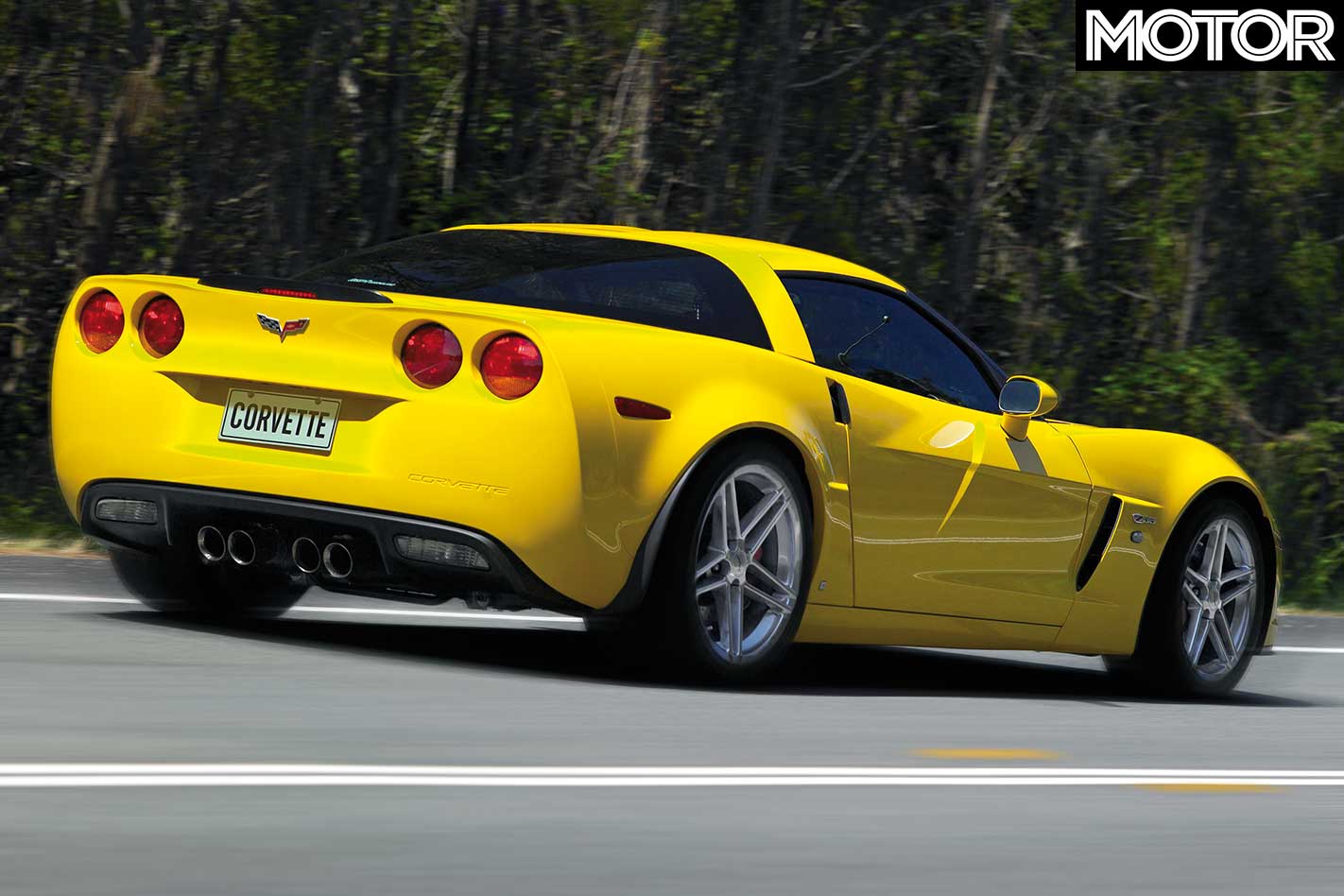
No other Gen IV V8 feels this racey. It revs crisply to 7100rpm with a V8 Supercar-like soundtrack, and with an endless dynamo of torque reserves everywhere, it’d bolt around the whole circuit in fourth. Corner exit drive is monstrous, with impressive power-down bite, and it takes a fair serve to unglue the fat 285mm rears, revealing a pliable and soft-edged breakaway.
The brawn is expected, but Z06’s accuracy is the big surprise. Its broad track, flat stance and finely-tuned, unusual-spec short/long-arm double-wishbone/transverse leaf spring suspension offers tenacious turn-in grip, with meaty-weighted tiller and exceptional sharpness and feedback.
GM claims it will hold 1.04G of constant lateral grip, and in the tighter stuff it feels like it will, too. And the brakes (the six-pot fronts have separate pads for each piston) never lose their commanding bite or solid pedal feel during constant hot lappery.
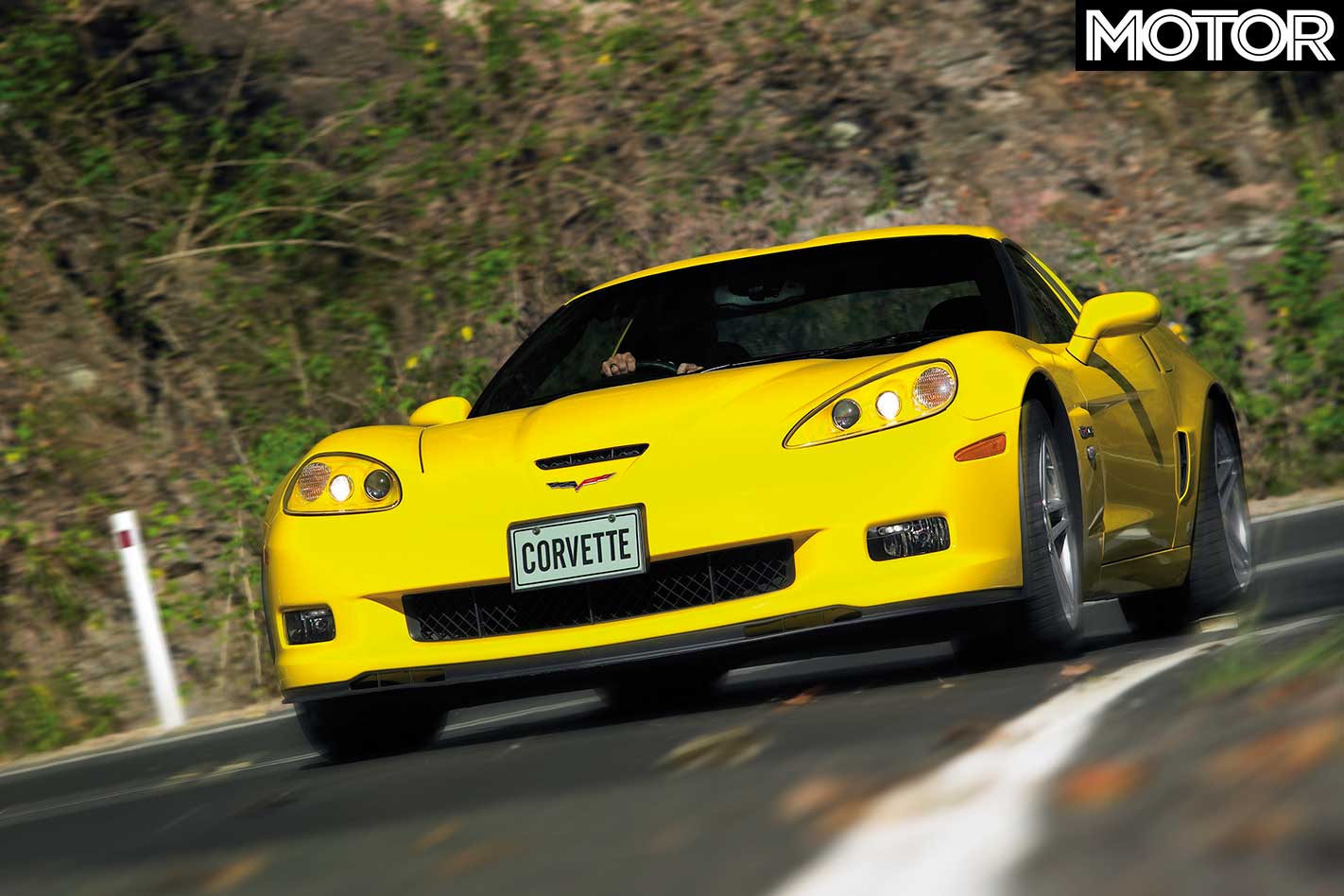
Pushed, the Z06 has real depths of ability. But its character is unique, a love child offering both Euro supercar-like performance exhilaration with the boofy fun and basic edification of a muscle car that’s been amplified to heavy metal concert volumes.
PI says the ’Vette is aimed at those after supercar performance for half the price. Perhaps there’s a more obvious buyer niche; where is the self-made, blue-collared, V8-lovin’ millionaire to go upward from a GTS or Senator? Well, the Z06 smashes through HSV’s glass ceiling and sits way, way up into the stratosphere as a lofty new V8 muscle car Valhalla.
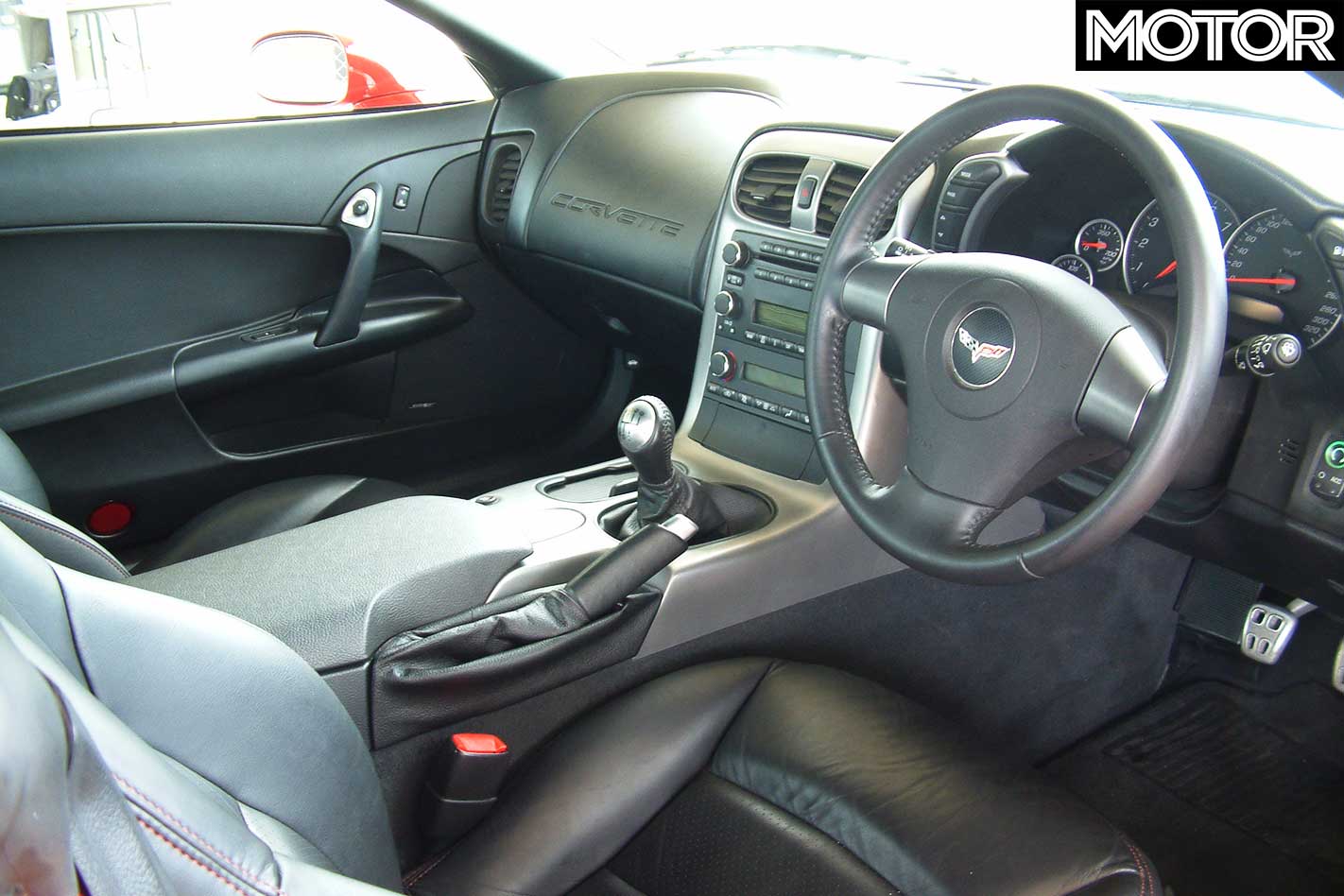
Sure, it lacks the sweetness and refinement of, say, the similarly priced Porsche Carrera S, but for some tastes the Z06’s lure is exactly that; it’s nothing like the bourgeois Euro exotics.
King ’Vette serves lashings of meat and potatoes, skipping the side salad and dressing, American style.
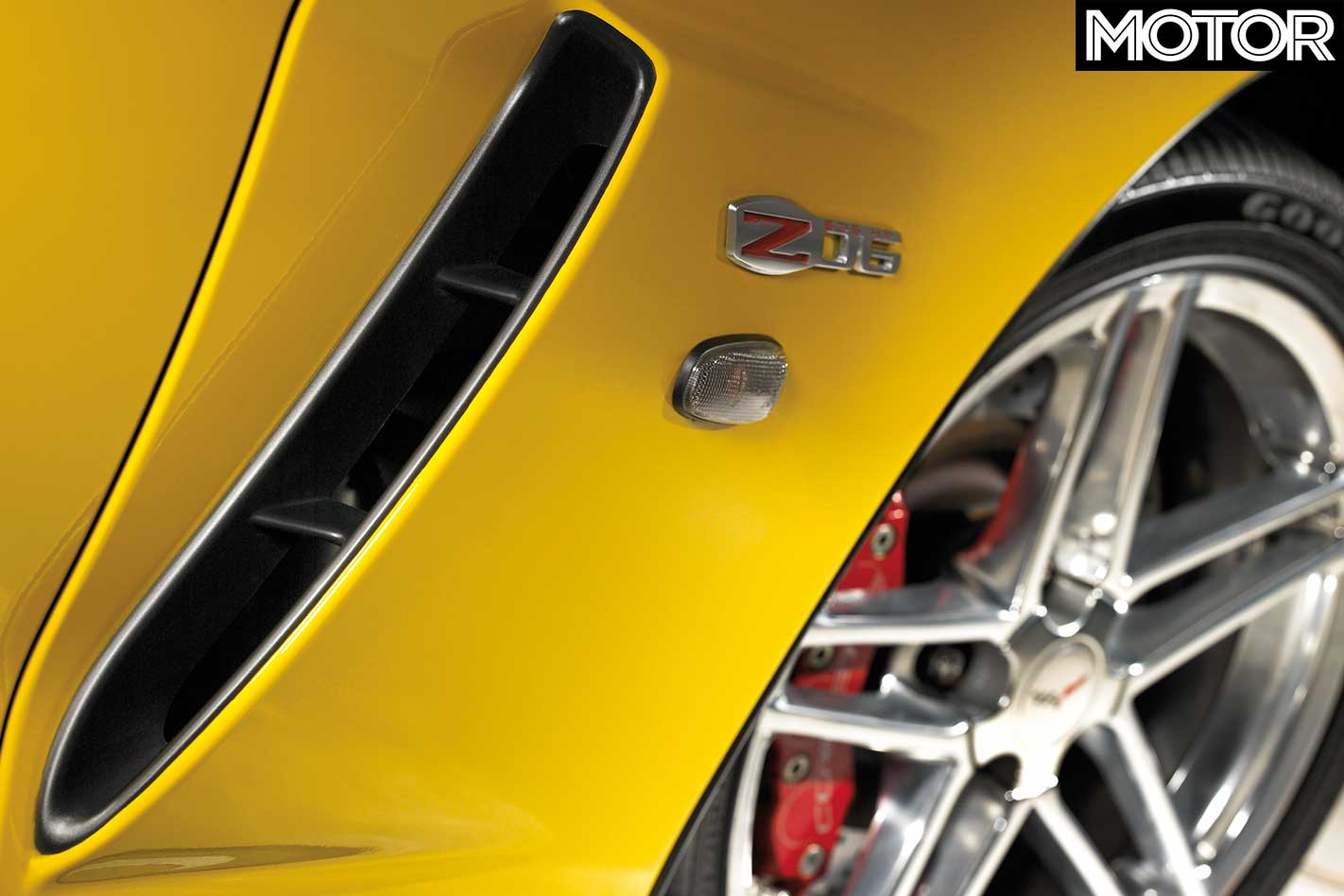
FAST FACTS 2007 Chevrolet Corvette Z06 Engine: 7008cc V8, OHV, 16v Power: 377kW @ 6300rpm Torque: 637Nm @ 4800rpm Weight: 1420kg 0-97km/h: 3.7sec (claimed) Top speed: 318km/h (claimed) Price: $240,000
Likes: Ferocious performance and handling, iconic (stigma-free) appeal Dislikes: Americana interior, gearshift quality, price, bystanders mistaking it for a “Ferrari” Rating: 4 out of 5 stars
I reckon it’s about time we had a chat about these new wire-rope barriers that are going up all over the place. I know there’s a bunch of insurance companies telling authorities that these barriers are a great road-safety initiative, but here’s the reality: these things are going to kill people. Directly and indirectly.
I’m talking about the three-strand wire fences on deformable posts that are lining more and more of our country roads every minute. The idea is that they’ll stop us from randomly running off the road and slamming into whatever roadside trees are standing around keeping the koalas off the deck. But they’re ill-conceived (the barriers, not the koalas). And lethal. And here’s how it’s going to pan out.
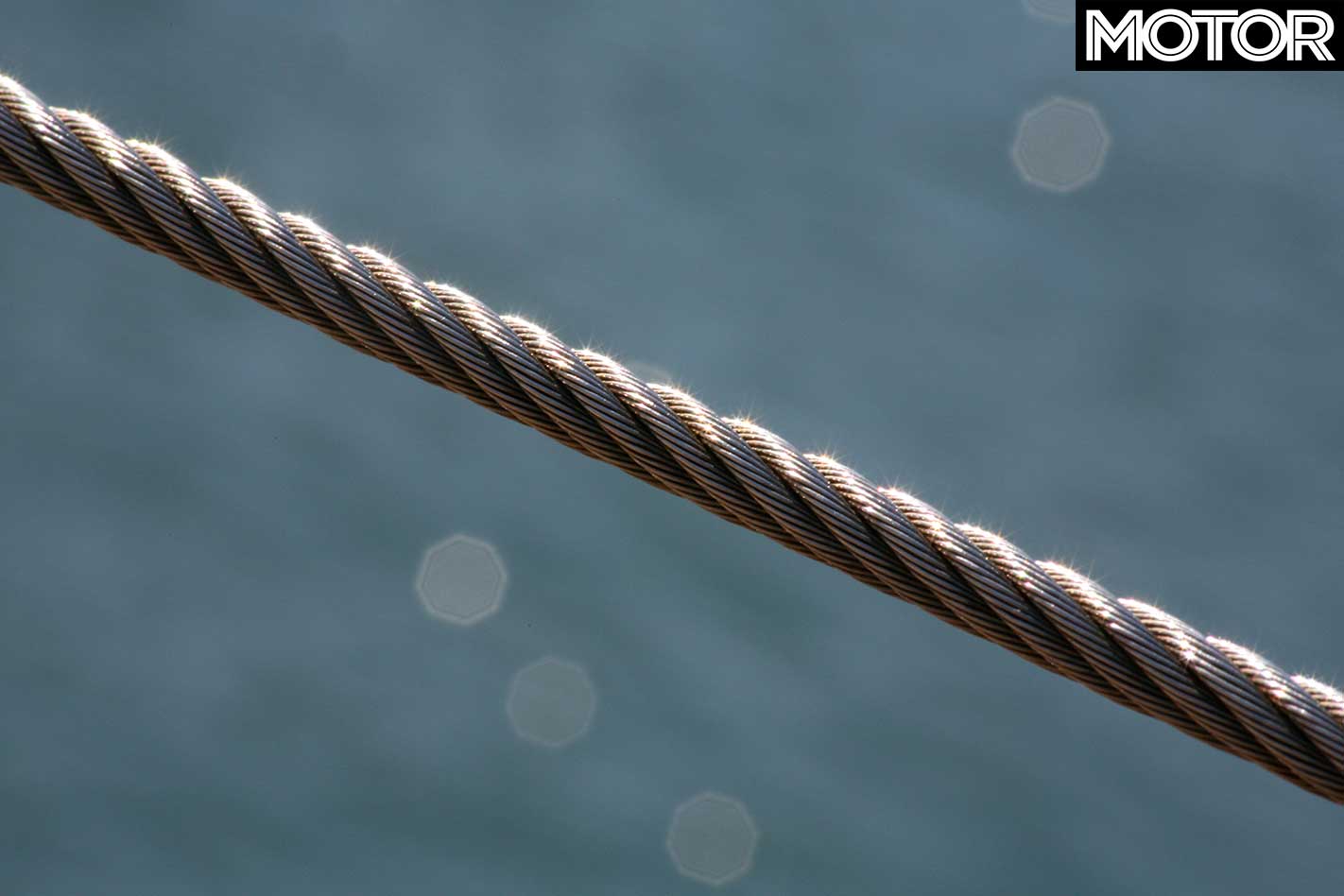
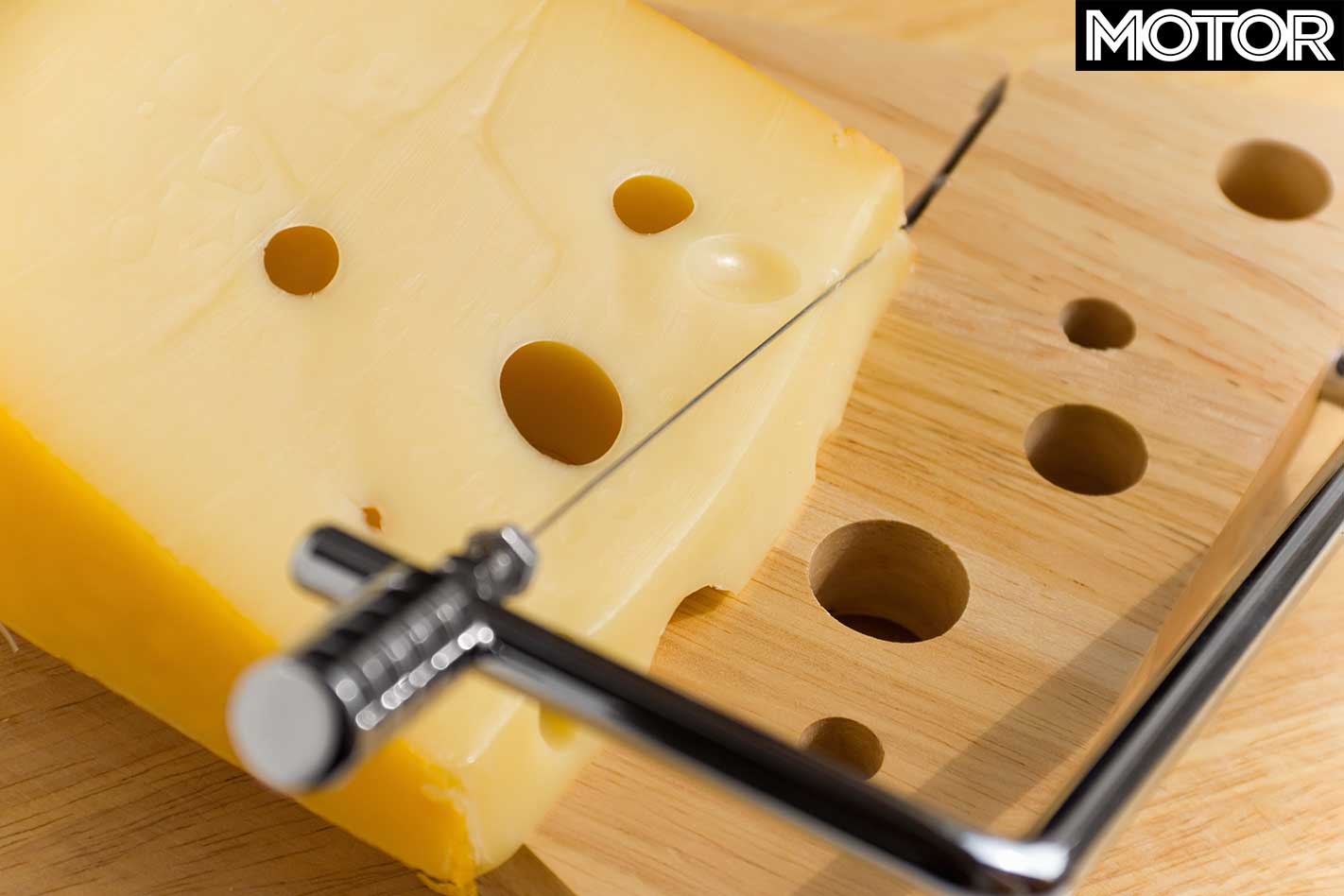
For a start, these cheese cutters are instant death to anybody who chooses to travel by motorcycle. And don’t give me that temporary Australian bullshit; a motorcycle is a legal way to get around and, in these times of climate change, a mode of transport that should be encouraged, not turned into a game of Russian roulette. The bottom line is that the wire ropes themselves are going to be like piano wires at 100km/h. And even if the posts are deformable, they’re not as deformable as human flesh.
Another problem is the installation of the barriers. I’m kind of okay with having them in the very middle of a divided road like a freeway, as a means of preventing a car that has lost control from swapping sides and screaming into oncoming traffic. The point being that if you’re that far off the road, you’re already three chapters into your crash.
But what I’m seeing is the barriers being installed right up to the edge of the road on the kerbside and – in some cases near my place – along the centre-line of an undivided road. Well, a previously undivided road, anyway.

In fact, there’s a stretch just outside Melbourne where the wires are strung hard up against the running lane with no emergency lane whatsoever, with a central barrier as well, turning the carriageway into, effectively, a one-lane tunnel.
My problem with that is that the ‘experts’ are telling me the barriers will arrest any car that swerves off the road, and that will save lives. Bzzzt. Typically, they’re giving us only one side of the tale. What it will mean is that anybody who haplessly puts two wheels anywhere near the gravel, will be grabbed by the wire ropes and brought to a lurching, panel-crunching stop.
What’s the ratio of two-wheels-off whoopsies, to proper, asleep-at-the-wheel road departures? I don’t know, but these barriers are going to turn the former into much bigger incidents.
The other problem with turning a country road into a tunnel is that there’s nowhere to get around an obstruction. Bear in mind, they won’t even slow down a kangaroo or wombat (the two most common things a driver needs to dodge in these parts) so drivers will be forced to rely on their brakes to miss our furry friends. It won’t be enough.
Yeah, I know the old adage that you should never swerve to miss a critter, but if you can safely get around them, I always have, even if it means using the other side of the road. Not any more.
But here’s what really bothers me. Since these barriers go for kilometres unbroken, with no emergency lane, what happens when a crash occurs at some pointalong their length? How do you get an ambulance to the crash site if the single-lane road is blocked with other traffic that got there first? Even a helicopter (should one miraculously be available) can’t land right on the wreckage.

And what about bushfires? What happens when one car conks out along a length of barrier as a whole community is using the same road to evacuate in the face of another Black Saturday?
Fair dinkum, if anybody but an insurance company suggested a road with no way to turn around or get a first-responder to the scene of a calamity was a safer road, they’d be laughed out of town. To refer to these arse-hats as road-safety experts is just an insult. To other arse-hats, mainly. Discuss.
Send your thoughts and opinions on the use of wire-rope barriers to [email protected].
YOU may not have even heard of it, but the Adelaide Motorsport Festival is fast becoming one of Australia’s premier automotive events.
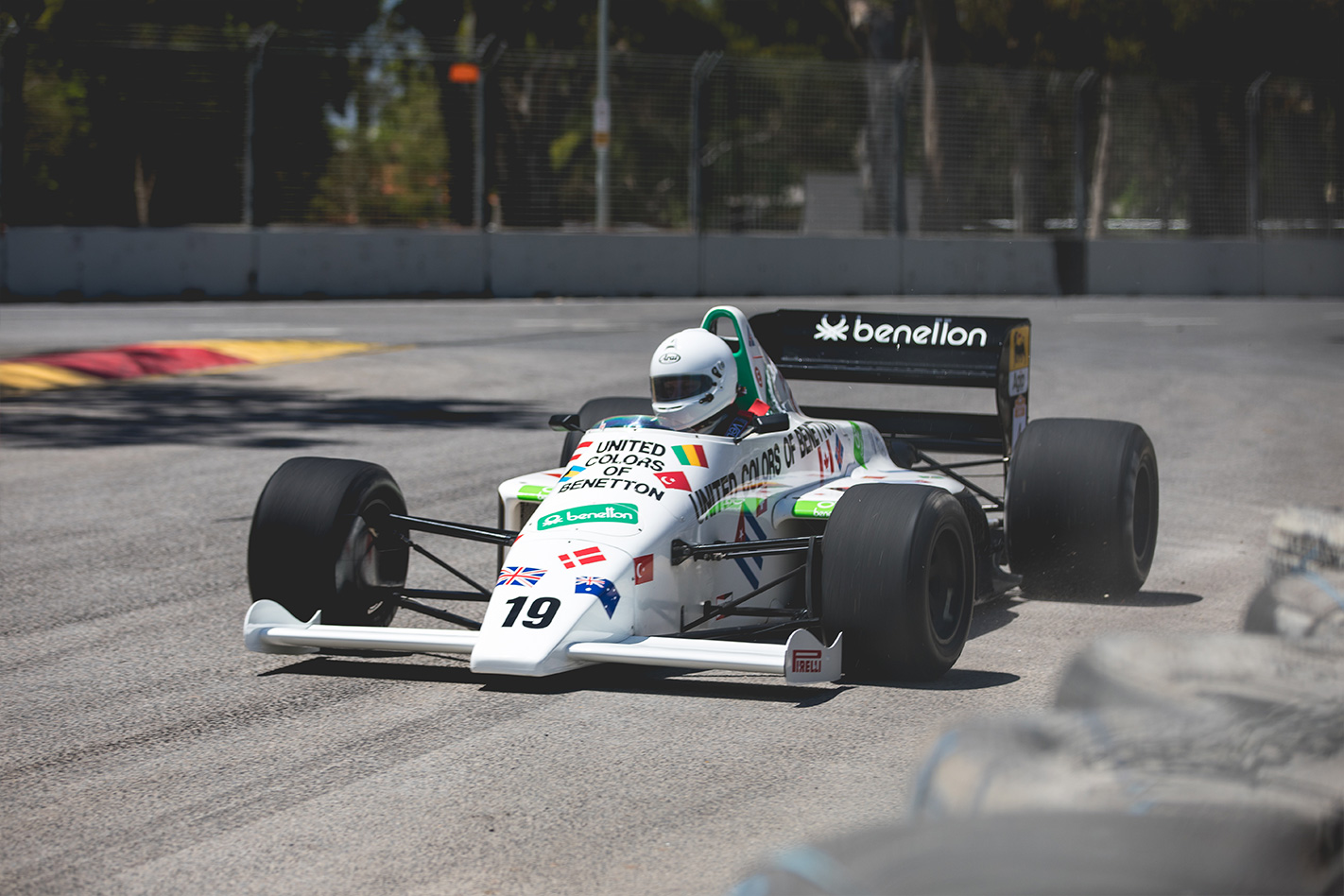
The two-day celebration of motorsport encompasses a variety of displays, showcasing the racers of yesteryear both on and off the track.
Click through the gallery above to see photos and learn more about what went down at this year’s Adelaide Motorsport festival
A heavy emphasis is placed on Formula 1 cars, which conveniently links back to when Adelaide hosted the Australian Grand Prix back in the ‘80s and ‘90s, and even utilises some of the old Victoria Park circuit.
But there’s much more to the four-year-old festival than Formula 1 cars. The field of tent-garages is scattered with rows upon rows of variation, with Le Mans retirees mixed in with past Bathurst-competing cars beside one another and rally legends sitting idly beside the hypercar Holy Trinity, the McLaren P1, Ferrari LaFerrari and Porsche 918 Spyder.
The track component is run in a super sprint fashion, with cars timed against the clock rather than competing against one another, yet there’s still anywhere up to 14 cars on track in each session.
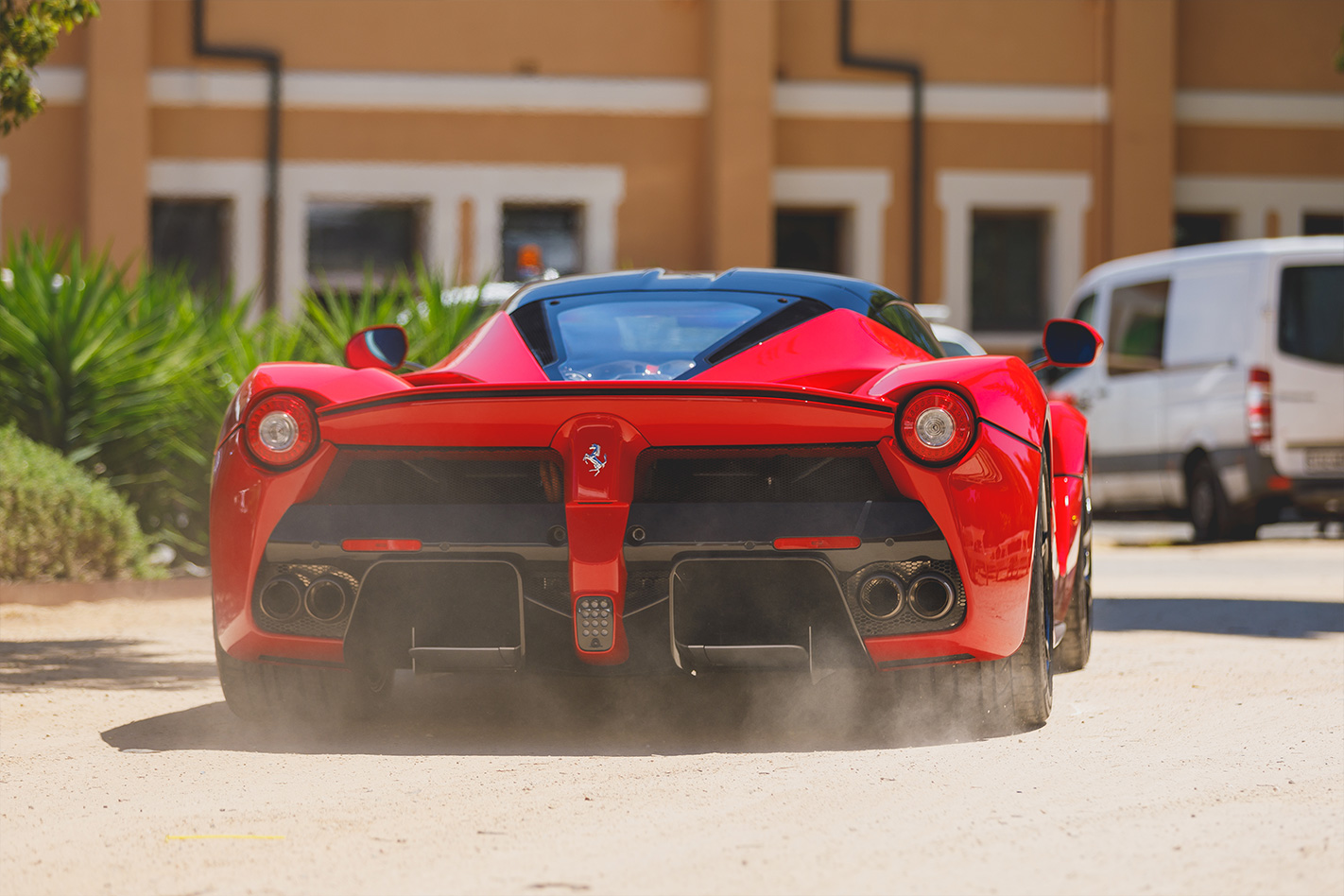
As part of the event, the Adelaide Rally snakes its way through Adelaide’s notoriously good hill driving roads before ending back in the city. Everywhere you look there seems to be some sort of car-related action in a festival that is starting to sound like Australia’s answer to the Goodwood Festival of Speed.
Arguably the coolest part of the weekend is the Peak Hour of Power, where motorsport legends like Craig Lowndes, Ivan Capelli, David Brabham and Jim Richards hop into motorsport icons like the Porsche 962, Brabham BT62 and Leyton House F1 car and rip through the city streets towards the Gouger St party. In a world so focused on rules and regulations, it’s incredibly refreshing to see a 1980s F1 car driving beside a Kia Sportage on Aussie roads.
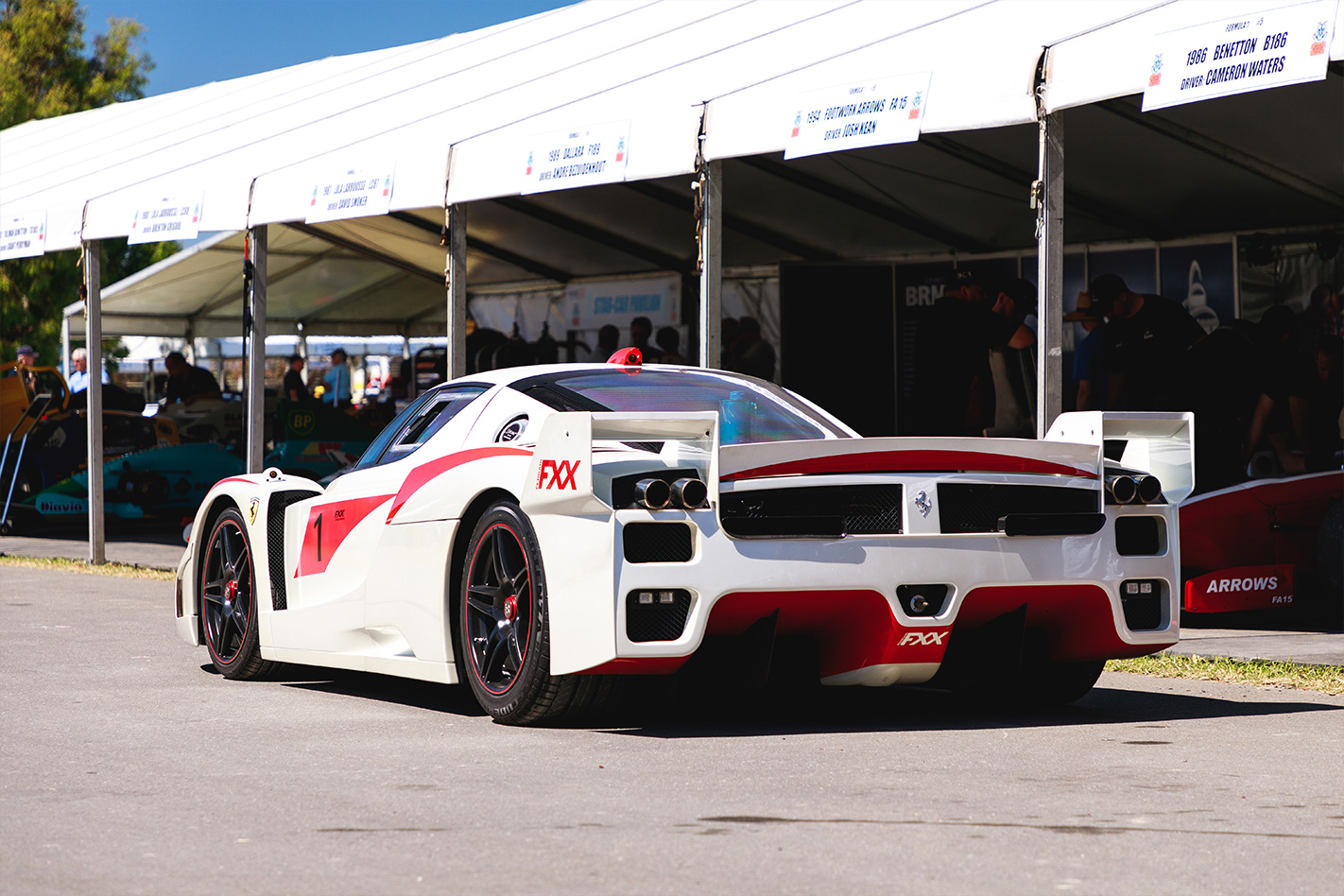
In addition to the motorsport sprint sessions, throughout the weekend the track hosted entertaining displays including drag races between the Holy Trinity, American muscle cars (Dodge Challenger Demon, Chevrolet Camaro and Ford Mustang) and even Australia’s only Red Bull Air Race pilot, Matt Hall, raced David Brabham in the Brabham BT62.
More than 800 cars were took part in this year’s Adelaide Motorsport Festival and more than 43,000 people were in attendance.
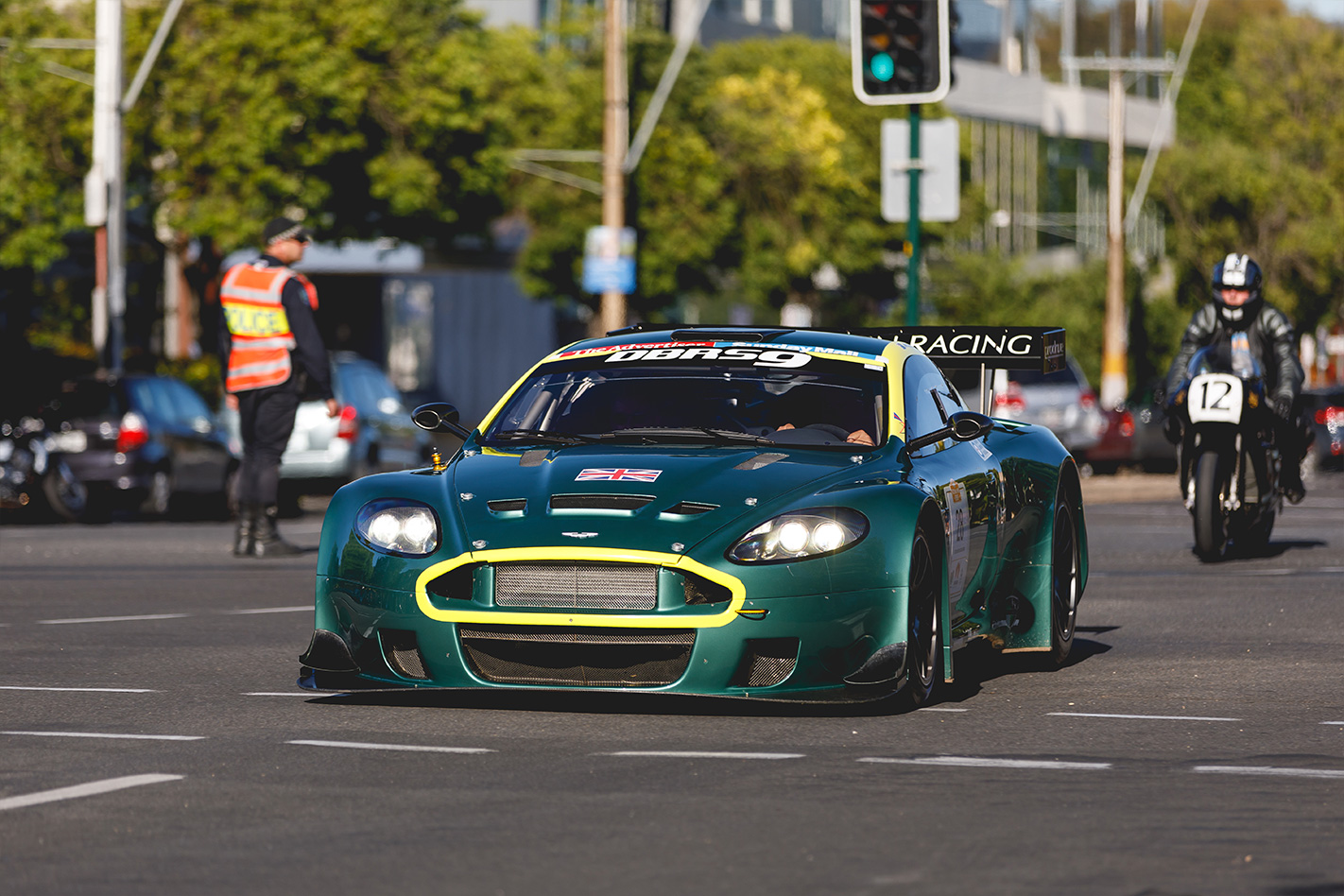
Despite losing the Australian Grand Prix to the city of Melbourne more than 20 years ago, South Australians are a resilient bunch and have created a special event that harks back to the best eras of motorsport.
Click through the gallery above to see photos and learn more about what went down at the Adelaide Motorsport festival
Price and equipment
The arrival of the new-generation Cerato sedan this year brought tech advancement, pushing the pedestrian Korean four-door into near-premium territory with the flagship Sport+ grade. The top-shelf Cerato flaunts leather, active cruise, dual-zone climate, heated seats, keyless entry/ignition and a higher-featured AEB system.
It’s also $2600 cheaper than the previous range-topper.
Retailing for just $100 more than its Korean rival, the Impreza has the range-standard advantage of AWD to augment its Premium-spec dual-zone climate control, sat-nav, sunroof, and host of driver aids, including lane-keep assist, AEB and active cruise. The Subaru misses out on leather upholstery and dusk-sensing headlights, but otherwise its spec aligns closely with that of the Cerato Sport+.
2018 Kia Cerato Sport sedan quick review
Interior and connectivity
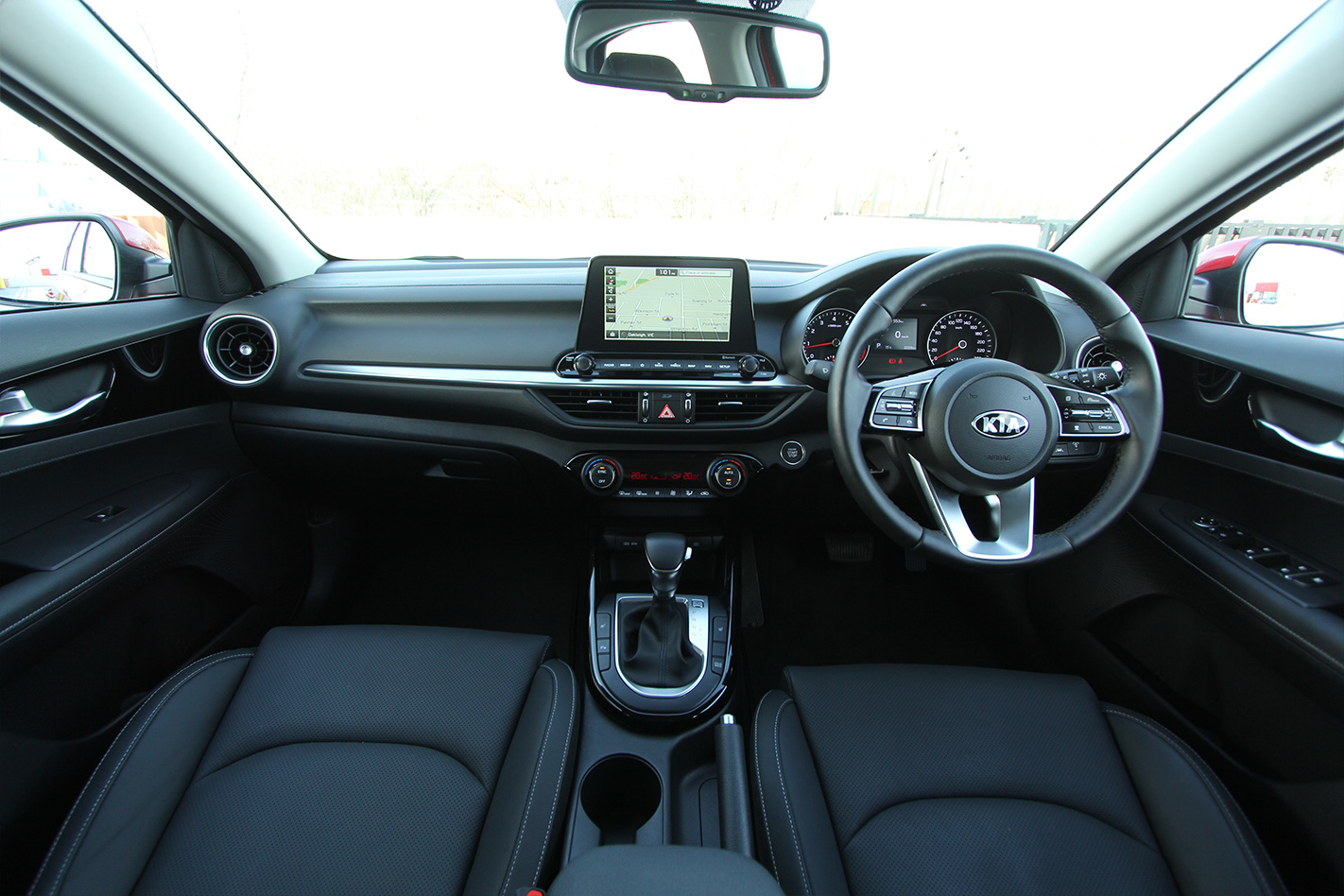
A generously sized 8.0-inch colour touchscreen presents clear, if simple graphics and is intuitive to operate, though some may prefer the greater internet-enabled functionality of the built-in Apple CarPlay/Android Auto smartphone mirroring. The Cerato cabin is appealing and the rear compartment is spacious, however the presence of some hard plastics dulls some of the sheen.
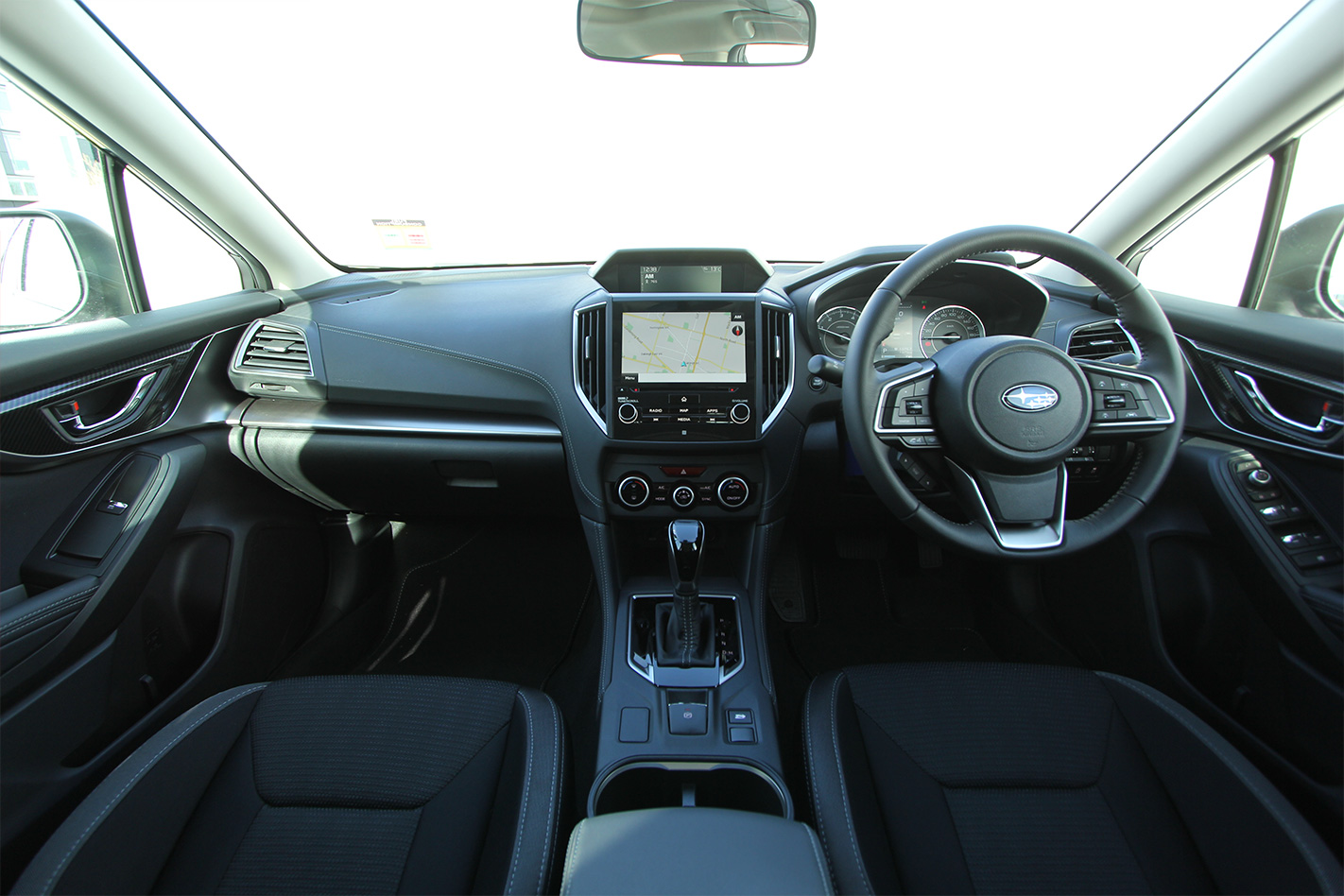
Also flaunting an 8.0-inch touchscreen front and centre in its dash, the Impreza augments its main display with an extra screen above, which can lead to some user confusion. Like the Cerato, CarPlay and Android Auto feature if the standard software is not for you. Rear seat space is almost limo-like, and combined with commodious front seats, it makes for an able people-carrier.
Ride and handling
Local tuning has given the Cerato an adept chassis that feels both composed and agile on sub-par roads. A stiffer body than the previous Cerato sedan provides the backbone for the dynamic capability, and the electric steering is accurate with a good sense of connection. It’s not as sporty as the badge on the bootlid may suggest, but the Cerato is sharper yet more pliant than before.
The Impreza’s handling errs toward safety and predictability, though still manages to provide decent engagement and steering finesse. The Premium grade misses out on the torque vectoring and grippier tyres of the 2.0i-S, which is a shame, but it still handles well. Ride comfort is another ace in its deck, though it’s slightly sharper than what you’ll experience in the supple Cerato.
Performance and economy
Here’s where the Cerato loses marks. A carried-over atmo 2.0-litre supplies just 112kW and 192Nm, and fuel economy is actually worse than in the previous generation. The six-speed automatic is delightfully smooth and intelligent, but the lack of any advancement in the powertrain department is a disappointment – especially as the rest of the package has taken such a substantial step up.
Subaru’s atmo 2.0-litre musters just 115kW and 196Nm, barely ahead of the Cerato, and a fun-sapping CVT is the sole gearbox available. Couple that with a 100kg-heavier kerb weight, and the Subaru is clearly the dozier car of this pair. That said, it burns nearly a litre less fuel per 100km, which is arguably the most important metric for the average small-sedan buyer.
Warranty and servicing
Seven years of unlimited-kilometre warranty coverage is hard to beat, and it’s an advantage Kia has held for some time. Servicing intervals are also generous at 15,000km or 12 months, and over three years you can expect to pay just $1055 to keep the Cerato in good running order. After-sales coverage is definitely a Kia strength, and will likely be a deal-maker for many service-conscious shoppers.
Subaru’s three-year/unlimited kilometre warranty pales in comparison with Kia’s standard-setting warranty terms, though service intervals of 12,500km/12 months at least minimise the number of visits you’ll make to the service department. Maintenance costs are capped for three years, and tally a reasonable $1298 over the first three years or 37,500km.
Verdict
As similar as they may be, the Subaru Impreza eeks out a win over Kia’s Cerato Sport – helped across the line by its commitment to interior quality and spaciousness.
It’s been two years – or three prime ministers – since SsangYong exited Australia, after the brand separated from former importer ATECO after a lacklustre three years in market.
Now, though, one of Korea’s most significant automotive brands is back, this time backed by the factory and with lofty plans to crack the top-10 list of car companies by volume.
But has the brand gone too hard, too early?
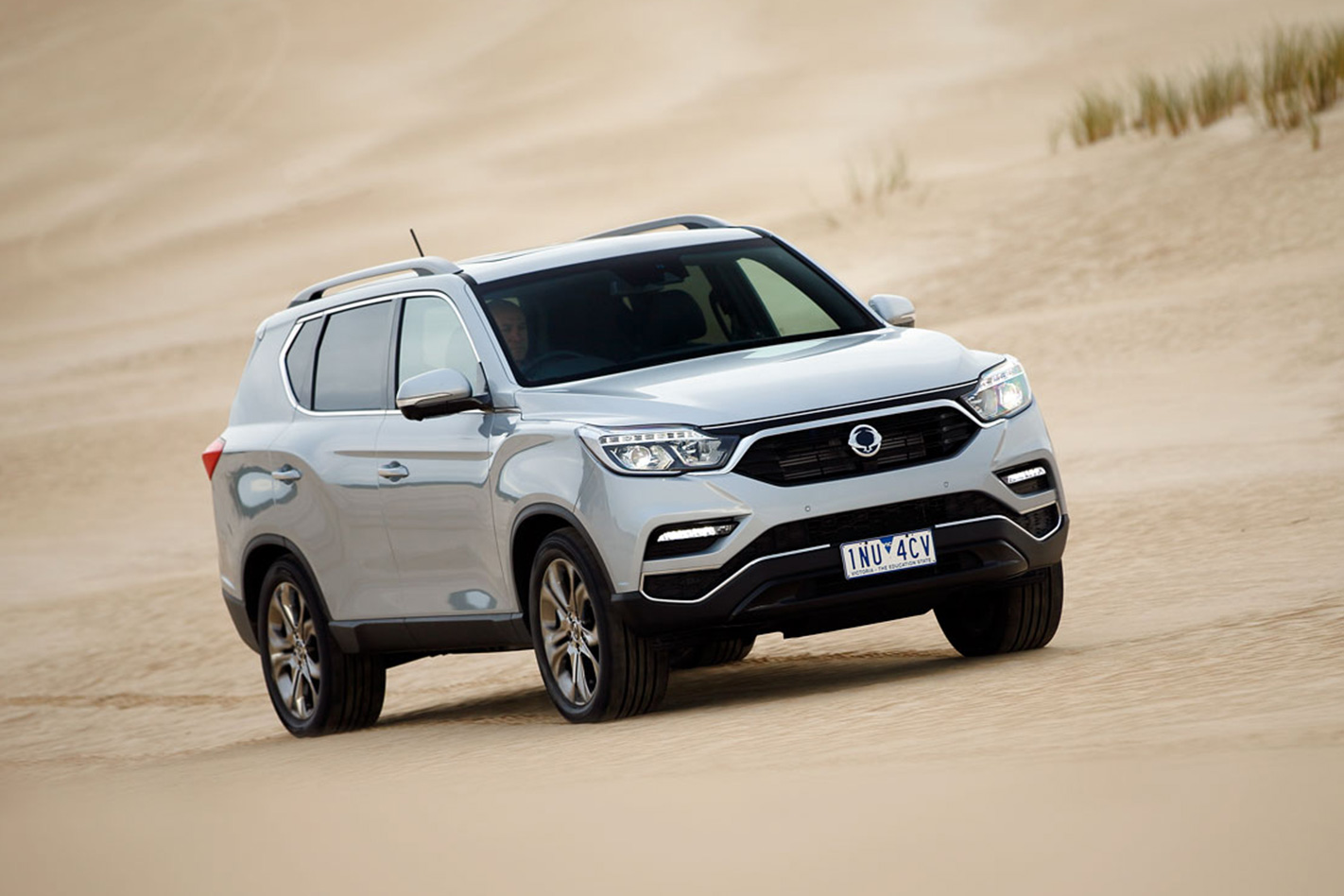
WhichCar recently covered the relaunch of the brand in Victoria, where it showed off its first three models. These included theTivoli small SUV, the Rexton seven-seat large SUV and the Musso dual-cab ute.
Of the three, the Tivoli is set to be substantially facelifted in less than six months’ time, while the Musso range will be expended with the addition of a long-tray version.
As well, the brand’s marketing and PR manager, Andrew Ellis, confirmed the brand is currently in discussions with a number of Australian-based suspension tuning specialists to localise the SsangYong range for Australian road conditions.
The process will start with the Musso, which will be initially offered as a short-tray coil-sprung version, before being joined by long-tray coil- and long-tray leaf-sprung variants.
The process will then extend to the Rexton and the Tivoli.
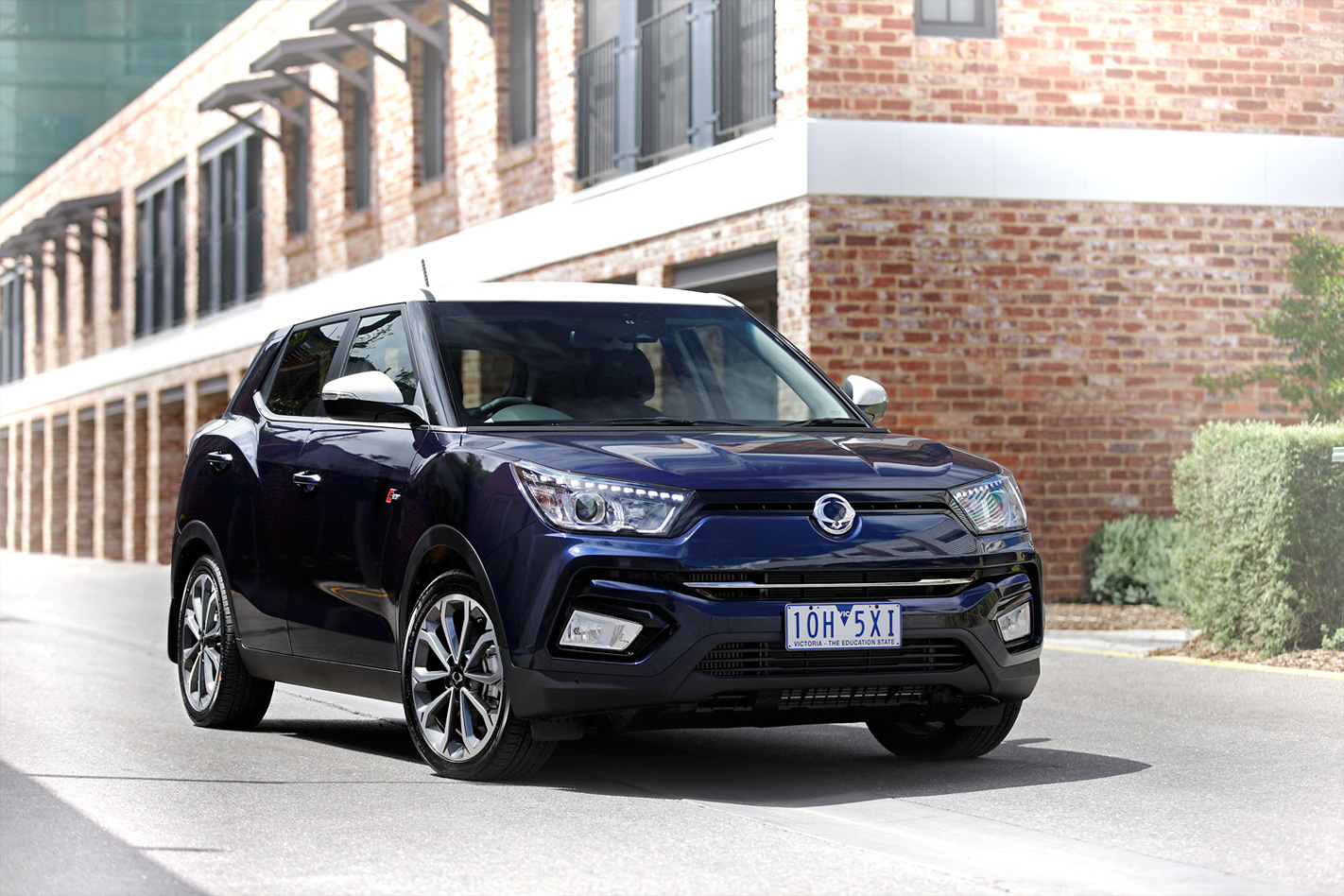
Along with the suspension, safety standards are also in a state of flux for the brand. For example, the Tivoli will go on sale as a four-star ANCAP car, with the ranking handed down from Euro NCAP after a low score for rear occupant protection.
Meanwhile, up to 70 copies of the Musso will land in Australia sans autonomous emergency braking, which will be fitted to every SsangYong product coming into the country from December.
The Rexton has a five-star ranking from Korea’s NCAP, but this does not necessarily translate to an equivalent score under the ANCAP regs.
Which begs the question … why not wait for a few months until everything is more shipshape?
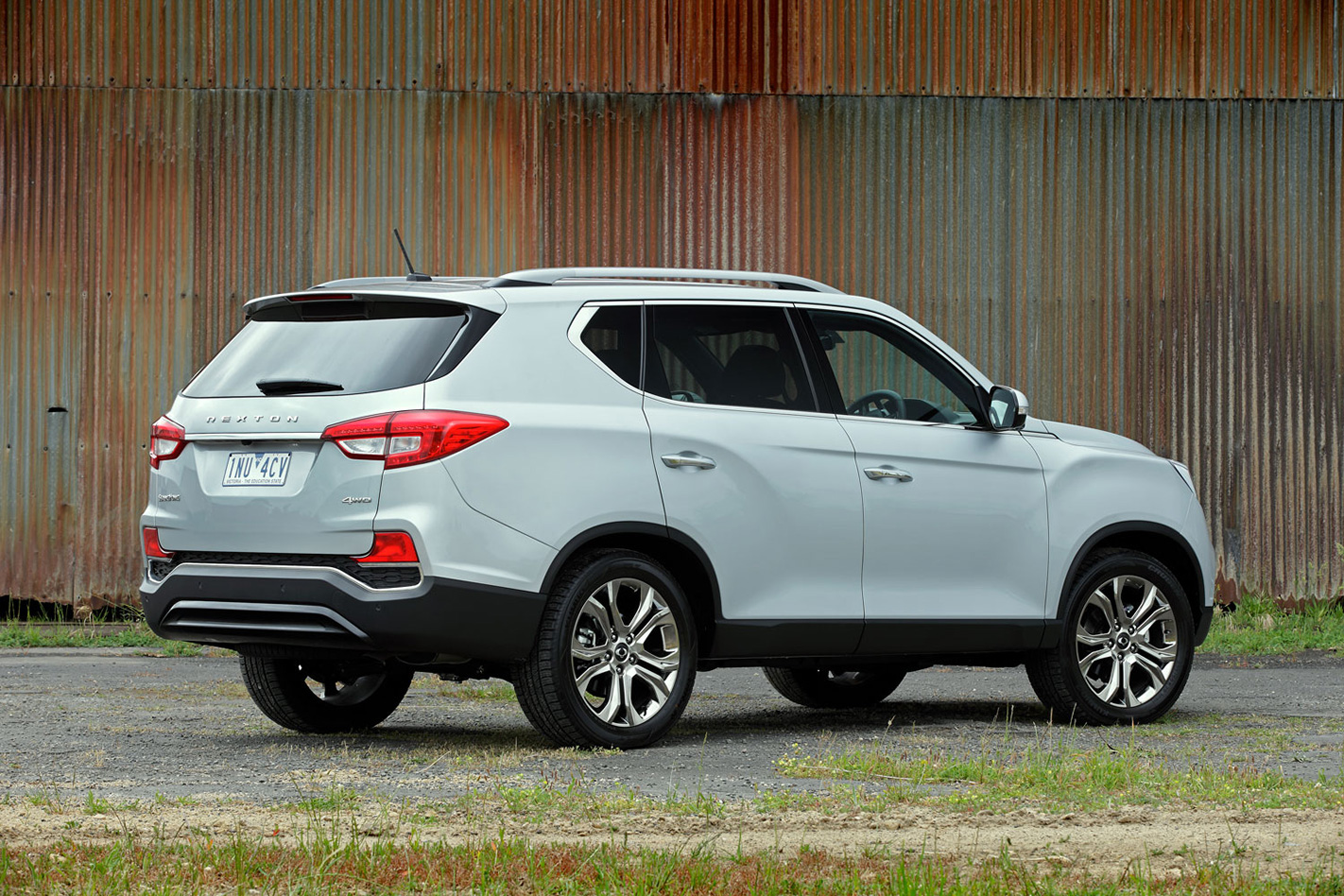
“The dealers are very keen to get their hands on product,” says SsangYong Australia’s managing director, Tim Smith, adding that 32 dealerships are currently signed up with the brand.
“We’ve had customers lining up, demanding a Musso. We got 150 leads today. My inbox is full of leads.”
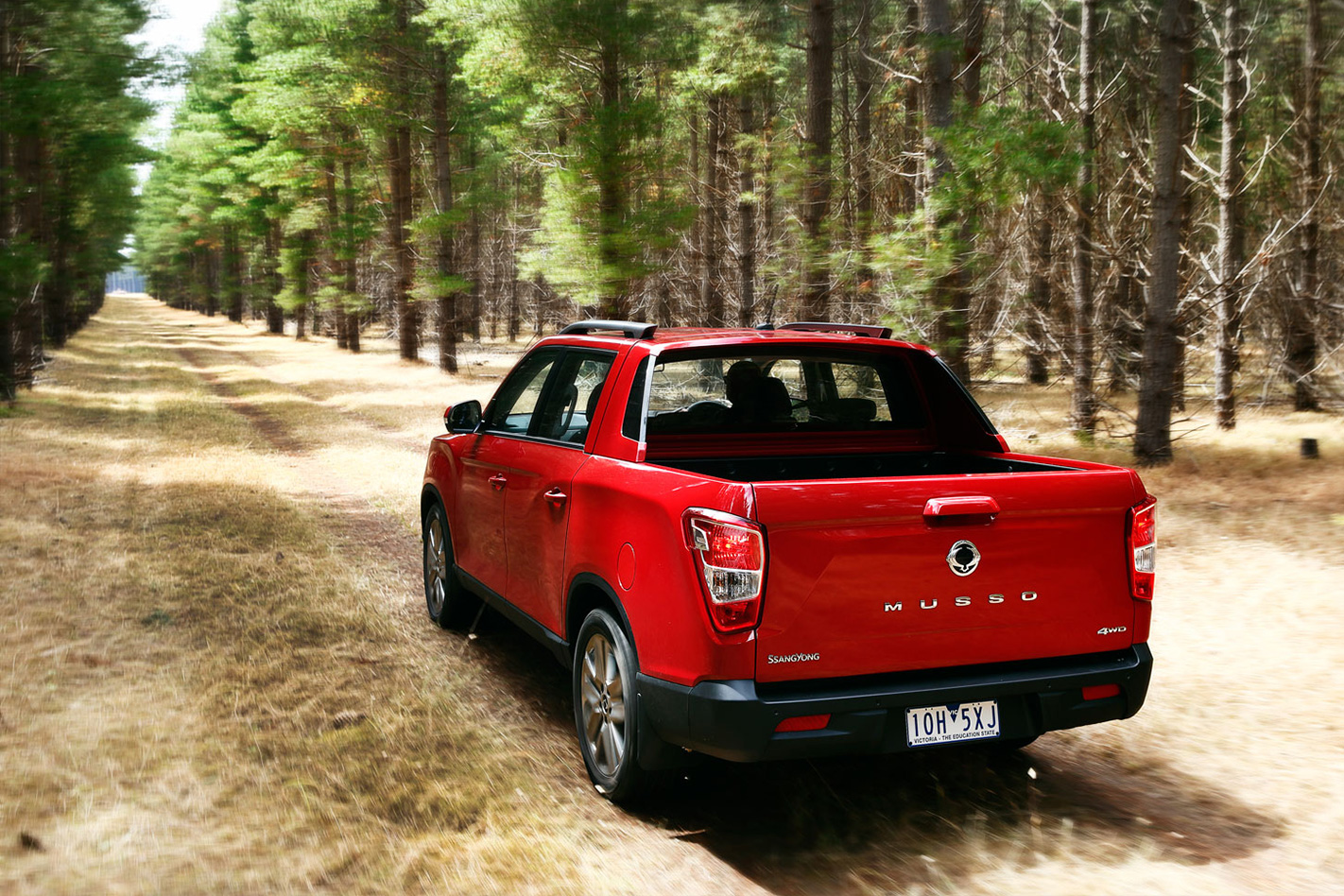
“We’ve had messages from September and from all our dealers, from Perth to Townsville, Hobart’… if you can give us a car now, we’ll sell a car now’,” said Ellis, who added that customers who buy the non-AEB versions of the Musso will be made aware of the vehicle’s spec.
“We made it clear from the start with the dealers, and they’ve been transparent with their customers about it,” he said. “Customers who want it just want it. They want that car at that price.”
All deliveries of Musso utes after December 2018 will have AEB as standard, according to Ellis.
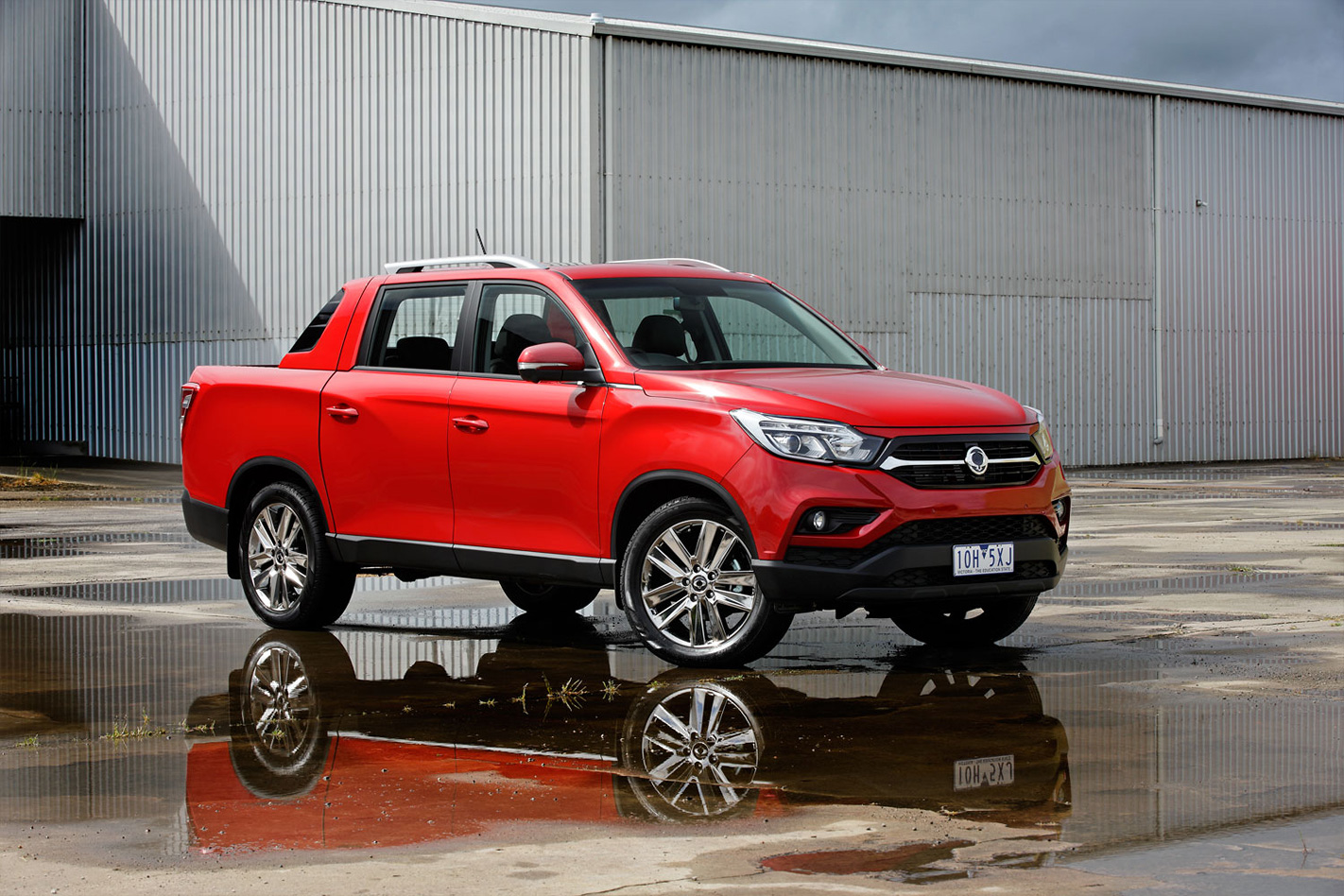
The four-star Tivoli is another work in progress, with an impending mid-life refresh only months away, as is the three-row Rexton SUV.
“We’ve had discussion with ANCAP with Tivoli, and getting the sign-off over from Euro NCAP,” said Ellis. “It’s the only [SsangYong] vehicle that’s been tested under that regime.
“The Rexton was tested under K-NCAP and got five stars, so we’re working on that with ANCAP very closely, and they’re working with our engineers.”
Both models ship with AEB and lane departure warning as standard, while the seven-seat Rexton offers curtain airbags that extend back to all three rows. The top-spec Ultimate variants in both models also offer additional driver aids, like rear cross-traffic alert and 360-degree view cameras.
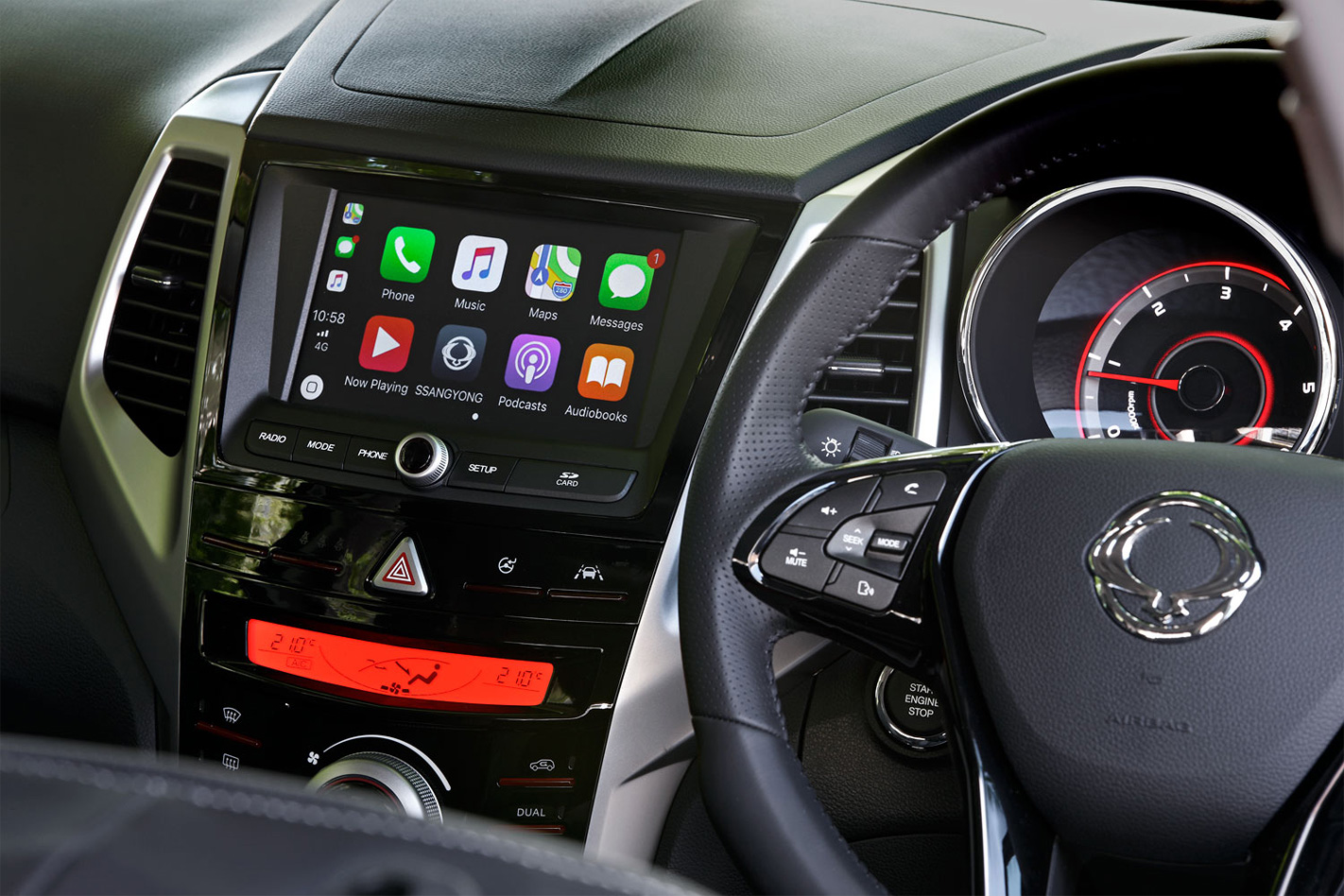
The SsangYong range starts from $23,490 (national drive-away) for a base model Tivoli, and extends through to $53,990 for a top spec Rexton.
All SsangYongs will receive a seven-year warranty, seven years’ worth of roadside assistance and seven years’ fixed priced servicing.
Happy scorching hot Friday friends of WhichCar,
Hope you’re staying cool while Melbourne boils as the mercury tops 38 degrees today! Last week it was Sydney’s Storm of the Century – bit of a fizzer if you ask me – and this week Melbourne’s roasting over an open flame. Next week: snowstorms in Adelaide!
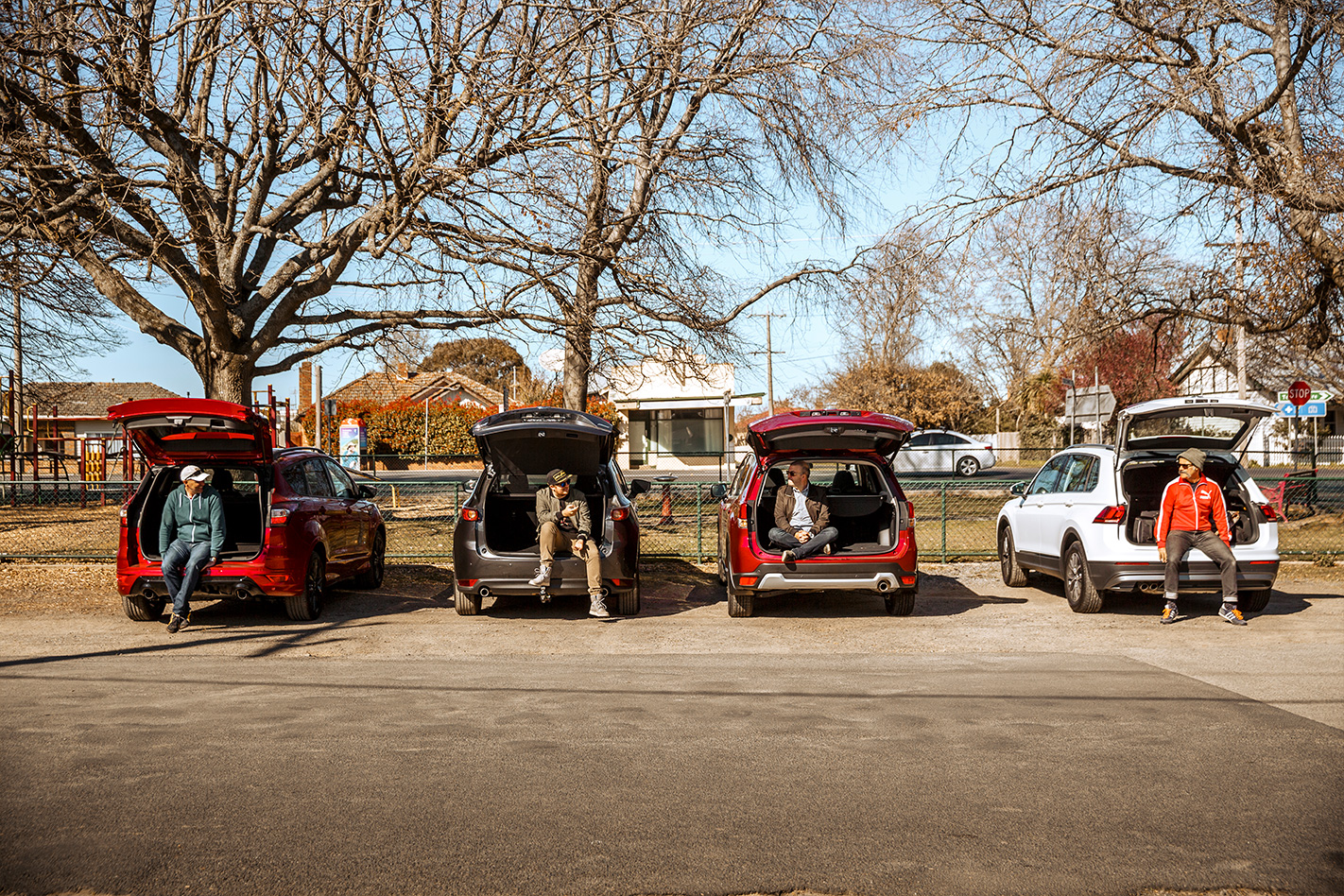
We do check boot space!
The automotive week started off just as hot with the new Subaru Forester winning a comparison test against fancied favourites Mazda CX-5, Ford Escape and VW Tiguan. From there we leapt to the defence of tyres as the unsung hero of performance cars, and followed it up with an ever practical look at cars with the best boot spaces. (Just quietly, you’d be amazed how popular that last article is.)
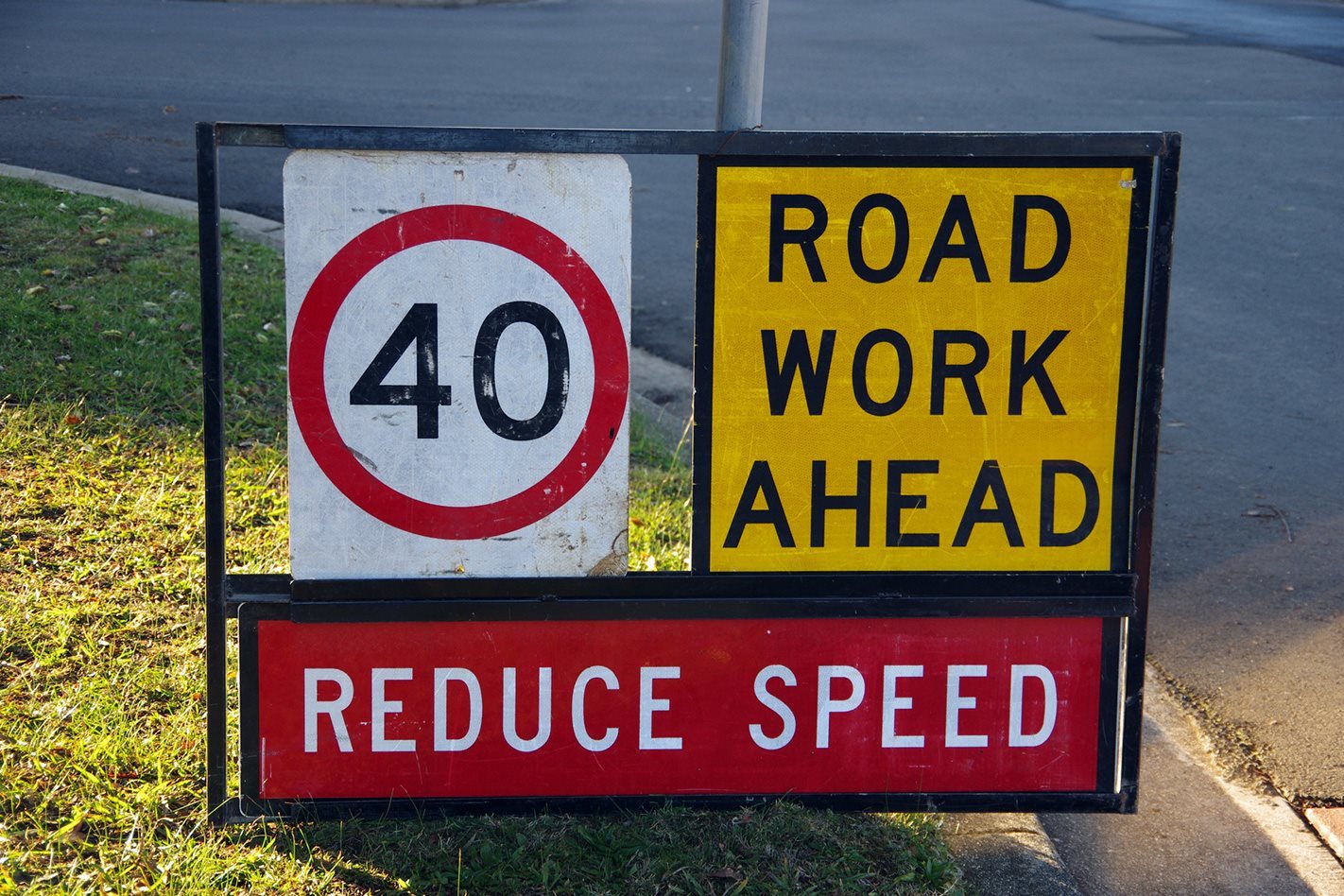
…but only while we’re working
We wrapped up the LA Show with our list of star cars coming Downunder, took a gander at the new Mitsubishi E-Evolution – a crossover that double crosses between an SUV, an electric car and a real-life computer game. We also bumped into Mark Webber in LA, who voiced grave concerns over Ricciardo’s move to Renault next year. Personally, we reckon that Alpine A110 will make a ripper F1 steed for Our Dan. Meanwhile, Victoria’s Dan Andrews revealed plans to repeal roadwork speed limits when the roadgang’s not working. Isn’t that the same as abolishing them outright?
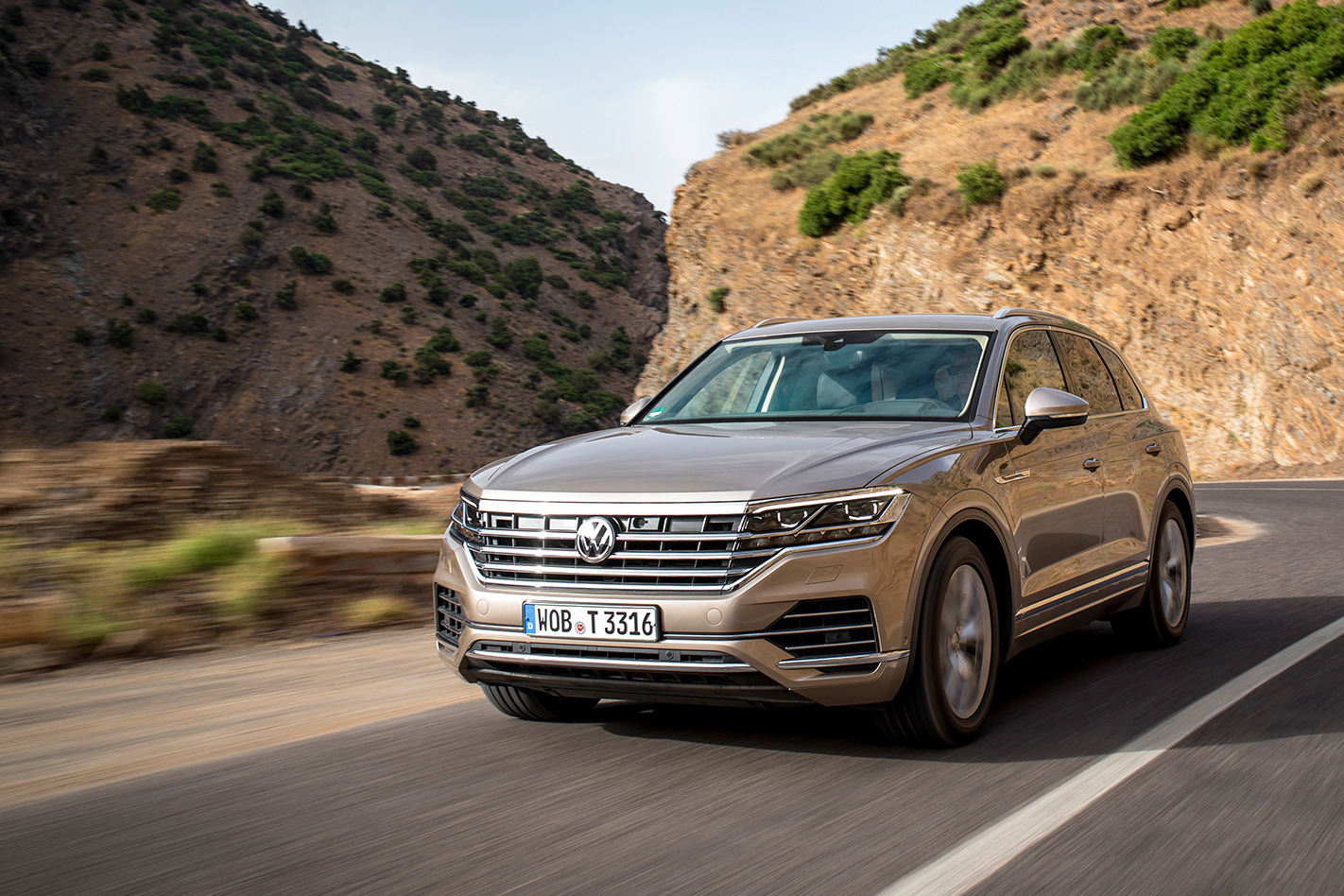
Get a load a ma grille!
Across the pond in Africa, we met the new sexier VW Touareg, and discovered 18 things that make it better than the last one – including Porsche-style badging! Meanwhile, in Germany, somebody leaked images of the new BMW M8, which we duly shared with our 800,000-strong audience. Lastly, we wish somebody had leaked images of the new Chevrolet Silverado, so we could have had time to prepare for the shock!
In other news, Infiniti waved the makeover wand at the Q30 and QX30 range, throwing additional equipment in an attempt to boost sales. Honda also refreshed the CR-V range, although important additions like AEB were strangely withheld from the base spec base price.
In the beginning… which is when, exactly?
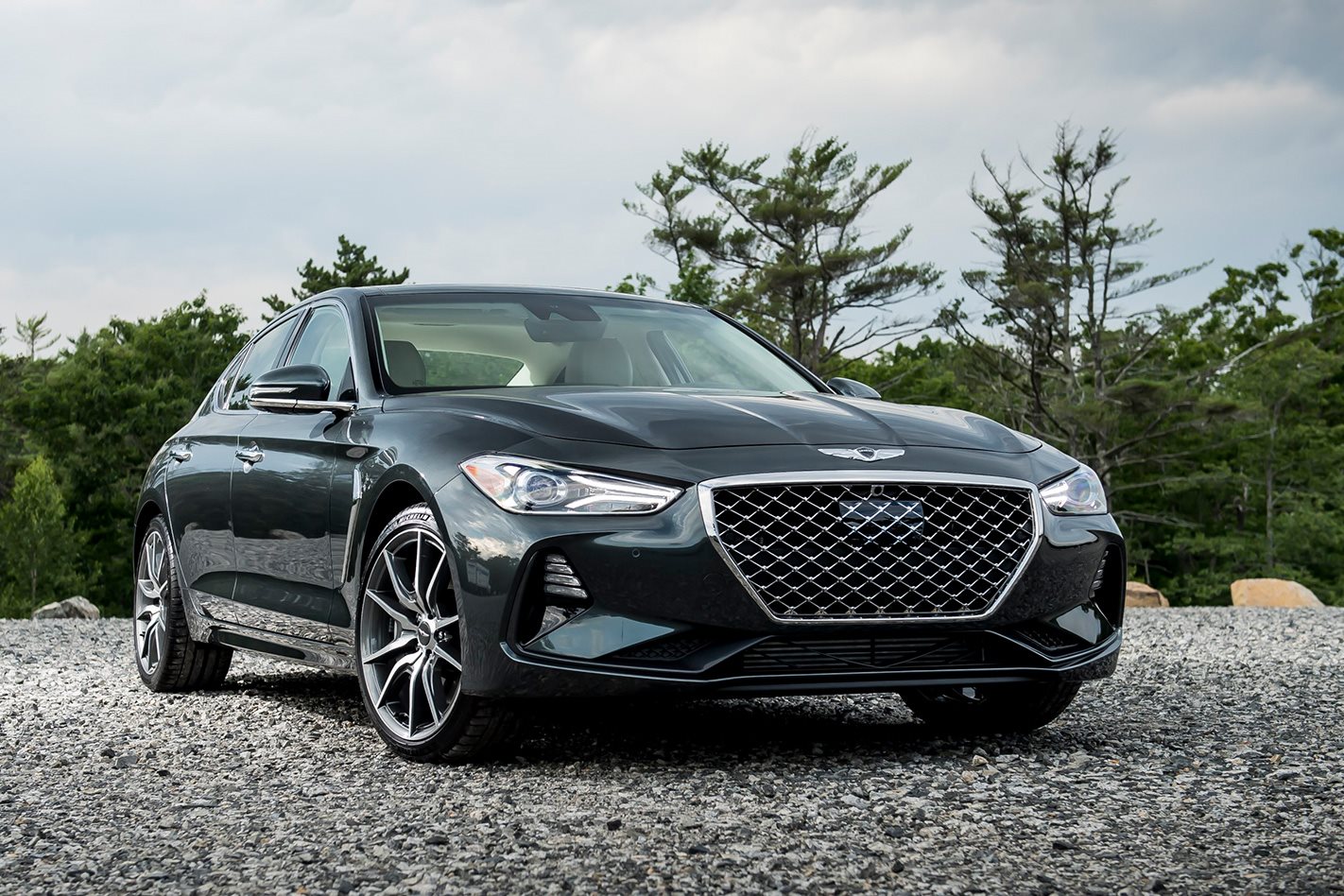
SsangYong started the week at pace, launching not one, not two but three new cars with sharp pricing, long warranties and inoffensive styling. We also wrote a story about Suzuki setting a launch date for the new Jimny – the interest in this little doer is just astonishing – and we wrote another news story about Genesis still not having a launch date set, even though it was crash tested and achieved five stars.
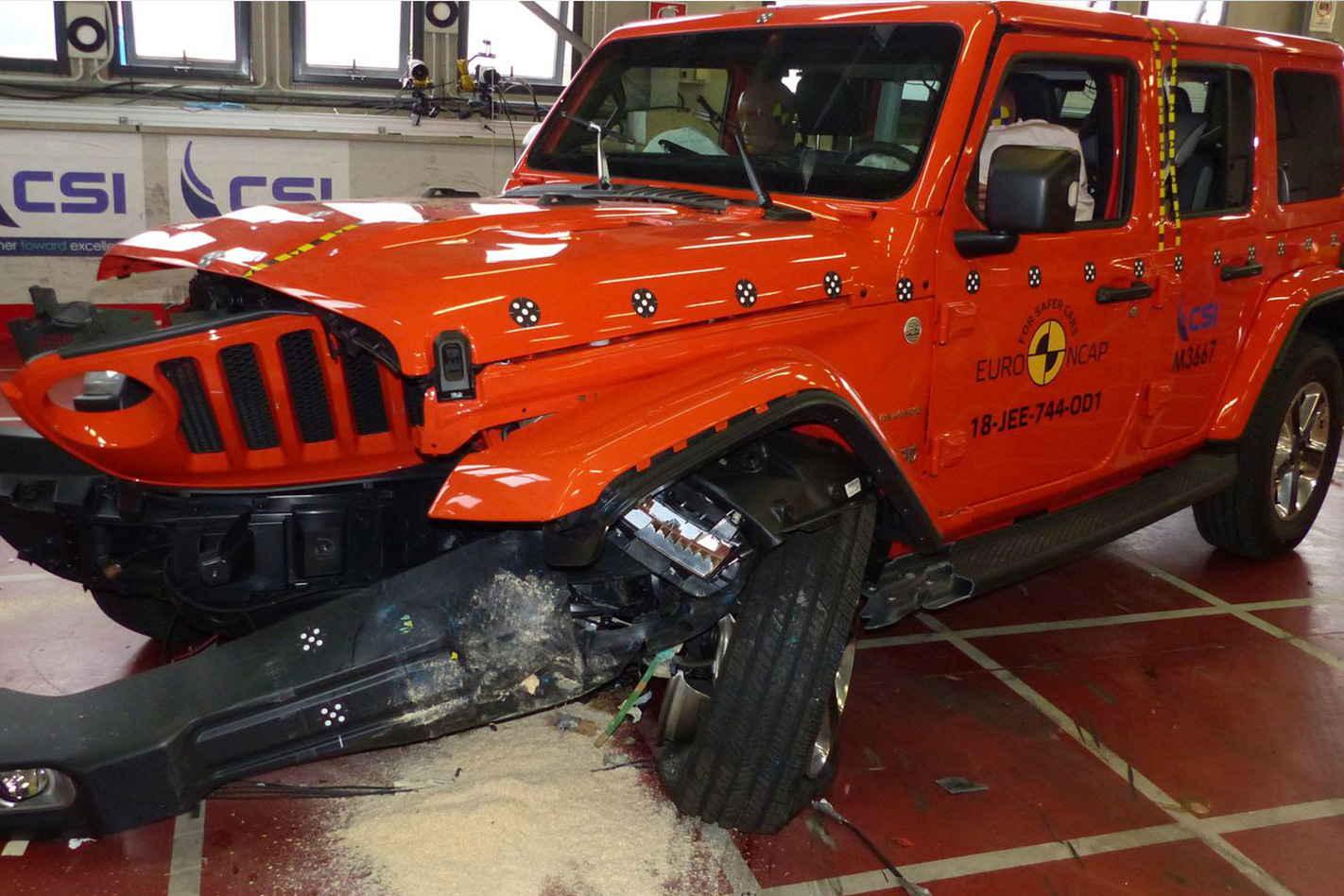
The Wrangler’s new design is pole-arizing
I suppose that’s better than an all-new, totally redesigned and completely re-engineered new Jeep achieving just one star in EuroNCAP crash testing… Some leapt to the defence of the new JL Wrangler, saying it’s designed for rugged offroad use, and for all its panels to come off. Perhaps Jeep needs to convince ANCAP before the JL gets to Oz in 2019 that that feature is actually a safety boon which makes it easier to free occupants after a crash.
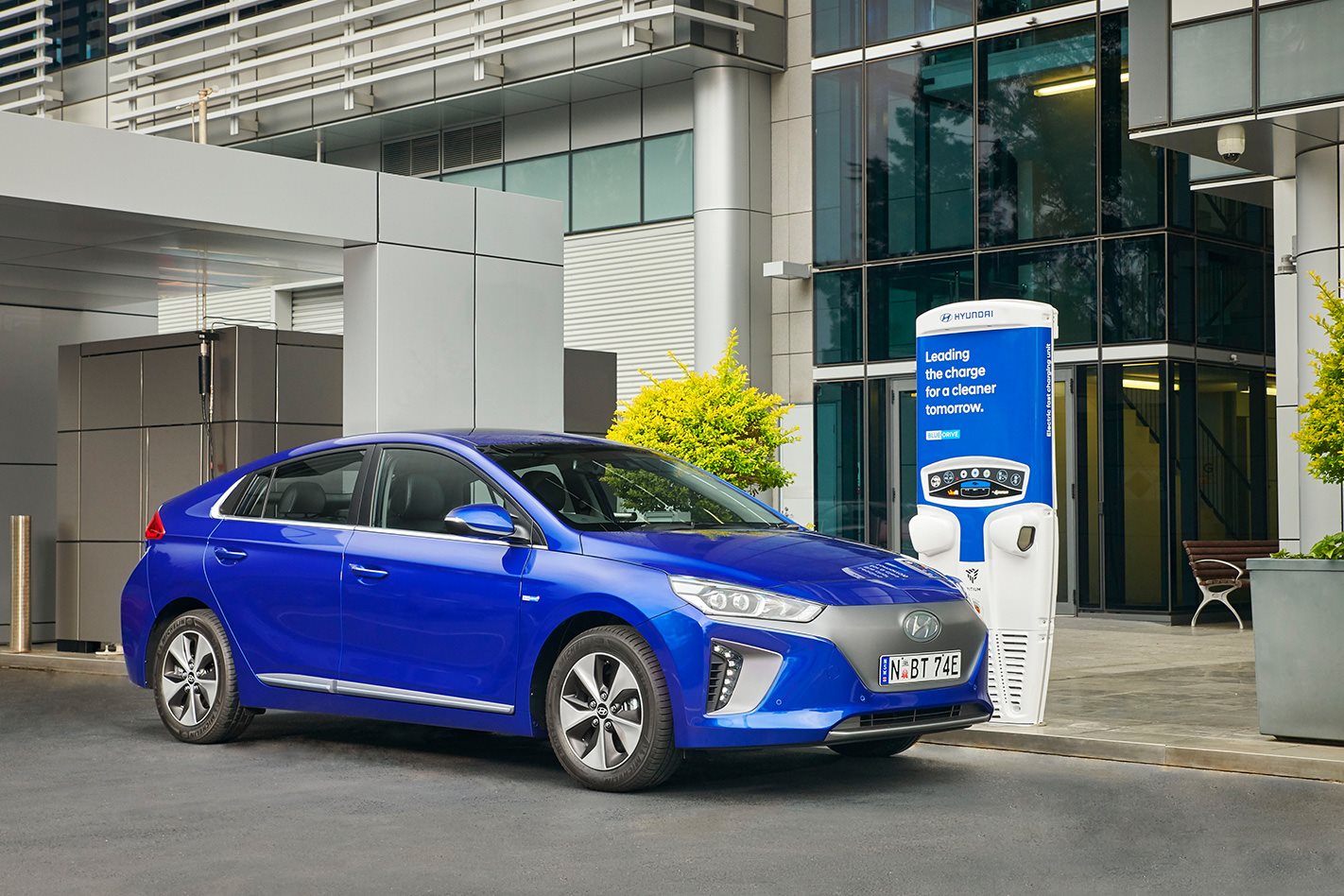
It’s the Ioniq, man!
We drove the new electric Hyundai Ioniq this week, covered the new Mazda CX-5 turbo, drove the Alfa Romeo Stelvio Ti, the Mitsubishi Pajero Sport, Audi E-Tron, and a few other tasty morsels. We also covered VFacts’ November results, down 7.4pc on November 2017. And we welcomed yet another dual-cab ute – Mitsubishi Triton – into the top ten as passenger cars continued to slide.
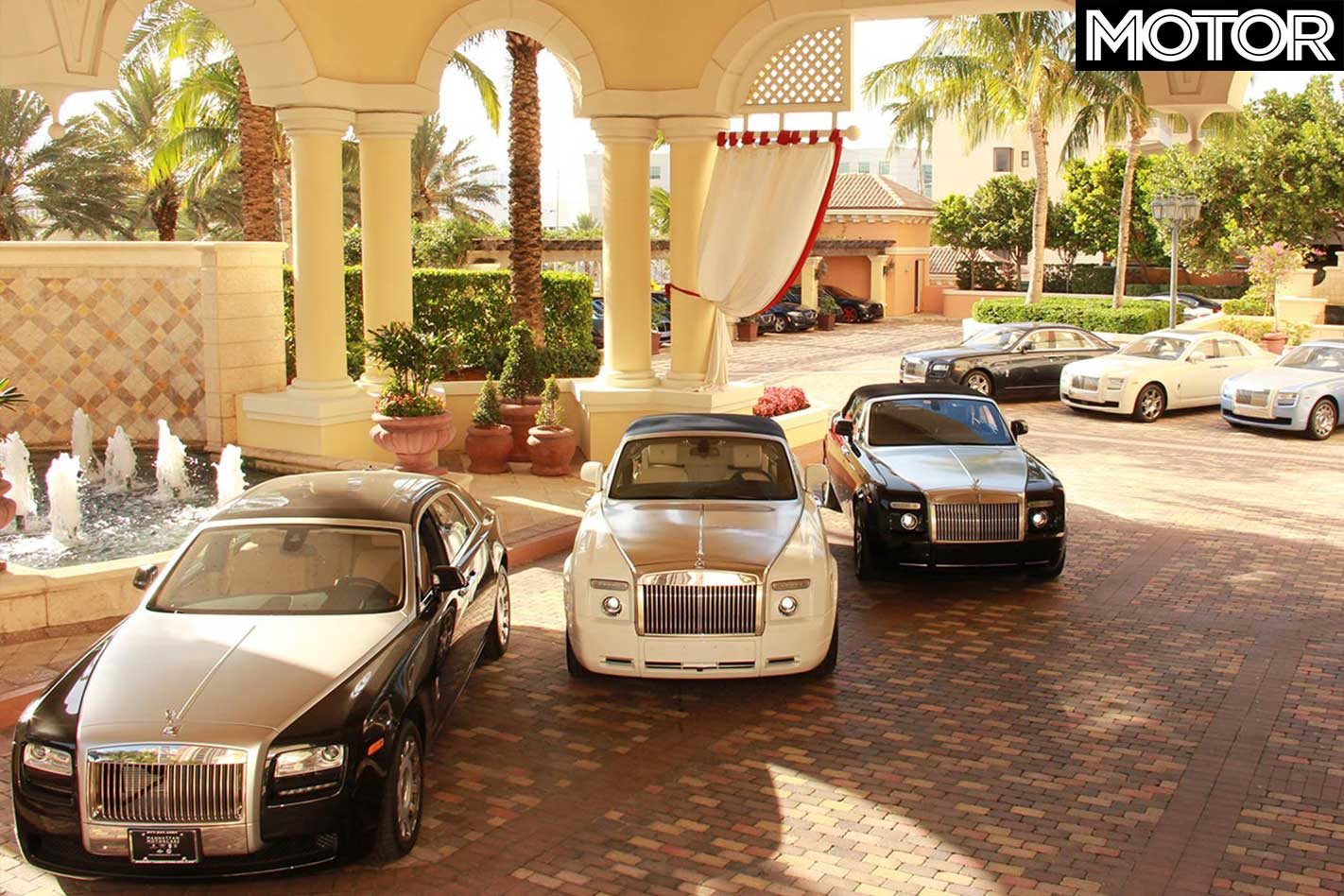
Miami realtor trials house and car package
Now some weird and wonderfully wacky stories from the week. ZF revealed plans to fit external airbags to minimise T-bone damage to cars’ noses and sides (and occupants too, presumably). Is it April 1? In Miami, a penthouse was offered for sale complete with free Lamborghini and Rolls Royce – full-size, not matchbox models.
And on that note, have a wonderful and slightly wacky weekend!
