
Exactly two years to the day after Audi launched its first mass-produced EV in a hall crammed with 2000 guests in San Francisco, the e-tron has arrived in Australia. And it’s priced $200 less than the COTY-winning Mercedes-Benz EQC…
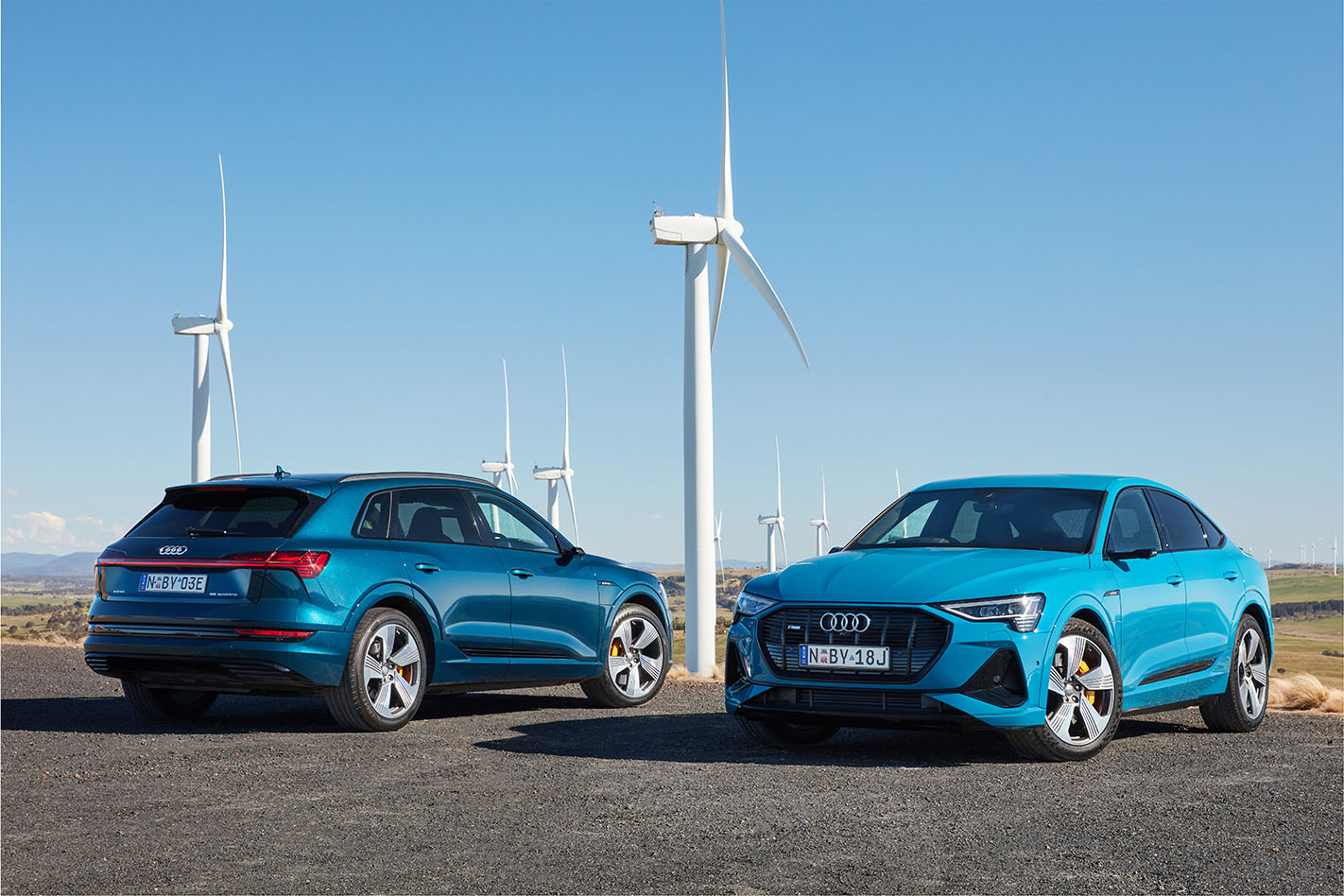
Such was the delay, Audi has launched both SUV and Sportback bodystyles at the same time, starting at $137,700.
Both use a pair of electric motors, with the front providing 125kW and the rear, 140kW. Both units also contain a single-speed transmission and two-stage diff. It equates to 265kW and 561Nm, while an eight-second Boost mode bumps things to 300kW and 664Nm for a claimed 0-100km/h time of 6.7 seconds.
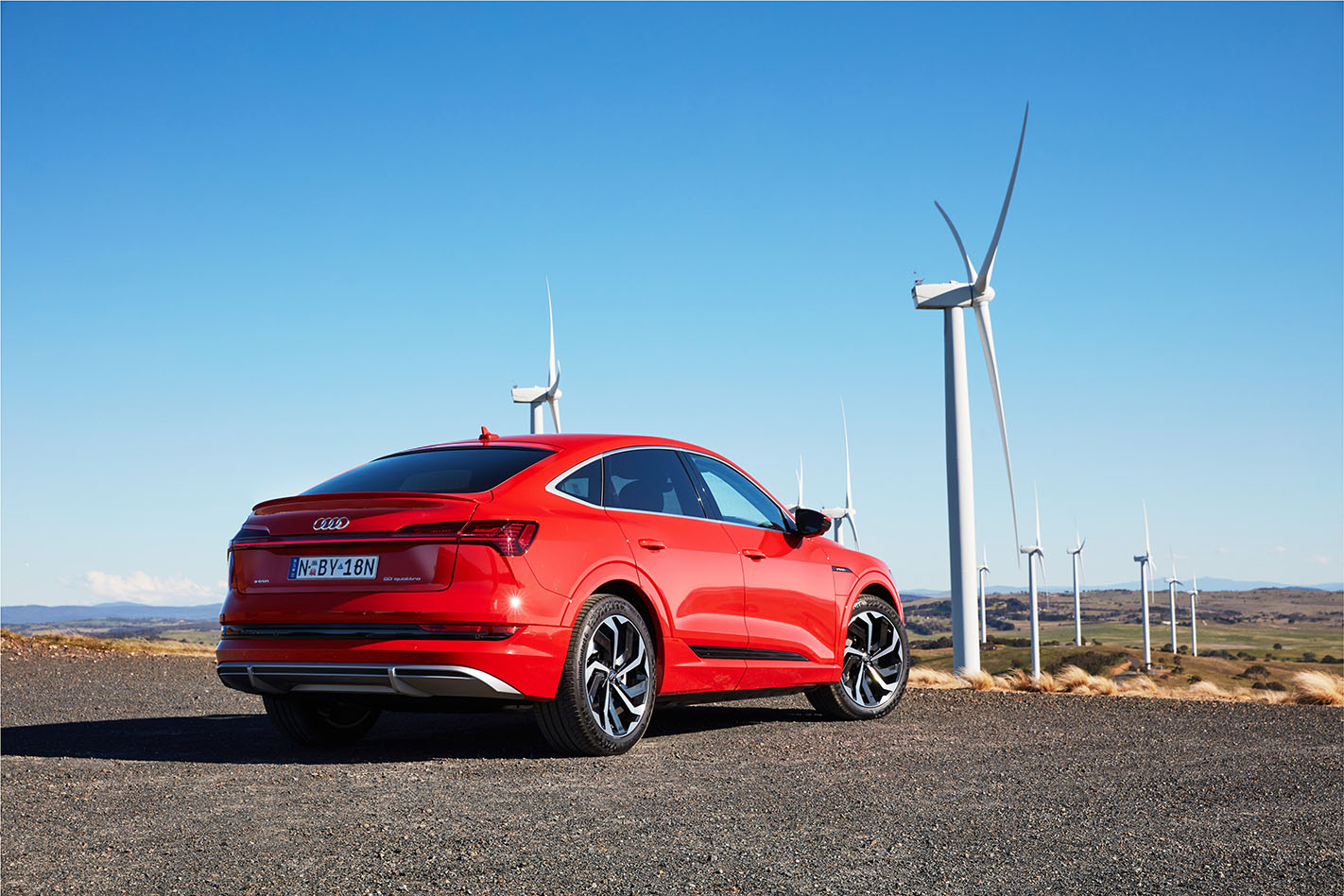
Two batteries are offered in both bodystyles; the e-tron 50 uses a 71kWh battery that gives a claimed 300km-plus of range, while the 95kWh battery in the 55 offers a claimed 400km-plus. The gel-cooled battery array is big, too, weighing in at 700kg and bolted to the MLB Evo chassis at 36 points. Opt for the 50 and you’ll save 120kg.
Sophisticated electronics give the e-tron seven driving modes including off-road and all-road. The e-tron’s all-new braking system also offers a three-stage regenerative system. A traditional gear shift paddle can swap between three levels of regen braking feel, and up to 30 percent of the e-tron’s range comes from regen braking. The only flaw here is that the chosen regen mode is overridden every time you touch the throttle pedal.
The brakes themselves are decent, too, with six-piston calipers up front. Air-sprung, adaptive-damped suspension is standard on Aussie cars.
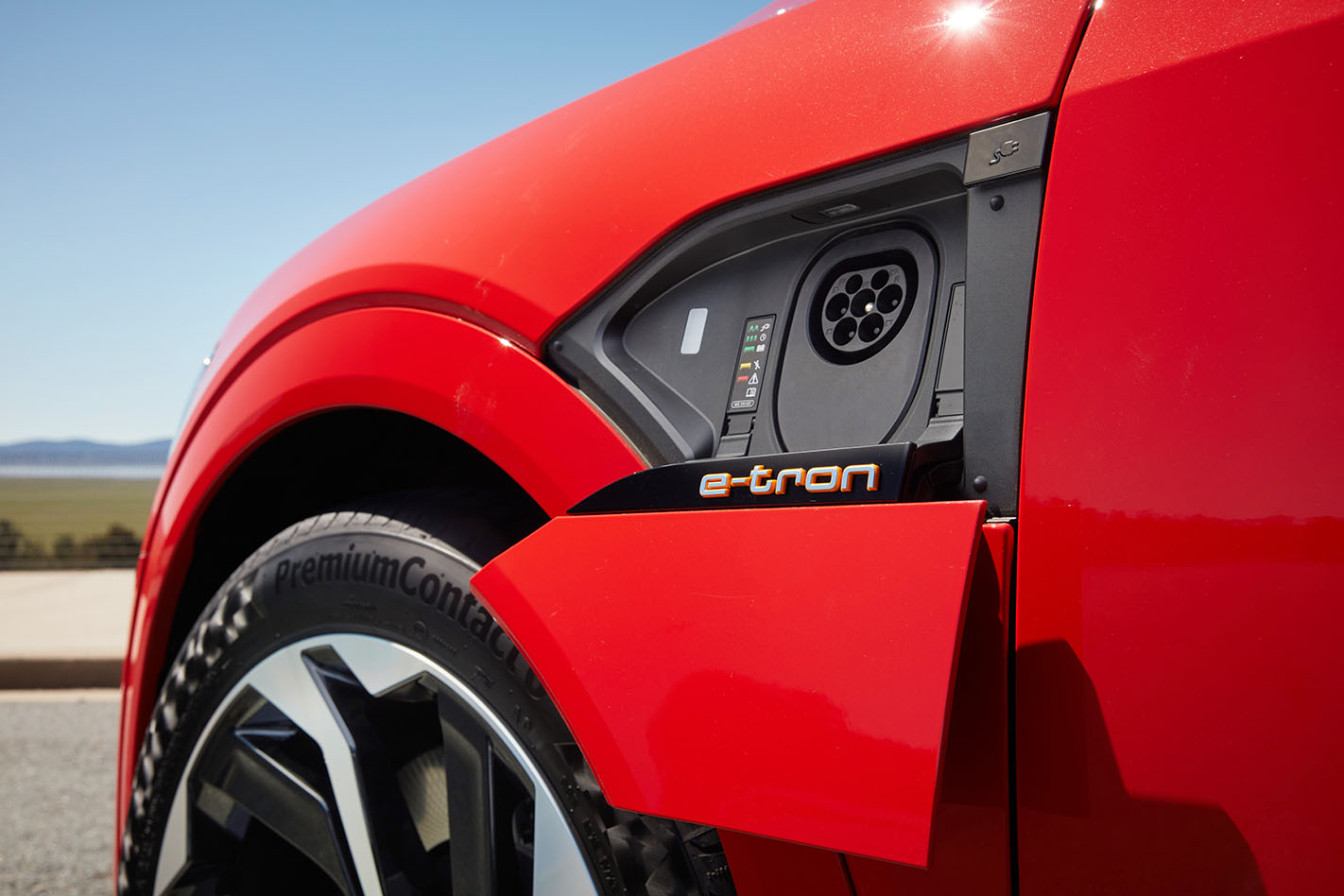
The e-tron can be plugged into any AC 240-volt socket (on either side of the car, too) via its own Type 2 plug-equipped charger unit. This, though, will take a long time to charge; in excess of 12 hours, in fact. Using three-phase power and the included Audi charger at home bumps output to 11kW and reduces that time. Audi will – initially at least – install its charger at your house for free (where suitable). This unit can also be detached for trips away.
The fastest way to charge the e-tron is via a DC ultra-fast charger, which can give you 80 percent range in as little as 30 minutes. Audi has partnered with ChargeFox to offer e-tron customers six years of access to their stations, which includes a brace of ultra-fast chargers.
A 300km stint in both the 55 Sportback and 50 SUV included a top-off at a ChargeFox ultra-fast charger in Goulburn. A Zoom-riddled lunchbreak covered a sub-30 minute charge to take the 50’s battery from 40 to 80 percent for the final run into Sydney, where we ended the day with an indicated 82km left on the dial.
What’s most impressive about the e-tron is just how resolved it feels right out of the box. There’s a bit of dull reluctance to get rolling, but once underway, the e-tron steers, turns, handles and brakes as well as – if not better than – a Q7. It’s about 300kg heftier than a Q7, though, which is hard to disguise.
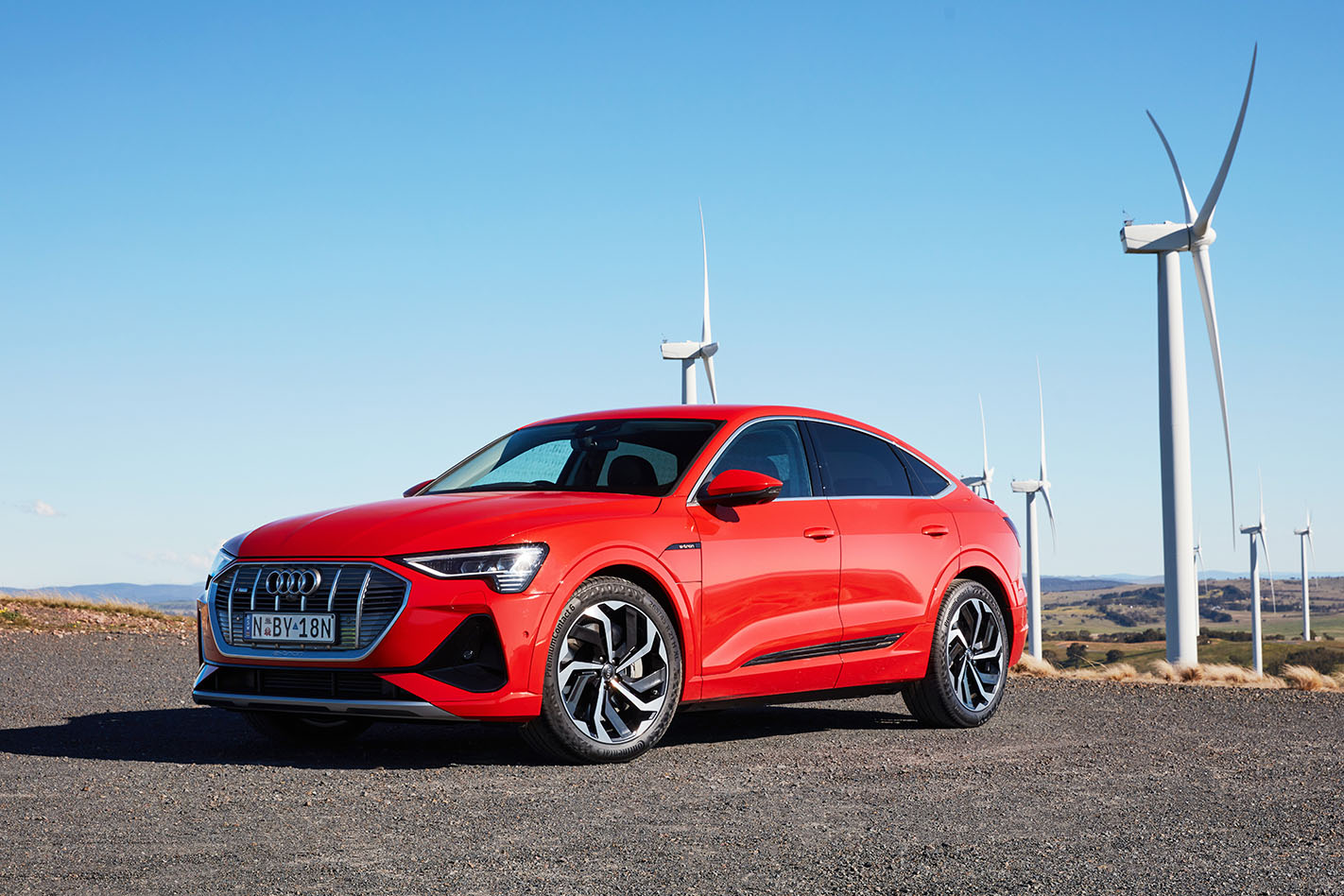
Highway driving is a silent delight, with more than enough urge to dispatch tardy traffic. The jury is out on the rear-view cameras, though; it’s very hard to retrain the brain to look inside and down at the door card to see what’s behind you.
Around town, a reluctance to let all the electrons out to play means the e-tron isn’t as sprightly as expected. Dynamic mode makes the ride a little jittery but not unbearable, but it improves the throttle response a lot.
Despite being Audi’s first real swing at the EV space, the e-tron is resolved, easy to access and a pleasure to drive. It also doesn’t shout ‘EV adopter’, which – like the EQC – should help entice more people into the electric world. The comparo is going to be a beauty.
AUDI E-TRON VERDICT
Plus: Smooth; swift; silent; easy to drive
Minus: Rear-view camera a challenge to learn; low-speed lag
AUDI E-TRON 50 SPECS
Motors: dual (front + rear axle)
Max power: 300kW (boost mode)
Battery: 71kWh lithium ion
Torque: 664Nm
Transmission: single-speed reduction
Weight: 2490kg
0-100km/h: 6.7sec (claimed, boost mode)
Economy: 28.5kW/100km (on test)
Price: $137,700
On sale: Now
The rival: Mercedes-Benz EQC ($159,900)
A surprise COTY winner and second only to the Jaguar i-Pace in getting to market. It offers more oomph (300kW and 760Nm), just as much range (434km claimed) and an 80kWh battery that’s sized between the two e-tron extremes. It also offers free ChargeFox access for five years. Game well and truly on.
Mazda might be best known for its rotary engine expertise – or more recently its petrol-come-diesel SkyActiv-X tech – but the Japanese company is finally ready to release its first mass production EV.
Revealed during the Tokyo Motor Show in 2019, it’s called the MX-30, and it’s now available in Europe. We’ll have to wait for full confirmation that it’s coming Down Under, possibly late 2021.
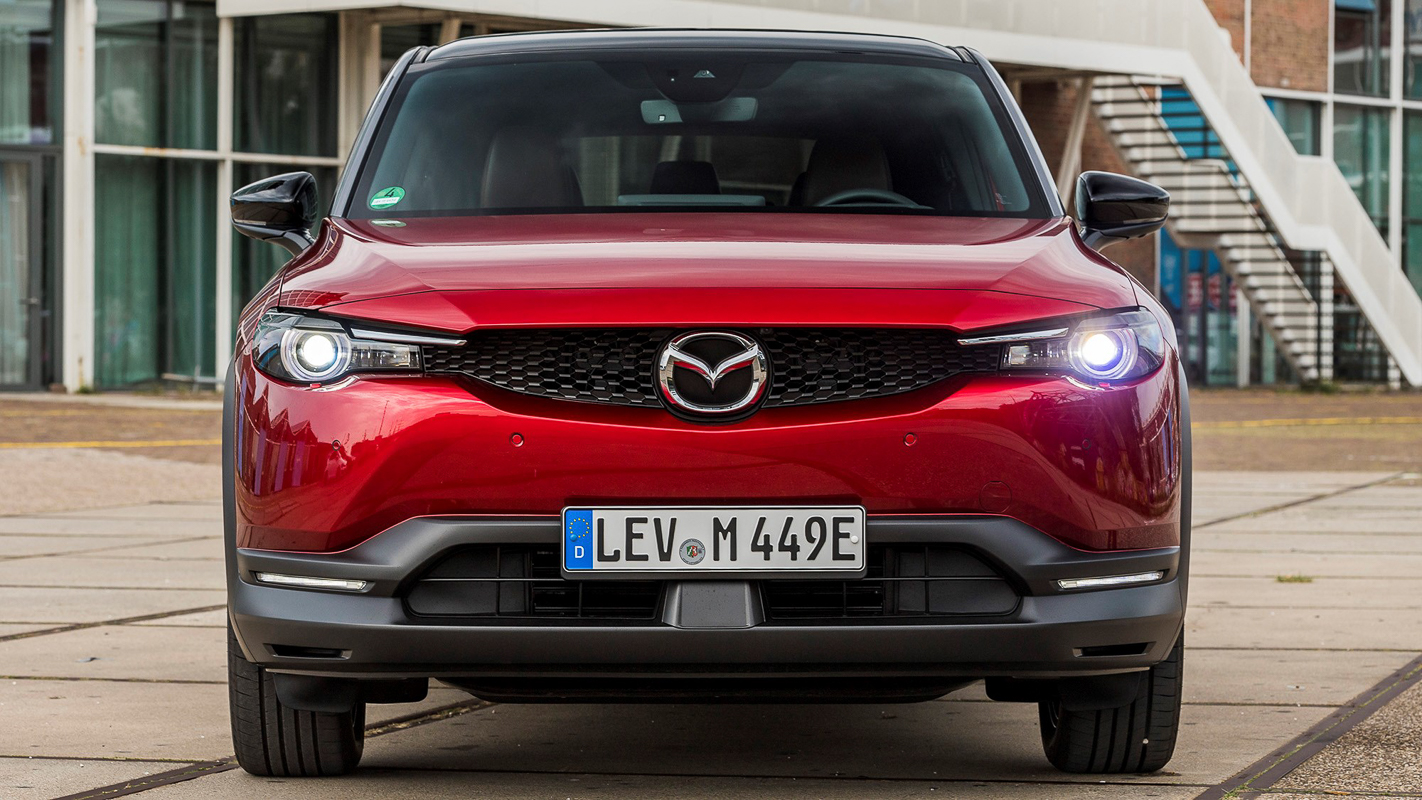
So what’s the first electric Mazda like to drive? Keep reading to find out why Mazda’s new EV is a different take on the electric car, and why its success could hinge on a test drive rather than a simple spec comparison.
What’s the spec, then?
Initially, the MX-30 comes as one flavour, starting with a relatively small 35.5 kWh battery. That’s as compact as the Honda e’s power source, but this is a much larger, family-friendly small crossover. There are three trim levels and all are generously equipped compared to rivals.
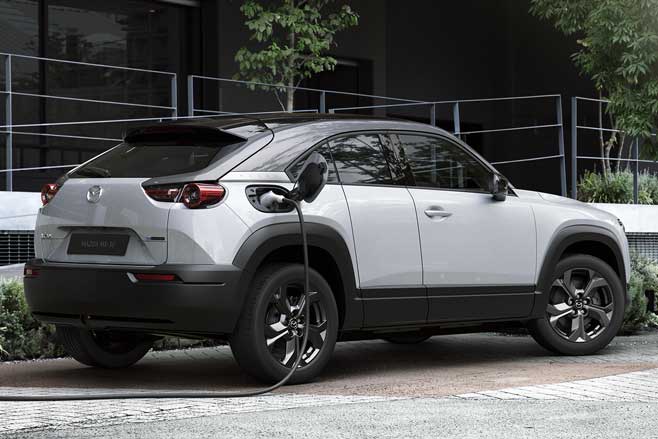
The motor produces a little over 100kW, and just under 270Nm of torque – not necessarily the numbers you’d associate with Mazda’s sportier MX brand, but the MX-30’s 1,645kg kerb weight is not that far off conventional crossovers of a couple of years ago.
It’s bad form to talk about your birthday at Christmas, but when you actually look under the bonnet at the motor, there’s an astounding amount of empty space – perhaps there’s more to come? You could comfortably fit a person in the room left behind when the CX-30 derived chassis is stripped of such fripperies as gearboxes, exhaust pipes and things to keep emissions away.
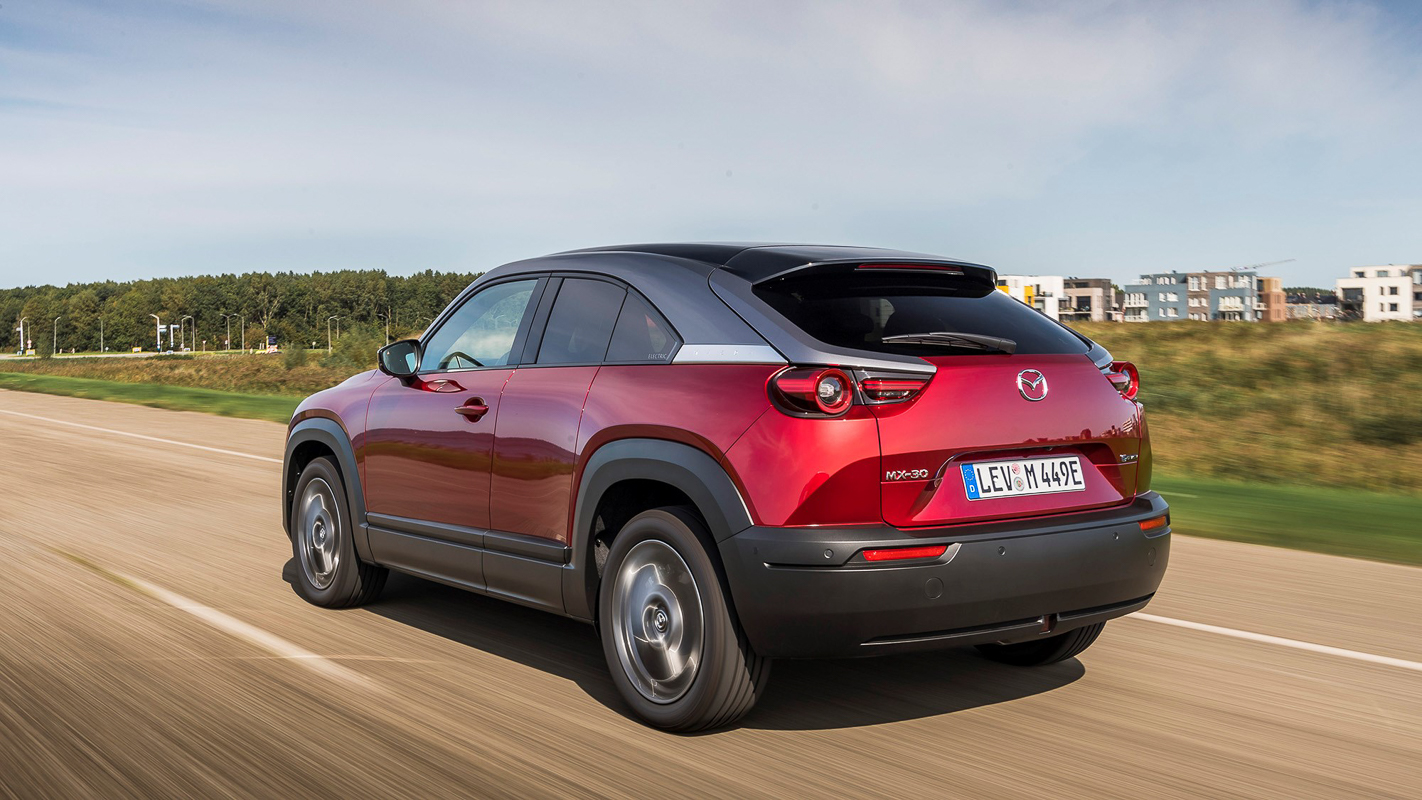
Mazda has a better idea than hiding people in there, apparently. Though exact details are unconfirmed, it’s definite that the empty space will be filled soon enough – and by a typically Mazda, Wankel rotary engine. This smooth, optimised range-extender could turn out to be the spec that gives the MX-30 real mass appeal, as long as the same masses understand that all the quirks of the RX-8 and forebears don’t apply here.
Japanese buyers will even be able to buy a conventionally-engined MX-30; in some ways, this really is the closest we’ll get to an MX-3 followup. As long as we’re not being denied an exquisite, tiny V6, the electric motor is plenty.
Why’s the battery so small?
It’s not small, it’s optimised. Actually, that’s not as mealy-mouthed as it sounds – there’s some very good logic behind the capacity. It’s enough for a 200-kilometre range (Mazda claim 260 kilometres of city driving), which – if it is achievable – is plenty for the average daily driving of commuters and families. It’s also easier to recharge fully on a home wallbox for the security of seeing the full ‘tank’.
Mazda’s justification is that most users don’t actually need a huge 75kWh battery, and making those big batteries involves a lot of raw materials and energy. Enough to significantly contribute to the embedded environmental cost of a car, which in turn affects how long your electric vehicle really takes to be better than a conventional car and its ongoing consumption and pollution.
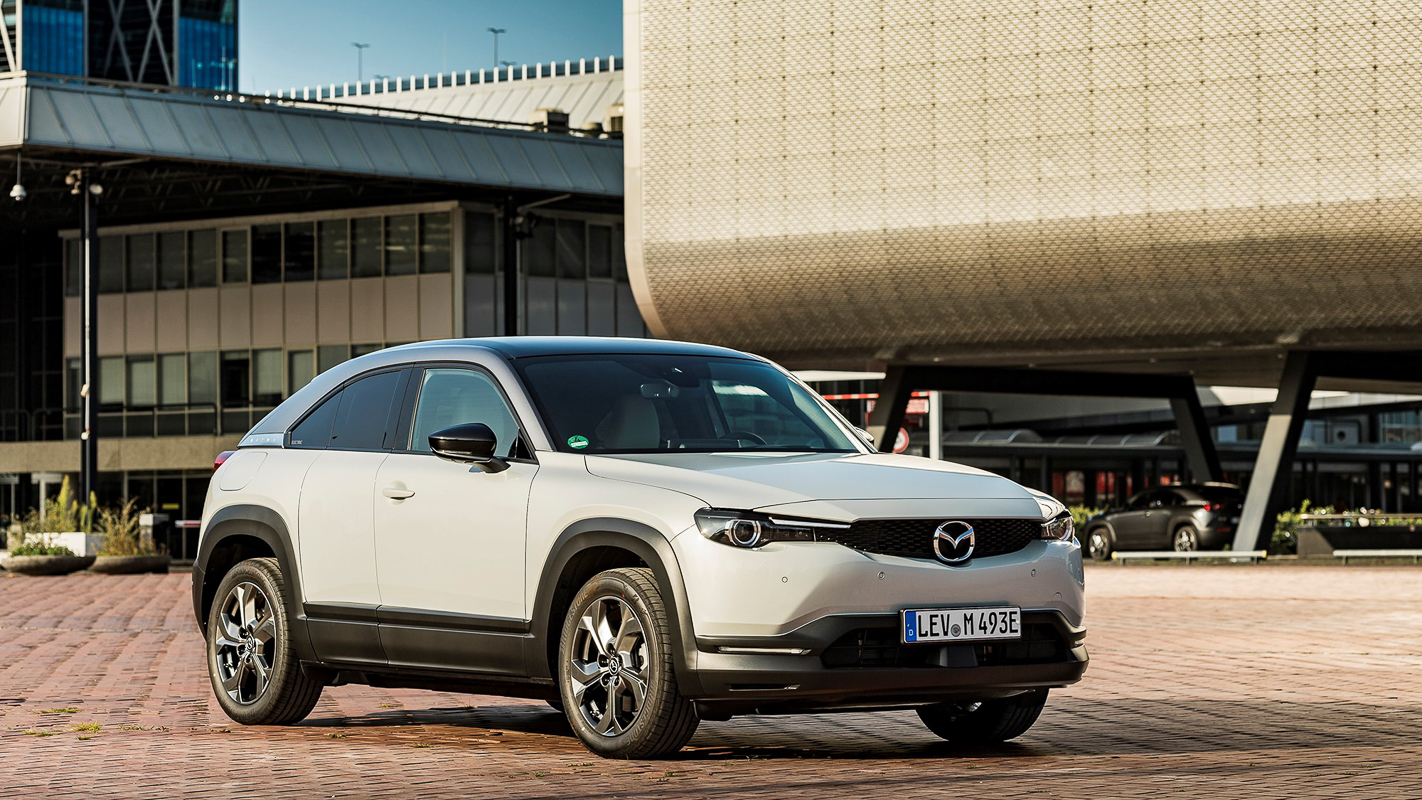
While not a scientific measure (your mileage may vary, literally), the smaller battery effectively halves the additional impact over a conventional car and, crucially, brings the ‘break even’ point forward to the stage where the initial owner of the car could see the benefit.
Most large-battery EVs will only give a return on that initial CO2 investment around the same time the conventional car is considered well-used and due for replacement.
But here’s the real surprise: The MX-30 does not drive like a typical electric car – and in the process, it doesn’t consume charge like a typical, hot-off-the-line EV either. Perhaps there’s more to this ‘smaller battery’ idea after all.
Driving the MX-30
Mazda is known for making cars that grow on you, as a driver, without necessarily screaming about their prowess externally. Even the RX-8 has hidden depths, should you try a good one, but it’s when you look to models such as the Mazda 6 that the differences are thrown into sharp relief.
That’s all traditional engineering, right? EVs are a different proposition entirely, all instant torque and iron-fist in a silent glove hilarity, until the charge runs out and you drive like the proverbial nun. Including a bit of praying.
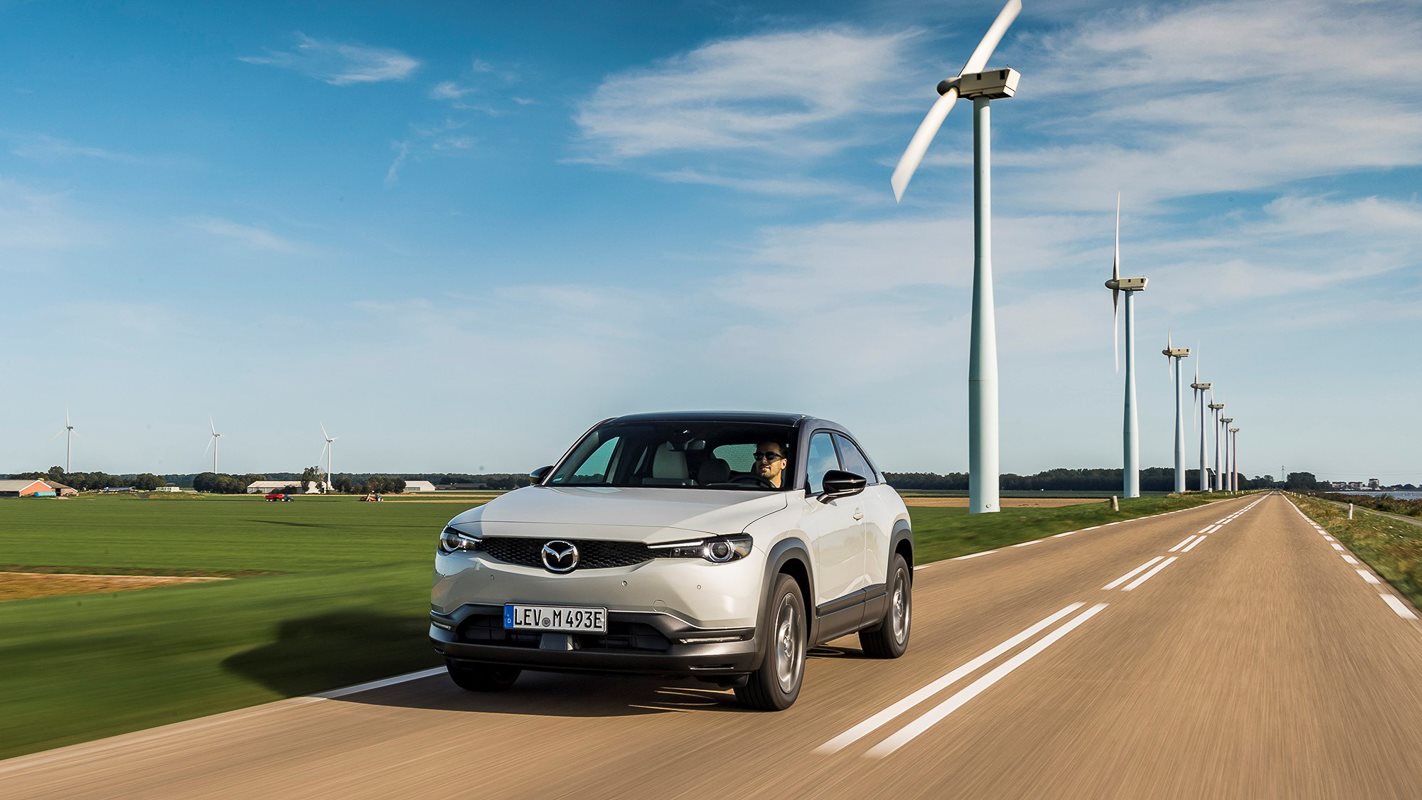
Just as the MX-30 is exactly the sort of pretty conventional, but quirky crossover you’d expect Mazda to produce even without batteries, Mazda’s aimed at making it drive like a petrol-engined car. There’s no whalesong-and-meditation in here, but a piped engine sound that’s gloriously reminiscent of a four-port RX-8 in third gear; tractable from urban speeds to motorway, revs ever increasing, and wonderfully satisfying. The illusion is aided by the MX-30’s limited top speed of 84mph, which helps preserve that range and keeps you almost legal – as well as being right about where third gear ends on a real RX-8.
Torque-map and touch points all contribute to this eerily familiar sensation. The motor control pedal (the one under your right foot – there’s little pretence of ‘one-pedal driving’ here, though it’s got the ability to come close) is a floor-hinged, organ style one that’s long, supportive and very, very progressive and controllable. It’s the kind of detail that contributed to the lazy, unhurried style of driving that a big old Mercedes would encourage, and it makes driving the MX-30 a real pleasure.
Even the gear lever is reassuringly mechanical. There are paddle shifts for regenerative braking, which defaults to a mid-way position and can be reduced or increased to suit, so the lever is purely a forward/reverse selector, but an unusual ‘move sideways to park’ adds an opportunity to engage with the car physically rather than pushing another button.
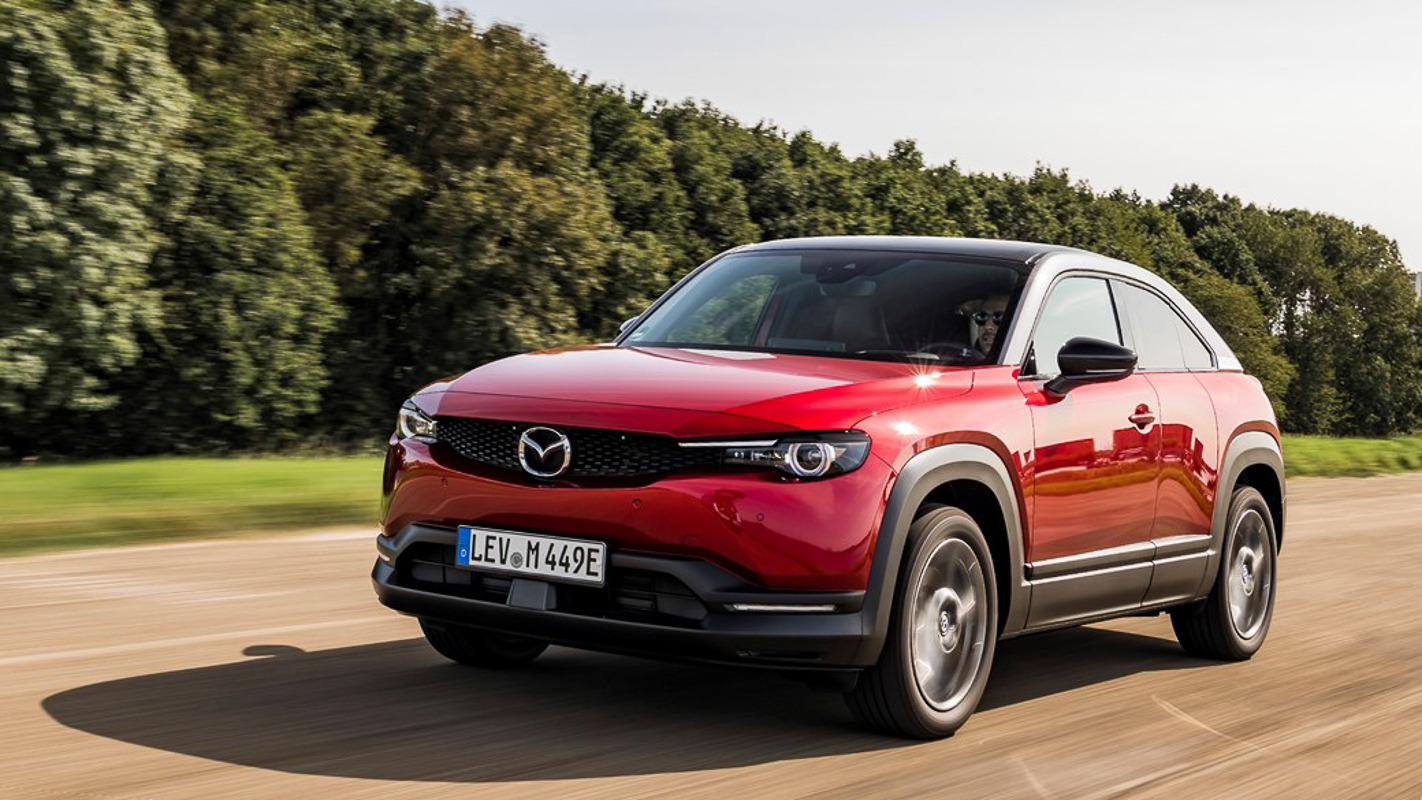
The parking brake’s electronic, though. Well, you can’t get everything right…
Encouraged by the artificial combustion and well-weighted, direct steering, you press on; the 0-100km/h time of 9.7 seconds feeling entirely reasonable. Bends are drawn in a smooth arc, with confident aim, and it takes a moment to remember that this is an electric car at all – there’s some torque-vectoring technology, but there’s pleasure to be found in absorbing the feedback and actually driving the car, not seeing how long the sensors can keep you on the road in denial of physics.
When your brain catches up, the difference in weight, in attitude, between the MX-30 and any other electric car in this price range dawns. There’s none of the stodge, the roly-poly cornering or aggressively controlled weight management ruining the ride. It’s basic stuff – just McPherson struts and torsion beam – but so were some of the most delightful hot-hatches ever made, and the MX-30 carries their spirit in its springs.
What about the passengers?
Mazda’s deployed a three-ring structure for the MX-30, surrounding the batteries and passenger compartment. It’s torsionally stiff and allows the suspension to compensate for the road and not the body. The result is a pleasant, predictable ride and good refinement.
That goes some way to compensating for the compromised side view out the rear passengers get while perched on the attractive, but quite shapelessly square rear bench. Being positioned quite upright below a tapering roofline isn’t as claustrophobic as you might expect, and sculpted seat backs mean two adults of average height can sit tandem, but you’re peering out of a porthole set in acres of black plastic.
Thankfully the top-spec GT Sport Tech comes with that most rare of options, a proper sliding sunroof, and the rear seats do sit a little higher than the front for a good view forward.
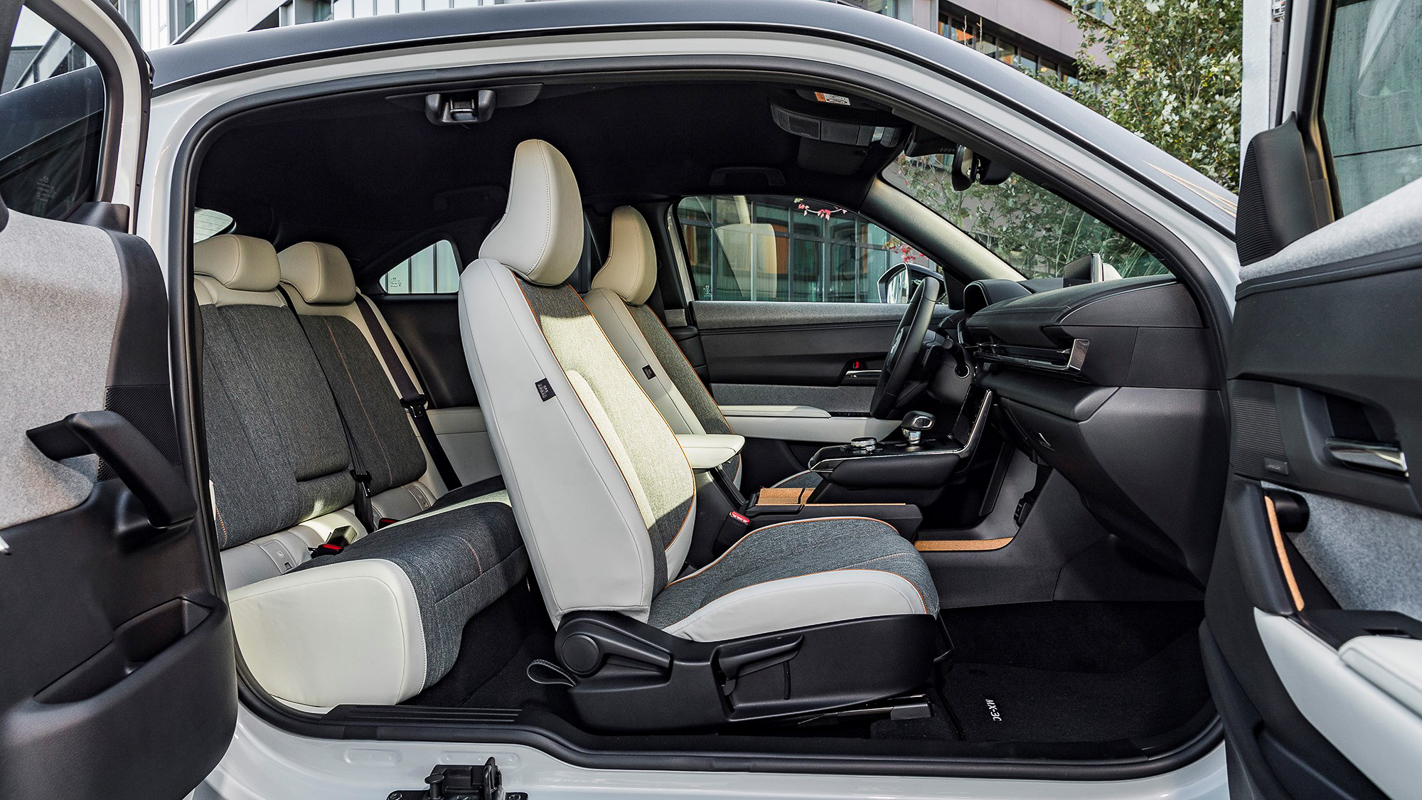
Smaller passengers are easier to deal with though, thanks to the flat-wide seats and Freestyle doors. Child seats are the right height and unobstructed, making this one of the easiest electric cars you’ll find if you’ve got infants or toddlers. There’s a reasonable 366-litre boot, too (you’ll lose a few litres if you have the Bose audio).
That square, padded seat structure is carried through to the front. Seats are very subjective, so first-person opinion here: I thought they were great, and suspect most people will appreciate the same qualities – chunky foam that’s like a firm memory foam mattress, well-shaped bolsters that hold you without being constricting, and just the right amount of lumbar support and width for shoulders. The materials are nice, too, but the most distracting thing in the MX-30 is the appearance of cork…
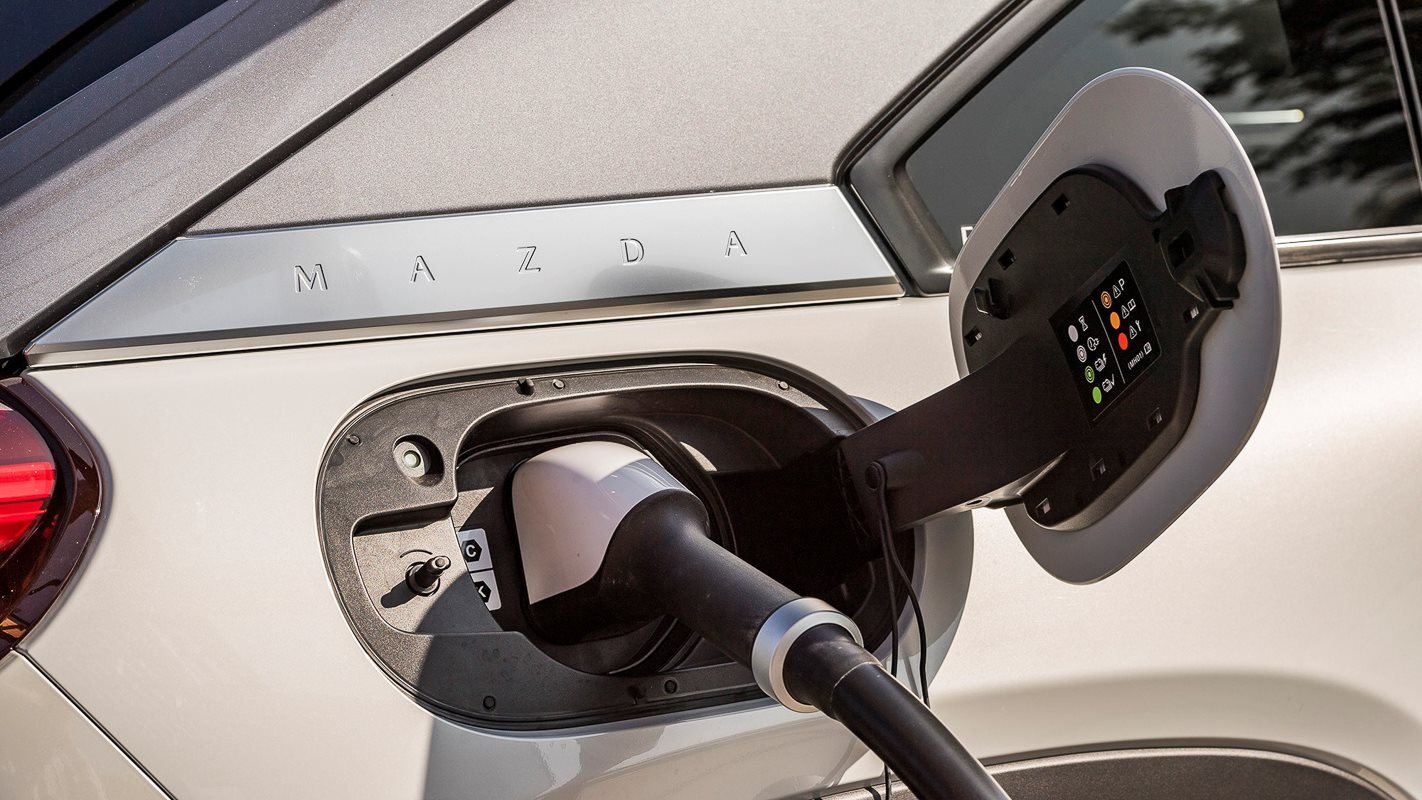
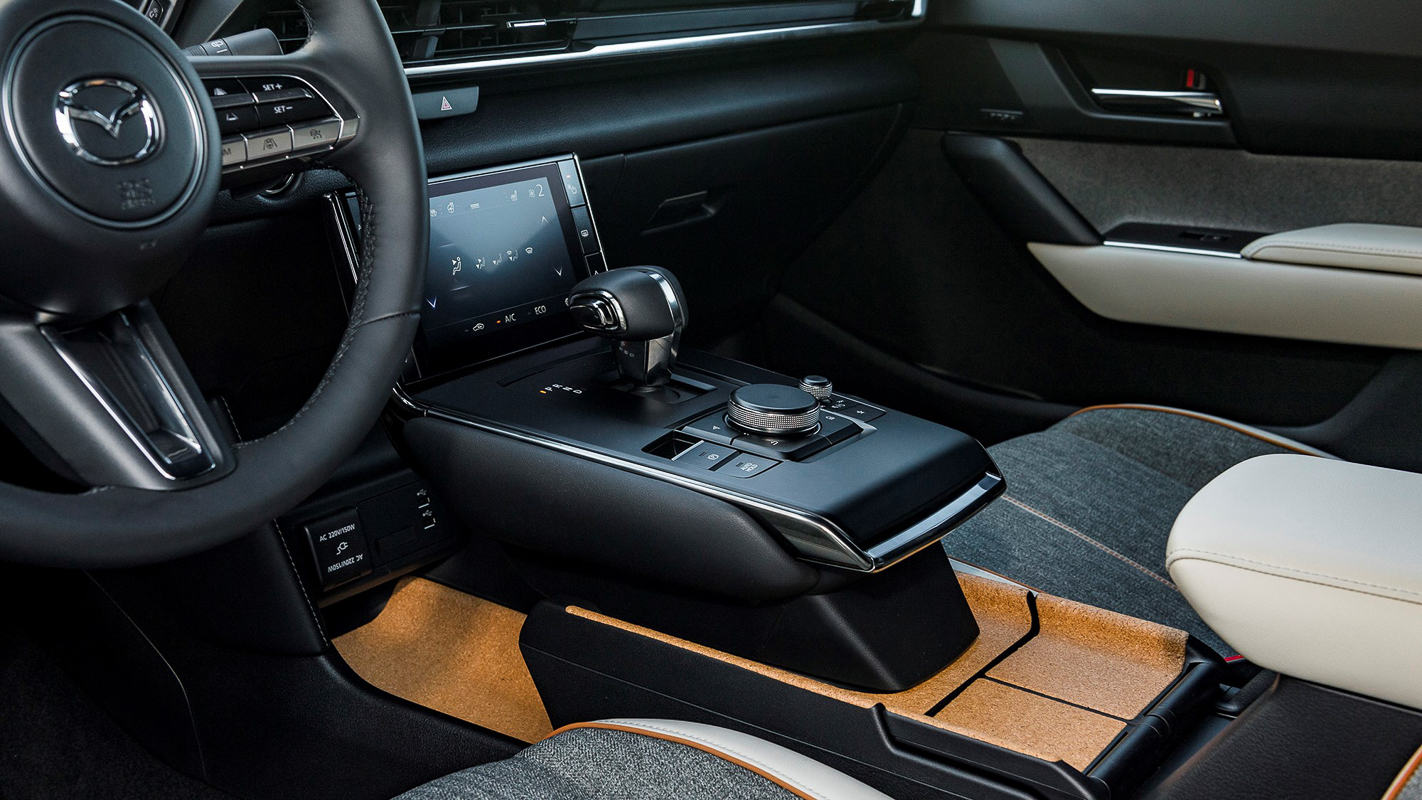
That natural material (much of the interior is vegan-friendly natural or environmentally-friendly recycled) is found not only on the centre console and simple, neat covered cupholders, it’s inside the door pull handle on the higher specifications too, where it’s a welcome tactile change from plastics.
Mazda hasn’t taken your pinboard and glued it to the dash – the cork is a special, high-density material that’s been treated and covered so it won’t absorb spills or age rapidly.
All MX-30’s are generously equipped, including a head up display and adaptive cruise control and lane keeping on all models; options really are all about convenience and personal preference, instead of being essentials for you to pay extra for.
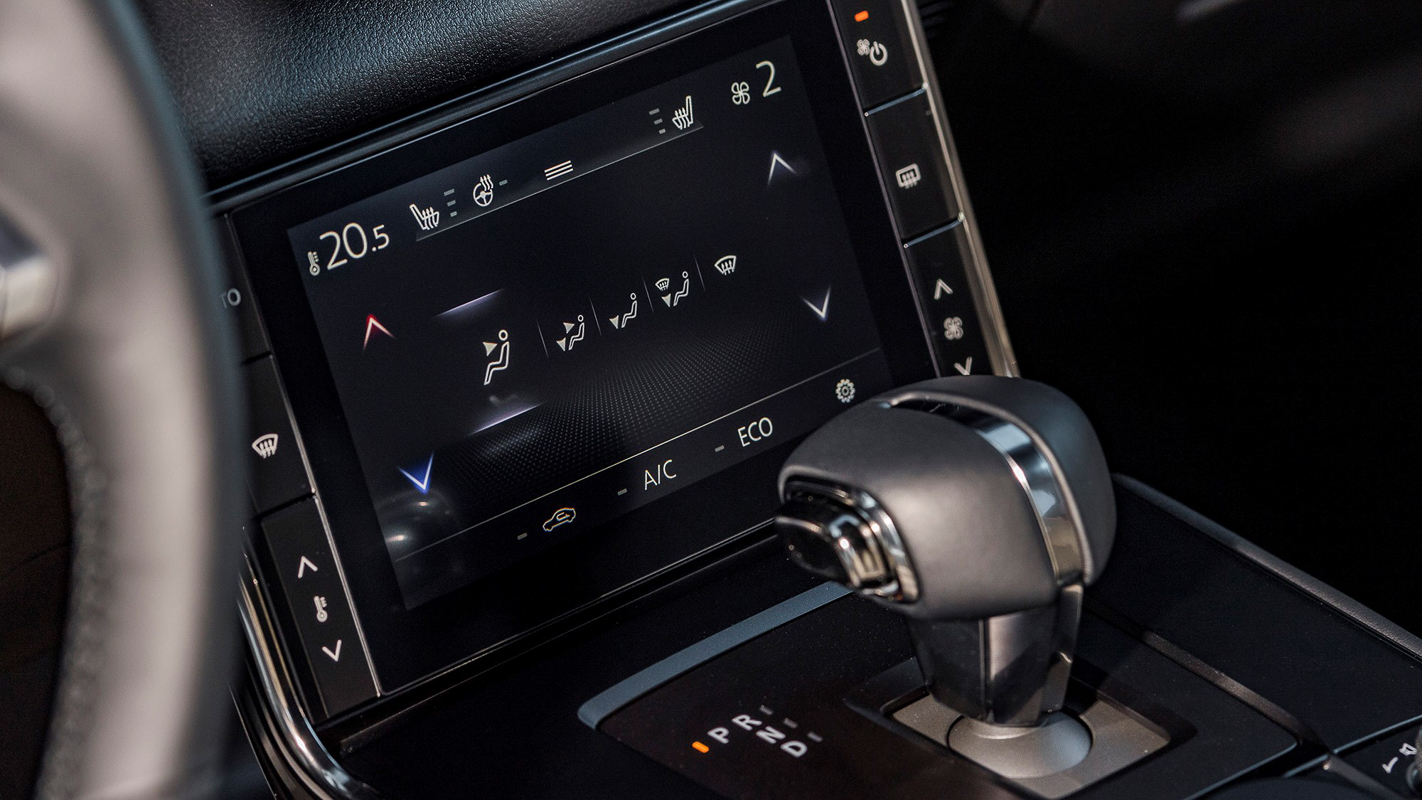
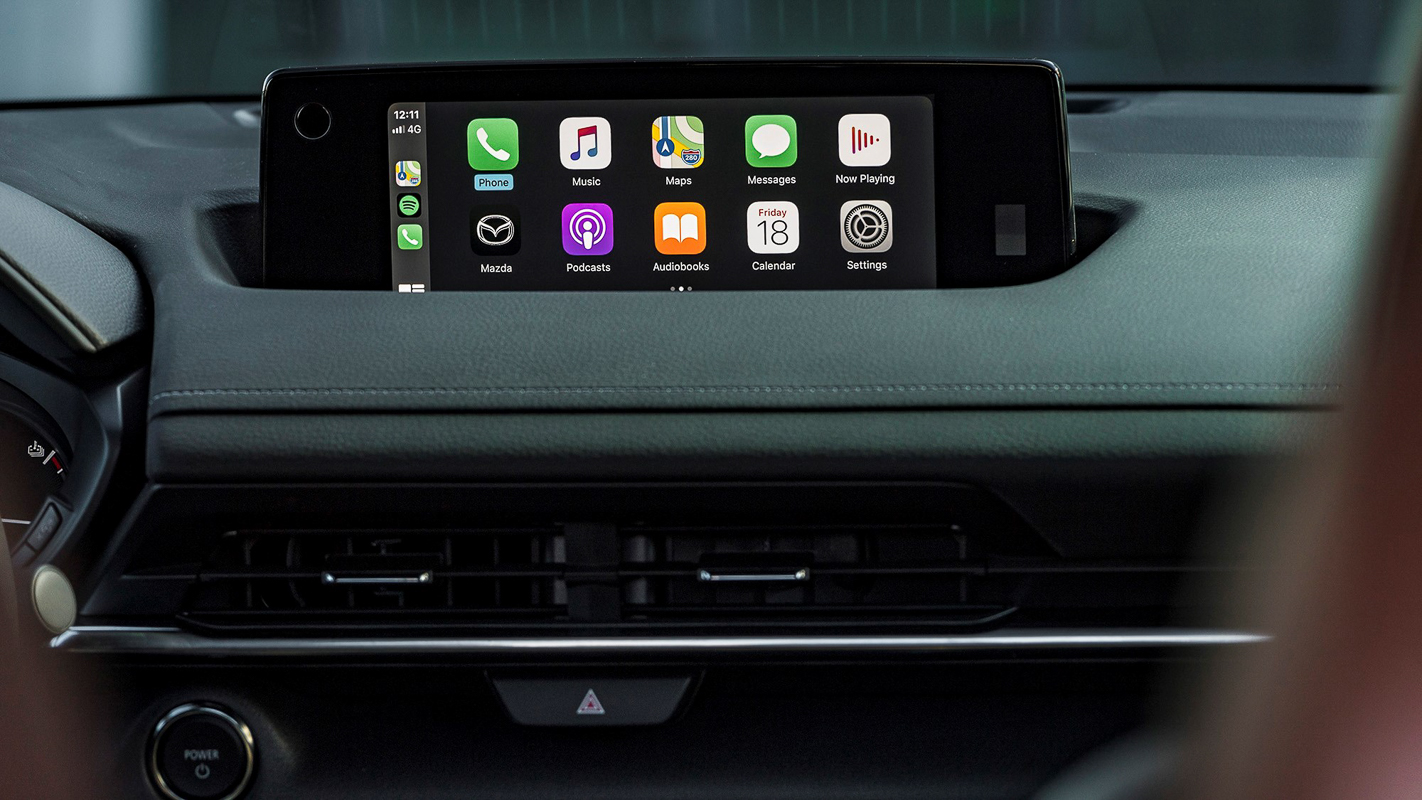
Infotainment is fully-featured, with Apple CarPlay support included and Mazda’s intuitive rotary control. It’s supported by steering wheel controls and a clear, crisp dashboard display.
Verdict
The company is convinced 35.5 kWh batteries are currently the way to go, so you’ll have to wait for a Wankel-powered range extender MX-30 if you want more range. Initial impressions are that you won’t need it; the way it delivers and uses power, and has been carefully tuned to keep you involved rather than remote, means it’s more likely to deliver that full range.
The Mazda MX-30 is an affordable EV that has real appeal for drivers, too. It’s genuinely nice – not in a ‘OMG this is so fast’ way like a Tesla – it’s satisfying to drive and would be just as satisfying with a regular engine; most electric cars are a compromise we accept because of the halo effect of being green. It deserves to succeed.
This article was originally published at carmagazine.co.uk
The simplest and easiest way to avoid a speeding fine, as we all know, is to stay within the speed limit, but some drivers still choose to ignore the law and take a chance. That’s why the police are constantly exploring new ways of detecting vehicle speed and enforcing the rules.
While fixed speed cameras are effective, their location is often known and even advertised, therefore the mobile speed trap or ‘hand-held speed gun’ can be a more effective way to catch even the sneakiest speeding motorists.
Shoot to kill (speed)
Law enforcement speed detection equipment has been around longer than you might think. The grandfather of today’s speed guns was invented in the late 1940s but, despite its age, the principle at its core remained unchanged for decades.
In fact, radar is still used in some speed gun devices because the technology is largely dependable and accurate.
Put simply, the gun shoots a radio signal at a moving object at a known frequency; if the signal bounces off the object it is returned to the gun at a different frequency and the difference is the speed of the approaching or departing object.

It’s called the Doppler effect and it’s exactly the same phenomenon that makes an ambulance’s siren pitch sound different when it is approaching compared with the pitch after it has passed you.
Radar does have its limitations though and the latest speed detection tech uses a very modern interpretation of a similar principle.
A lighter option
While radar guns still exist, LIDAR technology has been gradually replacing it since the early 2000s as the most favoured speed limit-enforcing hardware. Instead of a radio signal, the LIDAR gun shoots pulses of light at the vehicle and measures the time it takes for them to return.
Sophisticated electronics can accurately measure the projected pulses as well as those reflected from the target vehicle. Put simply, the equipment calculates change in distance over a very brief period of time and therefore – speed.
Advantages
LIDAR’s source of light is a powerful infra-red laser – invisible to the naked eye but strong enough to bounce back from vehicles hundreds of metres away.
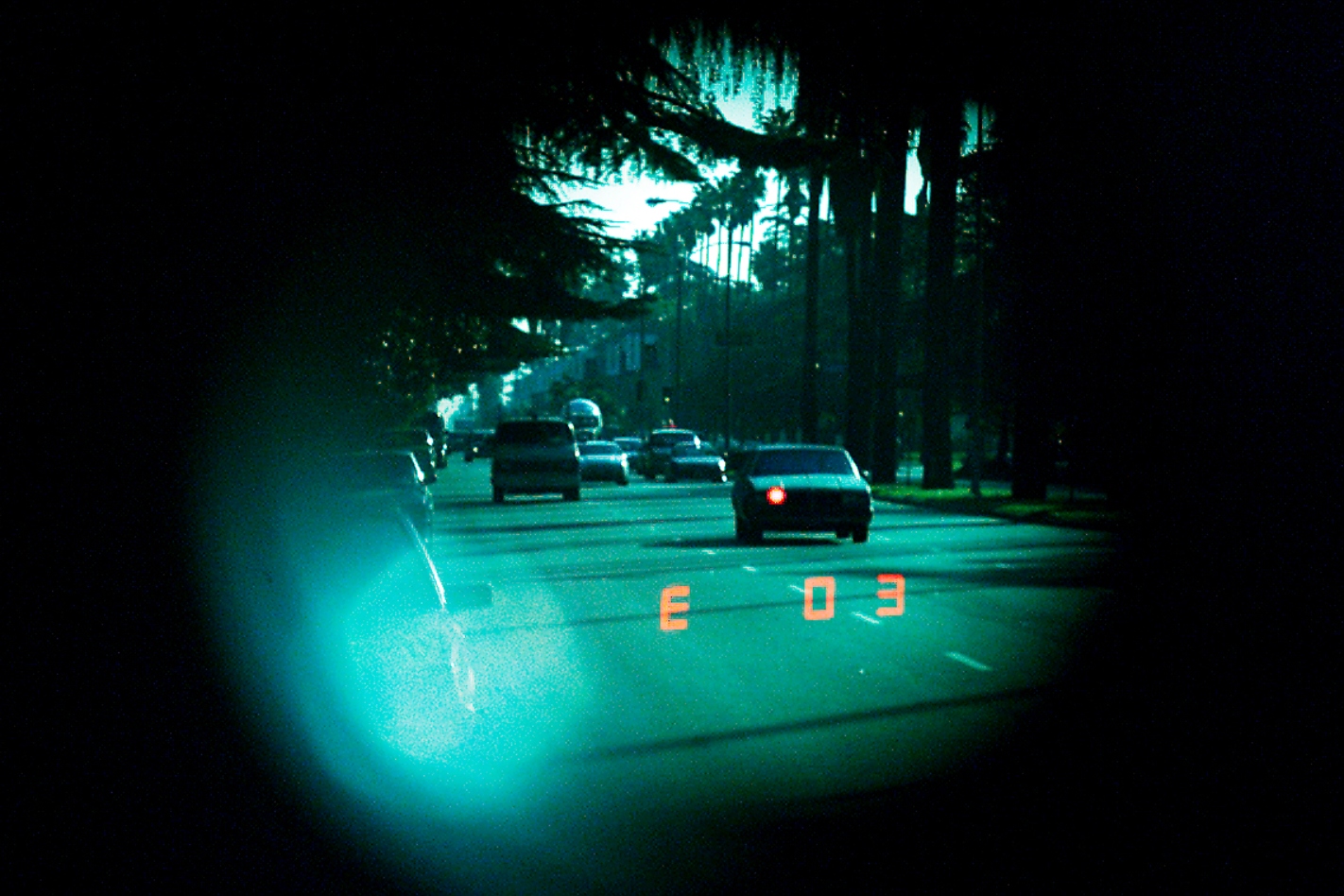
Unlike Radar, the laser is more accurate to aim, enabling officers to target a specific vehicle in traffic and the pulses of light are like a signature that’s hard to ‘forge’ or fool by evasion devices. The laser is also a very specific frequency (or ‘colour’) of light so it isn’t easily confused by other sources.
Operators typically target the registration plate of the vehicle as this offers a flat reflective surface at an angle that will bounce the laser directly back to its origin and, with more than 100 measurements taken in half a second, the measurement process is almost instant.
Can I beat a speed gun?
The short answer is rarely and if you do it’s more likely to be something the operator has done and not your own efforts.
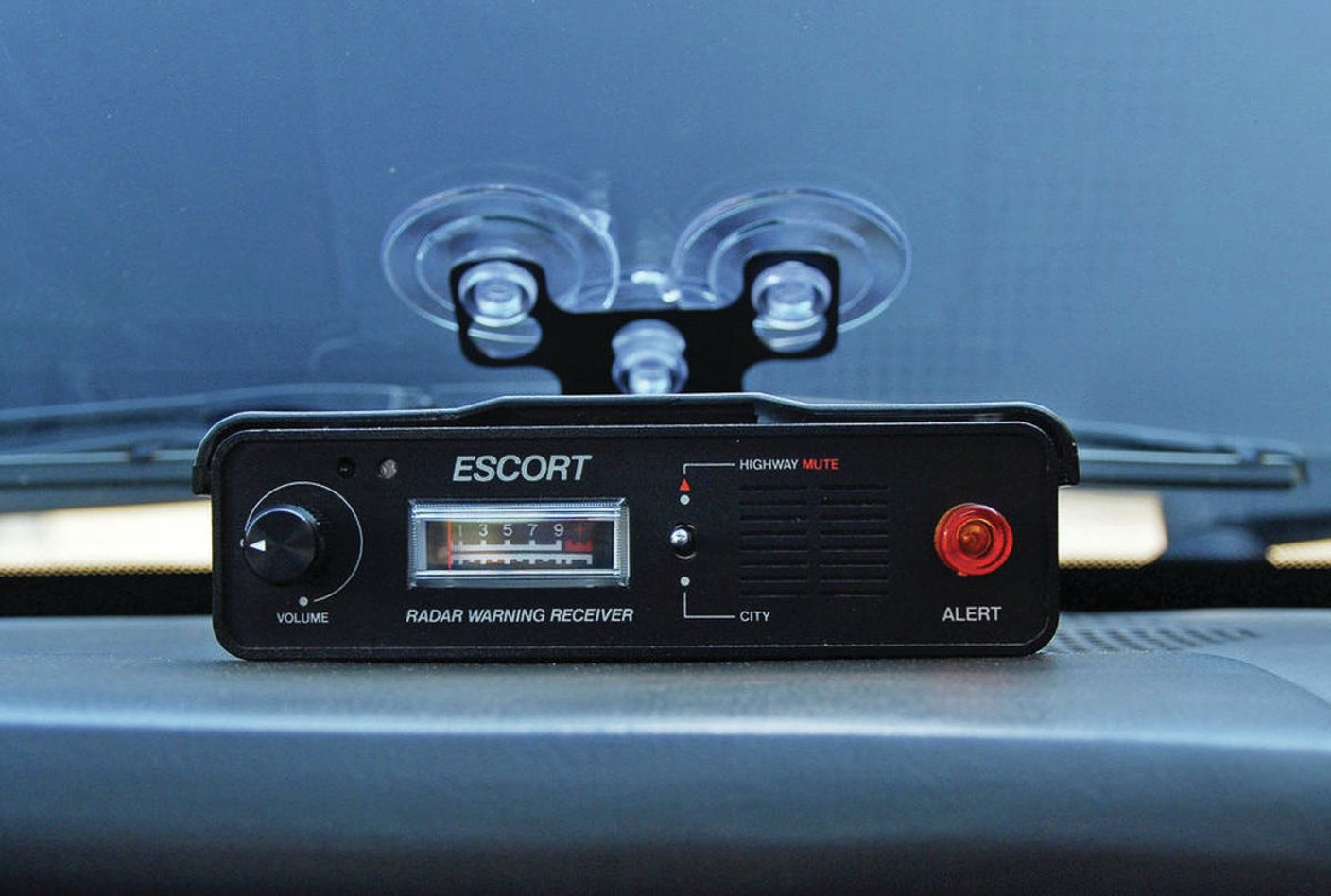
Some special devices exist that claim to detect when a LIDAR or radar is in use and warn the driver, but the speed in which a measurement can be made makes it virtually impossible to react and slow the vehicle in time. If the machine beeps, the chances are your speed has already been recorded.
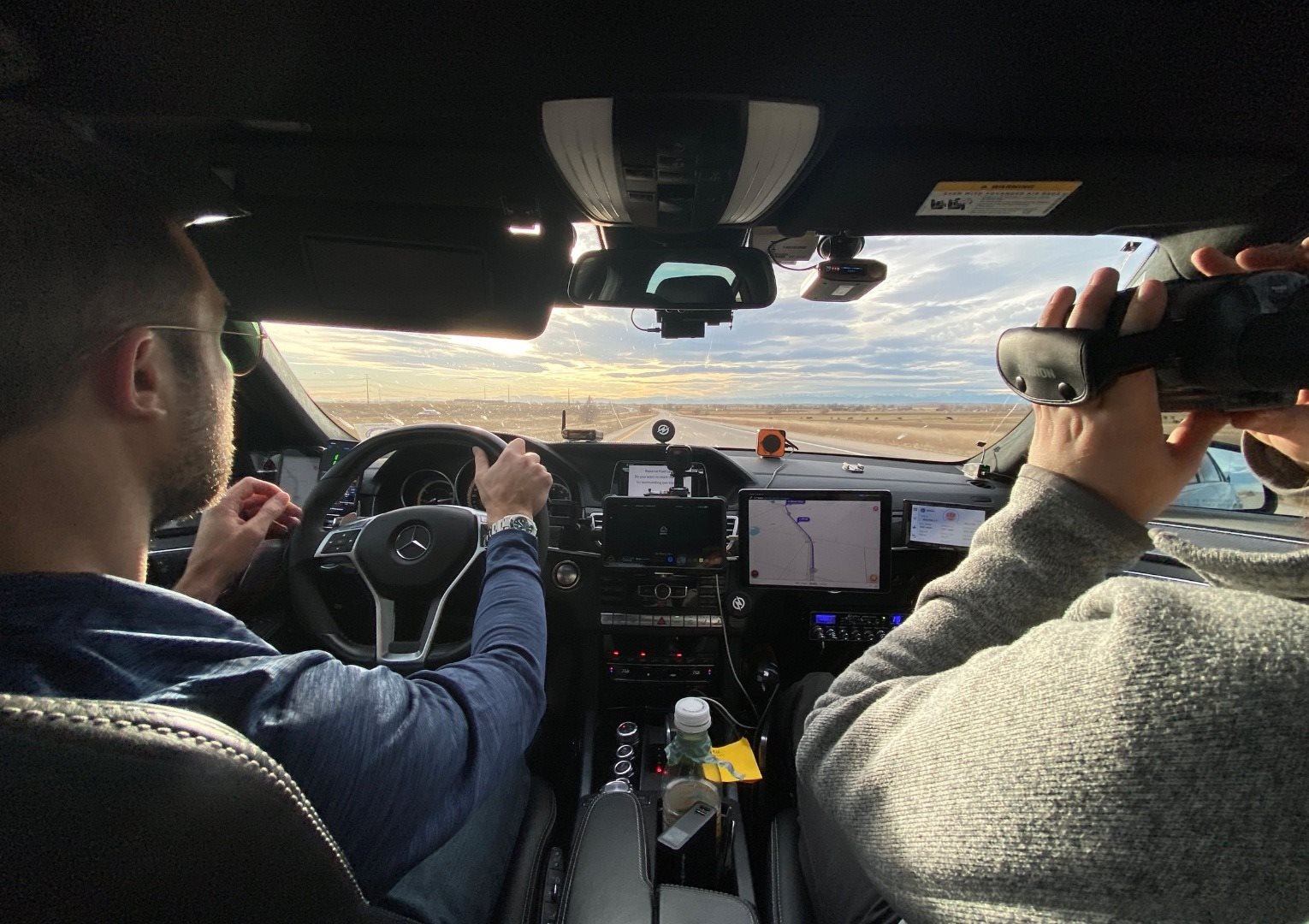
Other devices attempt to scramble or ‘jam’ the detector by firing back confusing information. While these machines may have some effectiveness, the speed gun designers are experts at writing algorithms to ignore false pulses and focus only on the ones it generates.
In either case, use of evasion and deception equipment is illegal in Australia.
Less easy to govern and legislate is the use of smartphone technology. Exactly which is the best police speed trap app comes down to a number of features but all essentially all versions offer users the location of all speed traps – both fixed and mobile.
LIDAR speed guns are not infallible and training is required for optimum effectiveness and there are still a number of operator errors and environmental factors that can prevent the device displaying a detected speed. However, the complex electronics will not record a speed reading unless several error safeguards are satisfied with each pull of the trigger.
And if you’re wondering whether speed guns work at night, the answer is yes. In fact, with less daylight to potentially mask the laser, LIDAR is often more effective after dark. Heavy rain and fog however, does limit the effectiveness of LIDAR because the droplets of water in the air can scatter the laser beam.
Maybe you are one of those drivers that flashes your headlights if you have spotted an unmarked police car conducting speed checks. Is it illegal to warn drivers of a speed trap? The answer to that varies from state to state.
In some states it is not illegal, however you might still cop a fine. Switching on the high-beam lights is illegal if you are following another vehicle or one is approaching within 200 metres and could land you a fine as hefty as the speeding ticket.
Now is your chance to own one of the coolest pieces of property in Australia.
We all know the famous Mount Panorama is a public road for the majority of the year, and there are residents who have the privilege of calling it home.
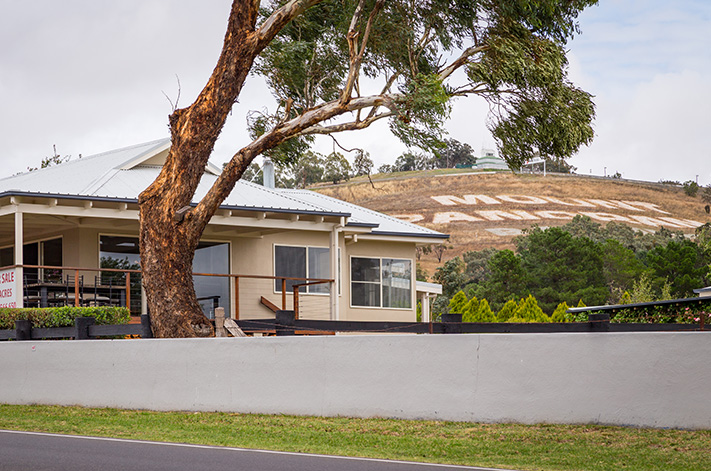
Well, now you could join that exclusive club, with the 10-acre property at 505 Conrod Straight up for sale.
Property on Mount Panorama doesn’t become available on a regular basis, though there has been a recent spate of sales, and this particular property was most recently sold three years ago.
Keith Tucker took over ownership of the property in 2017, following a $2.7 million sale with the previous owner Simon Montgomery (who lived at 505 Conrod for 15 years after purchasing the land in 2002 for $255,000).
Since then, he has been working with the council to get approval for new structures to be built on the property, with the green light now allowing for six new houses, a couple of machinery sheds, and two new swimming pools to be added.
“We did about 12 months of research and looked at what we could get approval for,” Tucker explains to Wheels.
“We could have put a lot more buildings on the lot than what we did.
“All up we have got approval for five new buildings, plus a new six-bedroom residence.”
The land will remain in one piece, with eight dwellings now located at the address.
This means that not only is the property a fantastic location for motorsport freaks to watch Australia’s best races, it is also is a genuine business opportunity for future buyers.
“We do a lot of bookings through Air BnB and Bookings.com,” Tucker explains.
“It has basically been run as a business all year around, and we reside in one of the houses here.”
All up, the land includes roughly 160-metres that sit on the fastest piece of bitumen in Australia, allowing you and friends to stand five metres from the Bathurst 1000 field as the barrel toward The Chase at nearly 300km/h.
If you want to buy the property, expressions of interest are now open, with a price guide of $3.15 million to $3.5 million.
For this you get a six-bedroom, two- and a half-bath renovated primary residence, a free-standing one-bedroom cottage, private workshop, and a purpose-built entertaining ‘man cave’ – plus approval for the new buildings.
But just imagine how cool it will be to write down your address as 505 Conrod Straight, Bathurst, something Tucker says prompts plenty of conversation.
“It’s one of those places that people know straight away. You’ll ring up to get your car insurance renewed and tell them you live at 505 Conrod Straight and next minute it is a conversation about what it’s like to live there,” he explains.
“Even when the cops pull you up they say ‘Oh, you live up on the Mountain, what’s that like?’”
If you did end up owning the property, you would have to deal with your drive-way being closed for five-weekends a year – but is that really such a problem when you will be able to have the best viewing position in the country?
You won’t be completely locked in though, with the property having under track tunnel access.
Footage of the stunning property was shot by Hagney Sky High Aerial Footage, and the ‘want’ is very real.
The Mitsubishi ASX has undergone its third facelift to help it retain its place at the top of Australia’s vibrant small-SUV market. But while it has seen off a host of new competitors, has Mitsubishi’s value-packed crossover finally met its match in the brand-new Kia Seltos?
What are they?
Australia’s top-selling small-SUV, the Mitsubishi ASX is popular for its spacious interior, comfortable ride and most of all, good value in terms of pricing and features.
Mitsubishi’s contender in this comparison is the top-spec ASX Exceed, which retails for $32,990 with a fixed driveaway price of $35,740.
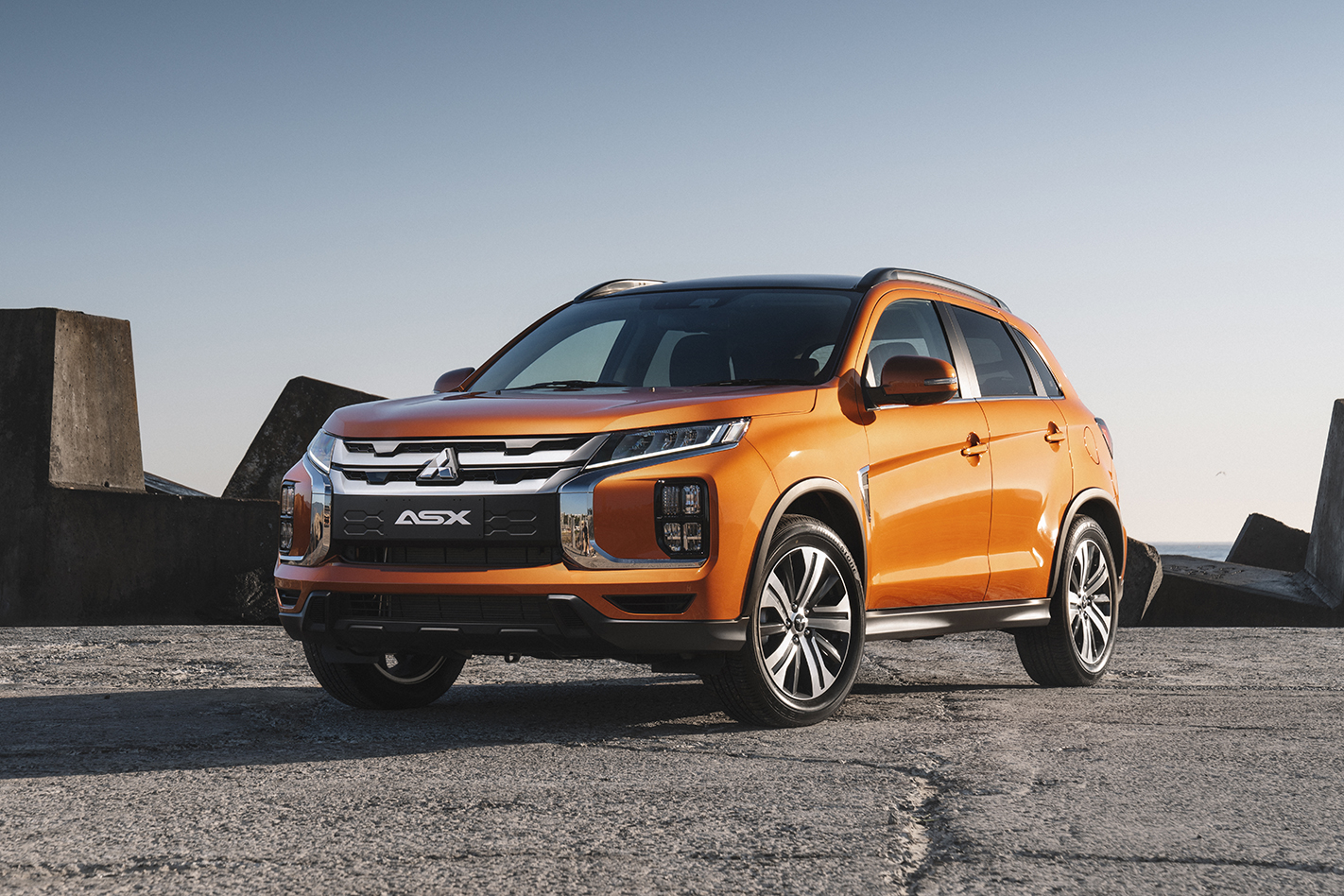
This is a well-equipped SUV for the price and it’s now powered by a strong 2.4-litre engine introduced as part of the 2020 facelift (its third since 2010) that also brings a revitalised exterior design, refreshed interior, and enhanced infotainment.
The all-new Kia Seltos arrived in October 2019 with a heap of features and four spec levels including the mid-spec Seltos Sport+ that’s similarly priced to the Mitsubishi ASX Exceed.
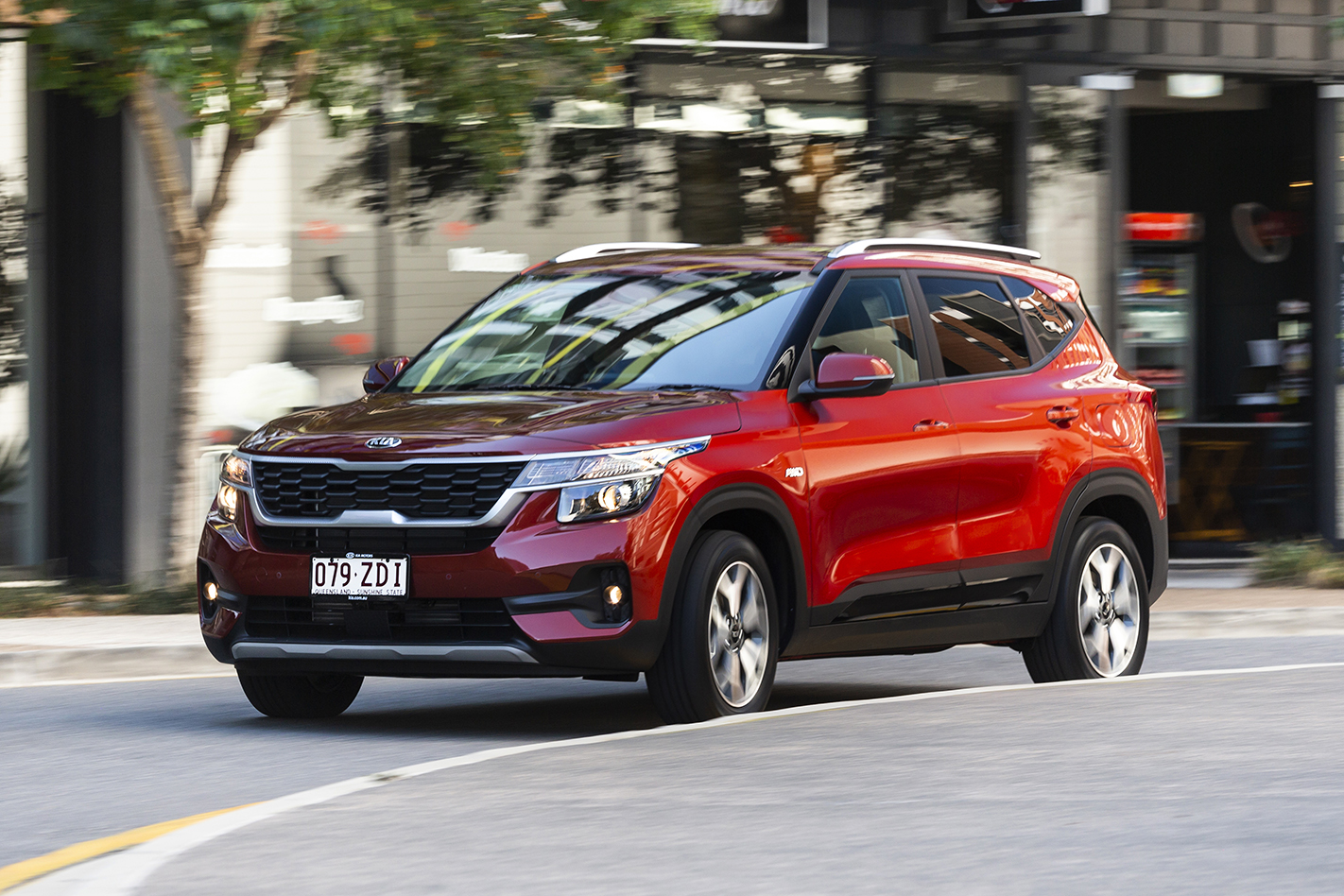
It’s powered by a 2.0-litre petrol engine and, like the ASX, has a continuously variable transmission (CVT) and front wheel drive. The Sport+ is also available with a 1.6-turbo with seven-speed dual-clutch auto and all-wheel-drive traction.
The 2.0-litre Seltos Sport+ comes with a fixed driveaway price of $32,990.
What are they like to live with?
Mitsubishi ASX Exceed
The Mitsubishi ASX is one of the roomier small SUVs, with good rear seat space that makes it big enough for family duties. It’s comfortable up front too though even the Exceed’s leather appointed seats could do with more under-thigh and lateral support.
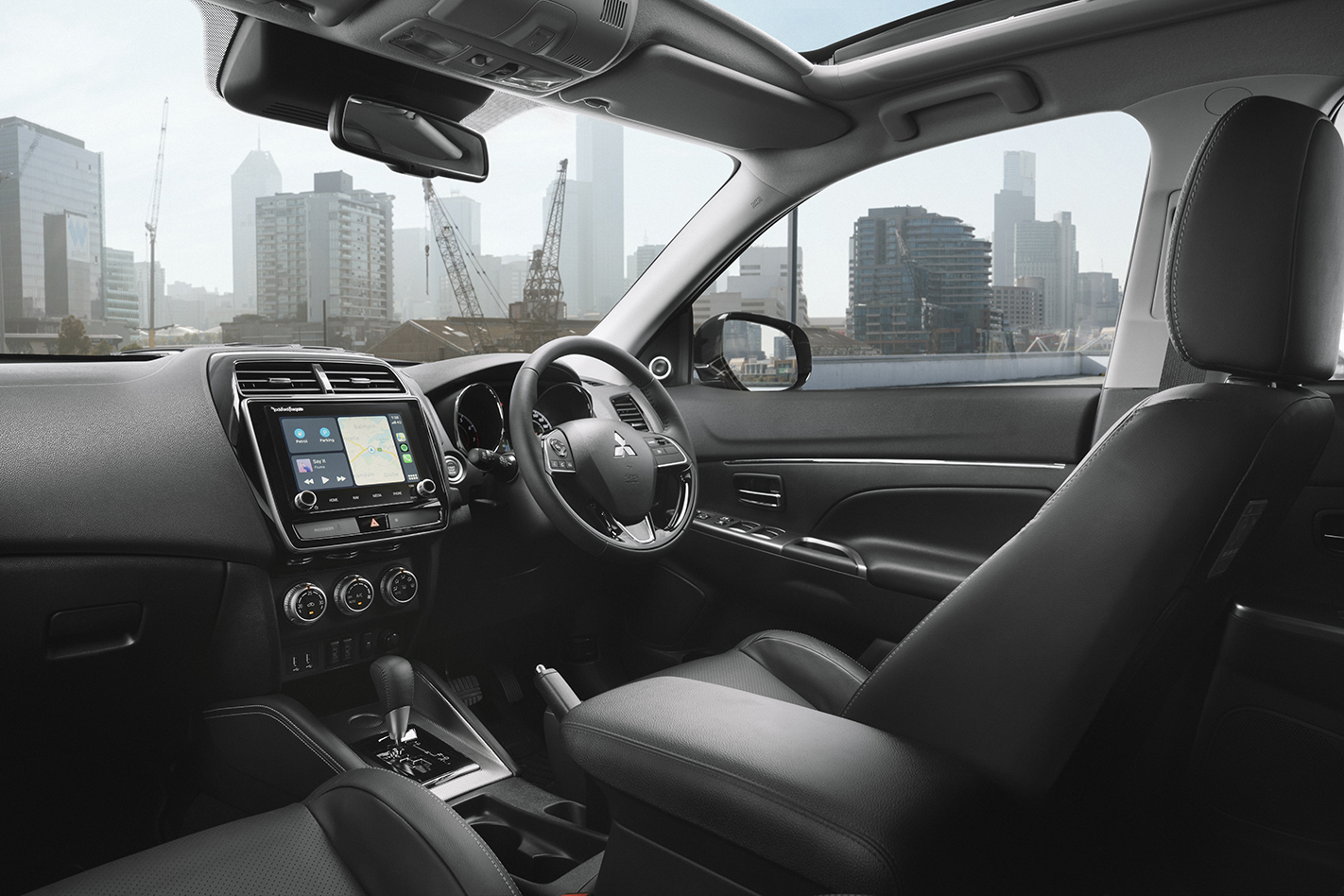
The 2020 ASX has a new dashboard layout with a fresh, clutter free, infotainment interface that includes a bigger 8.0-inch touchscreen (up from 7.0-inches) with Apple CarPlay and Android and digital radio (DAB+). The Exceed also gets in-built TomTom satellite navigation and a nine-speaker Rockford Fosgate premium sound system with an unexpectedly large sub-woofer mounted in the 393-litre boot.
The new dashboard layout has controls and displays intuitively laid out, though the gauge cluster could do with digital speedo.
The Exceed gets all the features available in the mid-spec LS, including autonomous emergency braking, 18-inch alloy wheels, long-lasting LEDs for all exterior lights except turn indicators, climate control air-conditioning, cruise control, auto-dimming mirror, reversing camera, keyless entry and start, privacy glass and roof rails.
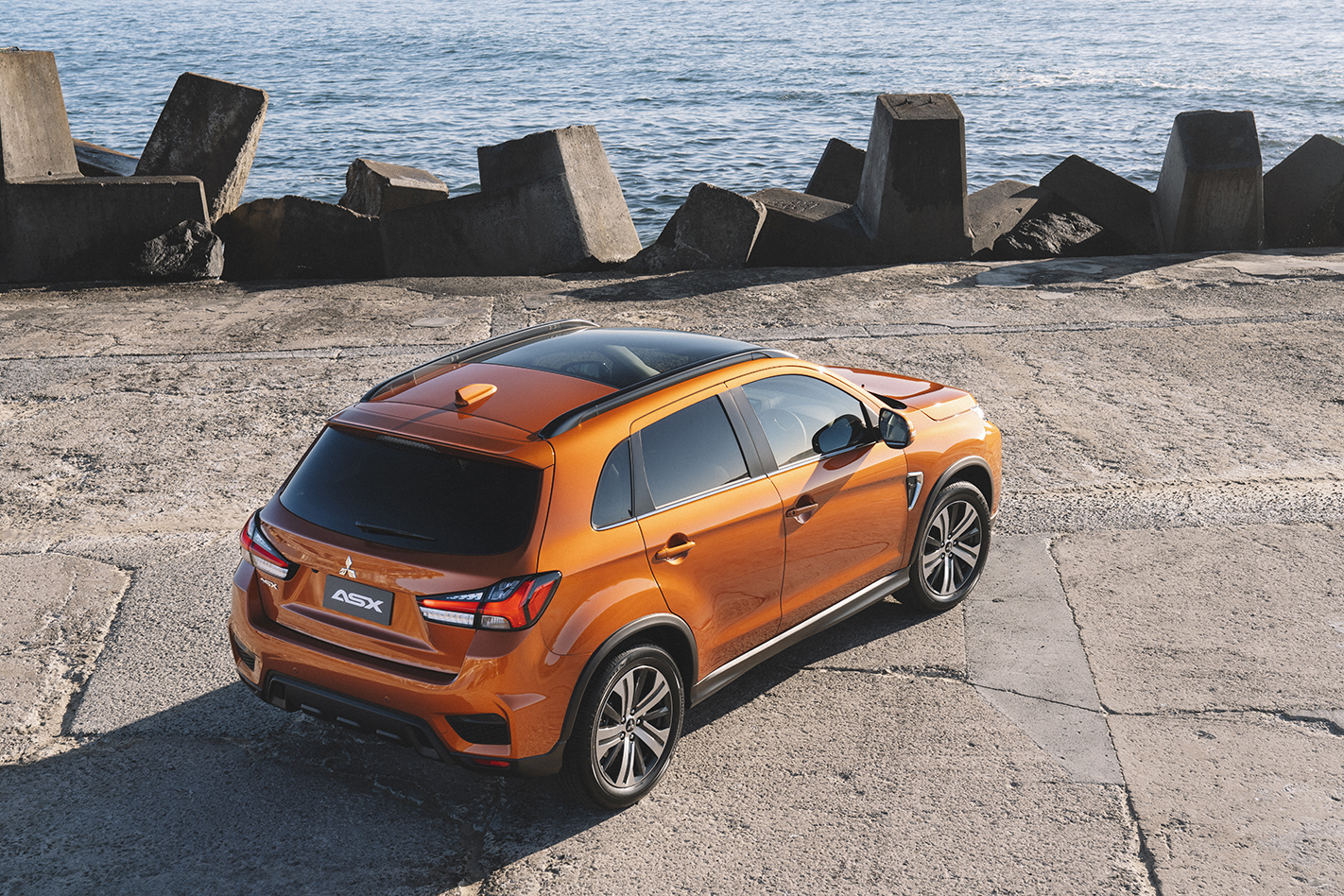
The extra money over the LS brings auto-levelling headlamps, huge panoramic sunroof, heated seats, four-way powered driver’s seat and the aforementioned sat nav, premium sound system and the 2.4-litre engine that’s coupled to a CVT auto.
Like the LS, the Exceed also comes standard with an ADAS safety pack that adds lane departure warning, auto high beam, reversing sensors, blind spot warning, lane change assist rear cross traffic alert, front fog lamps, rain-sensing wipers, and dusk-sensing headlamps.
On the road, the ASX does a good job of soaking up bumps, though you do get some jarring through the 18-inch wheels at lower speeds. Wind noise is reasonably subdued even at higher speeds, however the road noise can get a little loud on coarser surfaces.
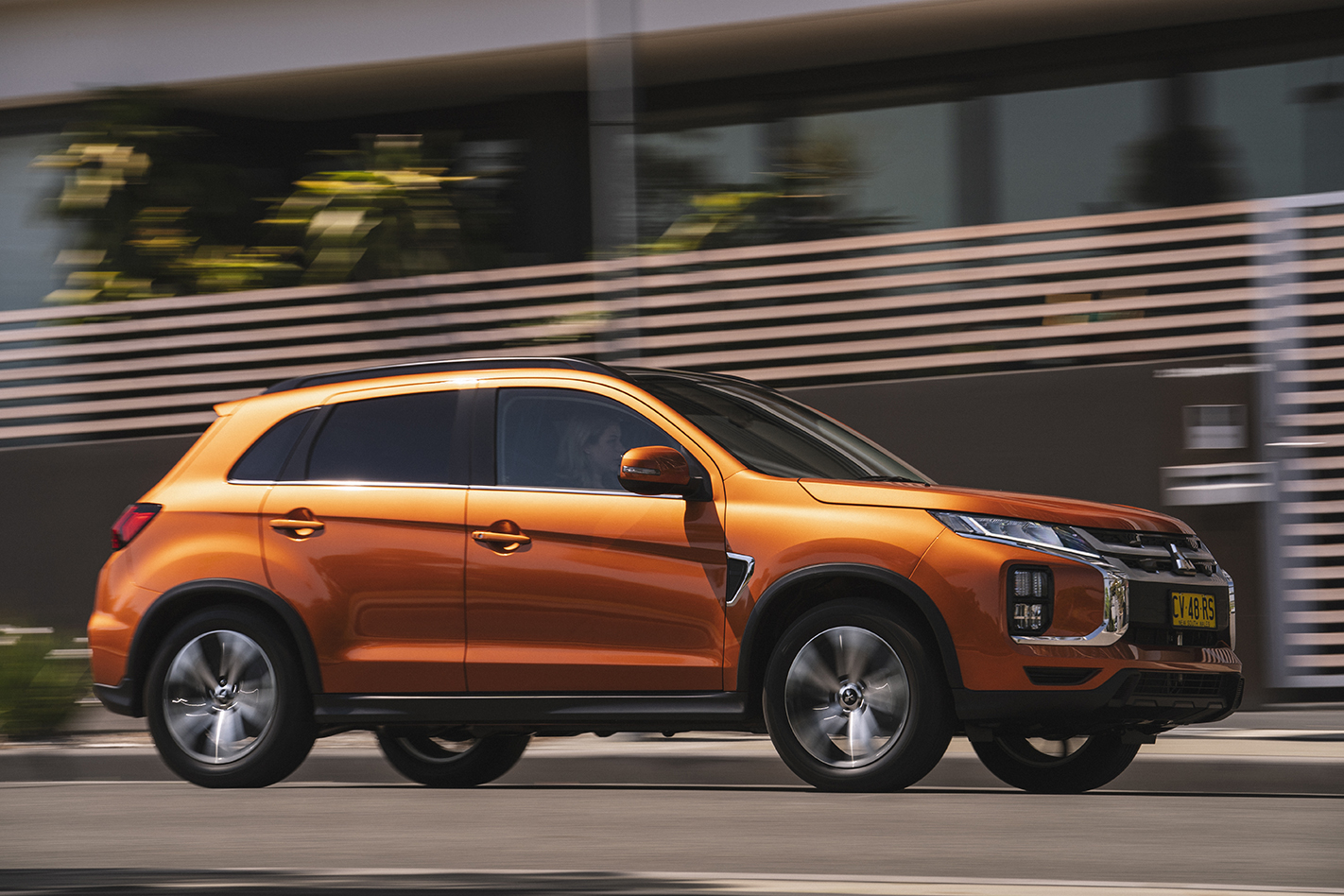
The 2.4-litre engine is much livelier than the 2.0-litre engine, that’s still under the bonnet of the ES and LS, but its 7.9L/100km fuel economy is marginally thirstier than the 2.0-litre’s 7.3L/100kms.
The Mitsubishi ASX comes with a five-year, 100,000km warranty and 15,000km service intervals. Each service is capped at $199 if you take your ASX to an authorised dealer service centre.
Kia Seltos Sport+
The Seltos is one of the more practical and comfortable small SUVs on the market with a 2630mm wheelbase that translates to generous 965mm rear legroom and a 433 litre boot that’s just a few litres shy of the class-leading Honda HR-V’s 438 litres.
The interior design is highlighted by a sleek dashboard layout dominated by a 10.25-inch floating infotainment screen with Android Auto/Apple CarPlay.
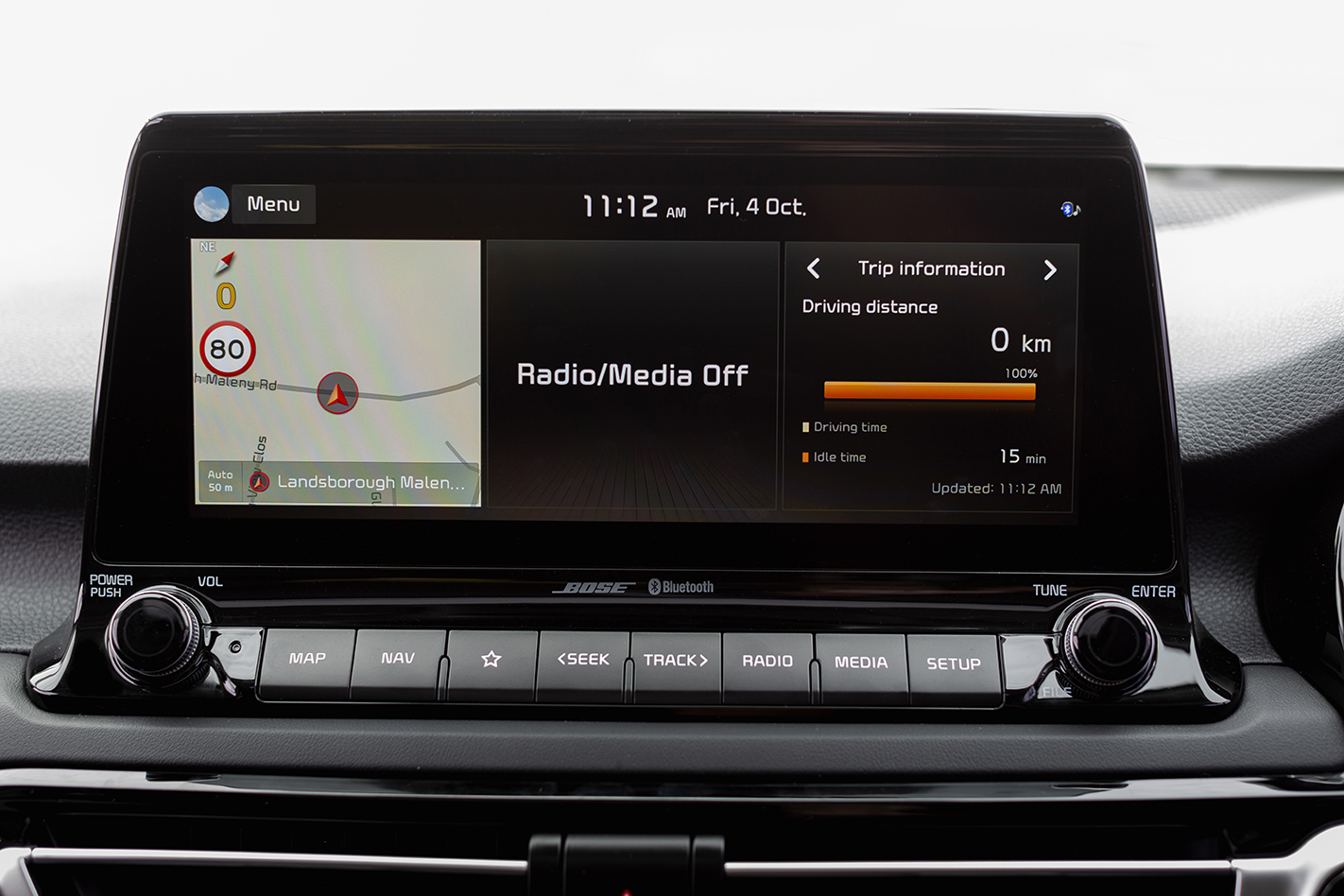
The user-friendly infotainment system allows for a split screen to view and operate different functions at once, and you can sync two phones via Bluetooth at the same time to receive calls through one and play music through another.
The premium-cloth front seats have good back support and the rear-seat backrests can recline slightly. The cabin is well isolated from road and wind noise.
The Seltos Sport+ is brimming with active safety features including Kia’s Safety Pack that brings a higher-speed radar and camera-based autonomous emergency braking system with pedestrian and cyclist detection, advanced smart cruise control, driver attention alert+ that also lets you know when a car in front drives off in case you’re distracted, electronic parking brake, and 15-inch rear disc brakes.
Other advanced driver assist features standard in the Sport+ spec include blind-spot detection, and new rear-cross traffic alert with auto braking.
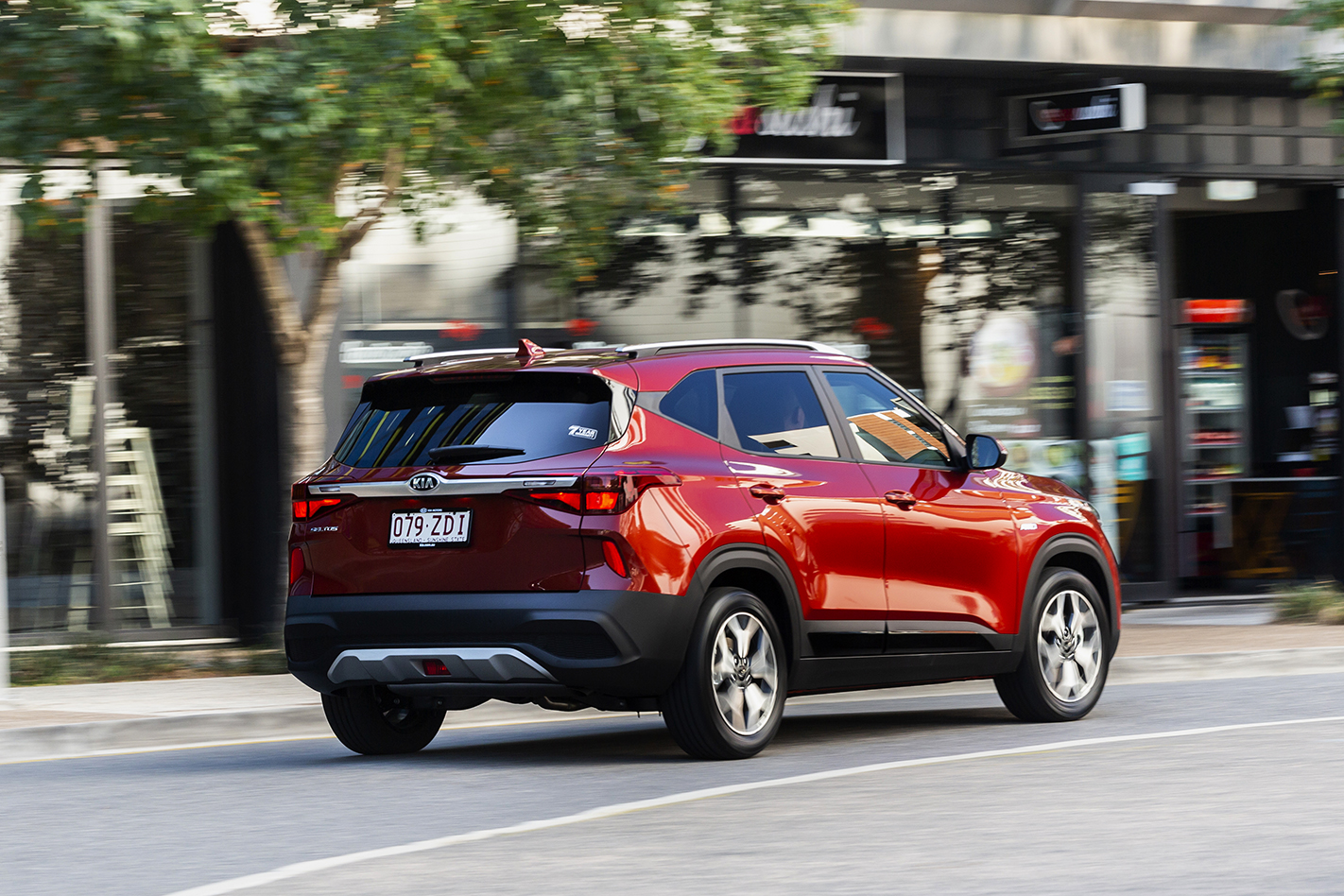
The mid-spec Seltos also gains smart key with push button start that lets you open it and drive away without getting your keys out of your pocket, heated side mirrors, LED Interior lights, auto-dimming rear-view mirror, and front and rear parking sensors.
This is the first Kia in Australia with a CVT. The company says this decision was driven by an American-led push for fuel economy and lowering of emissions. The Sport+ is indeed fuel efficient with an official combined 6.8L/100km.
The Seltos Sport+ comes with Kia’s seven-year, unlimited kilometre warranty.
What are they like to drive?
Mitsubishi ASX Exceed
The 2020 Mitsubishi ASX Exceed comes with a 2.4-litre four-cylinder petrol option that returns some pep to the range that was lost when the low-selling 2.2-litre turbodiesel was discontinued in 2018.
Taken from the now discontinued Lancer, it produces 123kW/222Nm, which is about 12 percent more power and torque than the ES and LS’ lacklustre 110kW/197Nm 2.0-litre that’s a bit underpowered for a small SUV.
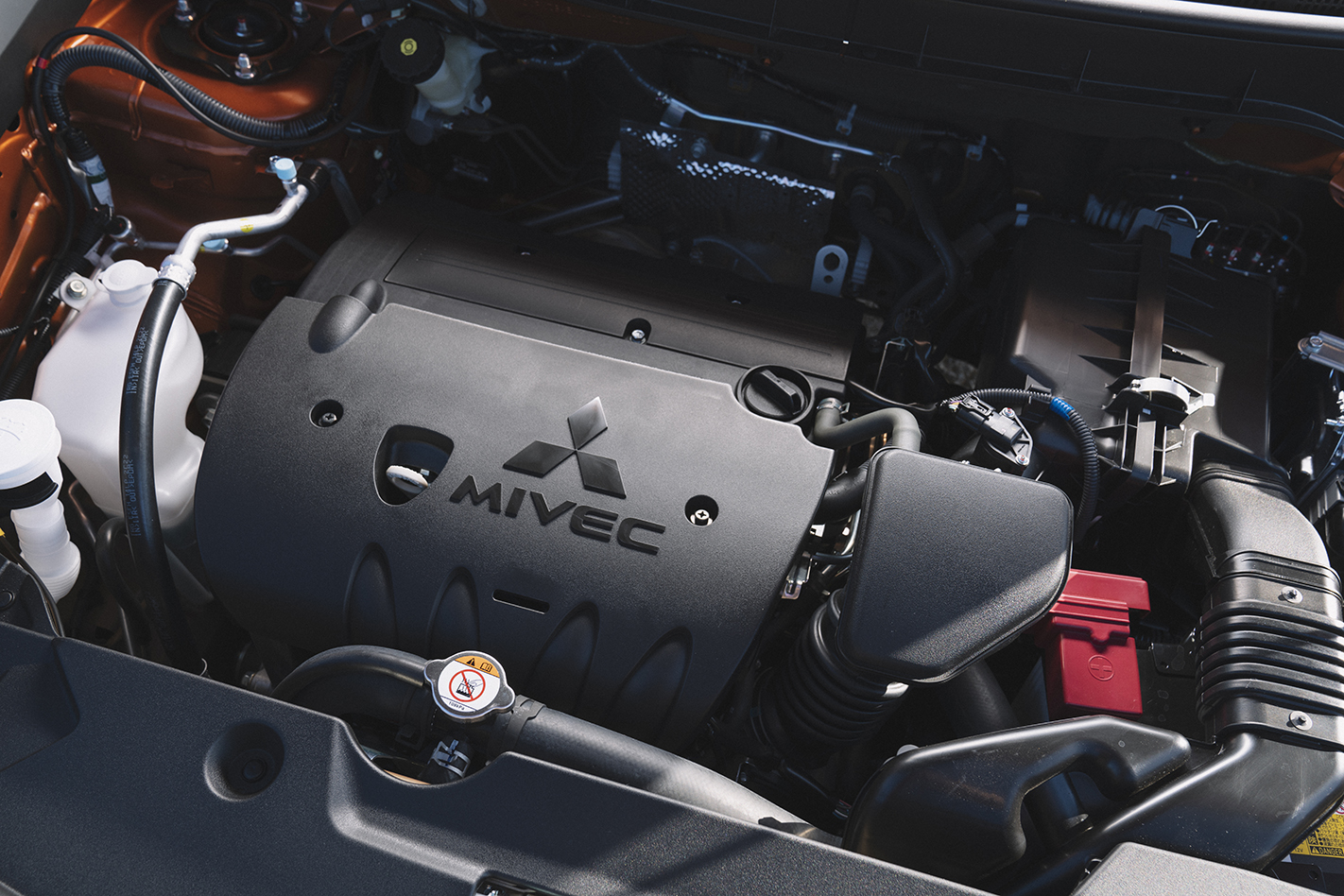
The extra shove is noticeable, as is the smoothness of the CVT auto that doesn’t have to work anywhere near as hard to reach and maintain freeway speeds.
With gradual throttle input the power delivery feels surprisingly seamless. Travelling at the 110km/h speed limit on the Pacific Freeway north of Byron Bay saw revs sit around a comfortable 1900rpm on level stretches, with the gearbox quickly adapting to hills and descents with little fuss with cruise control engaged.
Putting the foot down harder elicits the customary CVT scream but, with peak power at 6000rpm, it still takes a while before you run out of oomph. At lower speeds, the CVT has been programmed to feel more like a normal torque converter automatic, which makes for a smooth and quiet drive around town.
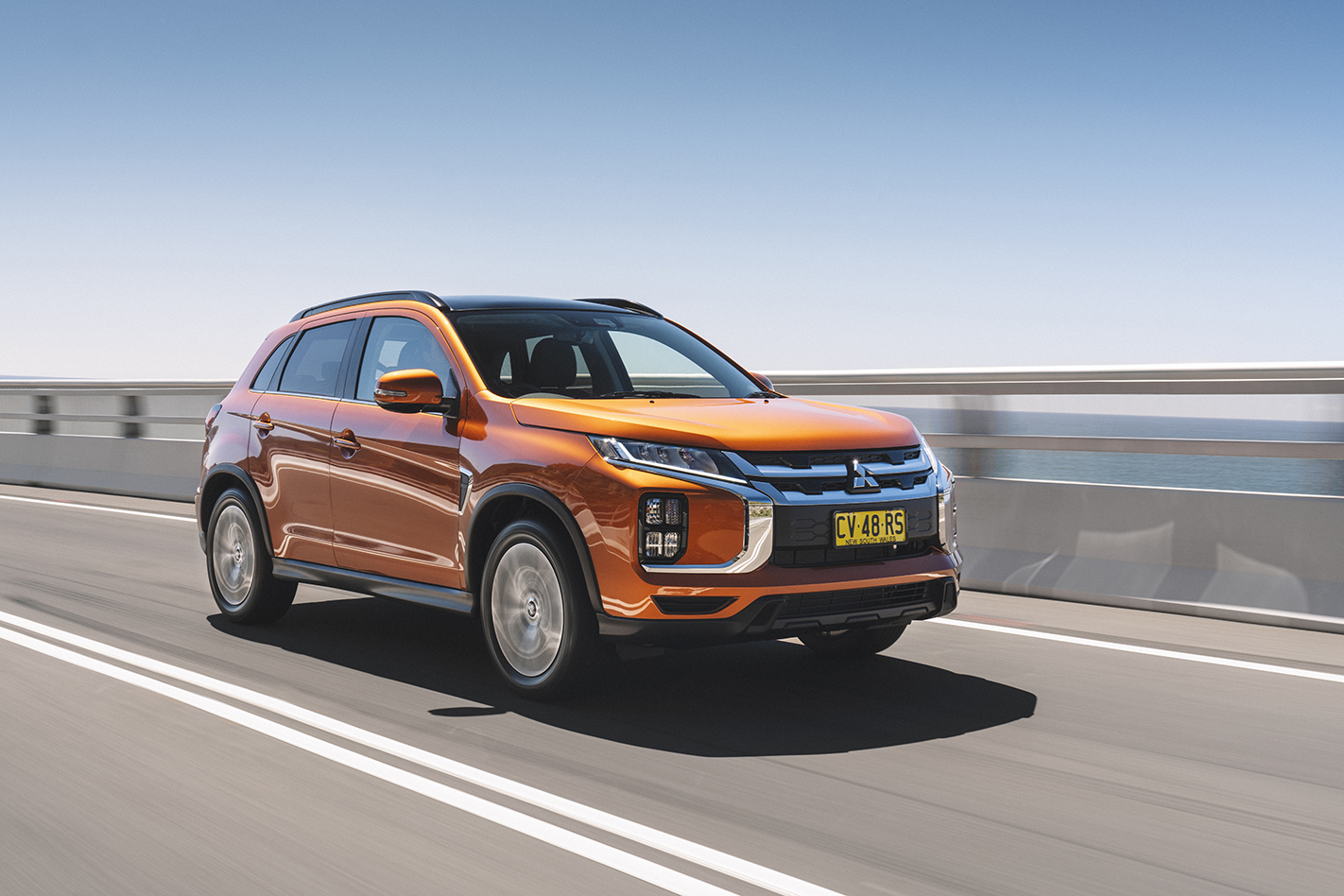
The change in driving dynamics the bigger engine brings doesn’t extend to handling. You still get that noticeable lean when cornering quickly, while the rear-end has trouble keeping up with the front wheels during quick changes direction, such as when negotiating S bends.
Kia Seltos Sport+
The Seltos’ 110kW/180Nm 2.0-litre petrol engine is very similar in size and output to the smaller 2.0-litre engine in the lower-spec ASX variants but doesn’t feel anywhere near as lethargic.
The CVT has to work a little hard when overtaking though and it can also feel unsettled when descending hills, but you’ll have no issues when driving around town.
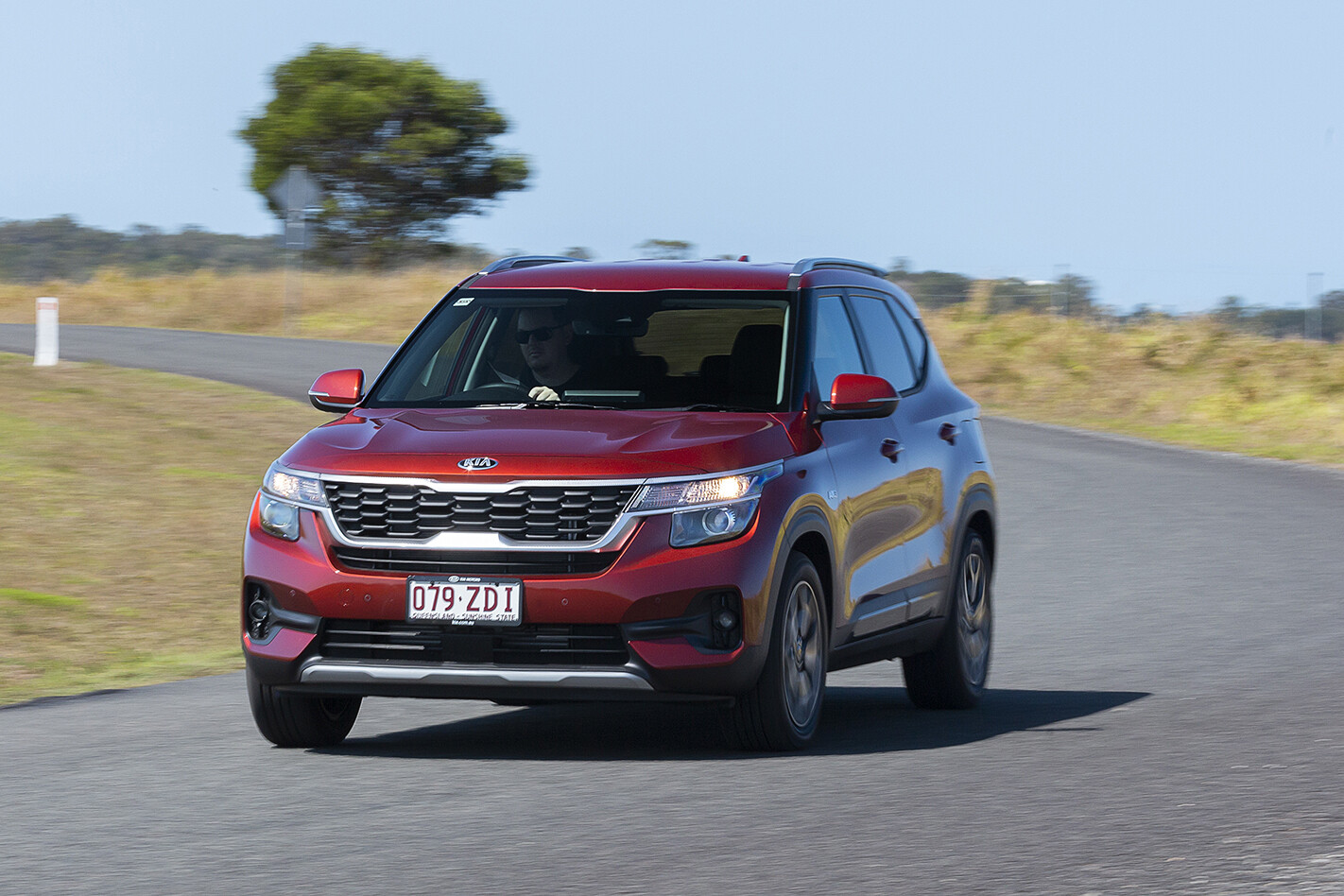
Like most Kia models, the Seltos has had its suspension re-tuned for harsh Aussie conditions. The theory is the Australianised product ensures a better ride on our tough, bumpy roads compared to the Korean versions which have a more floaty feel.
It absorbs the bumps well, with the 17-inch rubber absorbing road imperfections better than the bigger 18-inch wheels on the range-topping GT Line.
The electrically assisted power steering, which has also been set to suit local conditions, feels just right. It’s easy to steer but brings you a good sense of connection with the road, which is satisfying and inspires confidence.
Our opinion
The reason the ASX is Australia’s biggest selling SUV is because you get a lot of car for an affordable price. That’s why we recommend the ES with ADAS safety pack with a hatchback-rivalling $29,240 driveaway price.
Unfortunately, the ES isn’t available with the new 2.4-litre engine, which suddenly makes spending another $6500 on the Exceed more worthwhile, considering all the additional features it brings.
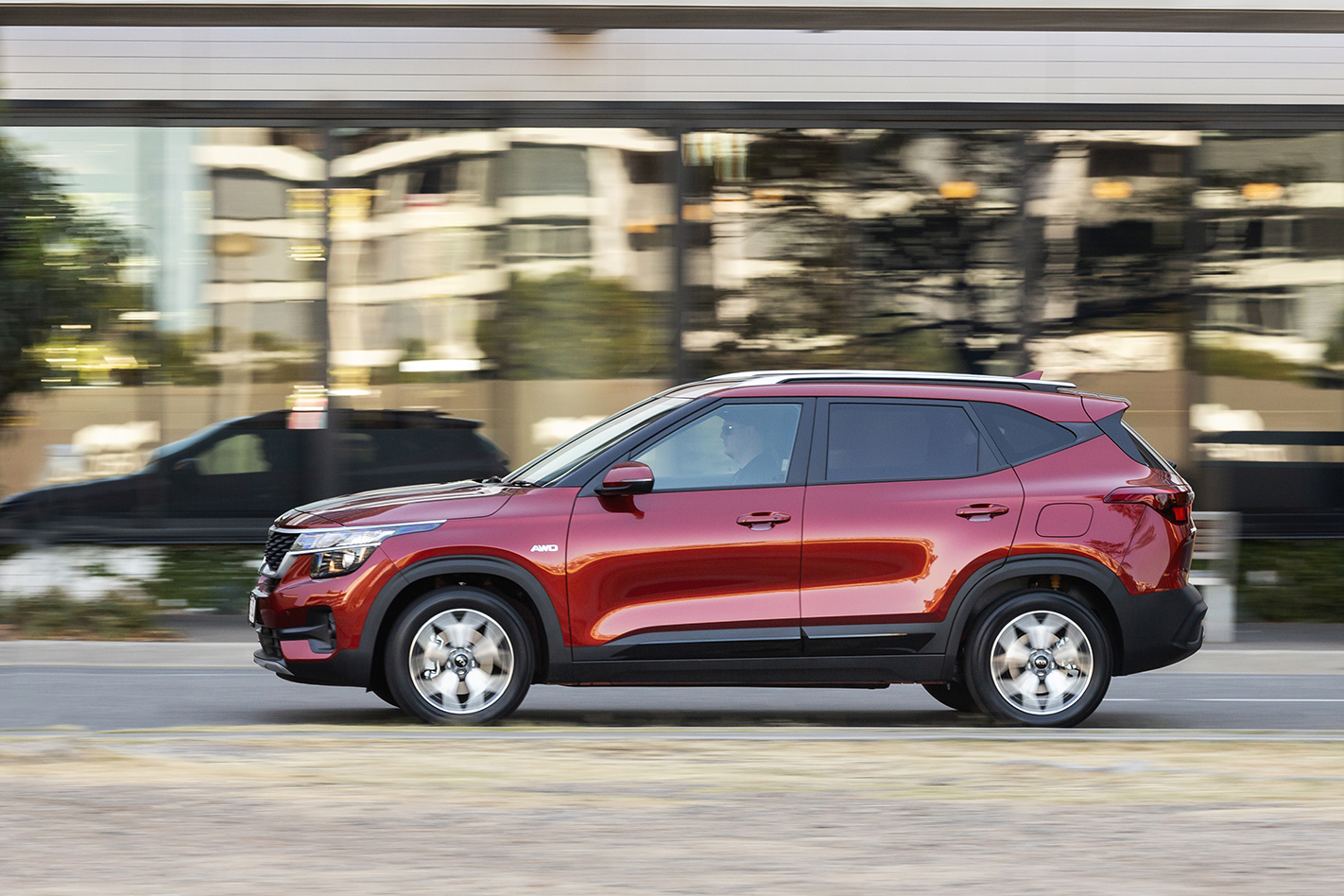
That said, the low-to-mid-$30k price range brings a lot more competition so if you’re buying the Exceed for the improved performance you may want to weight it up against some if its fresher competitors, not least he Kia Seltos Sport+.
This 2.0L FWD Seltos Sport+ sits in the sweet spot of the Seltos range, and while it misses out on the faux-leather heated seats, full LED lighting and panoramic sunroof (all available in the GT Line) it is superior to the ASX range topper in almost every way and isn’t based on a 10-year-old design. And if you prefer more power and hatchback-like handling, you can opt for the 1.6-litre turbo AWD Sport+ priced at $36,490 driveaway.
Euro NCAP, the European equivalent to vehicle safety rating organisation ANCAP, has released a report grading car manufacturers on their assisted driving technologies, and has specifically criticised a major aspect of Tesla’s Autopilot system.
While the Mercedes-Benz GLE, the BMW 3 Series, and the Audi Q8 all represented their respective brands and scored the maximum Very Good rating, Euro NCAP gave the Tesla Model 3 only a Moderate score, the second of four possible scores.
This comes not long after Tesla was banned from using the Autopilot name in Germany due to its misleading nature.
The Model 3 was beaten by Ford’s tech, as represented in the Ford Kuga (given a score of Good, the third of four), though Tesla’s entry was matched by the Volkswagen Passat, Nissan Juke, and Volvo V60. The latter is considered by many (including Volvo itself) to be a brand with a strong focus on safety.
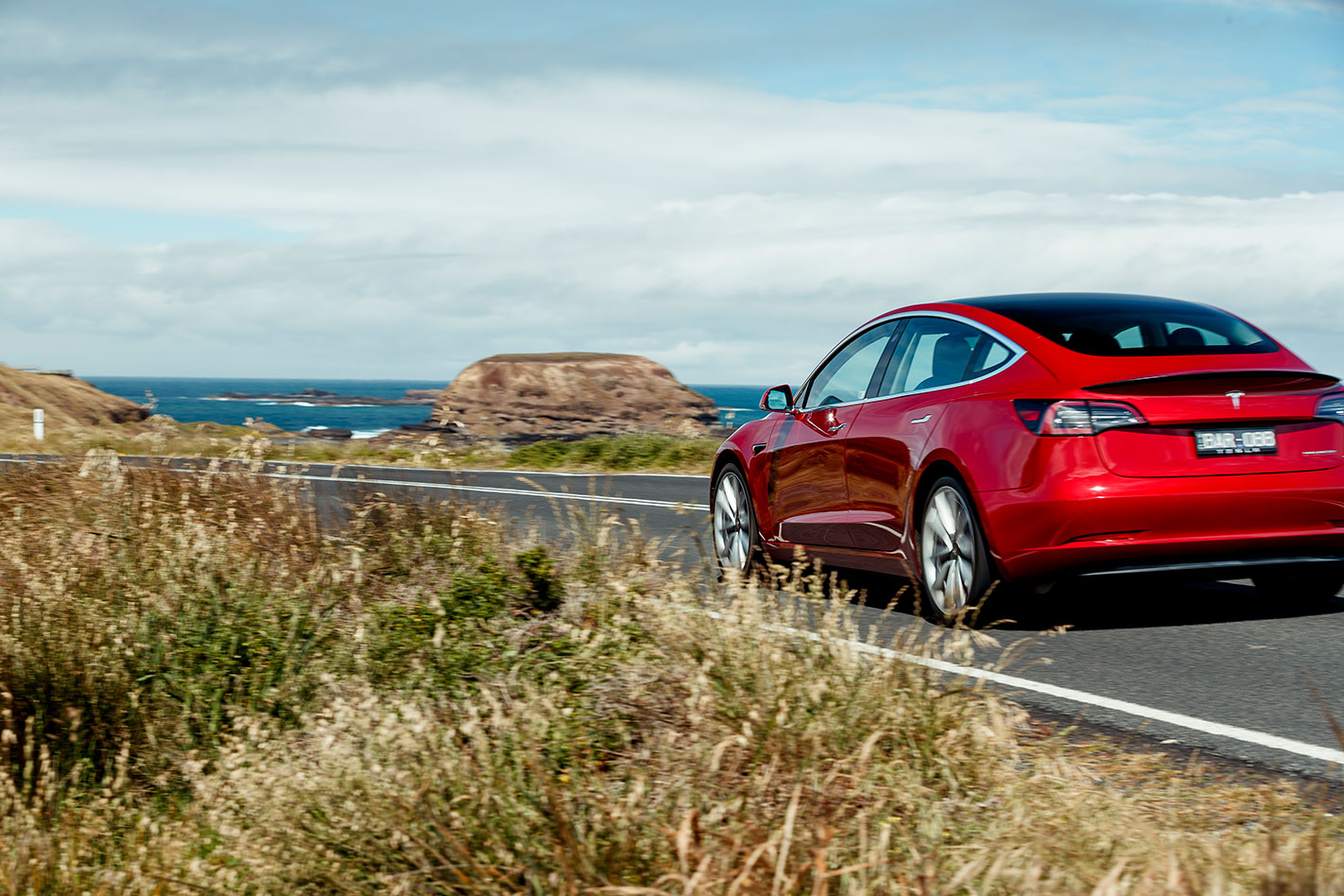
Three categories are considered for rating each vehicle’s technology, the main two being driver engagement and vehicle assistance, while safety backup is the metric which Euro NCAP considers to balance them.
“The score in the first two areas of assessment – Driver Engagement and Vehicle Assistance – are compared and the poorer score contributes to the total,” an explanation of the ranking system states.
This is how Tesla Autopilot sees the world
“The ‘balancing’ of these two areas reiterates the 2018 campaign which showed that good performance in one area is not helpful unless it is accompanied by good performance in the other. The poorer of the scores is added to the score from Safety Backup to give a total.”
The findings recognised that the push for self-driving by the US brand is important, but the rating system it uses requires strong performance across the categories.
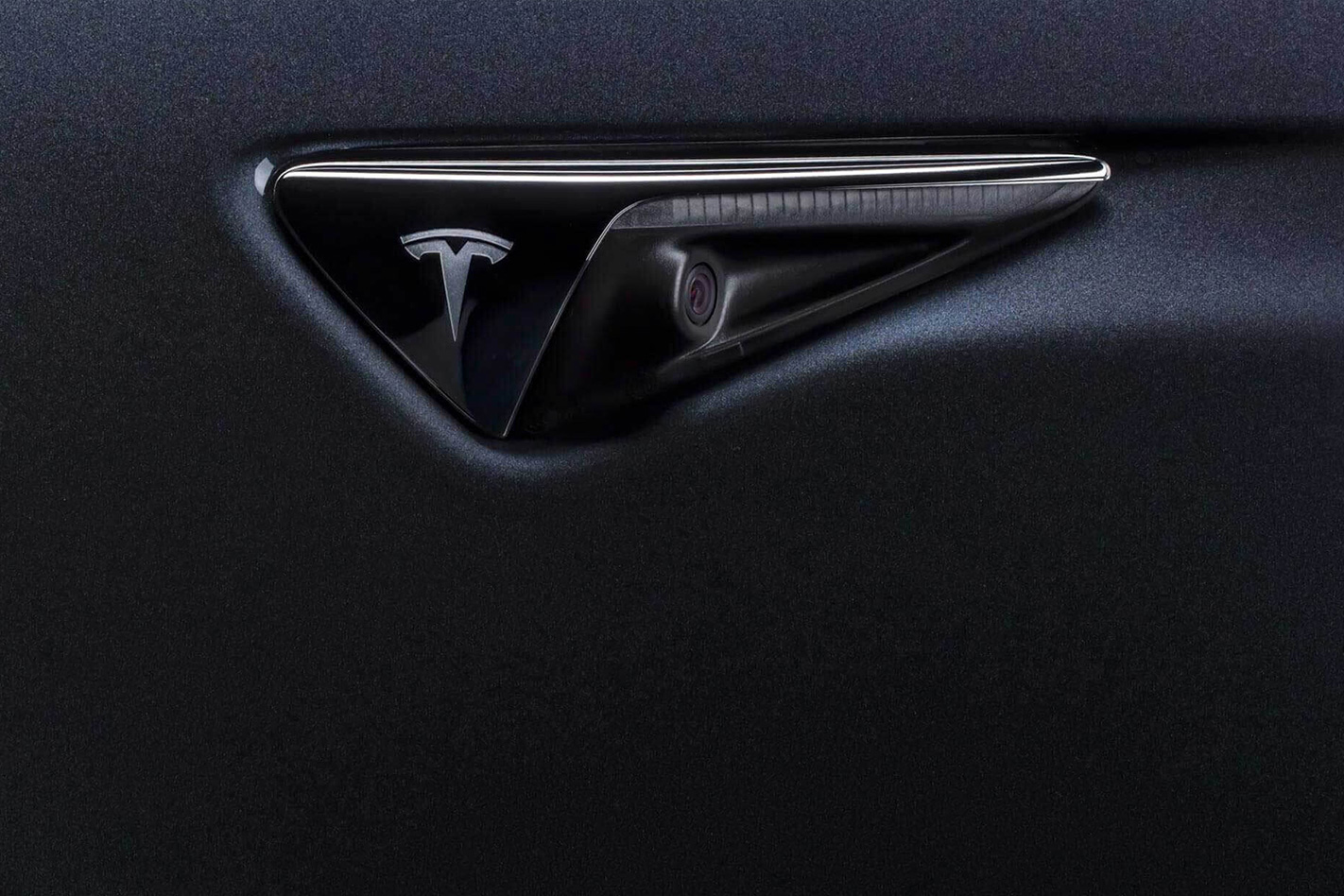
“Tesla’s pioneering role in self-driving technology is reflected in its top scores for Vehicle Assistance and Safety Backup,” the Euro NCAP report finds.
“However, its Autopilot system does little to keep the driver engaged. Its distinct steering strategy gives the impression that either the car is driving itself or the driver has full control, and the system is more authoritarian than cooperative.
“Grading wise, the car is badly let down by its performance in Driver Engagement and ends up ranked 2 ‘Moderate’. On the upside, Tesla offers over-the-air updates and can rapidly introduce performance improvements, as they have shown to be doing in recent years.”
The Renault Clio and Peugeot 2008 scored the lowest rating.
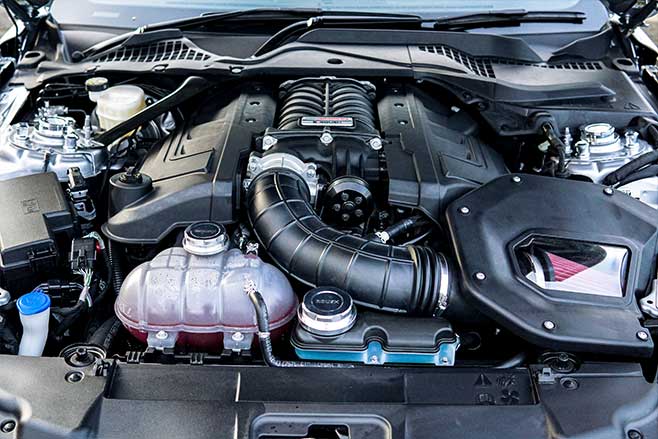
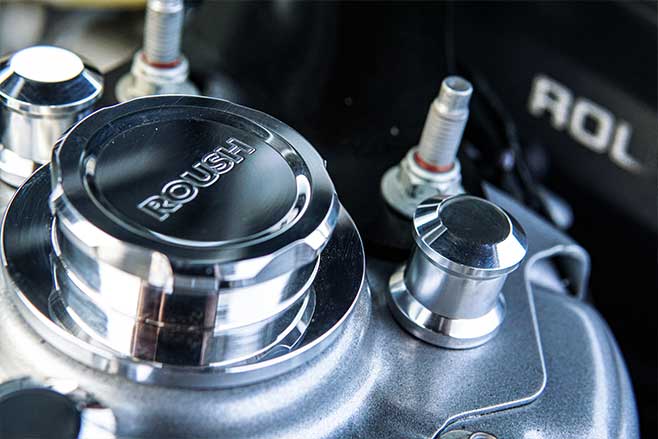
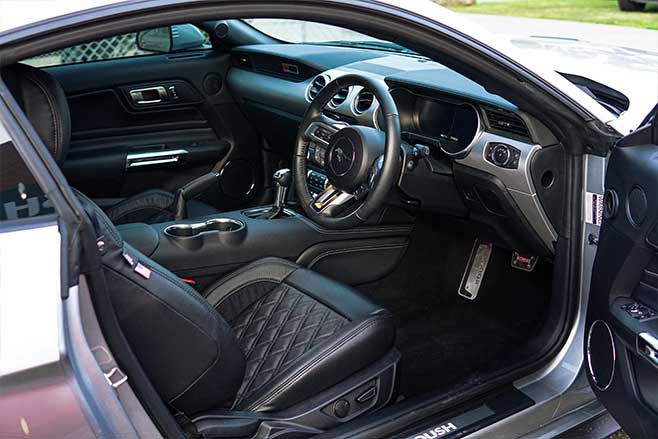
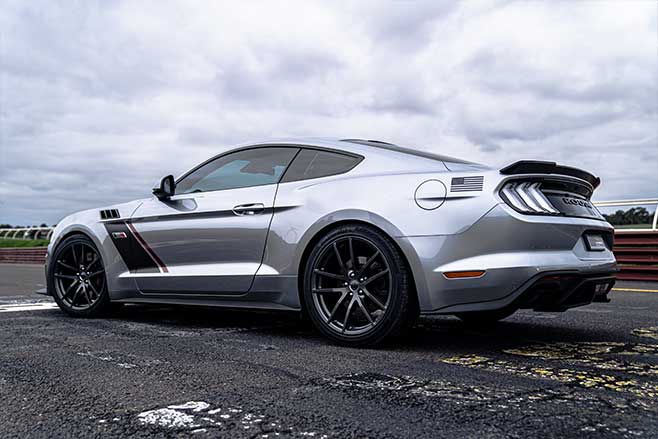
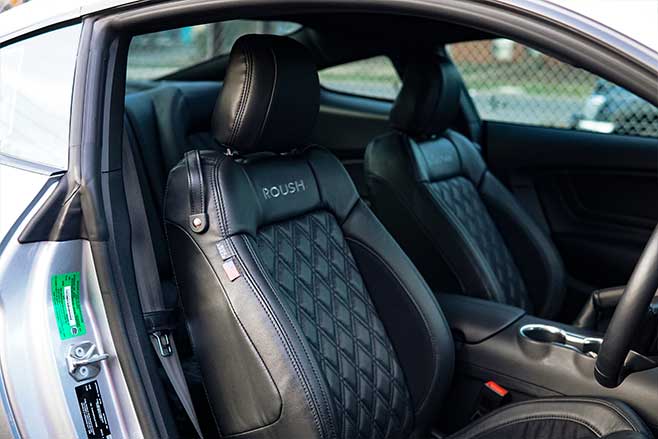
That sounds ****ing mental.” I’m surprised to see the lone Telstra worker sitting at the end of this long and twisting mountain road, but he’s not surprised to see me. The Roush RS3 has been announcing its approach for quite some time, belting out its bent-eight aria, but then this supercharged Ford Mustang has plenty to yell about.The RS3 is the latest and greatest creation from iconic American tuner Roush Performance, put together and sold by Roush’s authorised Australian agent Mustang Motorsport in Melbourne’s eastern suburbs. The $59,660 kit effectively doubles the price of a standard Mustang GT, but the addition of an Eaton TVS R2650 supercharger lifts outputs to a healthy 560kW at 7000rpm and 908Nm at 4600rpm.Keeping the resultant temperatures under control is an extra supercharger intercooler, extra radiator, larger primary radiator, transmission cooler and differential cooler. It all works. Not once during our test does the RS3 show any sign of heat-related stress.
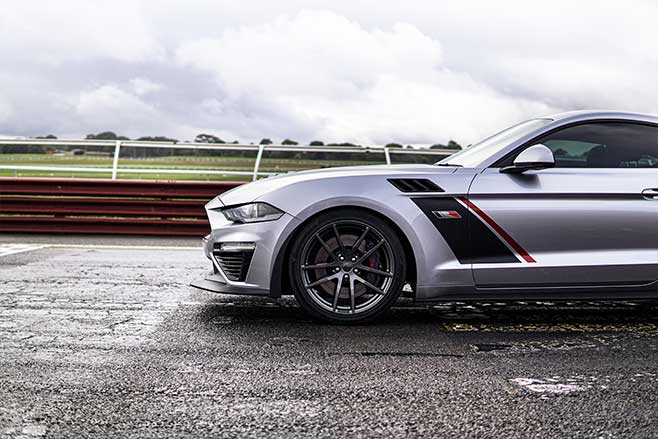
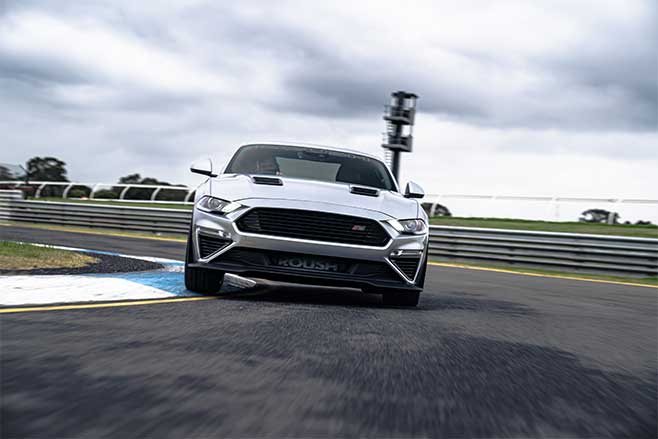
As such, applying power quickly alters this steady state into oversteer and it doesn’t really matter how fast the corner is, the option is always there. Exits of slower corners need a gently, gently approach and though the roads today are thankfully warm and dry, patches of runoff illustrate what an adventure the RS3 would be in the wet.It’s raw and extremely exciting, held back only by, again, the gearbox. In this case the Mustang’s 10R80 is like the regular kid that’s parachuted into the genius class at school; in isolation they’re fine but all of a sudden everything’s happening a lot quicker and the thought process can struggle to keep up.
The following feature is from the July 2014 issue of MOTOR Magazine, and we decided our (now six year old) idea should be readily available to read online… even if we know it’ll never come to fruition.
Rather than edit the story to ‘make sense’ in 2020, we’ve left it in its original wording below, minus a couple of references to pages in the magazine that don’t make sense unless you’re holding a copy. Enjoy.
WHERE’S THE GT-HO, FORD?
The fastest Falcon ever has landed. We’ve spanked the new FPV GT F in all its 351kW glory.
Call us greedy, or ungrateful, but we can’t help but wonder, is that it?
We understand that for GT F, Ford did the best it could with the money, men and time it had available. In fact, thanks to the passion of all involved, the project’s modest allotted funds would have stretched much, much further than usual.
Which means that unless Ford is toiling away on an unexpectedly berserk ‘FH’ XR8, the GT F really is the fastest Falcon we’ll ever see, forever. But what about a Phase V GT-HO like the one you see here?
Rare Ford Falcon GTs: XA GTHO Phase IV & RPO 83 XA GT
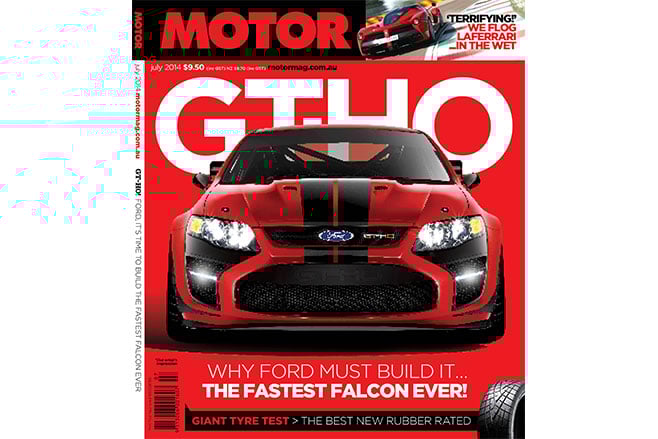
Of course, these images are from our graphic artist. But we thought we’d put the question to David Wilkinson, Vehicle Line Director, the man who counsels Ford Australia senior management on what car it should build next. If a GT-HO was to be built, he’d be one of the men signing it off.
Wilkinson, a car guy, cautions that it wasn’t a case of Ford being just outwardly hostile towards the idea.
“One reason we didn’t try to do an HO was not because we didn’t want to – there were lots of people who would have loved to have done an HO,” he tells MOTOR. “But we didn’t think we could have made it special enough to have the HO name.
“The HO had a place in history, a point in time. From a marketing perspective alone you just don’t put that badge on something else. Particularly to the people who were interested in that product, it means something. We don’t want to overuse it. We don’t think we’re overusing GT 351, it’s purely in keeping with the original. It’s something special.”
So what’s the answer, then? Has Ford dodged a modern-day GT-HO all this time because it’s spooked by the ghosts of the ’70s? Is it frightened of trespassing on sacred earth? Or is a case of it just doesn’t have the money to do the right job?
Ford Falcon GT-HO ‘vs’ HSV Maloo W1
“We never actually got to the point of asking ourselves, ‘do we want to do a GT-HO’,” clarifies Wilkinson. “We just knew from the beginning that the GT-HO was the product that it was and that we didn’t want to tinker with that. It was such an iconic thing; it would just seem wrong to try to do it again with a modern version. It’s emotional, probably, nothing more than that. Clearly to do a 450kW product with 10-inch wheels and [all the rest], which is what you’d probably want to do if you were going to that extent, it’s a much bigger program and we never really entertained doing something of that scale. We just never talked about it.”
Indeed to justify a production GT-HO would be an insurmountable commerical challenge to even the cleverest of Ford’s internal businesspeople. Ford, of course, wouldn’t spend a cent on such a risky enterprise if it knew it wasn’t to make any money. And it probably wouldn’t.
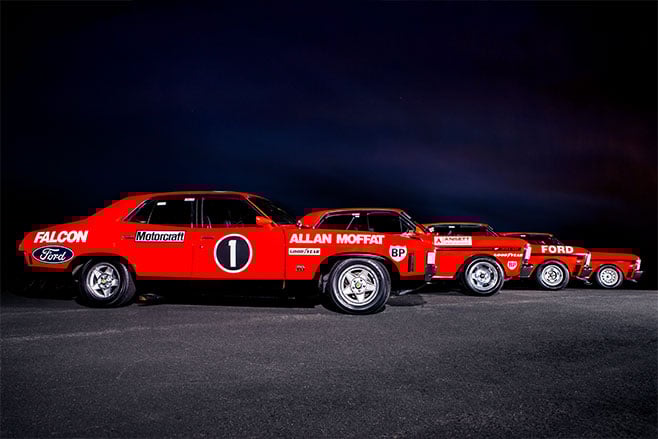
“Where is the GT-HO? If you look at what was required in the GT-HO, it would have been a big program,” explains GT F project manager Justin Capicchiano. “You can see when you’re around here [You Yangs Proving Ground] the amount of resources we’ve got dedicated to other things and to be honest, to do something that lived up to the name of the GT-HO would have been something more than what we would have been physically able to do with the resources we have.”
Justin Capicchiano on the last Falcon GT, GTF500
So it’s fairly clear – a production GT-HO appears out of the question, crushed by the fact it would be a major program cost with little apparent commercial viability. But what about a concept car? As outlined in the editorial on page nine, Ford would be freed from spending countless millions ensuring the car meets safety, emissions and durability standards. They could do whatever they want, really.
That’s one question you might find Ford a little evasive of. Because while a production GT-HO makes no commercial sense, there’s value in the concept car – at least to us, anyway. We don’t have a business case outlining projected revenues from such an experiment. Read our editorial for our reasons but ultimately, we’re only fans wondering if the GT F will be forever known as the hardest the Falcon could ever punch.
Call us diehards, greedy or ungrateful but somehow, we hope not.
A True Ford 351 V8?
Ok, now we enter into the realms of pure speculation. No engineer has mentioned to us that the following is possible, but it does provide a tantalising ‘what if?’ scenario. See, there is currently an engine in Ford’s performance arsenal that would add real gravitas to the HO’s 351 badge.
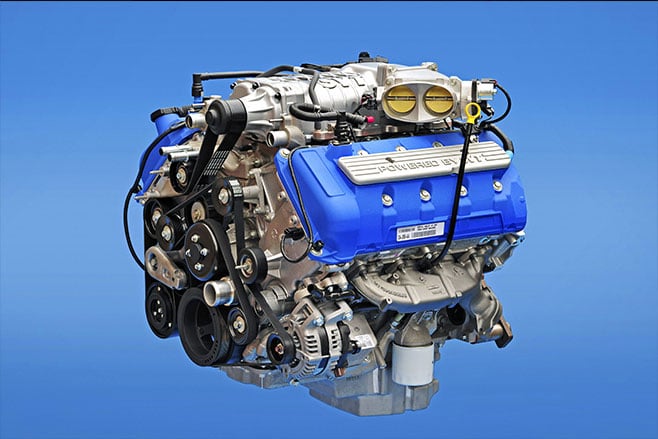
Wedged under the bonnet of the current Shelby GT500 is a 5.8-litre (351 cubic-inch) supercharged V8 which produces a thumping 495kW at 6500rpm and 855Nm at 4000rpm. Given a supercharged V8 already resides in the Falcon’s engine bay, space shouldn’t be an issue, though adapting the imported donk for right-hand drive could prove difficult. Still, given the blown 5.8 can simply arrive on crates from the US, it should cost a lot less than the $30-odd million Ford spent developing the Miami.
Ford XY Falcon GT HO vs FG Falcon XR6
Don’t go thinking this is some stone-age lump from the land where cubic capacity is king, either. There’s double overhead camshafts, forged internals and sci-fi stuff like plasma-transferred wire arc cylinder liners, which reduce friction and heat transfer as well as weighing a lot less than traditional steel liners.
Of course, this much grunt would turn the existing FPV driveline into molten metal, so while we’re dreaming. we’d better order up the six-speed manual gearbox and one-piece carbon-fibre tailshaft from the GT500 as well. Will it happen? Not a chance, but we can dream.
How to make a modern GT-HO work
GRUNT WORK
The most important part of any HO is, of course, the engine. While the Miami V8 is capable of producing the required numbers (around 450kW/700Nm), an imported engine (see breakout) would possibly be a more cost effective option.
STICKY SITUATION
Lightweight rims increase in width to 9.0 inches at the front and 10 inches at the rear, wrapped in semi-slick rubber. Upgraded braking hardware would be required, basically the biggest rotors and calipers AP Racing could supply.
TOUGHENING UP
Falcon driveline would need serious strengthening if it was to accommodate the grunt of a modern HO. One engineering source even mooted installing the transaxle from the V8 Supercar, but making it suitable for the road would be a huge task.
WING AND PRAYER
Giant rear wing and front splitter generate downforce at track speeds. The rest of the bodykit is primarily aimed at extracting the enormous heat generated by the engine, driveline and brakes.
A word about sponsors
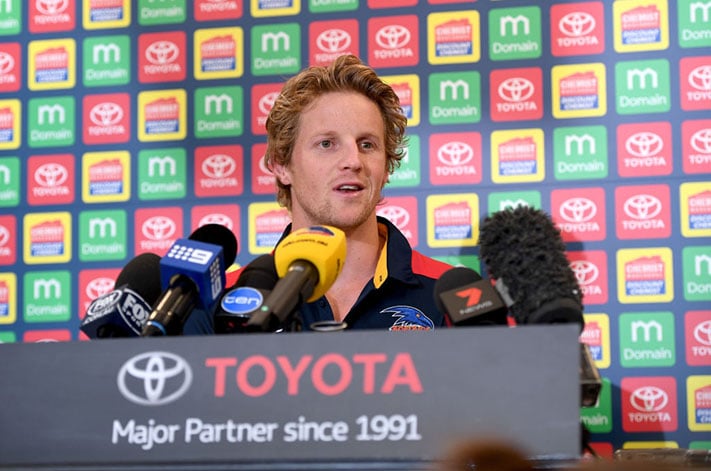
The motoring industry is a keen supporter of the Australian Football League. Toyota has been its major sponsor since 2004 and has just inked a record $74 million four-year contract that for the first time will include the AFLW (women’s competition).
AFL supporters span all social demographics across each state, which makes the sport fertile ground for car manufacturers. A 2014 survey showed that on average, around 13 percent of football club members intended to buy a new car in the next four years.
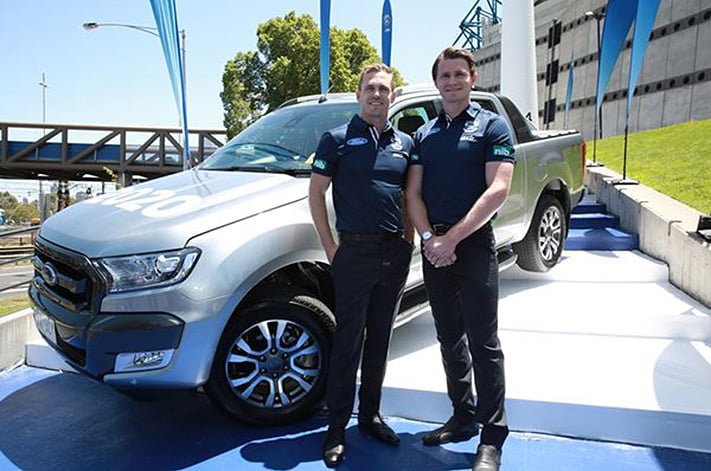
Which is why Toyota is happy to dish out $18.5 million per year and why other brands feature on team jumpers.
Incredibly, Ford recognised football’s marketing potential as early as 1925, when it started building Model Ts in Geelong and decided to sponsor the local footy team.
The blue oval has been a fixture at the Geelong Football Club ever since, which is one of the longest sponsor partnerhips in the world. The company also supports the Cats’ AFLW side and the relationship looks like enduring despite the closure of the local engine plant.
The Adelaide Crows have enjoyed Toyota Sponsorship since joining the AFL in 1991 and for a time a marketing campaign saw the side called the Camry Crows. And this year was the 21st that North Melbourne featured the Mazda logo on its jumpers.
Other car companies involved as major or key sponsors with AFL clubs in 2019 include:
- Jaguar – Melbourne
- Jeep – Richmond
- Hyundai – Brisbane and Carlton
- Kia – GWS Giants
- Mercedes-Benz Vans – Western Bulldogs
- MG – Port Adelaide
- Nissan – Hawthorn
- Volkswagen – Sydney
The Batmobile
The words ‘shameful’, ‘car’ and ‘AFL’ in the same sentence could refer to a litany of player drink-driving offences but they’re equally apt for one of the most cringeworthy episodes in the game’s history that doesn’t involve The Footy Show.
Yes, we’re talking about the pre-game entertainment at the 1991 Grand Final, when singer Angry Anderson and marathon champion Robert De Castella sheepishly entered the ground in a daggy blue winged-car which that was instantly nicknamed the Batmobile – an insult to the Caped Crusader’s excellent taste in modified cars.
In front of 75,000 people at Waverley Park (the MCG was being redeveloped) the car, based on a 1970 Chrysler Valiant VG coupe, stopped in the middle of the ground before Anderson stood up and – we hope with a sense of irony – sang his hit Bound for Glory.
A curious aside was the 14 Aussie-built Ford Capri convertibles parked in the centre square containing Brownlow Medallist Jim Stynes, retiring players and other dignitaries, whose bemusement at the unfolding spectacle turned to laughter that only stopped during Meat Loaf’s Grand Final performance 20 years later.
Jonathan Brown v Hyundai
Brisbane Lions hard man Jonathan Brown was hit by a car while riding with a group of 20 cyclists on the Gold Coast a month after the 2012 Grand Final. He was taken to hospital but was released a short time later after receiving 10 stiches on his left elbow.
Brown described the incident as a hiccup and was right as rain by the time pre-season training began a few weeks later.
The Hyundai i30, however, appeared to come off second best and was towed away after sustaining a badly damaged windscreen and broken side mirror.
Sam Newman’s Lambos
Former Geelong ruckman and The Footy Show star Sam Newman has to be the footy world’s biggest rev-heads among (yes we meant rev). He dabbled in motorsport a few years ago, racing everything from Holden Vectras to Lamborghini Diablos, and owns a collection of vintage and prestige cars. He has also owned a string of Lambos including a Diablo, a Murciélago and no fewer than three Aventadors.
Newman’s Lambo fetish turned sour in March 2006 when, several months after taking delivery of a yellow Murciélago roadster, the company released the more powerful Murciélago LP 640. Newman reportedly sued for the $750,000 cost of the car, claiming he was assured that no improved model was pending. Prior to that, he had taken the yellow terror to the Northern Territory to try out the speed limit-free roads, apparently clocking up 300km/h.
His beef with Lambo didn’t last long – in 2011 he became the first person in Australia to take delivery of an Aventador (see video) and is apparently now on his third, a blue LP 750 SuperVeloce.
Not in the pink
Former Sydney Swans owner Dr Geoffrey Edelsten is one of the more flamboyant characters in the game’s history and is still invited to the Brownlow Medal presentation so the media can comment on what his latest wife is barely wearing.
Edelsten epitomised 1980s excess with his helicopter and stable of exotic cars, including an Aston Martin Lagonda and Ferrari 308. The popular perception today is that all his vehicles – including the chopper – were painted pink. After all, he made his millions by decking out medical centres like discos.
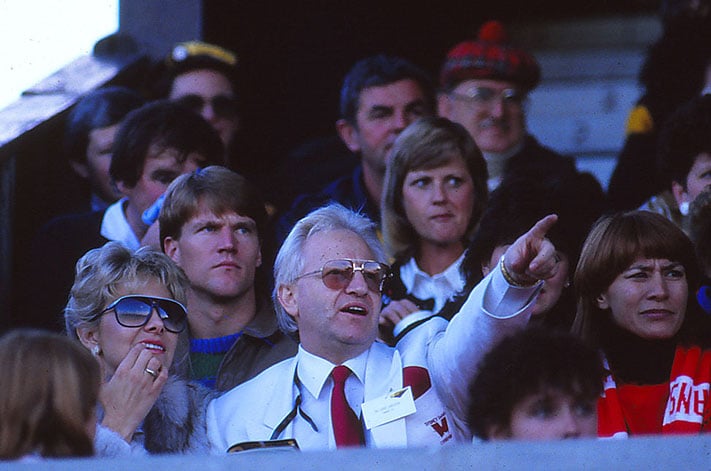
But the fact is Edelsten’s helicopter was a conservative blue and white, and the only pink car in his garage was one he gave to his then wife Laeanne for her 21st birthday – a De Tomaso Pantera.
Edelsten’s obsession with expensive cars continued and in 2012 three were stolen from the car park below his Melbourne CBD apartment – a black and gold Lamborghini Aventador, a blue Mercedes SLS Gullwing and his then wife Brynn’s BMW 335i. The cars, worth more than $1.4 million combined, were all eventually recovered.
What is the GLB 250?
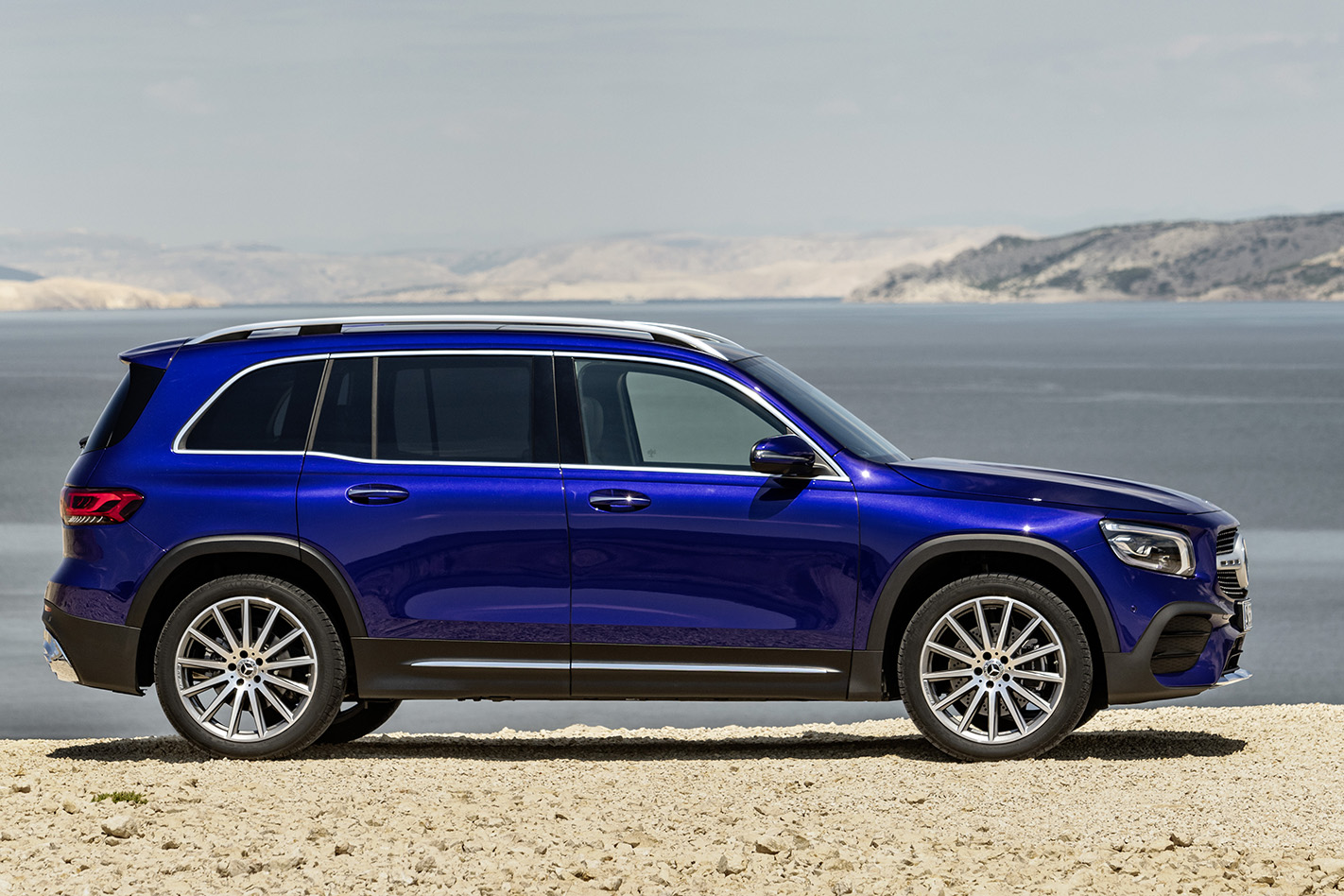
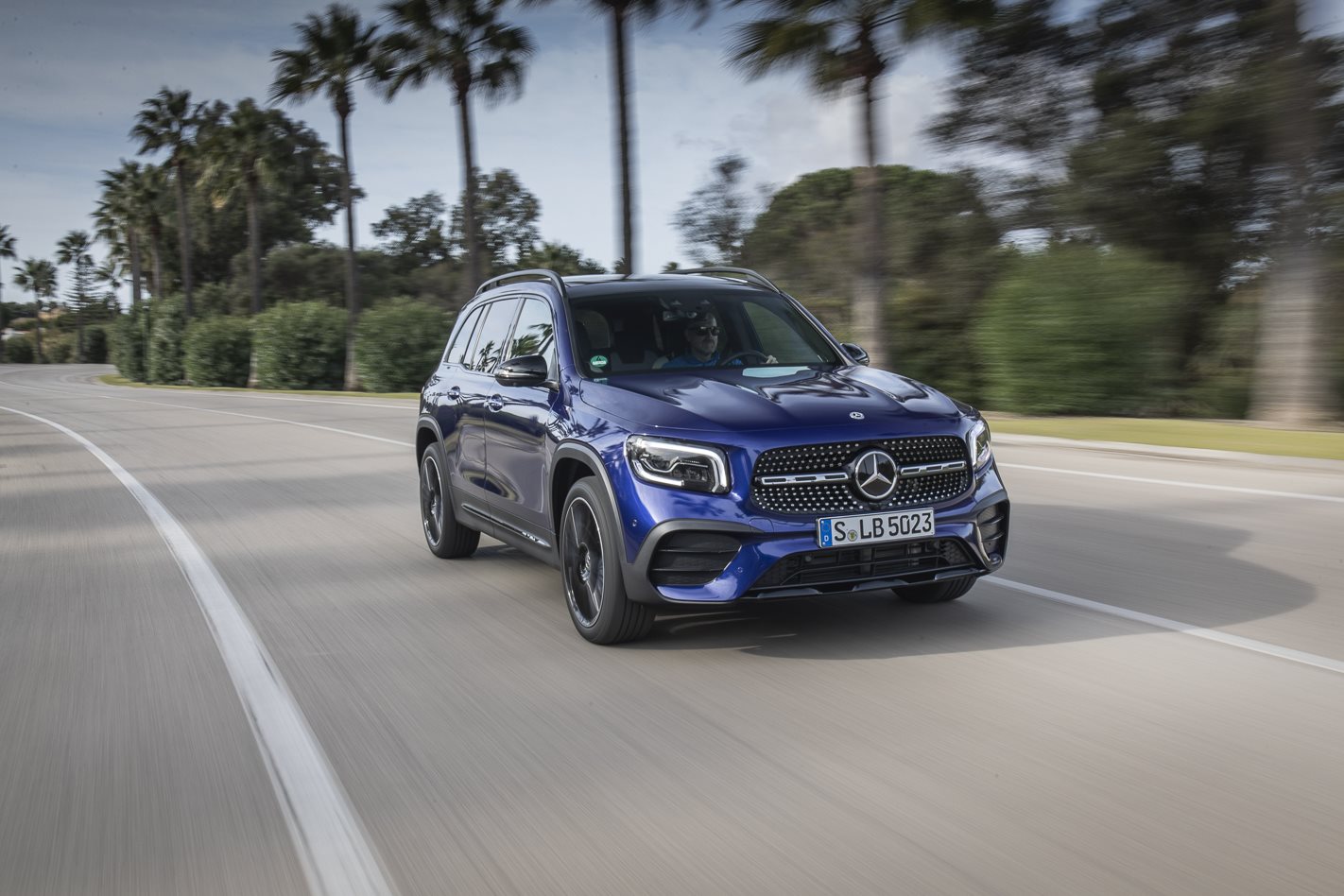
The GLB is the latest model to join Mercedes-Benz’s ever-increasing SUV family. At first glance, it appears to be a GLS photocopied at 75 percent, but look closer and you’ll start noticing the differences.
It rolls on Benz’s MFA2 platform, which underpins a significant share of its current model line-up including the A-Class small hatch and sedan, larger B-Class, as well as the GLA SUV.
The GLB slots in between the GLA and the GLC and, while it’s based on the A-Class, it is longer than the baby Benz at just over 4.6 meters, but offers room for up to seven occupants. We’ll call it ‘smallish’.
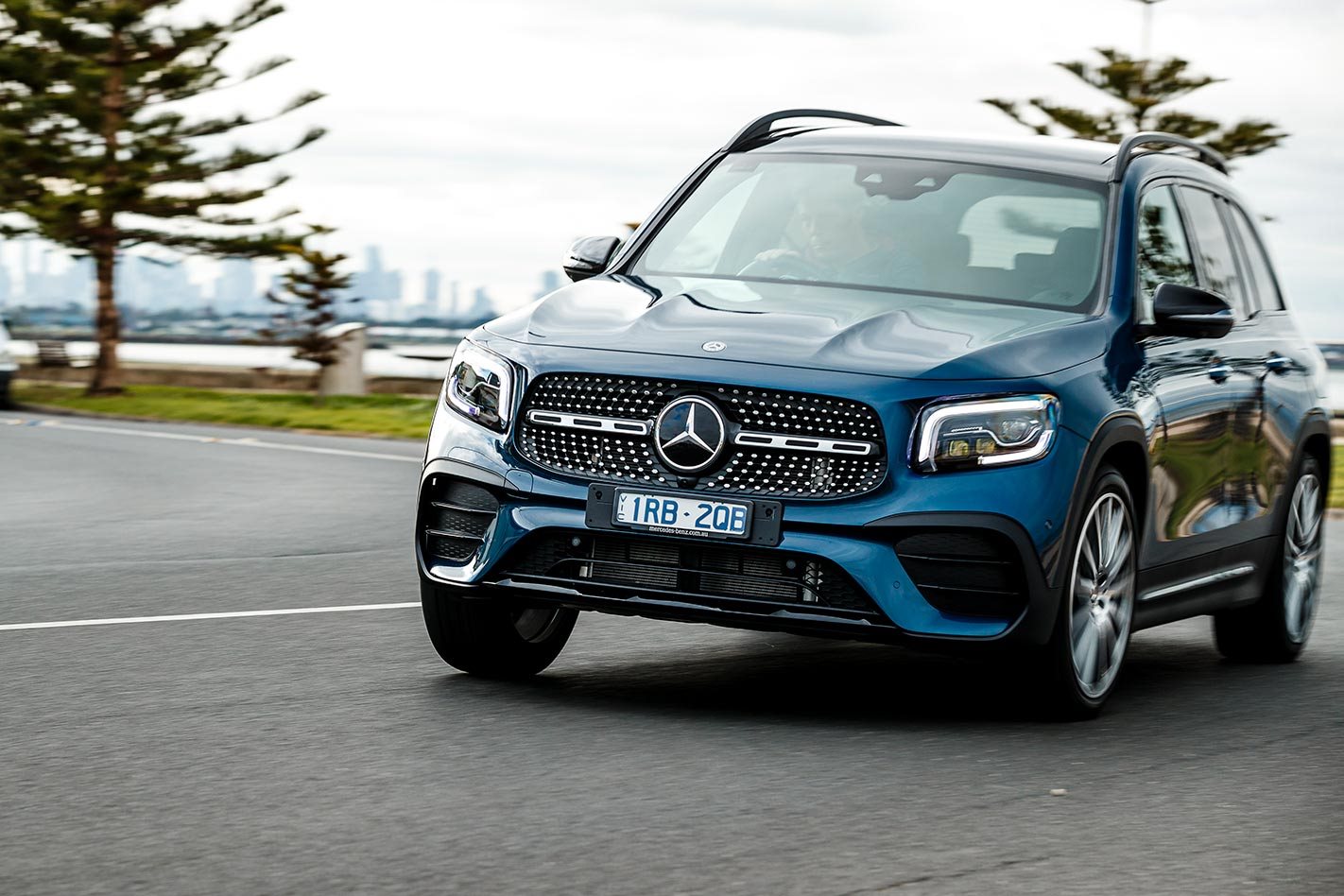
It enters a busy seven-seat compact SUV market that’s littered with choice and the GLB asks a premium over many of its competitors, but it also packs a lot of punch and is well worth considering in the premium mix.
Price and Value
Our test car was fairly optioned up, so its price tag was a neat $80,560 before on-roads. Considering the GLB 250 starts at $73,900, what exactly at you getting for the extra $6,500? For that matter, what do you get for the base price?
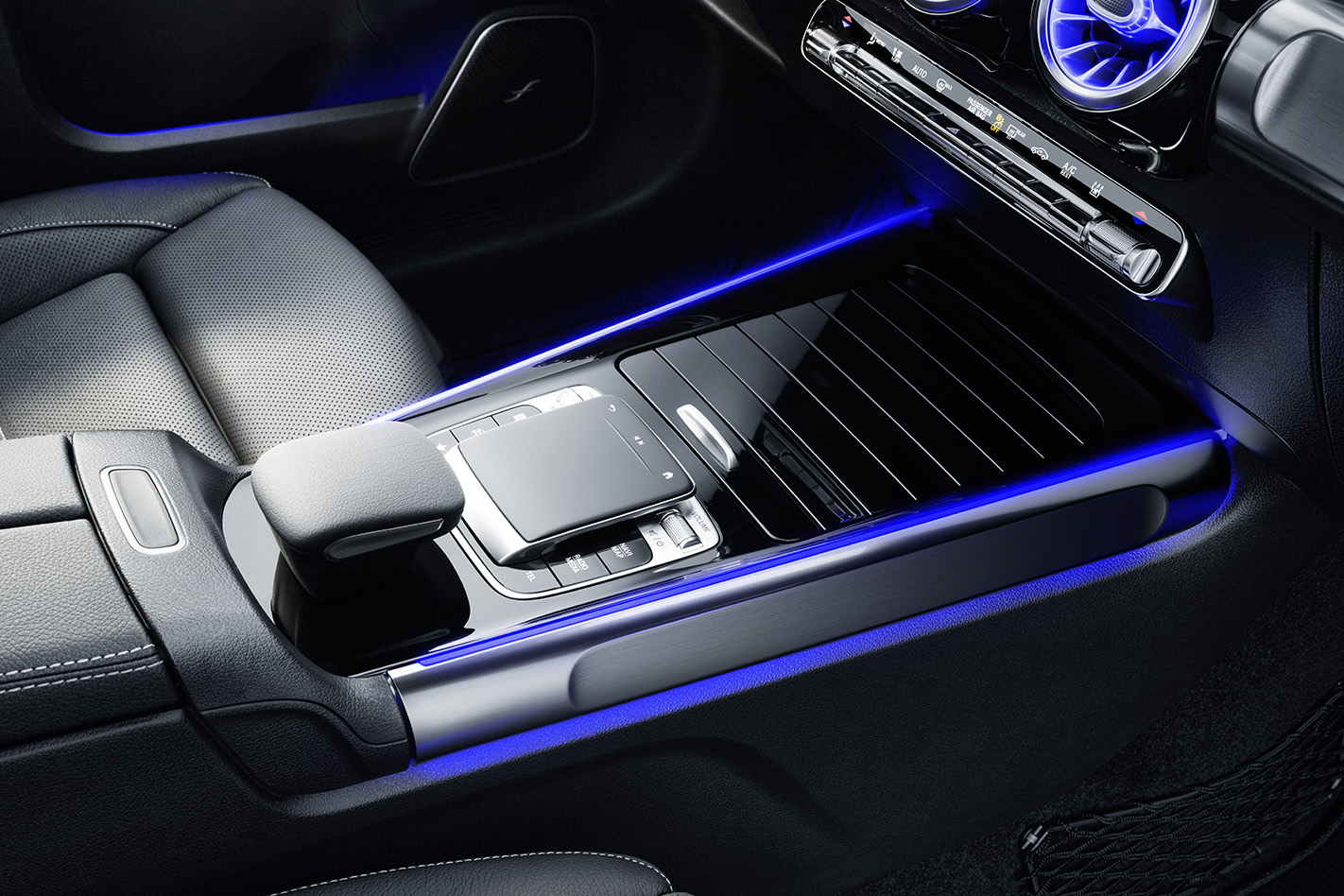
The off-the-shelf GLB 250 is not exactly tradie-spec. Its cabin is decked out two 10.3-inch digital screens, with touch sensitivity for the central display as well as controller that works a bit like a fixed mouse. Coloured ambient lighting, wireless charging, Android Auto and Apple CarPlay are all standard, as are USB-C power points and tablet holders for the second-row passengers.
There’s also plenty of convenience features including electric tailgate, keyless entry and start, a reverse camera, Mercedes’ MBUX system with voice control and navigation and fully electric front seats with heaters.
As you might expect from the Three-Pointed Star, safety gets a good look in with lane keep assist, brake assist, blind spot assist, nine airbags (front, pelvis side and window for driver and passenger, side curtain airbags for middle and rear rows and driver’s knee) and Isofix child seat anchors to name but a few features.
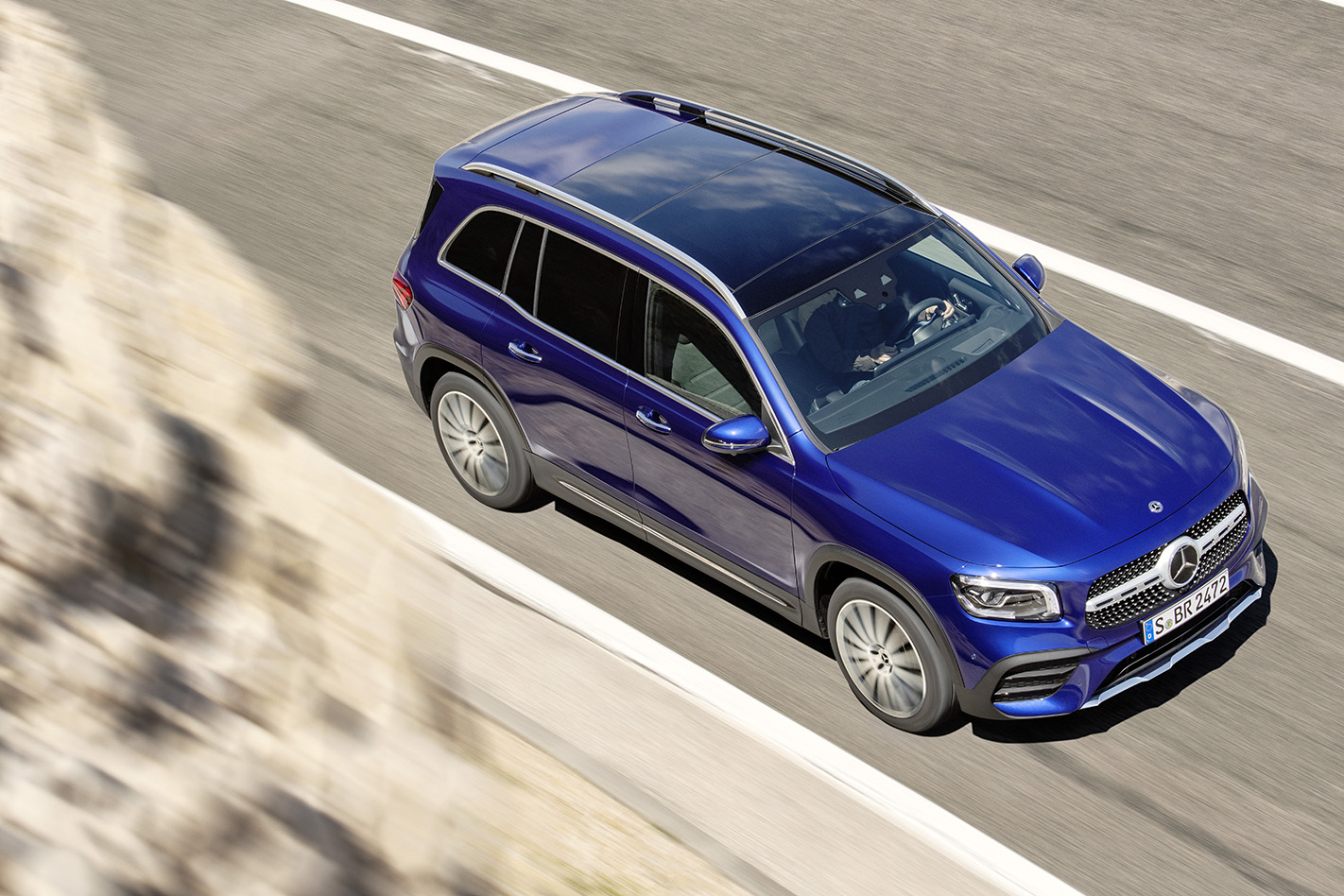
Capping off the notable kit, 19-inch wheels, 4Matic all-wheel drive system, eight-speed DCT automatic transmission, automatic panoramic sunroof, off-road engineering package, active dampers and a 60-litre fuel tank complete the long list of equipment included in the price.
As if that wasn’t enough equipment, the version we tested had been decked out with a number of options accounting for the extra $6500. They included the Galaxy Blue Metallic paint, Neva Grey/Black Artico synthetic leather seats, Sports package (AMG trimmings including 19-inch AMG wheels, roof rails, some tasteful carbonfibre trim pieces, paddle shifters, sports leather steering wheel and privacy glass on the rear windows).
An optional Driving Assistance package was also part of the deal, which adds lane change assist, route based speed adaptation, extended automatic restart in traffic and a number of other driving aids. And the Vision Package (adaptive high beam, Multibeam LED headlights and a 360-degree parking camera) completed the kit list.
Mercedes says most of these items would usually take years to trickle down from the S-Class vehicles, but have been fast-tracked to the GLB to impart as much extra technology as they can possibly cram into it.
Among other key rivals, Benz is taking aim at the well-rounded Land Rover Discovery Sport with its GLB.
In 250 specification, the Merc aligns closest with the Discovery Sport S P200 AWD Automatic. However, the GLB 250 is better equipped, more powerful, is larger overall and offers more headroom.
Styling Highlights
This is a Mercedes-Benz and a representative of an automotive brand that’s synonymous with style. To that end, the GLB delivers in boot loads. It mightn’t break any new design ground nor is it going to be the centerpiece of Milan Fashion Week, but it’s sufficiently edgy to appeal to a new audience.
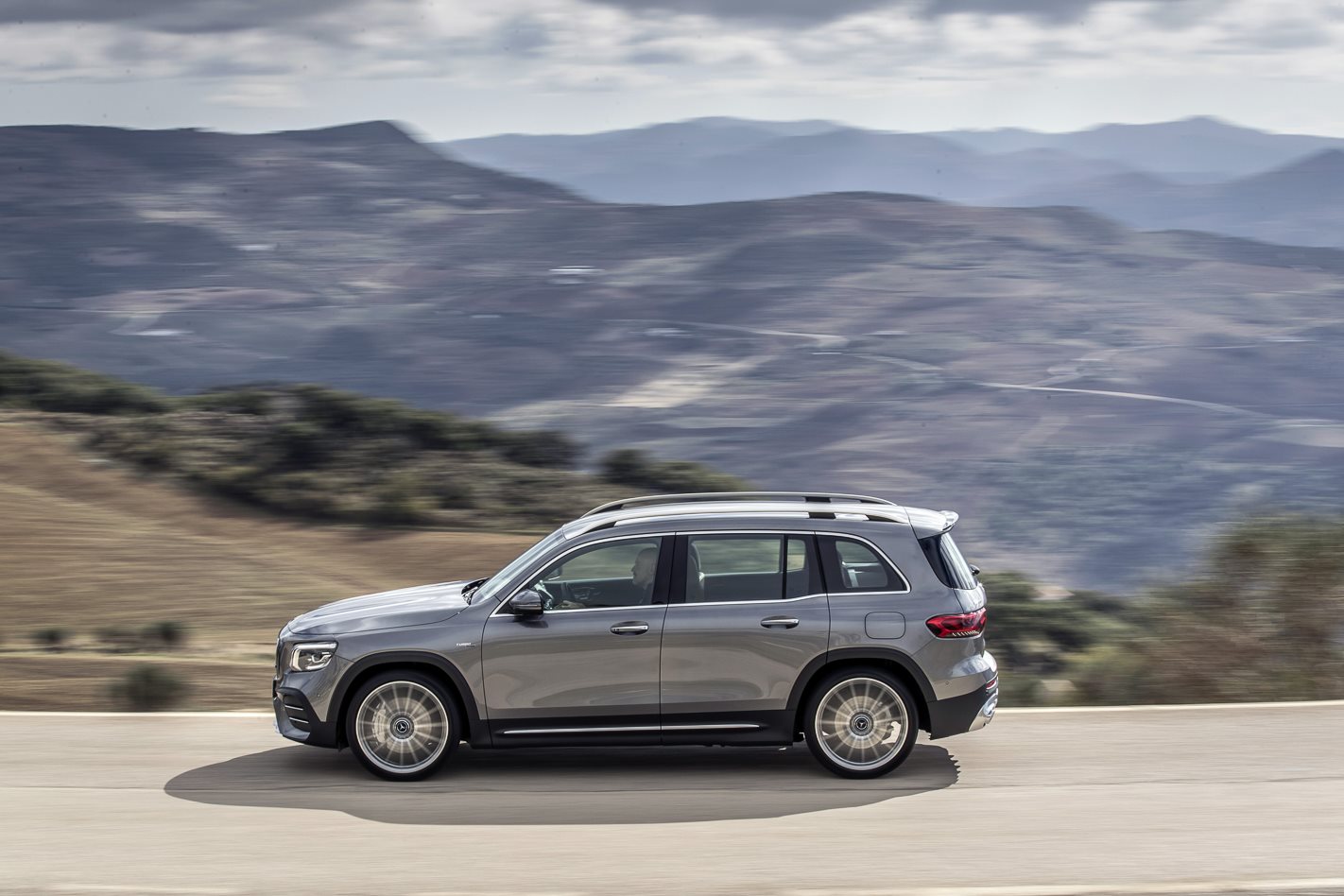
The exterior of the car speaks for itself. Sporty and chunky in all the right ways, whilst still maintaining a sense of subtlety. There’s no “look at me” about it and that is a really good thing. But if the outside doesn’t delight then it makes sense to focus on the interior where, an owner will spend a majority of their time looking around, and where this car really kicks some goals.
From the modern dual screen dash to the steel accented door handles and air vents, the two-tone leather to the ambient lighting that could pass itself off as a slow motion disco. Everything inside the GLB 250 is a pleasing sight that you’re unlikely to tire of. It feels fresh and light inside the cabin, even at night. Spend five minutes in it and you’ll be converted.
Living with the GLB 250
Few SUV’s feel as car-like as the GLB 250. It’s spacious, but doesn’t feel cumbersome, the interior, whilst pretty to look at isn’t delicate, and the digital dash is without question among the most impressive.
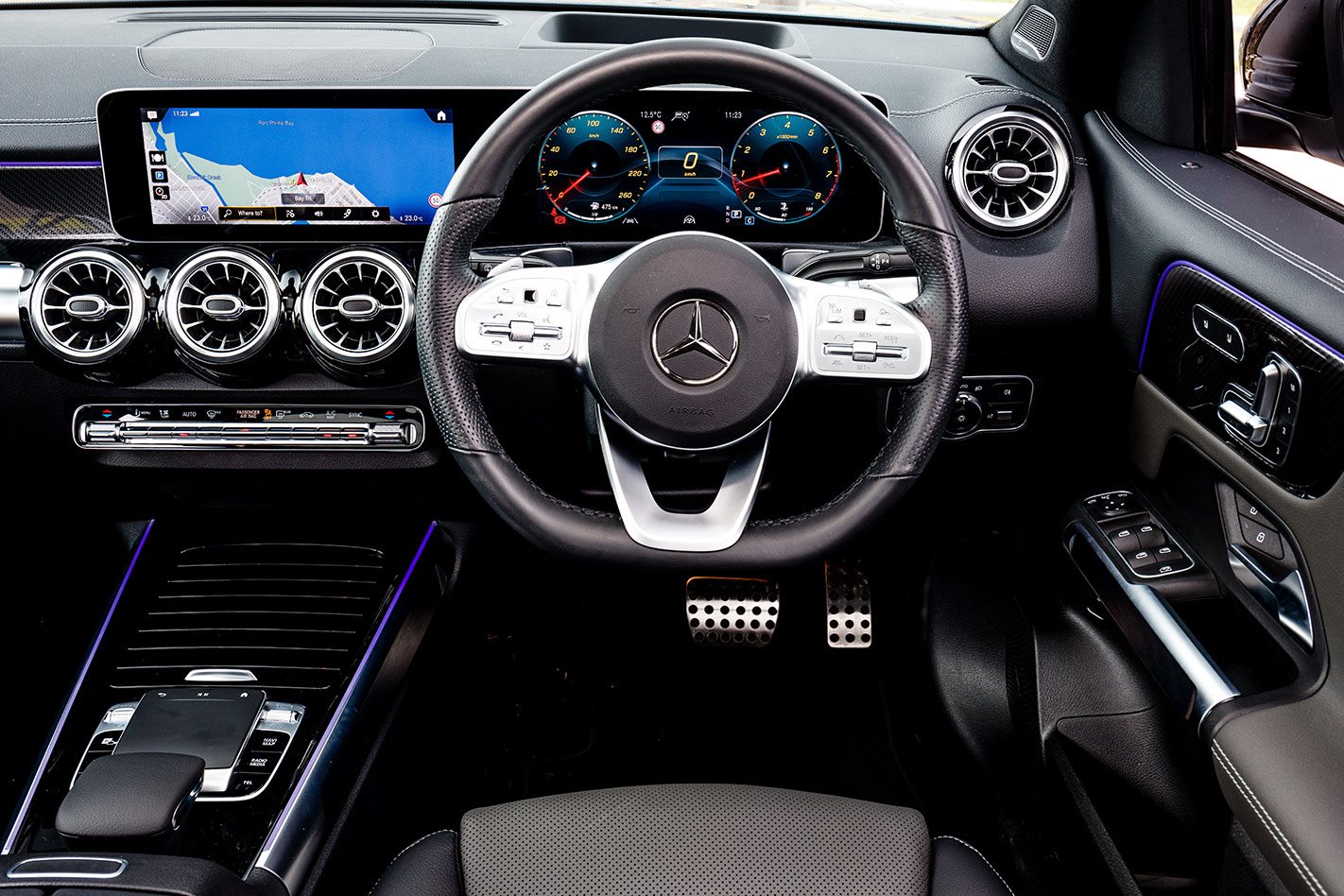
Everything on the two screens is customisable to display exactly the information required at any given moment; full-screen maps for navigation, sports gauges or even a monitor to see how kind you are being to the planet as you drive.
The central screen is similarly fantastic. All functions are controlled either through the touchscreen itself or, if you prefer not to have fingerprints all over your 10.3 inches of LCD, you can utilise the mousepad in the centre console. This takes a bit of practice to master and given the choice of just one method, the touchscreen would be staying.
A huge amount of the car’s digital systems can also be controlled through the intuitive MBUX interface, which allows you to tune the radio, set a navigation destination or even open the sunroof with a voice command. “Hey Mercedes” is all it takes to get its attention. A word of advice though – don’t say Mercedes whilst doing a piece to camera or she will interrupt your take.
The MBUX system goes a step further though and actually learns your habits as you drive. Within the first six weeks of driving, the GLB will pick up on your daily driving routine and begin helping you as you drive.
For instance, if you call your partner every day at 5:00pm after leaving work, it will suggest it on the days you don’t. And if you always use the navigation to go to work each day, it will automatically offer to plot the route when you get in the car each morning. Is Siri that attentive?
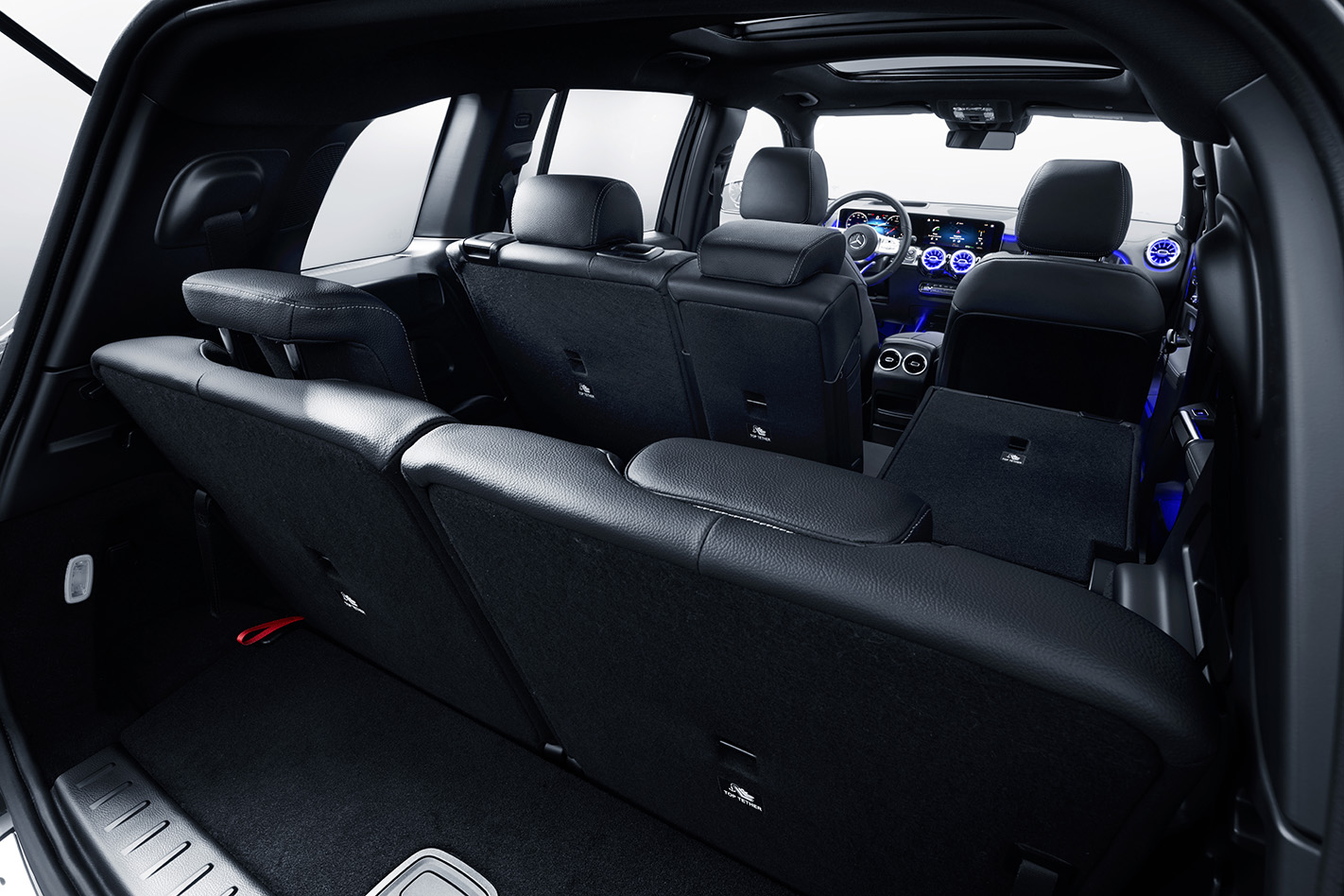
All seven seats are upholstered in a combination of real and synthetic leather which, as we discovered, can easily be wiped clean of chocolate spillage. Both rear rows are fitted with Isofix child seat anchors across all five seats. The middle row slides forward to allow for more legroom in the rear and all five rear seats fold flat for a massive amount of storage.
However, with all seats in place, the boot is tiny measuring about 150 litres. It gets better with the third row seating out of action and an increase of volume to 560L, while the load volume grows to a whopping 1800 litres with all seats folded flat.
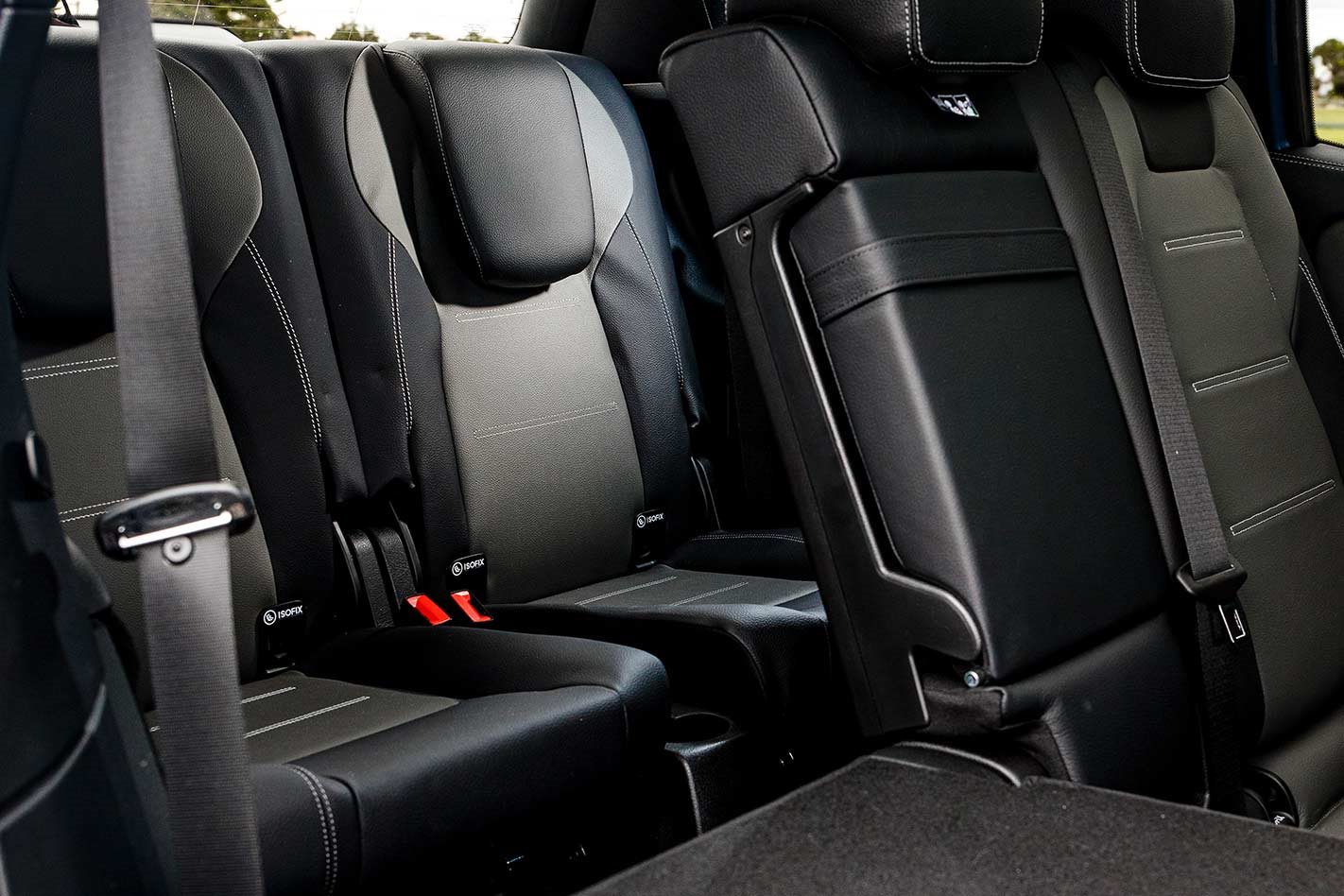
While there’s a decent amount of space for second-row occupants especially in headroom, the third row is a bit of a gesture. You can’t cheat physics and a small car on the outside is almost always going to be small in places on the inside. In the GLB it’s the third row, which should be reserved for the smallest children.
The front seats however, are where the magic happens. Both are heated and have a ‘massage’ function which uses small movements in the bolsters to help keep you alert on long journeys, but double as a soft back rub if the mood strikes.
We often test a vehicle’s storage capacity by throwing in a few of the camera crew’s large cases. The vast majority of small SUV’s don’t even allow you to close the tailgate once loaded but the GLB 250 fits them with ease.
For extra convenience, the tailgate is powered, but also hands free. Simply wave your foot under the rear bumper and, as long as you have the key in your pocket, it’ll open without contact.
There are some clever low tech features too. The doors extend all the way down to the bottom of the sills to prevent muddy legs when getting in and out, and tablet holders in the rear rows and the back of the driver and passenger seats are hard plastic, which goes a long way when the soccer team played on a rainy day.
Less impressive is the artificially generated indicator sound, which is loud and intrusive and could have been modeled on a 1990s Holden. Then there’s the annoying active lane assist which works flawlessly on the freeway but doesn’t deal well with Australian country roads.
Glancing a white line without indicating causes one front brake to grab angrily at the wheel and yank the GLB back into the lane and, while we’re certain the forward collision mitigating system works perfectly in city and pedestrian scenarios, it failed to identify Skippy’s corpse in the middle of the road. If country drivers feel the same, lane departure assistance can be switched off.
Engine, Transmission and Drivetrain
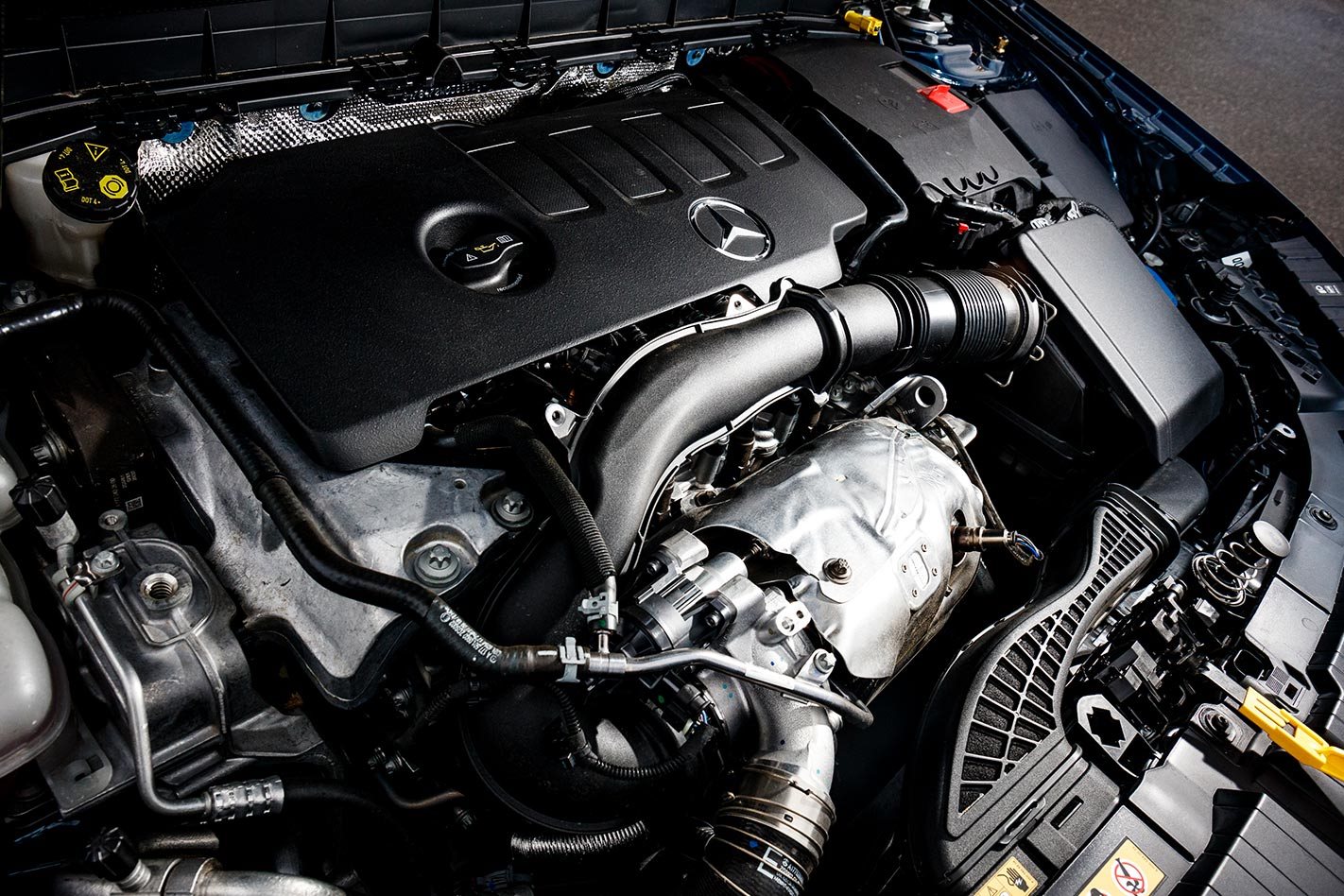
Ah the GLB 250, the gift that keeps on giving, and its engine and transmission are no exception. A 2.0-litre turbocharged four-cylinder – similar to the one in Mercedes’ A35 hot hatch – takes petrol and turns it into 165kW and 350Nm of torque. That decent output is sent to all four wheels via an eight-speed automatic transmission.
It’s by no means going to take you across the Simpson desert, but the 4Matic system feels planted, while the suspension is confidently firm on gravel and dirt but not uncomfortable thanks to active dampers which enable an incredibly smooth for such a small car.
Where the GLB 250 will live most of its life is on tar though and the 4Matic system is a gem here too. Rather than a part time system, the Merc’s AWD is constantly dealing power to the wheels with most traction, so you never have wheel slipping and the confidence to enjoy a good road is always there.
Benz went a step further and equipped the GLB 250 with its new eight-speed dual clutch automatic transmission, which means the gear changes are so quick and smooth you would be hard pressed to realise you’ve even shifted up.
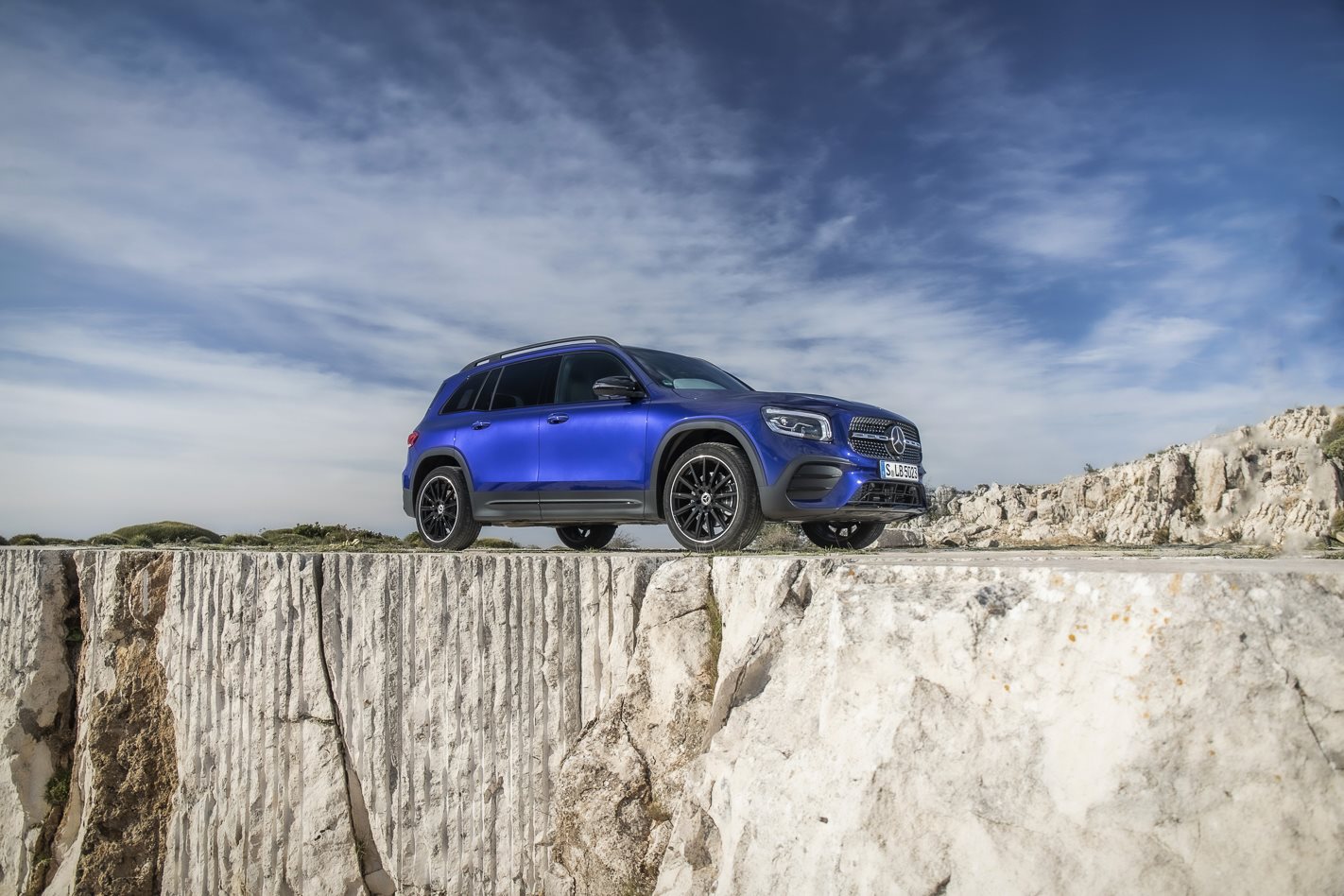
Standard is an off-road setting which doesn’t raise the car for greater ground clearance, sprout a snorkel or throw Maxtrax under the wheels, but the GLB is not intended for taking on Kakadu. It will however, take you to a scenic spot where a two wheel drive won’t go.
Off-road mode also changes some of the functions on the car. You get downhill speed regulation (hill descent) to reduce load on the brakes when negotiating a steep, loose track, and it locks the torque split to 50/50 front and rear to boost traction. Cleverly, the headlight globes that usually act as cornering lamps in town are switched on and allow the front facing camera to act as another set of eyes for you when crawling through an unknown area at night.
How safe is the GLB 250?
As you might expect, the GLB 250 has a full five-star ANCAP safety rating and even pedestrians are looked after with and ‘active bonnet’. In the event of colliding with a pedestrian, the bonnet unlatches and reduces the severity of the impact.
The safest place to be though, is inside the GLB with nine airbags throughout the cabin including full side curtain airbags from front the rear on both sides.
Like most Mercedes, it also has pre tensioning seatbelts to reduce the chances of ‘submarining’ and to increase the effectiveness of the restraint systems. That’s in addition to the myriad of standard driver assistance and safety tech we have come to expect on from the German brand.
How much does it cost to run the GLB 250?
We had the GLB 250 for a week and racked up just under 700km of town and country driving from of a single tank of fuel. That equates to about 8.5L/100km, 0.8L more than the 7.7L/100km combined cycle Mercedes claims, but filming duties hardly qualify as ‘regular use’, so we can allow a little dispensation here.
Benz’s vehicles now have one year/25,000km service intervals and a capped-price service model for the first three years of ownership. Therefore, servicing the GLB 250 will cost $2650 over three services and 75,000km.
A five-year/unlimited km warranty is also included with all new Mercedes passenger and SUV models.
Verdict
The GLB 250, as Mercedes claims, is a thoroughly thought out machine. Everything feels like it belongs where it is without ever feeling pretentious or excessive. Granted, there are a couple of niggles, including some of the driver assistance, which might be a bit of a nuisance. Generally though, most owners would enjoy and appreciate the rich list of kit, rewarding drive and practical features – both high-tech and simple. The GLB 250 is a lot of car for the money.
It would be a shame to see Mercedes’ cracking new model resigned to the school run because it’s a fun little SUV with so much more to offer at a sub $80k price. The GLB is another facet in Mercedes’ broader strategy to target and appeal to a younger demographic, but there’s no getting away from the fact that entry into the Three Pointed Star lounge still comes at a price.
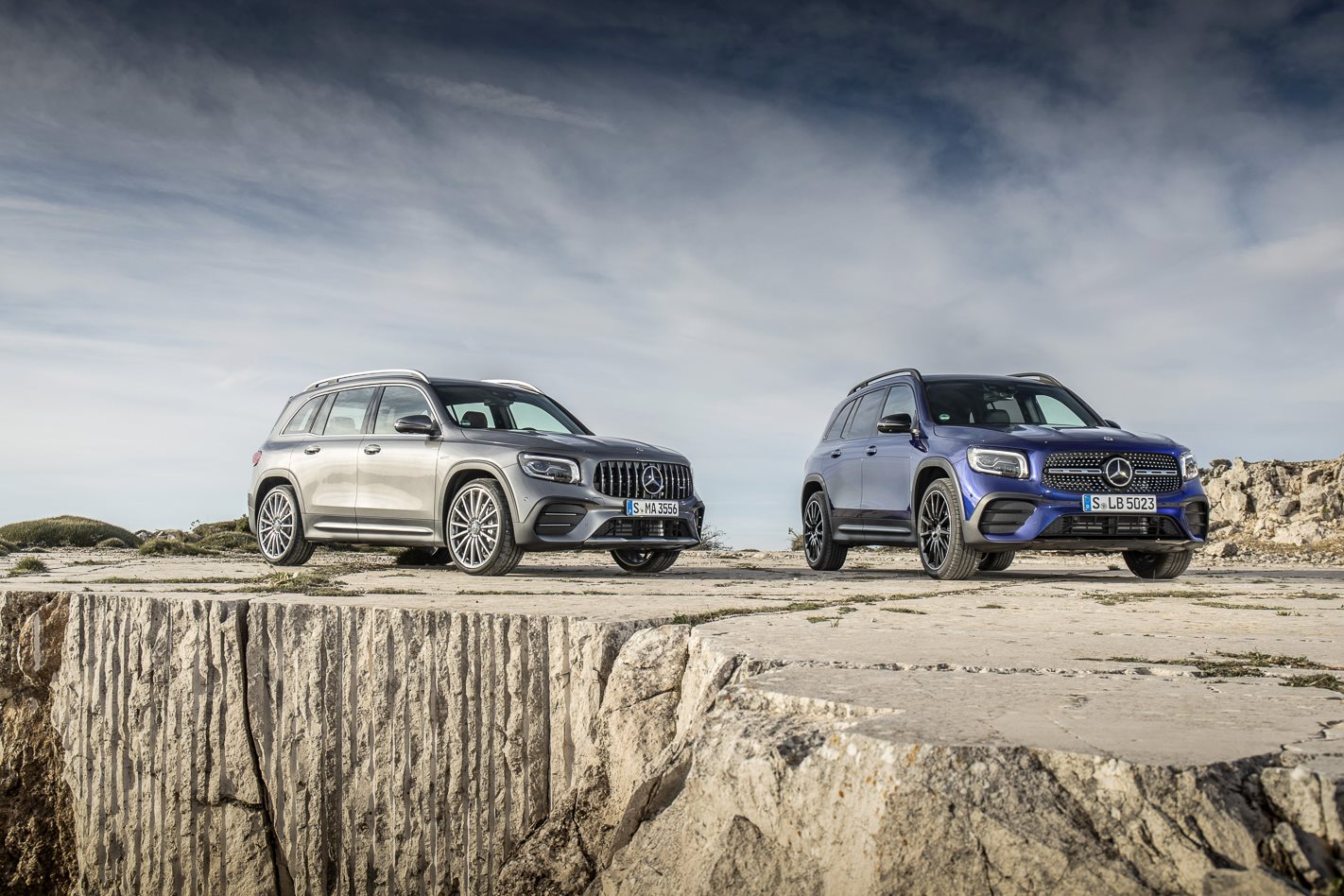
But where the GLB 250 really excels is making a case for downsized luxury. Models including the BMW X1, Volvo XC-60 and Land Rover Discovery Sport are proving that premium SUVs no longer exist exclusively in the large, V8-powered realm.
Every moment with this intriguing new Mercedes was enjoyable and we’re confident anyone’s impression of the GLB 250 would be similarly positive.
Rating
Rating Breakdown: 8/10
Value (judged on price, specs v competitors) 8/10
Safety (ANCAP, safety inclusions, child seating) 9/10
Running Costs (warranty, servicing, fuel consumption) 7/10
Comfort and Practicality (all seat positions, cargo space, ease of use) 8/10
On the road (engine/drivetrain, ride and handling) 8/10
What we like:
Comfortable, spacious, fun and light. Always a pleasant place to be.
What you might not like:
Cheap indicator sound, some intrusive safety features. Compromised rear leg room for over six-footers.
