
It’s the way I was taught, it’s the way you were probably taught, and it’s the way we’re probably teaching our kids.
And we are all wrong.
If you ever wondered what the right way is to navigate roundabouts in Australia, how to navigate a multi-lane roundabout, or even who has the right of way when merging, we can almost guarantee that the majority of drivers are giving way to traffic on their right, and this, without exception, can earn you a ticket in every state and territory in Australia.
A roundabout is, of course, a traffic device that was originally designed to replace intersections. They also work to reduce the instances of head-on collision, and are designed to keep traffic flowing through junctions and intersections.

However, there is a widely held misconception that, upon approaching a roundabout, a driver is only required to give way to traffic on their right that is already in the roundabout. This is incorrect.
Roundabout rules in Victoria and NSW, as well as all other states and territories, expressly state that a driver is required to give way to ALL traffic in a roundabout.
When entering a roundabout, a driver must give way to any vehicle, including bikes, in the roundabout, as well as any tram or light rail vehicle entering or approaching the roundabout.
In many cases, this does mean giving way to vehicles approaching from the right. However, a vehicle may have entered the roundabout ahead of the driver from the left, and the driver will have to give way to this other vehicle to avoid a collision.
Fail to give way to a vehicle in the roundabout, and you could be up for a nasty fine. ACT roundabout rules are the most stringent, with a $451 fine and three demerit points docked from offending drivers. The same offence carries a $330 fine in NSW and a $378 sting in Queensland.
It’s a relatively affordable $159 in Victoria and Tasmania, and ‘just’ $150 for breaking roundabout rules in WA.
We’ve also been asking whether you can change lanes in a roundabout. The answer to this comes down to the same thing as changing lanes and overtaking: the line markings. A multi-lane roundabout will usually have direction arrows painted on the road surface ahead of each junction point, and these serve as the first point of reference.
For example, the left lane of a two-lane roundabout will often feature a left-turn arrow incorporated into a straight-on arrow. This means you have a choice of taking a left exit or proceeding ‘straight’ through the roundabout.
If the roundabout is marked with solid lines throughout, you’re locked into your lane choice.
When it comes to indicating when exiting a roundabout, that boils down to courtesy and common sense.
Just like exiting any road, drivers have to signal left when leaving a roundabout if it’s practical to do so and turn off the indicator as soon as they have exited the roundabout.
When travelling straight ahead on a small single-lane roundabout, it may be impractical to indicate left when exiting. However, on larger, busier roundabouts, it can help traffic flow if you can briefly indicate your intentions to drivers waiting to enter the roundabout. It’s not a rule, however, and behaviour varies from state to state.
Supercars has declared that it is postponing the first half of its 2020 season, with just a single round in the books.
Tasmania, Auckland and Perth will have their respective rounds rescheduled until later in the year, mirroring other race series around the world.
More coronavirus news
- Live blog: AGP cancellation as it happened
- World motorsport season delayed for months
- Global car industry set to tank
“Our sport is a visceral experience and rather than run without crowds, we have decided, along with our key broadcast and government partners, to delay any further racing until June,” he said in a statement.
“Tasmania, Auckland and Perth events will all be postponed until later in the year, not cancelled. Fortunately, our calendar this year enables us to do this.”
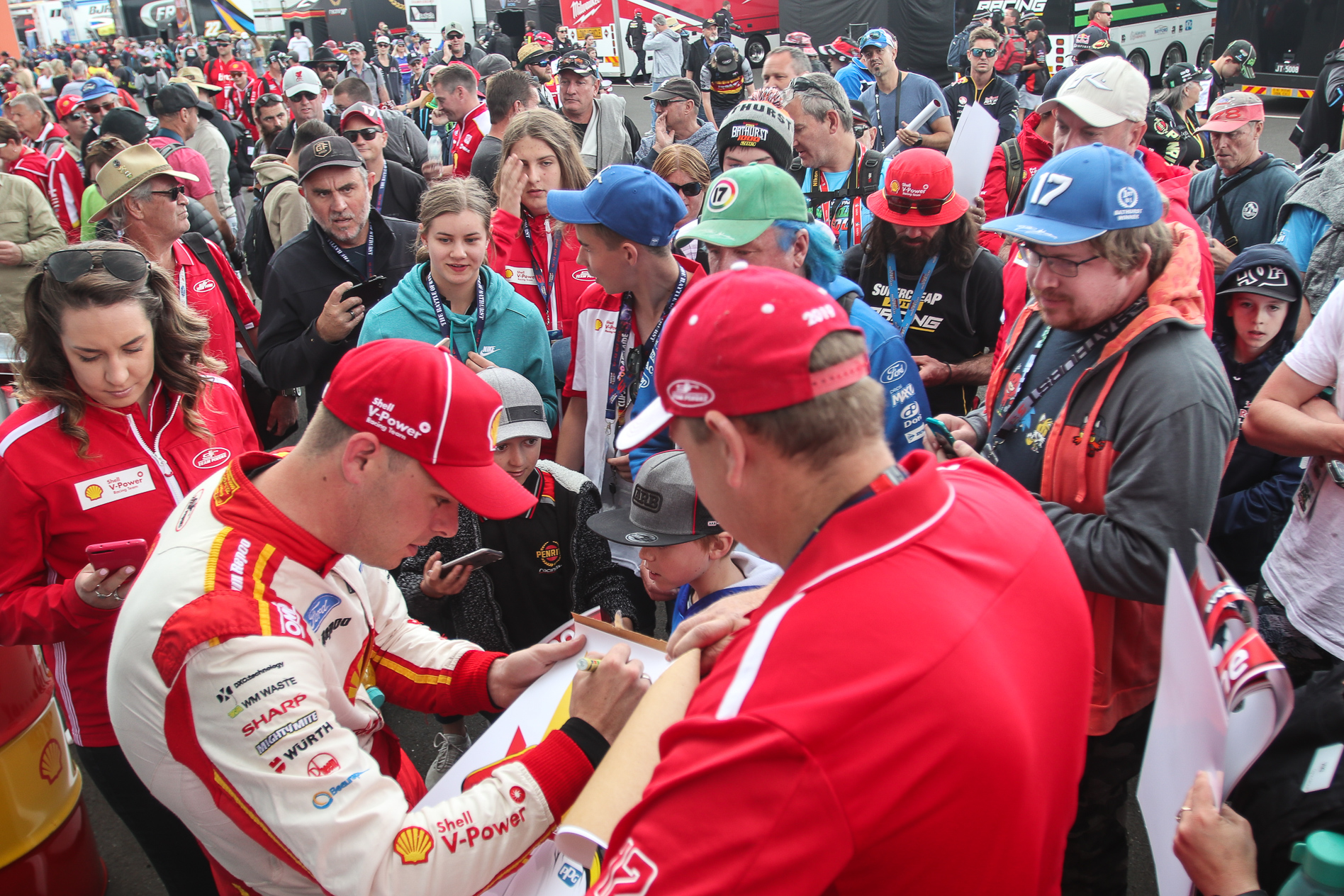
Huge crowds at the Bathurst 1000 last year
The series’ hand has been forced by onerous restrictions on travel across the world, including a ban on international travel and compulsory self-isolation periods on both arriving travellers and people travelling to New Zealand.
While the Adelaide 500 race went ahead as scheduled, the second round of the series at the ill-fated Australian Grand Prix was cancelled after Thursday qualifying.
Seamer said that the series still aims to present 14 rounds of the championship in 2020. It may need to take a leaf from F1’s book and run abbreviated race meetings, which may take the form of double-header weekends or single-day events.
Queensland Raceway’s owner John Tetley told speedcafe.com yesterday that he was willing to work with Supercars, despite the fact that his track was dumped from the 2020 championship.
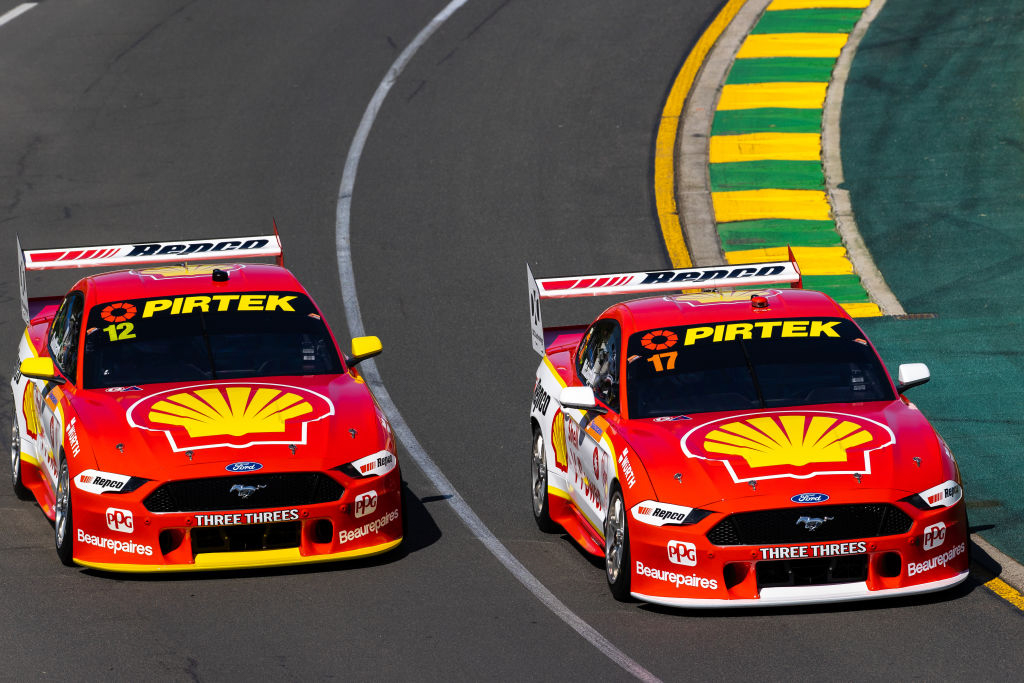
Teams practised and qualified at Albert Park before the meeting was abandoned
“Supercars’ priority is to deliver the 14 round 2020 championship for our fans and partners, irrespective of the dates,” said Seamer. “Bathurst will obviously proceed on its scheduled date. We have a plan for how we can make that happen and will begin discussions with all of our stakeholders over the coming days to lock this in.”
Team owners concerned over late scheduling
Team 18 owner Charlie Schwerkolt says it’s “one of the most incredible situations I’ve ever seen in my whole working career or for anyone at the moment. These are certainly uncharted waters.”
“First and foremost we have to look after all our staff and the team. It’s a family here and we are going to look after them as best as we possibly can,” he said.
“I can’t believe we’re not going to race for three months, but we have a big gap now so we just have to work out how we logistically manage the remainder of the year. We’ll still go over to Auckland, we’ll still go Tasmania, Perth and Bathurst and all of those rounds but it’s going to be a massive back end of the year.”
Schwerkolt said that working out how to juggle the back end of the season is at the front of his mind at the moment.
“With the potential of back-to-back races we’ll be doubling-up truck drivers and changing how we go about our regular processes to make sure we make these events happen and put our best foot forward in every race,” he said.
Charlie Schwerkolt (r) with drivers Mark Winterbottom (l) and Steve Richards
“We have an incredible fanbase and I appreciate all the messages of support from all of our partners and sponsors that are involved with the team. We are all so thankful for everyone’s support going through this period but we’ll do our best to look after everyone and come back firing when the cars roll out again.”
DJR Penske thanks fans for understanding
“We have taken direction and advice from Supercars management, government and health experts and we look forward to being able to return to doing what we love soon,” said Dick Johnson via a statement from DJR Team Penske.
“As we take this break, we wish nothing but good health for all of our members, Supercars fans and the wider Australian community. Please listen to the authorities, and do everything they ask as we try to slow the spread of this virus.
“We are proud of the way our fans have responded on the many social media platforms in recent days, and we appreciate your patience and support while we work through this extraordinary situation. For now, look after yourselves, your families and your communities.”
Supercars eSport virtual series announced
In the meantime, the championship is looking towards online racing to keep fans engaged, via a e-sports series that will star its principal drivers and be broadcast on cable TV. An official Supercars series is already hosted on US racing platform iRacing, with many of the series’ active drivers taking part.
“We are unique and fortunate in that we are able to simulate our racing via eSports,’ said Seamer.
“So, between now and late June, Supercars will host, via Twitch, Fox Sports and Kayo, an eSeries Championship where fans will get to see our stars battle it out in a virtual world while we wait to go racing again for real.”
Meanwhile, the travel bans have cast doubts on the Indycar future of Supercar champion Scott McLaughlin, who was set to tackle some races this year.
Shannons Nationals postpones Bathurst 6 Hour
In late news, Motorsport Australia (formerly CAMS) has finally decided to postpone the opening two rounds of the Shannons Nationals, which covers TCR and S5000 amongst other categories, amidst frustration from teams and competitors about the lack of a decision.
“A new date will be announced [to replace round one at Sydney Motorsport Park in late March] in due course, with Motorsport Australia and ARDC to work closely together to find a suitable option for all categories scheduled to be part of the opening round of the season,” read a statement.
“For the HiTec Oils Bathurst 6 Hour, the decision was made to restructure the event, the second round of the Shannons, which will now be part of this year’s new Bathurst International event in November, 2020.”
Subaru’s Impreza WRX is one. And Mitsubishi’s Lancer Evo is another. Even Ford’s XR8 and Holden’s Commodore SS are considered the road-going versions of V8 Supercars, kind of. Glamour by association, I think it’s called. Now you can place the Renault Sport Mégane on that list.
This review was originally published in MOTOR’s September 2006 issue
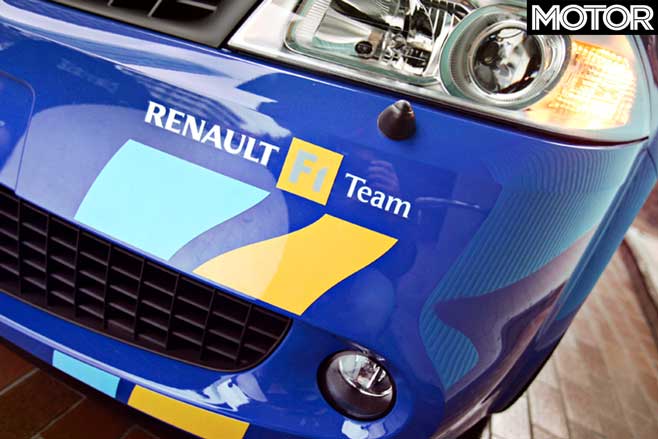
After Renault and Alonso snaffled both the 2005 Drivers’ and Constructors’ Formula One trophies, the Renault PR machine decided that something a little more special than just a commemorative mug was in order. Enter the (and take a deep breath) Renault Sport Mégane 225 F1 Team Limited Edition. We’ll call it the F1 for short.
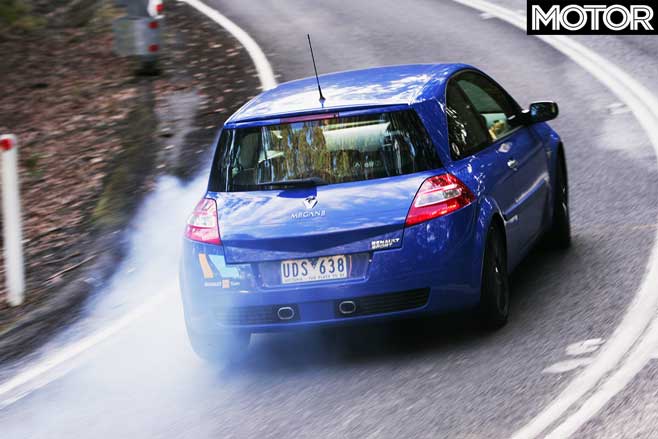
Thankfully those same Frenchies decided their commemorative car was best styled off the new three-door Mégane II. This update offers a prettier face and an ever so slightly re-styled rump.
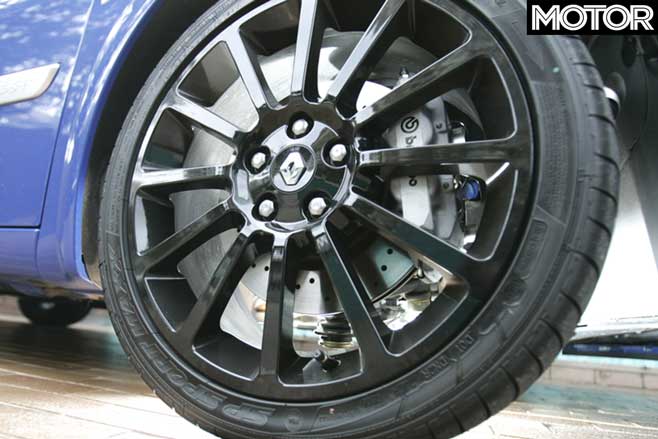
The ‘black-gloss’ 18-inch lightweight alloys and the matching wing mirrors lend the three-door F1 plenty of visual aggression. It also gets funky looking blue and black sports pews, but we miss out on the Recaro seats that all OS cars cop because they don’t meet our ADRs. Bummer.
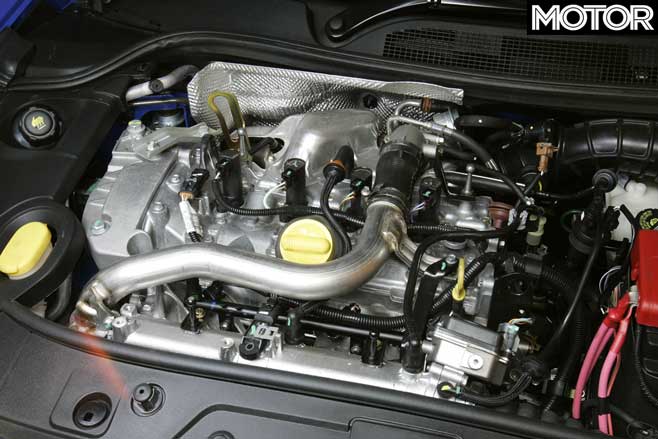
Sadly the Formula One stickers don’t equate to extra oomph, and the Mégane F1 has to make do with the Mégane 225’s 2.0-litre turbocharged four-cylinder which bangs out 165kW (at 5500rpm) and 300Nm. But, and this is important, 90 percent of that 300Nm is on tap nice and early from 2000rpm before peaking at 6000rpm, so there’s always plenty of shove available. The engine’s smooth, but there’s precious little noise. A car as angry-looking as this should snap and crackle on over-run, like the MINI, or the old Golf R32. But it doesn’t and that’s a pity.
But no-one ever knocked the Mégane for not having the ability to get down and boogie. Show it a straight stretch of road and the thing just rolls along like thunder. Pick a gear, any gear and the Mégane will effortlessly build speed regardless of the incline – tt really is the V8 of turbo’d hot hatches. It shirks the peak and rush of cars like the WRX, offering instead a thick and consistent dollop of creamy torque. And that’s the stuff that makes a car feel fast, anyway. Up to a point.
And you reach that point just as you grab second gear on your way into a slower corner. Despite the awesome mid-corner grip offered by the Dunlop SportMaxx rubber they can’t keep the F1 from falling into understeer. Maybe it’s because the weighty donk hangs slightly over the edge of the front axle – just enough to affect its poise in slow corners, anyway. It’s way better in faster corners and is much more adjustable. The steering gets better, too, once the road opens out. It loads up nicely, and while it’s not exactly Porsche communicative, it does keep you in the loop with a low whisper.
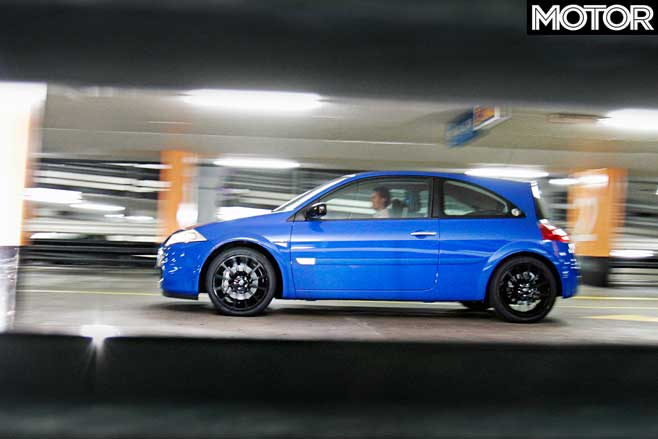
The six-speed manual ’box is a slick shifter even if the throws are a little long; then again, you don’t have to stir it that often to keep it on the boil. But the pedals do need to be used, and they offer nothing in the way of feel. It’s hard to judge the clutch take-up point and the brake pedal needs a good shove before it reacts, too.
But the F1 stops all right when you do give the pedal a hit, as it runs the same Brembo rotors and four-piston calipers as the 225 Cup. Around town the F1 will stand on its nose at just the merest whiff of the brakes. But out in the open, when the wick has been wound out, they actually fade surprisingly quickly. They never completely go away, they just fade to a point and then hold.
The F1 rides on the Cup chassis but it gets re-jigged rear dampers. And these new dampers have made the F1 a much better car; it’s more compliant, more settled and better able to exploit the tyres’ grip – in faster corners. The bulk of the car’s grip comes from its tyres, which get worked pretty hard. After just one day of being fanged around, the F1’s Dunlops were very much the worse for wear.
The three-door F1 is truly in a class of its own; style and aggression all rolled into one. It’s never going to be as quick in tight stuff as either a WRX or a Golf GTI, but in opening third- and fourth-gear bends it’s got the Golf’s measure and is capable of level-pegging the Rex.
If you want one, and you should, then you’d better get in quick. There are only 30 slated for Australia and by the time you read this it’s very likely that they’ll all have been sold. Go on, hurry!
Then again, the way Alonso’s going this year there’s every chance Renault will have to do something equally as special to celebrate next year.
2006 RENAULT SPORT MEGANE 225 F1 TEAM LIMITED EDITION SPECS Engine: 2.0-litre, inline-4 turbo Power: 165kW @ 5500rpm Torque: 300Nm @ 2000rpm Drive: front-wheel
For better or worse, smartphones dominate our daily life. Think about how much of your day-to-day doings, both professional and social, rely on that little glass-faced rectangle in your pocket. In fact, the odds are pretty high that you’re reading this article on your phone right now.
For obvious reasons, there are some areas where phone usage is frowned upon – or straight-up illegal. However, while whipping your phone out during a funeral will forever be in poor taste, smartphone use in cars can be somewhat kosher – provided they’re integrated properly.
Right now, Google’s Android Auto and Apple’s CarPlay are the best means of bringing your smartphone’s internet-enabled functionality to your car (head here to learn more).
To help those looking for the ability to bring some internet-enhanced infotainment to their next new car without having to splurge on something from the prestige end of the market, we’ve compiled a list of the 10 most popular cars in Australia right now that feature either Apple CarPlay, Android Auto or both, ranked in order of year-to-date sales at the end of February 2020.
This list has changed significantly since we first compiled this list in October 2018 with Toyota and Mazda and since adopting the technology due to overwhelming public demand.
1. Ford Ranger
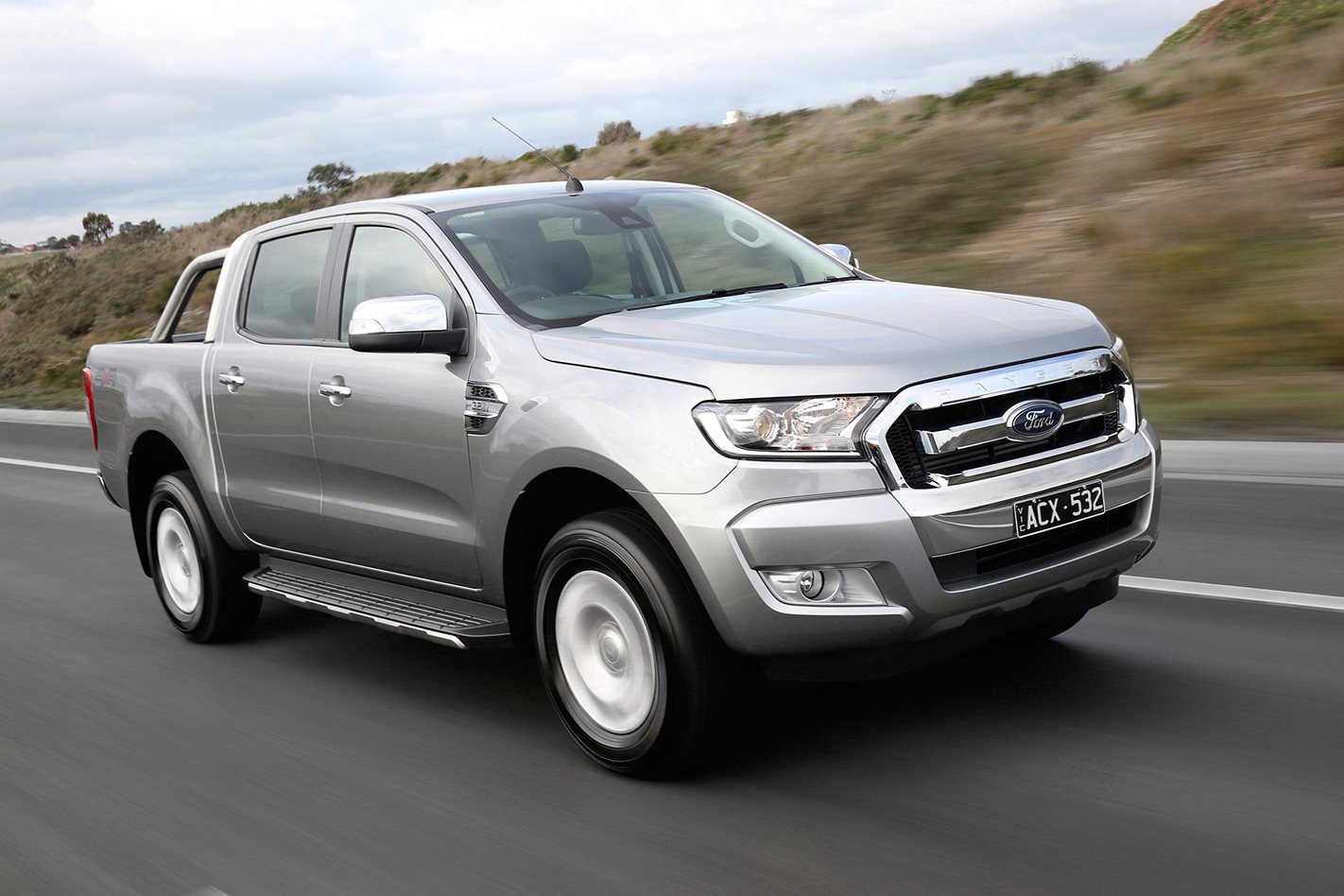
Ford’s top-selling vehicle brings smartphone mirroring functionality. For a while, it was only available in the higher-grade XLT and Wildtrak models, but it’s now available along with the SYNC3 infotainment system in the more affordable XL and XLS versions.
2. Toyota RAV4
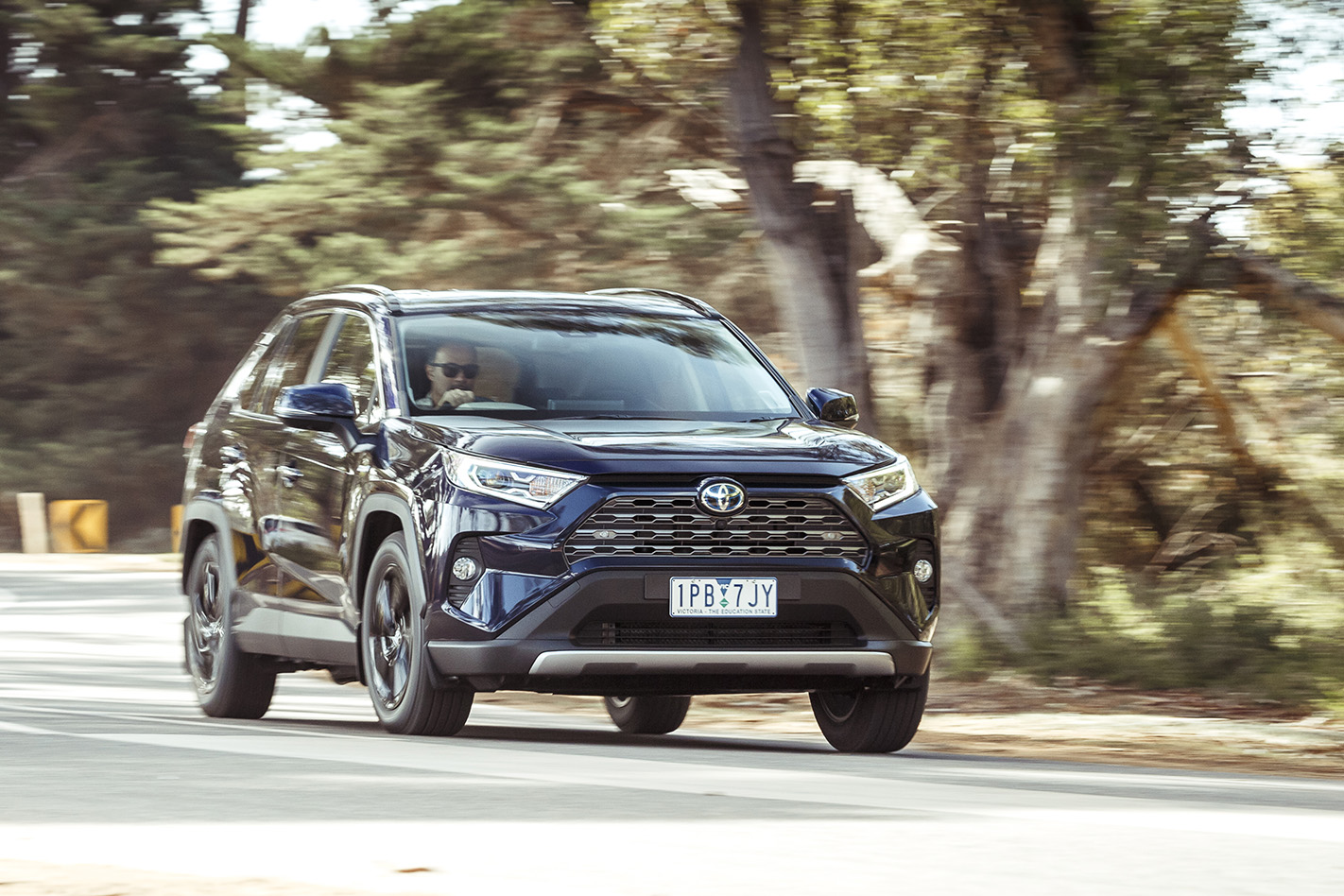
Android Auto/Apple CarPlay was added to the RAV4’s standard equipment list in November 2019 and it’s no coincidence that its sales figures have risen sharply since. Current model RAV4s sold prior to that date can have smartphone pairing retrofitted to the infotainment system by Toyota for about $200.
3. Toyota Corolla
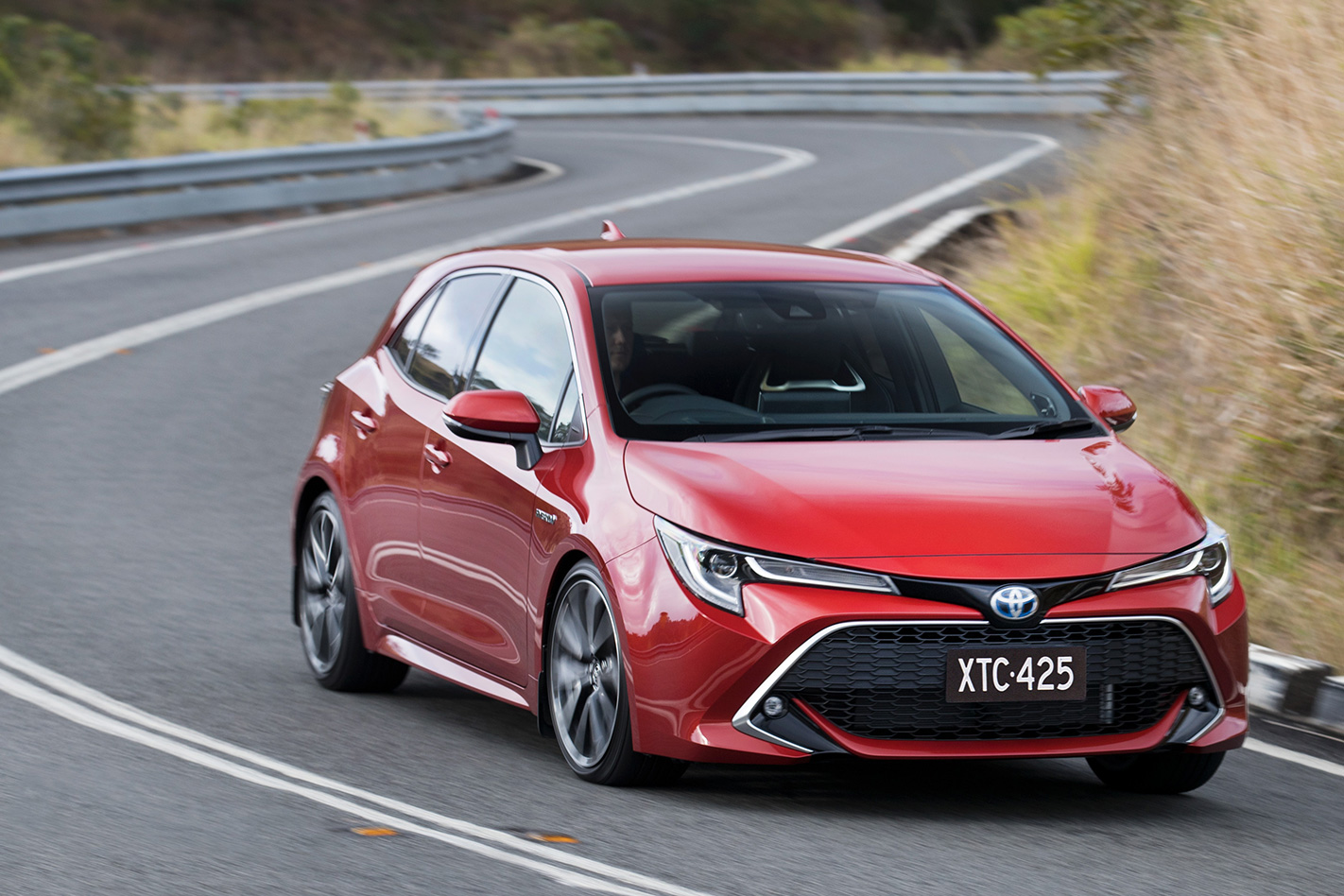
The Corolla was the first Toyota to gain Android Auto and Apple CarPlay, though like the RAV4 it had to wait, with the tech added in October 2019, more than a year after the hatchback first went on sale here. Like the RAV4, current-model Corollas sold prior to then can have the system retrofitted for about $200.
4. Hyundai i30
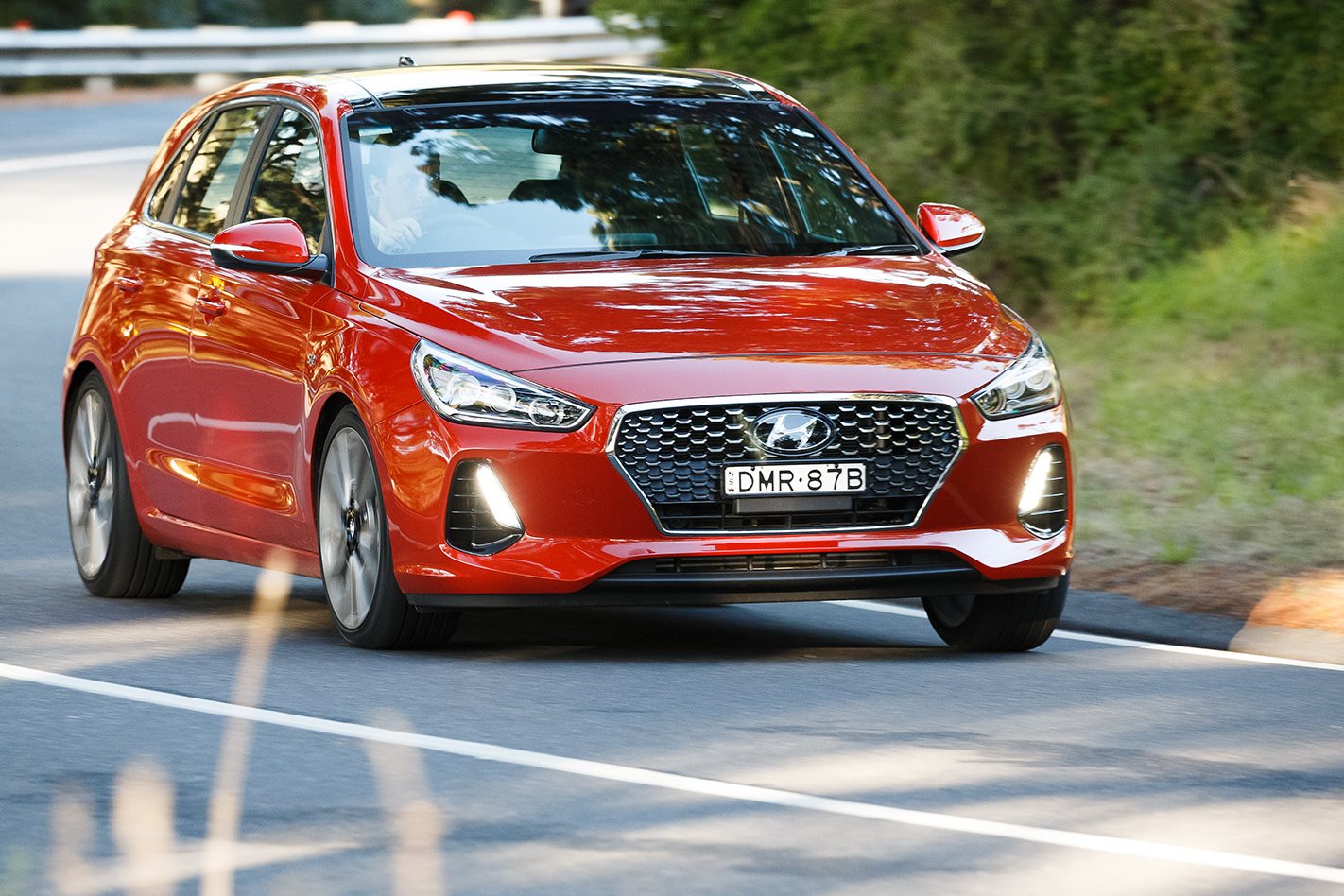
Hyundai was an early adopter of Android Auto/Apple CarPlay and it has been standard equipment in an i30 since the time when you had to pay extra for it in more expensive cars. All versions have an easy-to-view 8.0-inch touchscreen, and while the entry-level Go misses out on inbuilt sat-nav you’ll be able to use your favourite navigation app to help you get around.
5. Mazda CX-5
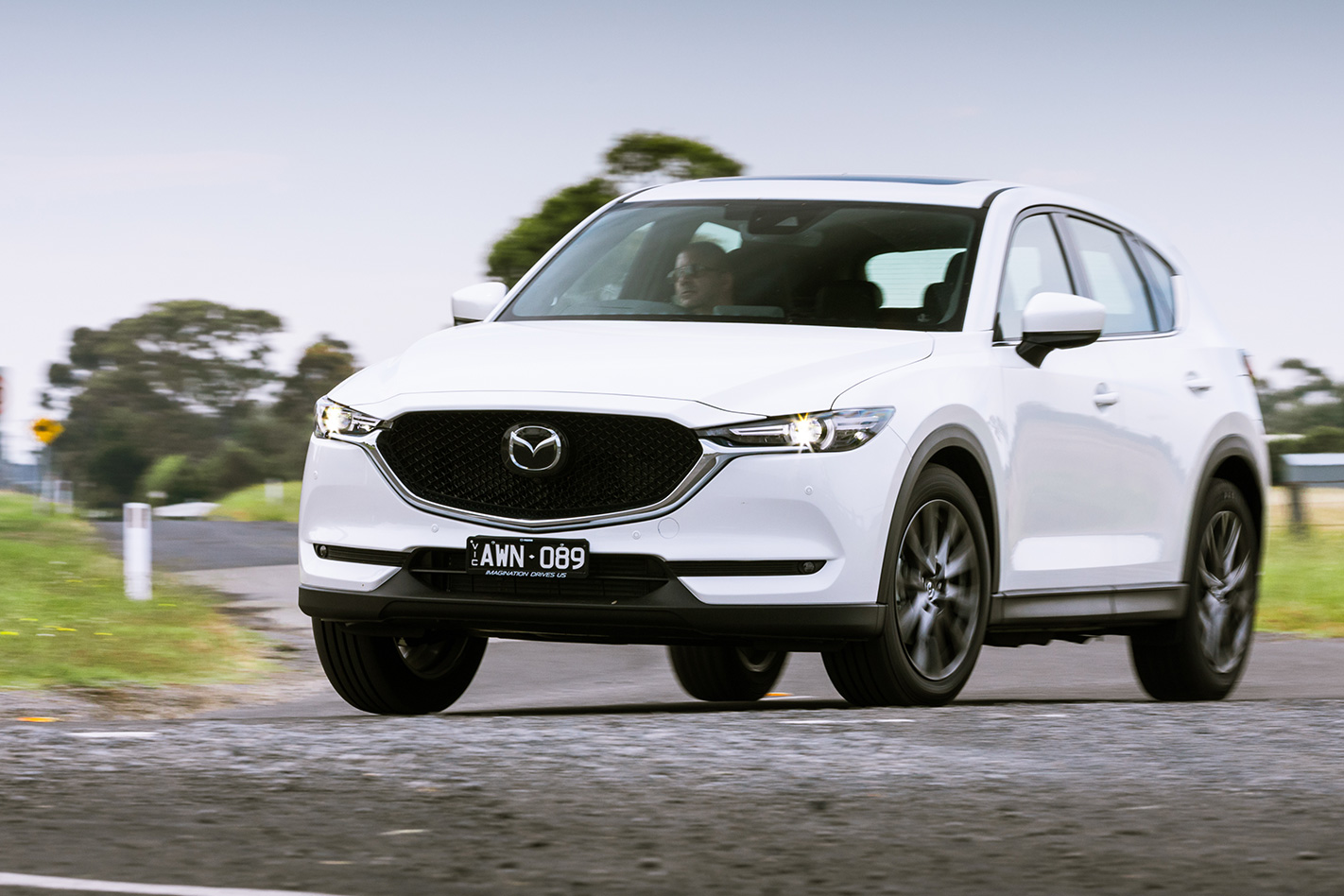
Mazda started rolling out Android Auto and Apple CarPlay with its model upgrades in 2018 and the CX-5 was one of the first to benefit. Both systems work really well with the brand’s MZD Connect infotainment system which has a rotary controller that makes it easy to scroll through apps and operate functions while driving. All Mazda’s with the MZD Connect system without smartphone pairing installed can have it retrofitted for about $500.
6. Kia Cerato
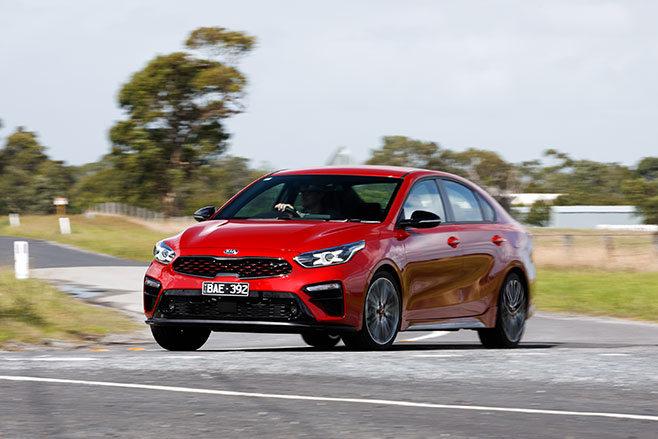
Kia’s mainstay model, the Cerato, is another smartphone-friendly vehicle, with Android Auto and Apple CarPlay now standard equipment across the range. All sedan and hatchback variants now come with an 8.0-inch touchscreen. Digital radio is also standard.
7. Mitsubishi Triton
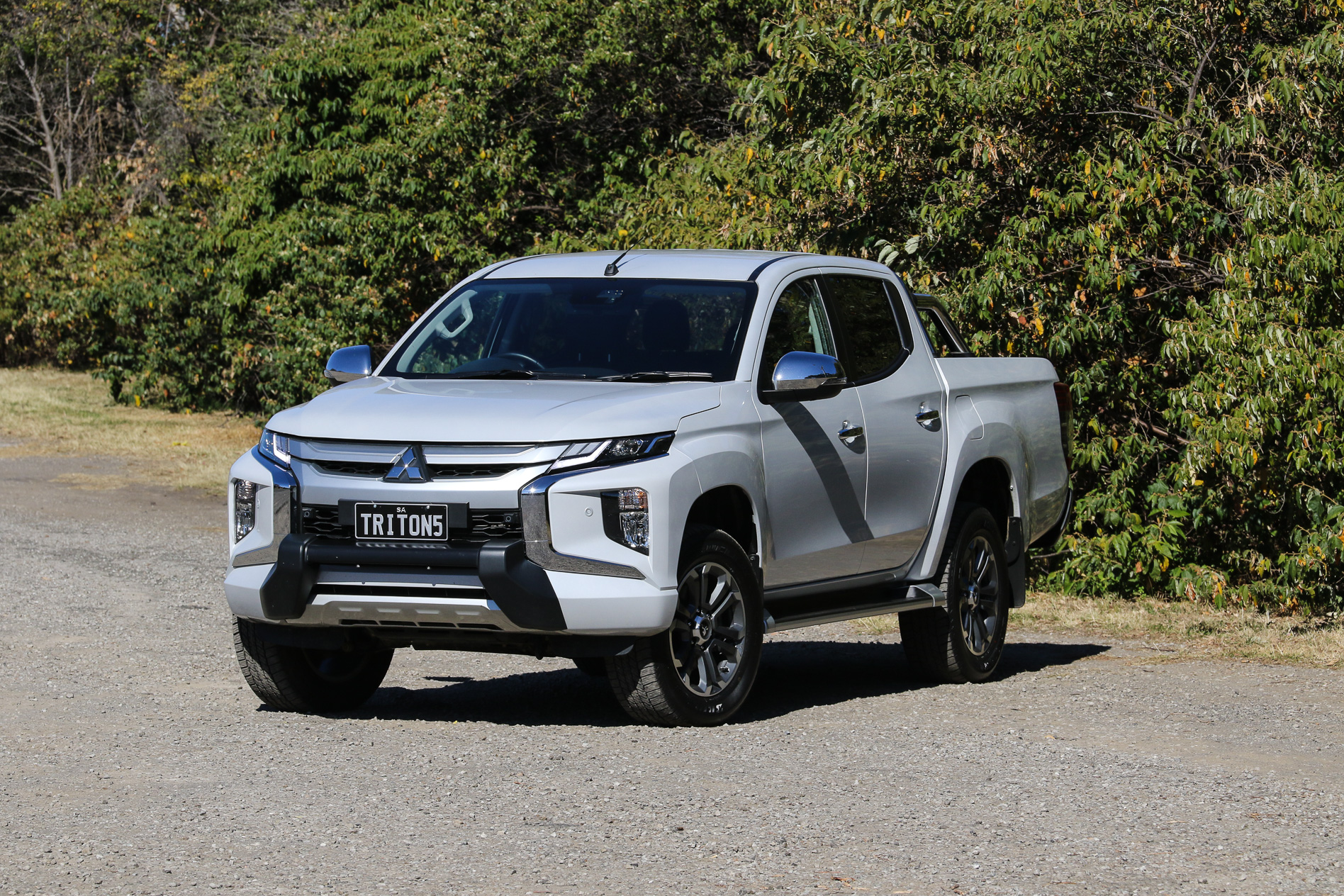
Like Ford, Mitsubishi also takes care of its tradie customers by equipping its Triton utility with smartphone mirroring, with all variants across the Club Cab and Dual Cab body styles getting Android Auto and Apple CarPlay. If you’re looking at a single-cab variant, however, you’re out of luck – as a bare-bones workhorse, that body style misses out on a more fully-featured infotainment package, and makes do with basic Bluetooth.
8. Mazda 3
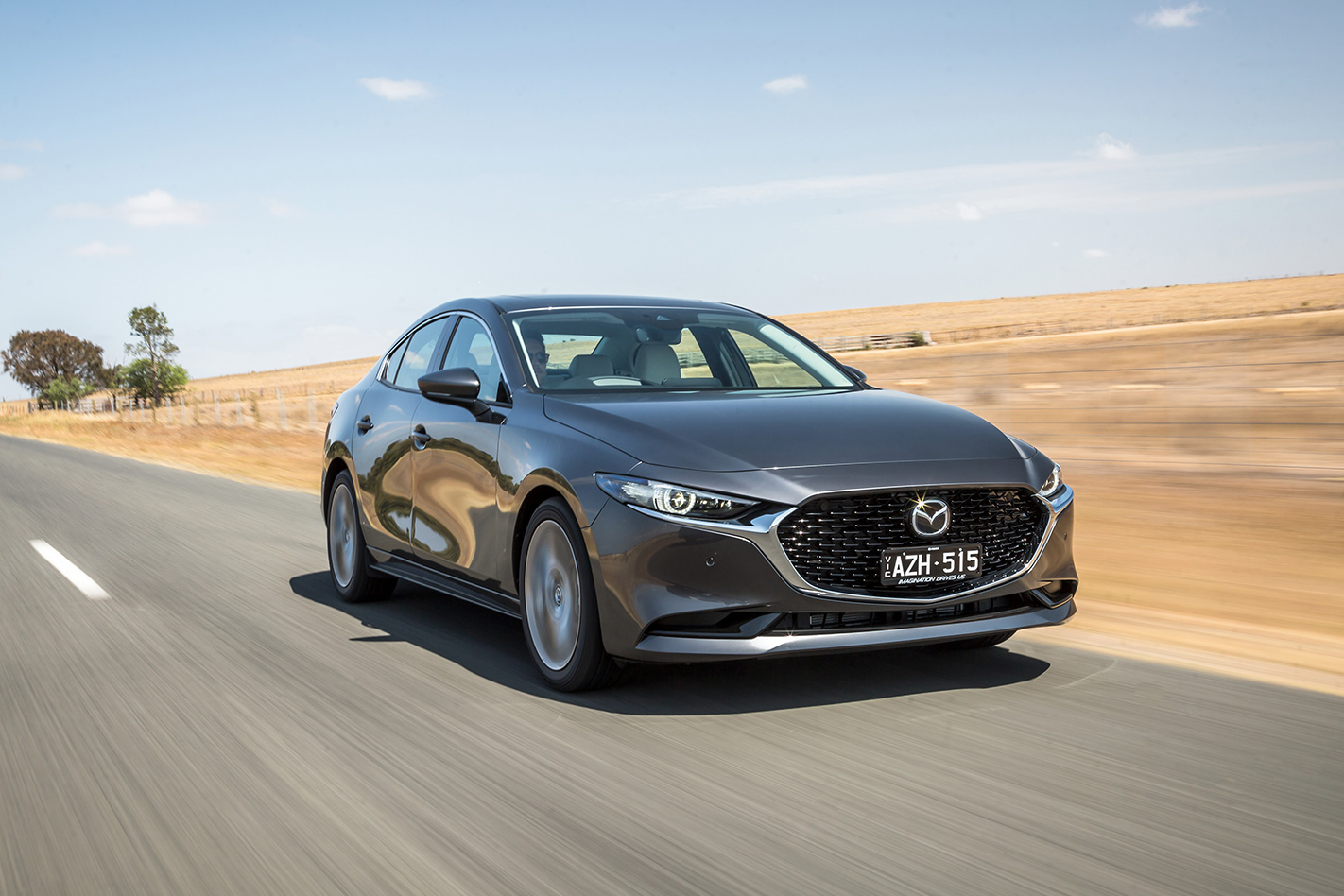
The fourth-generation Mazda 3 was the first Mazda model to arrive with Android Auto and Apple CarPlay, which is standard equipment across the generously equipped range. All variants have an 8.8-inch screen controlled by a dial on the centre console, which makes it easier to select functions while driving. If you have a previous-generation Mazda 3 with the MZD Connect infotainment system you can have smartphone pairing retrofitted for about $500.
9. Toyota Camry
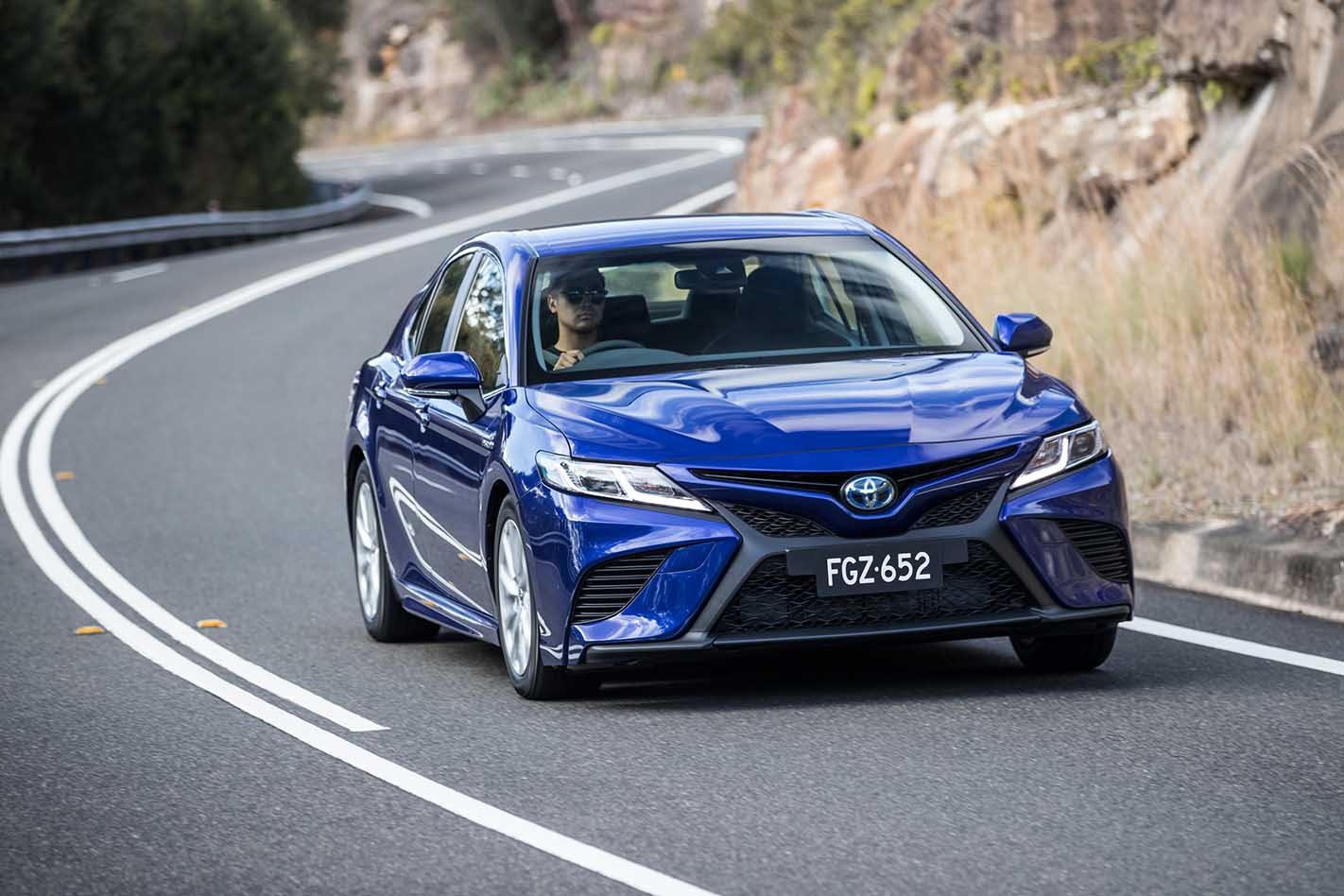
Australia’s biggest-selling sedan has Android Auto and Apple CarPlay fitted across the range that’s operated and viewed through an 8.0-inch touchscreen in all but the entry-level Ascent variant, which has a 7.0-inch monitor. The Camry range gained smartphone pairing at the same time as the Corolla. Like the Corolla, current model Camry’s sold prior to then can have the system retrofitted.
10. Mitsubishi ASX
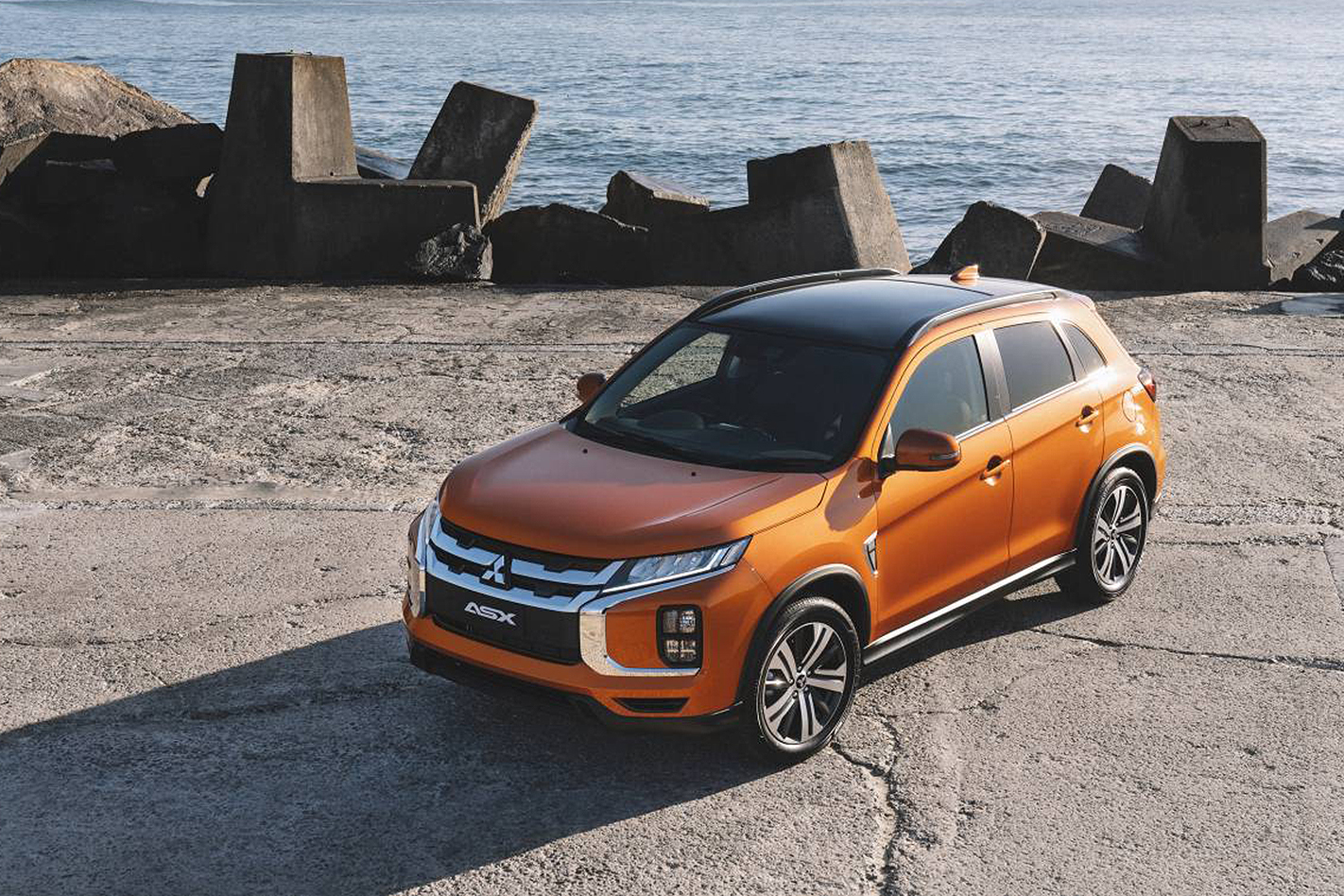
Neither Apple CarPlay nor Android Auto existed back when the current-generation ASX first went on sale. In fact, Mitsubishi’s now 10-year-old small SUV is about twice as old those modern smartphone mirroring systems, however, successive technology upgrades have kept the ASX up-to-date in terms of connectivity. An 8.0-inch touchscreen display is compatible with both Android Auto and Apple CarPlay from the base ES grade and up.
What Singer is to Porsche, UK-based Alfa Romeo restomodders, Alfaholics is to classic Alfa Romeos.
Renowned for its GTA-R build programme, which resto-mods Alfa Romeo’s famed 105-series coupes, the company has recently stepped up its game with the creation of a full carbon-fibre body for its latest build.
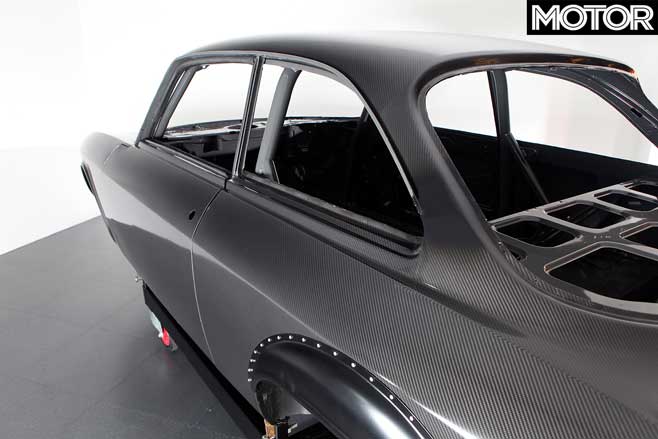
Destined for a build christened as the GTA-R 300, Alfaholics says that its carbon-fibre shell is 70kg lighter than its standard steel-bodied GTA-R builds, and represents a 38kg weight saving over its range-topping GTA-R 290 spec.
By comparison, the GTA-R 290 already features a number of lightweight fixtures, including being fitted with a carbon-fibre bonnet, bootlid, and door panels, and an “ultraleggera” titanium suspension package.
Considering that the GTA-R 290 tips the scales at 830kg, a carbon-fibre clad version of that would dip just under the 800kg mark, around the weight of a KTM X-Bow track toy.
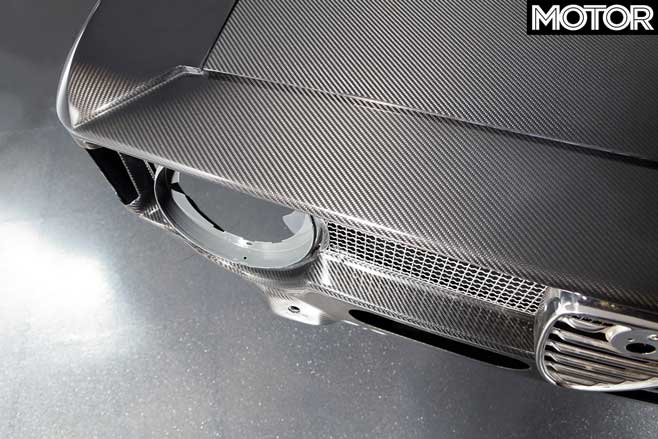
Fitted with Alfaholics’ bored and stroked 2.3-litre version of Alfa Romeo’s venerable inline-four Twin Spark engine producing 179kW and 271Nm of torque, the lighter body would be able to raise the build’s power-to-weight figure to “just over 300bhp per tonne (224kW/tonne)”, hence its GTA-R 300 moniker.
Like Singer, Alfaholics’ handiwork doesn’t come cheap. Reports put the GTA-R 290 price tag at around £240,000 (AUD$480,000), so expect the GTA-R 300’s price to be far north of that.
Figures from leading economists are pointing to a bloodbath in the retail sectors thanks to the ongoing impact of coronavirus in Australia, and the automotive sector won’t be able to escape it.
The car industry itself, meanwhile, is in crisis mode as coronavirus fears and tightening government restrictions around the world force the closure of factories.
Car sales set to tumble
Leading data analysts at Exante Data are predicting a huge downturn across key sectors of the Australia economy after what it calls a “series of missteps” by the federal government over the last few weeks, taking in the categories of recreation and culture, hotels, cafes and restaurants, and furnishings/household equipment.
It also sees huge downturns in the areas of the purchase and operation of vehicles as well as transport services, which includes taxi and ride-share operators.
“We are looking at a second-quarter GDP [gross domestic product] shock in the range of 20 to 30 per cent on a quarter-to-quarter annualised basis,” says the think tank, who has been tracking economic and other data around the coronavirus pandemic since early January.
If the forecasts are accurate, it means that the already-struggling local car industry will be under even greater pressure than it was coming in off a depressed 2019.
A best-case 20 per cent drop in sales in new cars, for example, means annual figures of new car sales will drop below one million units for the first time since 2009.

The exit of Holden from the Australian market will play a role in the declining figures, but for car makers on the margins, the next few months will be critical.
It’s being reported that Honda, for example, will make an announcement around the reduction of its dealership footprint in Australia later this month in the face of soft sales.
Who will be hurt in car industry shutdown?
Smaller players like Peugeot and Citroen will be under immense pressure as sales all but dry up, while bigger performers like Hyundai will be in head-office battles to maintain supply as its Seoul-based HQ grapples with multiple factory closures, slowdowns and parts shortages across its bigger territories like the US.
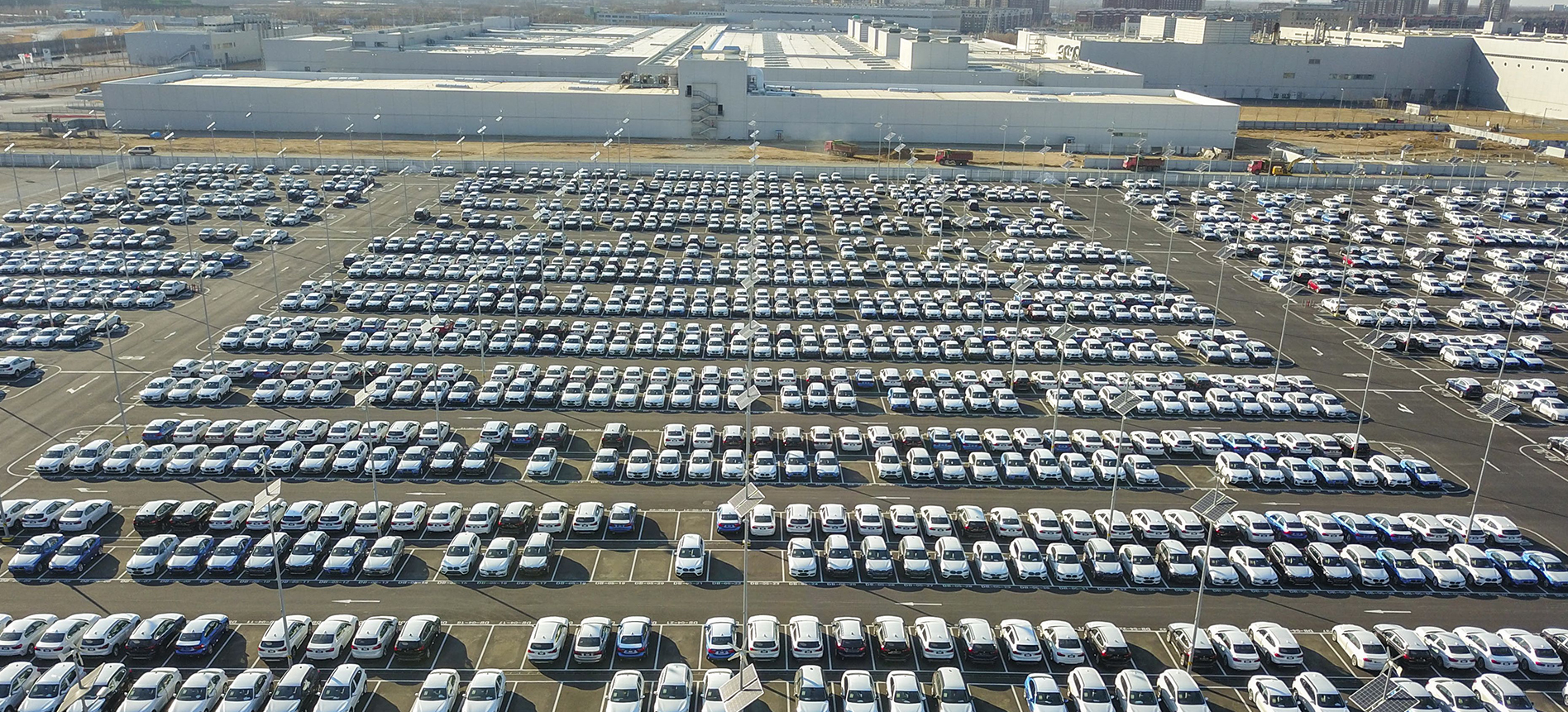
A slump in demand for work vehicles like dual-cab utes could affect brands like Ford and Nissan, who both rely heavily on ute sales to underpin poor performers in other categories.
Market leader Toyota is best placed to weather the storm, but history shows that it clamps down hard on discretionary spending and external programs when times are hard, which will likely affect Australian operations.
Why is the coronavirus affecting the car industry?
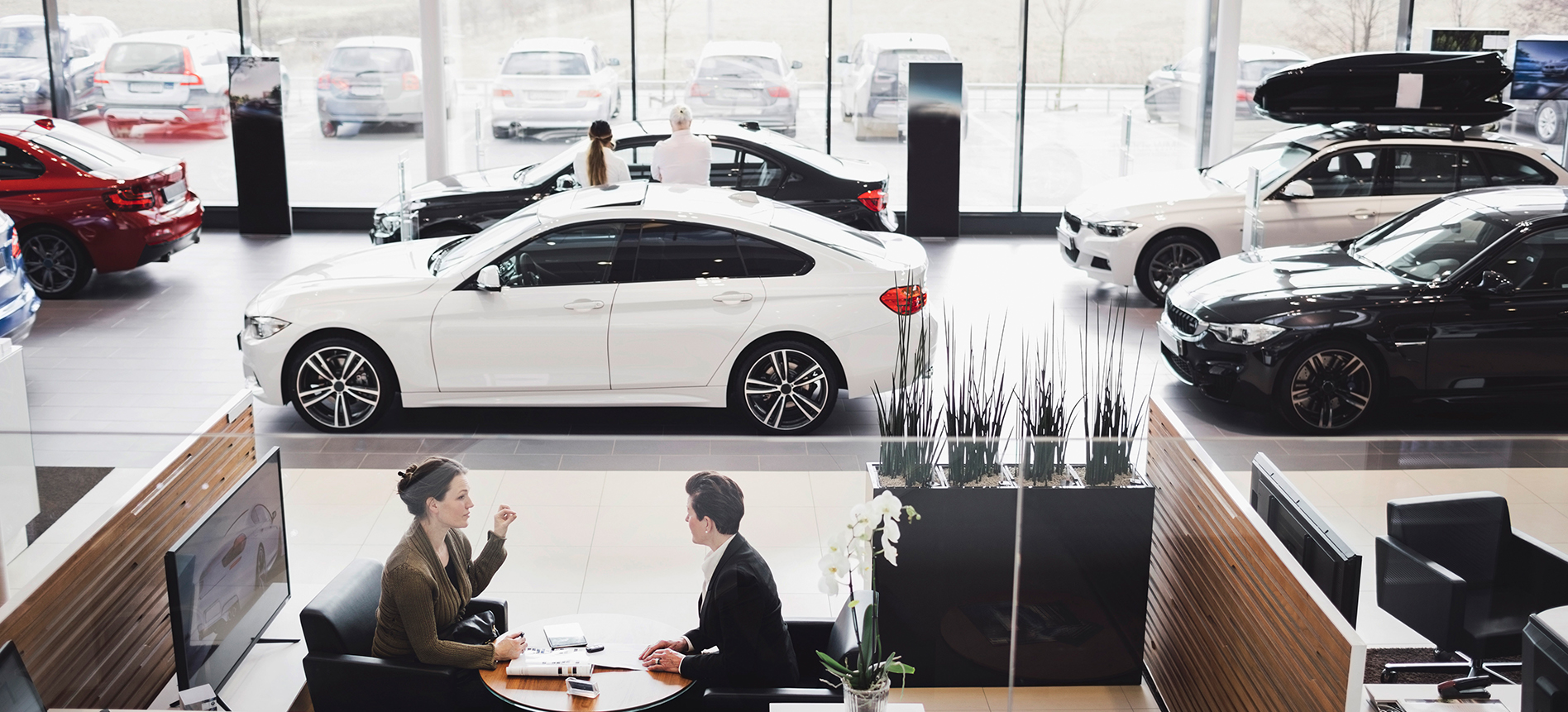
The effects of the global coronavirus pandemic are being felt in several ways. The most obvious indicator of slow sales is the fact that the community is being asked to practice social distancing, which is limiting people’s ability to physically visit new car showrooms.
As well, the growing concern of a recession hitting the Australian economy is stymieing retail growth across all sectors, with a slight lift in consumer confidence in February (after almost 18 months of decline) being the only glimmer of hope on the horizon for beleaguered business owners.
However, restrictions on travel and social gatherings imposed by the federal government will further erode customer confidence, as people prepare to bunker down ahead of an expected rise in coronavirus cases in Australia in the coming two months.
The practice of social distancing will also impact car-sharing and taxi services, as people opt to either use their own cars for essential trips or simply decide to stay put. More and more businesses – including many car companies – are mandating work-from-home policies that will also impact transport services.
Coronavirus scare cancels Australian Grand Prix
Ride-sharing services may claw some ground back through a rise in demand for food delivery, while the package delivery sector may also be able to weather some of the storm.
Secondary retailers like petrol stations, mechanics and even car parking stations will also feel the bite, as less people move around in their vehicles.
Global car industry grinds to a halt
On an industry side, there are almost more closures and plant idling than can be noted, especially in Europe.
- Mercedes-Benz had suspended production across Europe “The suspension applies to Daimler’s car, van and commercial vehicle plants in Europe and will start this week,” the company said.
- Tesla is unable to operate its main plant in San Francisco, thanks to ‘shelter in place’ provisions that apply to the county that the plant and most of its 10,000 workers reside in.
- Ford‘s plants in Germany, Romania and Spain have been idled for up to three weeks, though its UK plants are still running at the moment.
- Every brand in the Volkswagen Group, including all of VW’s German plants, Lamborghini‘s Sant’Agata plant in Italy, Skoda’s Czech plants and Audi‘s plants in Brussels, Germany and Hungary have been idled.
- PSA Group and Renault have both halted production, with PSA also closing its Opel lines in Germany.
- Toyota has suspended operations in Portugal and the Philippines, though it says its Japanese factories are operating normally.
- Nissan has closed its UK plant in Sunderland – home of the Juke – and is winding back production in Japan due to parts supply shortages.
- FCA has reopened a single light commercial plant in Italy, after reconfiguring it to provide more space between workers. The majority of its plants are closed, including its Ferrari factories in Italy.
It’s set to be a trying time for the automotive sector, but at least it won’t be alone.
“Hasn’t this been around for a long time?” That’s my first reaction as deputy editor Newman holds the keys to the Mercedes-AMG GLC43 over the partition between our desks and suggests I “review this”.
It has indeed been around for some time, but the GLC43 has just been facelifted as part of an update across the GLC range. If you have $120K to play with and have decided to join the legions of fast-SUV acolytes, you’re choices are likely this, a BMW X4 M40i or a Porsche Macan GTS.
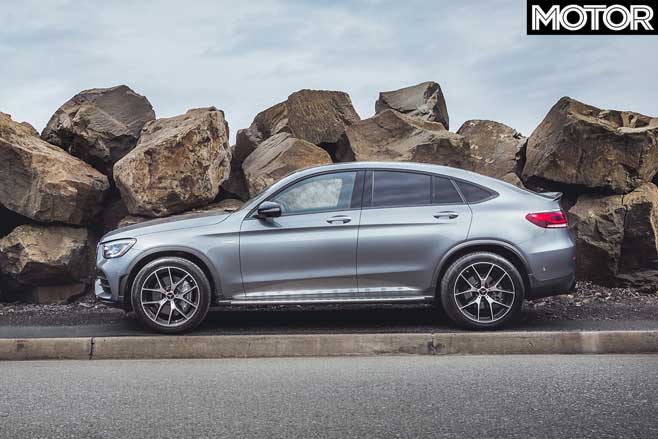
Of course, we can get into the argument that, if you enjoy driving and need the space, you should just buy a wagon. But here we’ll assume there is no other option… and that you’ve decided to opt for a ‘sportback coupe’ rather than a regular SUV and instantly lose the boot space you may have otherwise gained over a proper sportscar.Seats down, the GLC40 holds 1400 litres (200L less than the full SUV version).
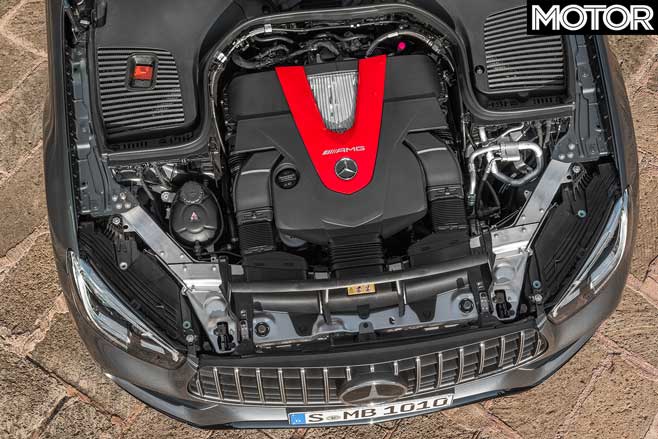
But you’ve got an AMG badge right there on the bottom of the steering wheel, so it’s likely the 3.0 litres up front is of more interest. And we’re pleased to say the ‘43’ designation now means the twin-turbo V6 now make an extra 17kW, totalling 287kW between 5500 and 6000rpm, with the same 520Nm (2500-4500rpm) as before.
The engine, even if not as characterful as AMG’s V8 (we have a GLC63 coming soon), delivers power purposefully and allows the 1855kg SUV to hit 100km/h in 4.9sec. AMG still has the magic touch when it comes to making excellent engines.
As soon as your right foot goes down the engine perks up relatively quickly; if it doesn’t, it’s usually down to the nine-speed dual-clutch taking a second to register what you’re after. Using the paddles is certainly useful at times, like when launching from a corner.
Having a gear ready isn’t the only part of cornering you really need to be prepared for in the GLC. It is an SUV after all, and there’s one thing we all know about performance SUVs: they’re tall and heavy, because they’re still SUVs. There’s a reason Alfa Romeo’s Stelvio placed last at PCOTY 2020. Putting your foot down late in the corner after entering relatively slowly is the best approach on a normal road in the GLC43.
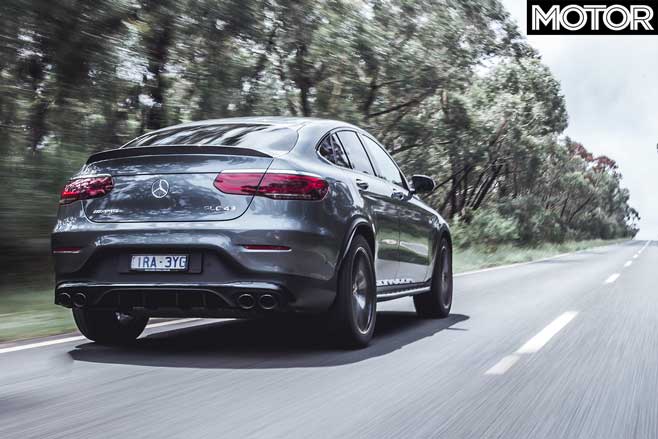
One good thing is that its suspension is at the comfort end of the spectrum rather than attempting to be sharp enough to really cope with its weight, which would have compromised its comfort on the highway. Not even those 20-inch wheels (wrapped in quite decent Dunlop Sport Maxx RT2s) make the ride rough, soaking up relatively harsh bumps and significant potholes impressively.
The facelift endows the GLC with Mercedes’ latest MBUX system, and it’s quite a good step up from the old infotainment aside from two relatively minor qualms. Firstly, the ‘hey, Mercedes’ prompt you have to use to activate voice control (much like ‘hey, Siri’) is set off by just the word ‘Mercedes’ or anything that sounded like it in a conversation.
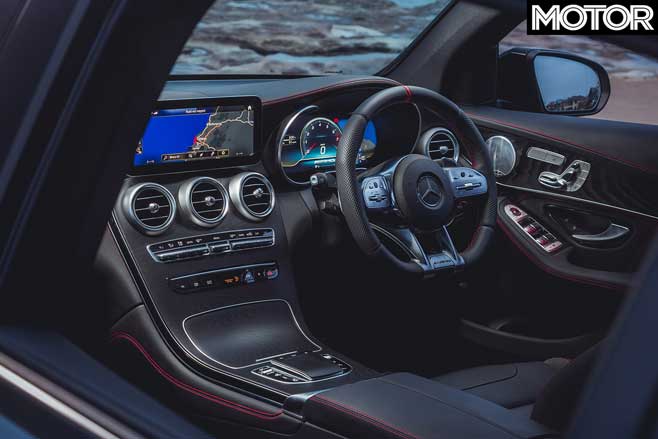
This might have just been an unlucky run, but it happened four times in a three-hour drive. The second thing is that using Android Auto seems to limit the functionality of the trackpad, which means using the touchscreen, and it’s distracting when the input method you’re used to no longer works. Sometimes it’s the little things…
Still, it could well be those little things that send a customer in the direction of the BMW X4, but the GLC is arguably better-looking (or less ugly; you decide). Then there’s the Macan, which brings a bit of badge prestige with it. It could also prove a stronger option as a driver’s car, but those who choose the performance variants of SUVs opt for a ‘coupe’ body style (judging by BMW X4 sales at least). And if you opt for a GLC43, you at least have a decent drive. For an SUV.
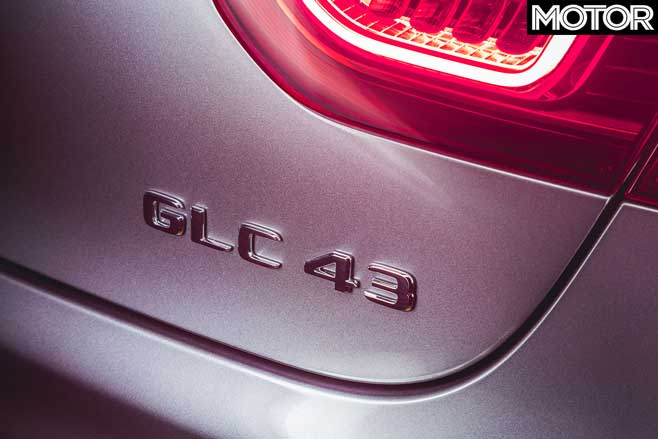
2020 MERCEDES-AMG GLC43 SPECS Engine: 2996cc V6, DOHC, 24v, twin-turbo Power: 287kW @ 5500-6000rpm Torque: 520Nm @ 2500-4500rpm Weight: 1855kg 0-100km/h: 4.9sec (claimed) Price: $117,400
In Victoria 1254 motorists are fined on average each day by the state’s 50 most profitable cameras alone.
Across the state’s entire camera network, the unit that issued the most infringement notices was at the intersection of King Street and La Trobe Street near the heart of Melbourne.
For the 2018/19 financial year, the camera dished out fines to 38,705 drivers – an average of 105 every day, or about four an hour.
The West Melbourne camera is a new top-earner for Victoria, a spot previously held by the infamous camera at the intersection of Warrigal Road and Batesford Road in Chadstone.
At its peak, the Chadstone unit was fining more than 50,000 people a year. For 2018/19 the figure was 34,019 – down just over 1000 infringements compared to the prior 12 months.
Interestingly, Victoria no longer reports the revenue figures of each individual camera.
The last time it did was during the 2017/18 financial year, with $338 million in fines being dished out across 1.3 million infringement notices.
That year the Warrigal Road camera was the state’s top earner, bringing in $8.4 million worth of fines after nabbing 35,075 motorists in a 12 month period.
Using that as a rough guide, you could estimate that the King Street camera that was the state’s most prolific finer for ‘18/19 likely added circa $9 million to government coffers.
Using the same average of a $240 fine per infringement, Victoria’s top 50 cameras combined we would estimate have earned roughly $110 million for the state.
Revenue from fixed speed cameras in Victoria peaked in the 2016/17 financial year, with $363.1 million added to the government’s coffers.
The most prolific mobile camera in the state for ‘18/19 was located at Ballarat Road, Footscray, according to government figures.
During a 12 month period it issued infringements to 5105 drivers, sneaking into the top 50 cameras list.
A full rundown of the state’s best performing speed and red light cameras is below:
| Camera site | Number of infringements |
| At The Intersection Of King Street And La Trobe Street, West Melbourne | 38,705 |
| At The Intersection Of Warrigal Road And Batesford Road, Chadstone | 34,019 |
| At The Intersection Of Fitzroy Street And Lakeside Drive, St Kilda | 29,766 |
| At The Intersection Of Flinders Street And William Street, Melbourne | 18,976 |
| Princes Freeway, Lara, Avalon Road Bridge, Melbourne Bound | 17,075 |
| At The Intersection Of Geelong Road And Droop Street, Footscray | 15,417 |
| Western Ring Road, Approximately 1600 metres West of Sydney Road, Broadmeadows | 12,104 |
| Princes Freeway, Little River, Point Wilson Road Bridge, Melbourne Bound | 11,684 |
| Princes Freeway, Point Cook, Forsyth Road Bridge, Geelong Bound | 11,328 |
| Princes Freeway, Hoppers Crossing, Forsyth Road Bridge, Melbourne Bound | 11,059 |
| Eastlink, Rowville, Southbound, Wellington Road Bridge | 10,909 |
| Peninsula Link Freeway, Moorooduc, Northbound, Loders Road Bridge | 9,998 |
| At The Intersection Of Maroondah Highway and Approximately 100 metres West of Hutchinson Street | 9,517 |
| Eastlink, Keysborough, Southbound, Dandenong Bypass Bridge | 9,443 |
| Princes Freeway, Lara, Avalon Road Bridge, Geelong Bound | 9,334 |
| At The Intersection Of North Road and Clayton Road, Oakleigh East | 9,261 |
| Western Ring Road, Laverton North, Northbound, Boundary Road South Side Gantry | 9,069 |
| Eastlink, Rowville, Northbound, Wellington Road Bridge – Lane 3 | 8,600 |
| Princes Freeway, Point Wilson, Point Wilson Road Bridge, Geelong Bound | 7,777 |
| Monash Freeway, approximately 470 metres South of High Street, Glen Iris | 7,593 |
| Eastlink, Keysborough, Northbound, Dandenong Bypass Bridge | 7,454 |
| Monash Freeway, approximately 290 metres South of High Street, Glen Iris | 7,345 |
| At The Intersection Of Burke Road And Old Burke Road, Kew East | 7,318 |
| At The Intersection Of Whitehorse Road And Surrey Road, Blackburn | 7,129 |
| At The Intersection Of Stud Road And Heatherton Road, Dandenong | 7,114 |
| At The Intersection Of Maroondah Highway and Mount Dandenong Road, Ringwood | 6,266 |
| Domain Tunnel, Melbourne, approximately 725 metres after the tunnel entrance | 6,183 |
| At The Intersection Of Dandenong-Frankston Road And Skye Road, Frankston | 5,922 |
| Eastlink, Rowville, Northbound, Wellington Road Bridge | 5,898 |
| At The Intersection Of Brighton Road and Glen Eira Road, Ripponlea | 5,753 |
| At The Intersection Of Warrigal Road And North Road, Oakleigh | 5,715 |
| At The Intersection Of Exhibition Street and Victoria Street, Melbourne | 5,643 |
| At The Intersection Of Brighton Road And Glen Eira Road, Ripponlea | 5,621 |
| At The Intersection Of Maroondah Highway and Approximately 100 metres West of Hutchinson Street – Eastbound, Lilydale | 5,383 |
| Western Ring Road, Approximately 1600 metres West of Sydney Road, Broadmeadows | 5,343 |
| Peninsula Link Fwy, Moorooduc, Northbound, Loders Rd | 5,323 |
| At The Intersection Of Cemetery Road West and Royal Parade, Parkville | 5,269 |
| At The Intersection Of Nicholson Street And Victoria Parade, East Melbourne | 5,111 |
| Ballarat Road, Footscray – Mobile | 5,105 |
| Eastlink, Rowville, Southbound, Wellington Road Bridge | 5,079 |
| Peninsula Link Freeway, Moorooduc, Southbound, Mornington-Tyabb Road Bridge | 4,973 |
| Peninsula Link Freeway, Moorooduc, Northbound, Loders Road Bridge | 4,703 |
| Western Ring Road, Sunshine West, Southbound, Boundary Road North Side Gantry | 4,688 |
| Peninsula Link Freeway, Moorooduc, Southbound, Eramosa Road West Bridge | 4,675 |
| At The Intersection Of Dandenong Road And Clayton Road, Oakleigh East | 4,655 |
| At The Intersection Of Alexandra Parade And George Street, Fitzroy North | 4,599 |
| Peninsula Link Freeway, Frankston, Northbound, Skye Road Bridge | 4,594 |
| Western Ring Road, Approximately 1600 metres West of Sydney Road, Broadmeadows | 4,485 |
| At The Intersection Of Warrigal Road And Centre Dandenong Road, Cheltenham | 4,420 |
| At The Intersection Of Middleborough Road And Eastern Freeway, Box Hill North | 4,295 |
| Total infringements issued (July 2018 to June 2019) | 457,695 |
Rumours of new bodystyles for Suzuki’s ridiculously charming Jimny have existed since before that car even launched, but besides a few hand-made one-offs there’s been no real deviation from the factory-issue three-door wagon format.
Until now. Suzuki New Zealand has revealed it will be offering a tray-toting Suzuki Jimny as a locally-converted option, costing an additional NZ$12,000 on top of the NZ$25,990 retail price of the entry-model Jimny JX manual that it’s based upon.
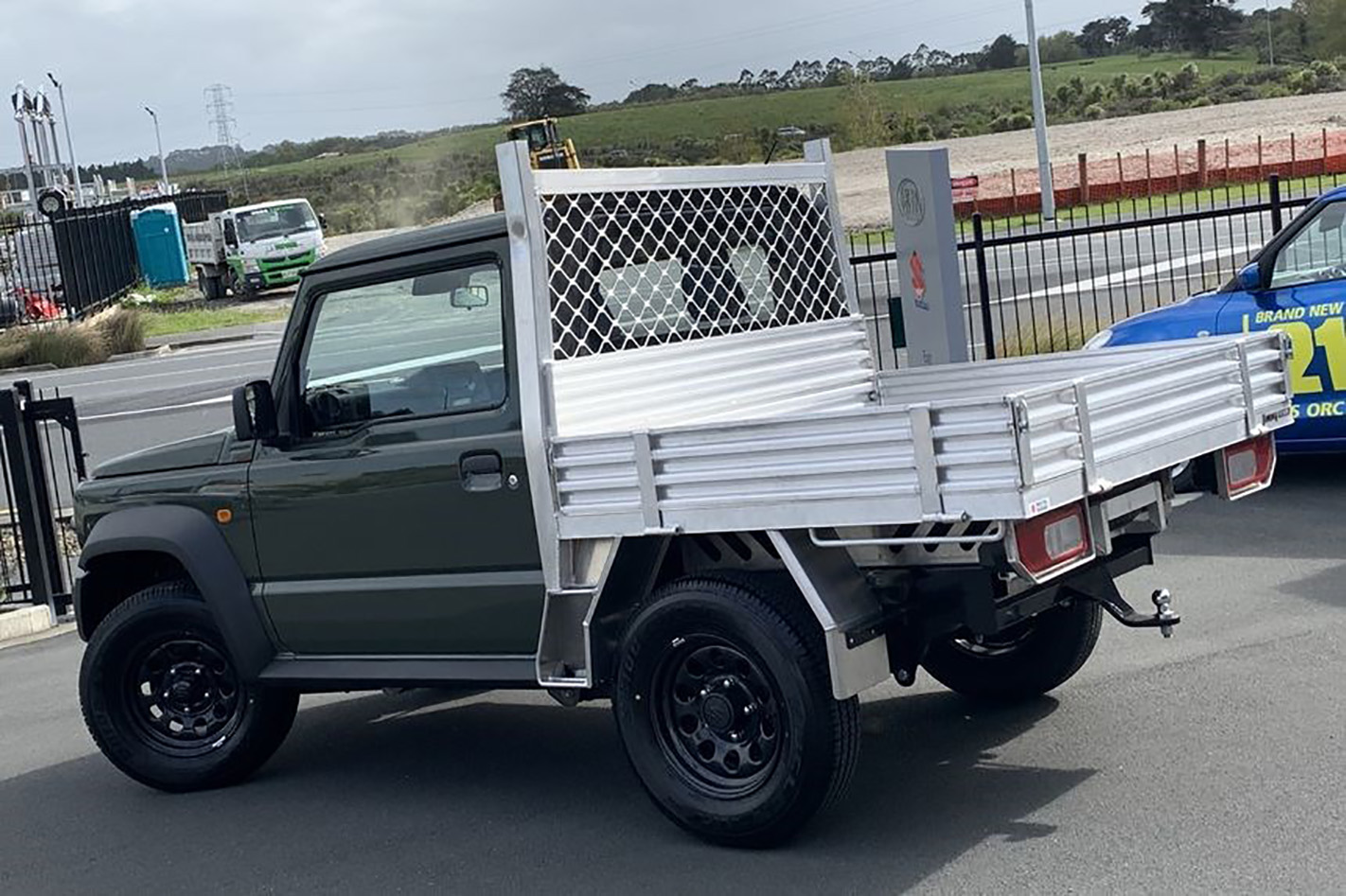
Those of you yearning for a return of the Suzuki Stockman, your prayers have been answered – albeit at considerable cost. The total bill equates to $37,560 in Aussie dollars, which is a fair whack for such a tiny ute. A single-cab Nissan Navara would cost you less and give you more.
The conversion does at least look neat. Cleaving off the rear of the cabin at the B-pillar, Suzuki NZ then encloses what remains of the interior with a steel rear bulkhead and a glass window, carpeting the inside and leaving a small shelf for bags and tools. An alloy tray is then bolted to the Jimny’s ladder frame, and sports drop-down sides and a beefy looking hoop up front, along with integrated side steps, tie-downs and mudguards.
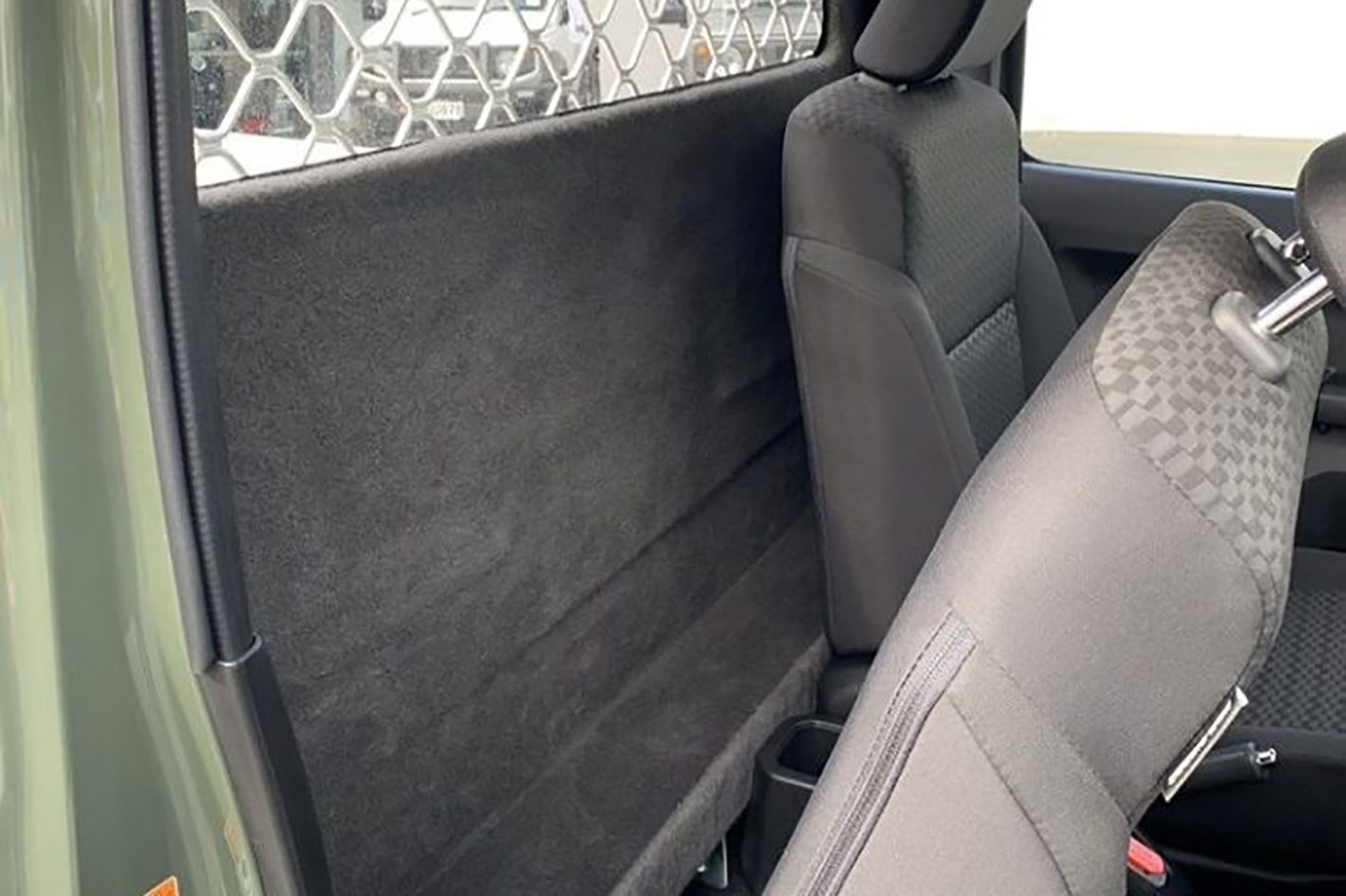
It’s extraordinarily cool, and should appeal hugely to the off-roader crowd just as much as the farmers it’s actually intended for.
Should Suzuki Australia consider a similar thing? It might not be quite so viable at the Kiwi car’s price point, but with Suzuki Japan having already tested the waters with a ute-ified Jimny show car at last year’s Tokyo Auto Salon there may already be a factory-issued Jimny load lugger in the pipeline.
We asked Suzuki’s local boss whether there was demand for such a vehicle, and the response was an emphatic – and loud – “yes!”.
“I’ve been inundated with questions, not only from customers but from dealers as well – ‘we want it, let’s do it!’”, Suzuki Australia general manager Michael Pachota said to WhichCar.
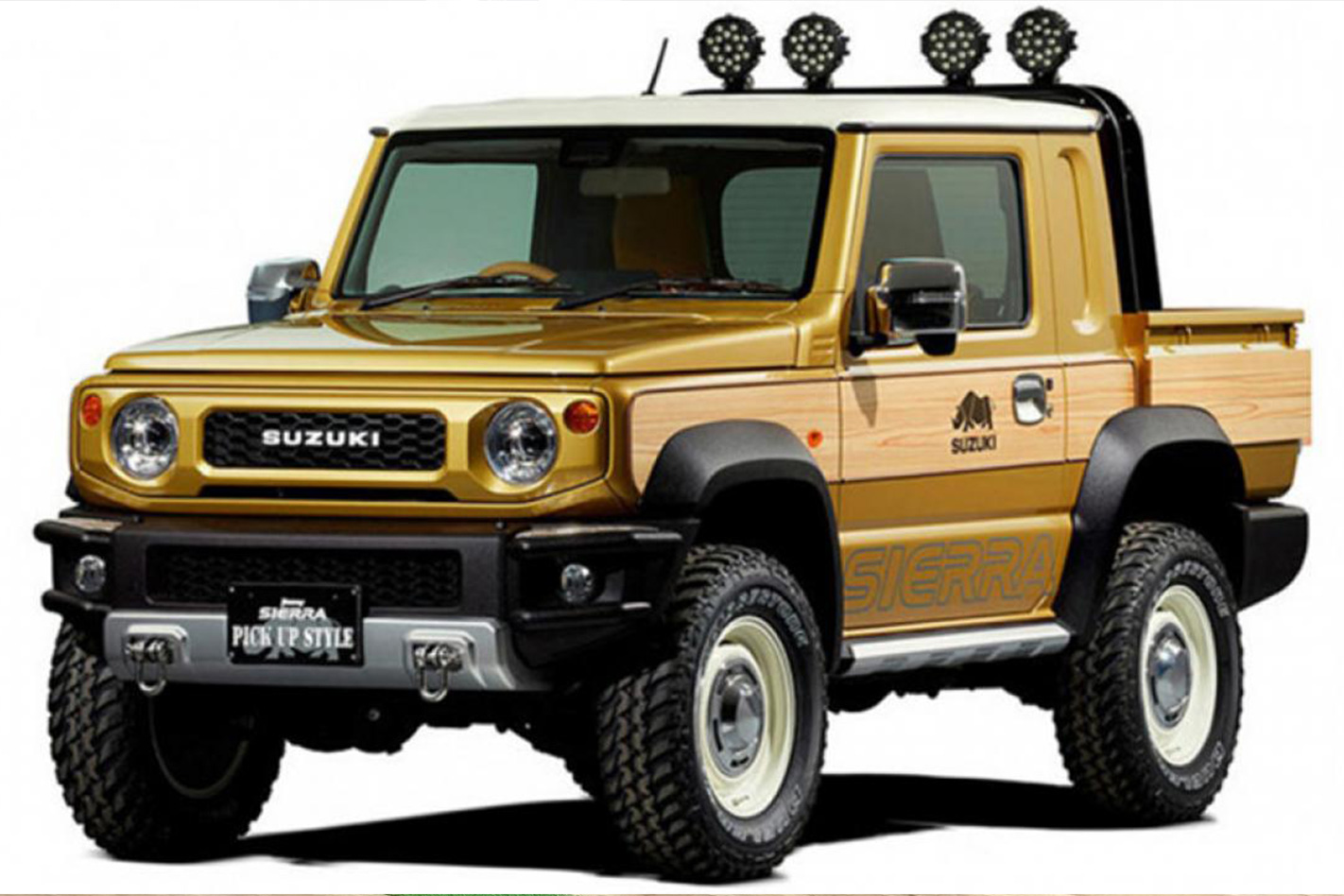
“The agricultural side of Australia [has a] need for a small off-road vehicle as capable as this with a ute tray. The demand is definitely there. Our dealer network is screaming for it, so when they saw that [concept] it created a few problems for me!
“Most countries have requested it from Suzuki Motor Co. We have a global distributor’s conference every six months, and at the last conference we all voiced our need for a ute-back [Jimny], as well as a five-door,” he said.
Do you think we could eventually see a factory-produced Jimny ute Down Under?
If you don’t recognise the name Nigel Tufnel, you’re not into hairy-chested rock’n’roll. The man with the mega mullet is responsible for one of the greatest lines in heavy metal history, which in turn has provided metaphoric inspiration to go-fast car companies around the world.
This feature was originally published in MOTOR’s October 2006 issue
Tufnel was the axe man in the satirical spoof on heavy metal culture, This is Spinal Tap, and the guy that believes he’s got the loudest guitar amplifiers because the dials “go up to 11”. So what the hell, you ask, has this got to do with the latest heroes from Holden’s hot-rod shop, HSV?
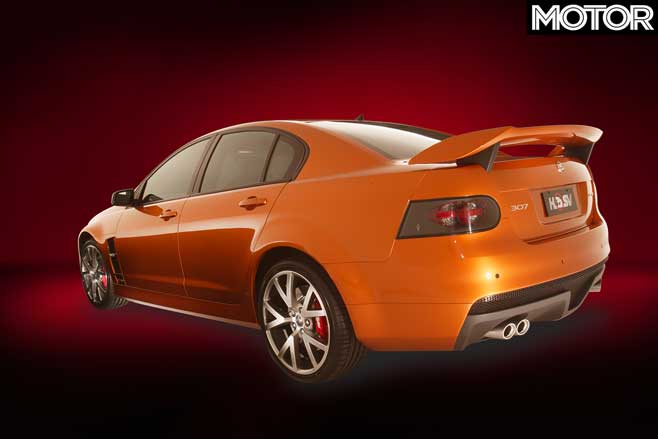
Well, if you think Holden’s billion-dollar belter, the VE Commodore, is a run-of-the-mill Marshall amp, then HSV has Spinal Tapped the fastest flagship-flier from Fishermans Bend and cranked the volume to ‘fast’.
HSV has revised its short-wheelbase sedan lineup, dropping the ClubSport for the ClubSport R8 and re-establishing the iconic GTS, although GTS no longer has more power than other HSVs. Beyond that, the Senator Signature is its ticket into the luxury market until the long-wheelbase Grange arrives next year.
HSV reckons its hard-rocking Commodores are certain chart toppers, and come with more power, more grip, world-class safety and stand-alone styling that certainly makes them look like more than just an SS with skin-tight pants, big hair and eyeliner.
Across the range, the 6.0-Iitre L52 V8 gets a hike in horsepower to 307kW at 6000rpm and 550Nm coming on strong from 4400rpm. It took a team of 15 engineers more than two years to improve ECM calibration and develop a new free-flowing exhaust, which has locally designed four-into-two-into-one tubular extractors.
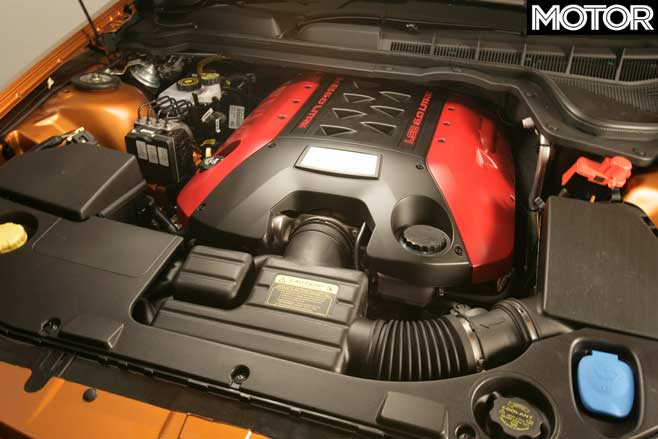
Despite being 100 kilos heavier than the Z Series, HSV claims the E Series will knock over the quarter in a tick over 13 seconds and shoot you to 100km/h in 4.96 seconds with the six-speed manual, and 5.04 seconds with the optional six-speed auto. The Tremec T56 manual has been upgraded, as in the Holden models, and adjustments have been made to the clutch master and slave cylinders to improve pedal feel.
The GM-developed 6L80E six-speed self-shifter is a welcome addition to the HSV range, and brings it in line with FPV’s optional ZF transmission. It has the same ratio set and Tiptronic manual-style shift function as VE Commodore, but has a unique calibration for quicker shifts and greater response.
The final piece in the drivetrain puzzle – and a key factor behind HSV getting into the elite four-second club – is a set of shorter final-drive ratios than VE V8s; 3.27:1 in the auto (2.80:1 in the SS) and 3.70:1 in the manual (3.43:1 in the SS), to be precise.
Getting all the grunt to the ground has always been a problem for the hi-po Commodores, but HSV is confident its latest cars are beefed-up all-rounders with plenty of rolling rubber and innovative new suspension technology.
In a first for an Aussie production sedan, the trio has been fitted with asymmetric front-to-rear wheels. The R8 runs 19×9.5-inch rears and 19×8.0-inch fronts, while the top two cop monster truck-sized 20-inch rims in the same widths. There’s a full-sized spare, but it’s only an eight-incher, which means that if you blow a rear, you’ll still be able to get home.
The ClubSport R8 has a tuned Touring Suspension set-up with stiffer, more linear spring rates and rebound springs inside the dampers that reduce roll to increase initial tum-in.
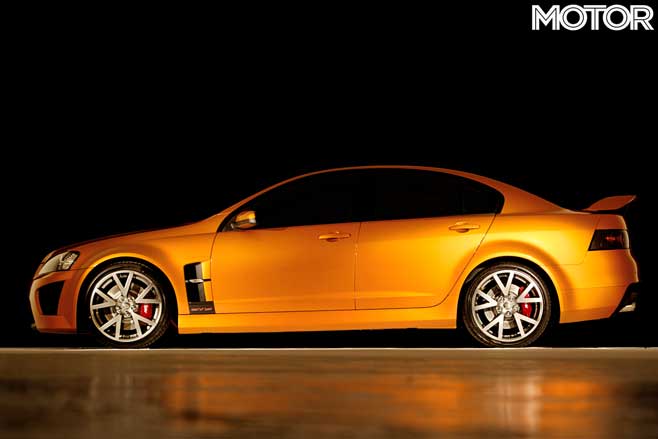
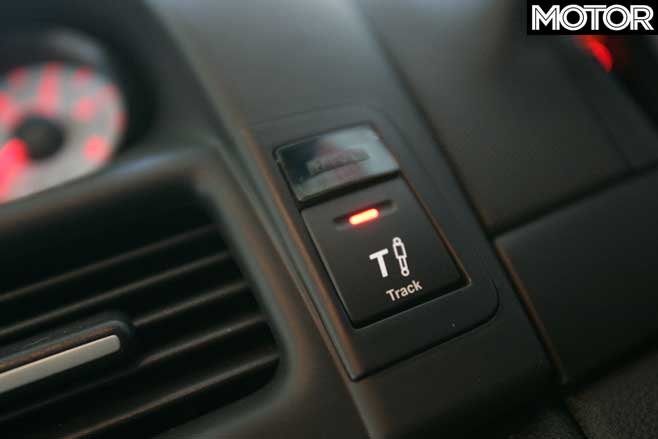
The GTS and Senator Signature are fitted with the whiz-bang Magnetic Ride Control system, which has been tailored by HSV over the past three years (see ‘Opposites Attract’ below), to essentially give the cars a Jekyll-and-Hyde personality, optimising the balance between everyday driving and, with the push of a button, a rock hard thrasher for the race track.
To ensure that each car not only gets out of the blocks like a bazooka and sticks to the road like a tank, HSV has lined up some pretty serious arsenal in the braking department. With the standard fitment of Electronic Stability Control, HSV has developed a single brake package across all models that it says is even better than the premium six-piston jobbies it offered on the outgoing VZ.
Developed with the assistance of AP Racing, all three cars come with 365mm front and 350mm rear ventilated and grooved rotors, with four-piston callipers that are 15 per cent more rigid and sport the same swept pad area as the six-piston jobbies. HSV reckons the GTS is capable of ripping your retinas off by coming to a standstill from 100km/h in just 36 metres – better than a BMW M5, AMG CLS 55 and even the awesome Lamborghini Gallardo.
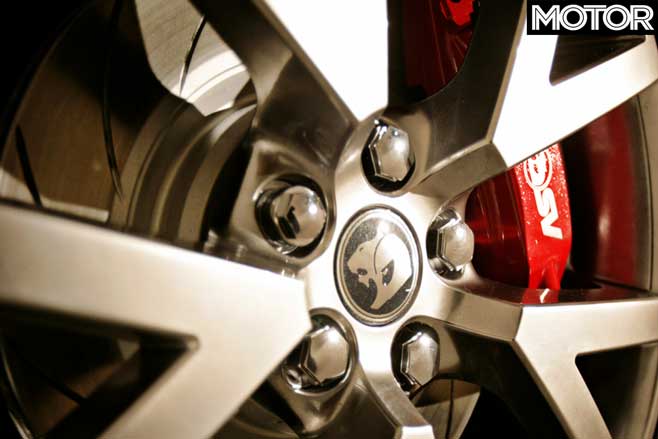
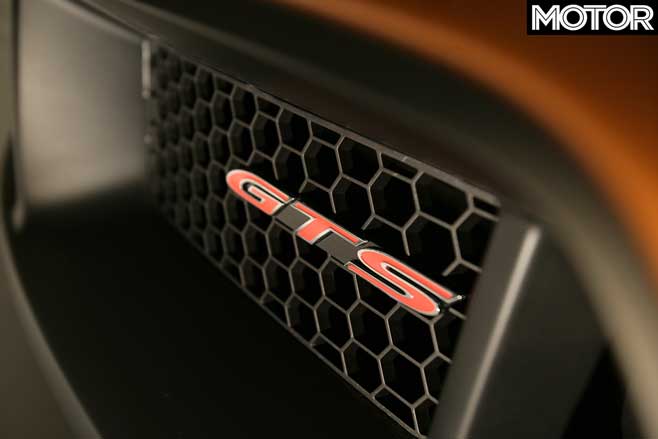
On the outside, the ClubSport R8 and GTS are obviously inspired by the look of the V8 Supercar clan, with a gaping air intake that features fake brake cooling ducts, a spider-eyed face with four individual driving and fog lamps, a raked-back rear wing and the trademark twin-nostril front grille. All models get a unique Jaguar-esque vertical gill in the front fender, an extended rear bumper that features a venturi design and wraps around the tail pipes, and exclusive LED horizontal tail lamps.
The GTS gets matt black highlights on the leading edge of the bonnet, the gills and rear wing supports – which are body coloured on the ClubSport R8 – while the Senator Signature is clothed in chrome with an exclusive front grille, fender gill highlights and window surrounds. It also has a horizontal matt black accent strip running around the lower rim of the body to stretch its proportions and make it look longer and leaner.
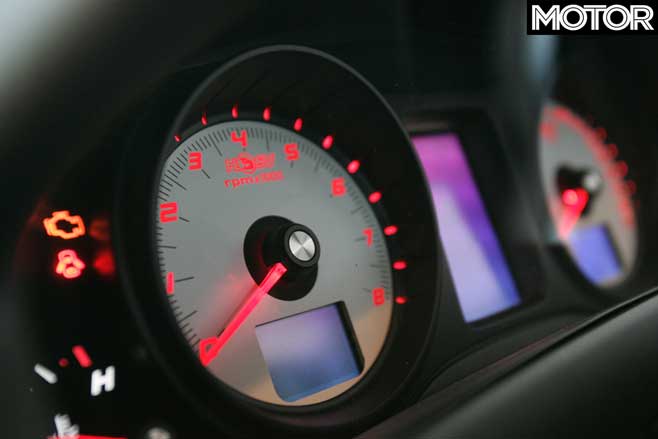
Inside the cabins, all three cars have their own seat designs, a thick-rimmed flat-bottomed steering wheel, a bass-bashing 230W 11-speaker sound system with 6.5-inch colour display screen, an up-spec HSV instrument cluster with white dials and an integrated three-dial gauge pod that displays voltage, oil temperature and oil pressure.
Overall, HSV claims there are 301 unique parts and pieces to its range – a new benchmark – to differentiate its cars from the VE Commodores that they are based upon.
Has HSV cranked up the volume with the new E Series? You bet. Get in, get going and let your ears bleed.
Opposites Attract – Magnetic Ride Control
Magnets are helping the latest HSV GTS and Senator Signature stick to the road.
HSV’s new E Series cars are the first Australian-made vehicles to feature the innovative Magnetic Ride Control suspension system that has already been adopted by the likes of Ferrari on its 599 GTB, Audi for its new TT and by Chevrolet for the monstrous Corvette C6.
The system effectively provides an electronically controlled two-mode suspension set-up that offers a comfortable ride for everyday driving and, with the touch of a button, a rock-hard, race-inspired setting for fast fangs.
It works by using a magneto-rheological fluid, which contains millions of tiny metal particles, and a special coil in the piston in each of the dampers. When the system is activated, the fluid is zapped by an electric current that changes its viscosity to speed up or reduce its flow through the damping holes. The current is constantly varied via an electronic brain that feeds off the inputs from a linear potentiometer, G-force meter and a steering-angle sensor mounted on the chassis.
The GTS is tuned in standard mode for performance and can be changed to track by the button, while the Senator Signature’s default setting is luxury with the option of a performance setting.
