
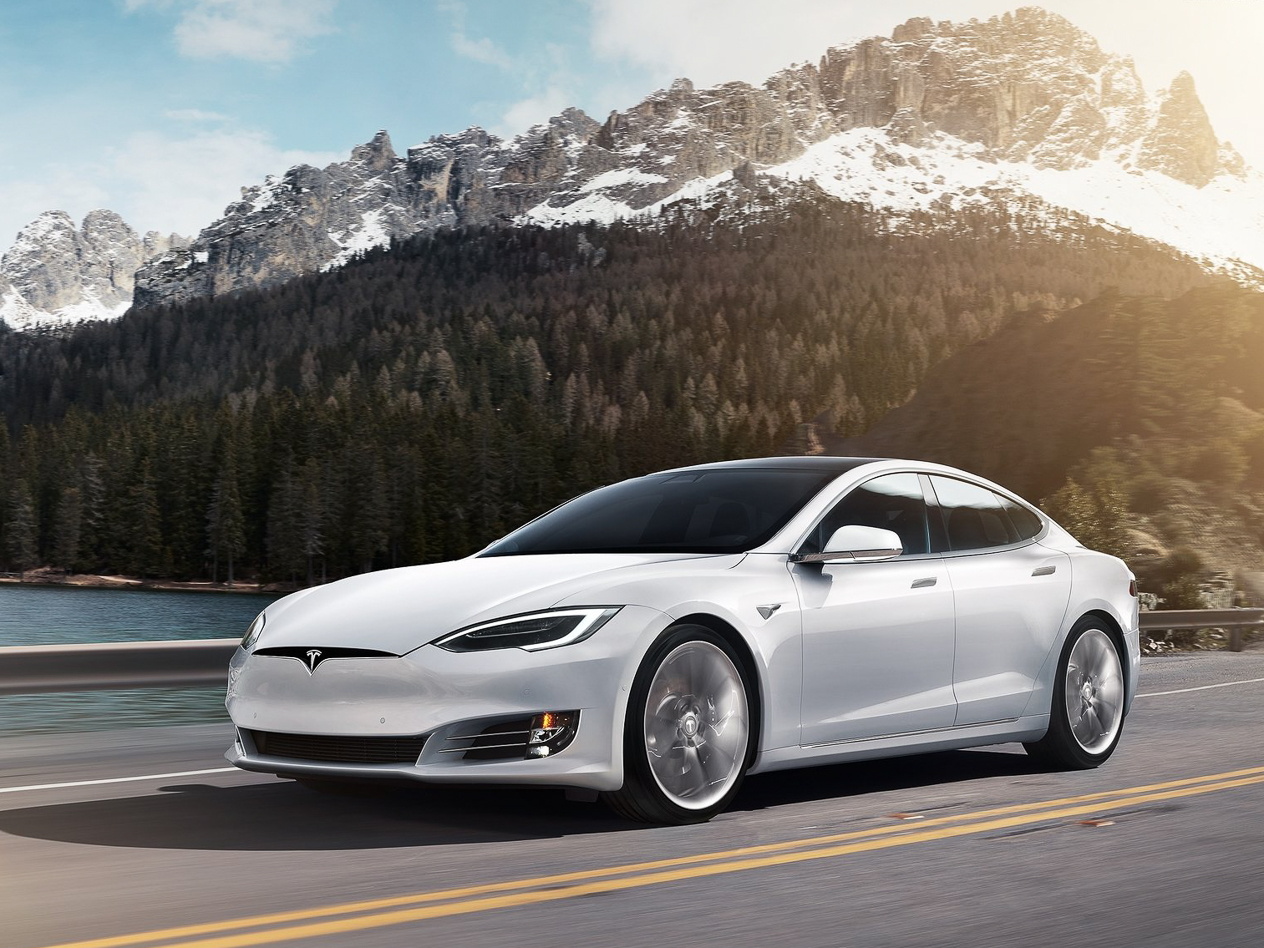
There’s been no shortage of competition for Tesla’s revolutionary Model S electric car. Challengers have been created by established manufacturers, been jointly developed between rival car companies, and we’ve even seen the rise and fall of EV start-ups that fail before they start.
But while many have tried to knock off the undisputed EV king, the Model S has been on sale for almost a decade and still remains the stand-out example of how to make an electric vehicle work in the real world.
That is, until now.
A new name has hit the market, and Lucid Motors looks to be aiming squarely at the Model S with its new Air electric sedan. Unlike its forebears, this one seems as though it’ll go the distance rather than fizzle into obscurity.
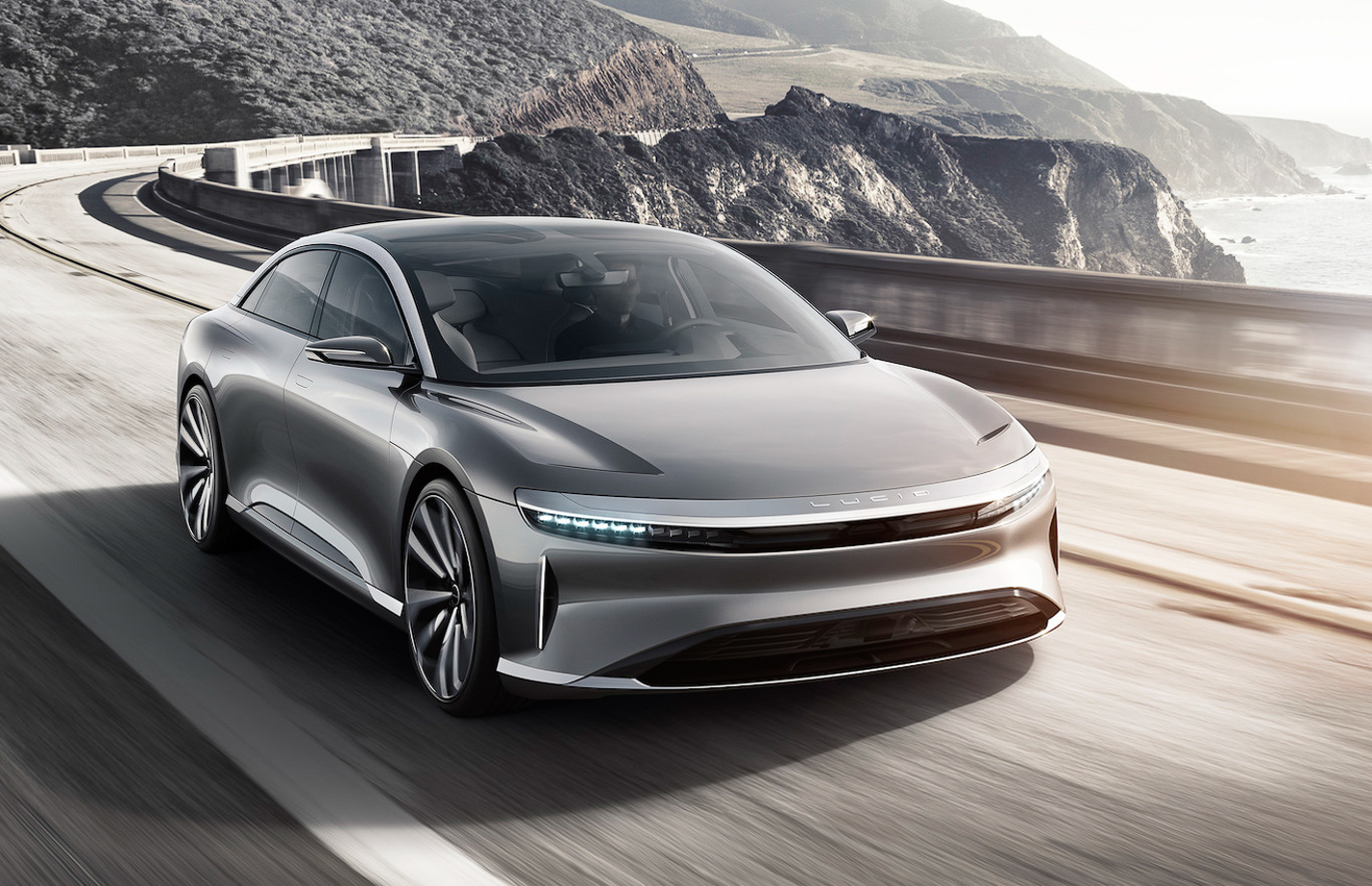
Before diving in, it’s worth mentioning the reasons we think the Lucid Air will go the distance. Lucid is a company that’s been around for well over a decade, and was originally just in the business of developing EV batteries for other manufacturers.
It then pivoted to developing electric vehicles themselves in 2016, and has been fine-tuning the Air sedan, which will go on sale late 2020, ever since. The company has more than 500 employees, some of whom were pilfered from Tesla, and holds funding in excess of a billion dollars.
With that, how do these two EV juggernauts compare against one another? Let’s pitch them head to head in a specification comparison.
Motor/Powertrain
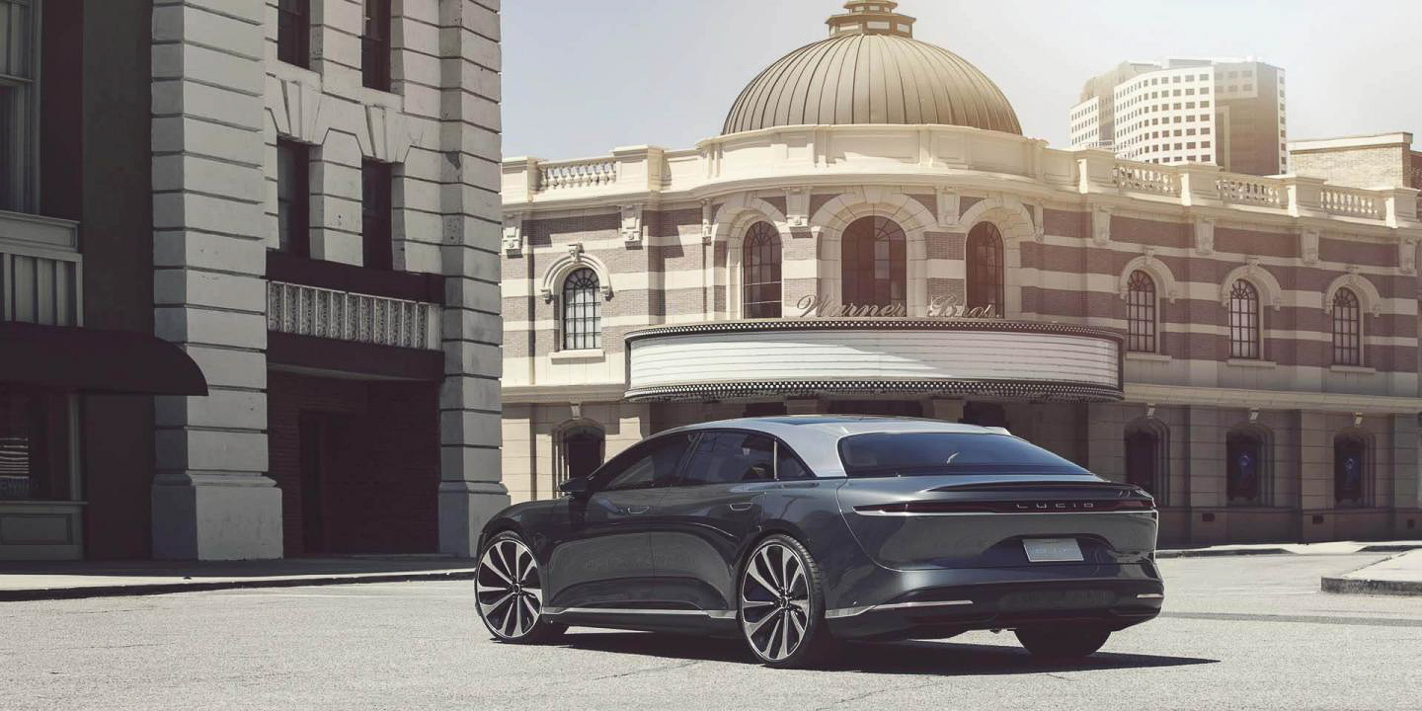
Lucid has come prepared to take on the best, stocking a stonking great powertrain that should – on-paper at least – comfortably eclipse the performance of even the quickest Model S.
Lucid hasn’t divulged the full battery details just yet, but pundits expect a battery size in excess of 100kWh which will power both single- and dual-motor options, the latter of which powers all four wheels and can output 746kW.

That should see the Air propelled from zero to 100km/h in roughly 2.5 seconds – among the quickest sprinting cars on Earth. Lucid also claims the Air can reach an electronically-limited 320km/h top speed.
Comparatively, the Tesla Model S can’t quite match those mind-bending stats, but it’s no slouch either. The largest battery fitted to the Tesla Model S is a 100kWh battery pack that powers all four wheels for a combined 580kW.
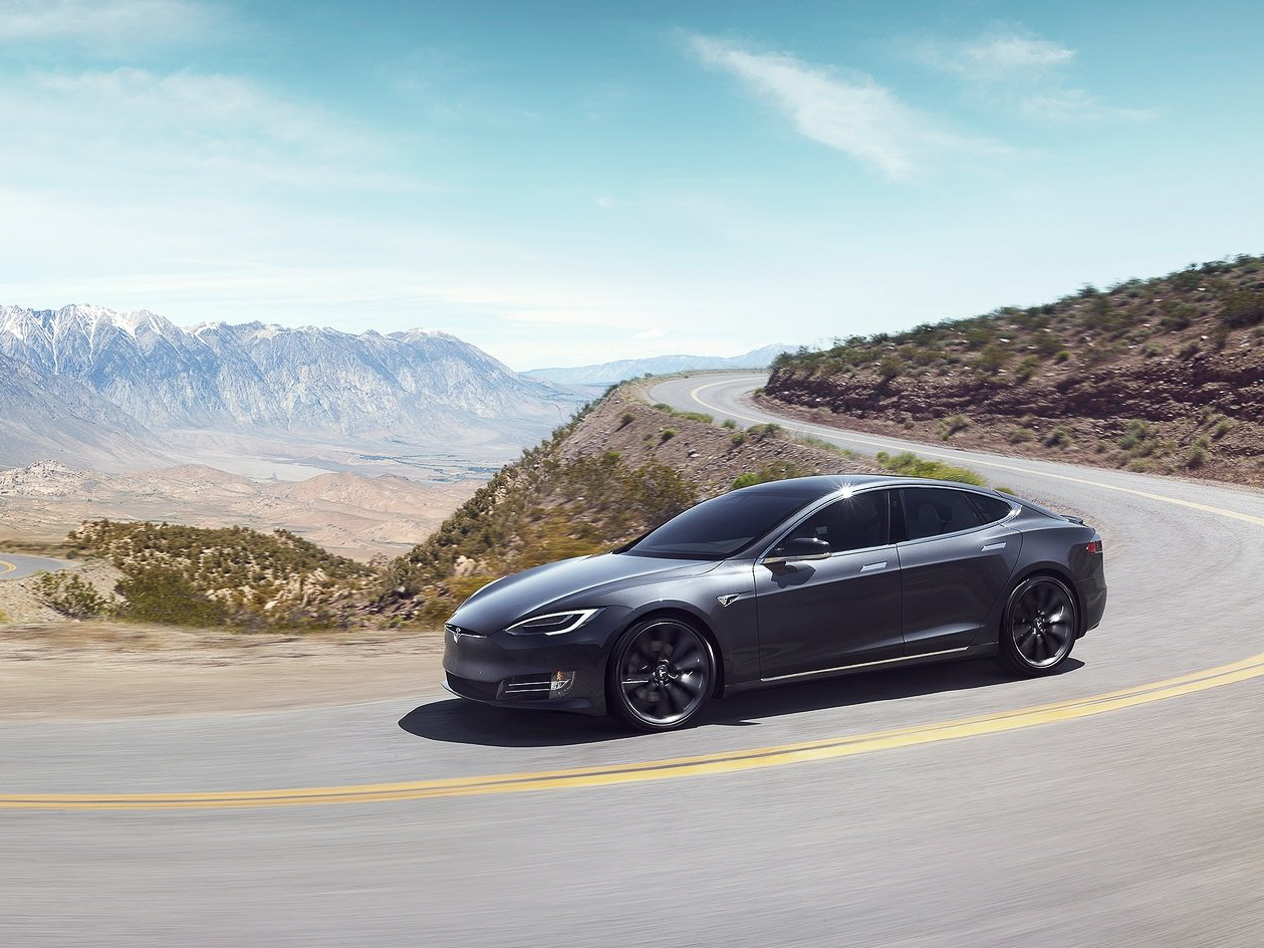
This shoots the Model S from 0-100km/h in roughly 2.5 seconds and onto a 260km/h top speed.
Range/charging
Not only does Lucid’s larger battery afford it extra performance over the Model S, the company has confirmed it will travel further between charges too. An independently-tested 832 kilometres is the maximum combined range for the Air, which is the longest of any EV to date.
It’ll also charge quickly, utilising a 900-volt charging system (which can charge at 300kW DC) to draw a 480km charge in just 20 minutes.
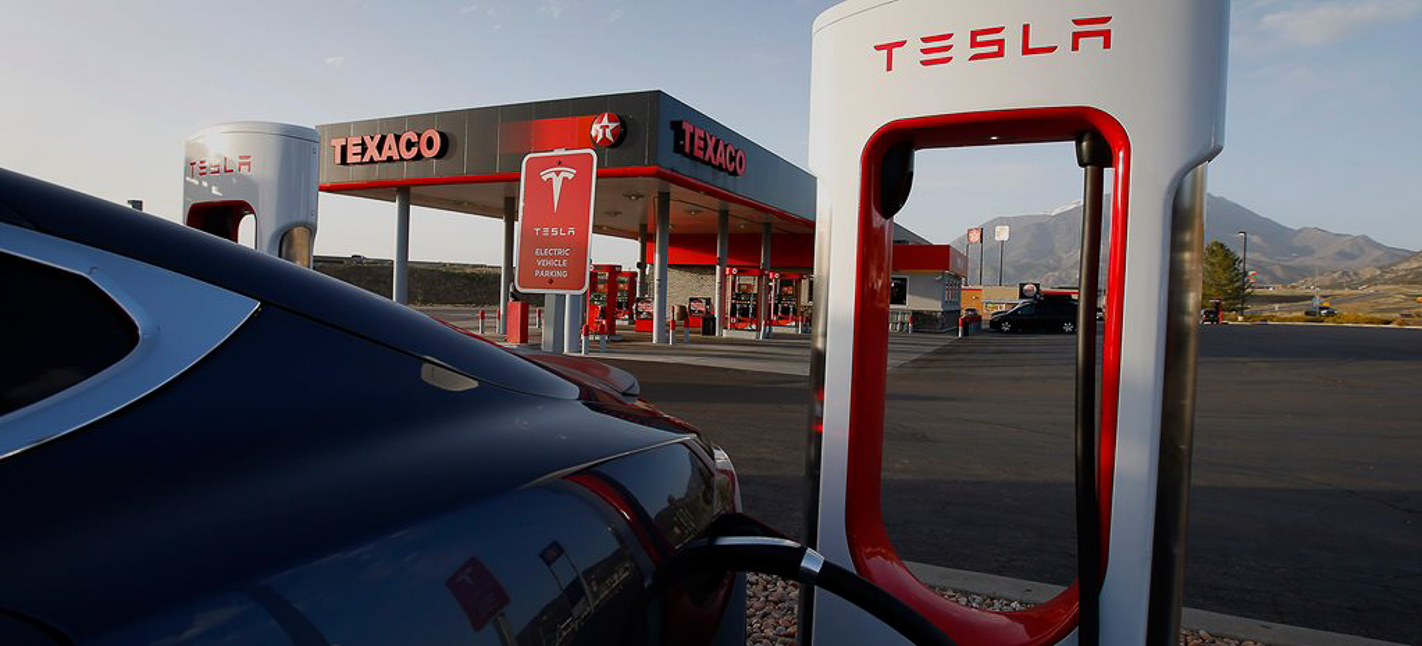
The fastest charging rate on a Tesla is 50kW less with a maximum rate of 250kW, which is accessed through Tesla’s Supercharger locations. The Tesla is able to regain 80 percent of its battery capacity in 30 minutes on charge.
Autonomy/Tech
Electric vehicles and autonomy have become synonymous and as such Lucid plans to offer self-driving technology in the Air. Staples like radar-based cruise control, lane-keep assist, autonomous braking and self-parking will all combine to form the Air’s self-driving capability.
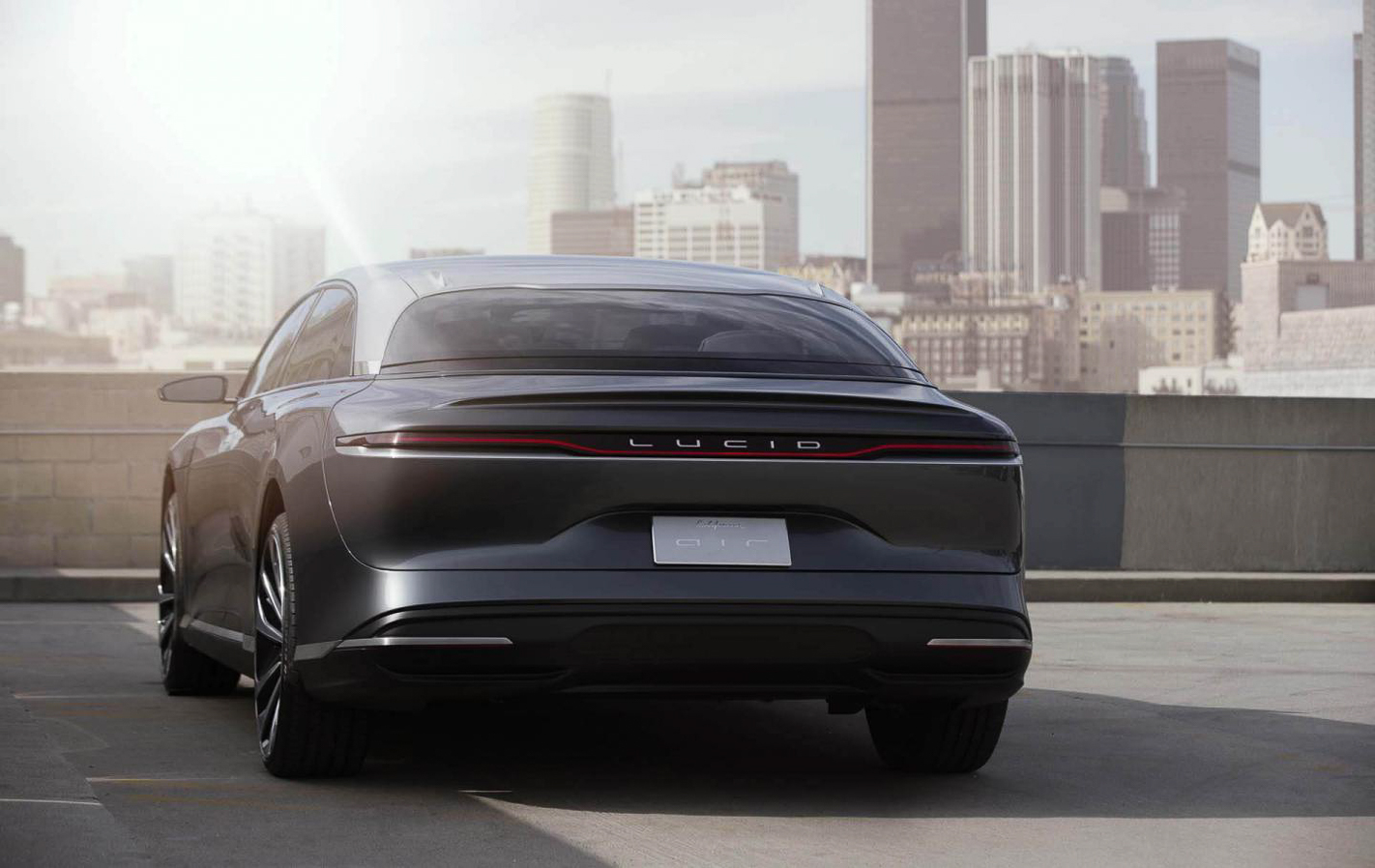
Lucid is aiming for a level 3 autonomous certification using LIDAR tech; the self-driving feature is said to be named DreamDrive. It won’t have level 3 tech at launch, but aims to develop the tech to that point within a couple of years.
There’s no doubt that Tesla has some of the best autonomous driving technology in the game, and that doesn’t look like it’ll change in the short term.
It isn’t quite at ‘eyes off’ level, but Tesla’s level 2 autonomous Autopilot system can function continually unaided in traffic using a litany of cameras and radars positioned around the vehicle.
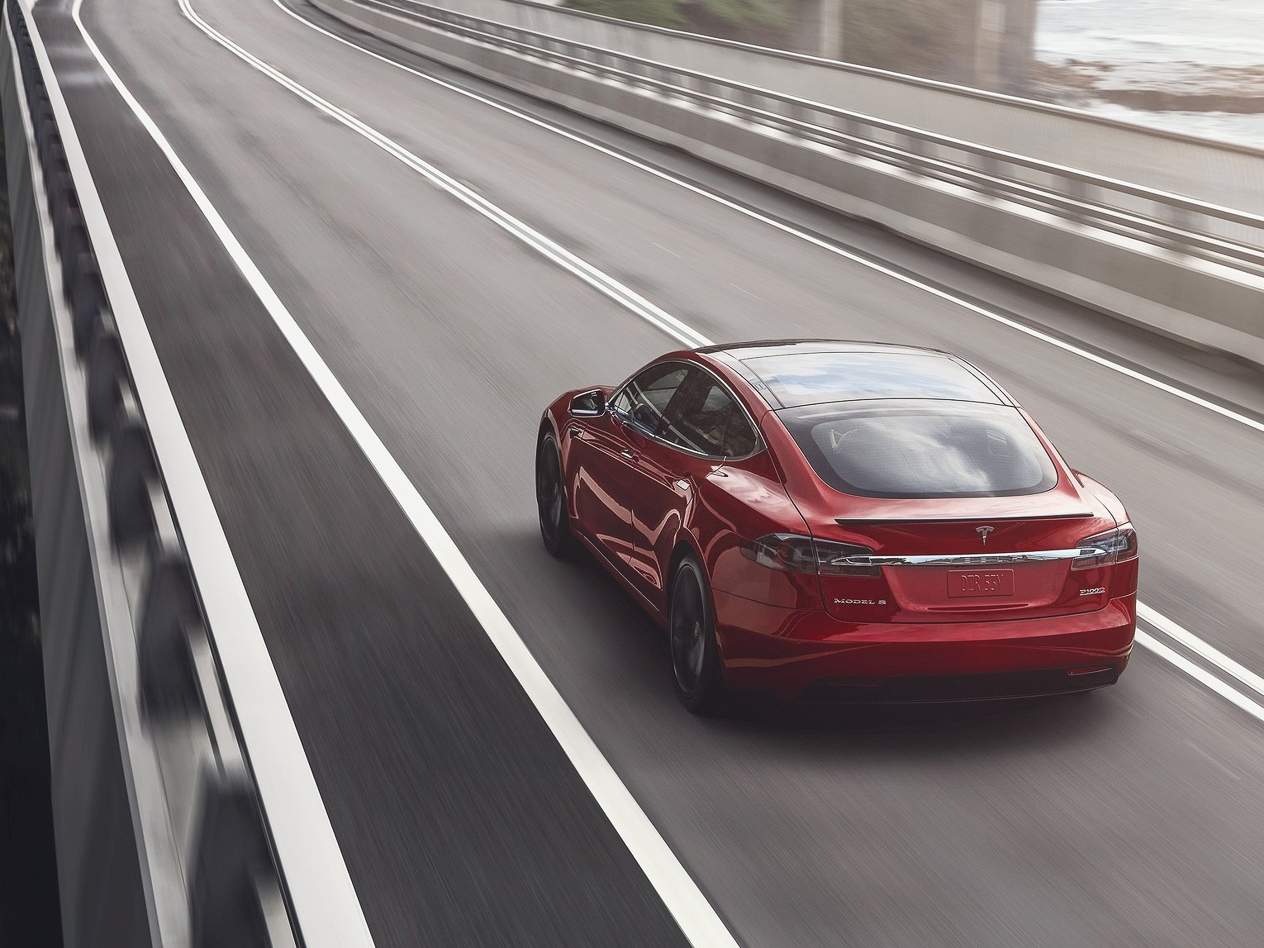
Elon Musk has said that level 5 autonomous tech is coming within the year, though we’re not holding our breath.
Interior/equipment
Lucid makes no bones about the fact that the Air is a luxury vehicle, and will be appointed as one. The upscale interior is fitted with high quality materials and tech in either four- or five-seat configurations and it’s all under a large panoramic glass roof like a Tesla.
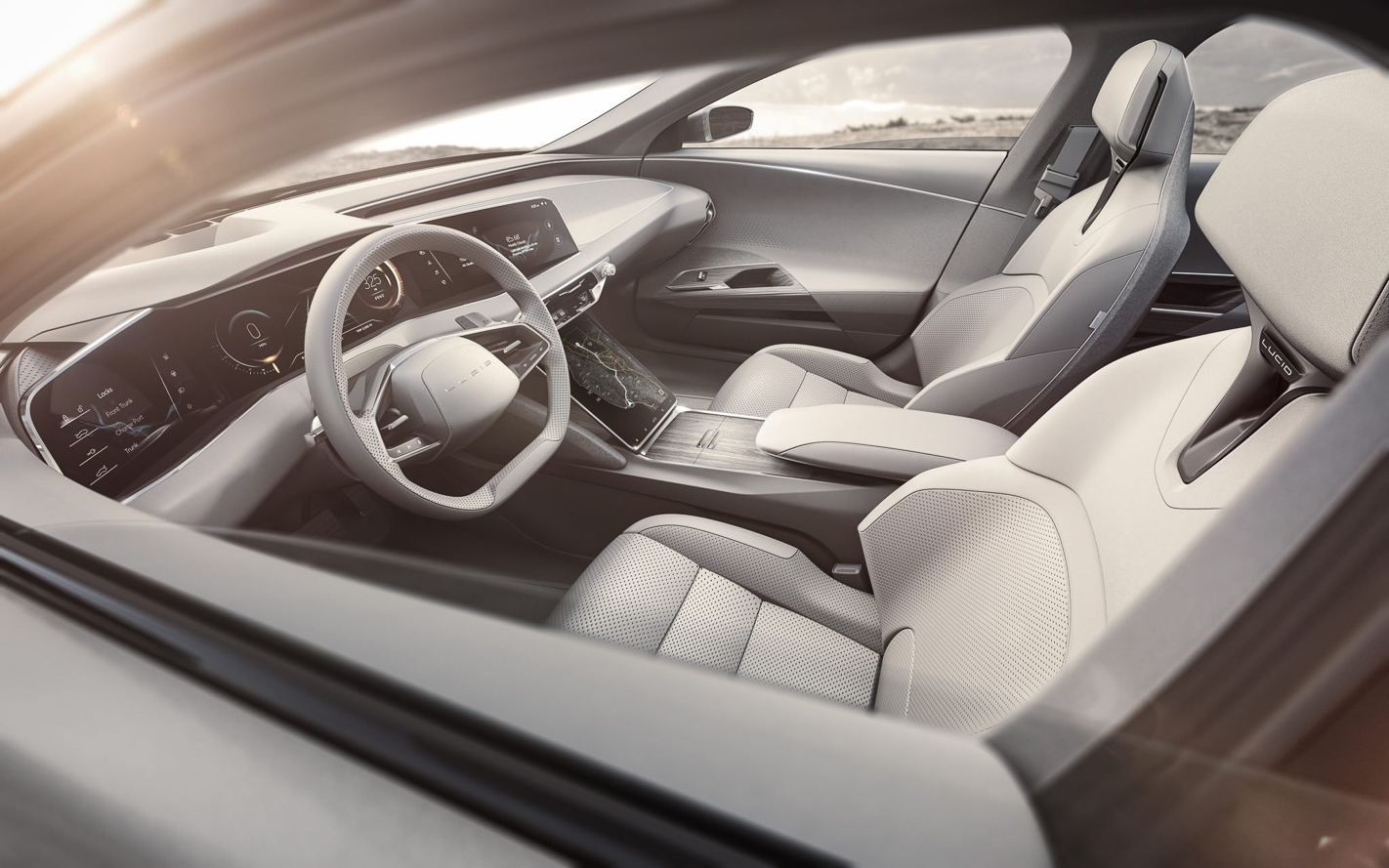
There are two main touchscreens that house a fully digital instrument cluster, and more controls are located on the second lower-mounted touchscreen. The car includes an artificially intelligent computer that can understand natural speech and learn preferences for music and destinations, for example.
The Model S is also a luxurious vehicle bursting with tech and quality appointments. Taking pride of place in the cabin is a massive 17.0-inch touchscreen which controls the car’s systems, flanked by a fully digital instrument cluster.
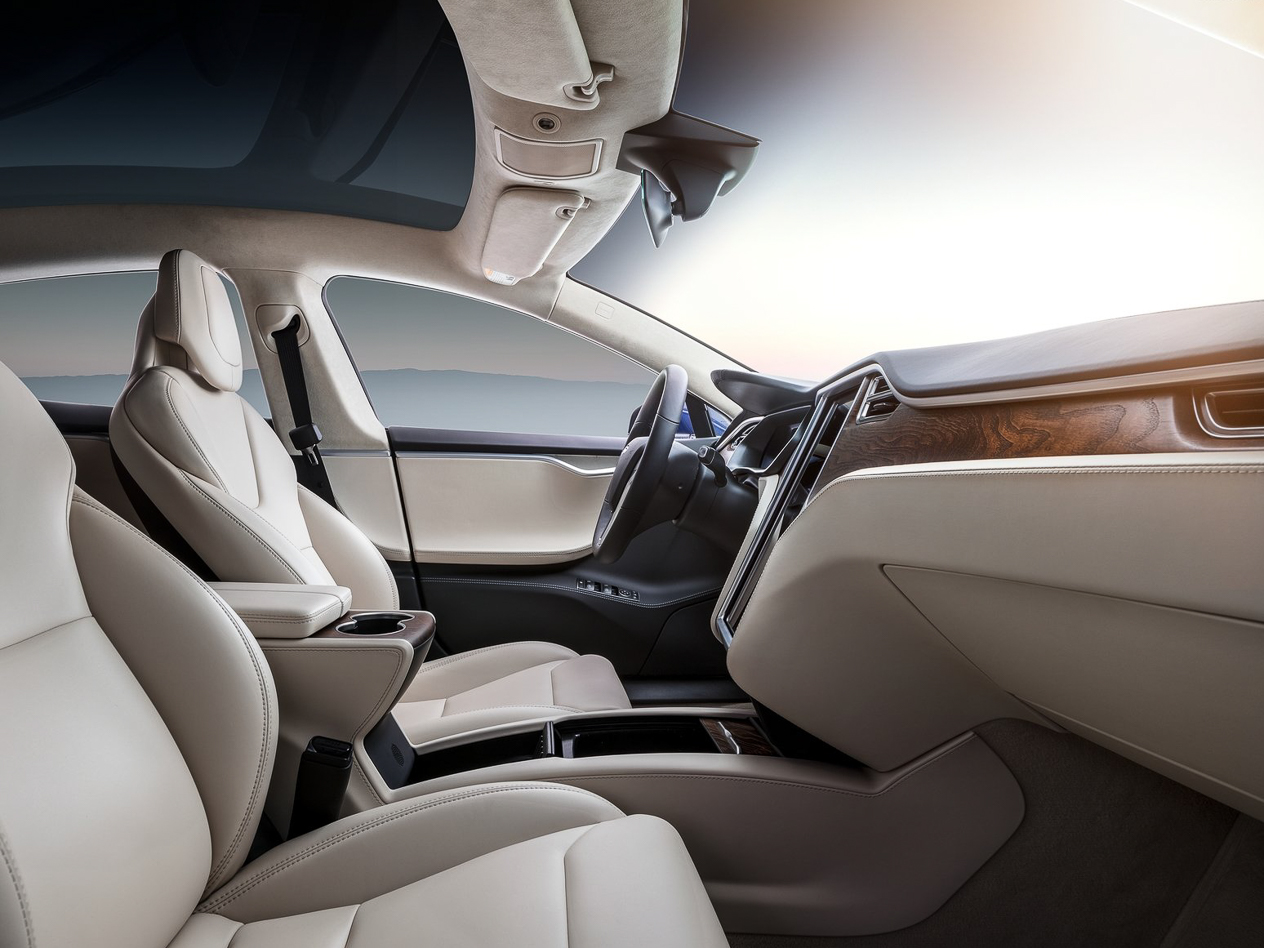
There’s ample storage space and a large amount of room in both seating rows, and it’s all illuminated by a glass panoramic roof. Tesla’s seat material is completely synthetic, keeping in-line with the car’s sustainable nature.
Conclusion
While there’s no doubt that Tesla has dominated the electric car market for the better part of a decade, there’s been little evolution over that time (save for some pretty impressive battery updates). Despite a facelift in 2016, the Model S is largely the same car that debuted in 2012.
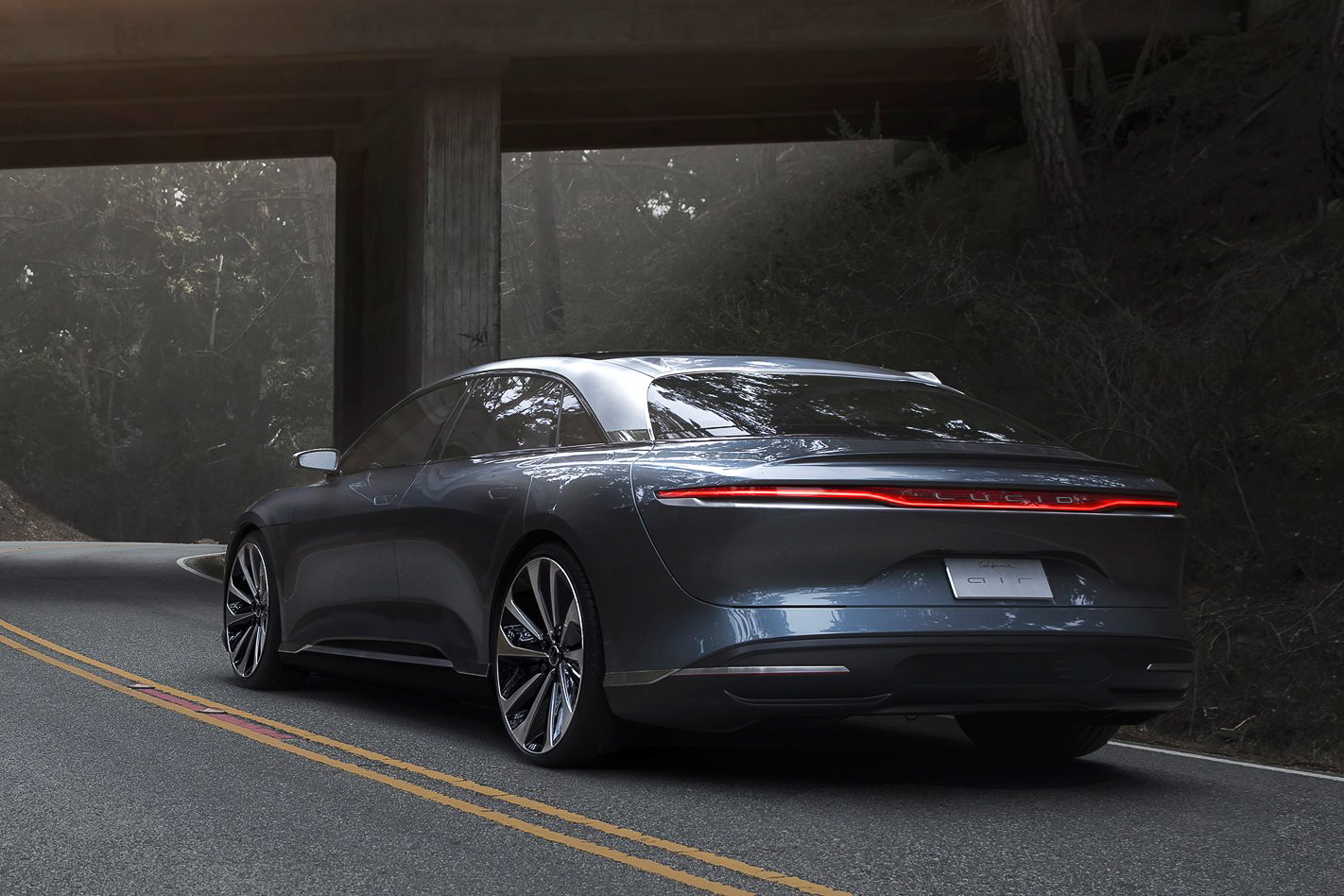
This presents a unique opportunity for Lucid, whose innovation and product promises look set to eclipse Tesla’s Model S achievements so long as they can back their word once the car gets to market.
MORE: WhichCar EV Buyers’ Guide
September 9 is World EV Day and while not too many Australians will have it marked on their calendar, there is plenty to celebrate with battery-electric and hybrid vehicle sales in this country finally making decent headway.
According to the Federal Chamber of Automotive Industries (FCAI), EV and hybrid sales have defied the car industry slump and COVID-19 to record 38,390 year-to-date sales up till August 31, which is a 91 percent increase over the same period last year.
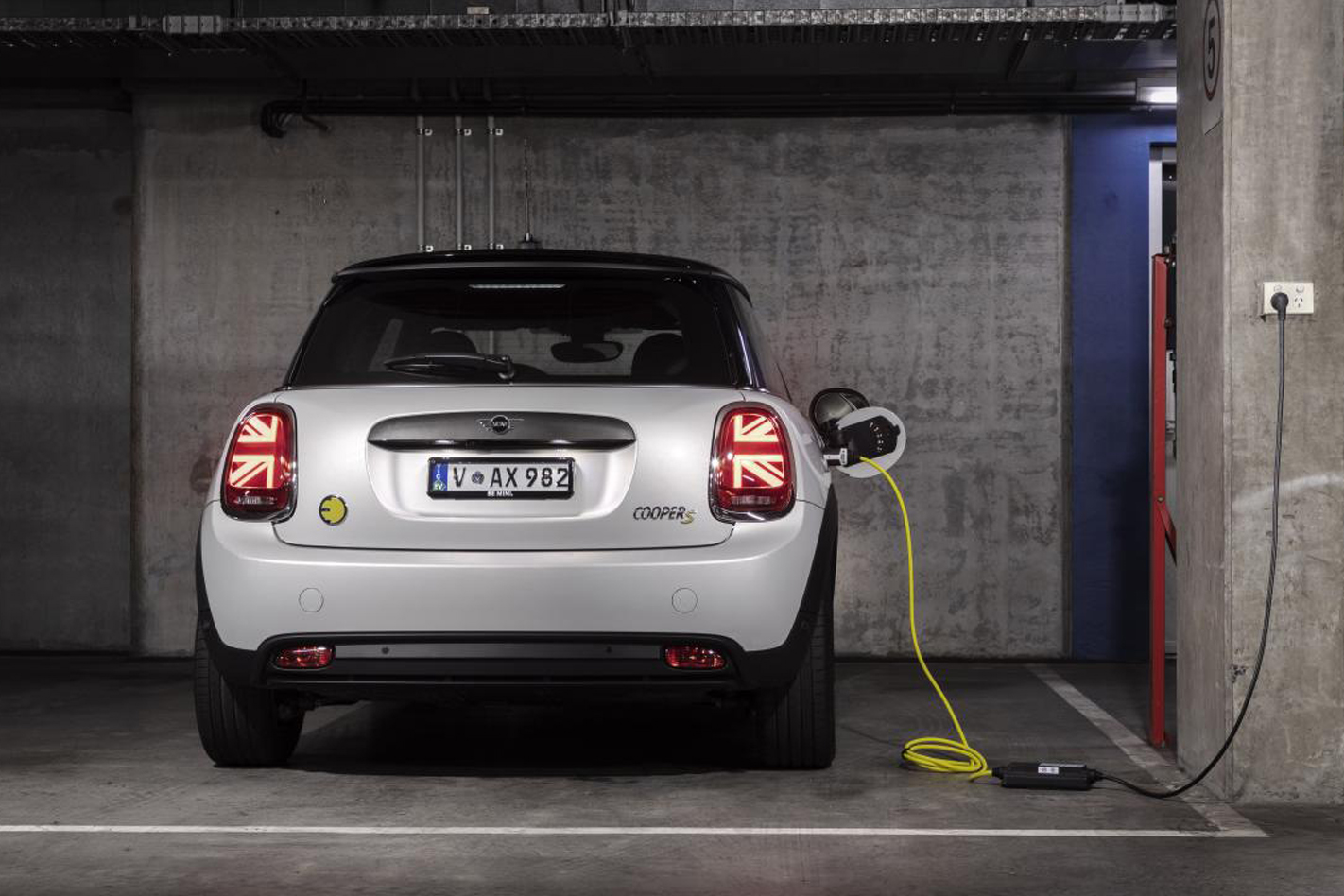
Those numbers are even more noteworthy when you consider there was a three-fold increase in EV/Hybrid sales in 2019 compared to the previous year.
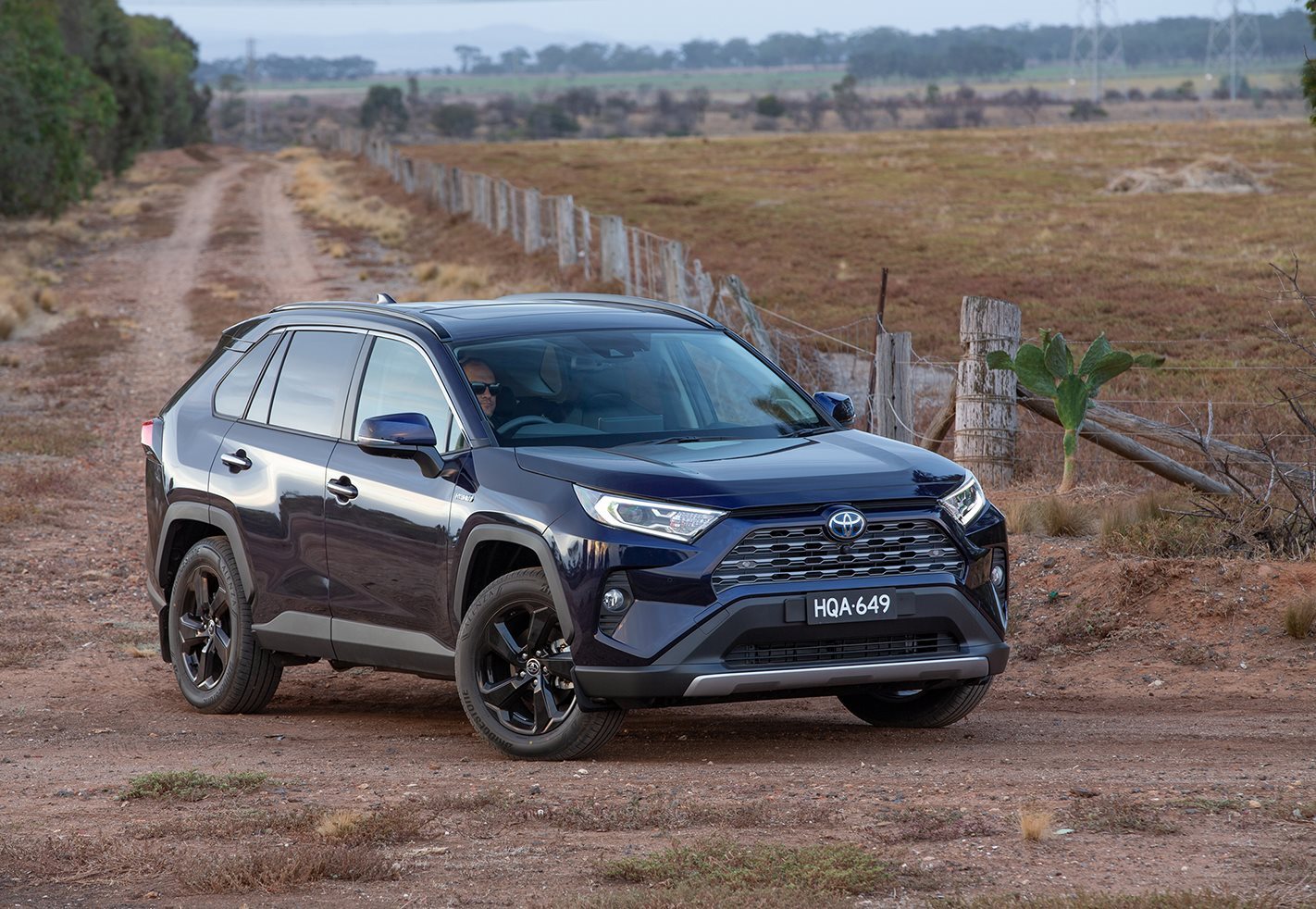
Meanwhile, there were 6694 EVs and hybrids sold last month alone, up 113.9 percent over August 2019. Many of these were the 4405 hybrid versions of the Toyota RAV4 medium SUV that made up the bulk of the marque’s 4825 sales.
Significantly, those 4405 RAV 4 Hybrids alone were the biggest selling model in Australia last month, which was the first time an electrified vehicle topped the monthly VFACTS sales chart.
FCAI Chief Executive Tony Weber said the industry hopes the first World EV Day will be remembered as a turning point for electric vehicles in this country.
“The inaugural World EV Day comes at a watershed moment for Australia’s e-mobility,” Weber said.
He added that various reports suggest that nearly 60 per cent of Australians are considering an EV for their next vehicle driven in part by the development of vital EV infrastructure.
500,000th Nissan Leaf rolls off the production line
Nissan has celebrated World EV Day with the production of the 500,000th Leaf, the world’s first mass-market full electric car.
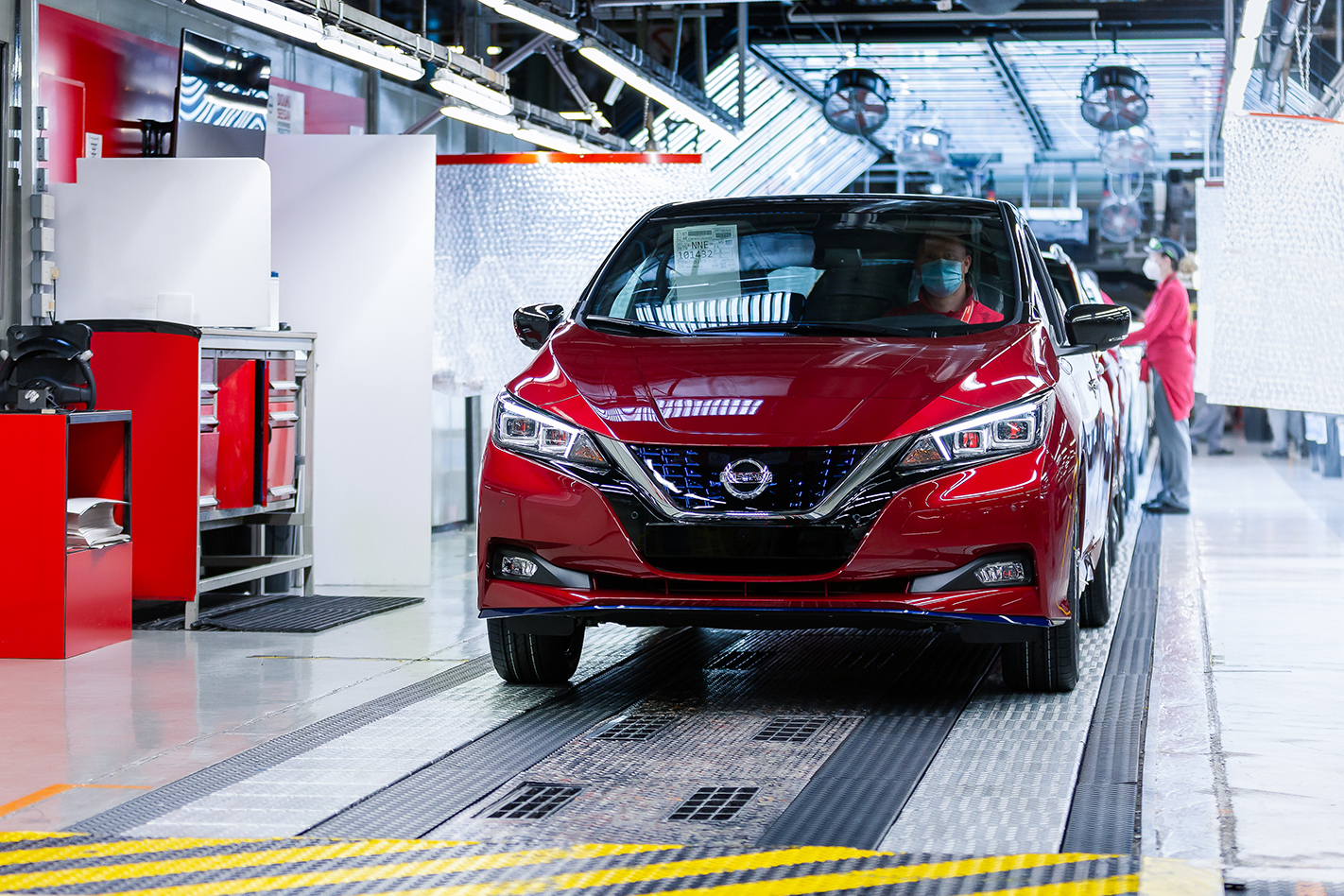
The half-millionth Leaf rolled off the line at the Nissan’s plant in Sunderland, England, almost a decade after the model first went on sale. The plant has built more than 175,000 Leaf hatchbacks since it began producing the model in 2013.
The second-generation Leaf arrived in 2019 and is on sale in Australia and priced from $49,990.
New charging network
Indeed, charging infrastructure is vital if EVs are going to take hold in a big country like Australia where range anxiety is common.
One organisation has used World EV Day to announce a new network across western Victoria that will be built with state and local government funding.
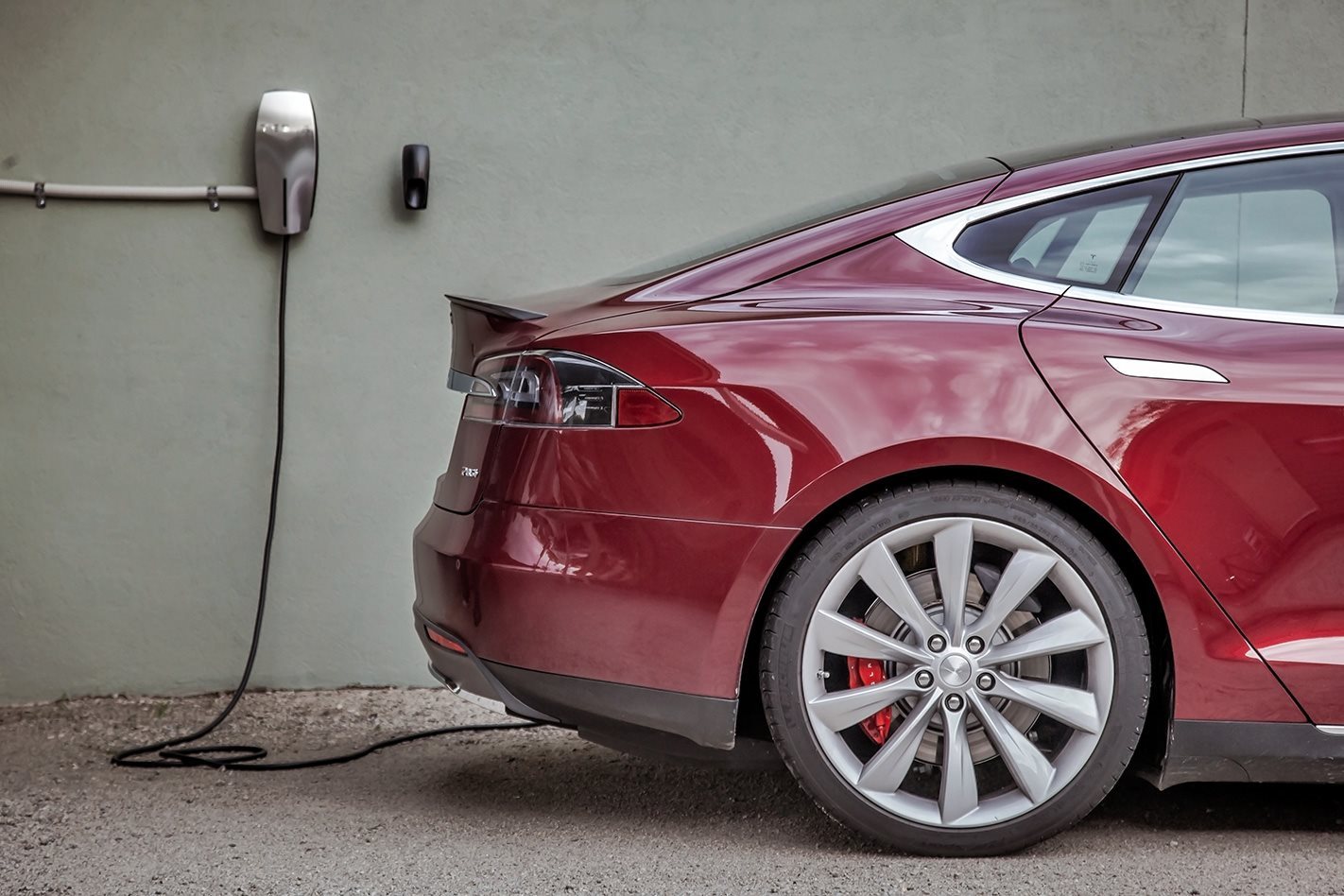
The network of more than 20 electric vehicle chargers is being rolled out across 17 sites in Central and Western Victoria in partnership with the Victorian Government and the following councils:
- Mildura Rural City Council
- Swan Hill Rural City Council
- Gannawarra Shire Council
- Buloke Shire Council
- Mount Alexander Shire Council
- City of Greater Bendigo
- Campaspe Shire Council
- Greater Shepparton City Council
- Loddon Shire Council
- Central Goldfields Shire Council
- Wellington Shire Council
- Whittlesea Shire Council
Rob Law, executive officer of Central Victorian Greenhouse Alliance, the local government network that is driving the project, says that increasing the charger network will help to boost jobs numbers and EV uptake in regional Victoria.
“The Charging the Regions network will ensure that regional Victoria does not get left behind as more and more electric cars hit the road,” he said.
“It will boost jobs, stimulate EV tourism and encourage people who live in regional Victoria to think about ‘going electric’ on their next vehicle purchase.
EV BATTLE: Lucid Air v Tesla Model S spec comparison
There’s been no shortage of competition for Tesla’s revolutionary Model S electric car. Challengers have been created by established manufacturers, been jointly developed between rival car companies, and we’ve even seen the rise and fall of EV start-ups that fail before they start.

That is, until now. A new name has hit the market, and Lucid Motors looks to be aiming squarely at the Model S with its new Air electric sedan. Unlike its forebears, this one seems as though it’ll go the distance rather than fizzle into obscurity.
So does the new kid on the block have what it takes knock off the car that has been the EV benchmark since 2012? – READ THE FULL COMPARISON HERE
Eight EVs that will want to make you convert

Still not convinced about EV ownership, then let us tempt you into the zero-emissions age with eight fascinating vehicles coming to market in the not so distant future that bust the most frequently cited concerns from Australian EV opponents. – CHECK OUT THE FULL LIST
After little consideration and much shallow thinking, I’ve decided I’ve cracked this whole ‘how to make a successful car company malarkey’.
The trick, you see, is to create a brand so strong that it transcends your product. Ferrari has this nailed. So do Lamborghini, Jaguar and Aston Martin.
How these cars drive is important, obviously, but the greatest vindication for most buyers will come from the fuzzy feeling of asking a doorman at a fancy hotel to “please bring up the Aston”.
Which brings me to Maserati.
Of all the brands on sale today, it’s rivalled only by Alfa Romeo for association with words like ‘passion’, ‘beauty’ and ‘luxury’.
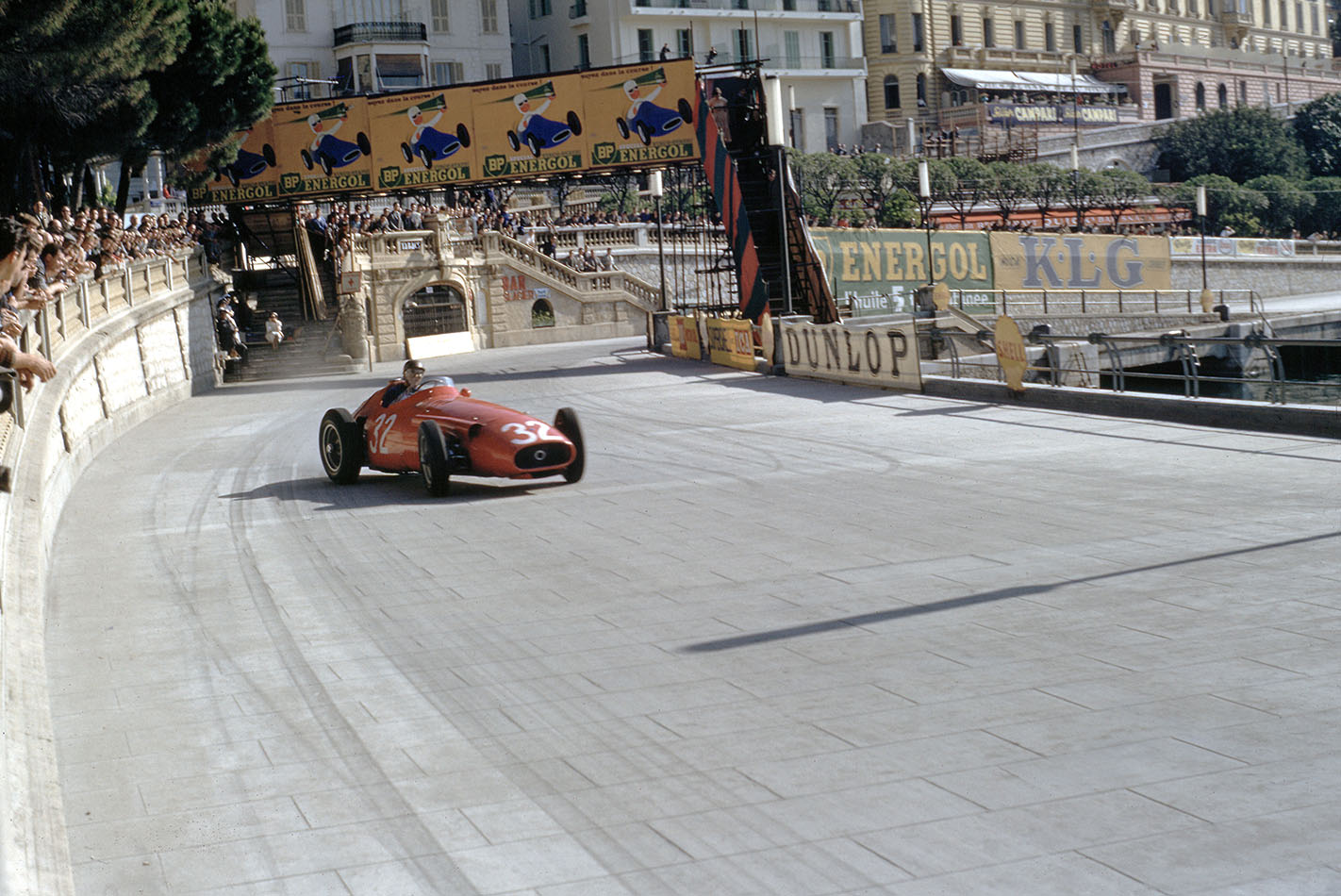
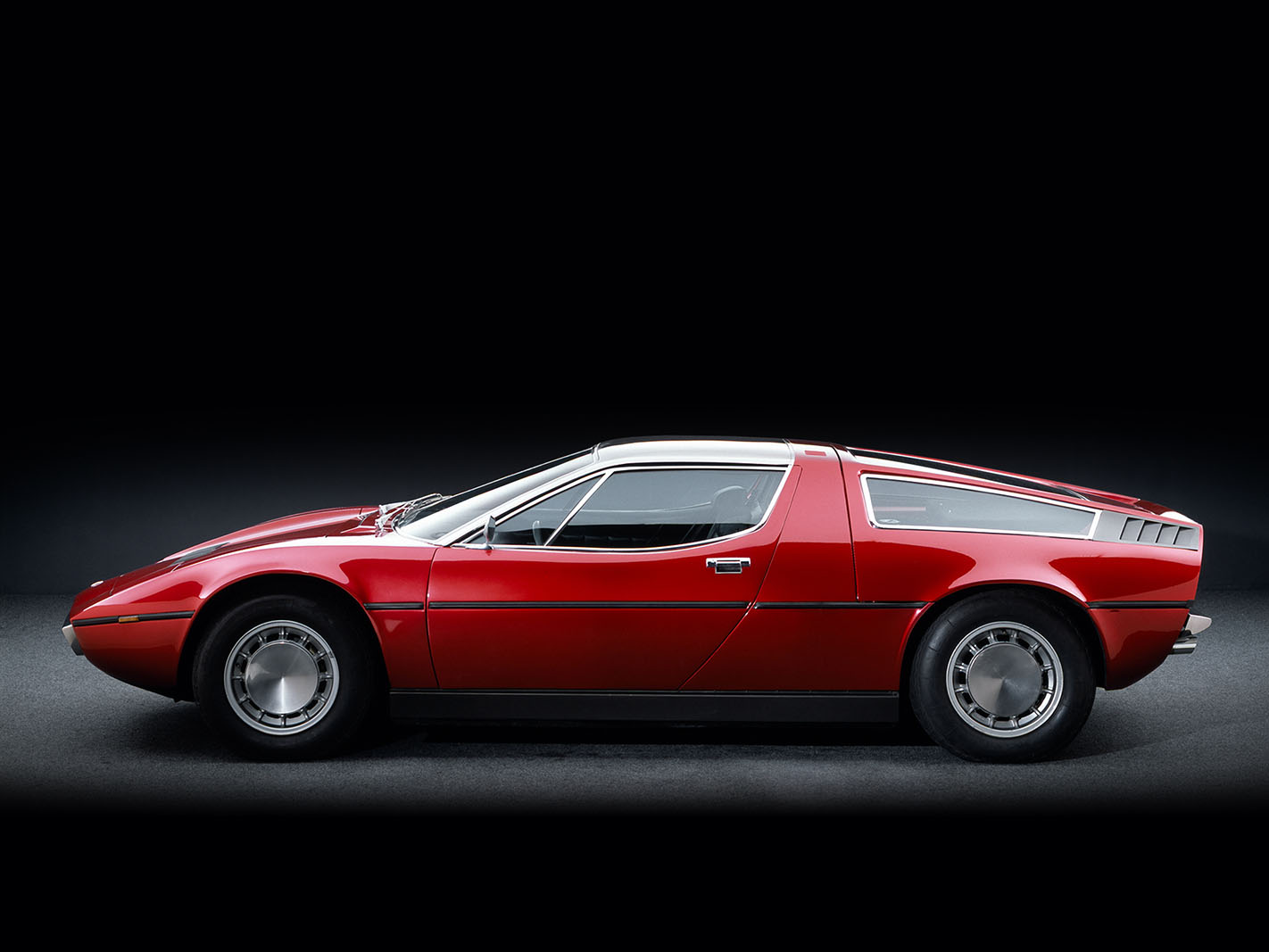
Think Maserati and your mind will fill with slow-motion images of Fangio sliding a scarlet red 250F, of gleaming 3500s, and the eyecatching wedge of the Bora. The Maserati brand is cool, but the product? At least recently? Well…
I’ve only driven one Maserati – a black Gran Turismo MC – and it was something of a mixed bag. It felt old, rather than old-school, the cabin was let down by a mismatch of Chrysler parts, and the jerky single-clutch robotised auto tarnished the driving experience.
But my goodness, what a looker. And its V8 didn’t so much burble and bark as it did sing.
Honestly, the noise it made was so evocative and magical that it sounded like the V8 was running on equal parts honey and caramel.
Objectively I couldn’t make a case for buying the Gran Turismo MC over its rivals, yet subjectively, it had an appeal all of its own. Brand over product. Job done then.
Except actually, it isn’t.
The shockingly enormous flaw in my logic is that despite the strength of its brand name, Maserati’s fortunes haven’t been rosy for a while.
The brand might be as strong as ever, but I can’t remember the last time Maserati turned out a class-leading car. And as a result, not enough people have bought them. And that’s not good business.
Since the 70s, Maserati has been owned by Citroen, put into liquidation, resuscitated by the Italian government and Alejandro de Tomaso, partly bought by Chrysler, fully owned by de Tomaso, then sold to Fiat.
The tumultuousness doesn’t stop there. In 1997 it was taken over by the biggest brand of them all, Ferrari, but then, eight years later it was palmed off to Alfa Romeo. Now it’s on its own once again, but under Fiat ownership.
Each new owner has had a fresh vision (or seemingly no vision at all), so Maserati’s product hasn’t only progressed at a haphazard pace, but I’ve lost count of the number of false dawns and broken promises.
Anyone remember 2014’s pretty Alfieri concept? It’s been on again and off again so many times that I can’t help an eye roll whenever it’s mentioned.
Recently, however, the tone has changed. The usual platitudes and grand promises have been replaced with action. No longer under the wing of Alfa Romeo, Maserati has been quietly and steadily building the foundations to begin a new era. It has moved into a new factory in Modena and has released details of an all-new, Maserati-built (i.e no Ferrari input) twin-turbo V6 dubbed ‘Nettuno’.
The headline stats are impressive: 8000rpm and 463kW/730Nm. This all-new engine will power an all-new supercar, known as the MC20, and even more encouragingly, this car isn’t a concept. It has already been fully developed and built.
We’ll have full details of the MC20 following the official reveal tomorrow and trust us, the early signs are encouraging. Eye rolls? Not anymore. I’m excited.
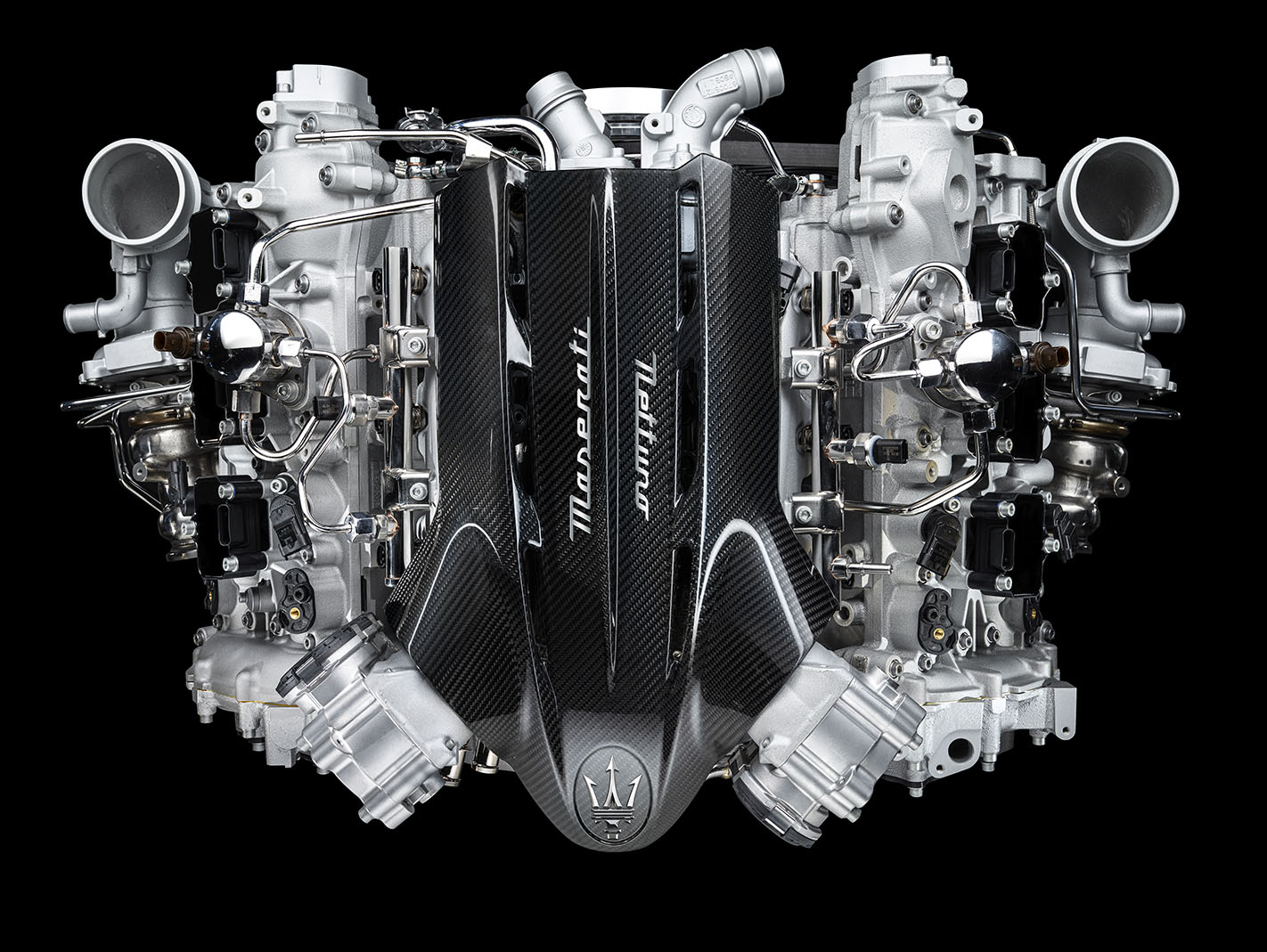
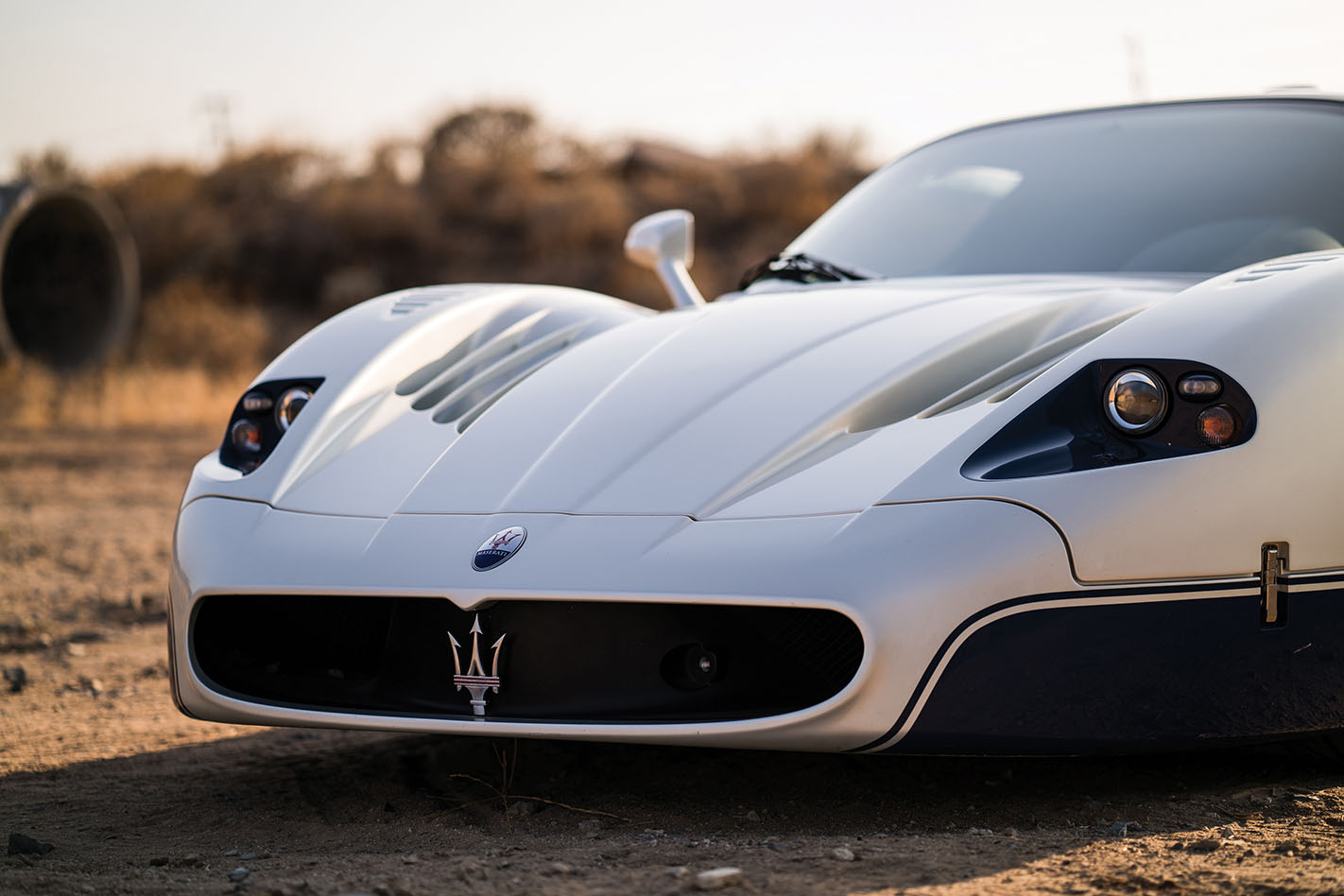
Maserati isn’t alone in being at a crossroads, of course. Aston Martin and Alfa Romeo are just two other brands with long legacies trying to reinvent themselves for their second century. Aston’s financials are especially grim, but as our fist taste of the pivotal DBX shows, strong product offers an ideal (re)launching pad.
So that kind of destroys my ‘brand over product’ logic. Brand recognition and perception might be invaluable, but in today’s cut-throat market, product is king.
Here’s hoping the MC20, and whatever follows it, delivers.
One of the main attractions of SUVs isn’t just the practical considerations of a tall seating position and easy access to the boot and rear seat, but the promise they make of being the versatile chariot capable of taking you and your family out into the great outdoors for a long weekend
Not all SUVs are created equal in this regard, but here we’ve got two midsizers that are arguably the best equipped in their segment as dirt-friendly adventure machines. How do they compare?
HOW AFFORDABLE ARE THEY?
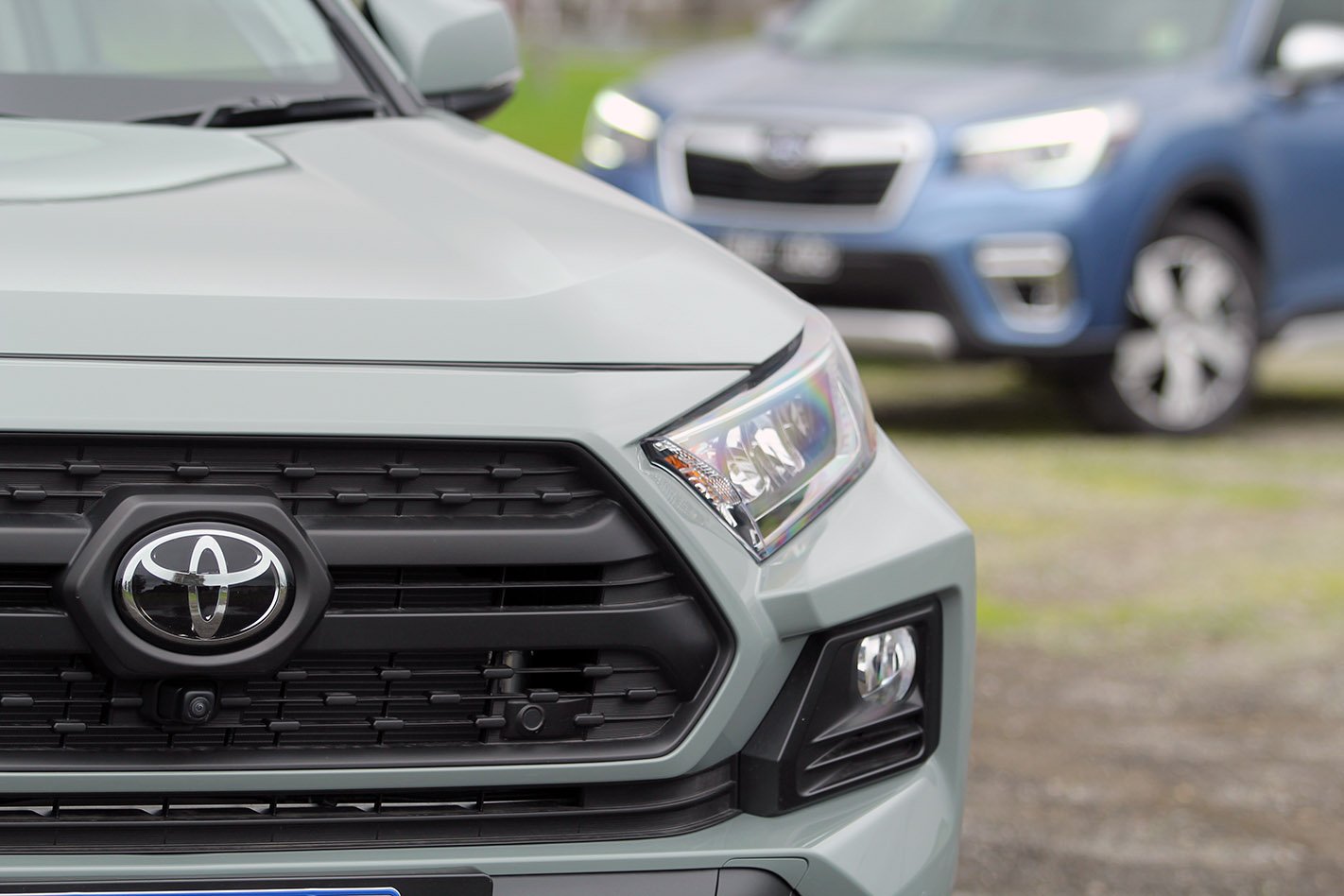
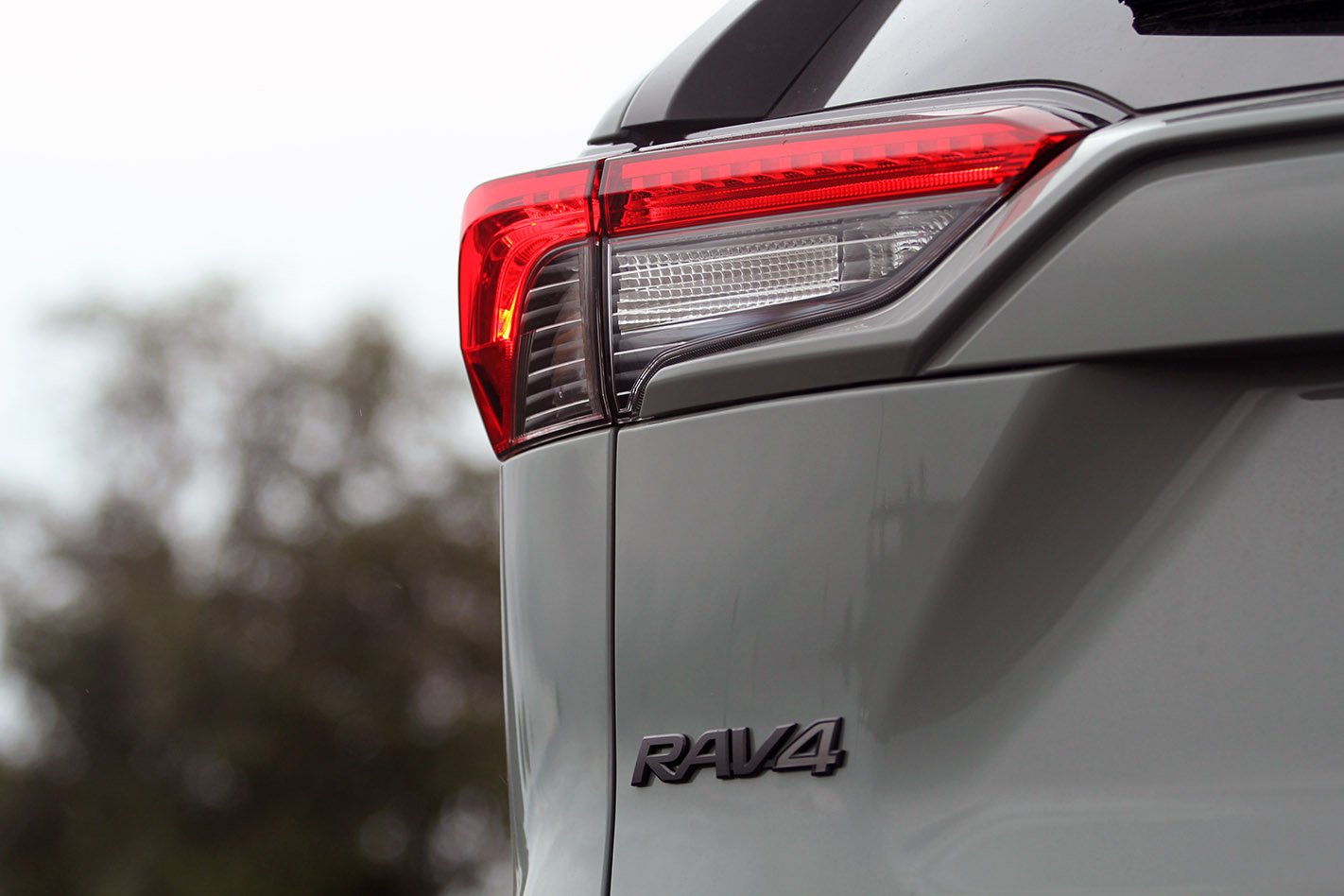
Toyota RAV4 Edge
Retailing at $47,140, the Edge is the most expensive model in the new Toyota RAV4 range. It’s also the only variant in the entire lineup to feature a regular petrol engine AND all-wheel drive (all other variants are either petrol front-wheel drive, hybrid front-wheel drive, or hybrid all-wheel drive with an electrically-driven rear axle), so if you had your heart set on that mechanical combination then the Edge is your only option.
It naturally comes with plenty of equipment but is it good value for a mid-size SUV, considering many larger SUVs kick off under that price point? Thankfully there’s reasonable value when it comes to ownership, with the first six scheduled services capped at $210 and the servicing intervals of 12 months and 15,000km being slightly less frequent than what’s stipulated for the Subaru.
Subaru Forester 2.5i-S
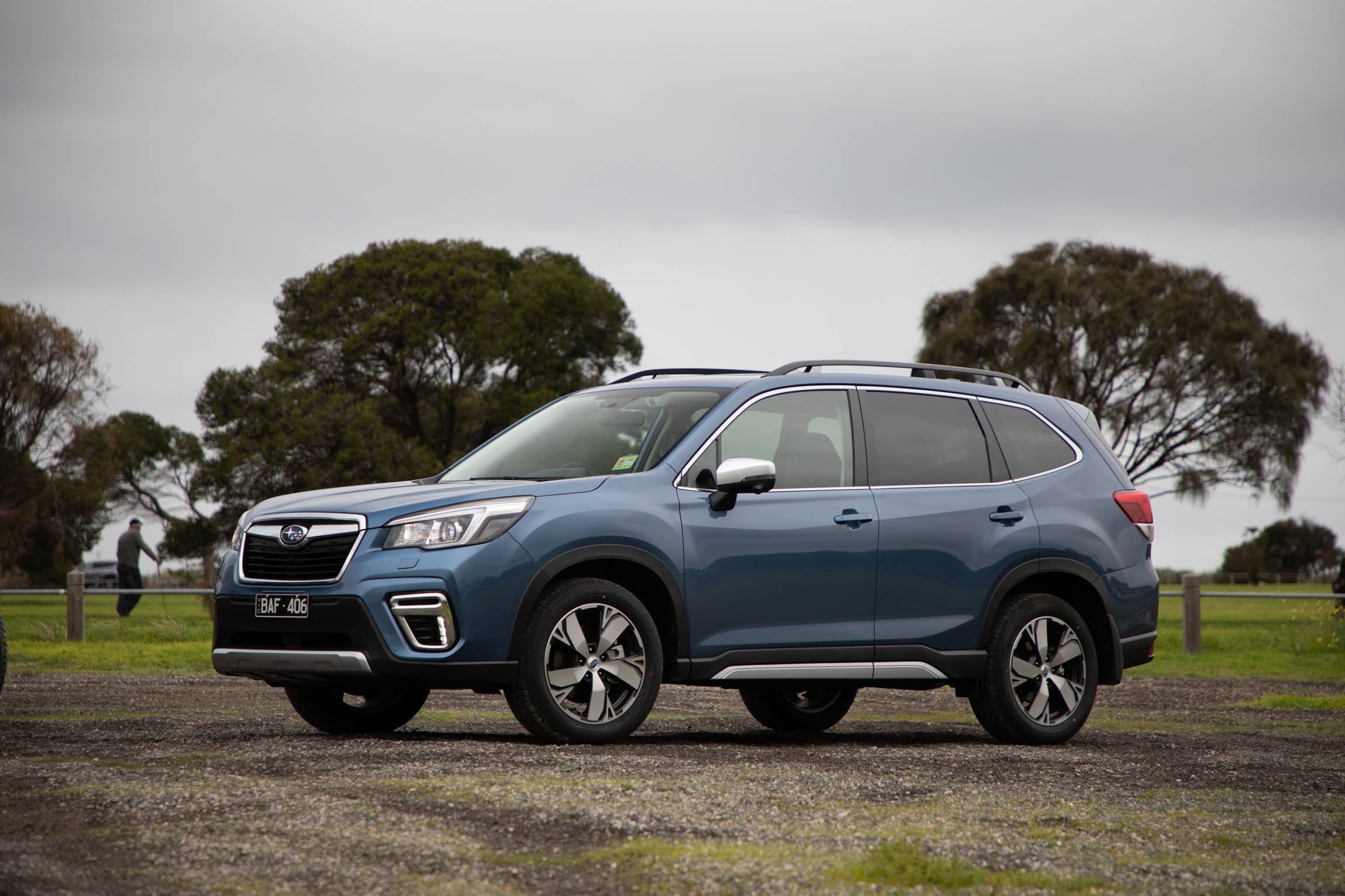
The flagship Subaru Forester is a sharper value proposition in the showroom, priced at $41,490 before on-roads with no options.
Eroding that value lead is its relatively costly maintenance requirements. Service intervals are set for 12 months or 12,500km, which isn’t too far behind what Toyota asks for the RAV4, but the cost per visit under Subaru’s service plan is significant: $346 for the first service, $584 for the second then back to $346 for the third.
That leaps to a huge $760 for the fourth service, before setting back down to $351 for the following visit.
WHAT FEATURES DO THEY HAVE?
Toyota RAV4 Edge
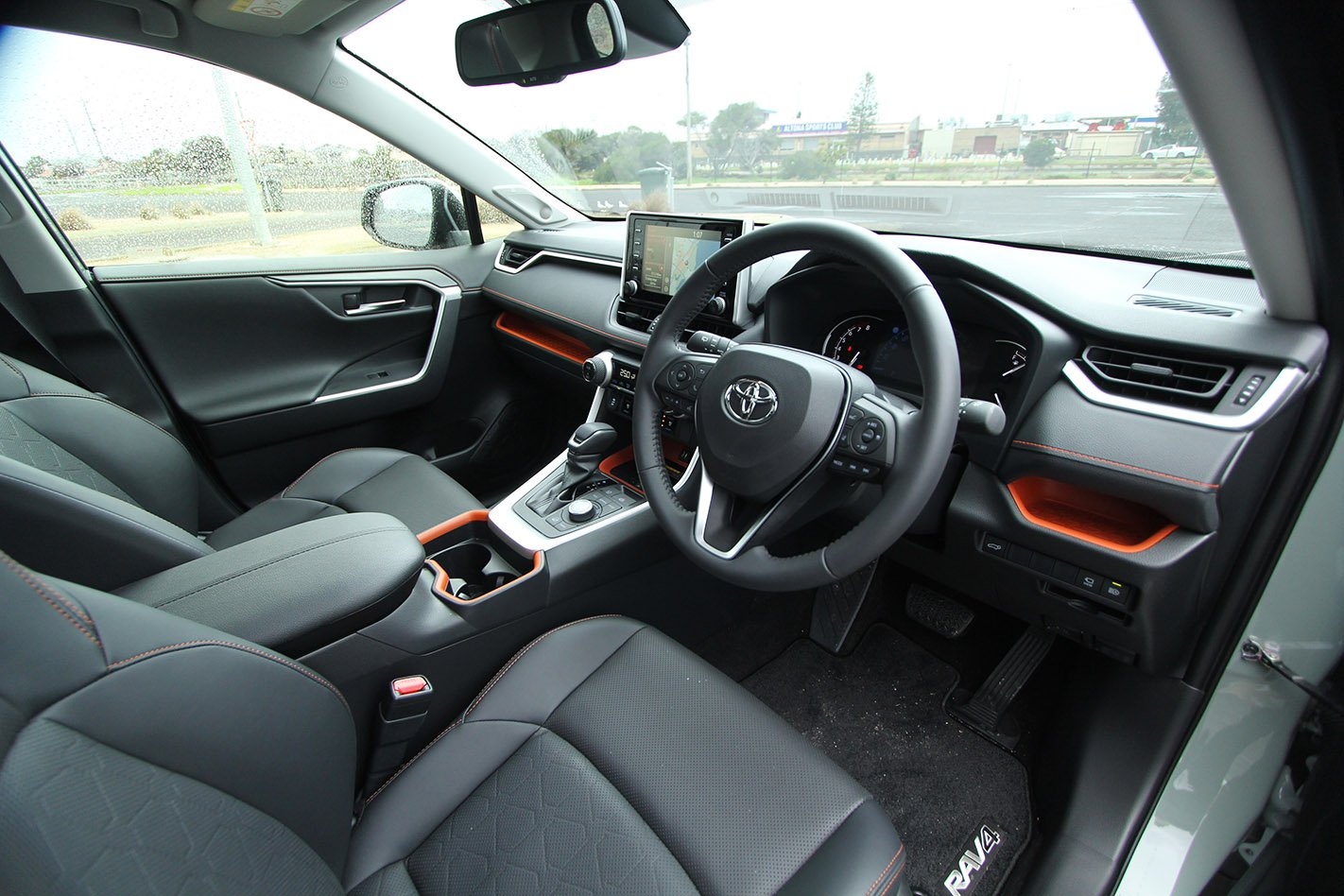
As the top-shelf RAV4, the Edge offers up active cruise control, LED headlamps, a wireless phone charging pad, powered tailgate, keyless entry/ignition, a well-featured 8-inch colour infotainment display with integrated sat-nav (but no smartphone mirroring as yet) and a seven-inch reconfigurable electronic dash display.
Cabin comfort is enhanced by a 9-speaker JBL premium audio system, heated and cooled front seats, a power-adjustable driver’s seat, glass moonroof and dual-zone climate control.
Subaru Forester 2.5i-S
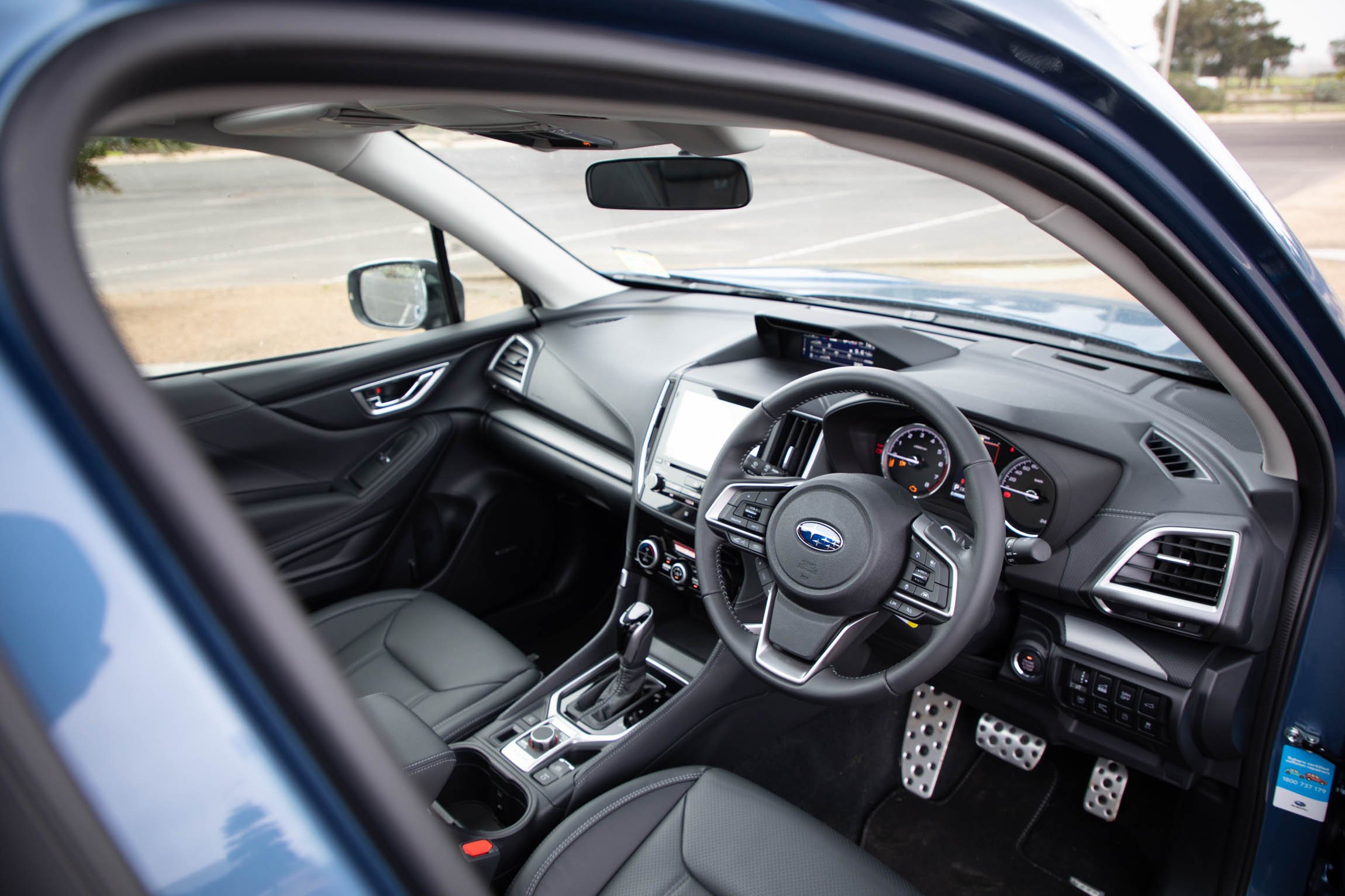
The Forester’s range-topper wants for little when it comes to equipment too, with a largely similar feature set to the RAV4.
There are some exceptions, like the absence of wireless phone charging, one less speaker for its Harman Kardon audio (for a total of 8), and regular analogue instruments rather than a partial electronic display, however that’s expected given the price differential between the two.
Even so, the Forester does boast some unique features of its own. Things like a driver recognition feature that can automatically load your favourite settings for seats, mirrors, radio and climate the instant it glimpses your face (perfect for avoiding spousal tension), and a kerbside camera that should make gutter-rashed wheels a thing of the past.
HOW PRACTICAL ARE THEY?
Toyota RAV4 Edge
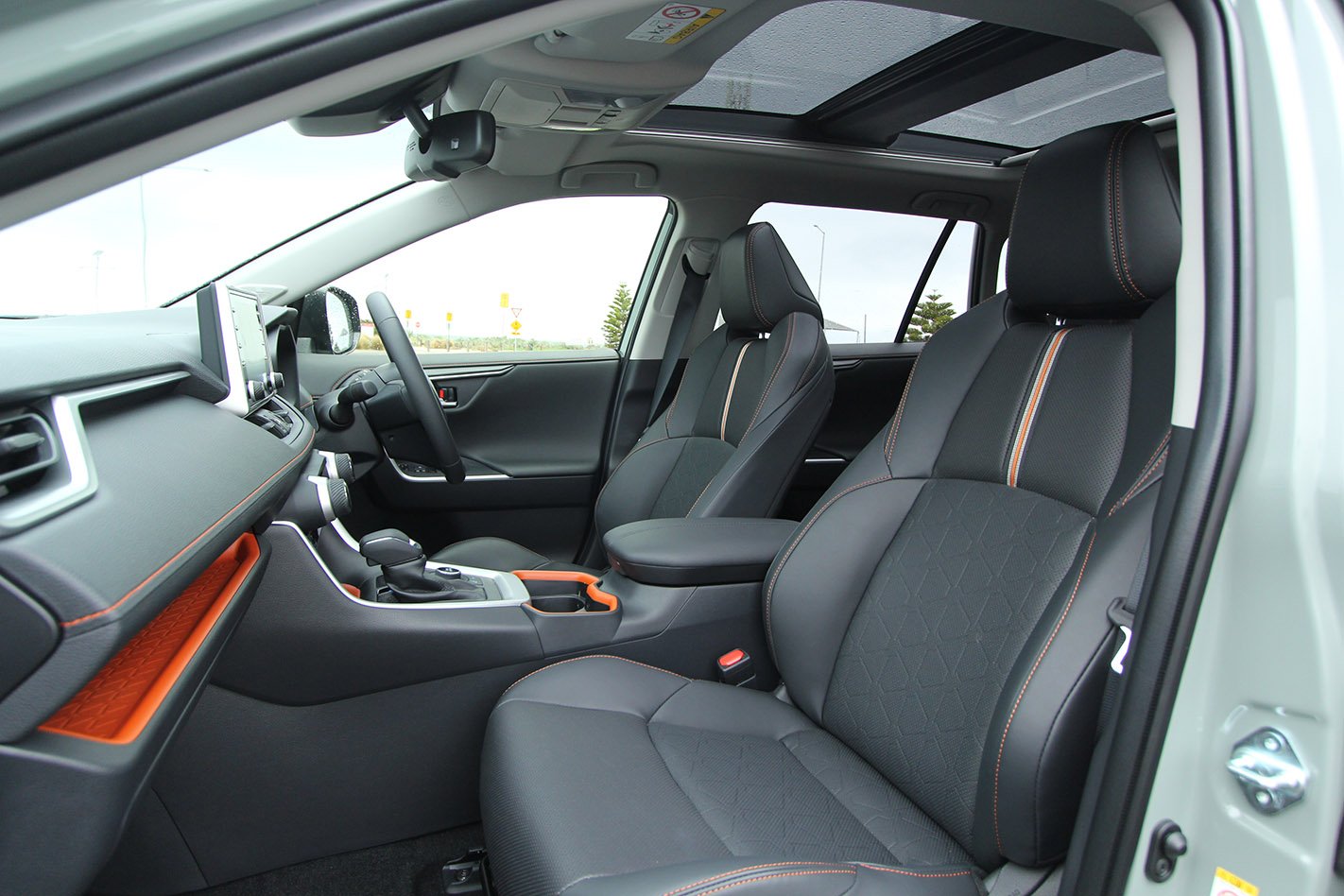
The Toyota has a cool and colourful interior that’s also nicely sized for a family of four and their belongings. We really like the in-cabin storage options provided by the dash-spanning shelf, giving plenty of places to pop a phone, pen or wallet while you’re driving. Covered storage elsewhere in the cabin is good too.
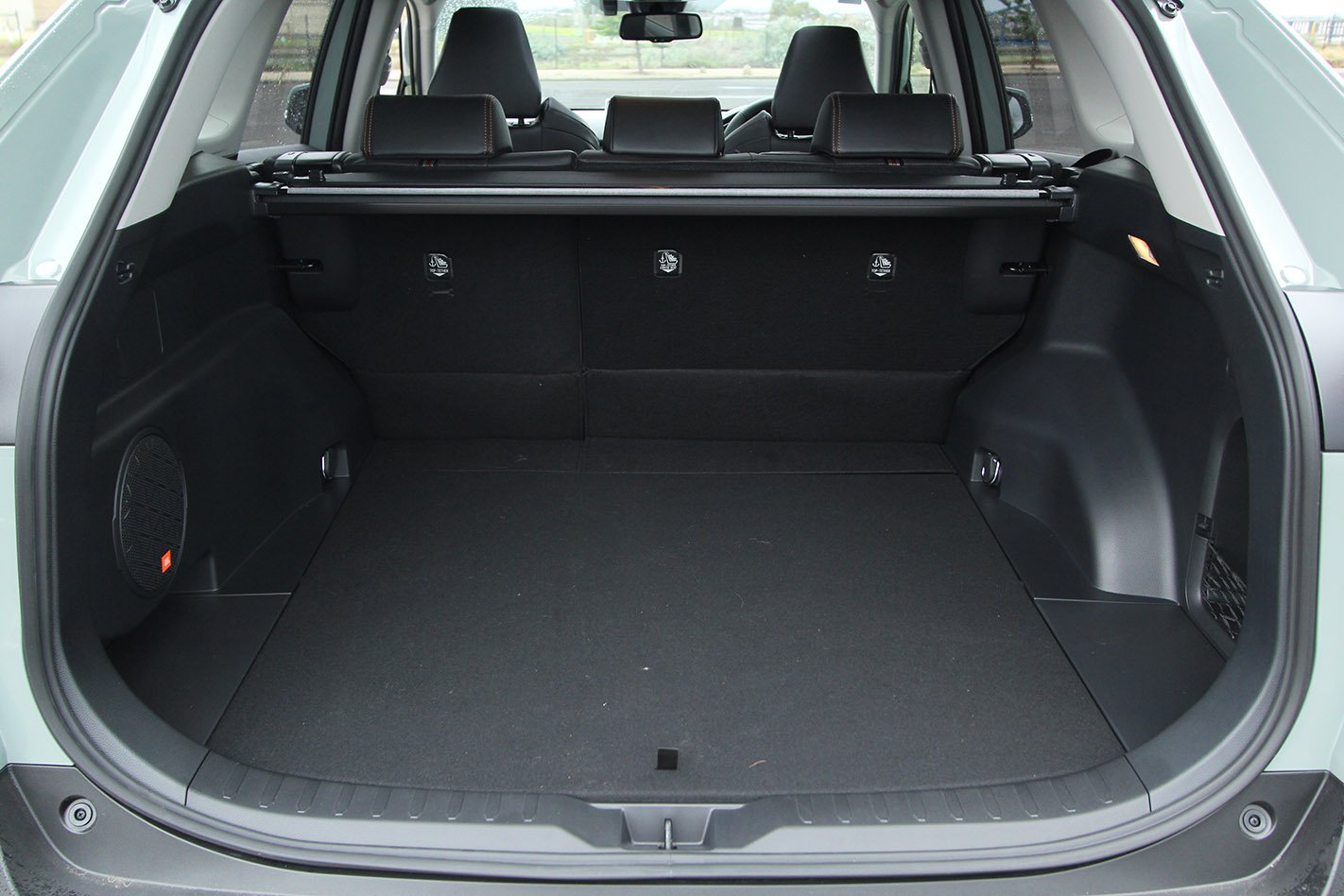
The boot floor is flush with the loading lip in the highest of its two positions, which makes it easy to unload heavy stuff, however while there’s some additional space beneath the floor around the space-saver spare tyre there are no moulded pockets or enclosures to make that area properly suitable for small cargo. Still, with 580 litres of seats-up capacity, there’s plenty of above-floor storage on offer.
A powered tailgate is standard on the Edge, but dropping the rear seats requires you to walk around to the rear doors to pull their release levers. There are no shopping bag hooks either, an oversight in a car designed for families.
Subaru Forester 2.5i-S
The Forester’s boot area is super-practical. Remote release buttons for the rear seats mean dropping them just requires a flick of the finger while standing at the tailgate, and there are four integrated shopping bag hooks to keep your groceries secure.
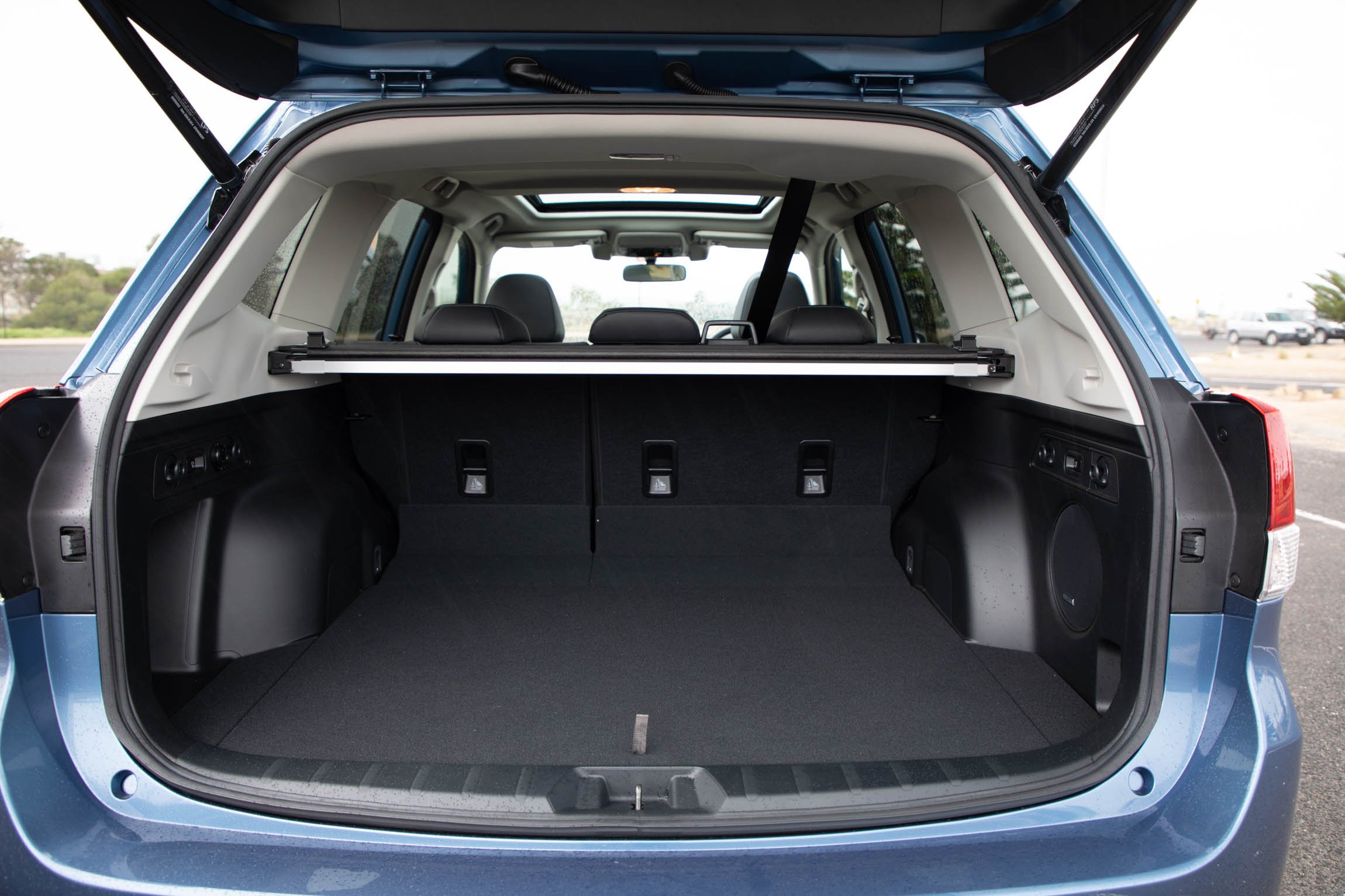
However, it’s a smaller space than the RAV4’s rump, with 498 litres of seats-up capacity. At least the tailgate opening is mega-wide to facilitate loading and (like the Toyota) a powered tailgate are standard issue.
There are fewer nooks and crannies for smaller objects in the Forester’s cabin, however the door bins are large, there are plenty of cupholders and bottle holders, and the centre console box is deep.
HOW SAFE ARE THEY?
Toyota RAV4 Edge
The RAV4 carries a five-star ANCAP rating, is equipped with seven airbags, and features lane departure warning, blind spot monitoring, autonomous emergency braking, collision detection, front and rear parking sensors and a top-down camera view as standard safety equipment.
Subaru Forester 2.5i-S
The Forester has the same safety feature set as the Toyota, with the addition of active driver fatigue monitoring courtesy of the driver recognition feature. The Forester also carries a five-star ANCAP crash safety score, and is equipped with seven airbags as standard.
HOW COMFORTABLE ARE THEY?
Toyota RAV4 Edge
The RAV4 offers up a commodious and comfortable pair of front seats, with the driving position allowing both a relaxed posture behind the wheel and a good view of the road ahead.
Synthetic rather than real leather is specced for the Edge to make it easier to clean up mud and dust (you get real hide in the Cruiser grade), but to be honest it feels less fake than some other supposedly genuine leather interiors.
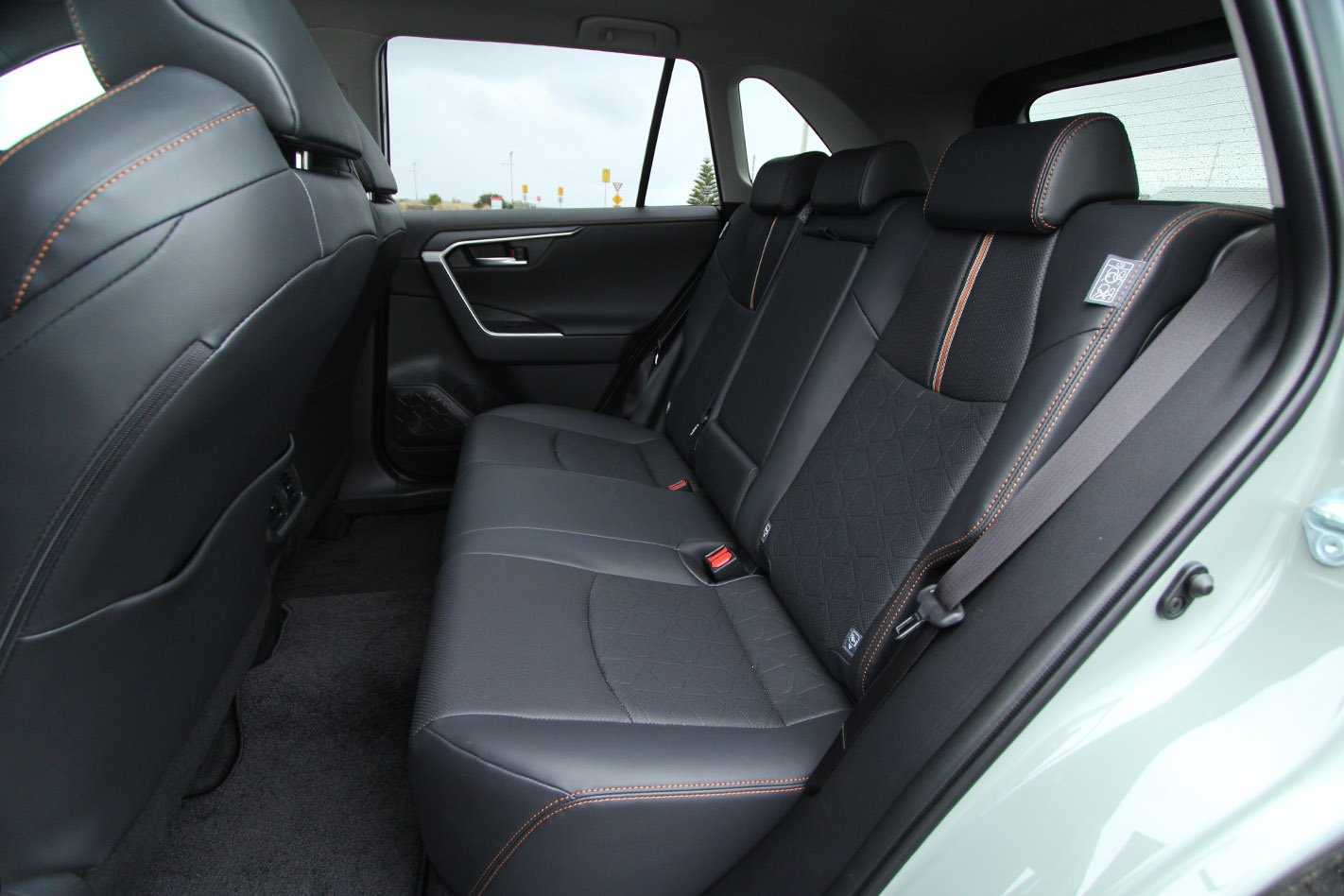
However it’s not so great in the back. The RAV4’s rear seats have you sink down low, giving those in the back a limited forward view. The windows are big, but the low seats mean you feel a lot more hemmed-in when sitting in the back seat.
It’s comfortable, with face-level air vents and a pair of USB charge points on the rear of the centre console, but the RAV’s back seat is just a smidge claustrophobic for shorter folks.
Subaru Forester 2.5i-S
Talk about spacious. The Forester’s extensive glasshouse and tall cabin make it feel significantly roomier and inviting than the Toyota, with unimpeded views in all directions and enough headroom to keep Marge Simpson happy.
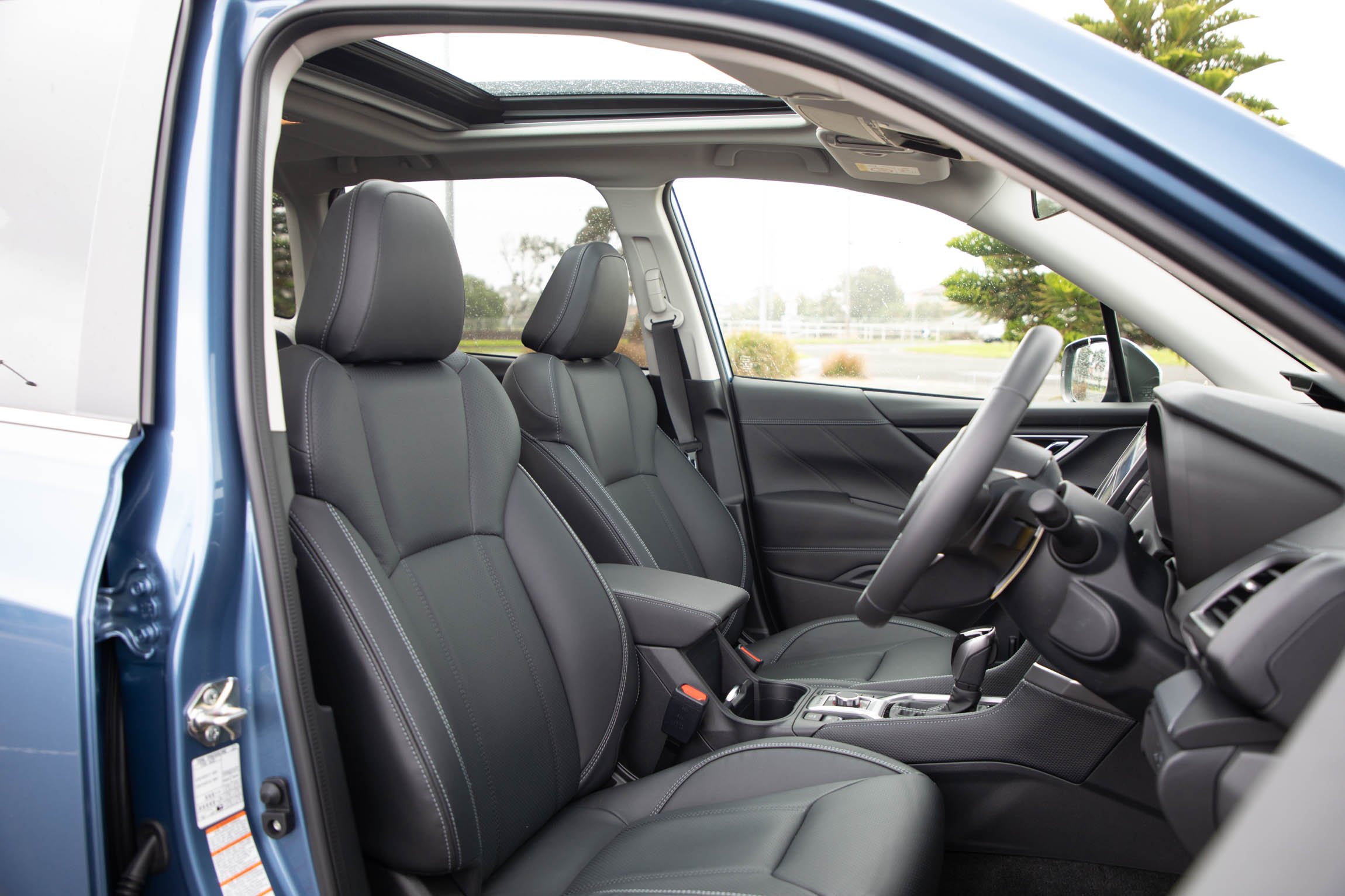
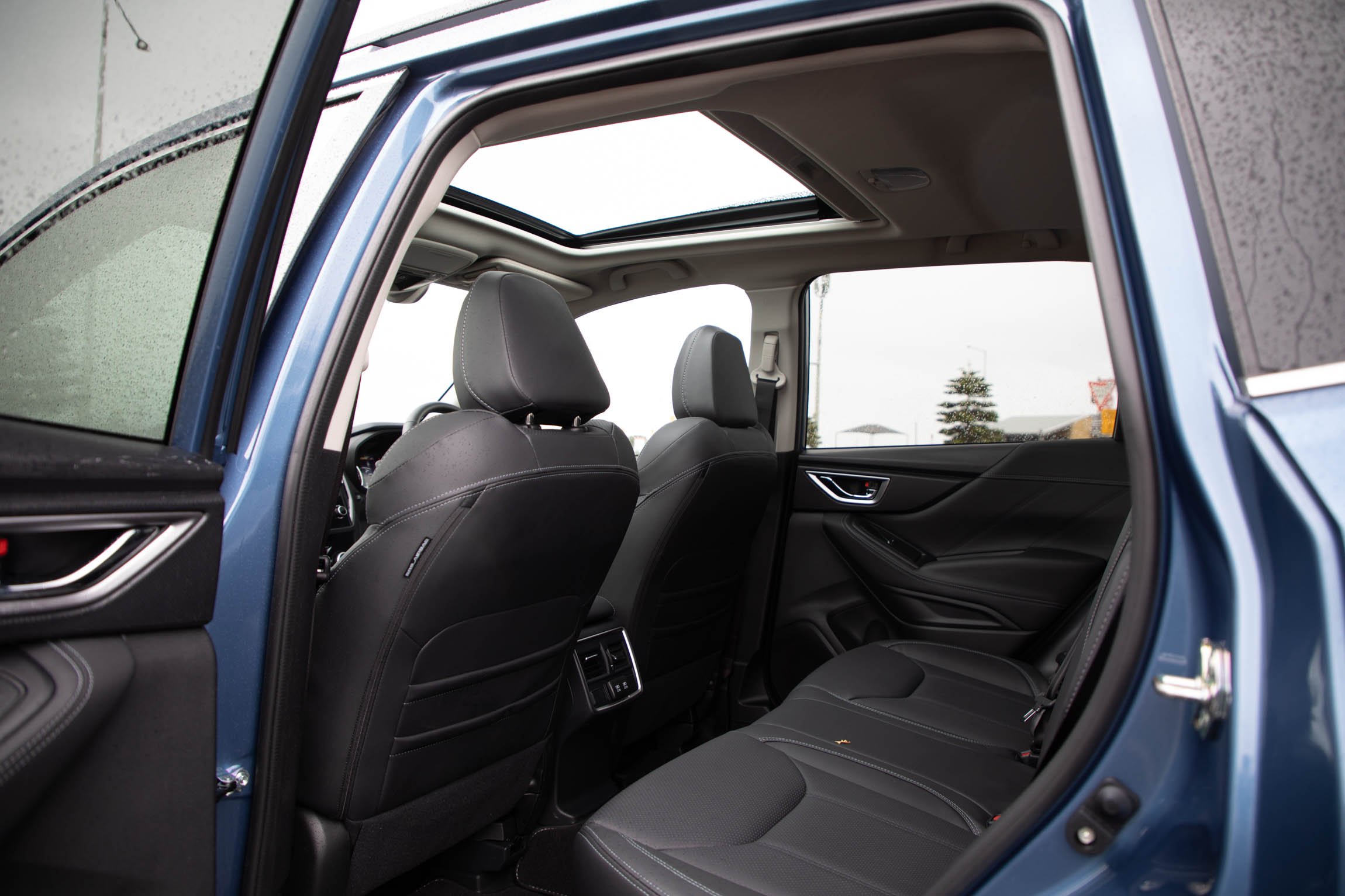
On top of that you’ll find excellent stadium-style seating that elevates the rear bench seat to give backseaters a decent view forwards.
It has rear face-level air vents and a pair of USB charge ports on the back of the centre console too, just like the Toyota, but with more rear legroom it’s a nicer environment for passengers.
WHAT ARE THEY LIKE TO DRIVE?
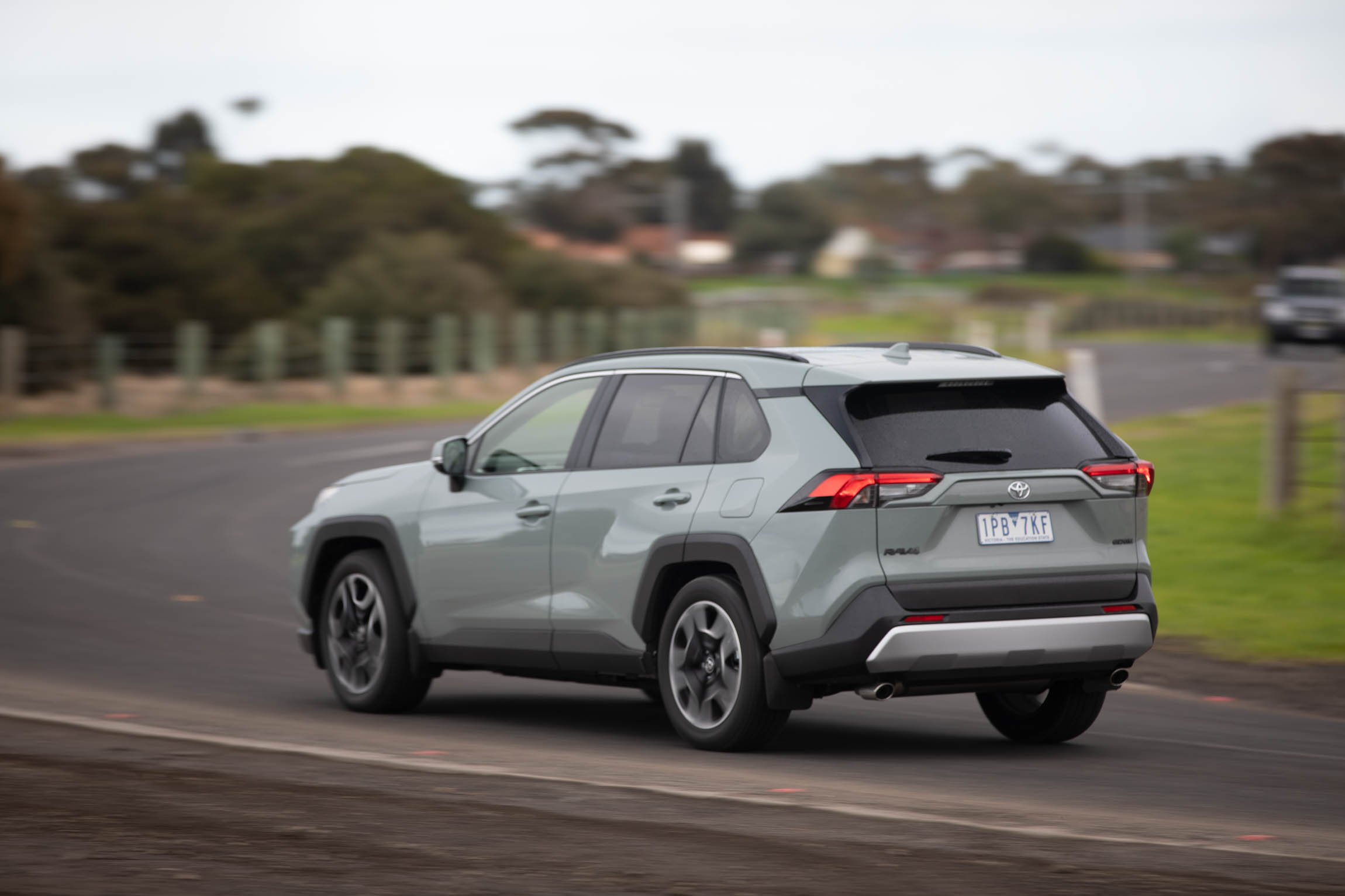
Toyota RAV4 Edge
It’s curious that the Edge is the only member of the RAV4 family to come with a conventional petrol engine and AWD drivetrain combination, something that’s more or less the norm with other brands in the SUV space. That’s not all either – it’s the only RAV4 to be equipped with a conventional eight-speed automatic rather than a CVT auto, and ships with a multi-mode traction control system for light-duty offroading.
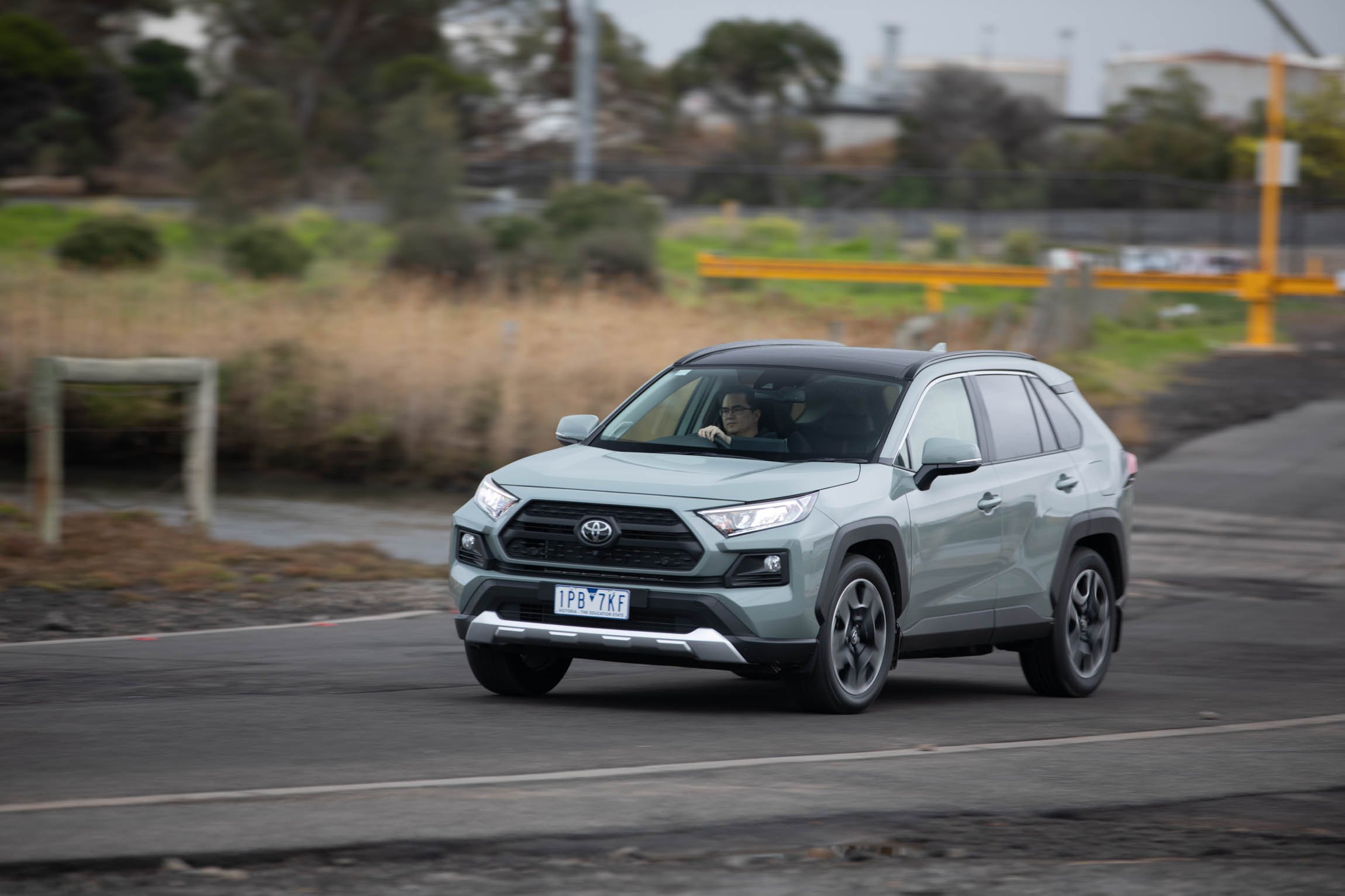
And that last point is important: if you’re planning on using a RAV4 for any dirt driving that could be considered challenging, the Edge is arguably the only one that’s suitable for the job.
With 152kW and 243Nm from its 2.5-litre petrol four-cylinder, the Edge has the most powerful engine in the lineup, and its all-wheel drive system can be tailored to mud, sand, rock, dirt and snow via a simple rotary selector next to the gear lever.
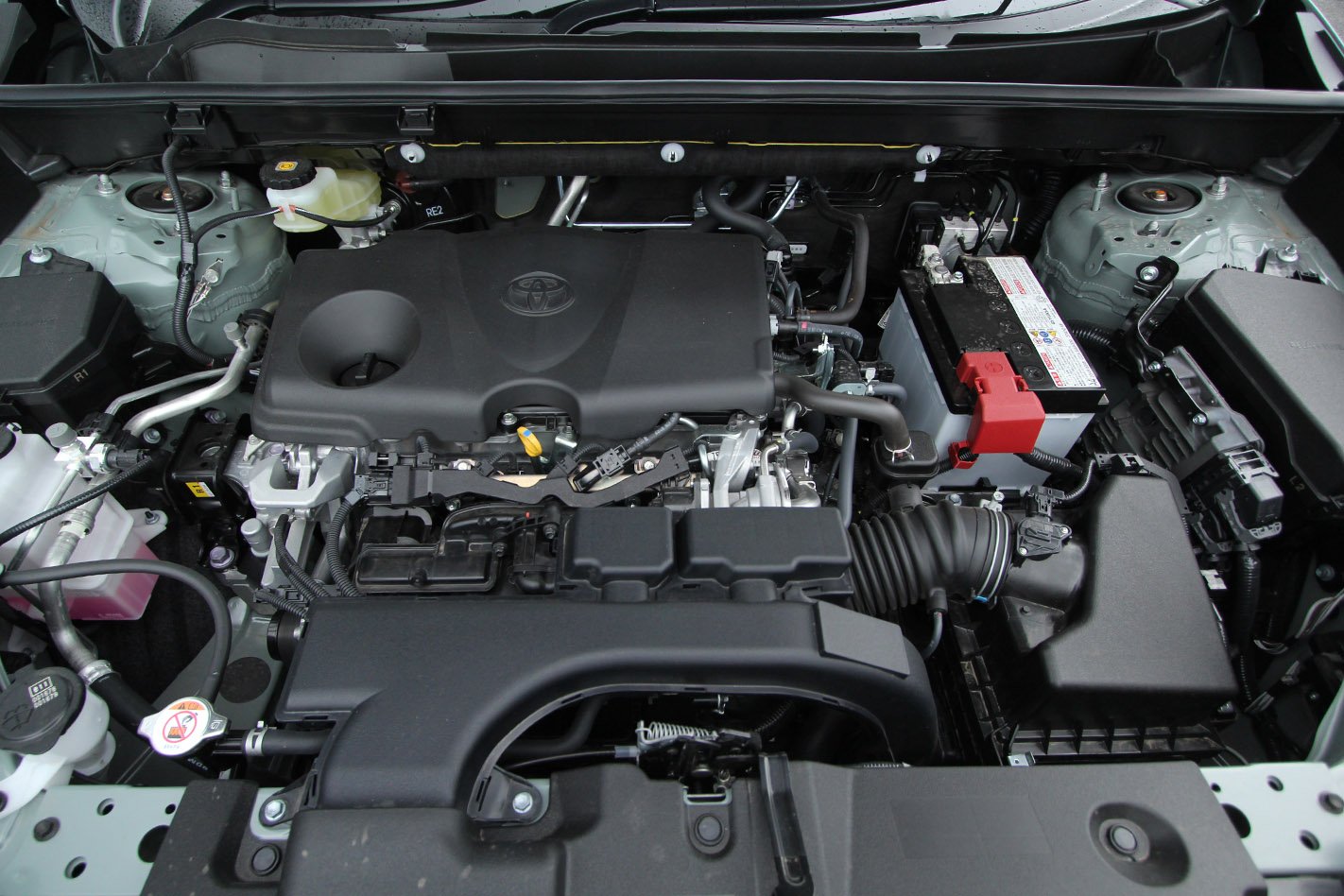
And while that engine certainly feels strong, it also makes a lot of noise if you’re doing anything more strenuous than light-throttle cruising. There’s also a sharp edge to its ride quality – not jarring, but definitely not as compliant as the easy-going Subaru.
Otherwise, it’s quite easy to drive. The 8-speed automatic isn’t as smooth and fluid in around-town driving as the CVT used by all other RAV4 variants, but that’s about the summary of our complaints about the way it drives.
Subaru Forester 2.5i-S
If there’s one thing that really separates the Forester from the RAV4, it’s the way it rides. With fatter sidewalls on its tyres and a more compliant damper tune than the Toyota, the Forester 2.5i-S rolls over rough stuff with ease and composure. Yet, at the same time it never feels bouncy or compromised by its comfort.
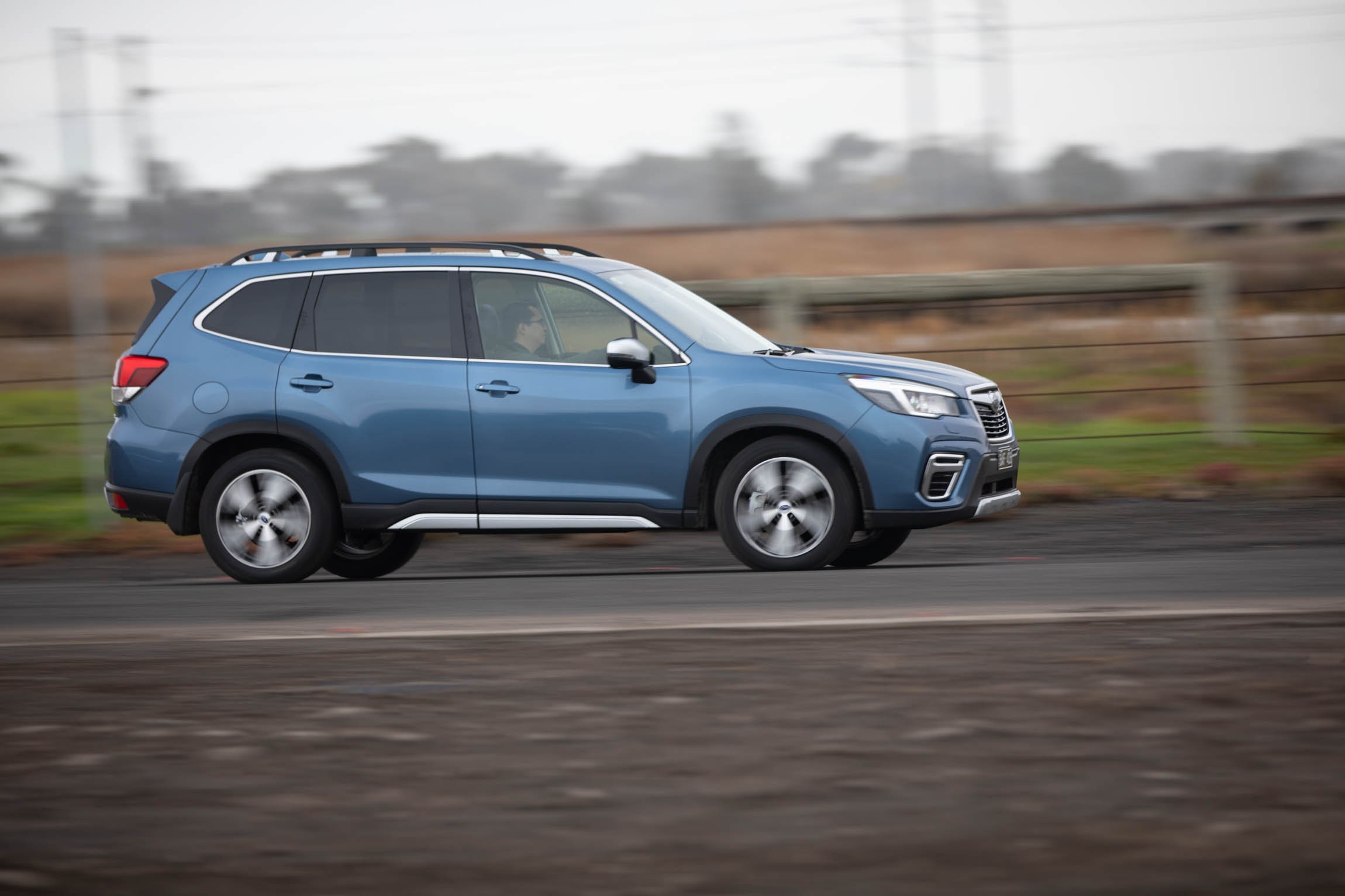
Sure, its 136kW/239Nm engine might be a little behind the Toyota’s numbers, but the Forester is no slouch. Despite its CVT – a style of gearbox usually not known for responsiveness – it reacts quickly to demands for acceleration, and seamlessly adjusts its ratios to extract the best performance or economy.
Like the Toyota, the Forester’s thrummy engine is louder than desirable when accelerating, but subdued at a cruise.
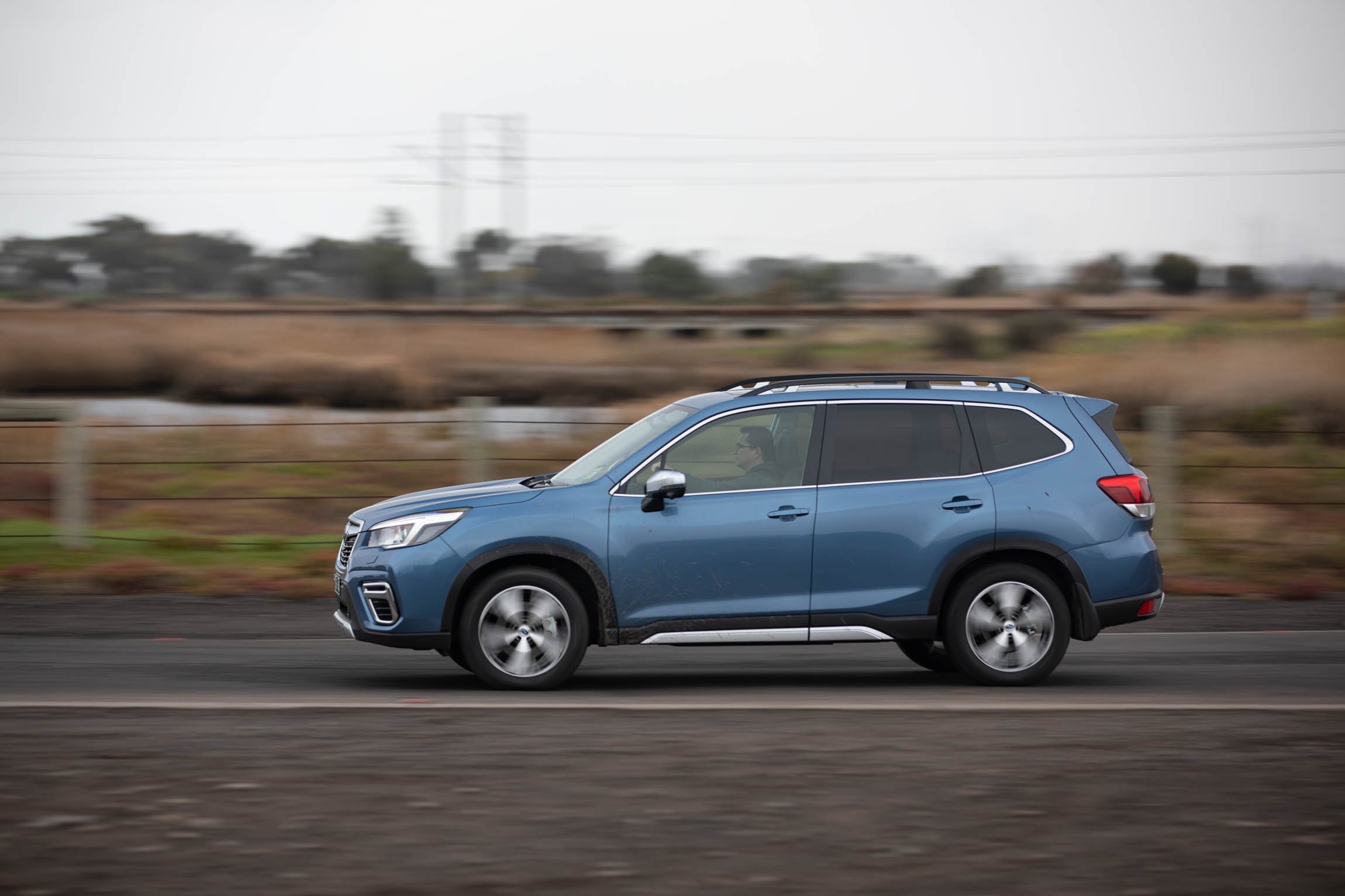
It feels a lot easier to wield around town, though, largely thanks to its better outward vision and 10.8m turning circle (the Toyota needs 11.0 metres)
And while the RAV4 Edge targets outdoorsy types with its special mechanical fit-out, the Subaru doesn’t need to – its hardware is trail-ready by default, courtesy of a standard-issue all-wheel-drive with an adaptive ‘X-mode’ offroad calibration and 220mm ground clearance.
OUR OPINION
If it’s a well-equipped, easy-to-drive, spacious and camping-trip-capable SUV you’re looking for, it’s difficult to go past the Subaru Forester 2.5i-S.
It simply excels at so many things, whether that’s build quality, driveability, comfort or cabin space, while also bearing a price tag that’s several thousand dollars less than Toyota’s similarly-positioned RAV4 Edge.
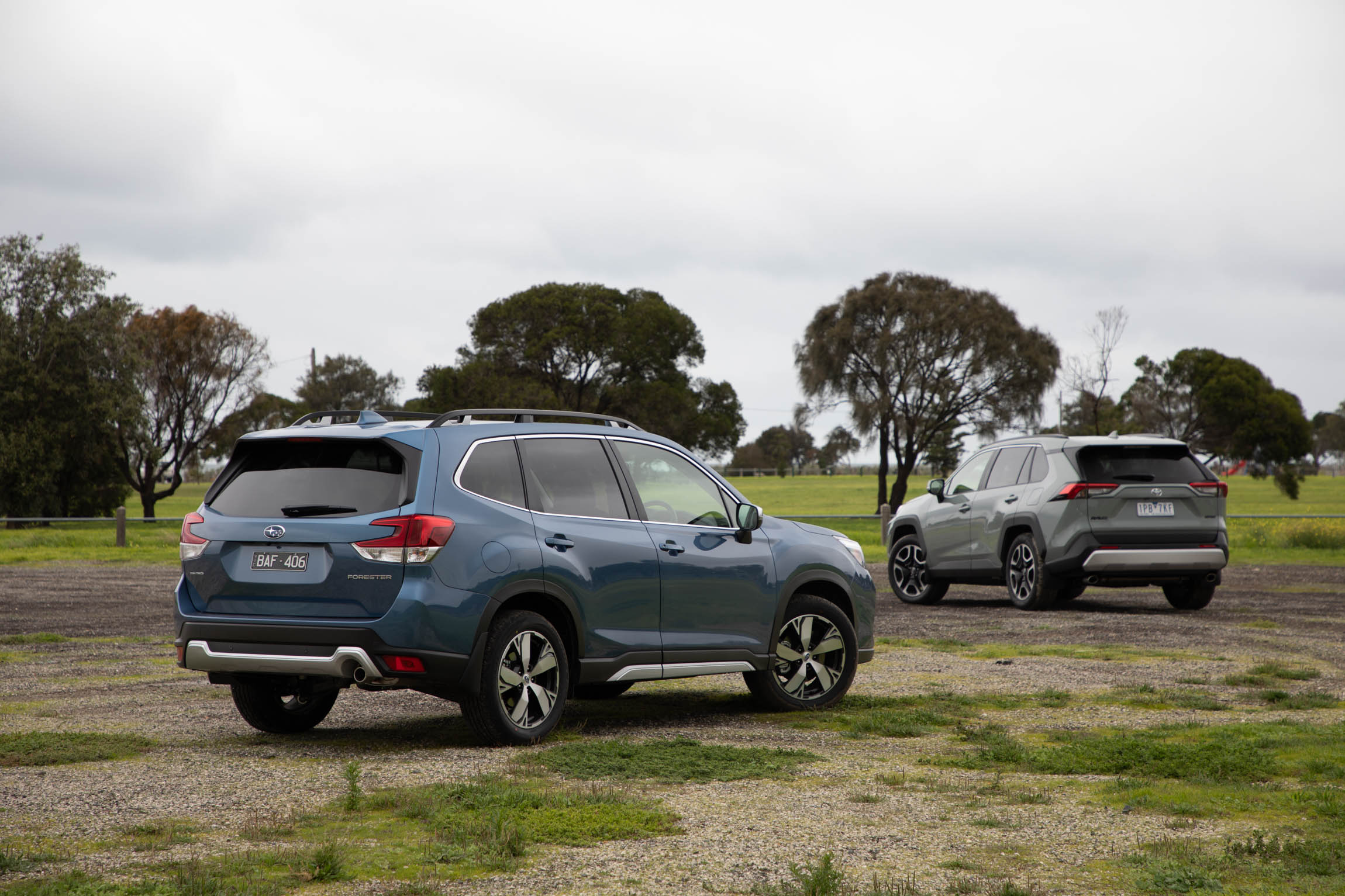
And if all you want are the AWD mechanicals and ride height to get you off the beaten track with confidence, well, every other Forester variant uses the same hardware. Just pick the one that best agrees with your bank balance.
The same can’t be said of the RAV4 Edge. It’s a shame that the only way to get a ‘traditional’ AWD setup in that model is to buy the most expensive variant, but you do at least get plenty for your money – not to mention a slightly bigger boot, some extra kit and drastically cheaper servicing that the Subaru doesn’t enjoy.
Today is World EV Day and while the rest of the planet is dancing in the streets under a blizzard of bunting and confetti, Australia’s celebrations are slightly lower-key. But they shouldn’t be.
As a nation, Australia might have been a little slow to catch the long rope dragging behind the global electric vehicle movement but, it appears we are finally holding on tight and paddling to try and catch up.
Along with the first stirring signs of government support at a local, state and federal level, there are a growing number of Australians who are interested in replacing their combustion powered car with something, at least in part, powered by electricity.
But while the number of EV models available on the market gradually increases, there’s a technological innovation that’s set to make the battery-powered car park explode, and it’s all thanks to a skateboard.
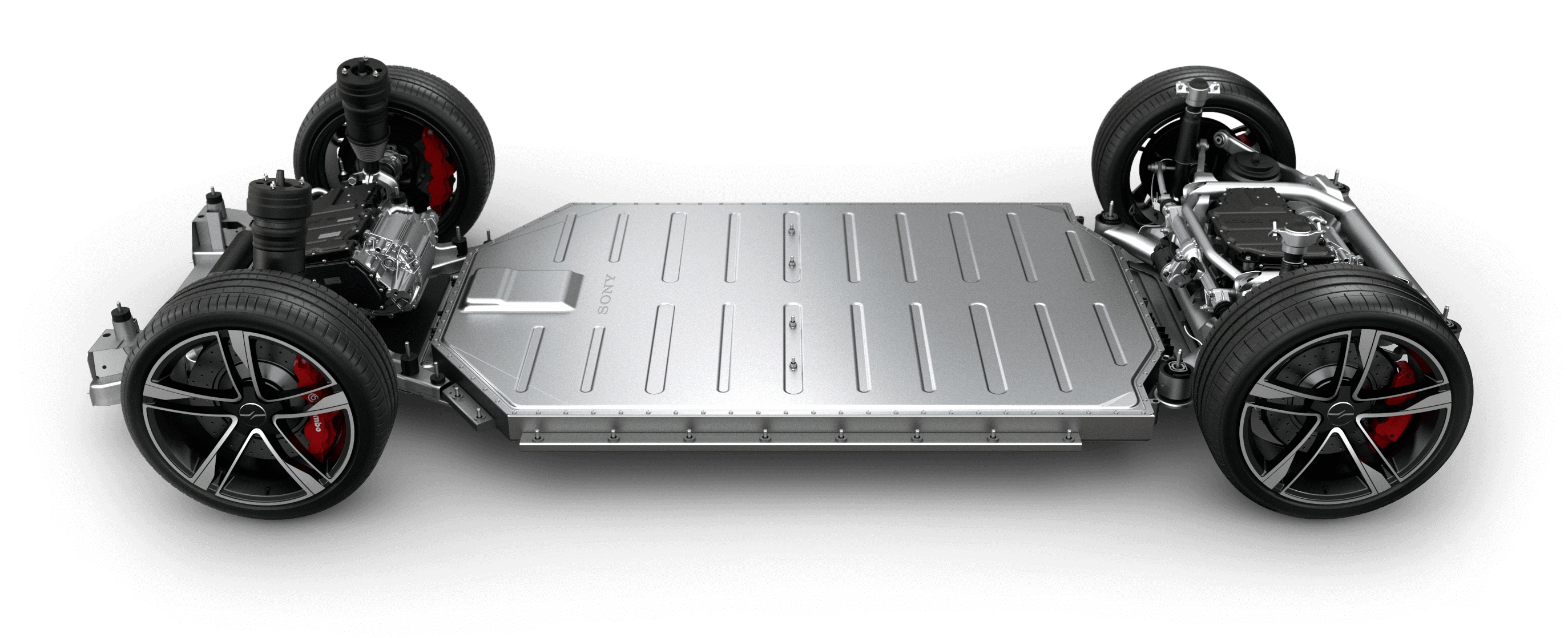
Flexible vehicle platforms have been proving their worth in vehicle production for decades, enabling many classes of car to roll on the same architecture – one development bill, many models. But electric vehicles are taking this principle to the next level with the so-called ‘skateboard’.
As the name suggests, this specialised but simple EV platform approach is providing the blank canvas for virtually any kind of vehicle to be built upon, and it’s allowing manufacturers to break the mould like never before.
If you’re a driver clinging to the notion of vehicles powered by very old zooplankton under the sea then let us tempt you into the zero-emissions age with eight fascinating vehicles coming to market in the not so distant future that bust the most frequently cited concerns from Australian EV opponents.
EVs are dull
If the somewhat conventional EVs to date haven’t excited you, then skateboard platforms are going to tear up just about every design constraint in the book as demonstrated, among others, by Volkswagen and its MEB modular EV chassis.
The carmaker has recently trademarked the name ‘e-Thing’ which suggests the German giant is developing an electric homage to its 1960s Type 181, which was radical at the time – let alone a modern version. How does a pure electric, big-wheeled, open-top beach buggy sound?
And it won’t stop there. Creating an outrageous and esoteric model like the e-Thing would previously have been prohibitively expensive given the limited audience and sales, but its incredibly flexible MEB platform will enable more niche passion projects for a fraction of the cost.
Car UK is reporting the company will produce another member of its electric ID family – the Ruggedzz in 2025 as a rival for Jeep’s Wrangler and the Land Rover Defender, minus the exhaust, of course.
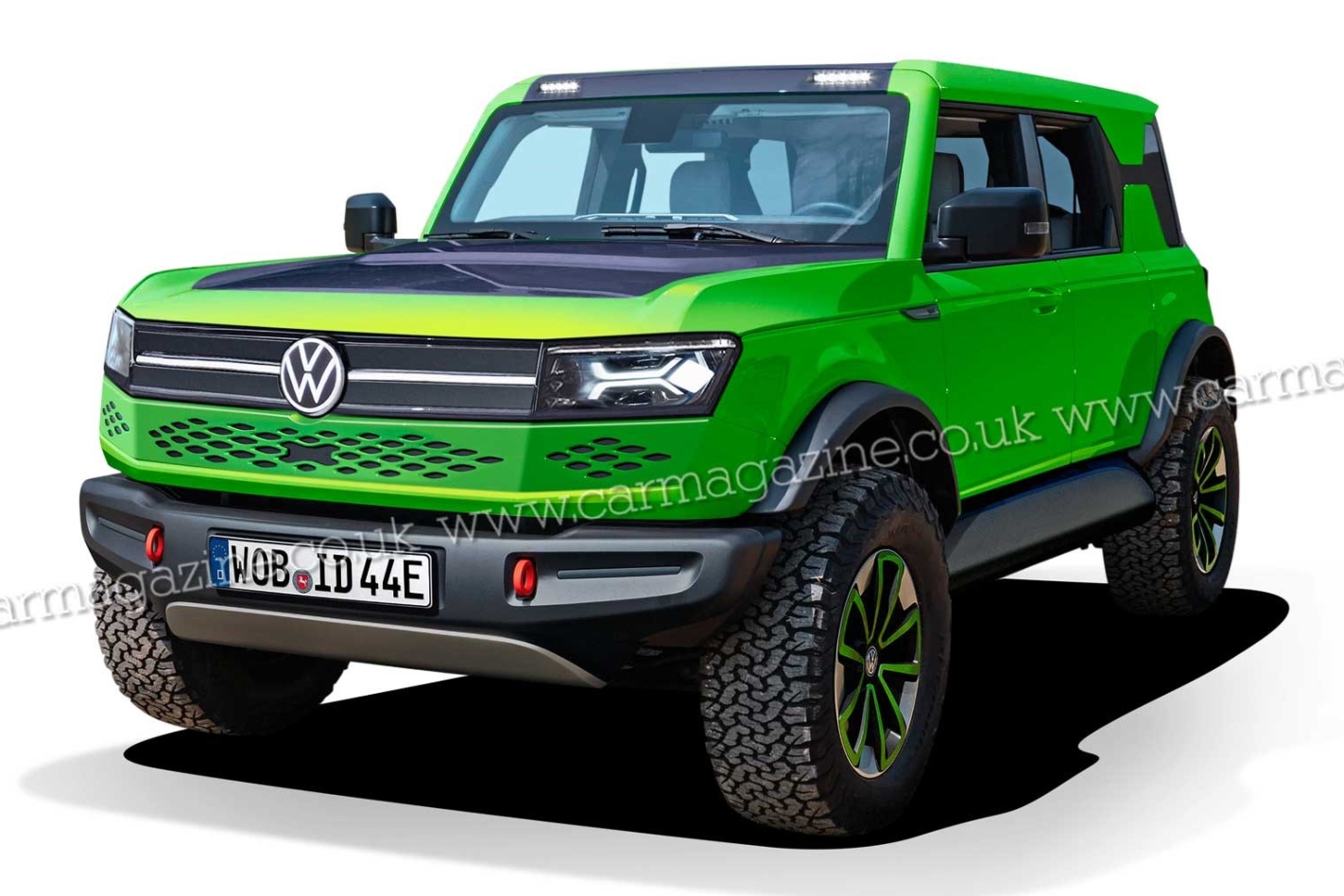
And there’s more. In addition to a whole line-up of more conventional EV models from a compact city car to a large SUV, keep your eyes out for production versions of the e-Bulli camper, ID Buzz and ID Buggy because, why not?
EVs can’t tow
Wrong again and the reason battery-powered vehicles can haul impressive loads is, once again, partly down to versatile architecture.
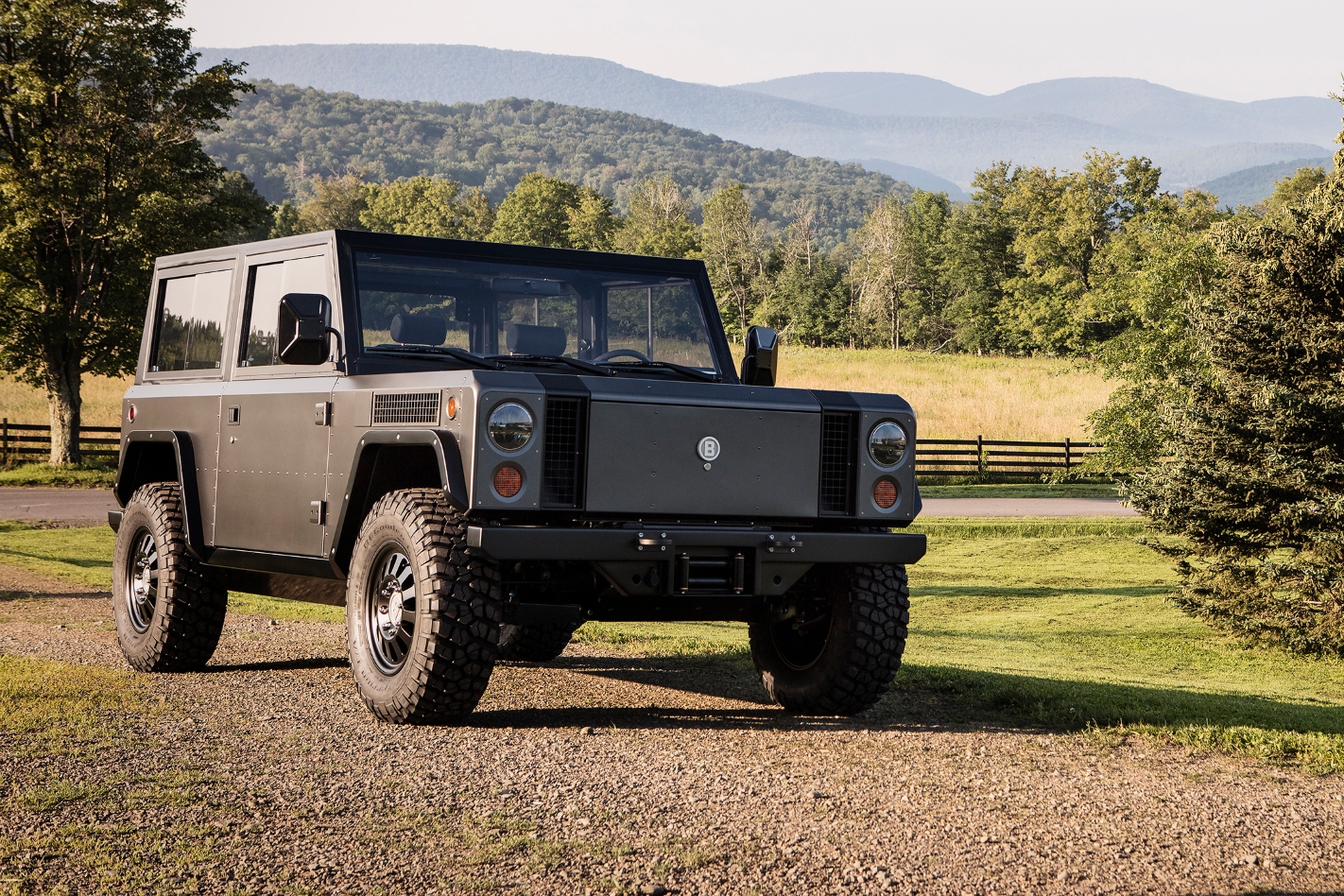
Get used to the name Bollinger if you’re a fan of tough off-road machinery. Not only will its boxy B1 and B2 trucks tow the standard of about 3500kg, but they can also accommodate a payload of up to 2.4 tonnes. They are equipped with a 120kWh battery (20 percent bigger than the biggest Tesla Model S) which means they won’t run out of puff early.
EVs are ugly
Fair to say beauty, style and design are enormously subjective but Tesla is certainly winning a lot of fans with the look of its next Roadster.
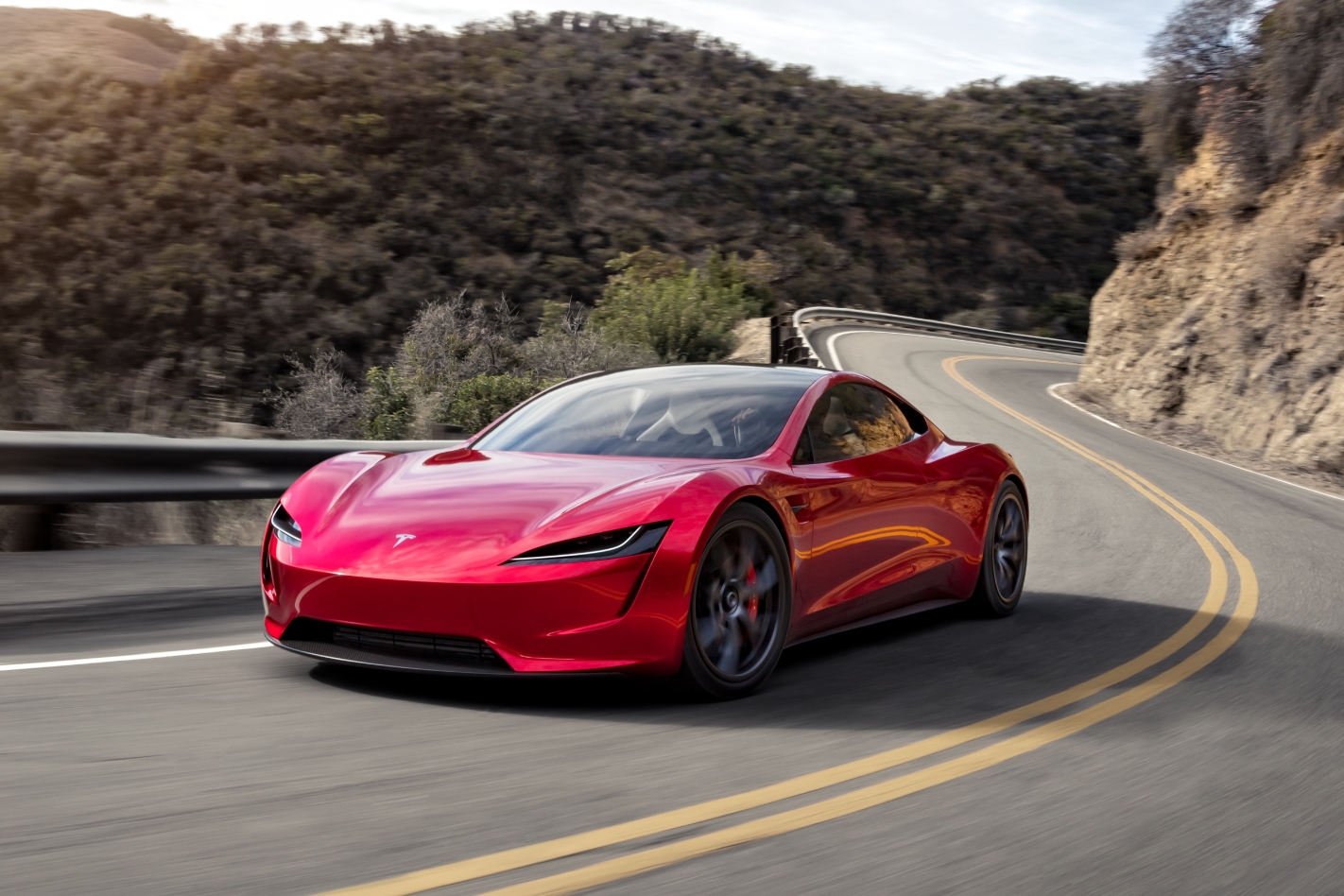
Once again, it’s the versatility of a skateboard platform that enabled Tesla to go ahead with a relatively low-volume model (as is typical for sportscars), instead of continuing to focus on volume offerings such as SUVs and sedans.
It’s the same design strategy that has enabled the Californian start-up to roll out seven models since 2008 and become an EV world leader.
EVs are terrible off-road
EVs don’t just have flexible platforms, their drivetrains can be equally versatile as demonstrated by Rivian’s R1T. Not only does this US-built ute have 147kW … per wheel, it can also perform a manoeuvre normally limited to vehicles with artillery.
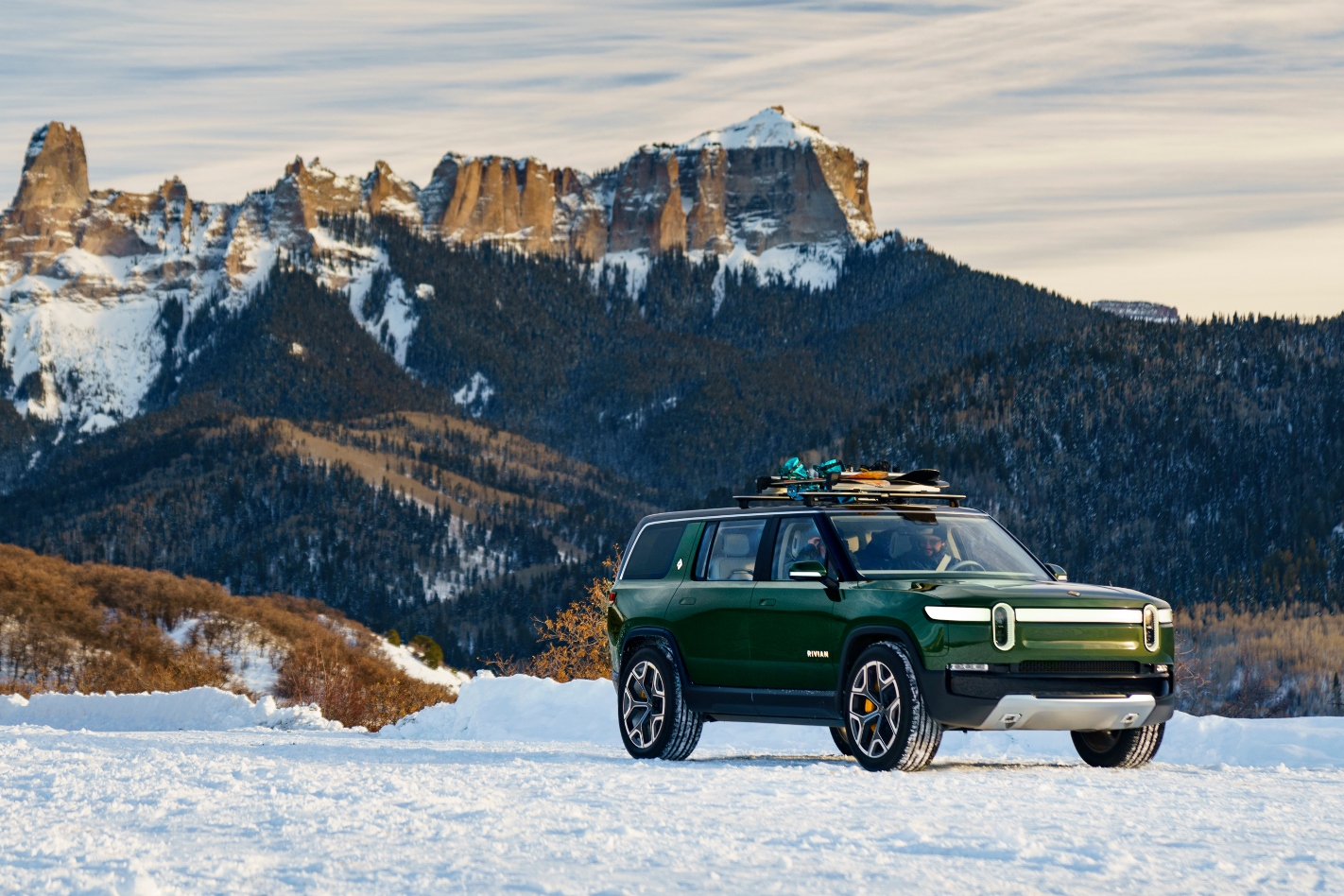
That’s right, the Rivian can actually rotate the wheels on one side the opposite direction to the ones on the other side, performing a tank turn. It may seem like a bit of a publicity stunt, but it might just get you out of a tight spot in the bush and there’s no petrol or diesel that can even come close to pulling the same trick.
Motorsport doesn’t work with EVs
We understand if the hybrid engines of Formula 1 and forthcoming WRC don’t exactly light your fire. And if the Formula E championship has so far failed to pique your interest then that’s not the only pure electric motorsport you have to look forward to.
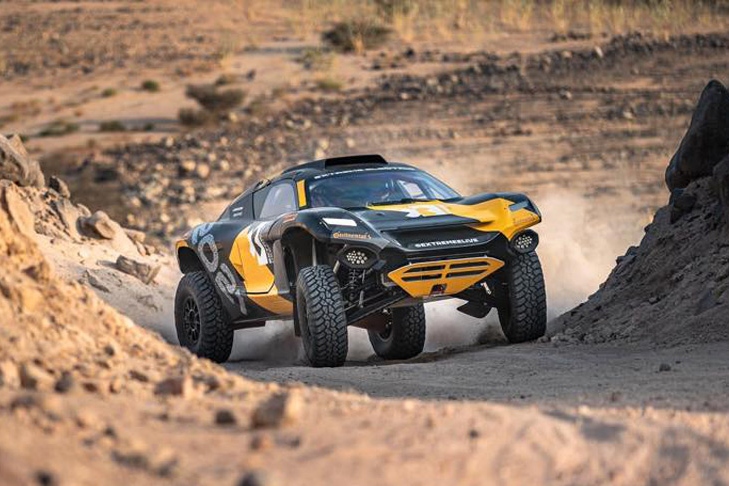
Starting next year, the Extreme E international series will blast into action with purpose-built electric rally SUVs fighting it out on a global stage. The homolgated Odyssey 21 packs a 400kW all-wheel-drive drivetrain and will battle it out in five international locations over the year.
What if I want to drive a classic?
EVs have that covered too. There are a few manufacturers that are developing skateboard platforms to supply to other manufacturers and fabricators. That means, not only will the number of weird and wonderful EVs expand even further, it’ll be possible to slot the bodies of older cars on too.
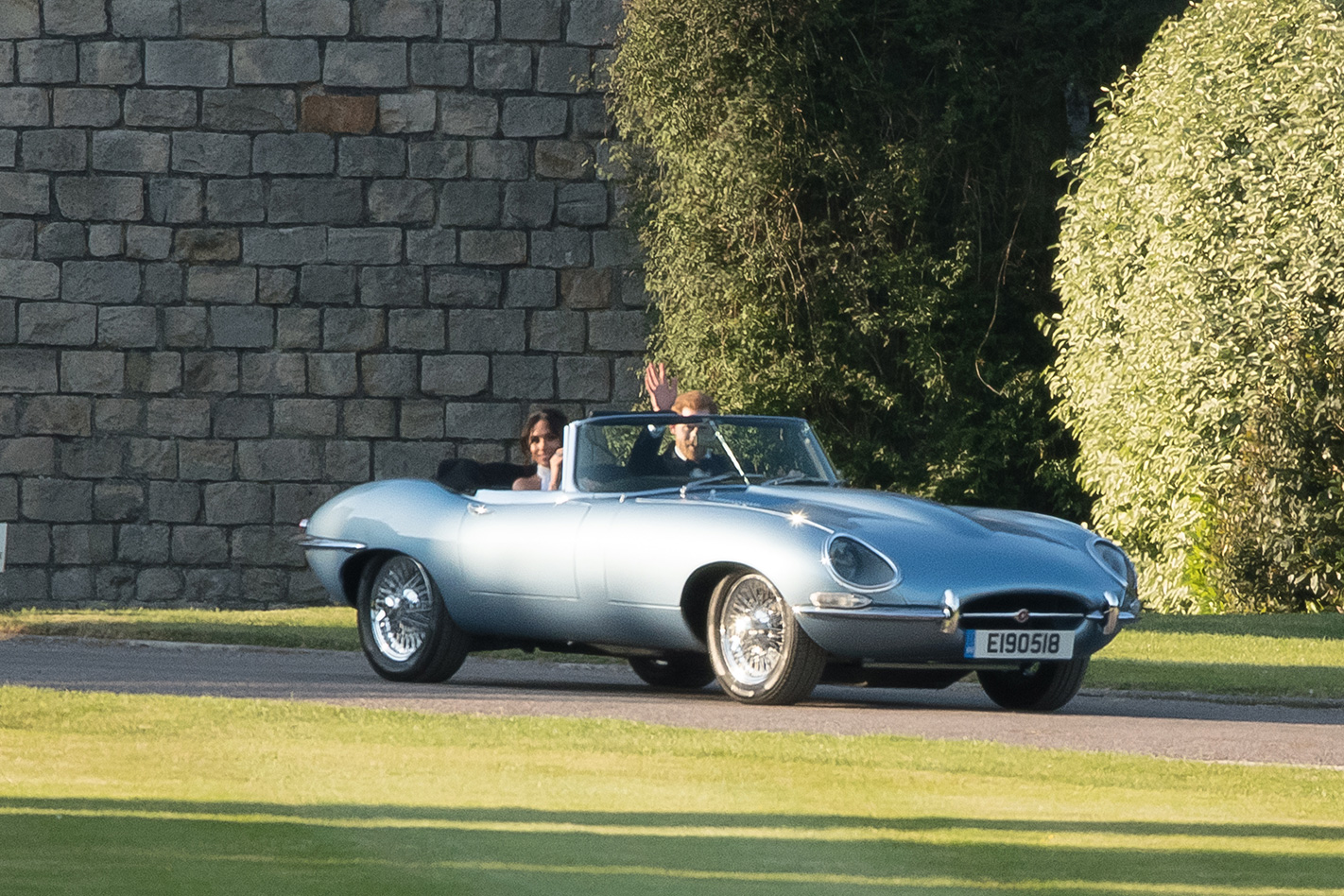
EDC Automotive Design is already doing it, using the underpinnings of a Tesla but the body and aesthetics of a Land Rover Defender. And that Jaguar E-Type that whisked Harry and Meaghan away from the church? Yep, an EV conversion too.
EVs can’t go very far on a single charge
That certainly used to be the case but with the exponential advancement of battery technology and the efficiency of electric drivetrains, EVs are proper marathon runners today, exemplified by Lucid Motors.
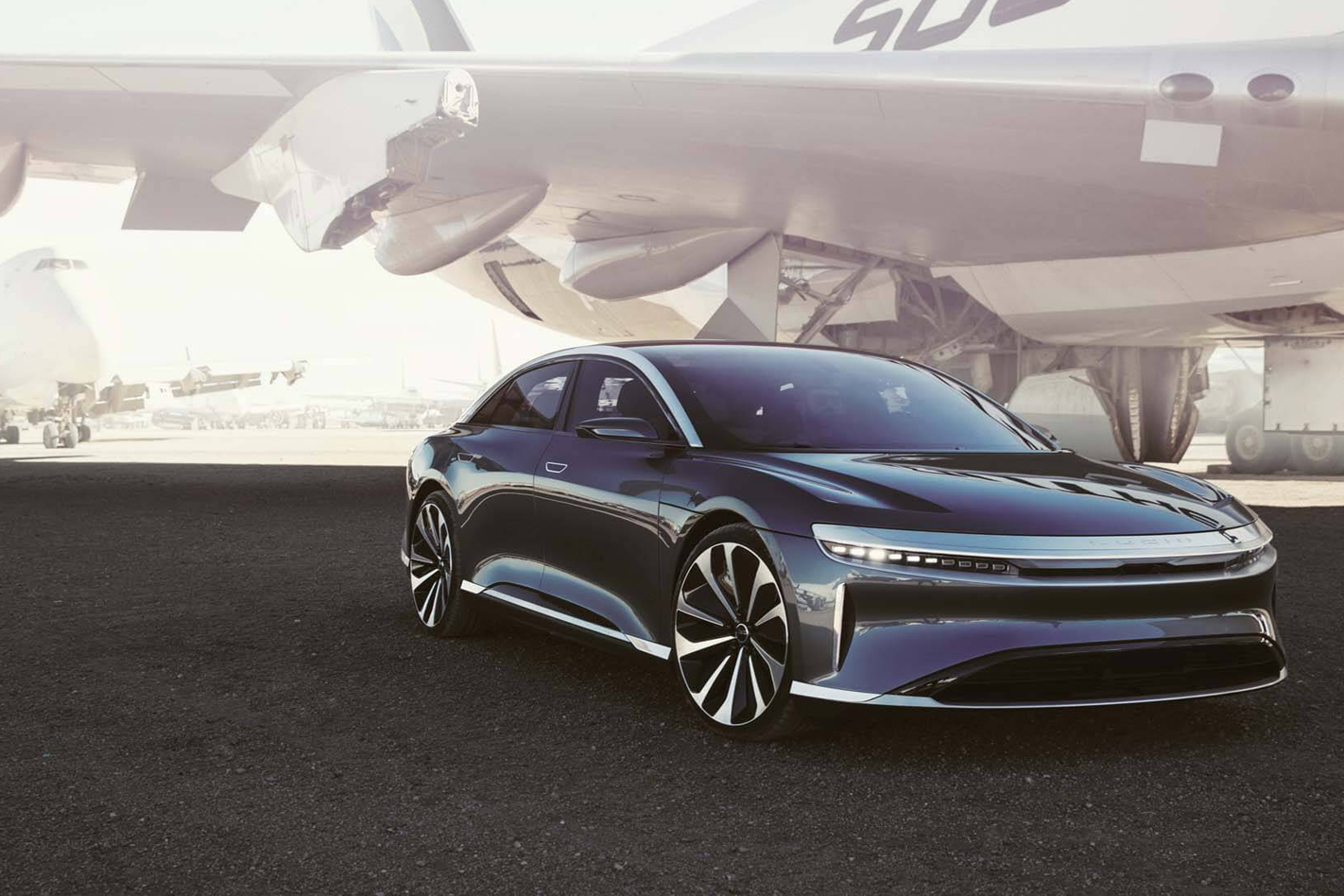
Making its official debut and launching on World EV Day, the Californian start up’s first model – the Air – will become the longest range production EV on the market. Not only that, but the company’s first production model is also luxurious, fast and the same price as a Tesla Model S.
Also like arch-rival Tesla, the Lucid has a beefy lithium-ion battery, but clever design and the latest chemistry has demonstrably proven the Air can travel more than 800km on a single charge. And this new presence in the EV arena intends to follow up with more models in quick succession thanks to, you guessed it, a skateboard platform.
EVs don’t sound good
There are plenty of people that would argue the silence of electric motors is golden allowing eerily quiet cabins and lower environmental noise, especially near busy freeways, but we certainly understand the joy of a car that sounds good.
If you’re one of those people too then you need to get your ears around Ford’s new Mustang. No not the old V8-powered thing and, no not the regular Mach-E SUV. We’re talking about the mental 1000kW, seven-motor version built to prove a point – a very smoky, noisy point.
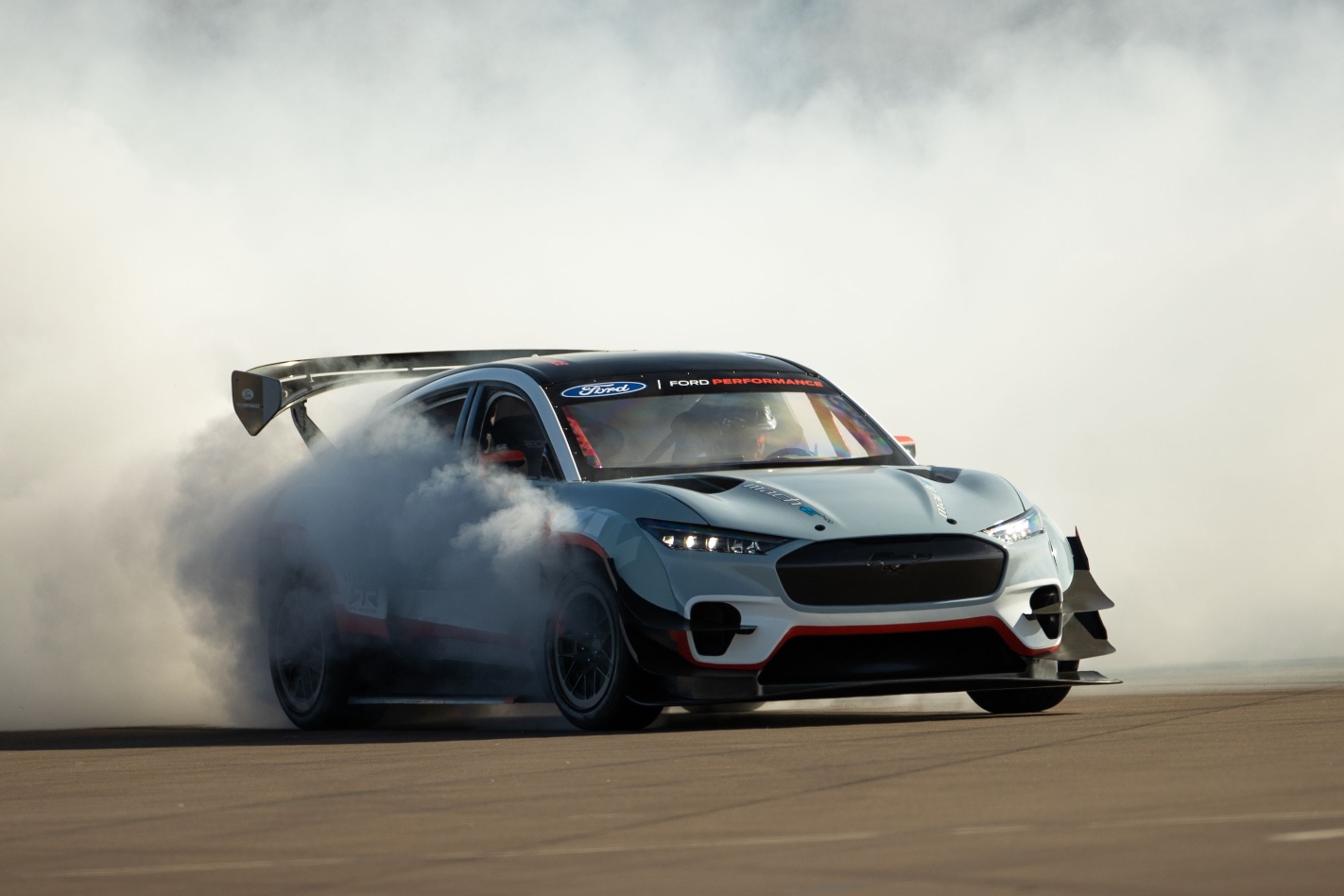
If you haven’t yet seen it in action, give your ears a treat and get a load of this screaming, howling monster and ask yourself if you would mind your next performance car sounding like that.
Between the mainstream manufacturers and disruptive, ambitious start-ups, EV makers are proving that the notion that alternative energy cars have to be boring is very much dead. Instead, the future of cars is bright and diverse, and it’s all thanks to the skateboard. Happy World EV Day!
Reigning Formula 1 champion Lewis Hamilton has launched a team to compete in the inaugural season of Extreme E, a radical new electric-powered off-road racing series.
Called X44 – which references his F1 car number – the team will be Hamilton’s first foray into motorsport team ownership. However, the six-time F1 champion will not drive or be involved the team’s day-to-day running.
“Of course, my ambitions and commitments with Mercedes in Formula 1 mean that I won’t be operationally involved in X44, but I’m excited to play a different role in this new series, one that brings my vision for a more sustainable and equal world to life,” Hamilton said when announcing the team on the eve of World EV Day.
“Extreme E really appealed to me because of its environmental focus. Every single one of us has the power to make a difference, and it means so much to me that I can use my love of racing, together with my love for our planet, to have a positive impact.”
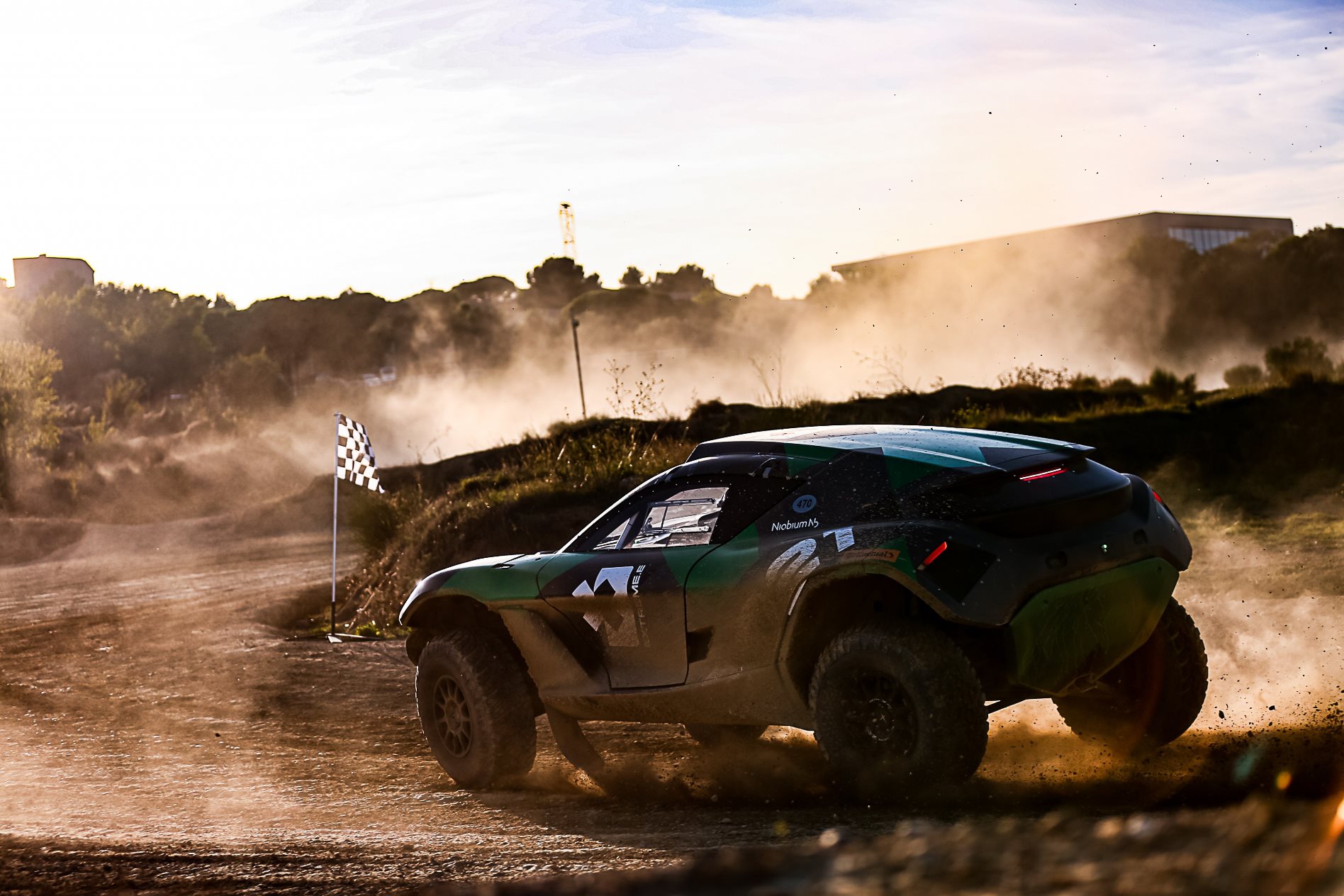
Hamilton added that Extreme E will also advance sustainable technologies that he hoped will trickle down into everyday use.
Beginning in Senegal in January 2021, the Extreme E races will be held in five remote places around the world that are acutely affected by climate change, with other locations to include Greenland and the Brazilian rainforests. The events won’t be open to spectators but will be televised.
All teams will tackle short-course off-road circuits in the bespoke Extreme E car, known as the Odyssey 21, which has been developed from Formula E technology. The chassis is built by Spark, the same firm who supplies Formula E cars to the series.
After The Bend Classic at the weekend, there’s a new record lap time for the West Circuit of the South Australian motorsport venue.
Former Supercar driver Josh Kean, who finished just outside the top 10 in the 2016 Supercars season with the likes of Anton de Pasquale and Bryce Fullwood, took to the track in a mid-‘90s F1 car to claim a 01:10.085 lap.
The Footwork Arrows FA15 suffered mechanical problems as Kean was on his hot lap during the final shootout, meaning his final placing was technically a DNF.
Rare, road-legal Porsche 911 GT1 Evo at The Bend Classic
Though the winner of the shootout event itself, Sam Shahin (in his Dallara F189 with a 1:13.5 lap time) said Kean’s lap record was the true highlight of the day.
“Josh was the absolute standout, he was robbed and really deserved that [sub-70-second] lap,” said Shahin, also managing director at The Bend.
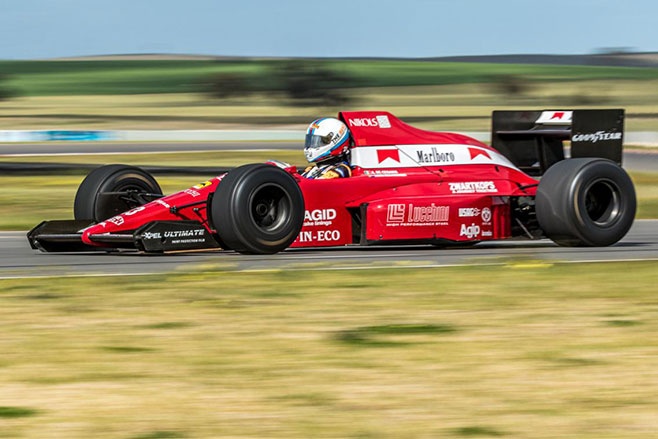
Sam Shahin’s Dallara F189
“He belted out a 10-flat earlier which is just astonishing: It’s five seconds faster than the [previous] track record. It is unfortunate that these cars can be so finicky.”
Kean’s lap is incredibly impressive once you consider how relatively short the West Circuit at The Bend is, 3.41km, with 12 turns and including the full main straight.
In the Porsche 911 GT2 RS which won our PCOTY 2019 event, full-time Supercars racer Rick Kelly managed a time of 1:24, though even that’s 14 seconds slower.
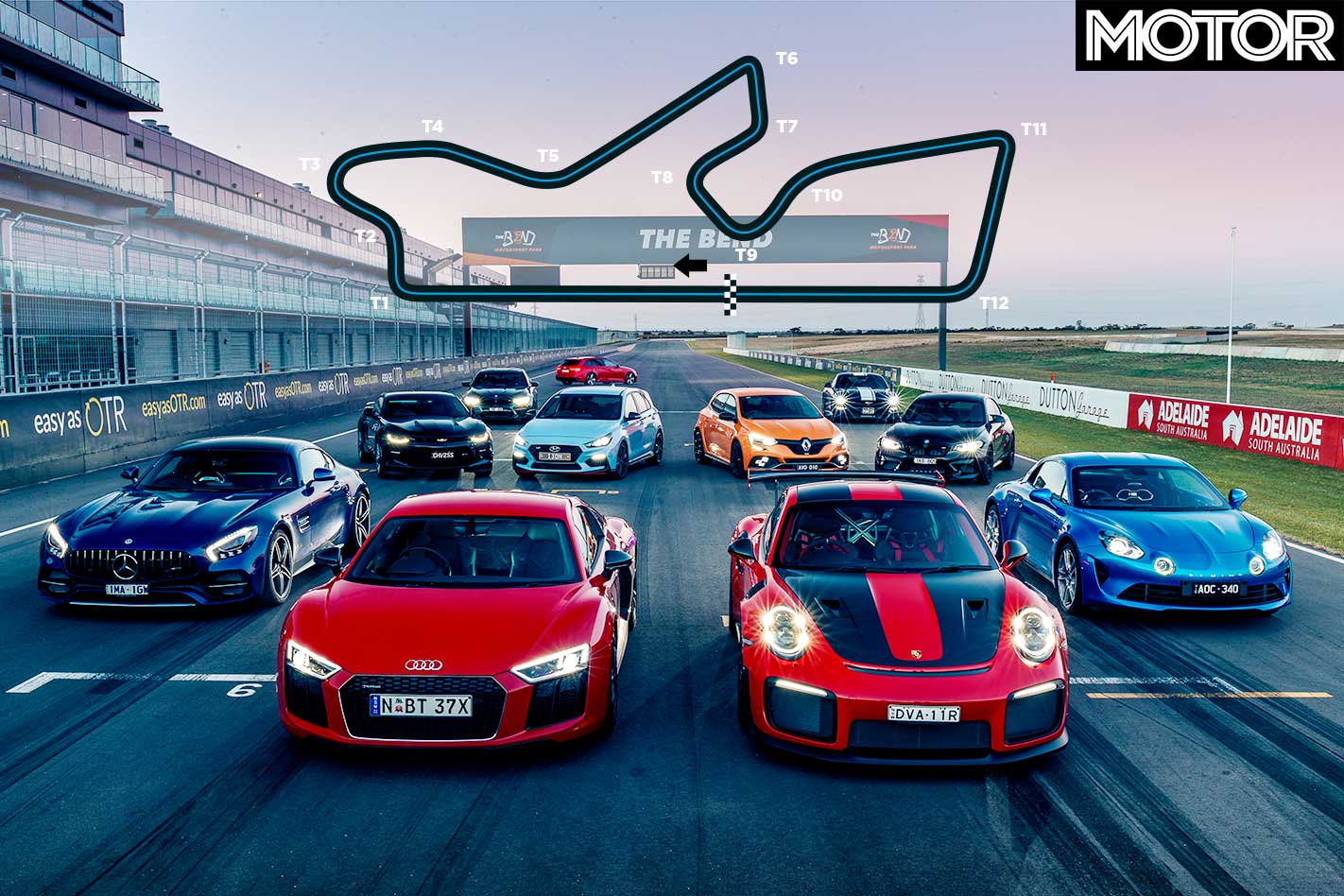
Below is a full rundown of our own laptimes (bold) compared to those of The Bend Classic Shootout. Kelly was MOTOR’s driver for PCOTY 2019, while Michael Almond steered for us at PCOTY 2020.
As you’ll see, the GT2 RS is the only car that really gets competitive in the mix of race cars, while our other sub-1:30 times are right behind them.
The Bend West Circuit Lap Times
Josh Kean | Footwork Arrows FA15 | 01:10.085 |
Sam Shahin | Dallara F189 Cosworth | 01:13.5 |
Yasser Shahin | Porsche 911 GT3R | 01:16.6 |
Brenton Grigoul | Lola Larrousse LC88 | 01:17.0 |
Yasser Shahin | Formula Toyota FT-40 | 01:17.8 |
Benjamin Runciman | Lamborghini Huracan | 01:18.5 |
Chris Meulengraaf | Porsche 911 GT3 Cup | 01:23.7 |
Rick Kelly | Porsche 911 GT2 RS | 01:24.0 |
Kevin Weeks | Lamborghini Gallardo Superleggera | 01:24.9 |
Malcolm Ramsay | Porsche 911 GT3 Cup | 01:27.2 |
Paul Russo | Ferrari 360 Challenge | 01:27.2 |
Rick Kelly | Mercedes-AMG GT C | 01:27.3 |
Rick Kelly | Audi R8 RWS | 01:28.5 |
Michael Almond | AMG GT63 S | 01:29.5 |
Australia’s new-car market is about to reach a sad milestone, with one of the most popular genres of vehicle set to no longer be available Down Under.
Pretty soon, you will not be able to buy a new four-door sedan powered by a naturally aspirated V8.
From the mighty highs of when V8 Ford Falcons and Holden Commodores dominated the sales charts, a new era of Australian motoring is upon us.
Instead of owning family cars with sports car performance, Australians now prefer high-riding SUVs with hatchback engines, and diesel dual-cab utes.
As a result, the atmo V8 sedan genre has wilted, and is about to go extinct locally in the next year or two.
Currently, there are just two options for those wanting a four-door sedan with a free-breathing bent-eight under the bonnet.
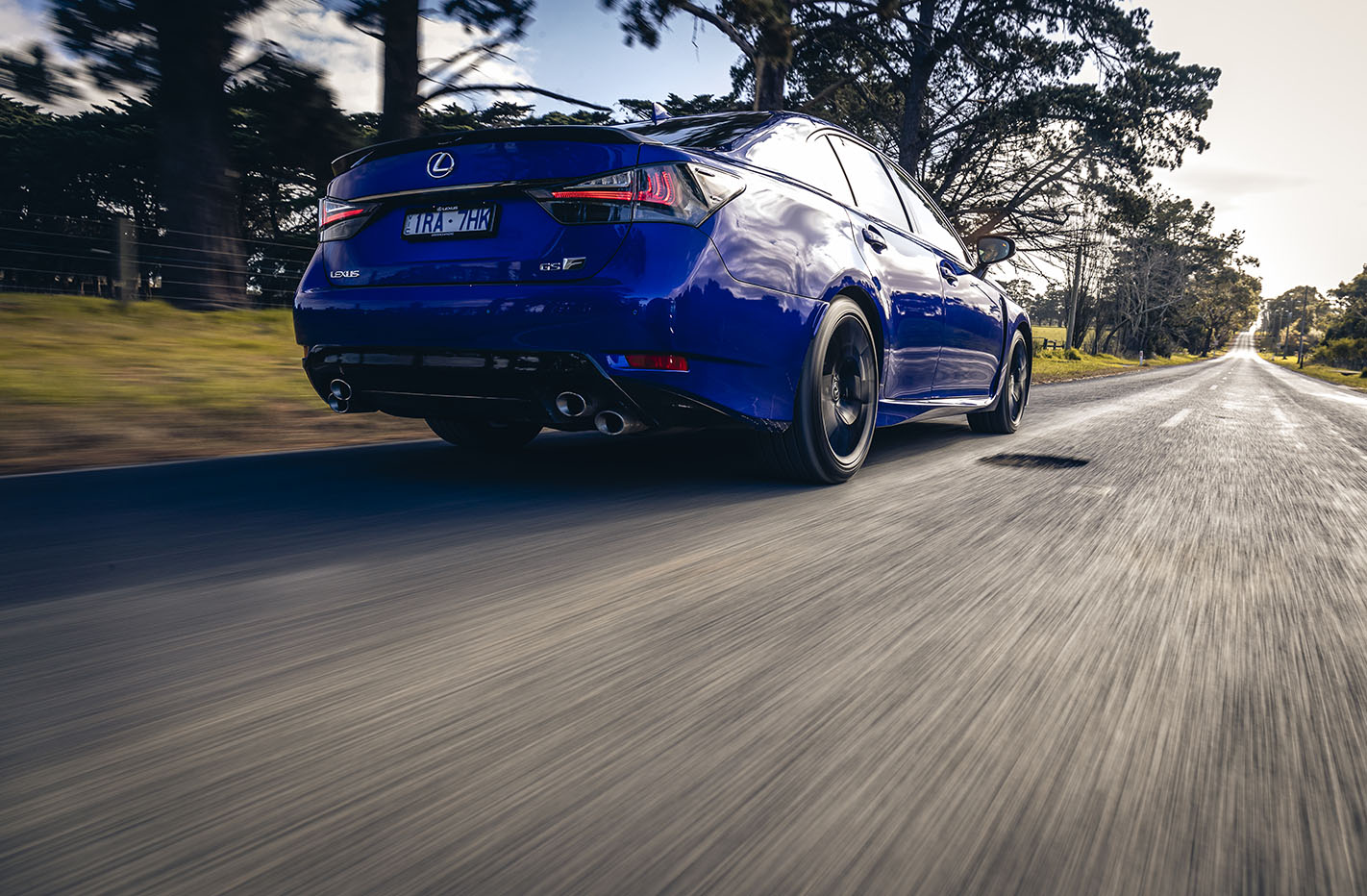
The first is the Lexus GS F, priced at $155,582, with a 5.0-litre V8 producing 351kW/530Nm.
Production for the large luxury performance sedan is set to end imminently, with no like-for-like replacement in the pipeline.
Lexus’ atmo V8 is available in other model lines like LC and RC, but both of those are two-door coupes.
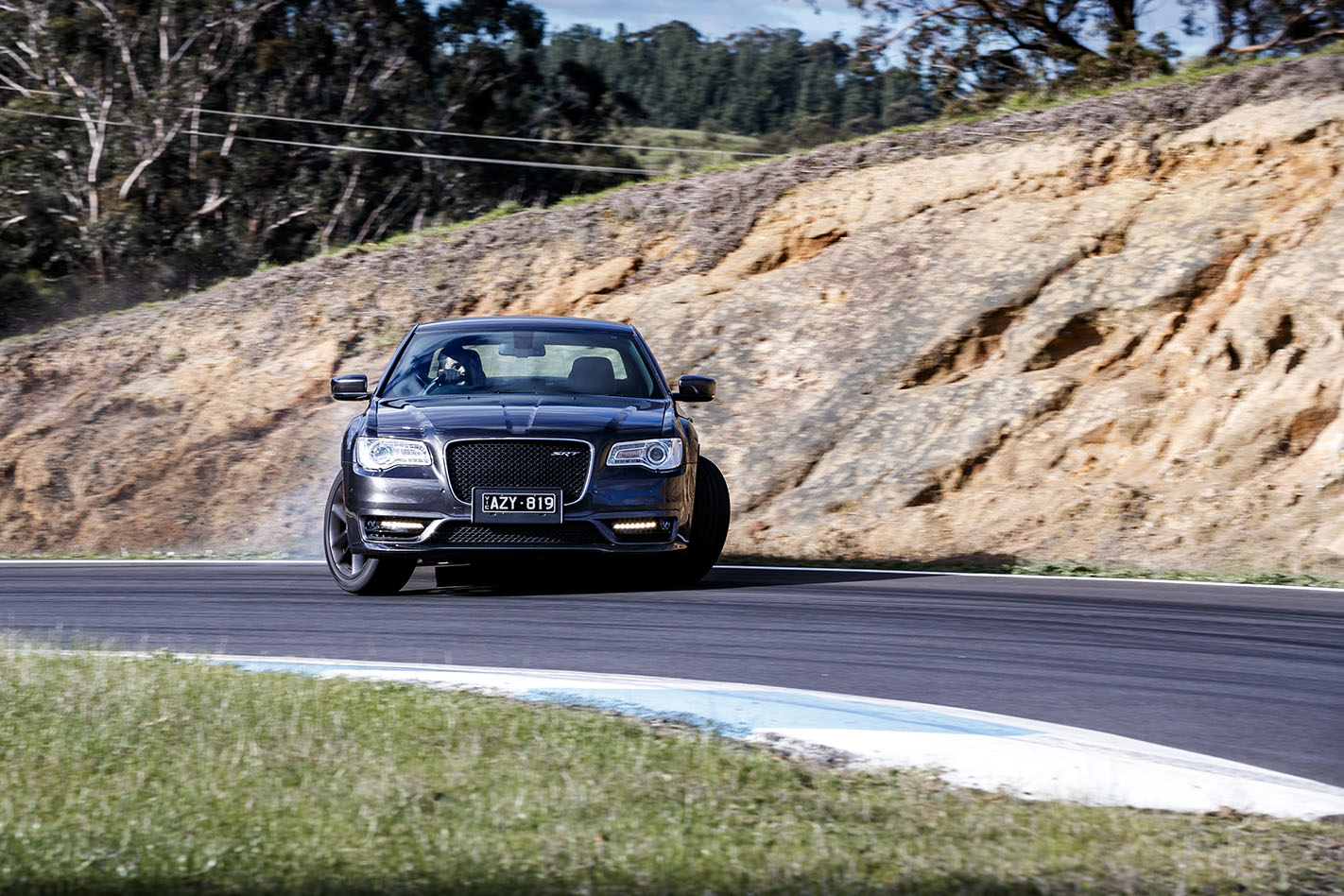
The only other four-door atmo V8 option is Chrysler’s venerable 300 SRT, which is set to celebrate its tenth birthday next year.
Powered by a 6.4-litre Hemi V8, producing350kW/637Nm, there a number of variants to choose from, but not all are freely available in showrooms.
Just the 300 SRT is available from dealerships on a regular basis, priced from $77,450, while the cheaper $65,950 Core variant is available for customer forward-order only.
Chrysler 300 SRTs are currently deployed by the NSW police force as Highway Patrol vehicles.
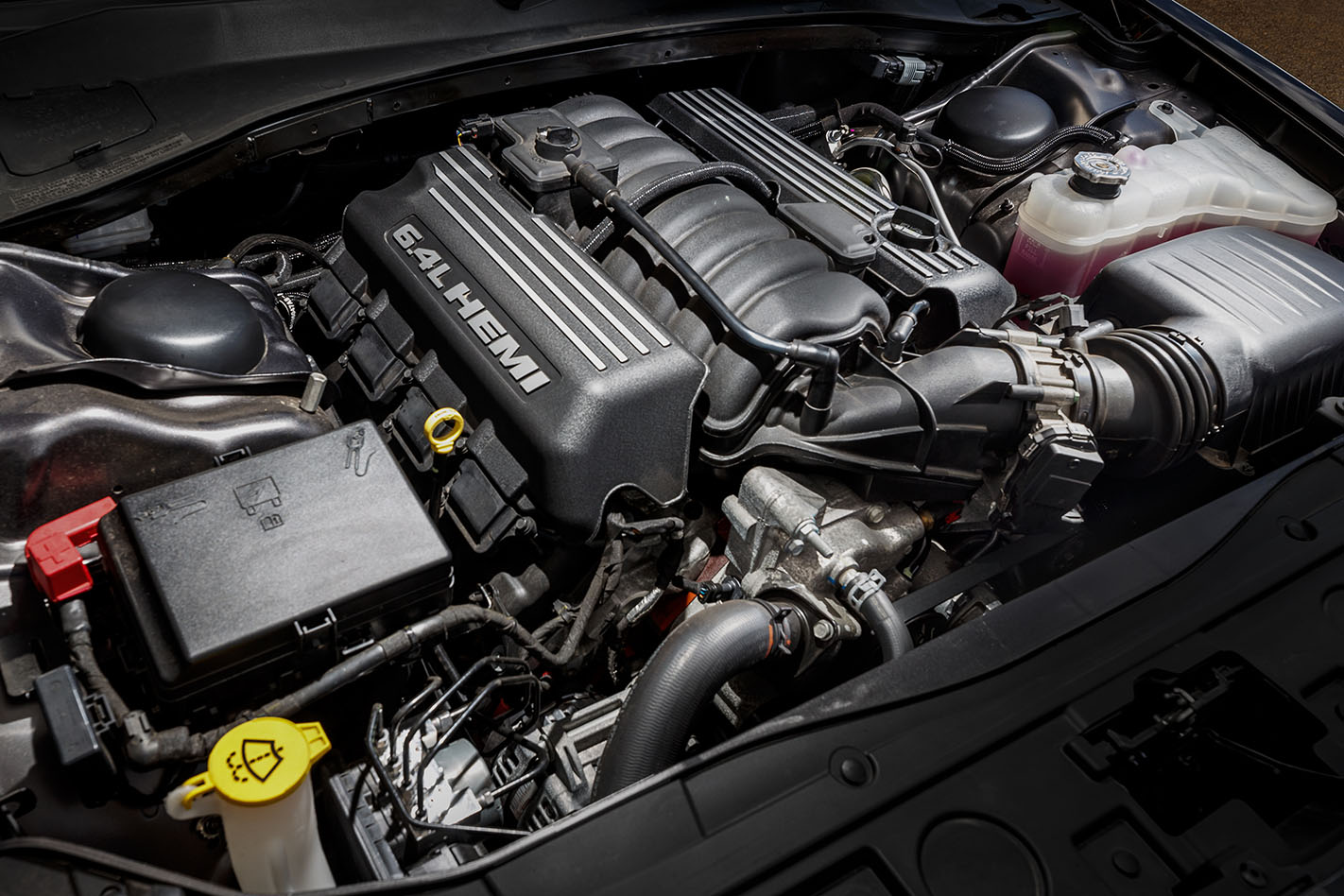
A replacement 300 SRT has not been confirmed by Chrysler, and it remains unclear when production of the American sedan will cease completely.
With the GS F likely to sell out completely by the end of the year, the Chrysler will remain as the sole vanguard of the atmo V8 sedan genre in Australia.
When Chrysler Australia announced it would be limiting certain 300 variants to special-order only, it told dealers the company remained committed to the model despite “a shrinking segment thanks to Australia’s shift towards SUVs”, according to CarAdvice.
While V8 sedans aren’t dying completely, all the remaining models use forced induction to increase power, meaning fans of free-breathing engines are left without any options.
It is expected the 300 SRT will remain on sale in some capacity, however limited, for at least another year, before it too is put out to pasture.
When it does, it’ll be a sad day for motoring enthusiasts across the country.
All of a sudden, shizz got real. Science called it a pandemic; those who look to Alcoa for their millinery requirements called it a hoax. And, from what I’ve seen, governments have hugged it to their sweaty, yeasty bosoms as a means of making untruths compelling. But never naming it so. Of course.
I speak, obviously, of your acquaintance and mine, Old Mate Covid-19. Unlike the rowdy mobs who wear sweat-pants outdoors even when gyms are closed, I don’t think the Covid situation is the result of anybody’s imagination. Nor do I think it’s anything other than a global disaster. I also happen to believe that the forced lockdowns and isolation regimes have largely been necessary.
But I do get bent out of shape when a bunch of well-paid (some of them fabulously so) footy players can be granted an exemption to travel interstate, are quarantined at a luxury resort at the league’s expense and feted by everybody from the State Premier down on the chance there’s a grand final up for grabs.
I get even further reshaped when, not a handful of kilometres away, families are being torn apart – and worse – by being denied the opportunity to seek emergency medical attention just another handful of kliks over a border in a State that was transformed from a British colony to a part of the Commonwealth of Australia as far back as 1901. Also, I’d really like to go for a drive that isn’t to a grocery shop within five kays of 13 Struggle Street.
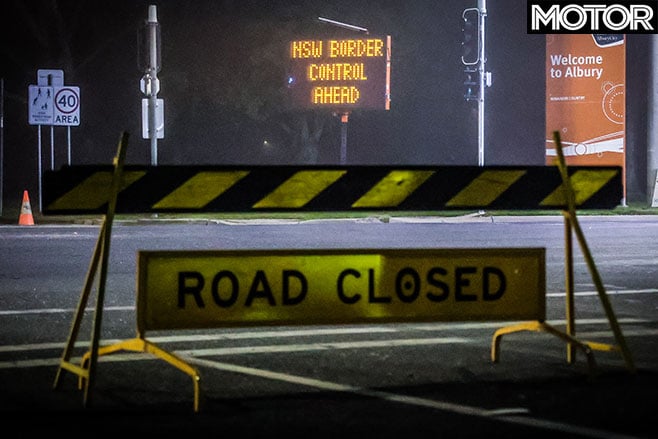
As I write this, a few States lucky enough to have low infection rates have developed a new game where the aim seems to be to see how far into touch they can kick Victoria. The administration of those same States will tell you that their hard line on a hard border is all to do with Covid safety. Frogshit. It’s all about extracting more votes from the same weirdos with tractor tattoos that got them elected last time. Oh, and securing the grand final. So let’s call it as it is, shall we?
While we’re shuffling that hot little tater from one hand to the other, let us also call out a bunch of other stuff that doesn’t pass the pub test. When Covid restrictions were first introduced, we were told, hand on heart, that a common-sense approach would be adopted. But lo, within hours, a schoolkid out for a driving lesson was pinged $1652 for leaving her house.
Now, I could be wrong about this, but in a post-Covid job market where the applicant-to-job ratio will be skewed to say the least, wouldn’t having a driver’s licence be an important thing to possess? And yet, it’s apparently worth $1652 the other way. Okay, so the Jacks eventually pulled the fine, but only after a fairly public pantsing in the media.
People keep telling me that the world will never be the same again. I agree. But maybe it’ll be better different. I’m of the view that we have, as a broader society, taken the Covid threat and our social responsibilities seriously, and acted – perhaps uncharacteristically – like grown-ups.
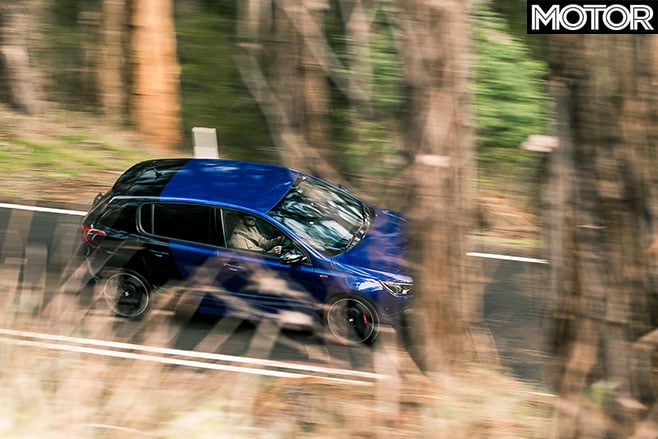
Shit got real, so did we. Which means the authorities now owe it to us to likewise get real.
On that basis, we deserve to have speed cameras turned off when there’s any doubt over their validity.
We deserve to have the idiotic zero-tolerance for speeding wound up to something closer to an actual speedo-needle-width.
We deserve to have road safety policy determined by experts rather than insurance companies.
We deserve to have those lethal wire-rope barriers torn out.
We deserve a government that is no longer permitted to call a revenue-raising activity a safety initiative.
And we deserve to go for a goddam drive.
Get your free weekly MOTOR report!
Dear WhichCar
I’m currently researching when is the best time to replace your car: how long is long enough before you should start thinking about moving up to a newer model, etc. With that in mind, I was wondering if I could run a few questions by you?
Jamie
How long does the average Australian hold onto their car before ‘upgrading’ to a newer model?
Hi Jamie,
The simple answer is that Australians replace their car every five to seven years but the period of ownership generally depends on the age of the vehicle when purchased. Drivers who prefer new cars may trade in their vehicle as frequently as every three years to take advantages of incentives offered by the manufacturer.

The various deals provide mutual advantages and, in return for various benefits such as guaranteed trade in price, the customer remains loyal to the brand.
However, a recent warranty extension by many mainstream brands to five years and beyond is encouraging more new car owners to hold onto their vehicle for longer, while longer lease deals are providing owners another reason to do the same. Owners of used vehicles typically keep their vehicles for the longest.
How long should you hold onto a car to avoid being stung by depreciation?
Unless you get your hands on something unusually rare or desirable, new cars depreciate. There’s no two ways about it. Depreciation is highest in the first year at about 20 percent and then slows to about 15 percent in years two and three. However, there are a number of things you can do to minimise the loss when it’s time to sell.
A good car depreciation calculator might be a good place to start but, broadly speaking, demand dictates value so buying a popular car that will be easier to sell later and for a good price makes sense.
But remember that, conversely, choice creates competition so you’ll be up against many others when it comes to sell which could drive prices down. Full service history at approved serviced centres, good maintenance and keeping your car clean and tidy is a money maximising must.
There is no particular mainstream brand that is either good or bad across the board and resale value comes down to individual models and variants so, as always, do your research. But most importantly, don’t let depreciation put you off your dream car if it’s what you really want for a whole host of other reasons.
The simple answer is, if depreciation is high on your list of car-buying concerns, shop in the nearly new or used market.
What’s the single most important thing to look for in a new car?
There is no such thing. Many drivers would put a premium on safety, whereas others would lean towards a car with better driving dynamics. For some, space and practicality are key but all-terrain ability might be the defining feature for a different type of use, for example.

No single thing will be at the top of everyone’s list, nor can any one car do everything. The most important thing is that every car buyer establishes their individual priorities before hitting the showrooms – and sticks to them.
