
What stands out?
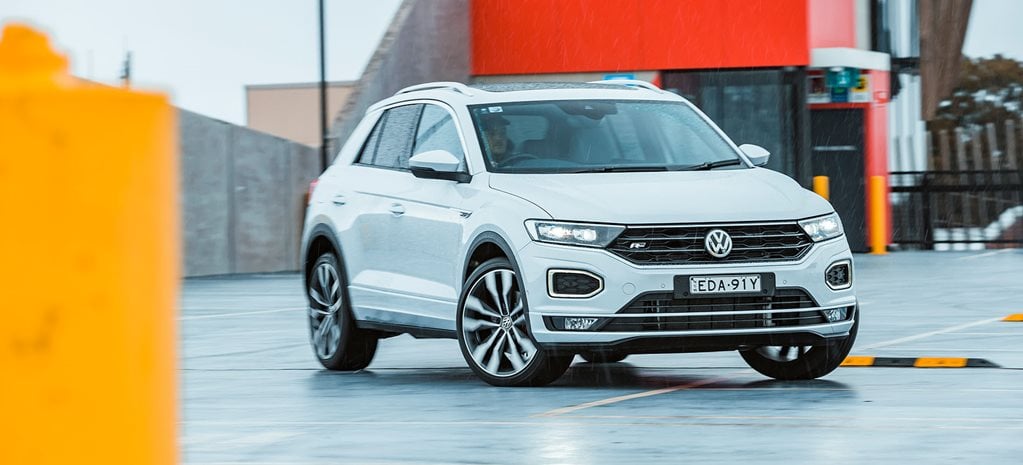
Based on the Golf hatchback, the T-Roc is the sportier of Volkswagen’s double-pronged entry into the small-SUV market along with the T-Cross. It’s propelled by a powerful 2.0-litre turbocharged petrol engine and handles bends incredibly well. It comes with excellent smartphone integration and a safety suite that includes autonomous emergency braking.
What might bug me?
Driving after a puncture. The T-Cross has a space-saver spare wheel, which limits the recommended top speed to 80km/h.
Paying more for fuel: the turbo engine requires premium unleaded, which costs more than regular unleaded.
What body styles are there?
Five-door wagon only.
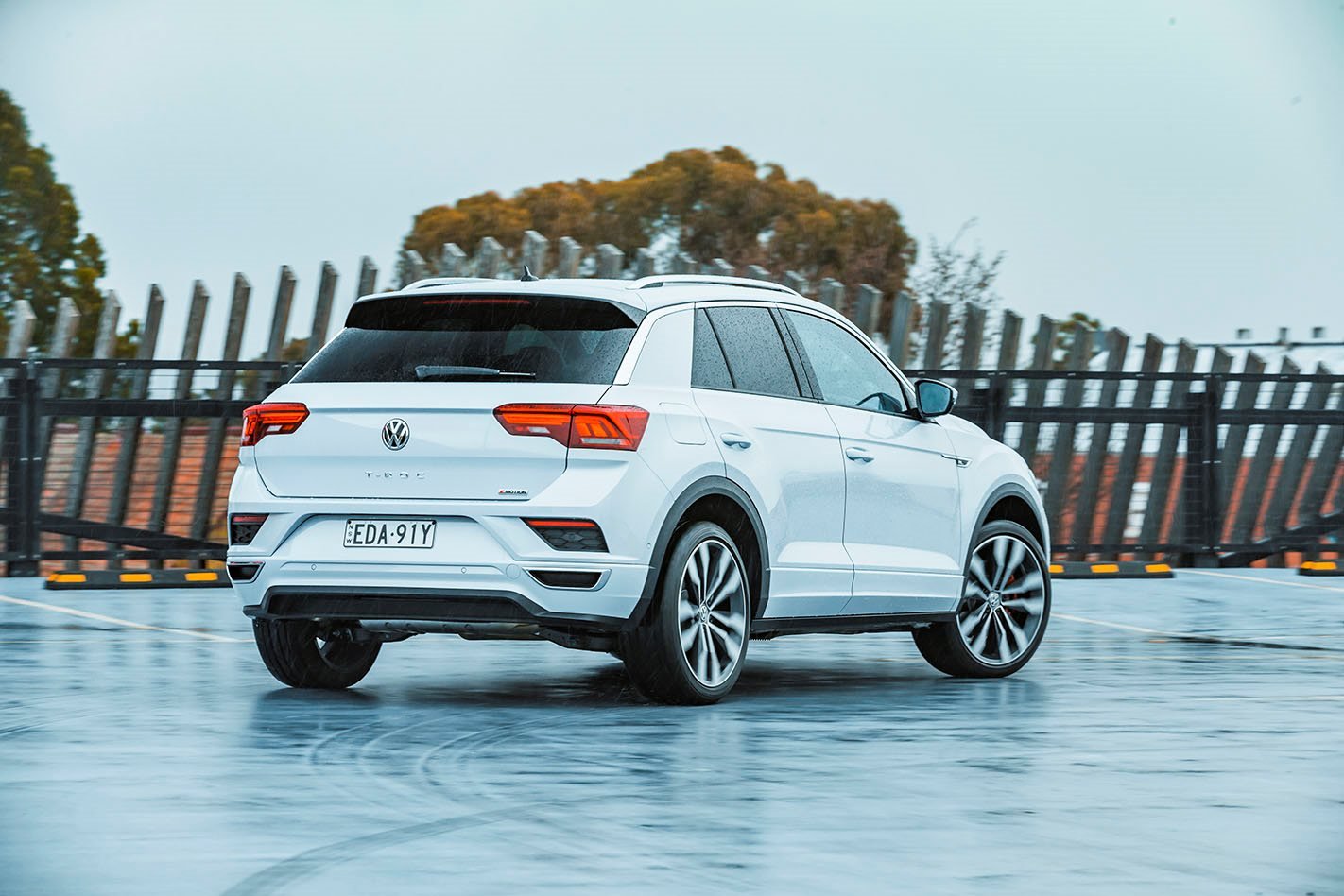
The T-Roc is currently only available in Australia with all-wheel-drive only, with a front-driving version arriving in November 2020.
It is classed as a small SUV lower priced.
What features do all T-Roc versions have?
The more affordable T-Roc 110TSI will arrive in Australia in November 2020, until then there is just the highly-specced 140TSI which brings a myriad of features including:
- An 8.0-inch colour touchscreen from which you can control the sound system and other cabin functions.
- A six-speaker sound system with an AM/FM radio, a CD player, an SD card slot, Aux and 4 x USB inputs, and Bluetooth audio streaming.
- Support for Apple CarPlay and Android Auto. If you plug in a compatible iPhone or Android smartphone, some phone apps – including mapping and music – are mirrored on the touchscreen display and can be controlled from there.
- A reversing camera with guidelines, and parking sensors front and rear.
- 10.25-inch digital gauge cluster with customisable displays.
- Active safety including autonomous emergency braking, lane-keeping assist, lane departure warning, driver fatigue detection, blind-spot monitoring, rear-cross traffic alert, and vehicle distance warning.
- Adaptive cruise control with speed limiter.
- 7-speed DSG (direct-shift gearbox) automatic transmission and 4MOTION all-wheel-drive.
- Keyless start and entry.
- Rain-sensing windscreen wipers.
- LED headlights that switch on automatically in low light, LED daytime running lights, LED tail-lights and fog lamps.
- LED ambient interior lighting.
- Auto-dimming rearview mirror, and power-folding heated door mirrors.
- Dual-zone climate control air-conditioning, and rear-seat air vents.
- A leather-wrapped steering wheel that carries buttons for operating the cruise control, the audio system, and your phone.
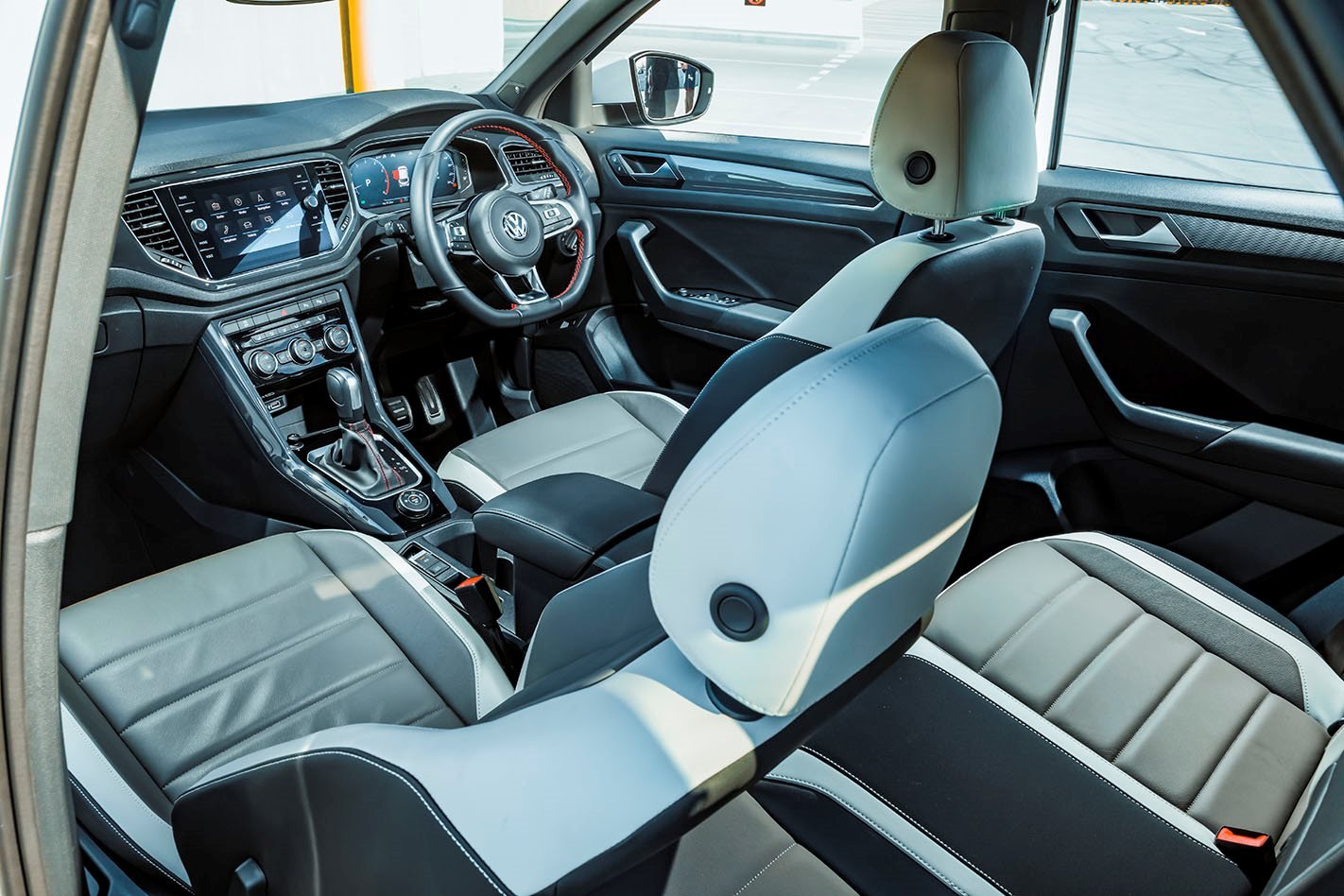
- Cloth sports seat with front lumbar support.
- 18-inch aluminium alloy wheels, which are lighter and more stylish than steel wheels.
- A space-saver spare wheel (with a recommended top speed of 80km/h).
- Tyre pressure monitoring, which alerts you if a tyre is losing air.
- Six airbags. Electronic stability control, which can help control a skid or slide (all new cars must have this feature).
The T-Roc comes with Volkswagen’s five-year, unlimited-kilometre warranty.
Which engine uses least fuel, and why wouldn’t I choose it?
So far there is only the one engine available in a T-Roc – the 2.0-litre 140kW four-cylinder turbocharged petrol engine that consumes 7.2 litres/100km on the official test (city and country cycles combined).
It is coupled with a seven-speed DSG (for direct-shift gearbox) automatic transmission. DSG autos work much like a manual gearbox with robotic control. They shift very smoothly and quickly and save fuel, but cannot match the fluid take-off from rest that you get with conventional or CVT autos.
A more economical engine will become available in November 2020 when the T-Roc 110TSI Style arrives with a 1.4-litre turbocharged engine matched to an eight-speed torque converter (conventional) automatic transmission with front-wheel-drive. This will consume about 6.2 litres/100km.
One reason you wouldn’t choose the 110TSI is that you’d prefer 140TSI’s sharper performance and all-wheel-drive traction.
What key features do I get if I spend more?
With the just one version of the T-Roc available for now, the only extras are option packs and premium paint. The T-Roc comes with two standard colours, Flash Red and Pure White, with Atlantic Blue Metallic, Indium Grey Metallic, White Silver Metallic and Deep Black Pearl Effect cost about $600 extra.
Option packs include the Luxury Package that for about $3500 adds Vienna leather-appointed seat upholstery, heated front seats, panoramic sunroof.
For about $2000 you can the Sound & Style Package, which brings adaptive dampers with driving profile selection to suit different conditions, bigger and fancier 19-inch wheels, progressive steering that tightens to suit sporty driving, and a 300W beats premium sound system.
Does any upgrade have a down side?
How comfortable is the T-Roc?
The T-Roc’s dash layout is neat, logical and fairly easy on the eye, but is tainted by hard plastic surfaces around the cabin. It looks ultra-durable but after stepping out of something like a Mazda CX-30, the T-Roc’s scratchy materials and hollow door slam sounds have you wondering what the margins on this $41K car must be like.
But the touchpoints are pleasant; the steering wheel is upholstered in fine leather, the central touch screen is not excessively proportioned and presented with sharp graphics.
Look beyond the superficial and there is substance here. The packaging is fundamentally good, with decent space upfront and reasonable kneeroom and headroom (for a relatively compact crossover) in the rear.
The driver’s seat is easily adjusted for a tall (leggy) driver and the view from the helm is very good.
The 2596mm wheelbase is actually 41mm shorter than a Golf Mk7, so temper your expectations if you regularly carry long-legged adult passengers. Thoughtfully, the optional sunroof doesn’t impinge on rear passenger headroom, and as a result, there are bulging recesses in the headlining for taller passengers.
The suspension has a sporty tune and with the 18-inch rims and low-profile tyres will feel jarring over smaller ruts. If you opt for the Sound and Style pack you gain adaptive damping that offers a softer-riding comfort mode.
What about safety in a T-Roc?
Every T-Roc has the mandatory electronic stability control, auto wipers, a reversing camera, front and rear parking sensors, daytime running lights (which help other drivers see you), and six airbags.
In addition, each T-Roc version has city-speed autonomous emergency braking, a highway-speed forward collision alert, lane-keeping assistance, and a driver fatigue monitor.
Two airbags protect the driver and front passenger’s upper bodies from frontal impacts, and a third protects the driver’s knees. One outside each front seat protects at chest level from side impacts. And curtain airbags extending down each side of the car at head level protect front and rear passengers from side impacts.
The T-Cross’ standard driver assist systems use radar and camera sensors to monitor the roadway ahead when you’re driving. Its autonomous emergency braking, which Volkswagen calls Front Assist with City Emergency Brake, operates at speeds up to 30km/h and can automatically brake the car if it concludes a collision is imminent (typically with a sharply slowing vehicle ahead).
Lane-keeping assist uses the camera to monitor lane markers. At speeds over 55km/h, if it concludes you are drifting out of your lane – perhaps from distraction – it will gently adjust the steering in an attempt to bring you back. If you continue to drift, it will vibrate the steering wheel and flash a warning.
Fatigue Detection monitors your movements of the steering wheel. If it suggests you might be falling asleep, it proposes you take a break.
Should none of this prevent a crash (perhaps because you have been hit from behind), Multi-collision brake acts to prevent your T-Roc drifting into the path of another vehicle after impact, automatically applying the brakes.
The T-Roc 140TSI also has blind-spot monitoring and rear-cross traffic alert – both relying on rear-facing sensors. The former helps you avoid changing lanes into the path of an adjacent or overtaking vehicle, warning you with a light in the exterior mirror and even seeking to steer you away from danger. The latter works when you are reversing, looking to either side behind you for vehicles crossing on a collision course.
The Australasian New Car Assessment Program (ANCAP) has rated the T-Roc at five stars for safety, most recently in April 2020.
I like driving – will I enjoy the T-Roc?
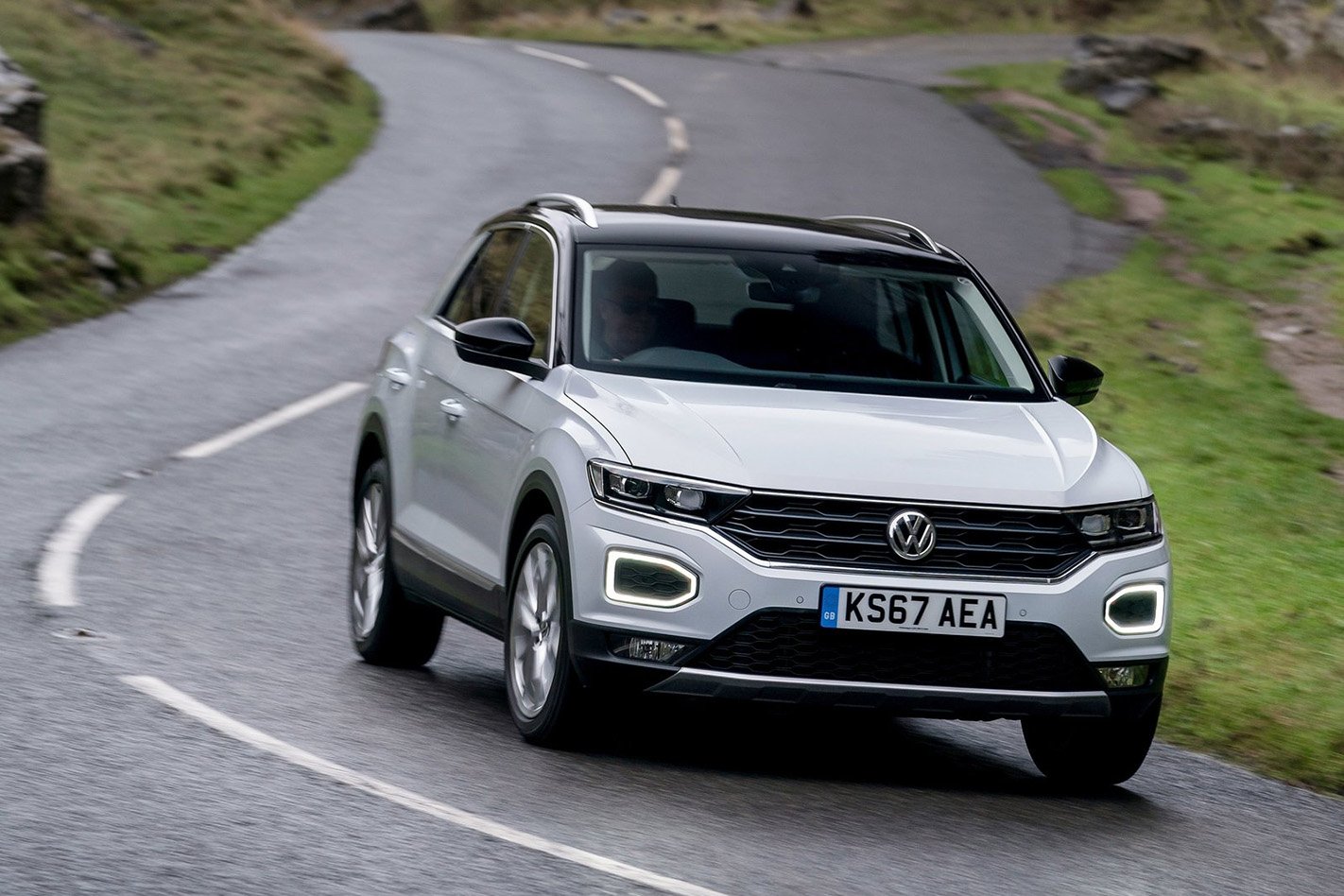
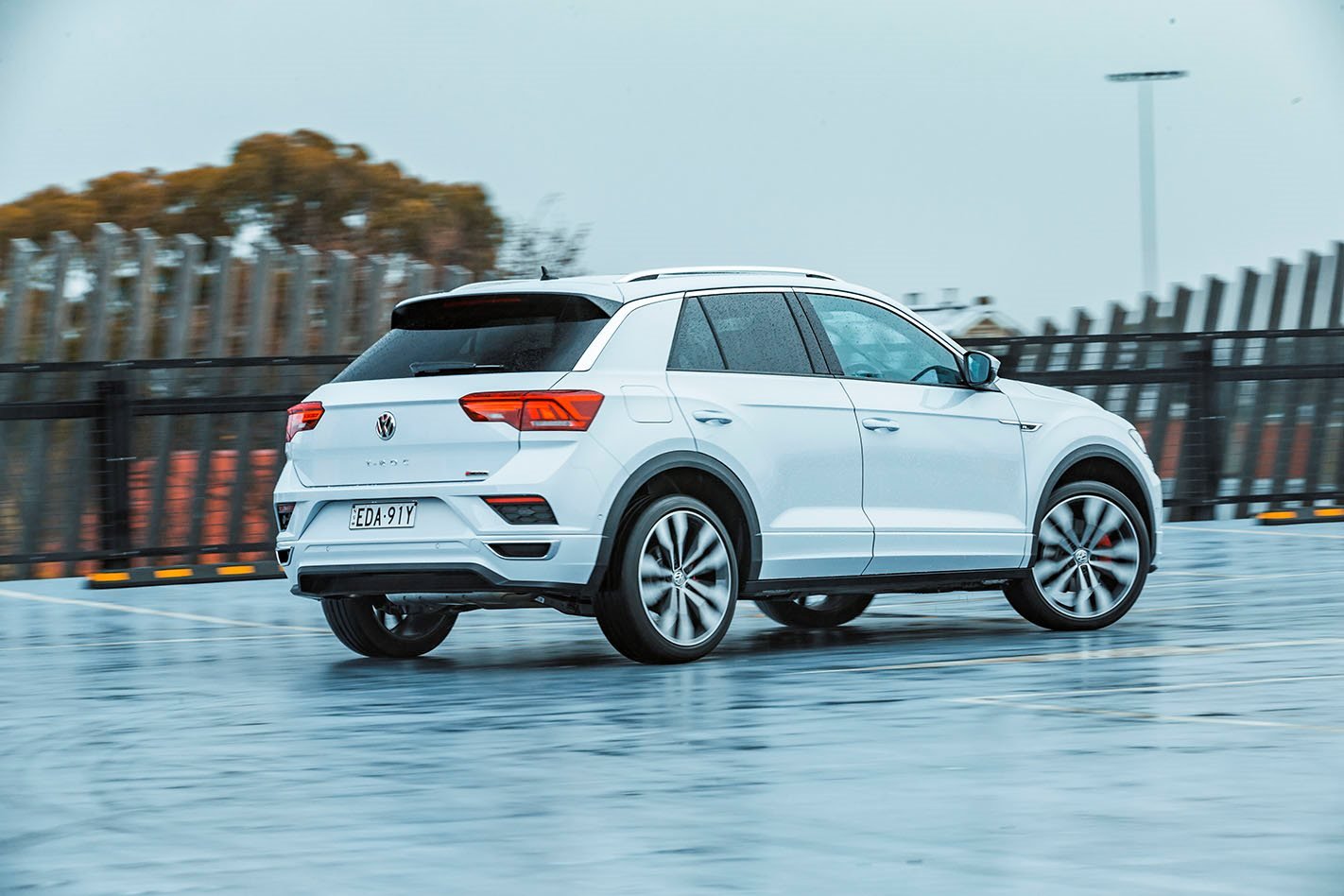
The T-Roc is entertaining to drive but can also be comfortable and relaxed. While higher-riding than the Golf it feels very much like the hatchback on the road.
The 140kW turbo isn’t the most refined at idle, but it’s a fundamentally good engine. Pair it with the T-Roc’s all-wheel-drive system and you have a combination that’s capable of deploying almost all of that power out of tighter corners.
The seven-speed dual-clutch automatic is a willing participant and is helped by the fact that body control is very good indeed.
The adaptive dampers, available with the Sound and Style pack has a slick Custom mode where you can specify damper rates (suspension settings), gearbox response, steering weight and so on. Besides that, it’s easy enough to shuttle between the two other drive modes that you’ll probably use – Comfort and Sport.
How is life in the rear seats?
Legroom is tight for taller people but there’s and excellent head even with the optional panoramic sunroof.
There are air vents in the back, a fold down centre arm rest with two cup holders, rear door bins, and storage pockets on the back the of the front seats.
Child car seats are well catered for with two ISOFIX anchor points and three top-tethers.
How is it for carrying stuff?
The all-wheel-drive T-Roc has a 392-litres boot space and up to 1237 litres with the 60:40-split rear seats folded down.
With the rear seats upright the boot space is 830mm long and you can an item up to 1532mm long behind the front seats with the back seats folded down.
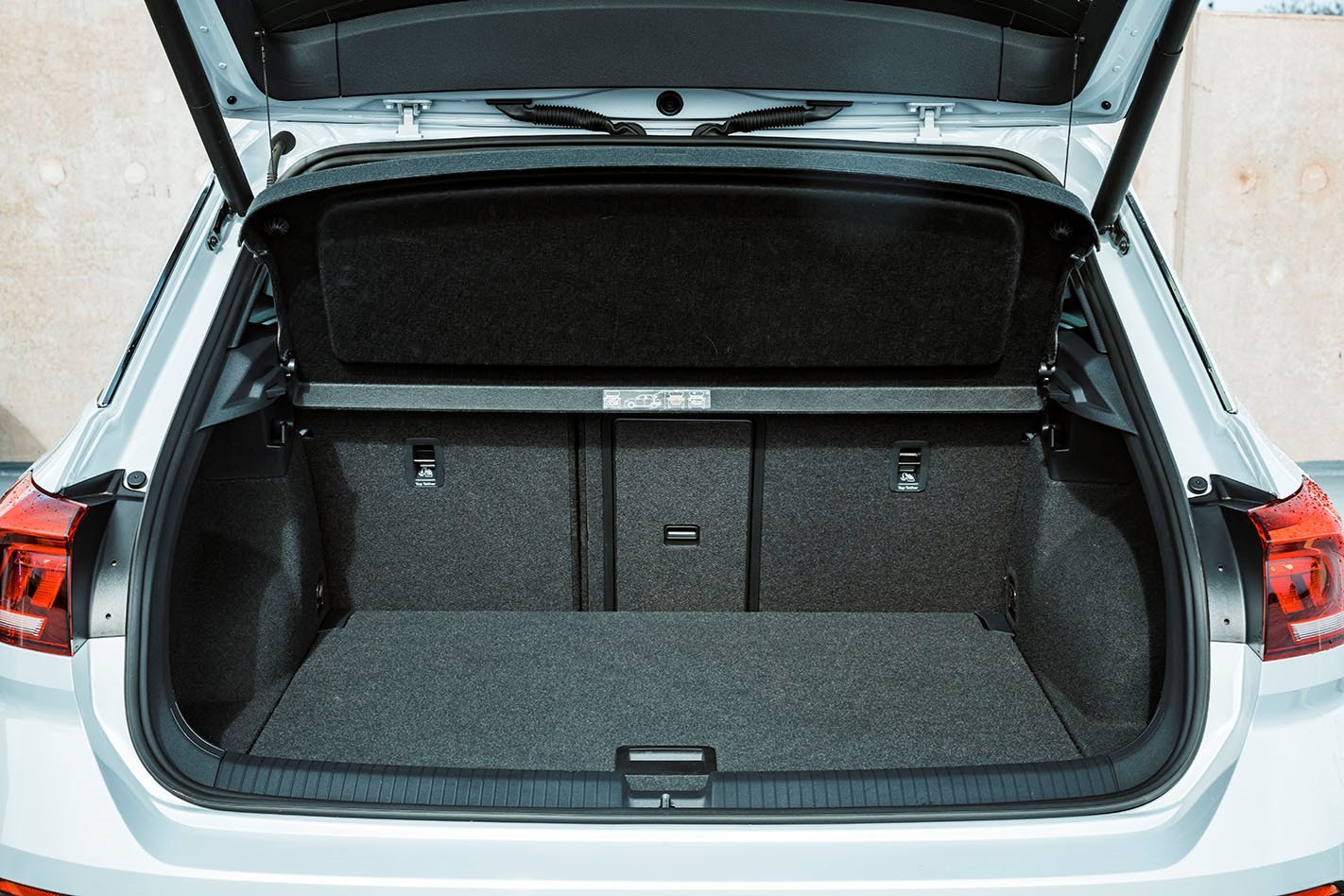
The T-Roc has a handy braked towing capacity of 1700kg or 740kg unbraked. The owbar load limit is 80kg.
Where is it the T-Roc made?
The Australian-market Volkswagen T-Roc is manufactured in Portugal.
What might I miss that similar cars have?
The T-Roc is one of the newest and better equipped small SUVs on the market and one of the most powerful too, so there isn’t too much that it misses out on, compared to its rivals.
A notable omission, for now, is the lack a more affordable front-wheel-drive option, as available with its sportier, the Toyota C-HR, Hyundai Kona, Mazda CX-30 and Kia Seltos.
This will be rectified when the T-Roc 110TSI arrives at the end of 2020, or you can check out the less sporty Volkswagen T-Cross.
It’s also worth noting the Skoda Karoq, which is another close relative is already available with both 110TSI FWD and 140TSI AWD powertrains.
The upper-spec AWD versions of the C-HR, CX-30, Kona and Seltos have a more refined interior trim.
I like this car, but I can’t choose which version. Can you help?
The 140TSI Sport is the only version available at the moment.
That said we recommend spending the extra $2000 for the Sound and Style pack with adaptive chassis control brings noticeable improvements to ride comfort and handling, along with the fancier 19-inch wheels, progressive steering and the 300W beats premium sound system.
Are there plans to update this model soon?
The T-Roc arrived in Australia in July 2020 with 140TSI Sport, and a 140TSI X launch edition that brought additional features for an additional $2000.
A more affordable front-wheel-drive 110TSI version is due to arrive in November 2020.
Don’t expect an update before mid 2022, though we may see more special edition versions before then.
Manthey-Racing has turned the Porsche 911 GT3 RS into a sharper, more focused machine in much the same way it did the GT2 RS u2018MRu2019, the car that lapped the Nu00fcrburgring Nordschleife in 6:40.3 and stole the title of fastest road-legal car around the circuit.The Porsche 991.2 911 GT3 RS MR retains the drivetrain as engineered and finalised by Porsche, which most should find no reason to complain about, and instead is different in key high-speed aspects such as aero and braking.
So with a naturally aspirated 383kW and 470Nm still nothing to scoff at, the GT3 RS MR gains a three-quarter-way adjustable set of coilovers, as well as a brakes upgrade designed by Manthey, as well as braided brake lines, and can be optioned with magnesium wheels.
Porsche 911 GT2 RS MR driven at Phillip Island
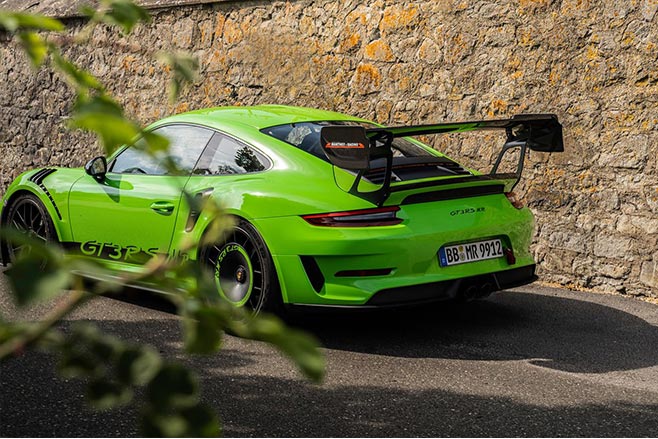
Then there’s the main event, the aero pack, which adds a plethora of extra guides for airflow and replaces some parts with carbon, including the engine deck lid.
A Gurney flap is also added below the rear wing blade, while the wing’s supports themselves are replaced with MR parts.
The aero discs, also carbon, added to the wheels are optional.
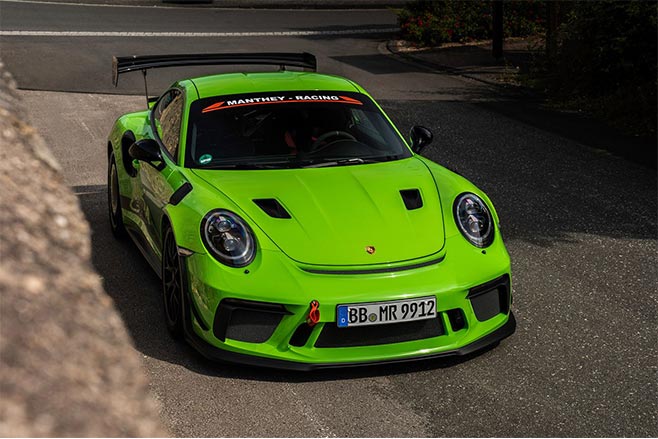
“With the latest MR model we are once again expanding our product range for the GT vehicles of the Porsche brand.
“The performance kit is based on the modifications of the Porsche 911 GT2 RS MR, which among other things is the fastest road-legal sports car on the Nürburgring Nordschleife,” says Manthey-Racing managing director Nicolas Raeder.
A source tells us the GT3 RS MR was only half a second off its GT2 sibling at the Blisterberg track during testing, so it’s safe to say this new kit makes the atmo 911 quite a serious weapon indeed.
Porsche 911 GT3 RS MR for Australia
We’re now able to confirm the Manthey-Racing kit will be available in Australia, with the first delivery outside of Europe for a 911 GT3 RS MR expectedto be made to Porsche Centre Doncaster in Melbourne next week.
Manthey-Racing parts are available at Porsche dealers around the country, with any Porsche Centre able to create a full ‘MR-spec’ car in its own workshop.
The base set, minus the mag wheels and aero discs, costs 39,911 Euro, converted into AUD at time of purchase to maintain a constant price from Manthey-Racing. Today, that’s AU$65,312 on top of the price of your 991.2 911 GT3 RS.
If you’re interested in Manthey-Racing parts for your GT2 or GT3 RS, Porsche Australia recommends contacting your local Porsche Centre.
Get your free weekly MOTOR report!
BMW is set to fire an opening salvo in a new super sedan power war, aimed directly at rivals AMG and Audi.
The military-grade shot will come thanks to the new BMW M5, which is reported to arrive with 750kW at its disposal.
Yup, BMW is said to be working on a 1000hp sedan that will be sold to the public.
The news comes from a report by CAR in the UK that states an all-electric 750kW flagship will be added to the M5 range as part of a two-pronged attack on the super sedan battle.
If electric power doesn’t get your pistons firing, then the other M5 variant should. The same report claims a more traditional M5, with a twin-turbo V8 mated to a plug-in hybrid battery, is also in the works.
With combustion and battery power working in unison, the PHEV powertrain is expected to unleash 560kW and 1000Nm.
Sound tantalising? It should!
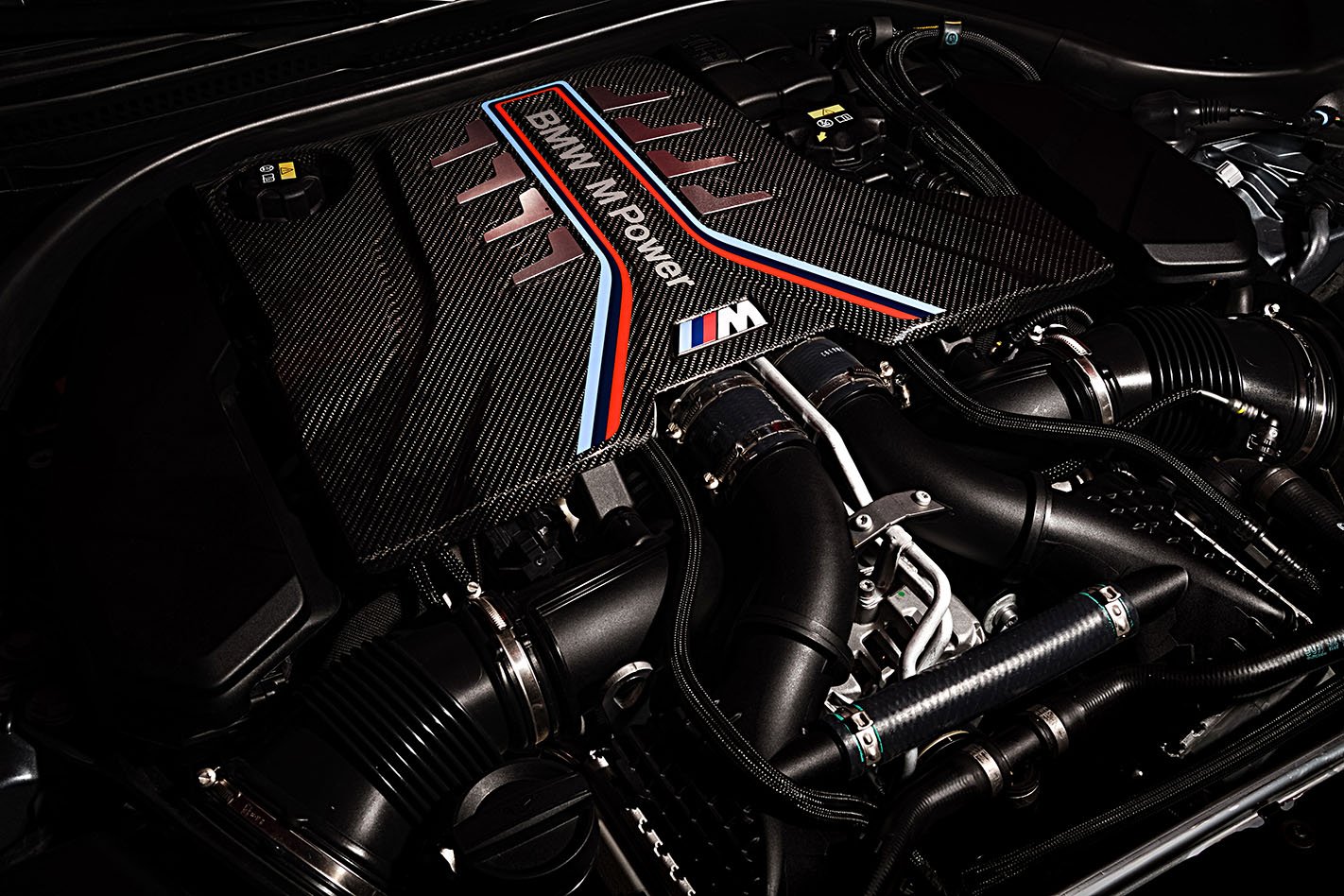
We haven’t seen this new amped up powertrain just yet, with its development still ongoing under the secret codename ‘Project Rockstar’.
Project Rockstar is expected to debut as the yet unconfirmed X8 M coupe SUV, but it’s the powertrain that interests us most.
Currently the most powerful vehicle in the M Division’s current arsenal is the M8 Competition, with the 4.4-litre twin-turbo V8-powered coupe producing 460kW and 750Nm. Power is delivered to all four wheels via an eight-speed automatic transmission.
For the new M5 that turbocharged V8 will get a working over, and be paired with a 150kW electric motor to maximise off the line acceleration.
Expect a 0-100km/h time quicker than 3.0- seconds.
Those rumoured 560kW/1000Nm outputs would instantly make the next M5 one of the most powerful four-door cars in the world, rivalling the likes of Dodge’s Charger SRT Hellcat Redeye, which produces 595kW/959Nm from a 6.2-litre supercharged V8.
But it wouldn’t be the most powerful M5, with the all-electric variant set to utilise next-gen battery technology for truly staggering power outputs.
We’ve known BMW has been working on a high-performance electric powertrain for some time.
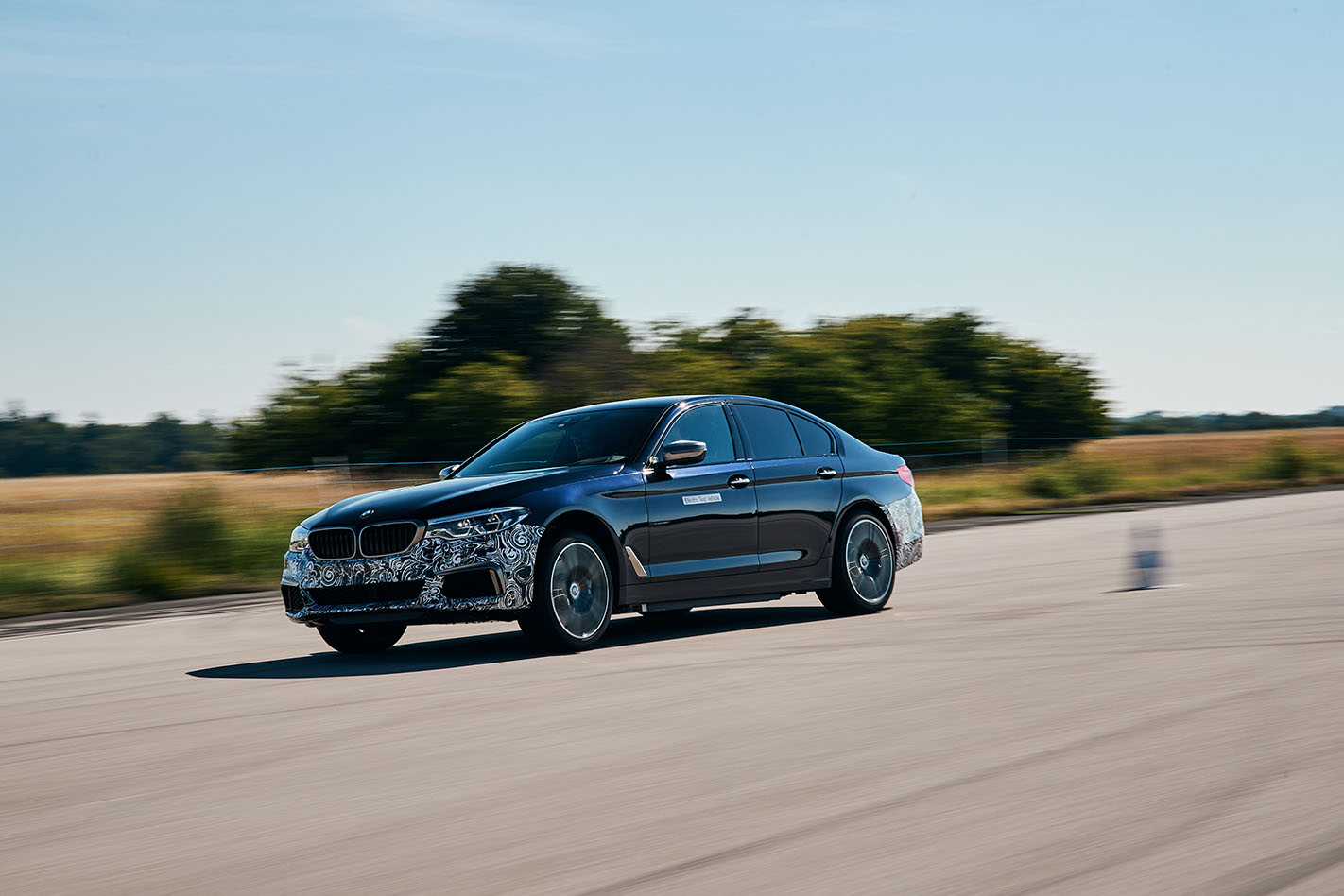
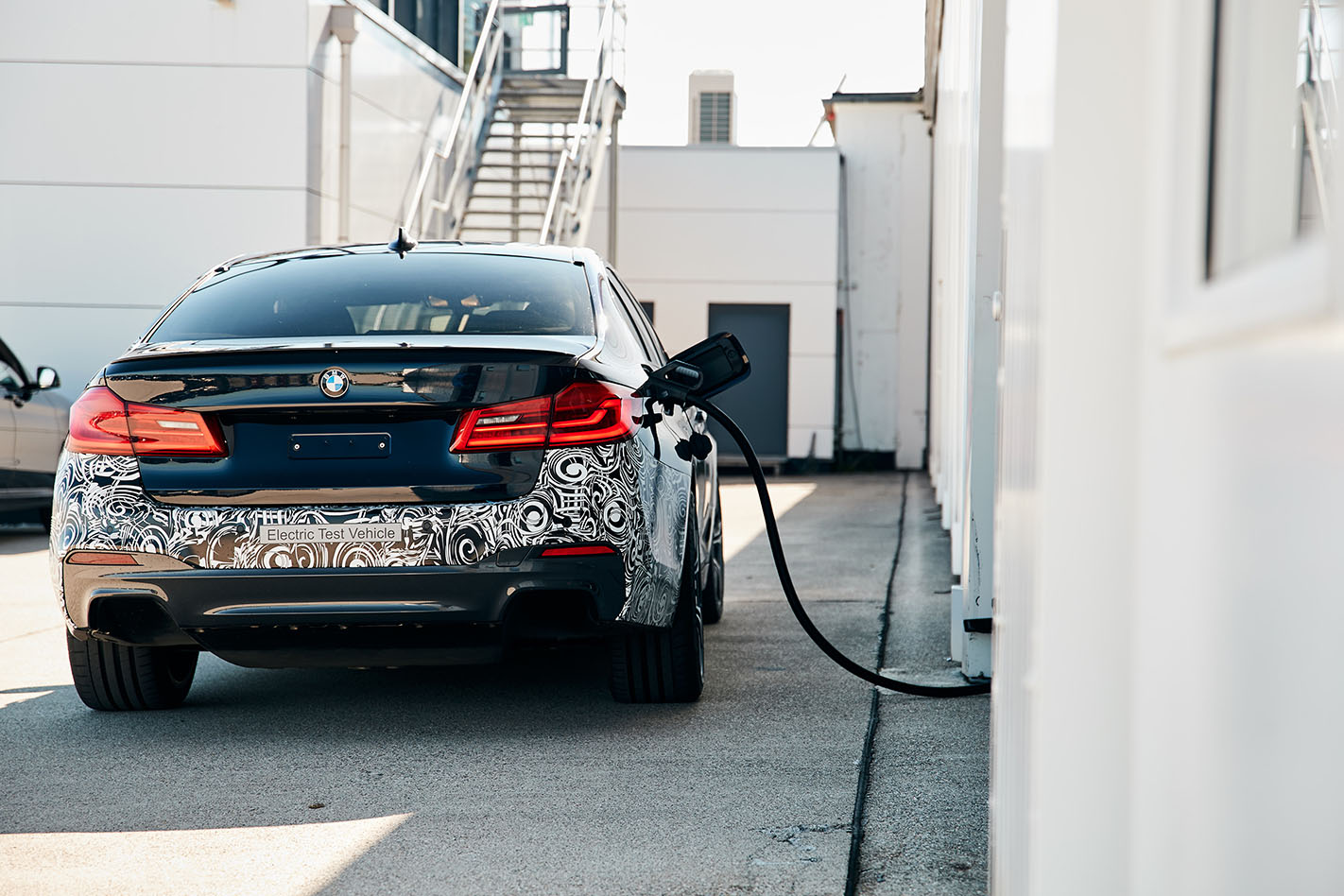
Last year, engineers revealed ‘Project BEV’, which was built using a current 5 Series mule, and was fitted with three of BMW’s next-gen electric drive units (EDU).
Two were fitted to the rear axle, while the third was used to power the front wheels, with BMW reporting outputs of 529kW and 1150Nm.
BMW claimed the 2.4-tonne test car could crack 100km/h in 2.8 seconds.
Now, imagine what it can do with double the power output. Crikey!
CAR reports that new “Gen V pouch-type batteries” will be used to provide power to a trio of electric motors, each rated a 250kW – two on the rear, one on the front, just like Project BEV.
If that seems like a lot of grunt to put in the hands of regular citizens, BMW’s boss Markus Flasch has said previously that he won’t be telling engineers to cap power outputs any time soon.
Instead, the M Division boss says the company will be focusing on utilising and harnessing a powertrains unchained potential.
“Power is nothing without control, right? And if there isn’t something with too much power it’s just a question of how you tune in and hone into a car, and how you make it accessible,” Flasch told Wheels last year.
“You look 10, 15 years back and if you imagined 625 horsepower [466kW] in a saloon car, you’d probably be scared. Now, I can give an M5 this 625 horsepower and only drive to my mom, in winter, and she’d still be okay.
“It’s all just a question of how you incorporate it into a package that makes it accessible for everyone, and this is what M has always been brilliant in. Don’t expect a power limit.”
If you’re the owner of a high-performance road car or even thoroughbred race machine, the only place you’ll be able to stretch its legs and toast tyres without attracting the mire of the law is at a certified track.But while many of Australia’s circuits offer top quality tarmac, alas the experience can be a little underwhelming when it comes to the ‘apres skid’. Not anymore.
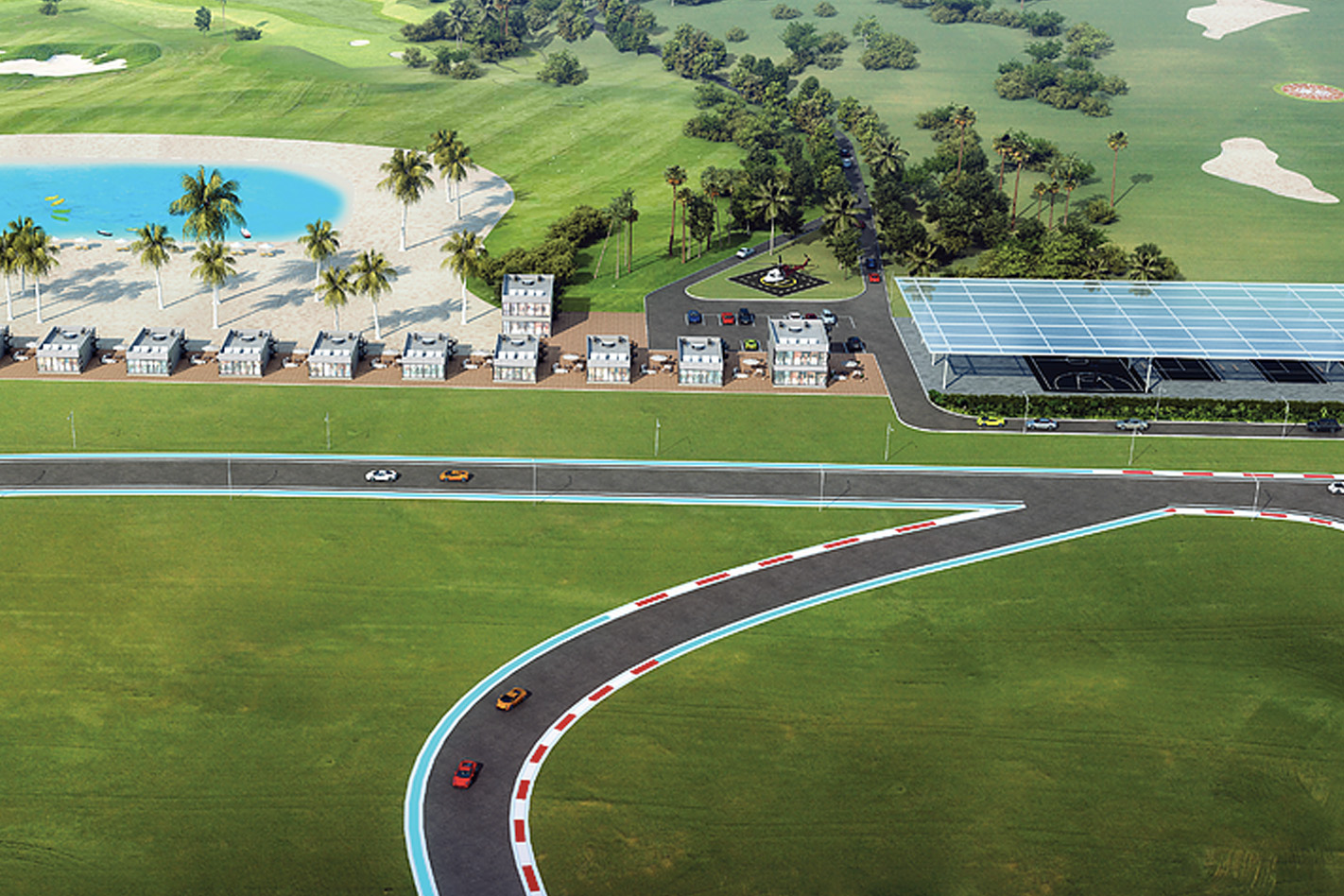
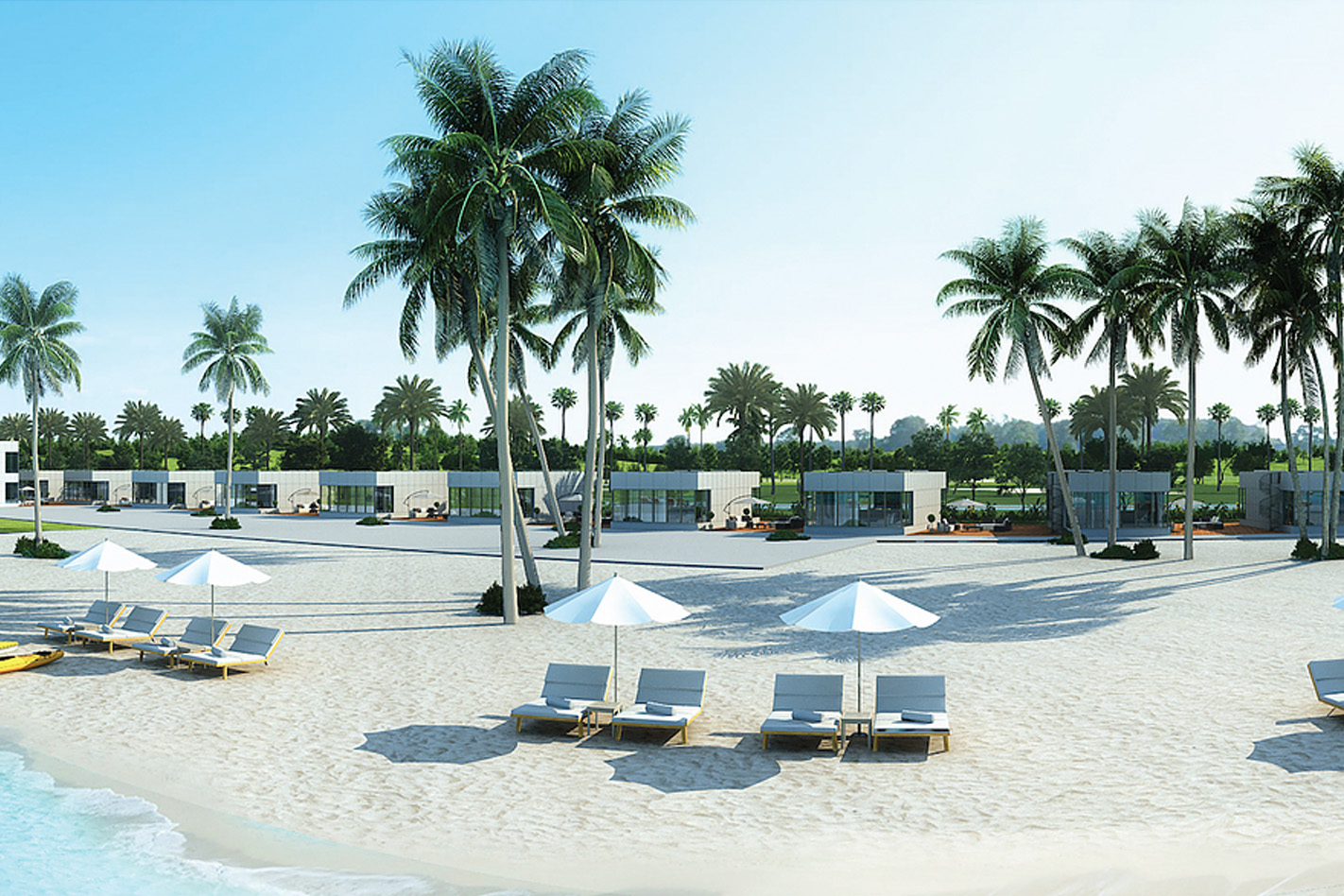
Due to open its doors (and pit garages) in 2022, Club Moolia is promising to be Australia’s most exclusive resort for racing enthusiasts, but its extraordinarily high-end experience comes at an eye-watering cost.
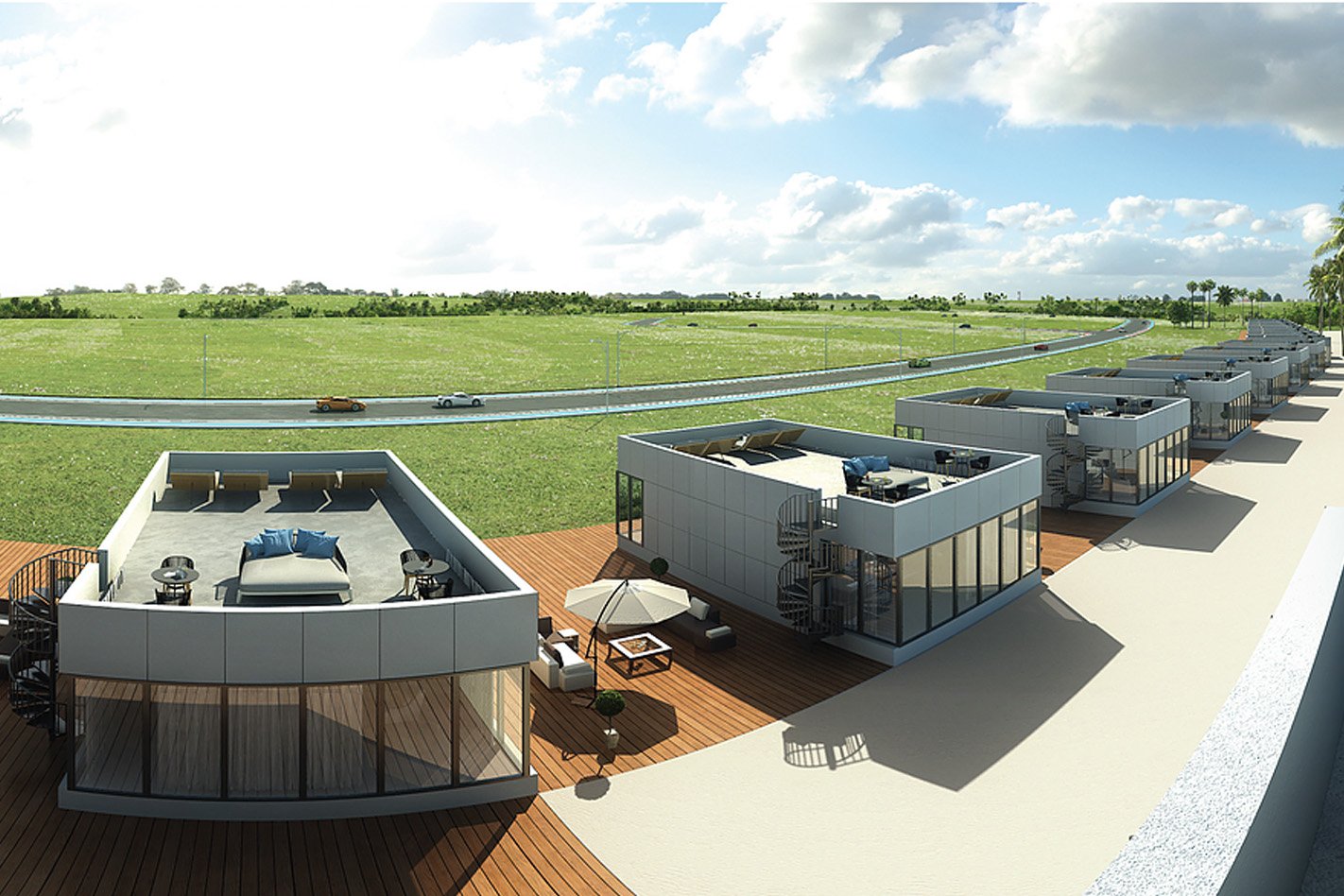
Measuring about the same as Sydney Motorsport Park’s track in length and a healthy 12 metres wide in places, the Moolia track will include 17 turns and will be equipped with high-quality asphalt for long life and consistent friction characteristics.
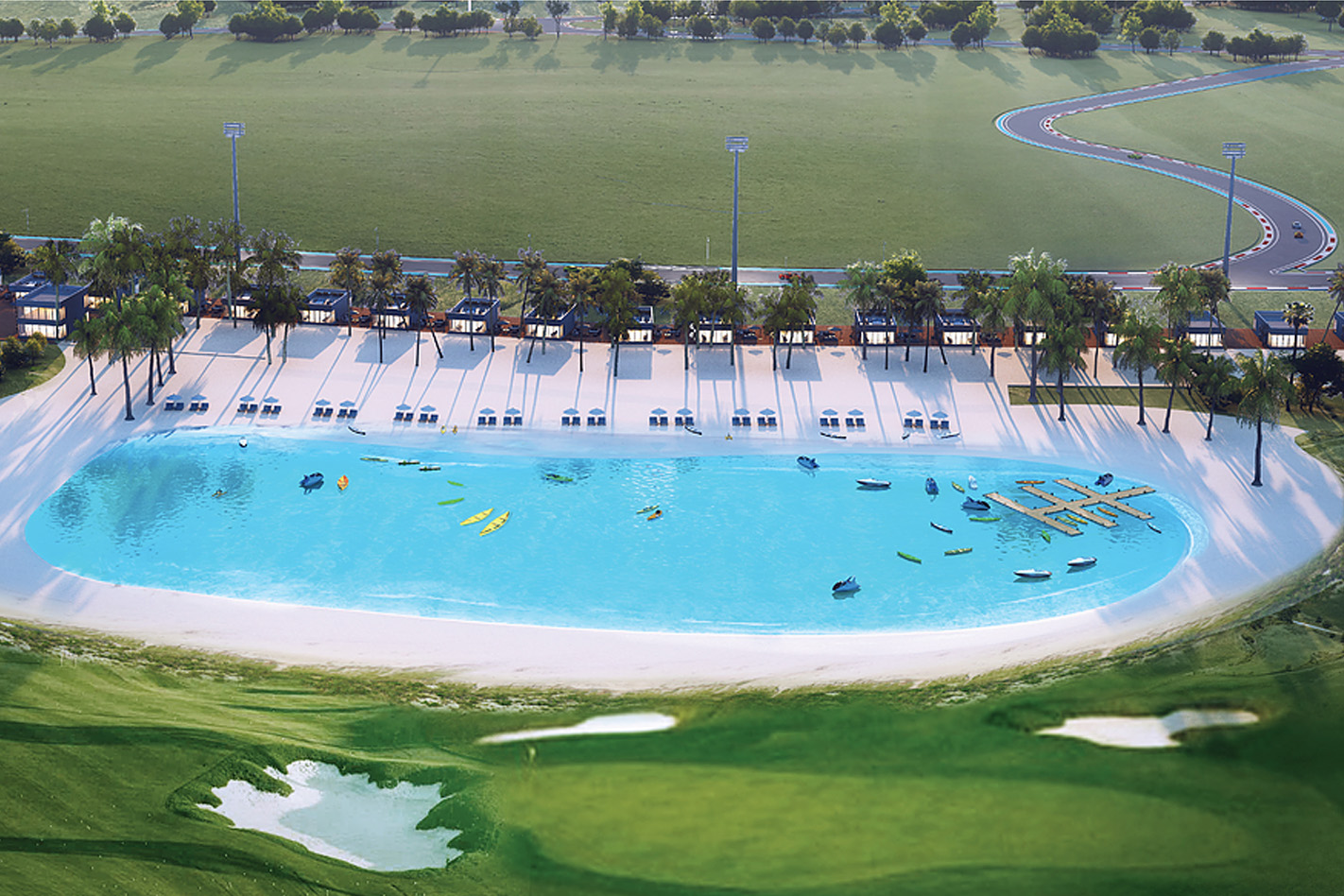
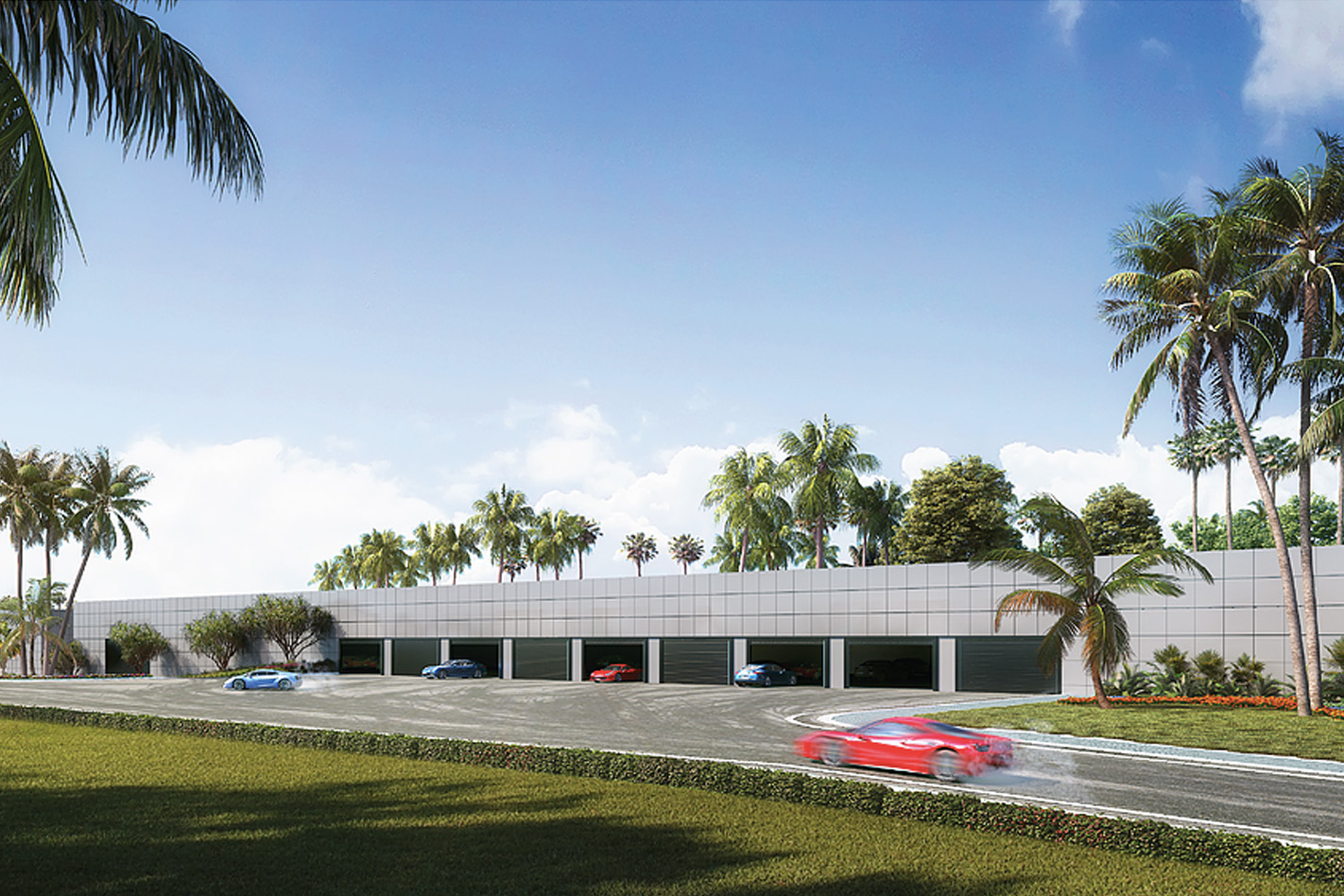
Speaking of which, the resort will offer special secured entrances for the ultimate in privacy and anonymity.
Pit garages will be climate controlled for maximum comfort all year round as well as providing optimum vehicle storage for rare and exotic machines.
Tick all the boxes to be recognised as a ‘Prodigy’ then Club Moolia will ask $50,000 plus $7000 every 12 months.
We understand if those rates seem a bit steep, so perhaps you might consider buying your own racetrack and enjoy lap after lap fee-free?
Here are a few options:
Today’s browse through the classifieds turned up an intriguing question: if you’re in the market for the ultimate Chevrolet muscle car, should you buy new or almost-new?
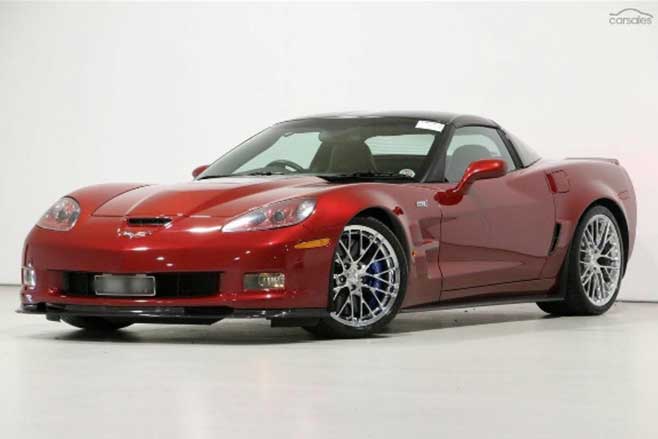
The catalyst for this was the discovery of a 2013 Chevrolet Corvette ZR1 in Western Australia. Converted to right-hand drive and having covered just 22,052km it’s offered for $134,984 before on-roads.
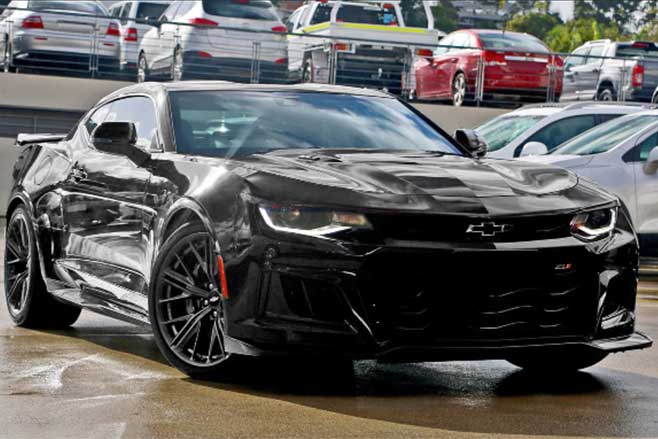
In the new corner is the HSV-converted Chevrolet Camaro ZL1. On the face of it the newer Camaro is much more expensive, its MRP starting at $159,900, but there are numerous examples available, manual and auto, for around $130,000 drive-away with delivery mileages.
It’s a shame, as it’s an awesome car which we love, but it appears Australia’s muscle-car buying public aren’t sold on the 477kW/881Nm 6.2-litre supercharged LT4 V8, choice of six-speed manual or 10-speed automatic, MagneRide adaptive suspension and big brakes.
In which case, perhaps the Corvette will tempt them? It may be the older car, first appearing in 2009 as the flagship of the C6 Corvette range, which also makes it the more exotic machine.
The basics are similar to the Camaro – 6.2-litre supercharged V8, six-speed manual gearbox, MagneRide adaptive dampers – but the Corvette’s brakes are carbon-ceramic and its engine is the titanium-filled LS9.
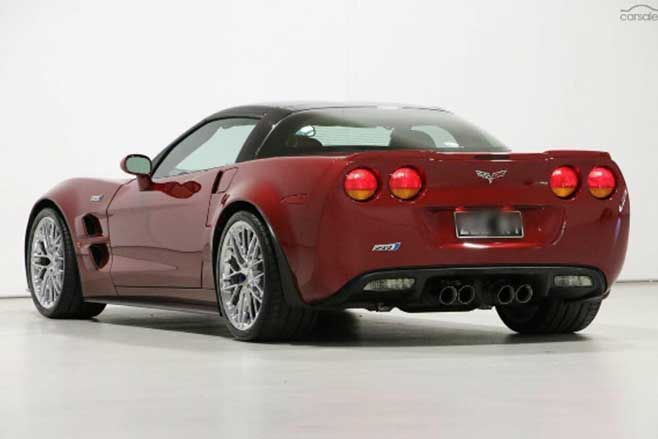
Power is slightly less at a still more-than-adequate 476kW/815Nm but, crucially, it has almost 300kg less to propel in the composite-bodied Corvette. That makes it really, really fast. Motor Trend figured the ZR1 at 3.3sec from 0-60mph and 11.2sec at 210.1km/h for the quarter mile, while pushing it to 323km/h. Chevrolet claimed a max of 330km/h.
In comparison, our best figures (with roll-out applied to match US testing procedure) for the Camaro ZL1 are 3.99sec from 0-100km/h and 11.85sec at 196.51km/h in the manual and 3.79sec and 11.60sec at 200.03km/h in the automatic. Quick, but not as quick as the Corvette.
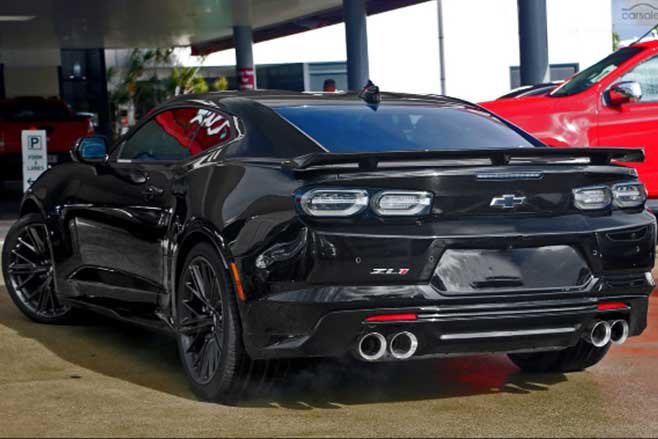
Of course, the new Camaro comes with the advantage of a warranty and the knowledge you’re the first owner, but it’s an intriguing contest nonetheless. Let us know which car you’d take in the comments below!
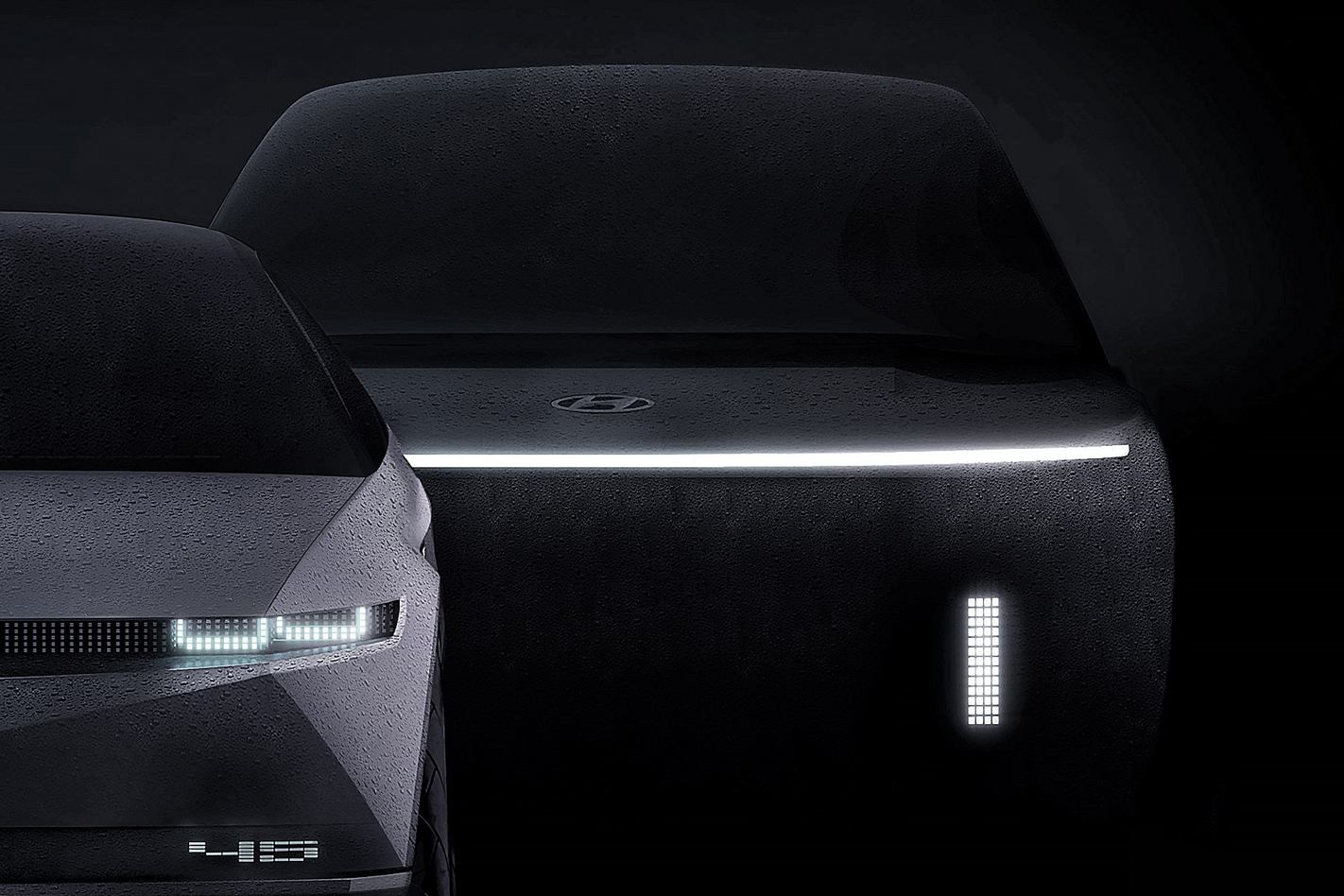
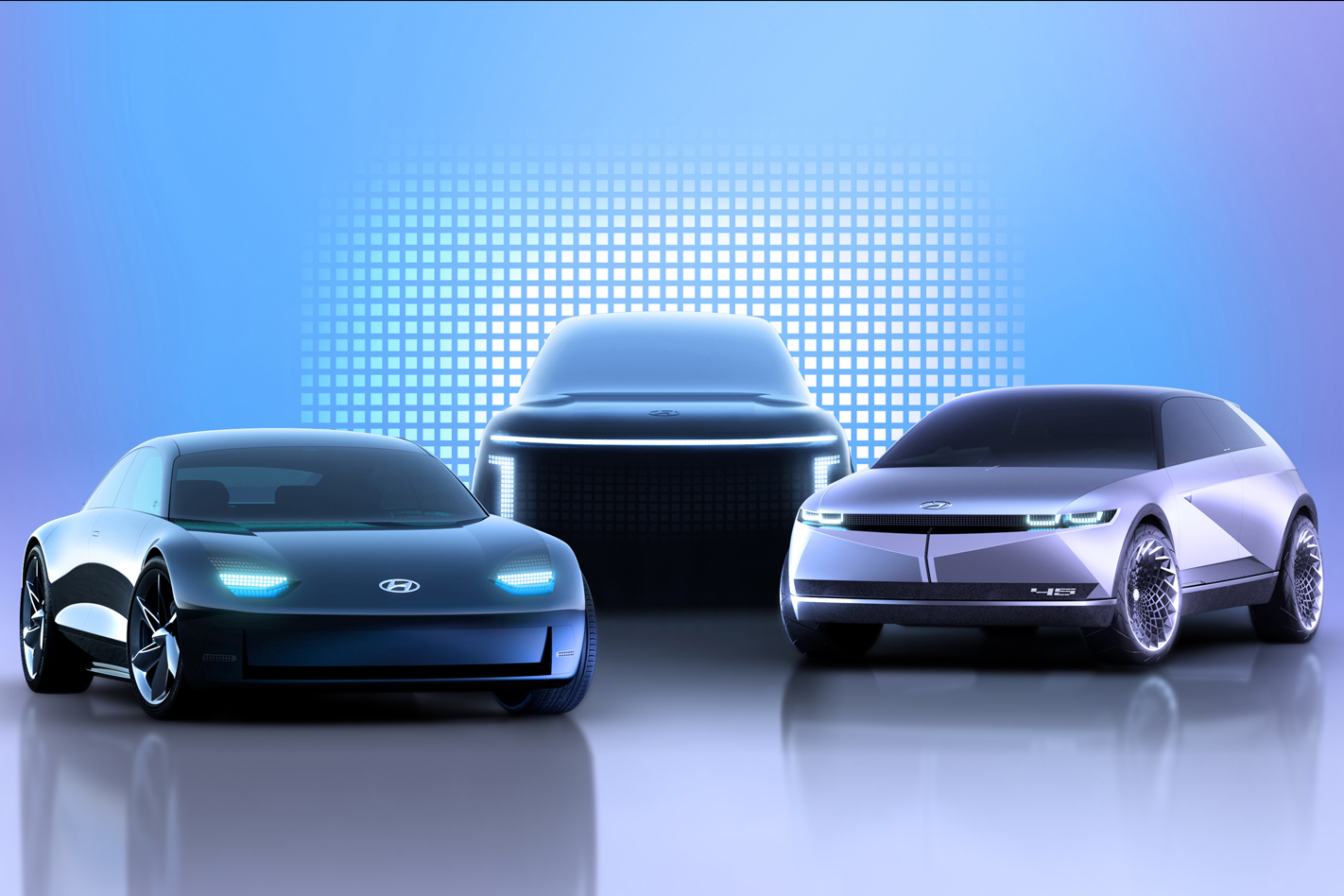
Hyundai has announced that all its future electric models will be branded Ioniq as part of a freshly forged EV-only family tree, with three new zero-emissions vehicles arriving over the next four years.A simple numerical naming policy will apply to all joining members of the new Ioniq range in favour of Hyundai’s existing word amalgam nomenclature – of which Ioniq itself is an example – blending ‘ion’ and ‘unique’.
The strategy to spin all Hyundai EVs off to a separate consolidated brand is almost identical to the company’s graduation of the Genesis brand, from a single Hyundai badged model to an entire standalone luxury line-up.Exact model allocation for the Australian market is yet to be confirmed but given Hyundai’s EV championing approach to the local alternative energy cause, you can expect all the emerging models to show up in local showrooms.
While Hyundai Australia wasn’t willing to confirm any models under the new umbrella just yet, the company is very keen to offer any new Hyundai electric vehicle and WhichCar understands the local team is aiming to bring the complete Ioniq family Down Under.
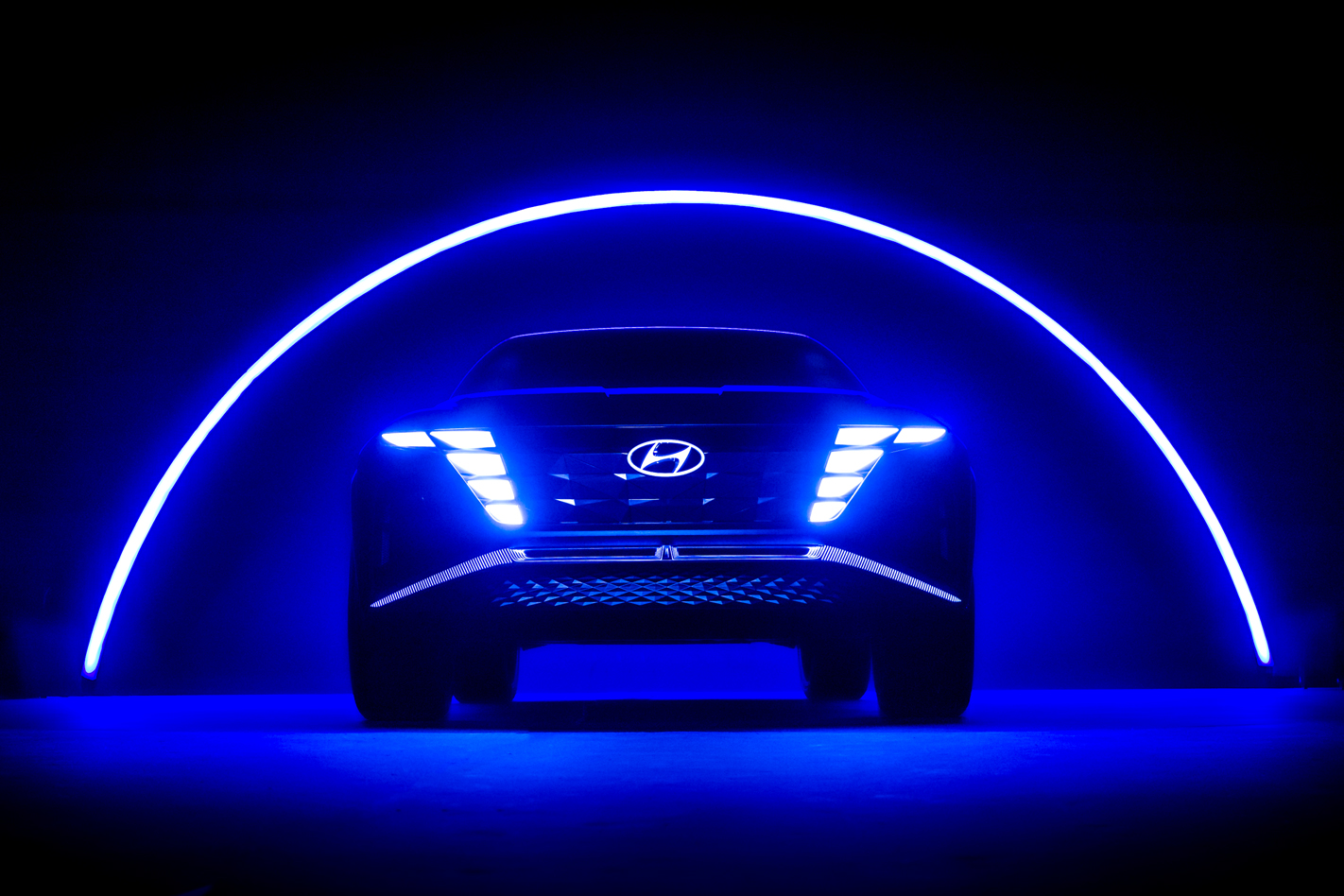
These include the Kona EV, Nexo and even the trio of electrified sedans that pioneered the Ioniq name for Hyundai.
IONIQ EV RANGE
Ioniq 5
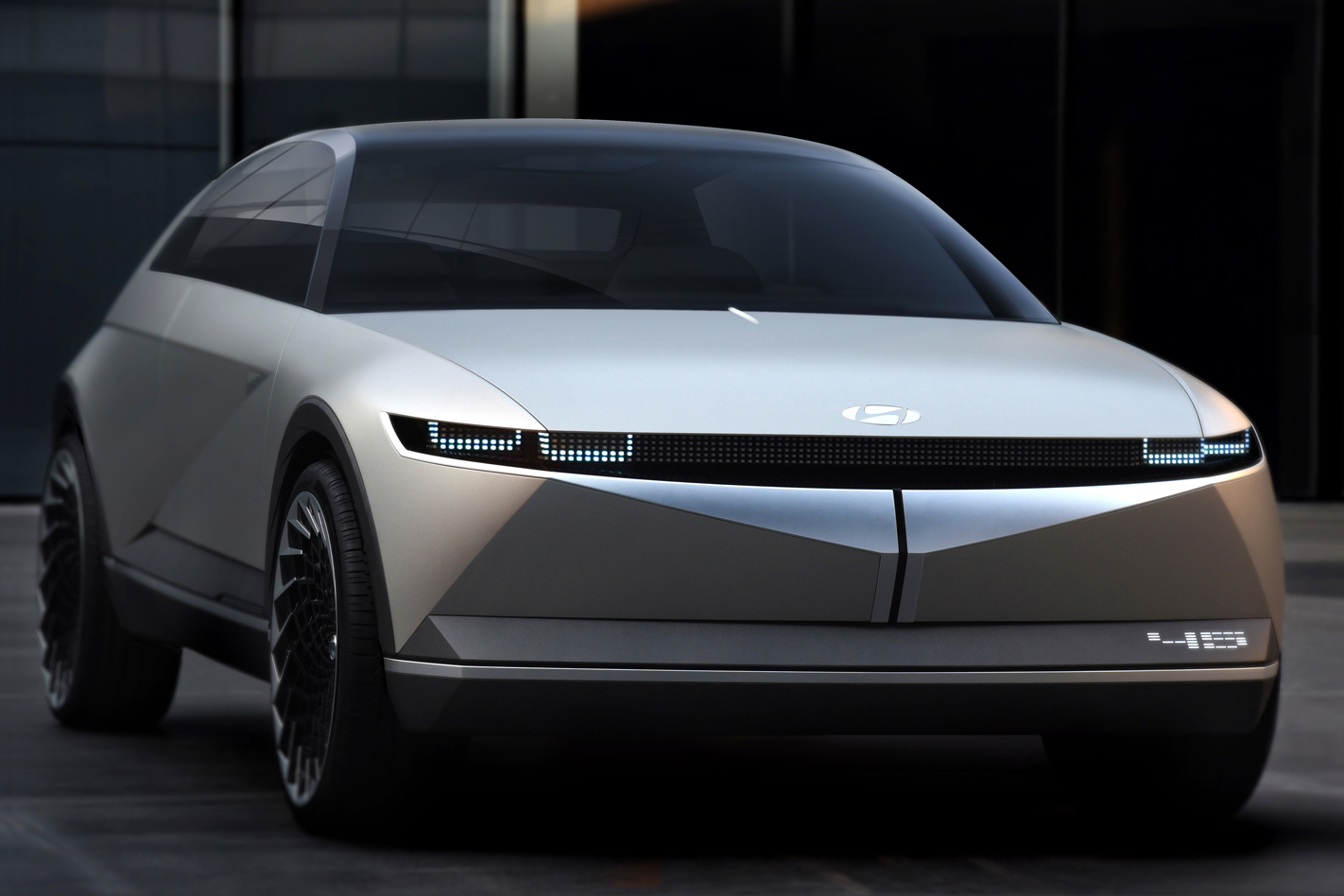
The founding member of the Ioniq line-up could arrive in as little as six months, with the Ioniq 5 mid-sized crossover hitting global markets in early 2021.
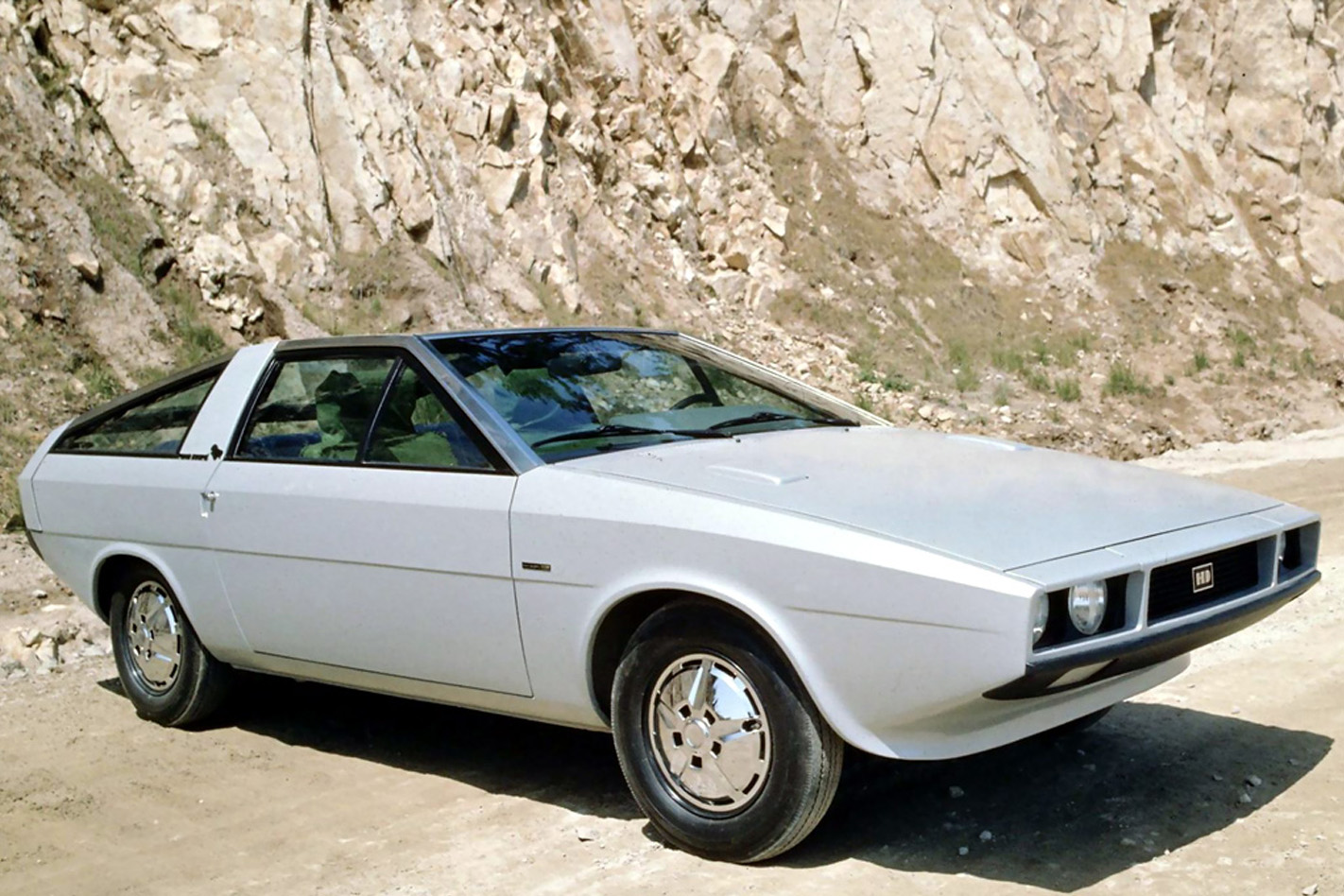
It takes its basis from the Hyundai 45 concept that was revealed last year at the 2019 Frankfurt show.
Ioniq 6
Hot on the heels of the first model, the Ioniq 6 will join the new family about a year later, bringing a sedan model to the line-up that was first teased with the company’s most recent concept.
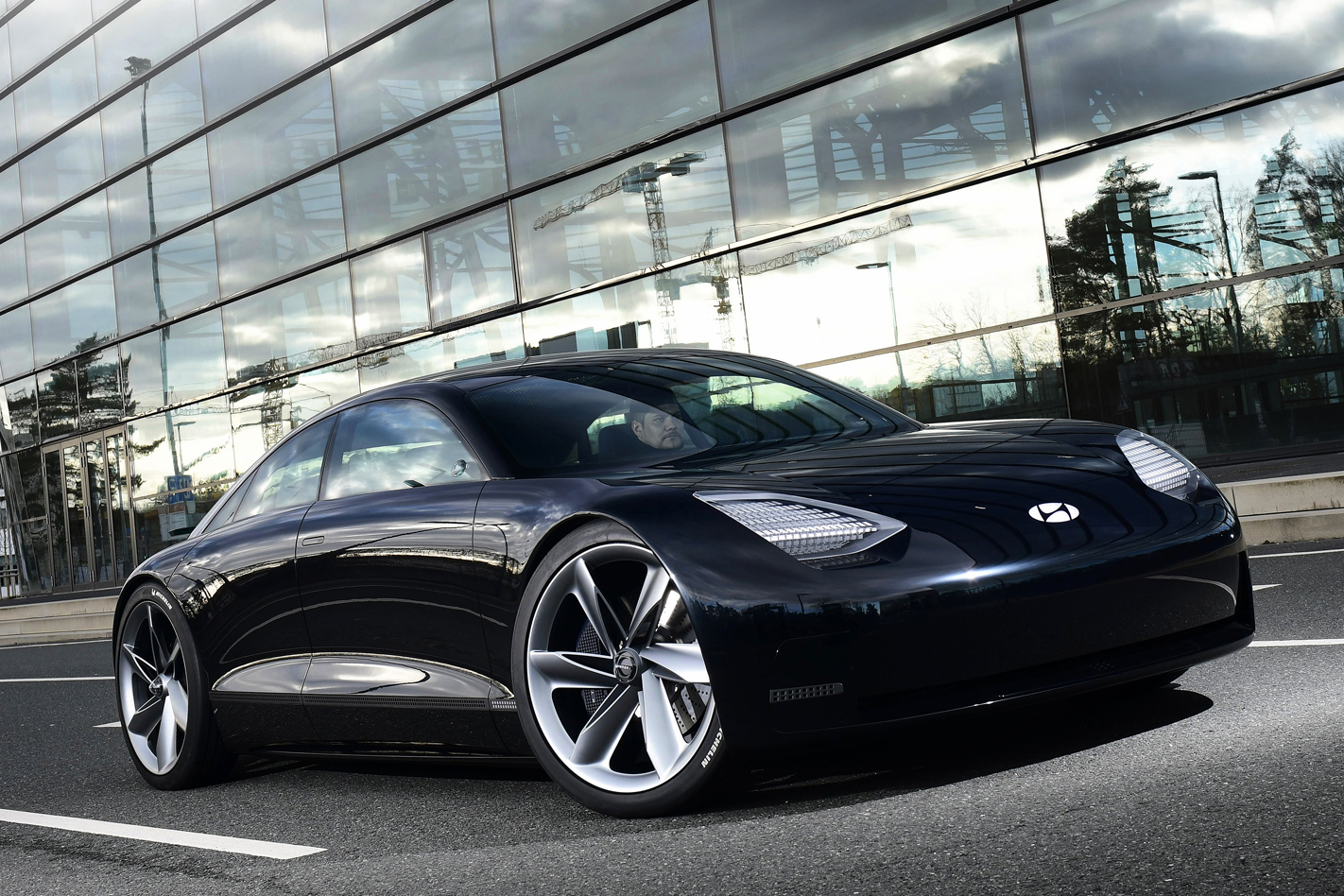
More excitingly, the Ioniq 6 is likely to be the model that steers Hyundai’s freshly forged N performance brand into an electric era. Watch out for an Ioniq 6N at some point in the near future.
Ioniq 7
Finally, and most tantalisingly, a third Ioniq model will arrive in 2024, adding a large seven-seat model to the range. Little is known or revealed about this trio-completing enigmatic model, though.
Ioniq X …
Just as BMW’s single-digit naming structure (established in the 1970s) has allowed it to continue slotting models into its family of Series cars, Hyundai will progressively add more Ioniq numbers into the mix with more passenger cars, SUVs and ‘CUVs’ planned.Under the structure, even numbers will be applied to the boots of sedans, while SUVs will be given odd-number monikers. No mention is made of hatchbacks, sports or commercial models. Read into that what you will.
The rapid roll-out of the first three models has been enabled in part by a new scalable E-GMP platform on which all the Ioniq family EVs will be based.
The same flexible and EV-specific architecture will allow the consistent addition of “more innovative” machines to the fledgling family.
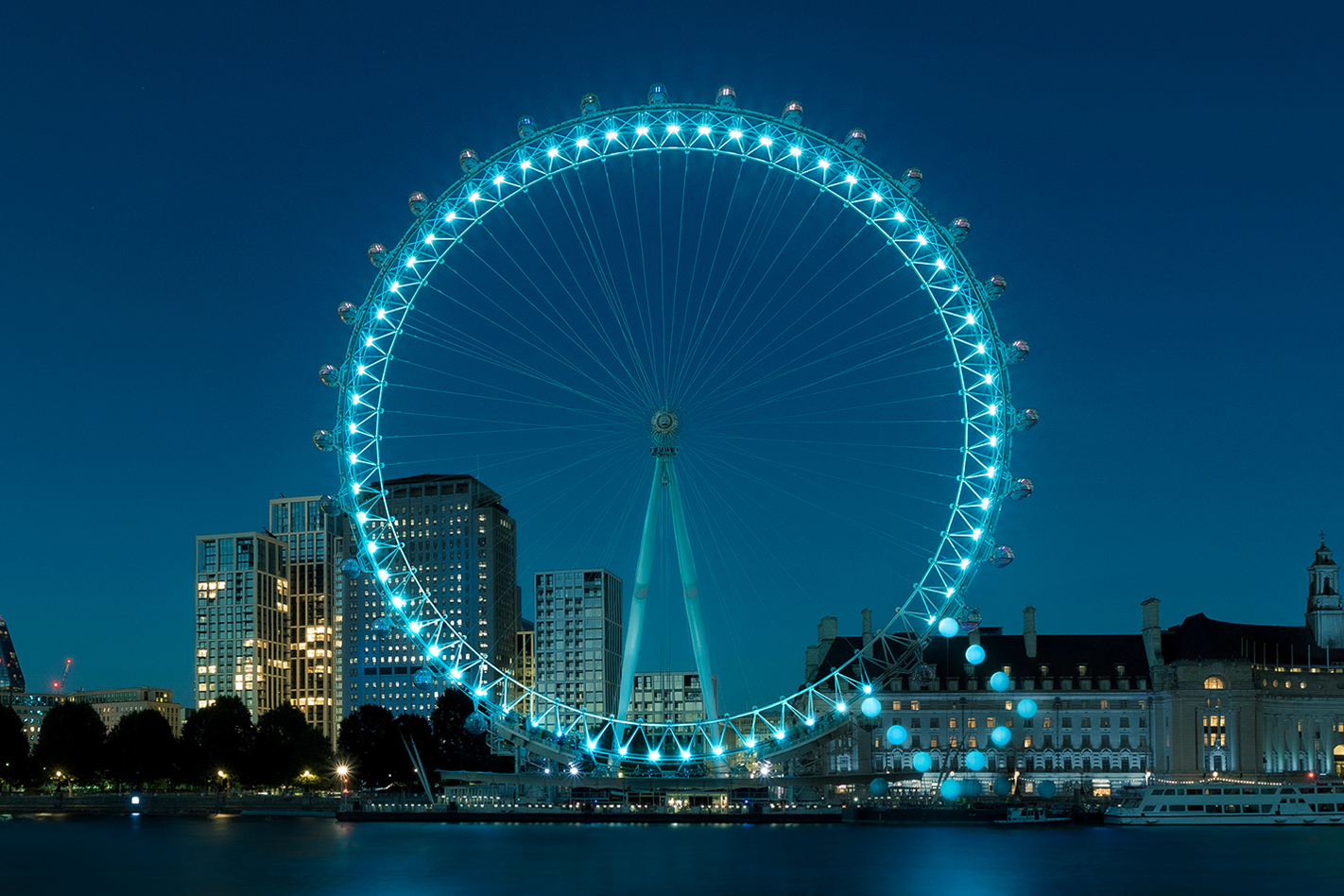
To celebrate and suitably mark the occasion of a whole new Hyundai sub-brand, the company commandeered the UK’s London Eye mega Ferris wheel, turning it into a giant blue-lit Q.This new evolution of the Hyundai story certainly seems to be as revolutionary as its latest publicity stunt. Literally.
In many ways, the reborn Bronco feels like a real outlier play for Ford, which as a company is in a pretty weird place right now.
Like its rivals, it’s struggling to sell anything that doesn’t have a cargo bed, it’s tipping obscene amounts of money in the direction of electrification, and it’s jettisoning poor sellers over the side at a rate of knots as it trims the fat (and sometimes the flesh) off one of the oldest automotive nameplates left in the game.
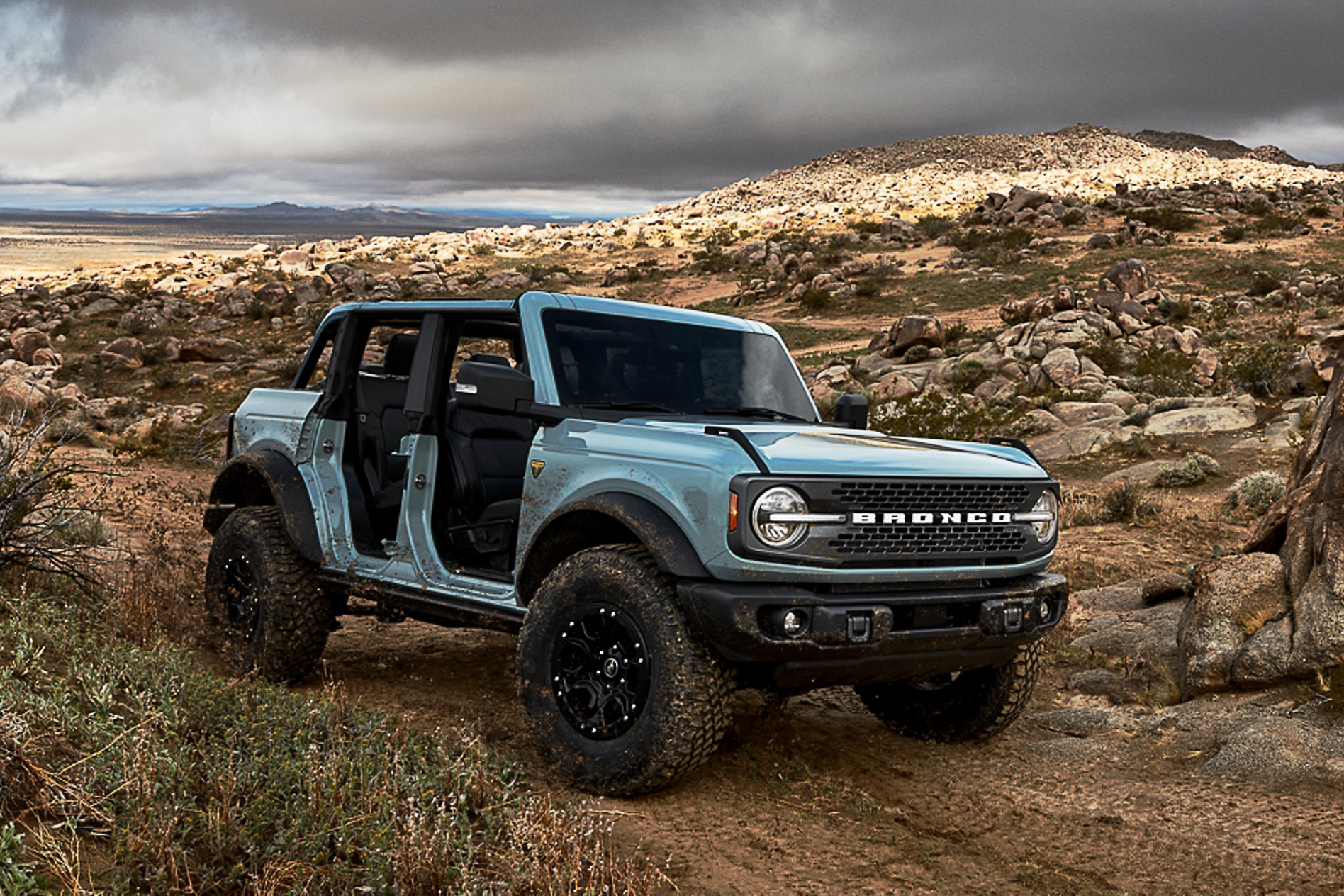
Yet, the Bronco – based not on the all-conquering US-only F-150 truck, but a new evolution of the T6 chassis that lives under the humble Ranger and Everest – managed to stay the course, evading the accountant’s red pen even as widespread cost-cutting spread across the industry like a creeper vine.
Ford’s always done the new car long-play drip-feed thing better than most, but the tease program for the Bronco felt longer than the final ep of Game of Thrones. Or even the marketing program for the Toyota Supra. Okay, maybe not that long, but it was a long one.
But when the covers finally came off, the wait was absolutely worth it. Fans dallied just long enough to whistle in admiration at the bold, brassy new interpretation of Ford’s 55-year-old Bronco nameplate before pounding their keyboards to pre-order a reported 250,000 of them.
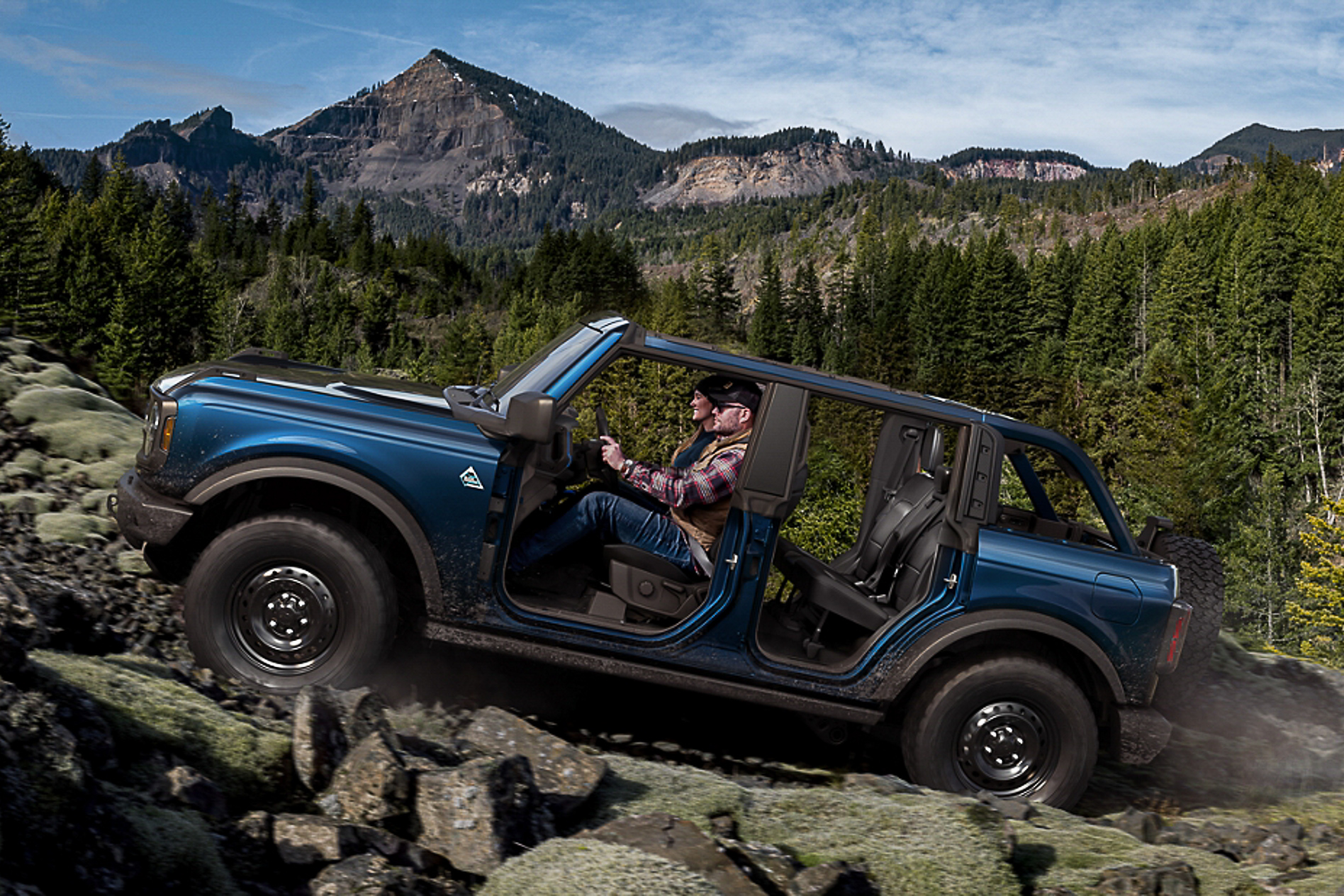
Cleverly specced, thoroughly engineered and blessed with bold, overt styling, the Bronco is a ripper of a thing.
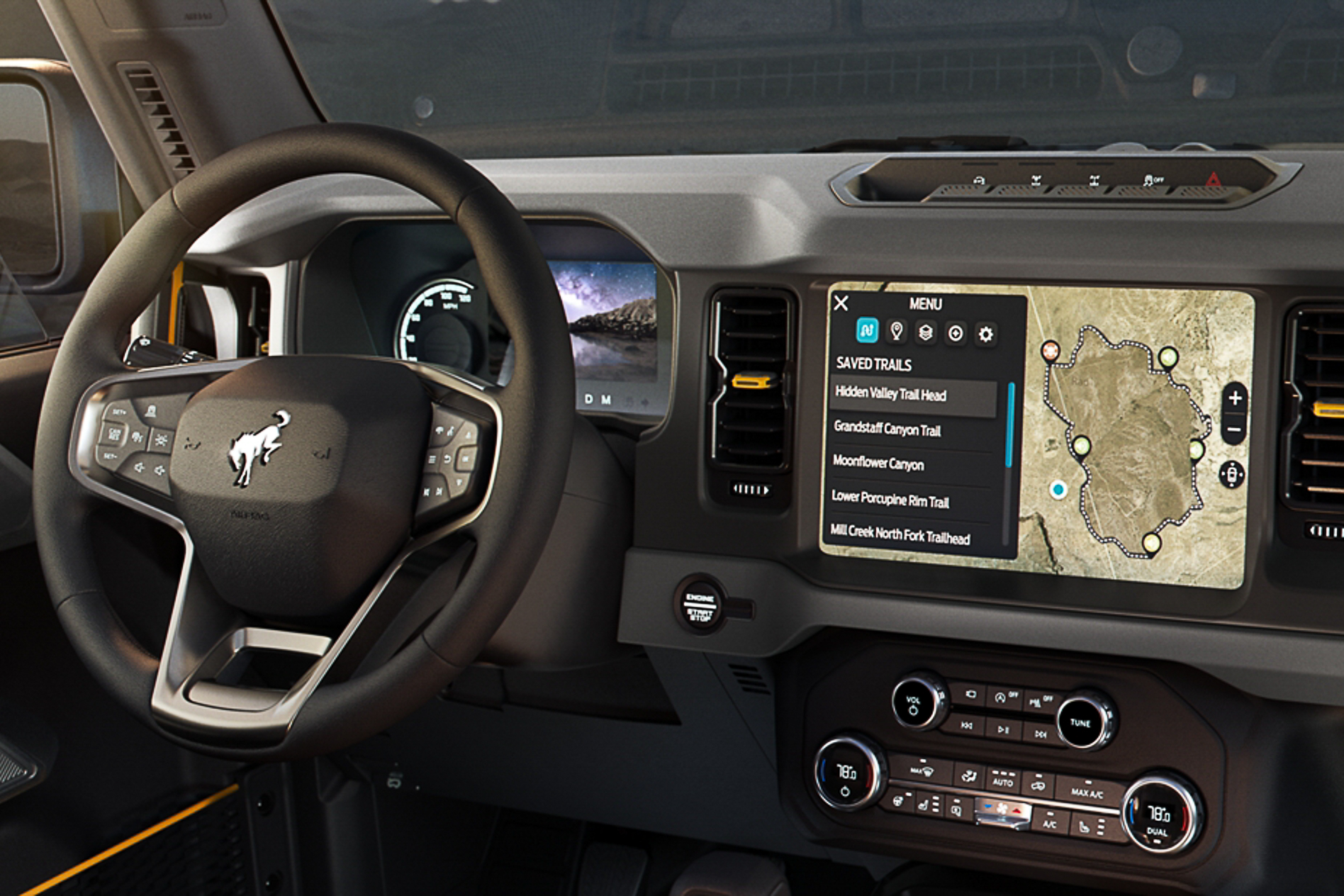
Hose-out floors, LED floodlights, a cool slide-out tailgate tray, crazy-low off-road gear ranges, removable doors and roof and even a built-in bottle opener in the cargo area all point to a car that could attract a new type of buyer to the brand.
For a program that would have been funded (relatively speaking) by loose change found down the back of the couch in the staff common room, it looks as if it’s going to be a huge win for Ford against the run of play.
So, if it’s based on the Ranger T6 platform… why the heck isn’t it coming to Australia? That’s a good question.
On the face of it, the Bronco – which will come in short- and long-wheelbase versions, as well as an Explorer-based SUV – should be a lay-down misère for Australia.
The T6 platform on which it sits was, after all, developed here, and so stands ready to offer a steering wheel on both sides of the car.
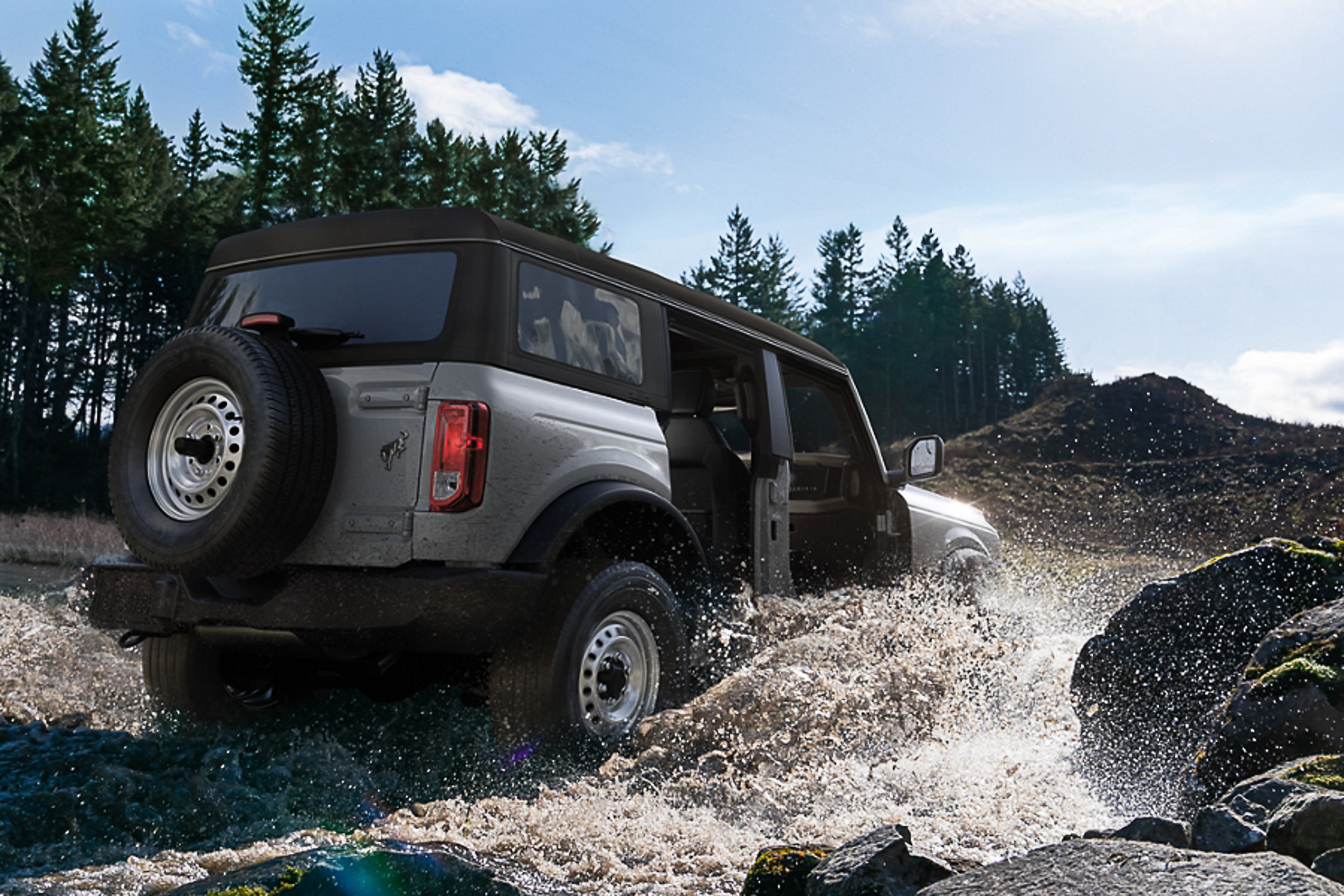
As well, the powertrains being offered in the Bronco – specifically a 2.3-litre EcoBoost four-cylinder turbocharged petrol engine and a 2.7-litre V6 turbocharged V6 petrol engine – would pass muster in with Australian customers; we can, in fact, expect to see that V6 feature in the next Ranger.
All the hard work around emissions engineering, suspension calibration and the like would have been done for the left-hookers, so mirror-engineering a new centre console and swapping the mirrors over shouldn’t be that hard to do. Right?
Well…
While the specs of the US Broncos are impressive, we’re still talking about a vehicle that calls only the Jeep Wrangler a foe – and such a dedicated off-roader is simply not likely to sell in the volumes that Ford would need to offset the cost of engineering the Bronco in right-hand-drive.
As well – and despite the now-superseded ‘One Ford’ program the company instigated late last decade that partly sounded the death knell for the Falcon and Territory – there are just not enough right-hand-drive markets left in the world for Ford to sell the Bronco into in sufficient volumes.
The Bronco would, in my view, dovetail in well with the Ranger-centric product mix in Australia, but could it sell enough of them to make a proper go of it?
Given the perilous state of the economy, the relatively high specs of the off-road versions and the potential for exchange rates to tank, the Bronco may end up simply pricing itself out of contention – and something that their rivals at Jeep can no doubt tell them all about.
It’s a double-edged sword for the local outfit which, without the Ranger, would be in all sorts of trouble on the sales front.
The Bronco would certainly add sparkle to a local roster that could really use it, but it’s not a decision that’s in their hands… despite the fact that the Bronco was engineered and tested here!
The appointment of Andrew Birkic, who is currently the chief product marketer of Ranger and Everest, as president and CEO of Ford Australia and New Zealand, could be interesting, though.
He would be uniquely placed to see how the Bronco could dovetail into Australia’s new car market, which looks vastly different than it did even ten years ago.
As it stands, we understand that Broncos are winging their way to Australia via private importers, who will do the hard work of converting them to right-hand-drive for local sale – at a considerable markup, if other converted imports are any guide.
The decision not to add a right-hand-drive Bronco was probably the correct one to make at the time the project was given the green light some five or six years ago… but I wonder if Ford is now starting to think ‘what if’?
What stands out?
The fourth-generation Hyundai Santa Fe is a seven-seat, road-focused SUV with sharp handling and a choice of engines – a fuel-efficient diesel and powerful V6 petrol. It is well suited to long journeys, and comfortable for families who like to get out of town. Some Santa Fes drive all four wheels, and all come with autonomous emergency braking and have excellent phone connectivity.
Something newer…
STORY CONTINUES
What might bug me?
Trying to fit luggage belonging to all seven occupants into the tiny boot space with the third row in use.Copping a speeding fine because the speed limit display on the satellite navigation and head-up display, in the Elite and Highlander, is out of date or doesn’t consider variable speed zones.That the Santa Fe’s head-protecting, side-curtain airbags do not extend to passengers in the third row of seats.
What body styles are there?
Five-door wagon only.Diesel Santa Fes use an on-demand AWD system, which optimises fuel consumption. They drive the front wheels all the time, and distribute power to the rear wheels when that’s helpful. To improve performance at slow speeds in slippery going, you can lock-in 50-50 power distribution to the front and rear wheels by pressing a button on the dash. Petrol Santa Fe versions drive the front wheels only.The Santa Fe is classed as a large SUV, lower priced.
What features does every Santa Fe have?
- Adaptive cruise control, which automatically matches the speed of a slower car ahead on the highway and resumes your set speed when the way is clear. It also has a ‘stop and go’ feature that holds your place in stop-start traffic, halting and restarting the car as required.)
- A reversing camera, and rear parking sensors.
- Automatic transmission.
- Support for Apple CarPlay and Android Auto, which lets you display mapping and other apps from a compatible smartphone on the car’s touchscreen, and control them from there.
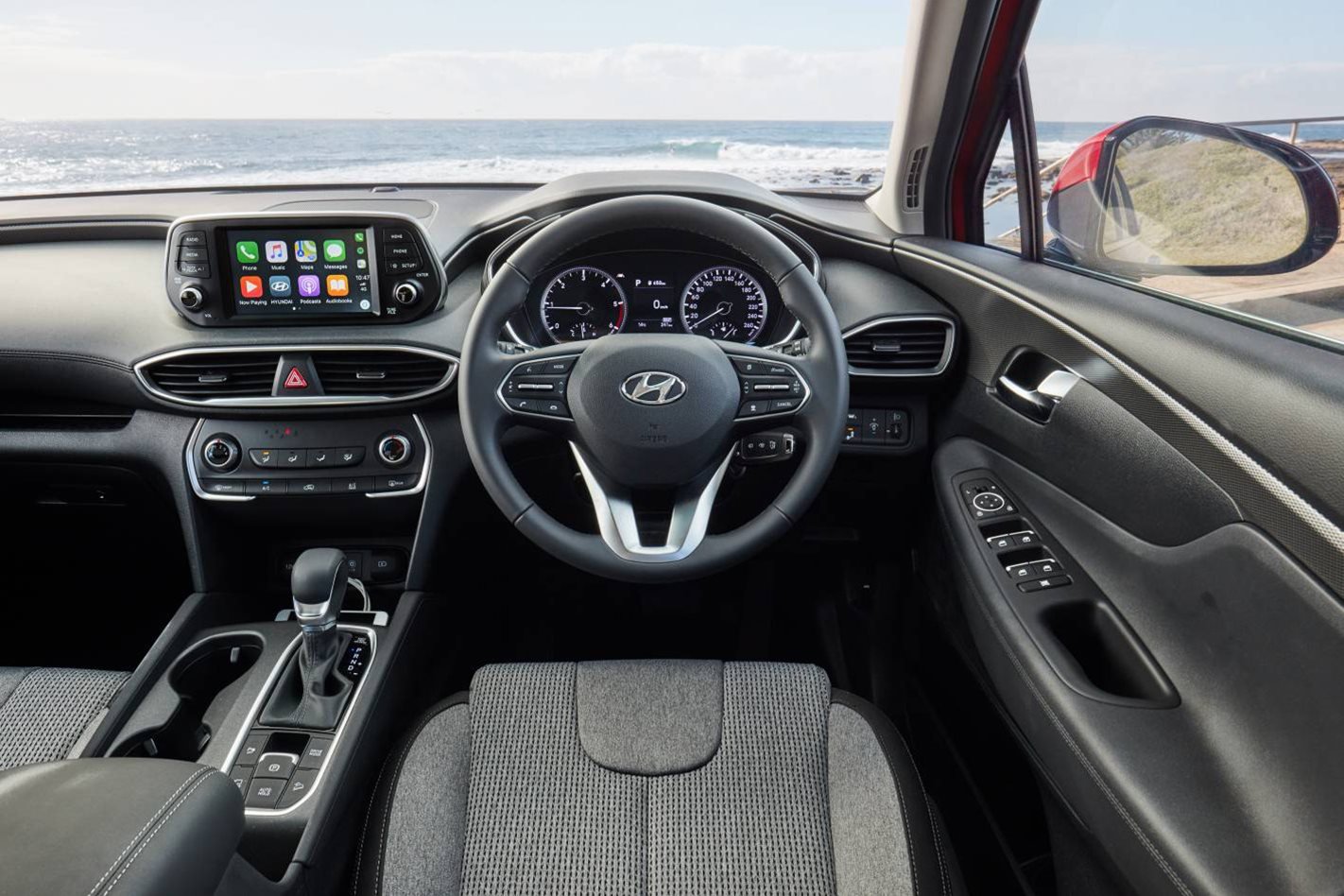
- A sound system with an AM/FM radio, Aux and USB inputs, Bluetooth phone connectivity and audio streaming, and at least six speakers, controllable from a colour central touchscreen.
- Broadly effective autonomous emergency braking, as part of Hyundai’s SmartSense active safety suite – which also brings you a lane keep assist, blind-spot detection, driver attention warning and a rear cross-traffic alert.
- Headlamps that come on automatically at night or in a tunnel.
- Automatic high-beam assist, that dips the lights in built-up areas and for oncoming traffic. LED daytime running lights, and front and rear fog-lights.
- A leather-clad steering wheel, from which you can operate the cruise control and audio system. (If you have a compatible smartphone plugged in, you can also switch on voice control from the wheel.)
- Air-conditioning with rear temperature controls.
- Electric switch on second-row backrests for one-touch flip-and-slide access to the third row.
- Aluminium alloy wheels, which are lighter than steel wheels and don’t need plastic trim, and a matching full-sized spare wheel.
- Adjustable drive mode with four settings including Eco, Comfort, Sport and Smart that alter steering weight and engine revs accordingly.
- Hill-start assist.
- Roof rails
- Six airbags. Anti-lock brakes, and electronic stability control – which can help control a slide or skid. (For the placement of airbags, and more on Santa Fe safety features, please open the Safety section below.)
Which engine uses least fuel, and why wouldn’t I choose it?
Each version of the Santa Fe comes with a choice of two engines, a 3.5-litre V6 petrol engine, and a 2.2-litre turbo diesel. There was a 2.4-litre four-cylinder petrol engine available with the Active version, but this was deleted from the range in December 2019 for the 2020 model year.The diesel is the most fuel-efficient and uses 7.5 litres/100km in the official test (city and country combined). In real-world driving you might not match this figure, but you could get close if you drove gently and did plenty of country trips.The main reason you would not choose the diesel is that it adds about $3000 to the price of a Santa Fe, though it is worth noting that this price includes all-wheel-drive traction.Another reason is that you prefer more power. Santa Fes with the petrol V6 are quicker than diesels, but they are also thirstier. On the official test, the V6 consumes 10.6 litres/100km. In the real world, expect to average 13-14 litres/100km over a mix of city and country driving.The V6 petrol Santa Fes are front-wheel-drive only.All Santa Fes come only with an eight-speed automatic gearbox.Power outputs and all other specifications for each Santa Fe can be reached from the Cars covered carousel near the top of this review.
What key features do I get if I spend more?
All four Santa Fe versions come with the 3.5-litre V6 petrol engine and front-wheel drive as standard, with the all-wheel drive diesel powertrain costing about $3000 more.
The least costly Santa Fe is the Active, which has cloth seats, 17-inch alloy wheels, a 7.0-inch touchscreen, and all the features common to all Santa Fes.
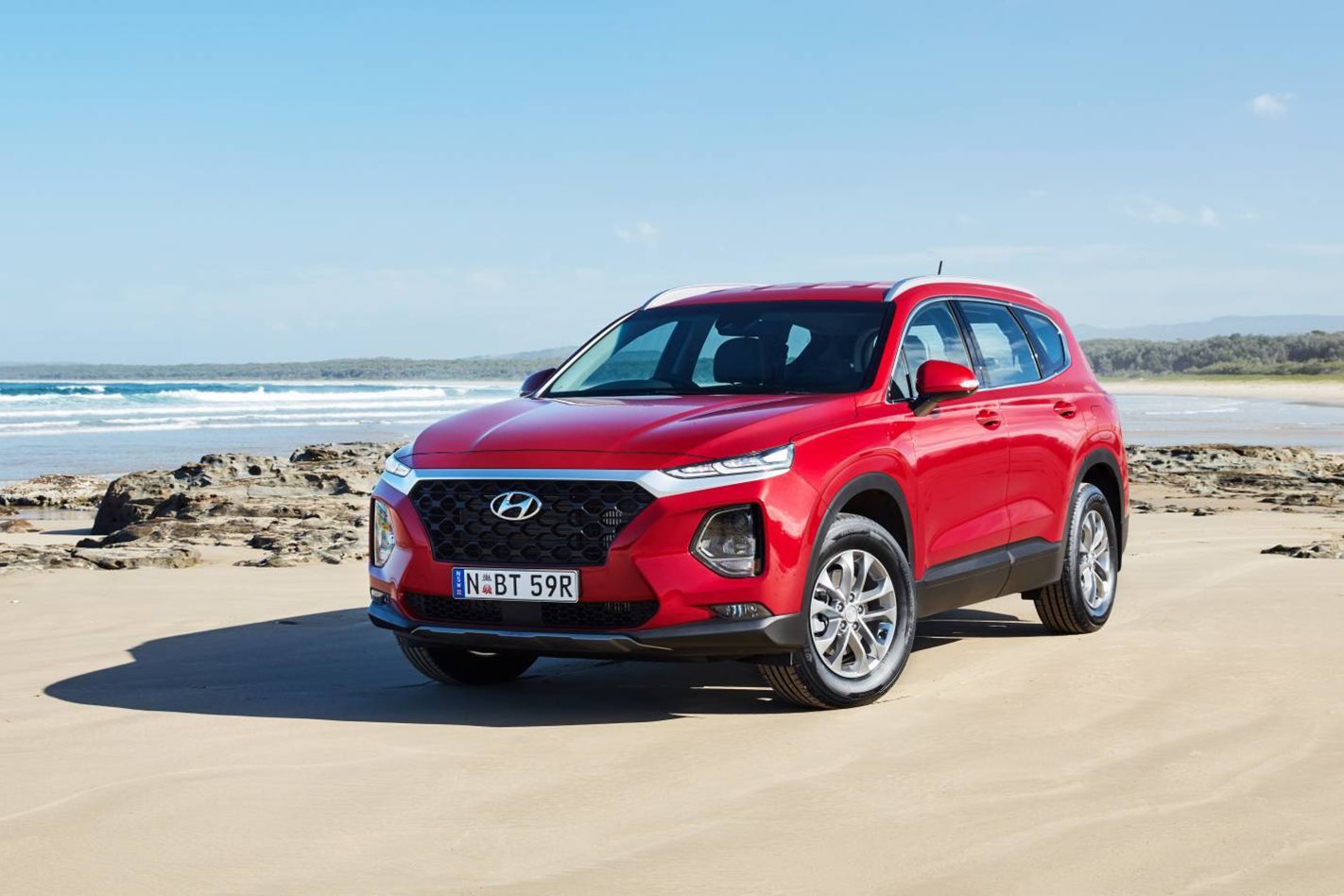
If you want more comfort you need to shell out for a Santa Fe Active X, which brings:
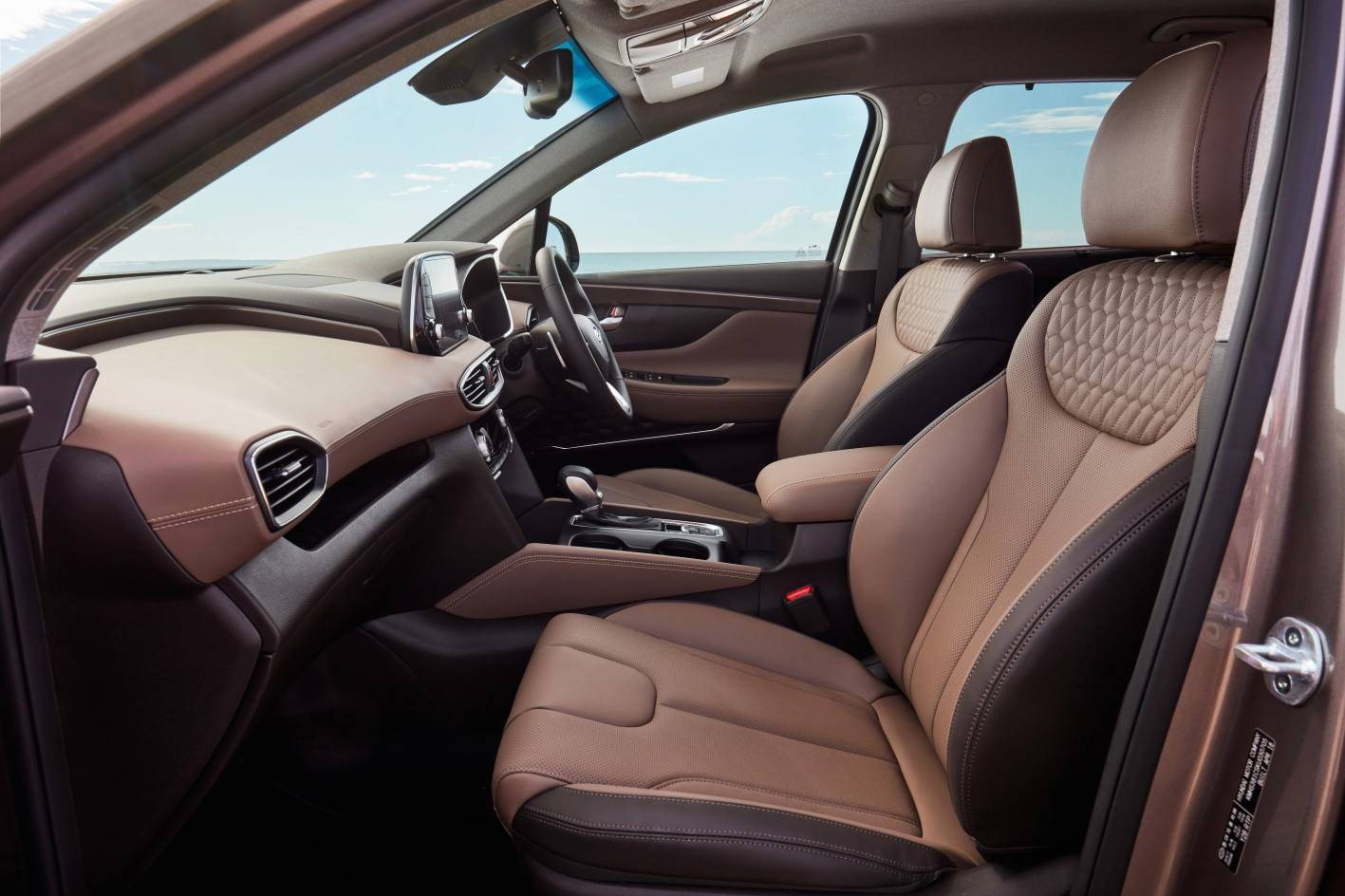
- Leather-appointed interior trim.
- Bigger 18-inch alloy wheels.
- Front parking sensors.
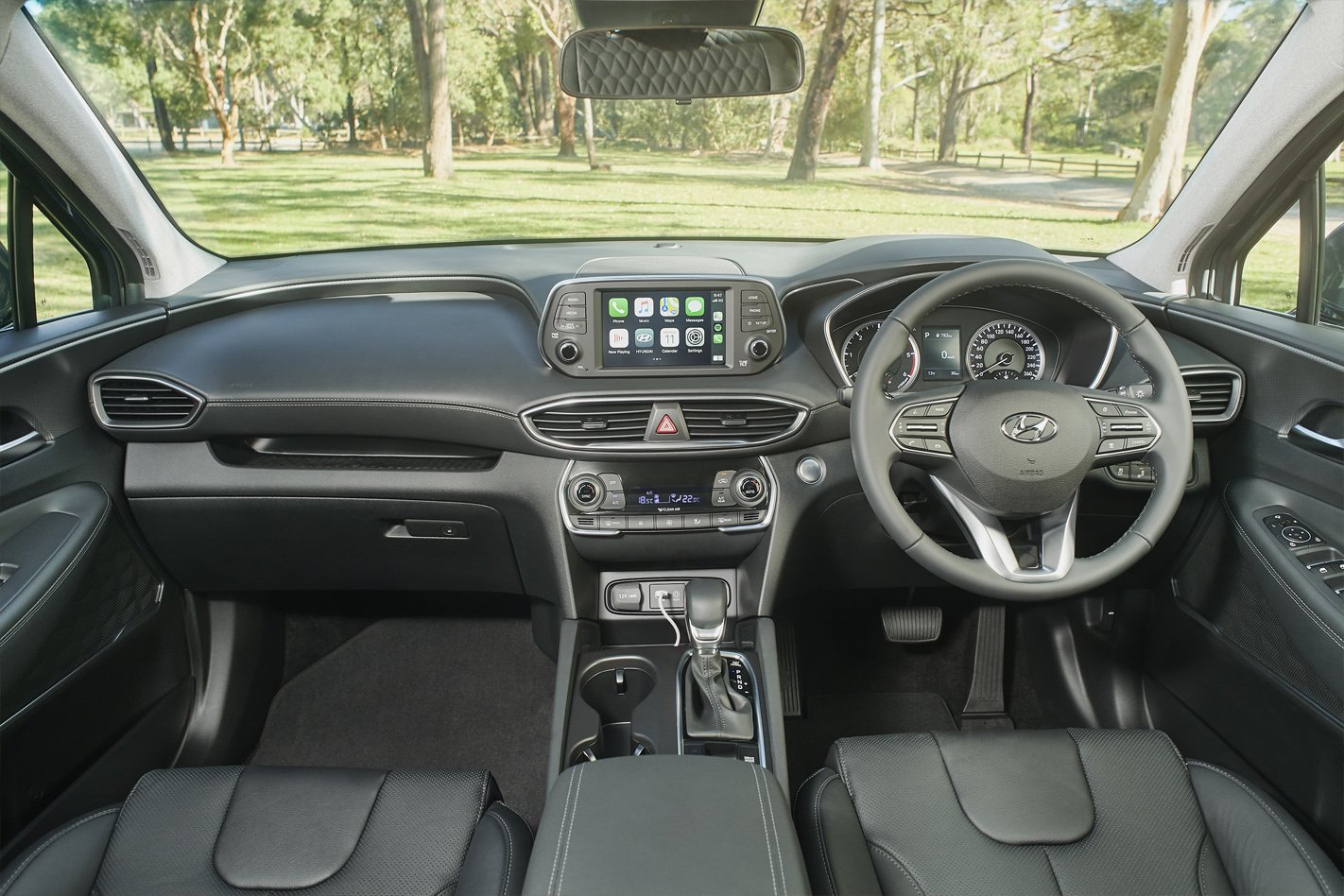
- Smart key with push-button start.
- Dual-zone climate control with automatic defog.
- Glovebox compartment cooling.
- Rain-sensing windscreen wipers.
- Puddle lamps integrated into exterior mirrors.
- Power folding exterior mirrors.
- Heated and power-adjusted front seats – with 10-way settings for the driver’s seat, and 8-way for the passenger.
- A bigger 8.0-inch touchscreen.
- DAB+ digital radio.
- Satellite navigation that does not depend on your phone.
- Power-operated tailgate that unlocks and rises automatically if the key is nearby for three seconds.
- 10-speaker sound system with external amplifier and a bass-boosting sub-woofer.
- Blinds for the middle row seats.
- Steering wheel paddle shifters.
- A head-up display shows speed, adaptive cruise control and sat-nav information on the windscreen near your eyeline.
- 360-degree view parking monitor.
- Panoramic sunroof that covers the front and rear seats.
- Heated and ventilated front and outboard middle-row seats.
- Heated steering wheel.
- 14-way power adjusted driver’s seat including under-thigh cushion extension and memory settings that also recall the door mirror and head-up display position
- Sharper LED interior lighting.
- Wireless charging pad for compatible smartphones.
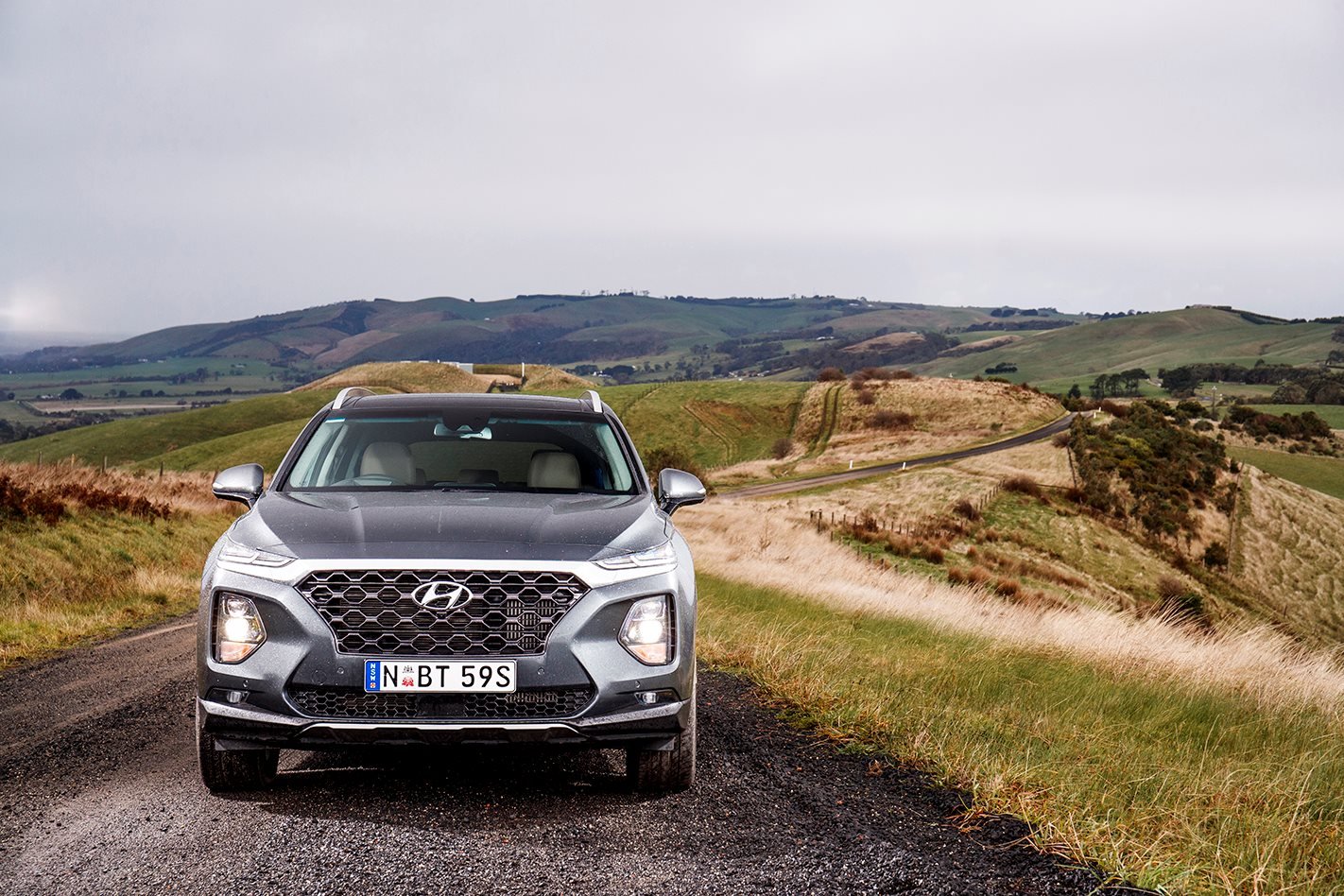
- Extremely bright HID headlamp units that shine into corners.
- LED tail-lights and front-fog-lights.
- A self-parking system can automatically steer the car into or out of a space while the driver controls the throttle and brake.
Does any upgrade have a down side?
The steps up in wheel size – from 17-inch on the Active to 18-inch on the Active X and Elite and 19-inch on the Highlander – reduce ride quality slightly, because the lower profiles of the bigger tyres leave less air between the wheel and the road.White Cream and Stormy Sea are the only standard colours, with the other seven costing extra.
How comfortable is the Santa Fe?
Any Santa Fe looks elegant inside, with well-crafted interior that’s a big improvement over its plasticky predecessor. The overall interior design errs on the side of conservatism but gives a strong impression of quality. The seats feel plush, with the front seats offering long bases under your thighs.The driver’s seat adjusts for height, and has power-adjustable lumbar (lower back) support in all versions, with power settings in the Active X, Elite and Highlander.
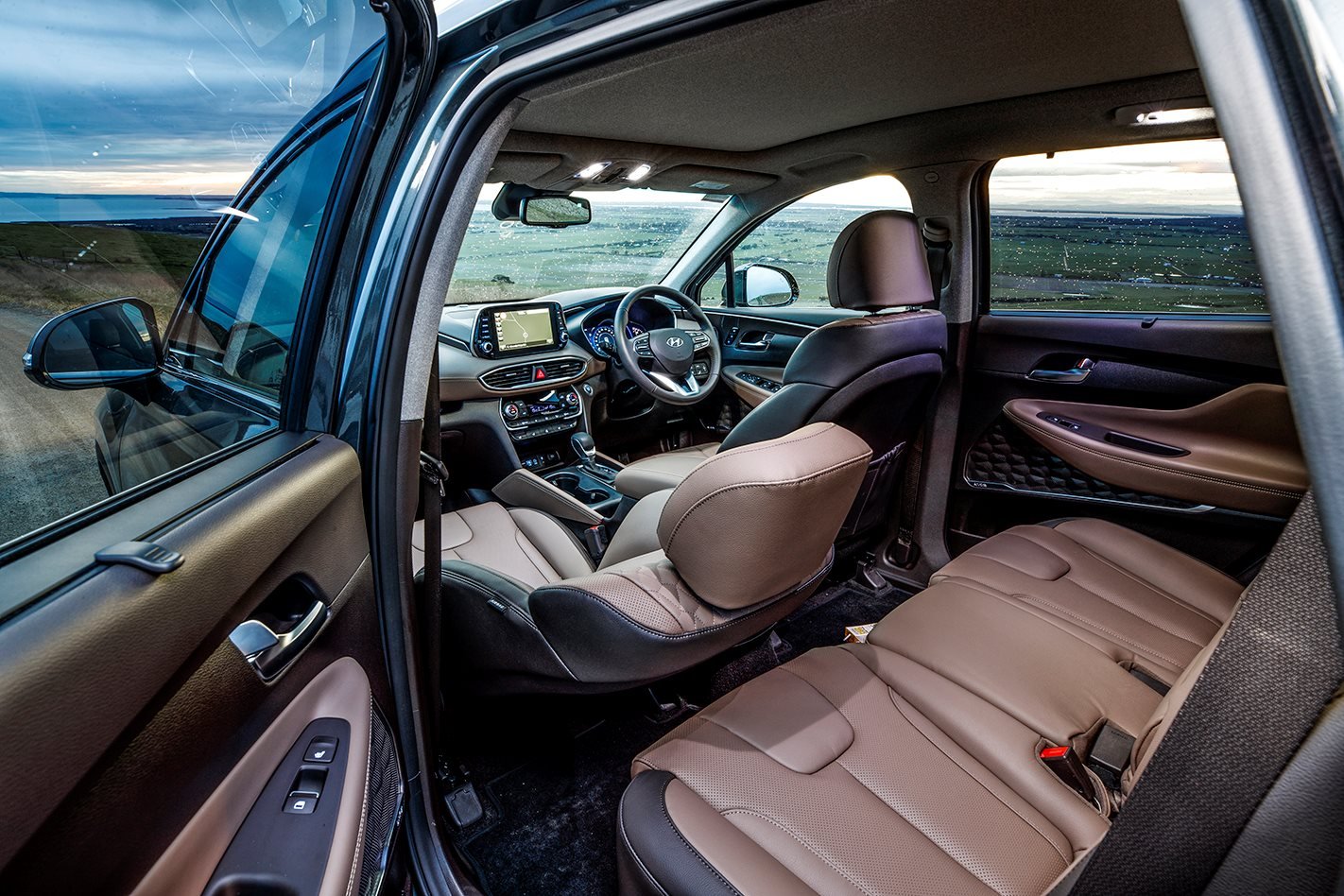
A pleasing mix of textures and stitching lift the new Santa Fe well beyond the Korean/Japanese norm, and even the entry-level Active’s cabin, with its cloth trim, holds some interest.
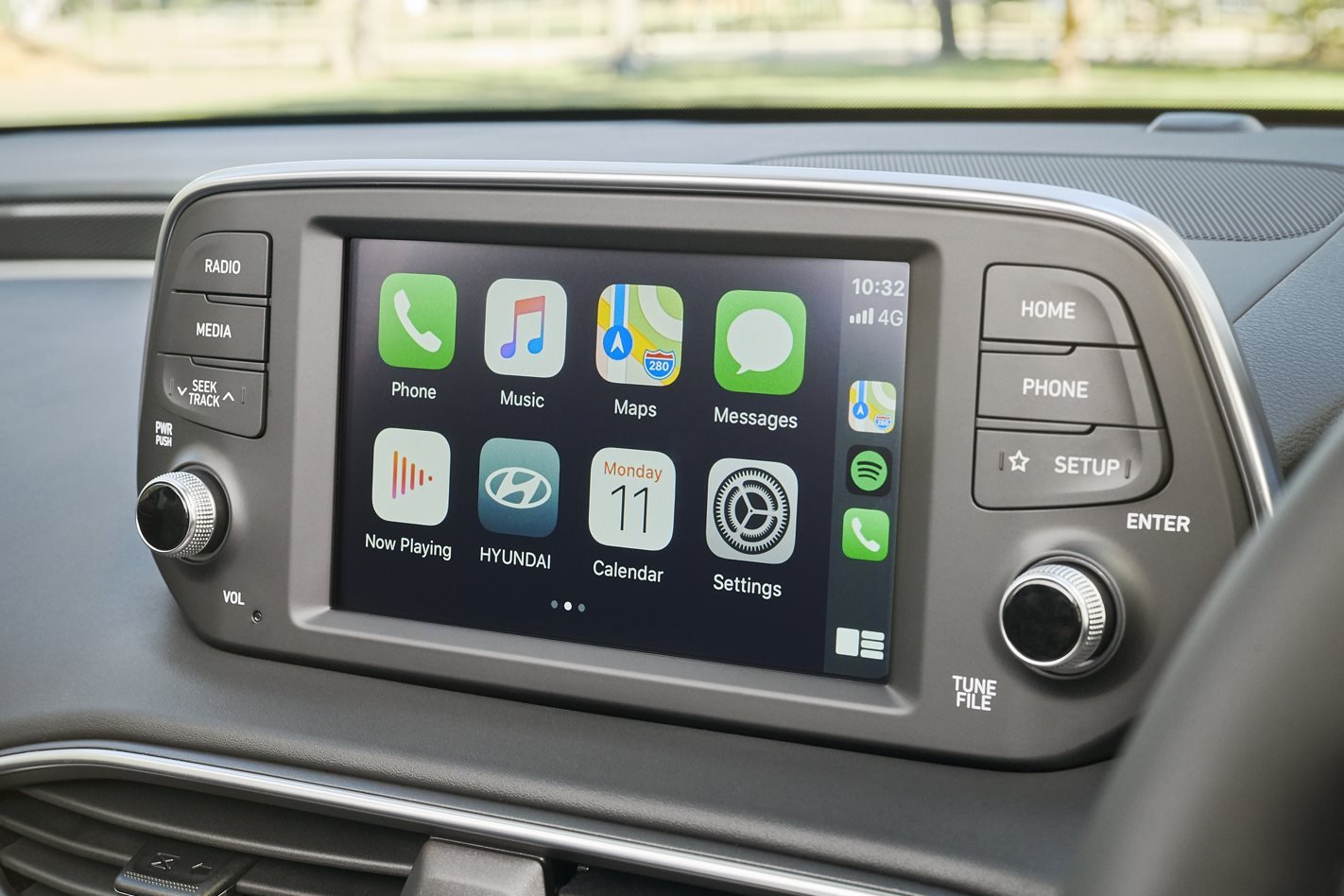
A deep storage compartment in the centre console has a removable shelf, and there is a big binnacle ahead of the gear lever with a 12v power outlet, and AUX and USB sockets. There is also a handy shelf above the glovebox for the front passenger to place their own items such as phone and keys.On any Santa Fe you can plug in a compatible smartphone and operate several apps via Apple CarPlay or Android Auto – from maps to music and text messages – via the touchscreen or (if you’re driving) by voice. A button on the steering wheel lets you toggle the voice control system built into your phone.
What about safety in a Santa Fe?
Every Santa Fe has anti-lock brakes, stability control, seven airbags, LED daytime running lights, auto- headlights and wipers, a reversing camera, and rear parking sensors.In addition, all Santa Fes have Hyundai’s SmartSense active safety suite, which brings autonomous emergency braking and lane keep assist, blind-spot detection, driver attention warning and a rear cross-traffic alert.The auto-braking on Santa Fes is a broadly effective system that draws on radar and camera sensors and (Hyundai says) can detect pedestrians. If it predicts a collision with an obstacle in front (typically a sharply slowing car), it sounds and flashes a warning. If you ignore that, it will brake the car automatically. At speeds under 80km/h it will brake very sharply; at speeds in the range 80-180km/h, less sharply – but you can of course apply maximum braking yourself.There are two airbags at the front for frontal impacts; one outside each front-seat occupant to protect the body in side crashes; and a curtain airbag down each side to protect heads in a side impact. The side-curtain airbags cover only passengers in the front and second-row seats, however. No one riding in the third row has airbag protection.Rear Occupant Alert lets you know if someone has vacated one of the second or third row seats before you drive off without them, while Safe Exit Assist warns you of any oncoming traffic as you exit the Santa Fe.The Australasian New Car Assessment Program (ANCAP) has yet to assess the fourth-generation Hyundai Santa Fe.
I like driving – will I enjoy this car?
The Santa Fe achieves a pleasing level of dynamic agility for an SUV this size.The chassis is much more compliant than the previous model’s and the new rack-mounted electric power steering and standard (on-demand) all-wheel drive combine with extensive Australian suspension tuning for a much more well-rounded driving experience – one that now manages to achieve both ride and handling adeptness, without one being detrimental to the other.
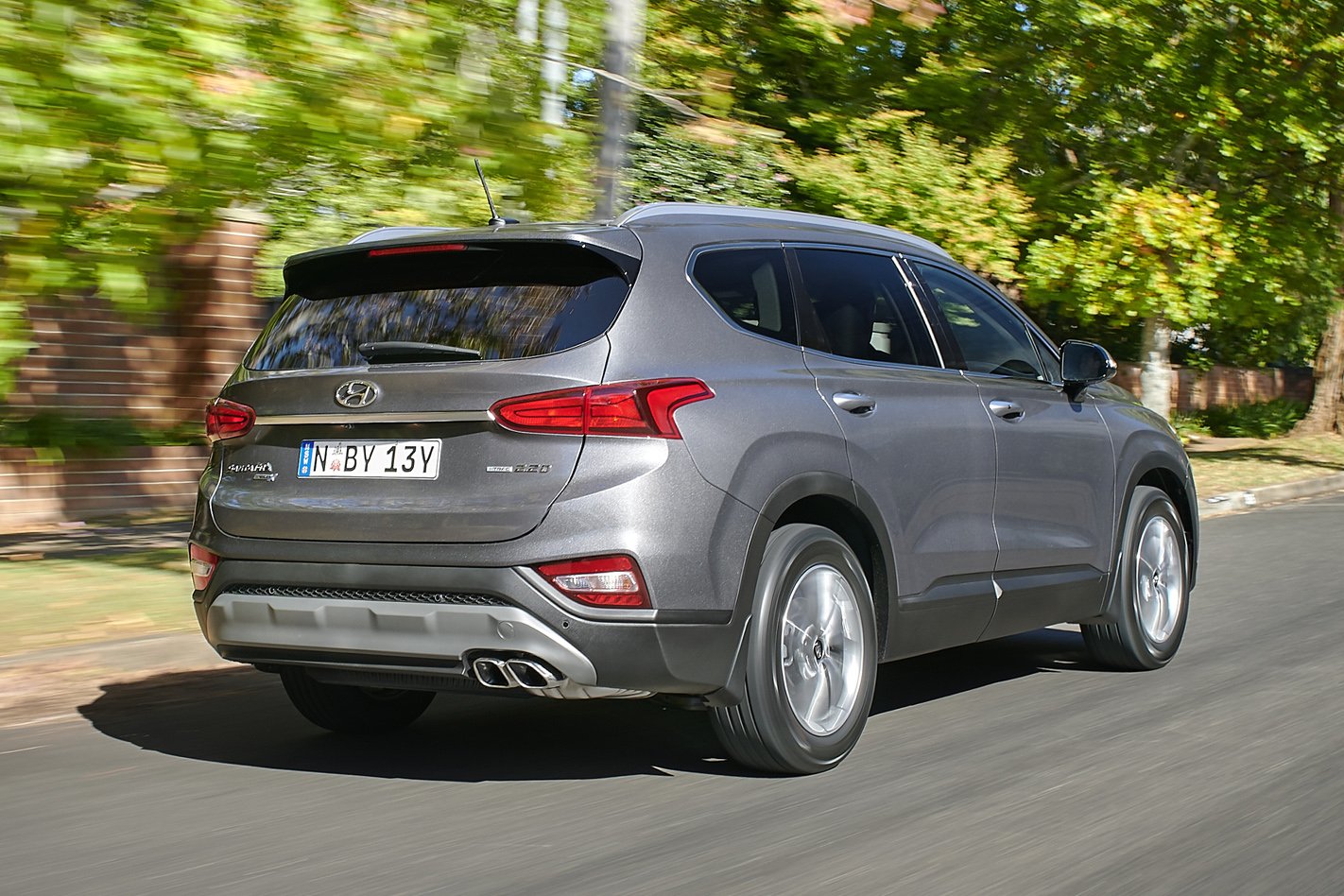
The 2.2-litre turbo-diesel is also carry-over, but the eight-speed automatic transmission is new making this powertrain a far better match for the Santa Fe, with seamless gear shifts and a decent 440Nm of torque. It has great punch, especially in Sport mode, which makes overtaking easy.All Santa Fes drive all four wheels, but the on-demand all-wheel-drive is more about better traction on slippery surfaces (such as snow or gravel) than tackling rugged trails. If you do get off the beaten track, you have the security of a full-sized spare tyre.
How is life in the rear seats?
In the middle row it’s really good. A wide seat easily allows for three across it (that middle person will be perched higher, due to the shape of the outer seat cushions). There’s great headroom and plenty of room for big feet under the front seats. Little touches, such as the mild scalloping in the backs of the front seats, ensure good legroom too, and if you want even more you can slide the middle seats rearwards.The Santa Fe Highlander also has heating for the middle-row outboard seats, and mesh window blinds that will keep sunlight off a sleeping child.
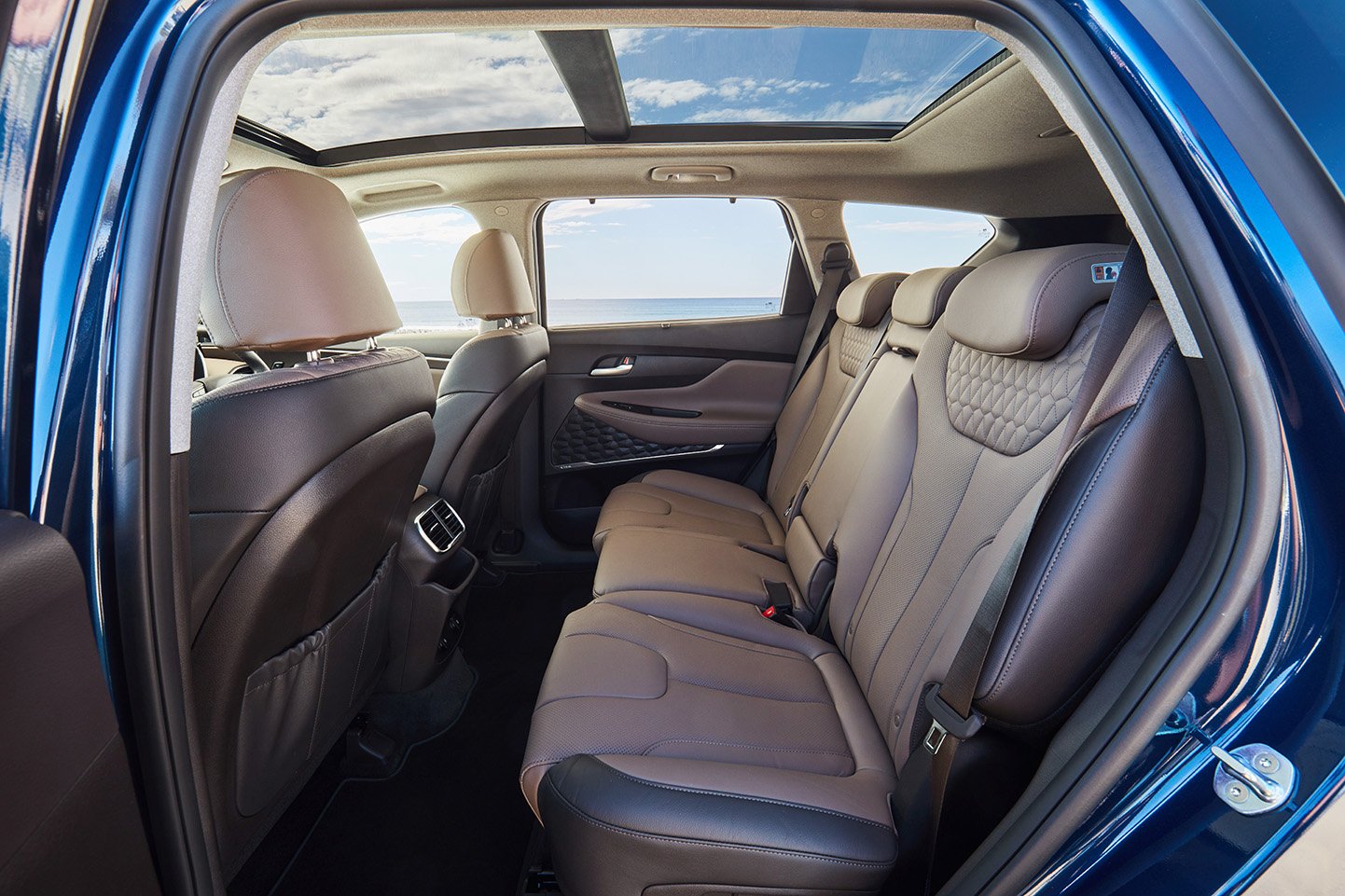
That third-row seat is much tighter for room than the second, but it’s an improvement over the previous models, with occupants no longer finding their heads underneath the tailgate glass.
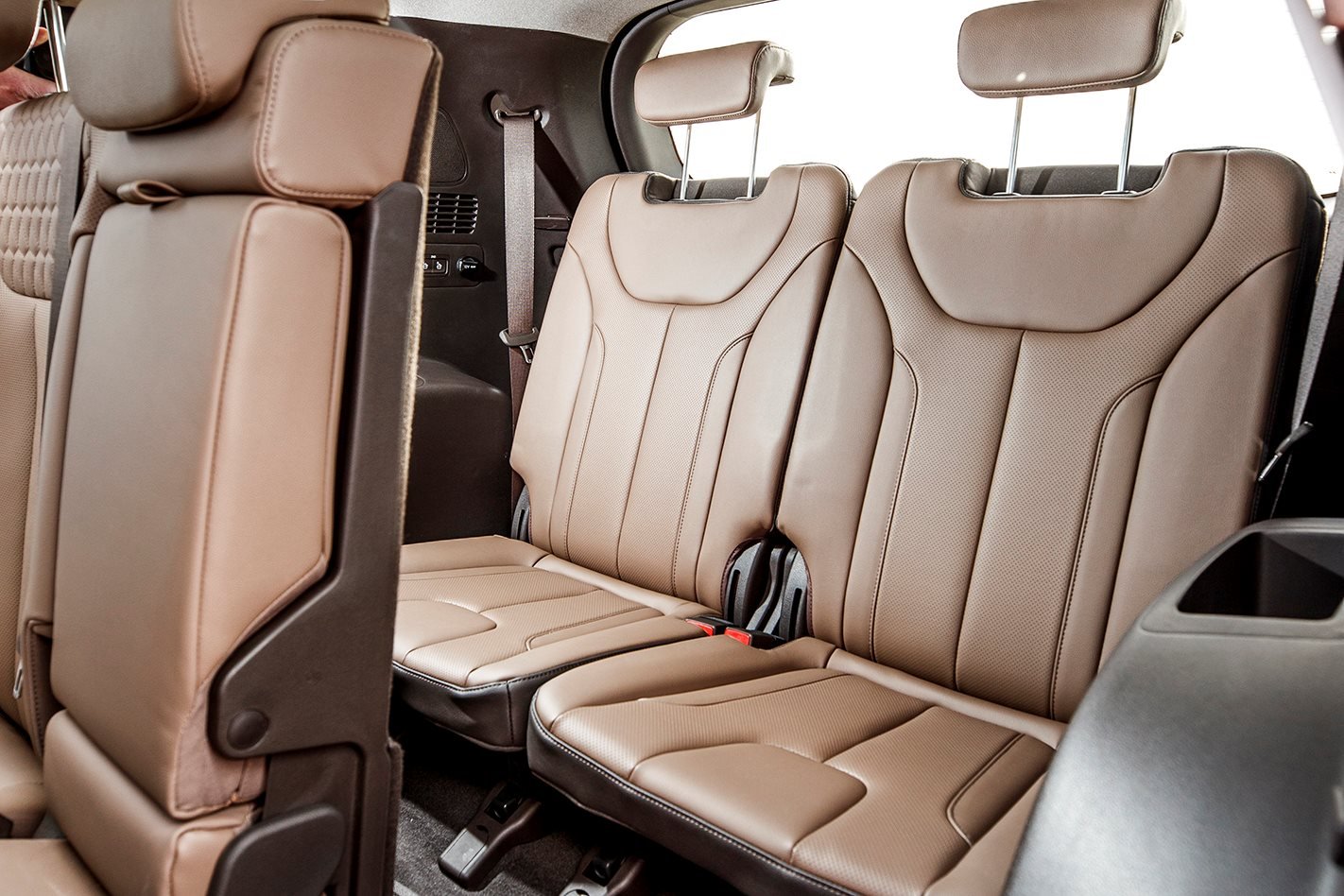
How is it for carrying stuff?
With all seven seats in use there is only 130 litres of boot space, which is less than a third of most small hatchbacks, and will fit a couple of soft bags. There’s some additional space under the floor for small items.
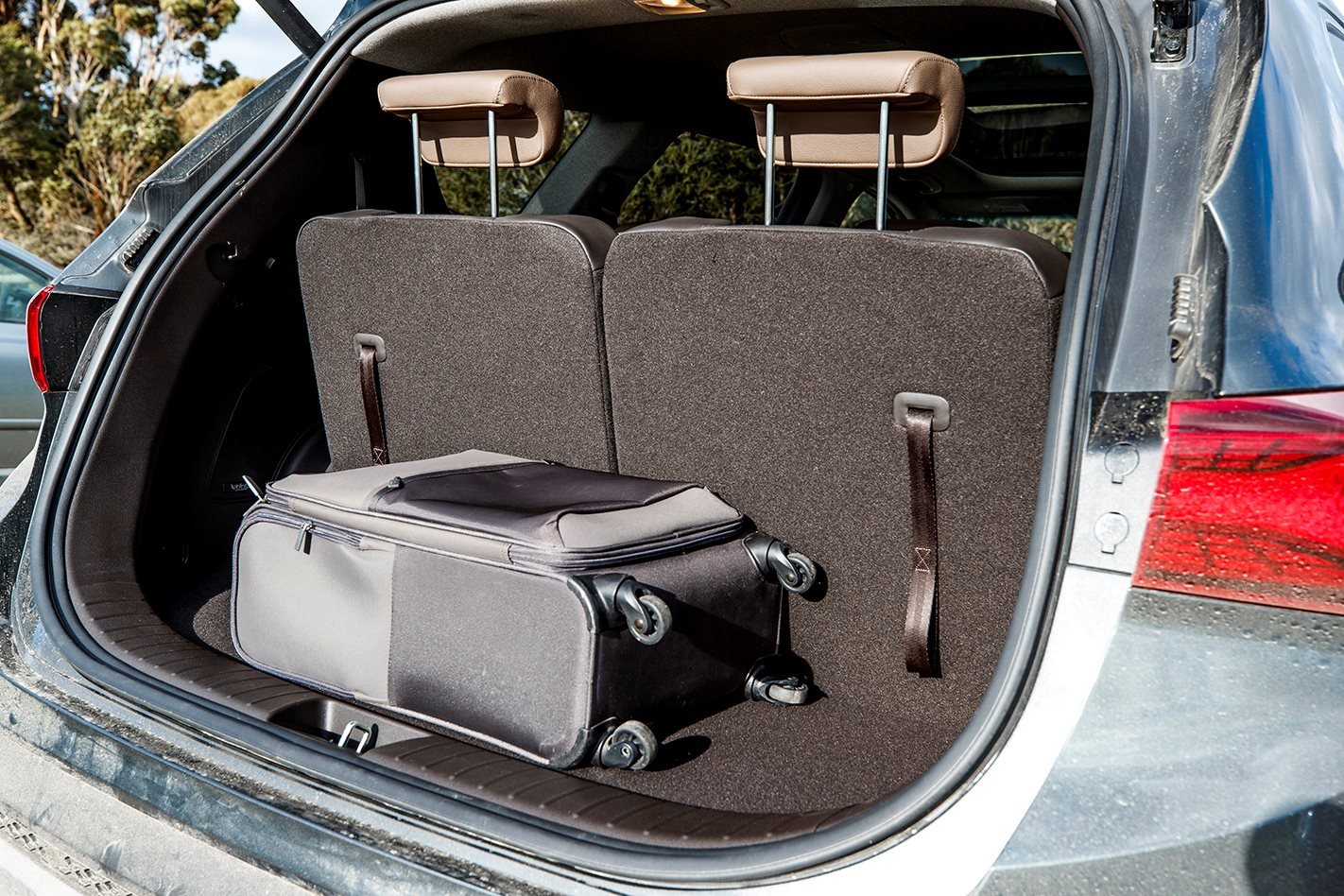
The middle row seats split-fold in a 40-20-40 configuration, which is great for flexibility. You can flip just the centre section, for example, to accommodate a long item, and still have two comfy outer seats. Pushing all the second-row backrests down brings a handy 1647 litres.The tailgate rises very high, so there’s no stooping to load stuff in the back. The Elite and Highlander have hands-free tailgates that add convenience when your arms are full of cargo.
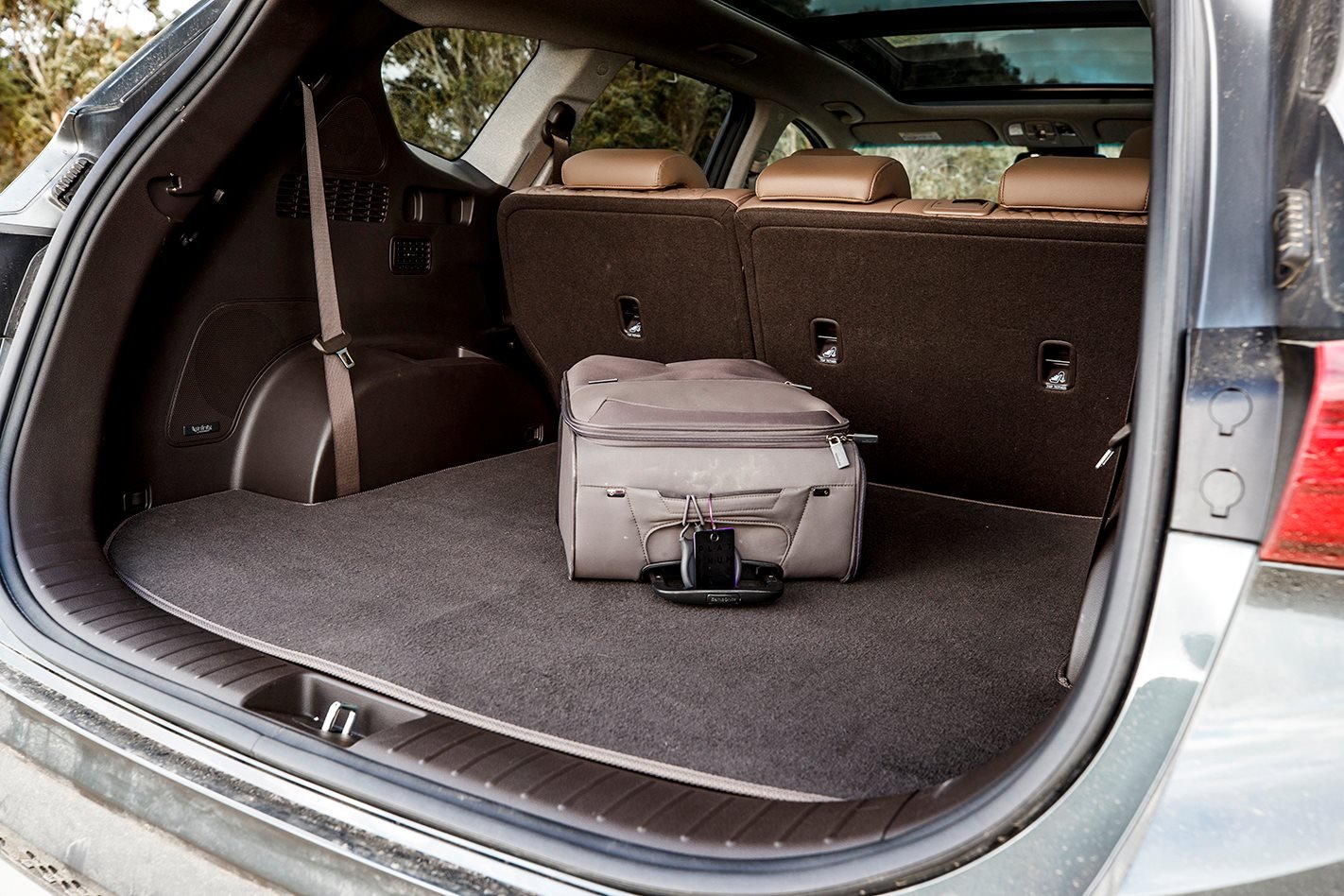
There’s no shortage of cabin storage, which includes a large centre console and nooks for the driver and front passenger, cup holders in all three rows, and door bins with bottle bulges at the front and back.
The Santa Fe can tow up to 2000kg and has a 100kg tow ball weight.
Where does Hyundai make the Santa Fe?
All Santa Fes are produced in South Korea.
What might I miss that similar cars have?
Curtain airbags that protect passengers in the third row of seats against side impacts – such as fitted to the Toyota Kluger, Mazda CX-8, Mazda CX-9, Nissan Pathfinder and Peugeot 5008.A more economical turbocharged petrol powertrain as in the CX-9 and Skoda Kodiaq.Among other seven-seat SUVs you might consider is Kia Sorento, which uses the same diesel and petrol powertrains as the Santa Fe as well as a 2WD petrol V6, and also shares many of the Hyundai’s infotainment and driving displays.
If carrying seven people in comfort is a high priority, and use off-tarmac is not, it could be worth taking a look at the Kia Carnival.
In contrast, if you would contemplate trading some on-road comfort and precision for the ability to tackle rough tracks off-road, you might want to look at the Ford Everest and the Toyota Prado or Toyota Fortuner, all of which offer seven seats.
Are there plans to update the Santa Fe soon?
The fourth-generation Hyundai Santa Fe arrived in July 2018, with plenty more cabin and driving refinement than the previous model, albeit with the same 2.4-litre petrol and 2.2-litre diesel engines as before.In December 2019 Hyundai dropped the lacklustre 2.4-litre petrol, which was only available in the entry-level Active version, and introduced the more powerful V6 that proved popular in the previous model’s Active X variant. Unlike before, the V6 was made available across the Santa Fe range.
In July 2020, Hyundai reintroduced the Active X variant that added some luxury extras to the Active spec.
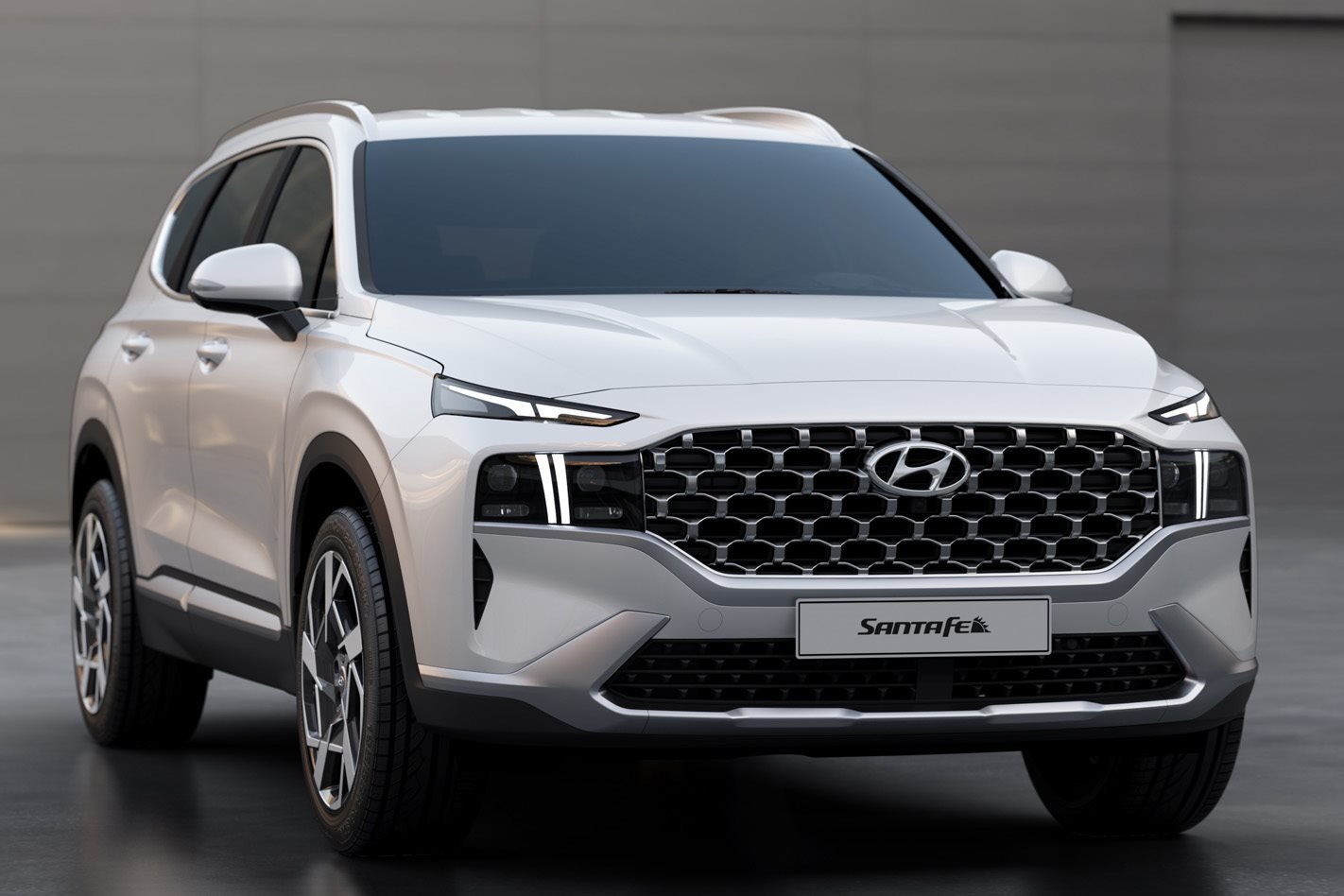
The fifth-generation Santa Fe (below) is expected to arrive in 2021 which will likely share features with the new-generation Kia Sorento.
I like this car, but I can’t choose which version. Can you help?
Any of the AWD diesel Santa Fes are a good bet, but the mid-spec Active X provides the sweet spot in terms of pricing and features, though spending $5000 on the Elite does bring some desirable extras.
The biggest motor race – and the largest single sporting event – of 2020 has finally succumbed to the coronavirus disaster that is sweeping the United States.
The Indianapolis 500, pushed out from its traditional May date to August 23, will run for the first time in its history in front of empty grandstands at the Indianapolis Motor Speedway, after organisers finally conceded that even quarter-full stands were not feasible as positive tests continue to rise in the towns and cities around the venue.
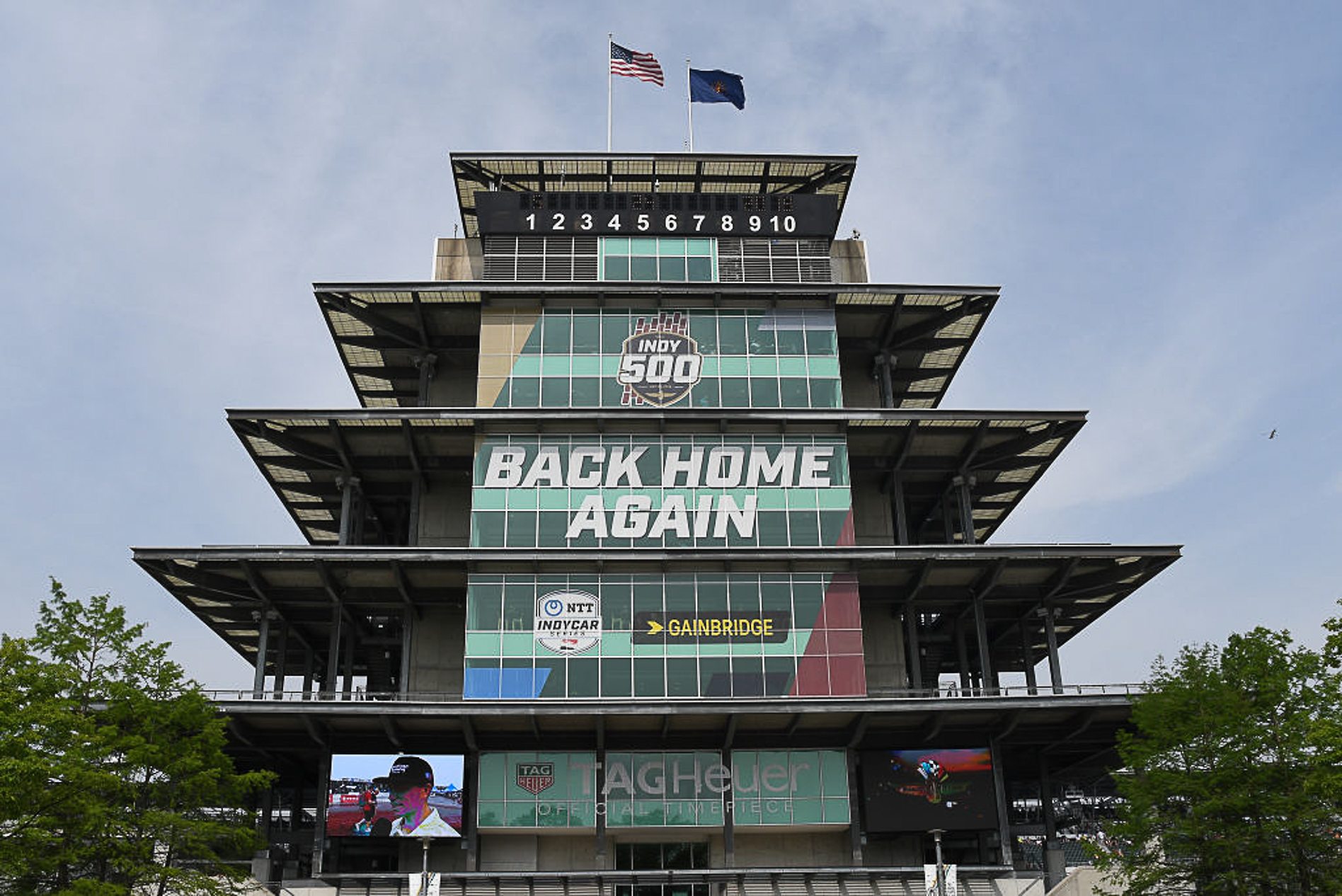
Previously, the track – recently purchased by auto industry doyen Roger Penske – has announced that it would run the event at 50 percent capacity, which would still have meant 175,000 people converging on the facility.
A further reduction to 25 percent in recent weeks has now been superseded by the call to shut the gates to IndyCar’s biggest spectacle.
“While hosting spectators at a limited capacity with our robust plan in place was appropriate in late June, it is not the right path forward based on the current environment,” an official release stated.
The move comes despite Penke’s pronouncement in early June that the event would not run at all if spectators couldn’t attend.
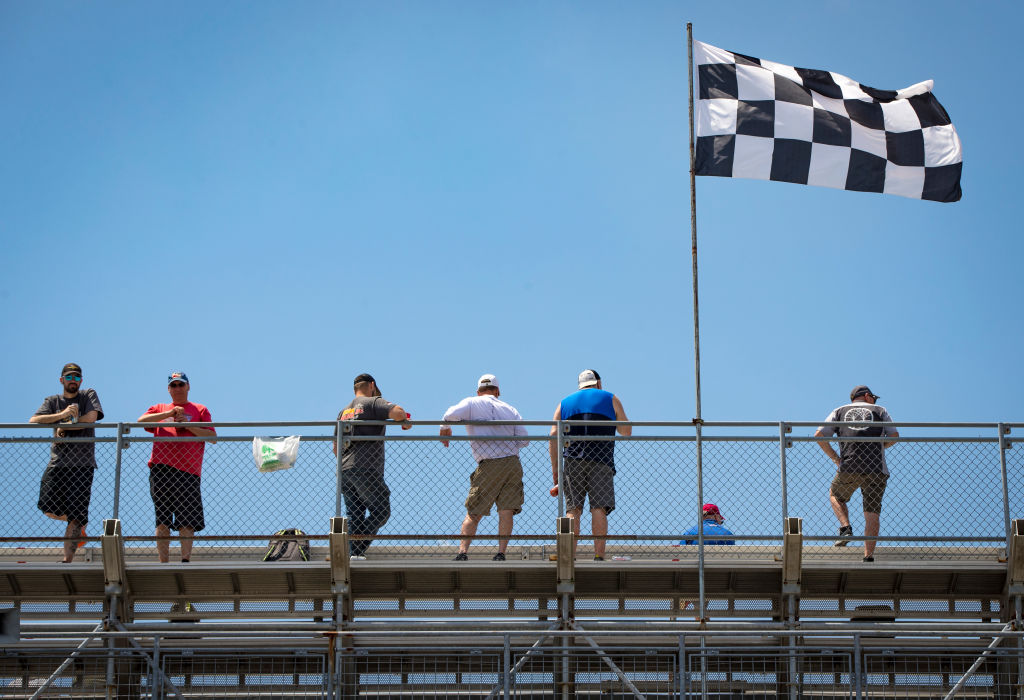
“We’re on for fans in August and planning on it and we feel good,” Penske told US site Racer at the time. “It’s still almost three months from now and I think we’ll be okay. But we will run it only with fans.”
However, the COVID-19 picture has not improved in Marion County, and the largest healthcare organisation in the state of Indiana had expressed its concerns about the viability of up to 350,000 people attending the event, despite the measures announced by the Indianapolis Motor Speedway.
This included a detailed 88-page COVID operations manual, masks and hand sanitiser for all ticket holders and enforced social distancing.
“We have concerns about the risks of infection beyond the scope of the IMS plan, including social gatherings, travel, restaurants, bars, accommodations and other event-related activities,” IU Health said in a statement.
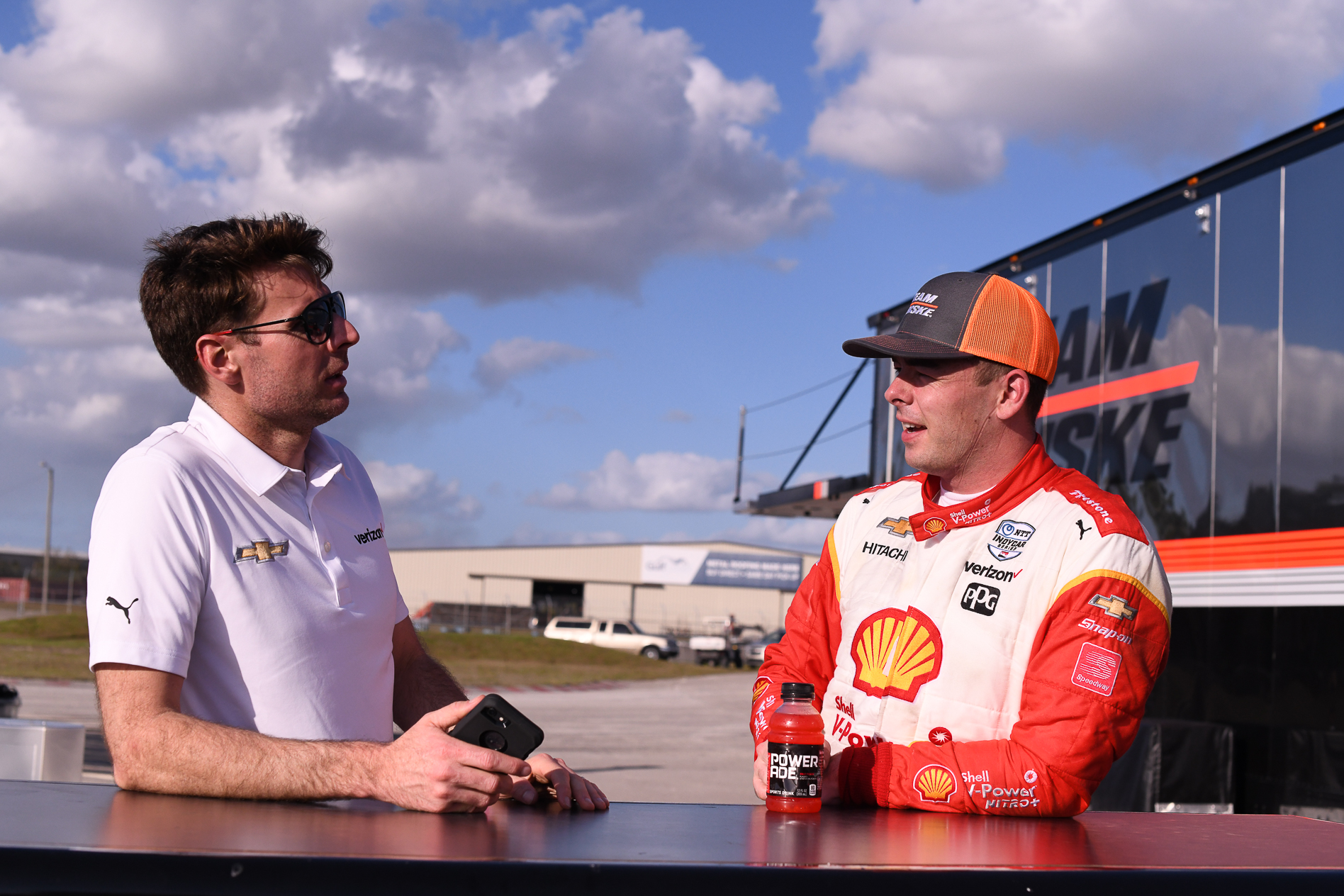
Despite the lack of fans, a full 33-strong grid of IndyCars is expected to take to the track in August, including former winner and series champion, Australian Will Power (below left), as well as multiple champion Scott Dixon from New Zealand.
The Indy 500 has only been cancelled six times since its first event in 1911. Those six cancellations came in 1917-18 and 1942-45 during the First and Second World Wars.
In the later 1990s Volkswagen almost started its own lineage of high-tech, mid-engine 12-cylinder supercars that would’ve taken on the best from Ferrari.
The story goes that in 1997 late VW overlord and mad scientist-cum-engineer Ferdinand Piech requested Giorgetto Giugiaro and his Italdesign team style a supercar to properly signal VW’s plans for world motoring sales domination.
The first of three versions of VW’s W12 concept was unveiled at the 1997 Tokyo Motor show sporting a mid-mounted 5.6-litre 12-cylinder in a brand new W configuration, two narrow-angle V6s attached to common seven-bearing crank. A fully functioning concept, it used double wishbone suspension all round, featured an active rear wing and sent its 309kW through VW’s Syncro all-wheel drive system, another of Piech’s original ‘musts’ of the concept brief.
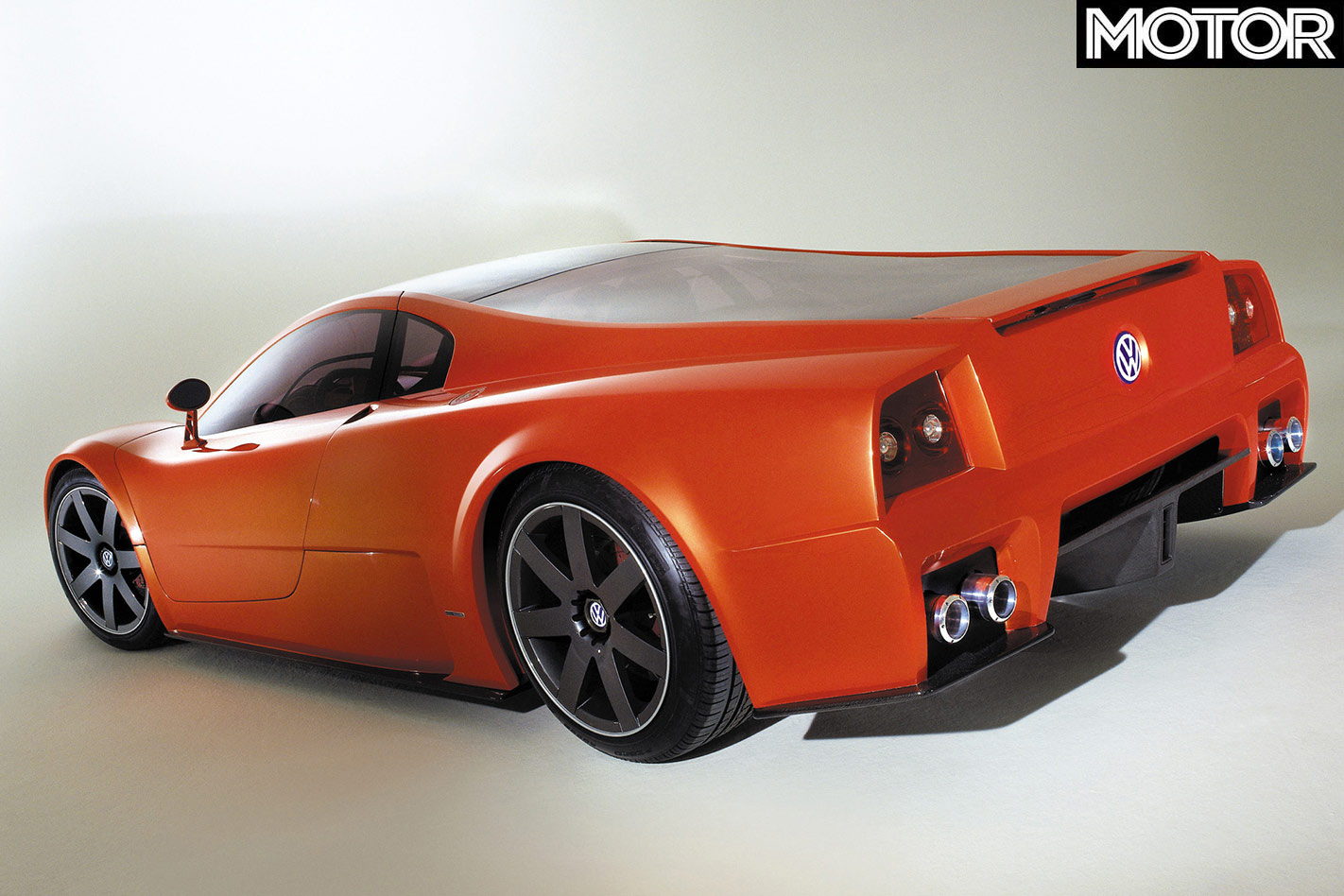
In 1998 a roadster version was unveiled but this time rear-wheel drive, which would later also be used in the final W12 concept iteration, the famed Nardo pictured above.
Revealed in 2001, the Nardo saw an increase to 6.0 litres in engine capacity, power also hiking to 441kW. The sequential auto of the previous concepts was replaced with a six-speed manual. VW claimed the Nardo could do 0-100km/h in as low as 3.5 seconds but proved its top speed of 357km/h at the track it earned its name in Lecce, Italy. In fact, over 24 hours and using a crack team of Le Mans drivers, the Nardo broke multiple speed records including most distance covered (7901km) and highest average speed (322.8km/h).
The W12 sadly never entered production, but spawned a family of engines that would power everything from Bentleys, VWs and Audis. But also it helped VW prove to itself and the world it was capable of attempting a properly ambitious supercar program – and would later give rise to the mightiest of them all, the Bugatti Veyron. For that car we’ve the W12 to thank and the Nardo especially.
2001 VW Nardo W12 specs Engine: 5998cc W12, DOHC, 48v Power: 448kW @ 7000rpm Torque: 620Nm @ 5800rpm 0-100km/h: 3.5sec (claimed) Price new: Erm, POA
