
What is it?
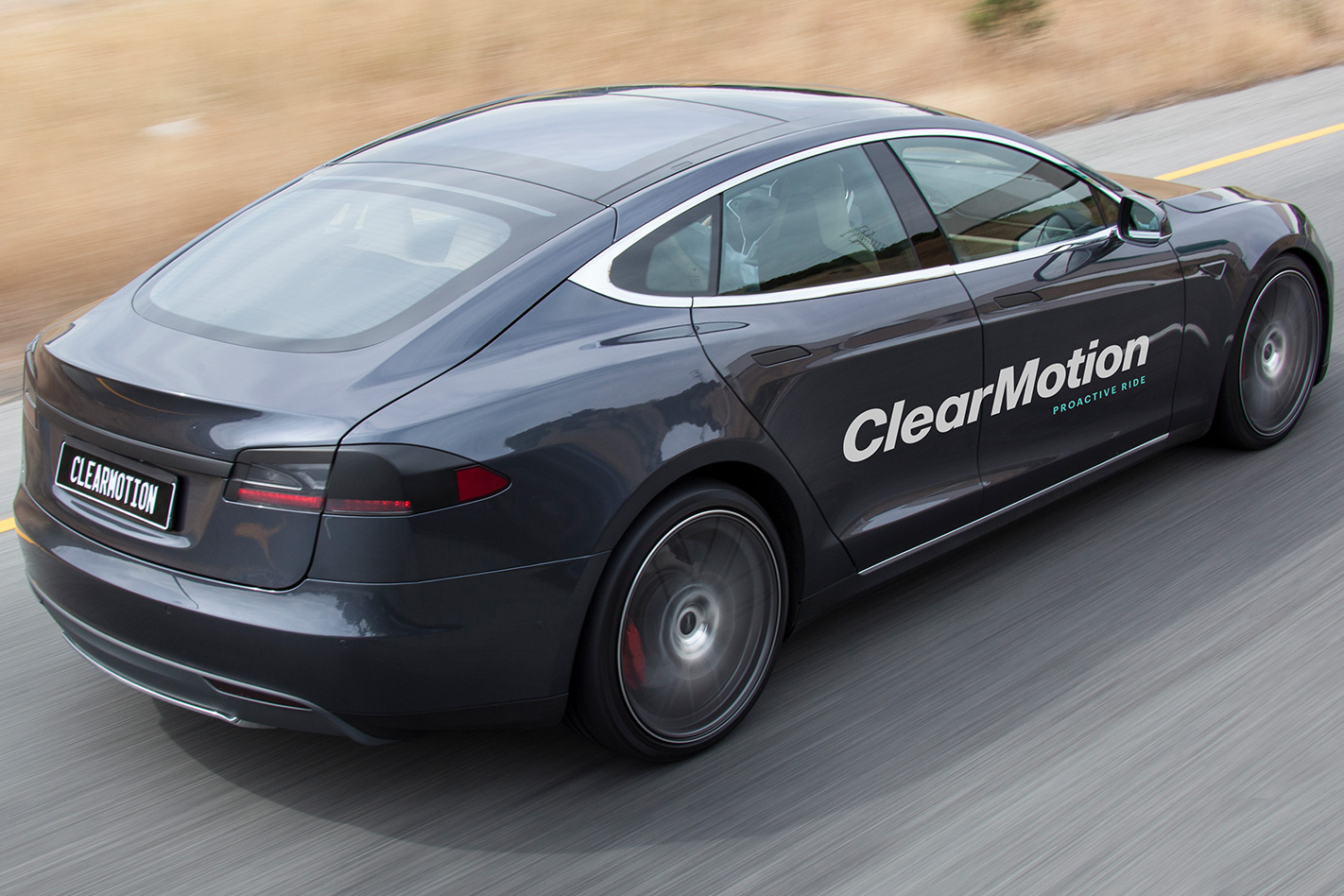
Remember the Bose Ride suspension innovation that broke cover in 2004? Clearmotion bought that technology and is picking up where the consumer electronics company left off. Thanks to a fully active (‘proactive’) damper, the system gains a new level of control over wheel movement to deliver what is claimed to be an eerily smooth ride. The company has about US$100m invested in advancing the idea with its sights set on commercialising the technology for production cars.
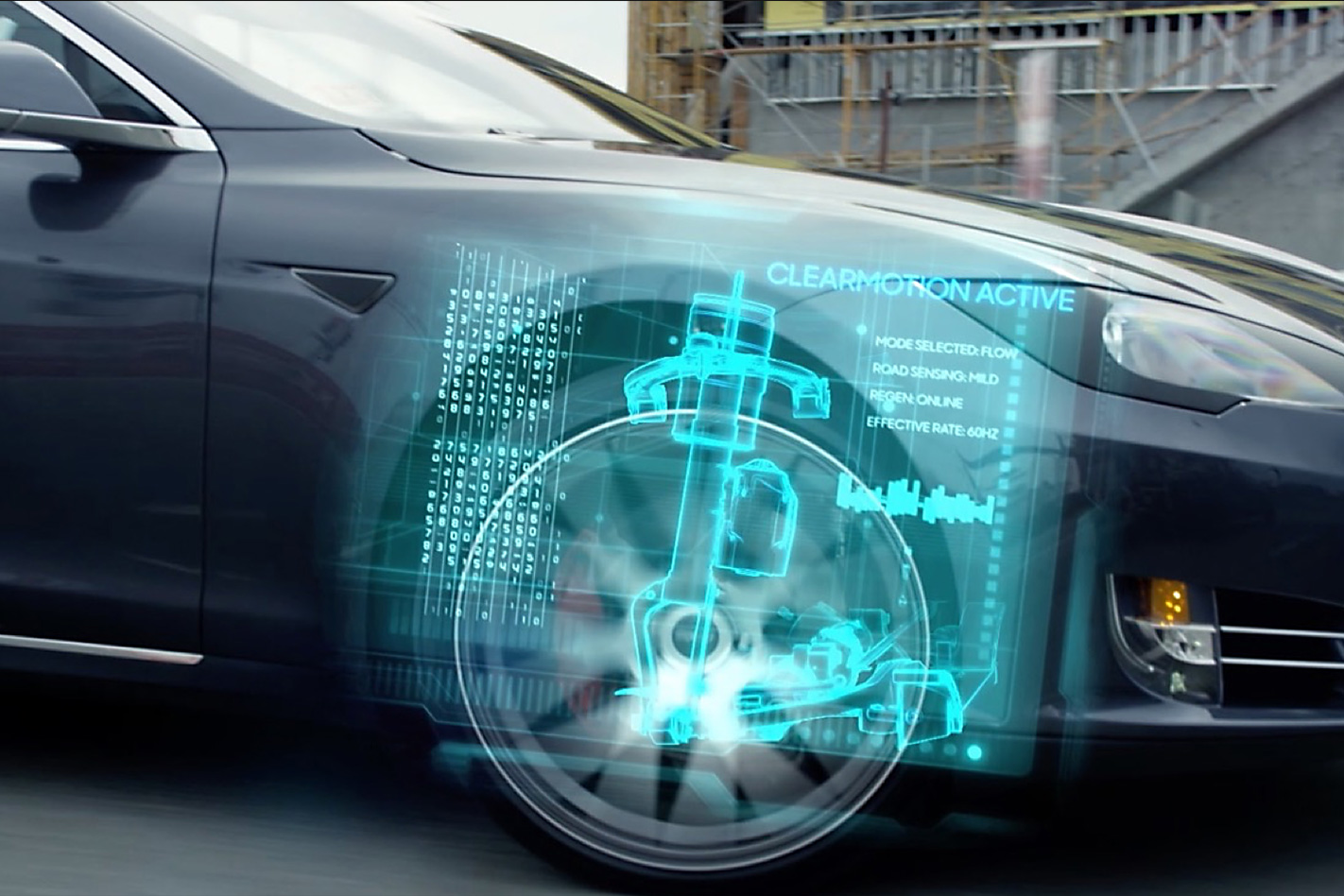
Unlike Bose, which was targeting the luxury car market, Clearmotion sees greater potential in the emerging autonomous car arena. The system has already been miniaturised and lightened, resolving one of the hurdles experienced by the technology’s previous custodian.
How does it work?
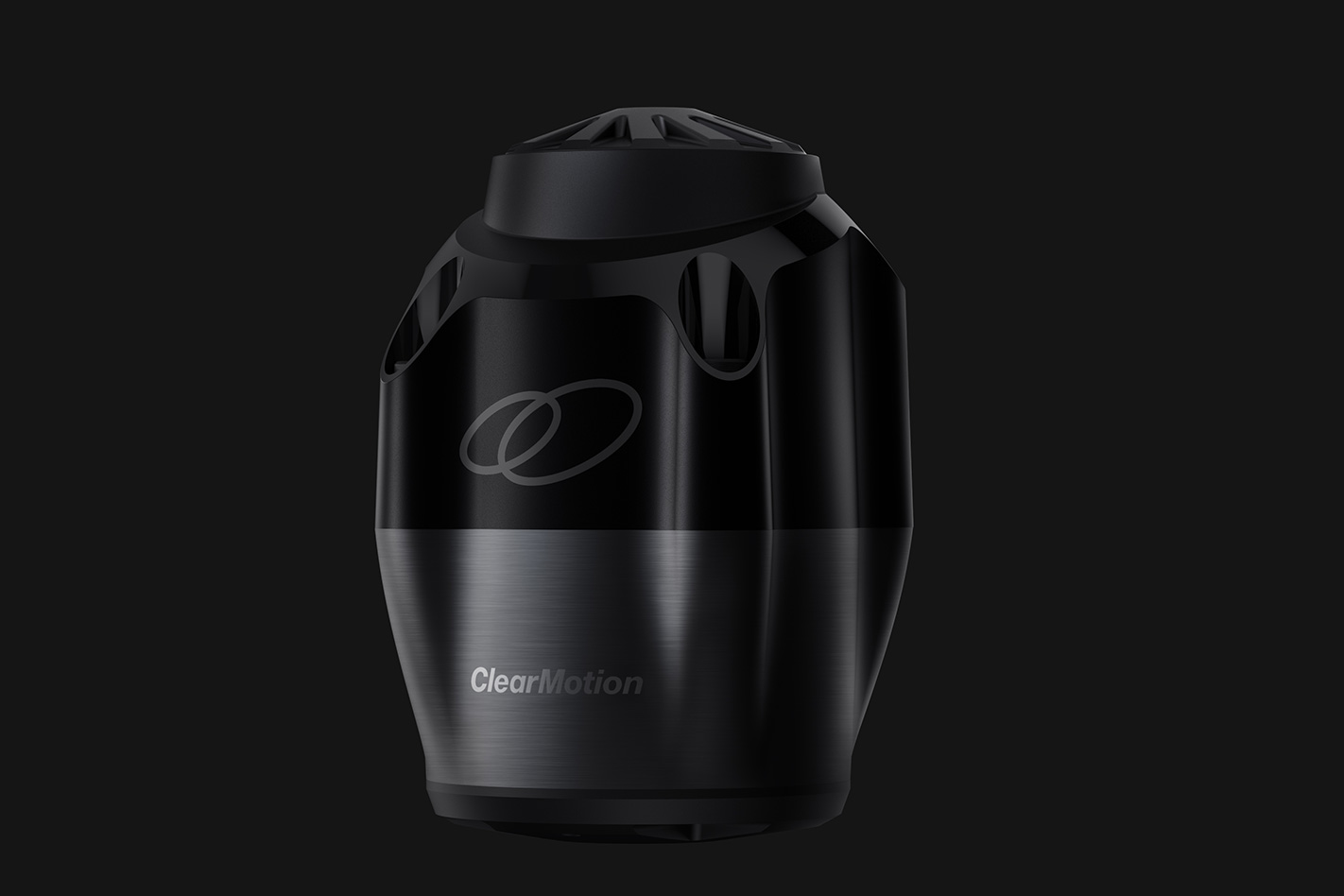
With conventional suspension systems, the movement of the wheel is dictated by the surface it rolls over, or changes in speed and direction of the car. Modern adaptive dampers can alter the extent to which suspension resists movement but Clearmotion’s technology can actively compress and extend the suspension independently. Linear motors replace conventional suspension dampers. When voltage is applied to the motor, the wheel moves up or down in the arch depending on the polarity. In combination with sensors that read the road ahead, the system can move a wheel to roll over an obstacle with lessened impact on the car body.
Why does it matter?
With more control over suspension movement, the impact of bumps on the car and its occupants can be reduced, to increase comfort, while a reduction of bodyroll in corners and dive under hard braking brings dynamic benefits. Clearmotion sees greater potential with the advent of self-driving cars, however. The theory goes that passengers are willing to tolerate a degree of movement when they are aware of their surroundings, but in an autonomous vehicle, occupants might be preoccupied by other tasks.
Reducing the amount of disturbance felt in the cabin will make typing or reading easier, for example, and would reduce the likelihood of motion sickness. The system can also be configured to regenerate electricity, reducing the net power it consumes and extending the range of EVs that adopt the technology.
Sound principles
The idea behind Clearmotion’s proactive suspension is the same as that behind an audio speaker. When current is applied to a coil of wire, the magnet is repelled forcing the speaker cone to move, creating a sound wave. In the case of the suspension, the cone is replaced by a bar connected to the suspension arm. When the control system senses a lump in the road ahead, a signal is sent to the coil forcing the wheel to move before it hits the obstacle.
IT’S UNHEARD of for a road test to be concluded before you’ve driven the cars, but I reckon this one could be a done deal. Peugeot’s 5008 has just pulled up to the bowser alongside the Mazda CX-9 and, to be honest, it looks like Grant Denyer squaring up to Lennox Lewis. Both have seven seats and both are priced around 50 grand, but the similarity ends there.
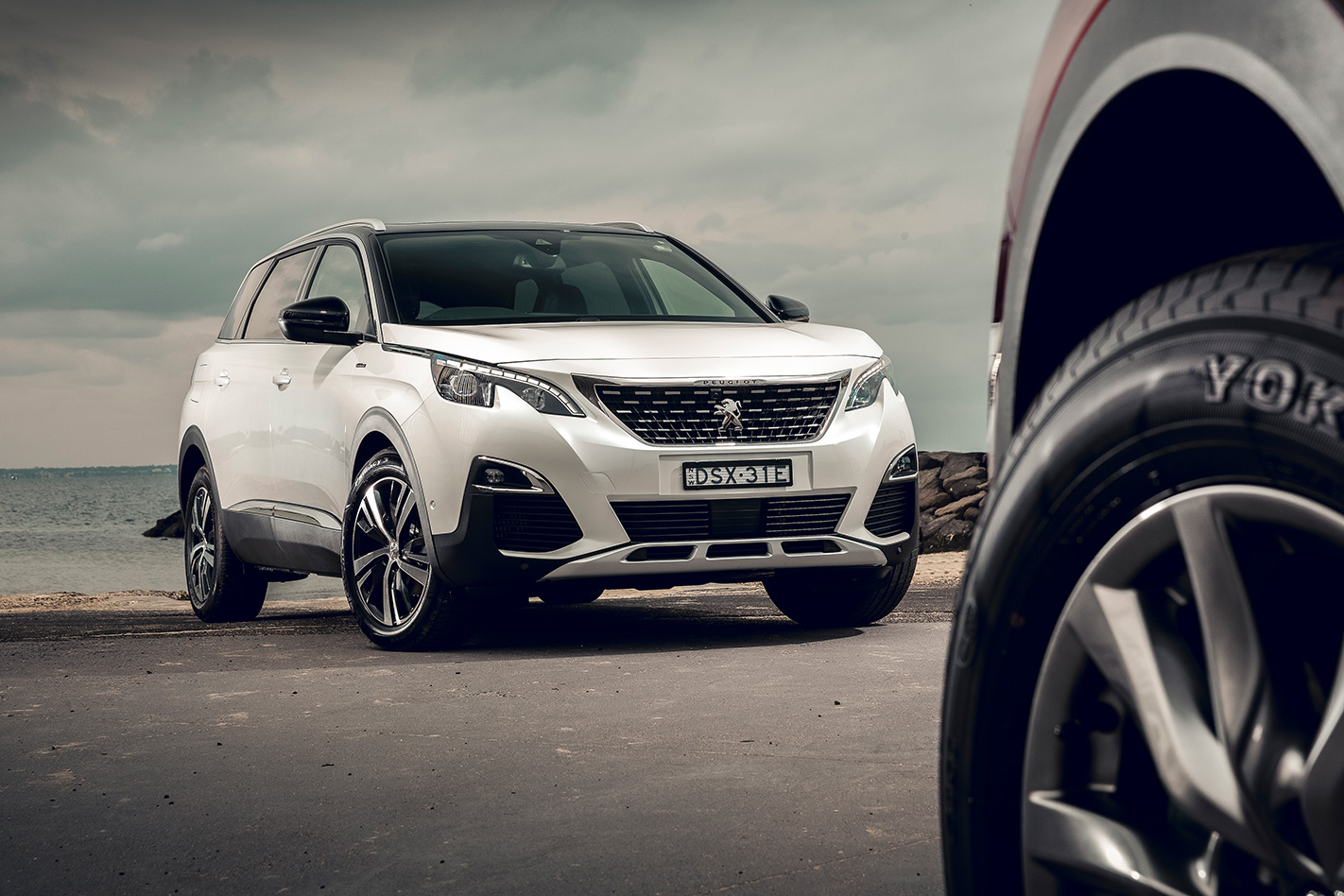
The large Japanese SUV dwarfs the svelte Peugeot, its roofline arcing way above that of the mid-sized 5008, its flanks and overhangs all solid heft against the Pug’s pinched surfacing. We know the CX-9 is a formidable package, so the category-busting Peugeot will need to bring something utterly exceptional to win this one.
Its task isn’t made any easier by the inclusion of the Skoda Kodiaq, an SUV that came within striking distance of this year’s Wheels Car of the Year crown, only to be pipped by the Volvo XC60. We rated the Skoda’s practicality, value and dynamics then, and we’re interested to see how it stacks up to both the 2017 champ and the new pretender from Rennes-la-Ja nais.
You’ll be forgiven if you feel a sense of deja vu about the 5008. The first generation was an amorphous MPV that shared its underpinnings with Citroen’s previous C4 Grand Picasso. Marginally better to drive than its gormless looks suggested, the 5008 was studiously ignored by Aussie buyers from 2013 before being quietly taken outside and shot. The badge has once again returned on a vehicle based on the new-gen Grand Picasso, but this time round it appropriates the styling cues of an SUV, despite lacking any semblance of propulsion to the rear axle.
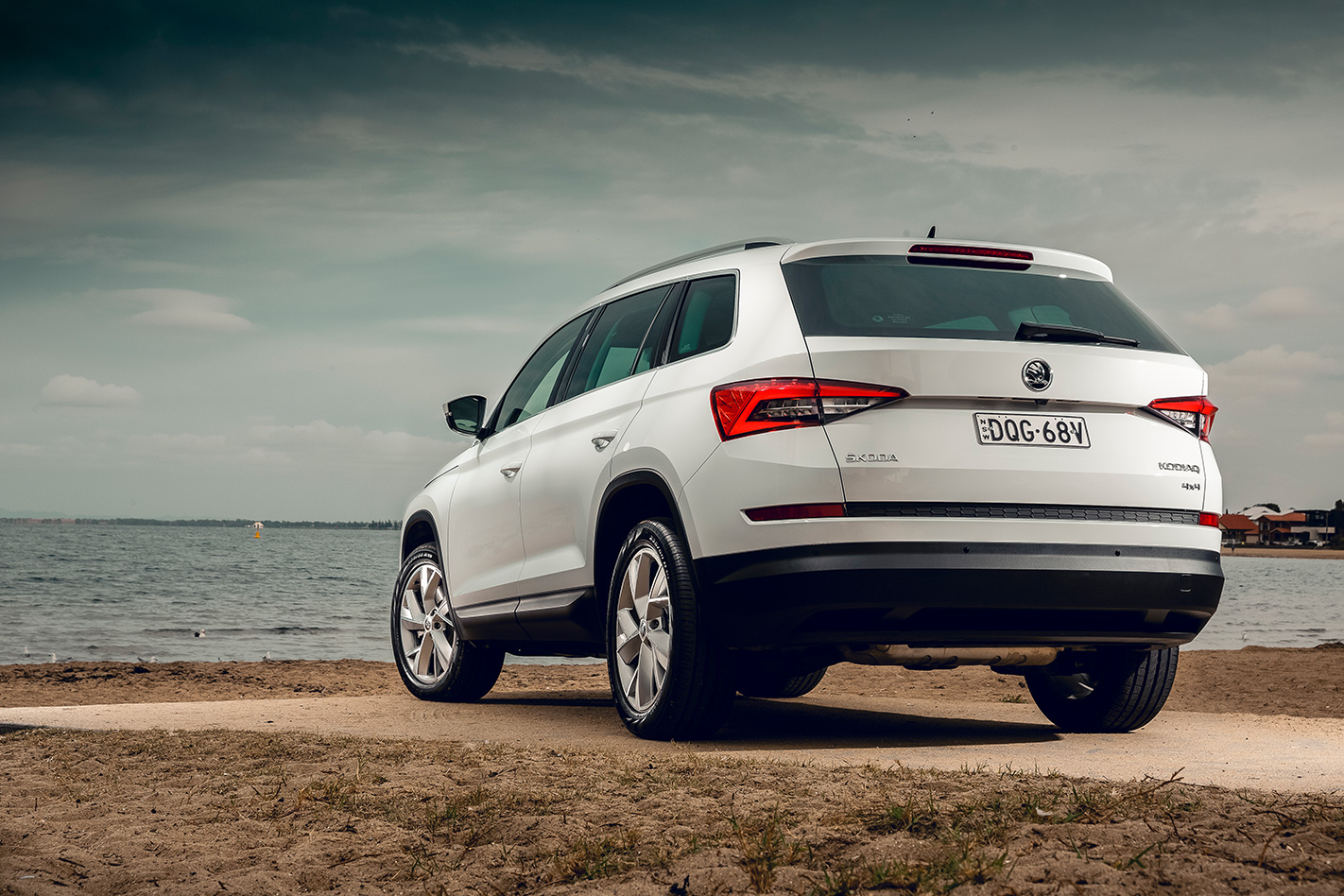
Students of automotive history might well recall the Matra Rancho, a French contrivance that pioneered this genre back in 1977. The front-drive Rancho was basically a Simca 1100 that went all-in on the 4×4 dress-up. There was even a Grand Raid model that featured nonsense like an electric winch and a spare wheel mounted on the roof. Despite being largely dreadful, the Rancho went on to spawn the Renault Espace, so as well as being an idea before its time, it helped create the MPV genre that today’s Peugeot 5008 so conspicuously shuns.
Whatever your take on its authenticity, there’s little doubt that the 5008 is a distinctive and deft piece of design. From the B-pillar forward, it’s virtually identical to the 3008, albeit with modified front bumper and grille designs. Peugeot has grafted another 165mm into the wheelbase to bump it to 2840, bringing the car’s length to 4641mm. While its wheelbase is 49mm longer than the Skoda’s, the 5008 is 56mm shorter than the Czech wagon and a massive 434mm less than the CX-9, and size counts in the seven-seat SUV sector.
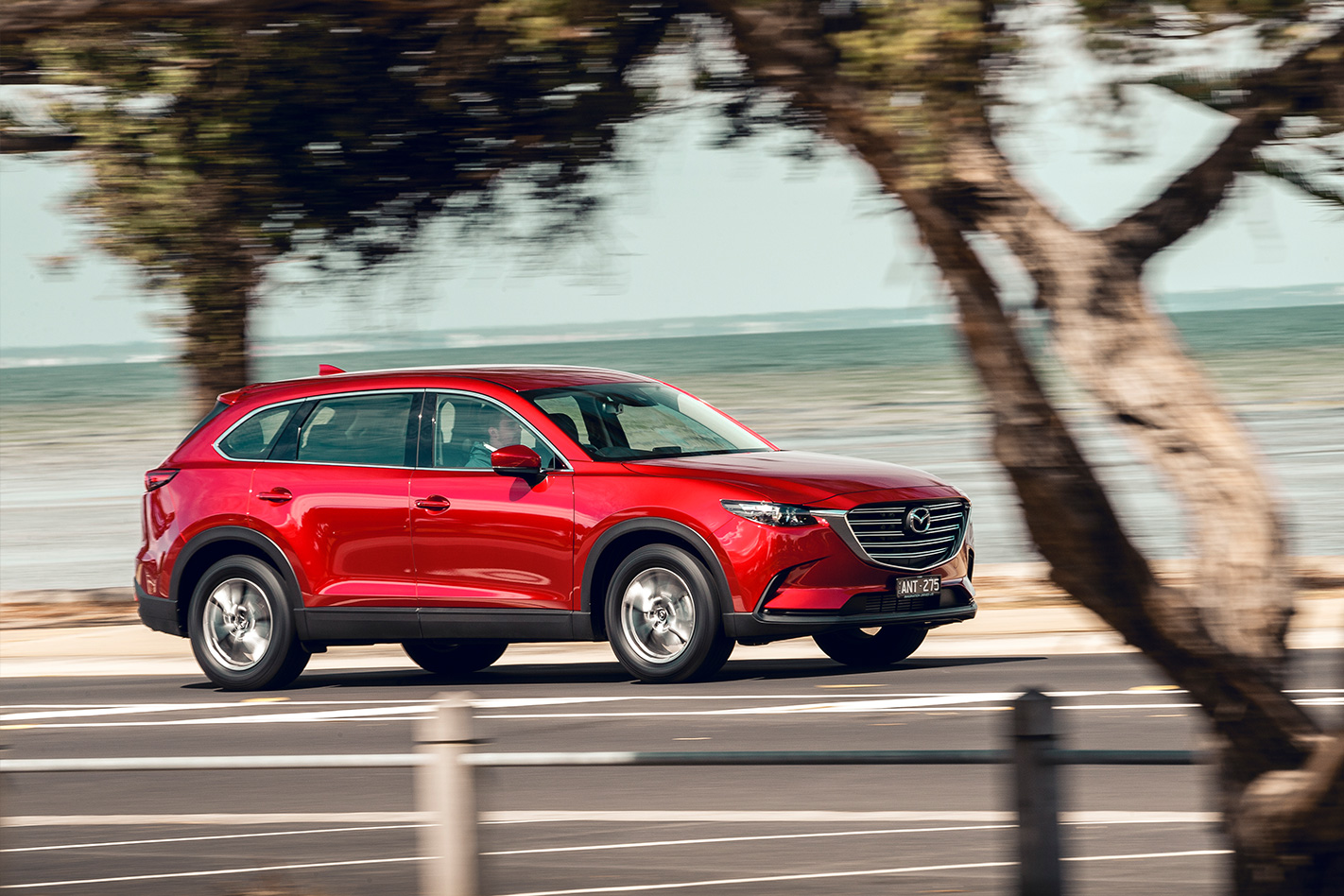
The Peugeot wings it at $46,990 in GT-Line guise, although options bump that price up to $53,740 as tested (see sidebar, p.101). The Kodiaq 132TSI is, refreshingly, supplied in almost bare-bones spec aside from metallic paint, the base price of $42,990 looking strong value, especially as it’s the only car of the trio with all-wheel drive (though shares a five-year warranty with the Peugeot). The Mazda is the most expensive car here in front-drive Touring trim, wearing a $50,290 sticker. It’s also the oldest of the three, so perhaps it’s going to face a tougher test than initially expected.
While it’s bigger and a massive 388kg heavier than the 1470kg Peugeot, the CX-9 counters with a real sledgehammer of an engine, for this class at least. The 170kW/420Nm 2.5-litre direct-injection turbo four makes the Pug’s 121kW/240Nm 1.6-litre unit look seriously malnourished, even when you take weight into consideration. The 132kW/320Nm engine in the Kodiaq sits somewhere in the middle and these outputs are reflected in respective performance figures, the Mazda being notably quicker than the others, hitting 100km/h in 7.4sec when bolstered to 188kW via 98-octane juice.

The Skoda was a little trickier to launch, the dual-clutch transmission not lending itself to being loaded up off the line, and registered 8.8sec 0-100km/h, while the 5008 was left struggling in their wake at 10 flat, half a second ahead of Peugeot’s conservative claim.
Sure, you don’t buy a seven-seat bus to crush it at stoplight grands prix, but it’s always good to have a bit in reserve. It’s some measure of the Mazda’s potency that it accelerates from 80-120km/h 32 percent quicker than the Peugeot. That could be the difference between a safe overtake and having to sit behind a truck until the next passing lane. That’s assuming the Peugeot hasn’t taken the long and winding road instead because in terms of driving reward, the slowest car here is definitely the most fun.
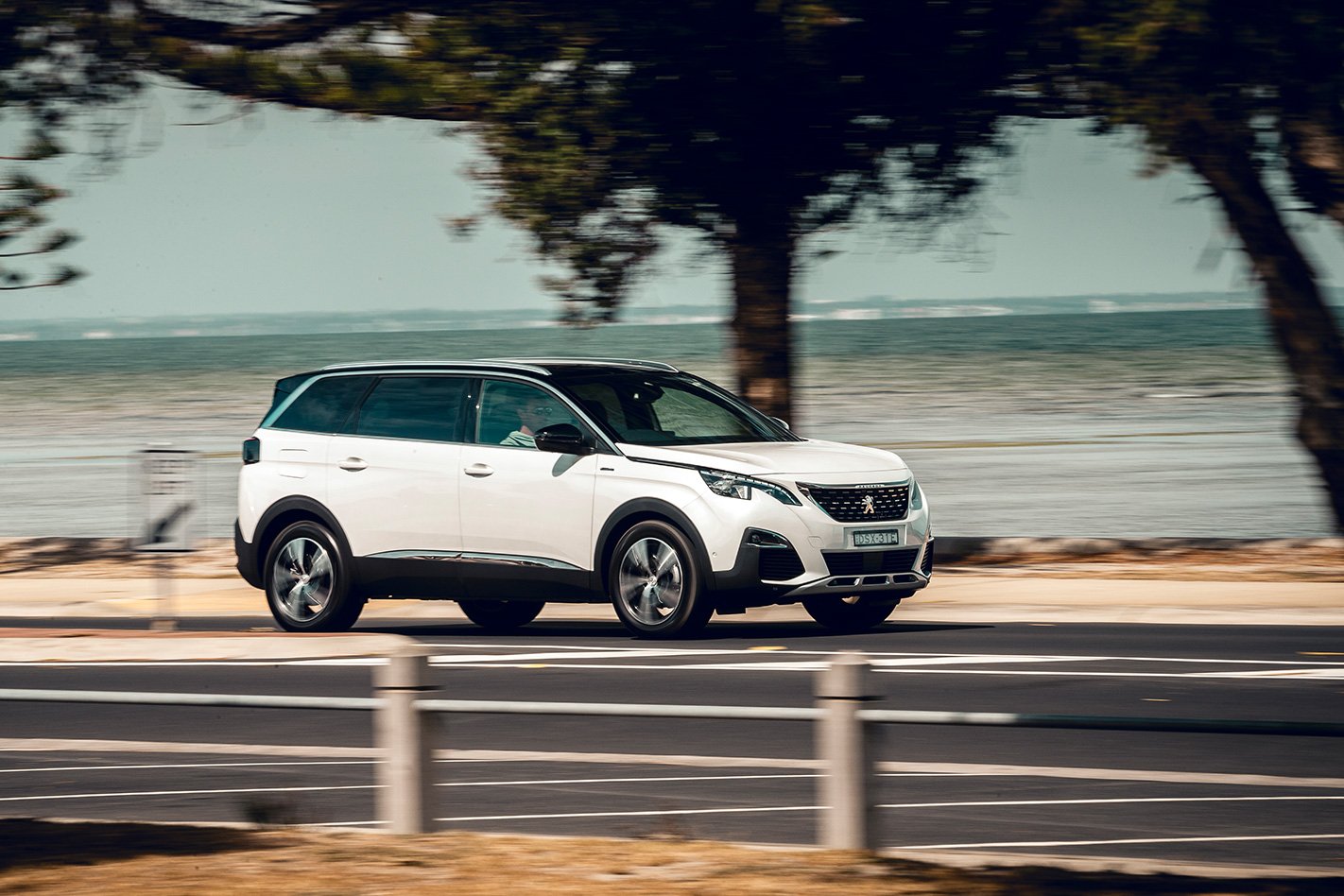
You’ll feel the Peugeot’s lightness in the alacrity of its responses, and although you may harbour the suspicion that the EMP2 architecture might actually be comprised of fairy floss and helium (it’s not), you’ll love the way it changes direction. The tiny steering wheel requires almost three turns lock-to-lock but it feels tightly geared about the straight ahead, with sharp turn-in and minimal pitch and roll.
Ride quality is respectable, however the torsion-beam rear end injects a bit of noise via the cargo compartment, and the engine needs continual encouragement to make respectable progress. But you’re helped by a Sport mode that weights up the steering, sharpens the throttle response and brings some welcome smarts to the otherwise languid six-speed automatic calibration.
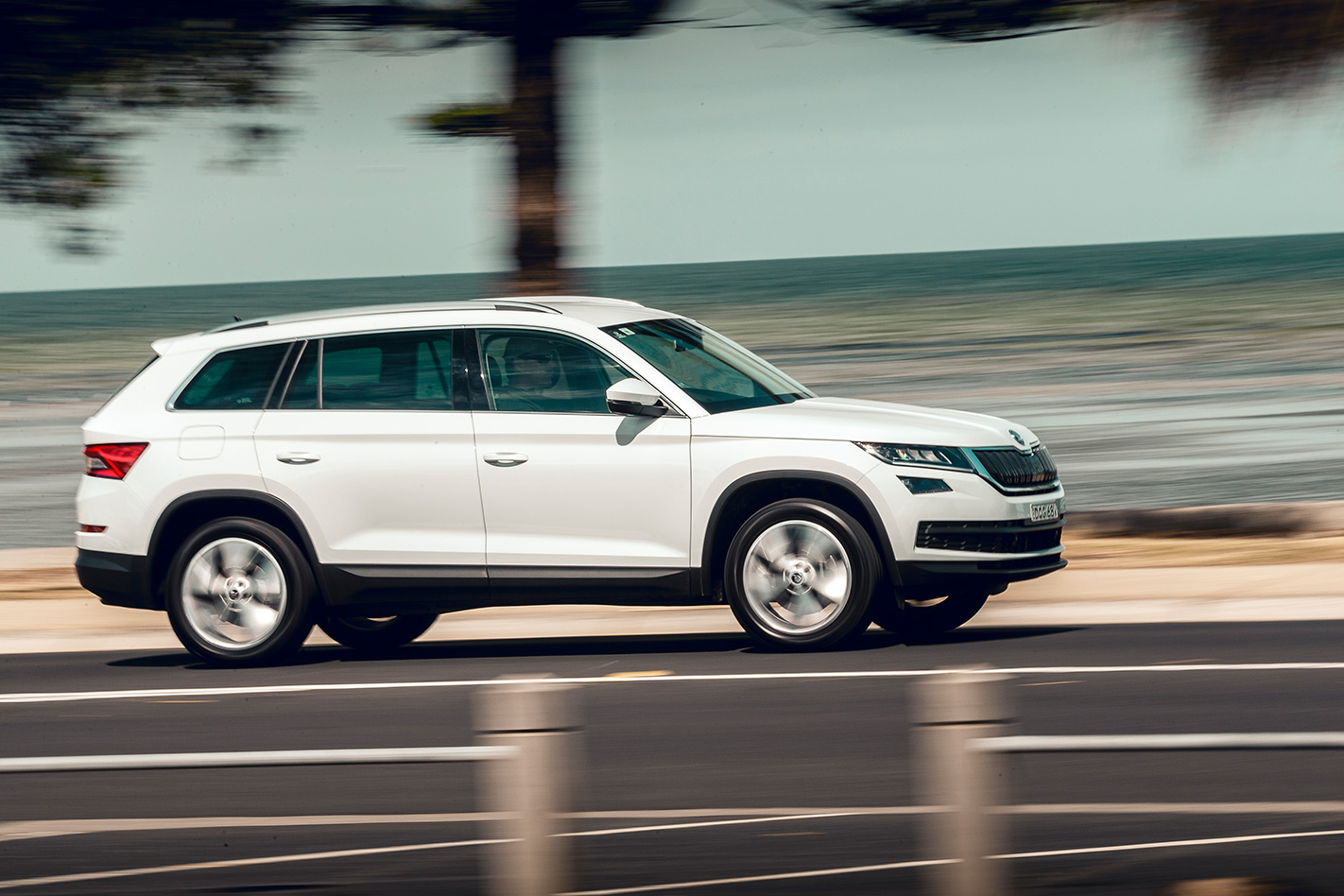
Drive the Kodiaq along the same road at the same speed and you expect it to be a bit of a handful, but it’s certainly game. It does feel like it’s clinging on a bit though, and the Skoda driver will be gritting their teeth while the 5008 pilot is grinning like an idiot. Back off a bit and the Skoda feels fun in its own way, delivering great front end bite for a big ’un, taciturn but accurate steering, admirable body control and comfortably the best brakes of the trio.
We’ve come to expect this level of excellence from Volkswagen Group products riding on the MQB chassis, and there are few genuine complaints about the way the Skoda drives. The DSG transmission’s hesitation to accelerate from standstill has us slightly perplexed, though, an issue also noted during this year’s Car of the Year testing. The suspension is also a bit more composed in compression than rebound but other than that, the Skoda earns a standout report card on both drivetrain and chassis.
The Mazda feels its size after you drive the others. Its bitumen credentials are compromised from the outset by Yokohama Geolandar H/T 60-series bouncy castles at each corner, but what you lose in corner carving ability, you gain back in ride quality. It’s possible to hustle it along a back road at a fair lick, and the CX-9 backs up the best engine with the smartest transmission calibration of the trio.
It rarely disguises its bulk, though the CX-9 telegraphs its limits in a sensible fashion. On poor surfaces, you feel the unsprung weight of the front wheel assemblies occasionally struggling to damp and isolate shock loadings, but otherwise refinement is exemplary. Because of the vast reserve of torque the 2.5-litre engine places at your disposal, you’ll rarely feel the requirement to go full Neanderthal on the throttle pedal, instead preferring to keep the transmission in its default setting where it does an admirable job of economically tipping into the engine’s torque plateau.
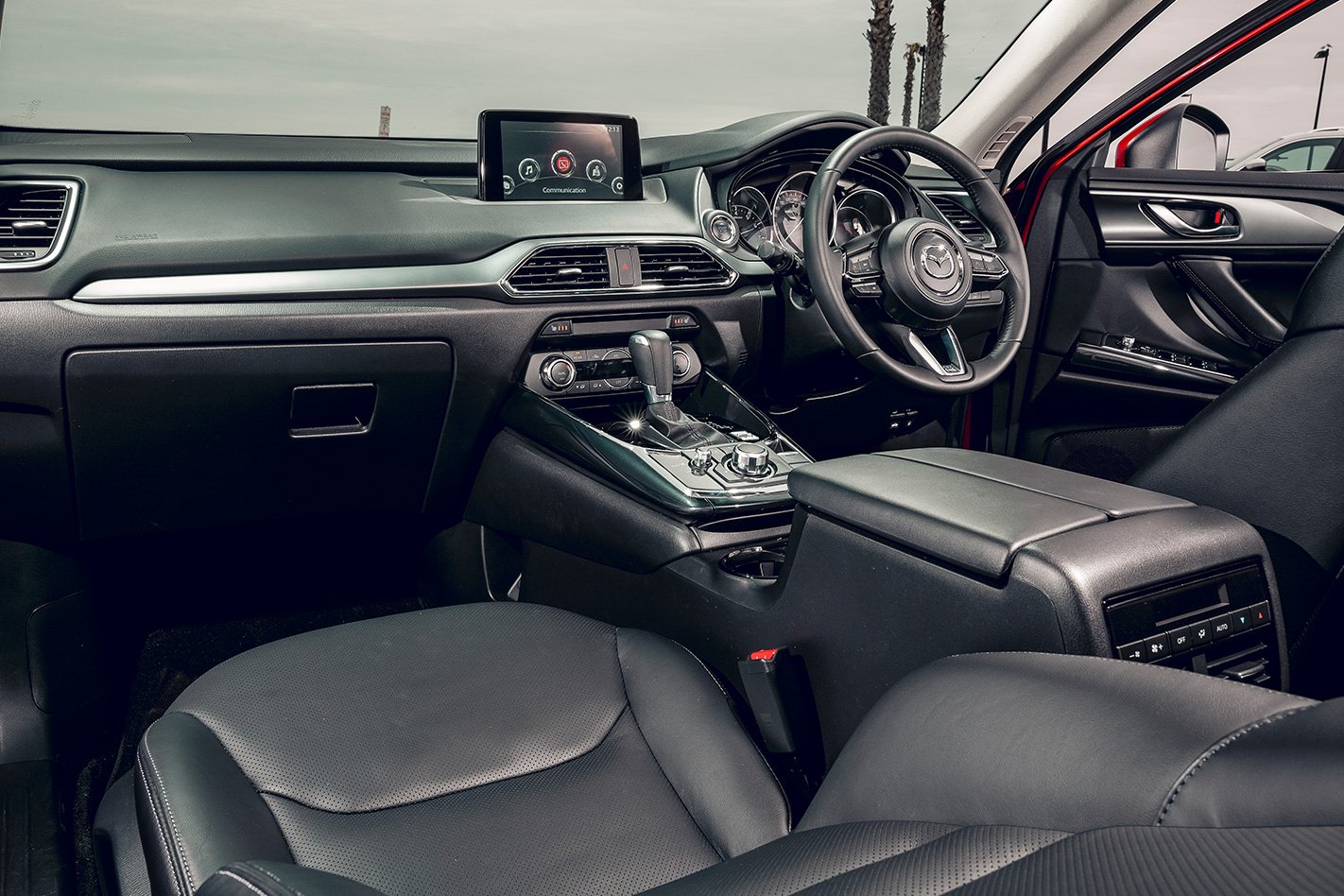
The massive cabin of the CX-9 is a great place to cover big kilometres in either the front or middle rows. It’s also the only car here where the rearmost pair of seats feature top tethers, which could swing a decision for those with a need to fit child seats or booster seats into the third row. The dash architecture still looks neat and logical, with the welcome fitment of physical dials for audio volume, air-con and drive modes. That said, the twin omissions of a digital speedo and adaptive cruise control date the CX-9 somewhat. The infotainment screen also appears a generation behind the Skoda’s slick system.
The second row in the Mazda is particularly good, allowing a decent recline for the flattish 60/40 split, a sliding bench, lots of legroom and acres of space to get your feet under the seats in front. The view ahead is good, with the rear occupants sitting higher, theatre style, though taller passengers will have to duck their heads to get in. Even with the second row reclined to the farthest extent, the third row can raise and drop. Fold both rows and you have a virtually flat load floor that almost induces agoraphobia.
If the CX-9’s cabin is all about well-judged practicality, the Peugeot responds with a high-concept assault on the senses. Our test car was fitted with beautiful quilted Nappa leather seats with a massage function, including ‘Cat Paw’ setting which does indeed feel like that thing that moggies do when they climb onto your doona at 3am and stomp up and down on your unmentionables, dribbling and purring like simpleton. Switch the cryptic Multi Sensory Ambience button between Relax and Boost, and the 5008 will alter lighting, drive mode, massage functions and even fragrance, switching the latter from Harmony Wood to Cosmic Cuir. That’s so French, you almost feel tempted to shrug, start every sentence with ‘beeeeurrrggh’ and set fire to a McDonalds.
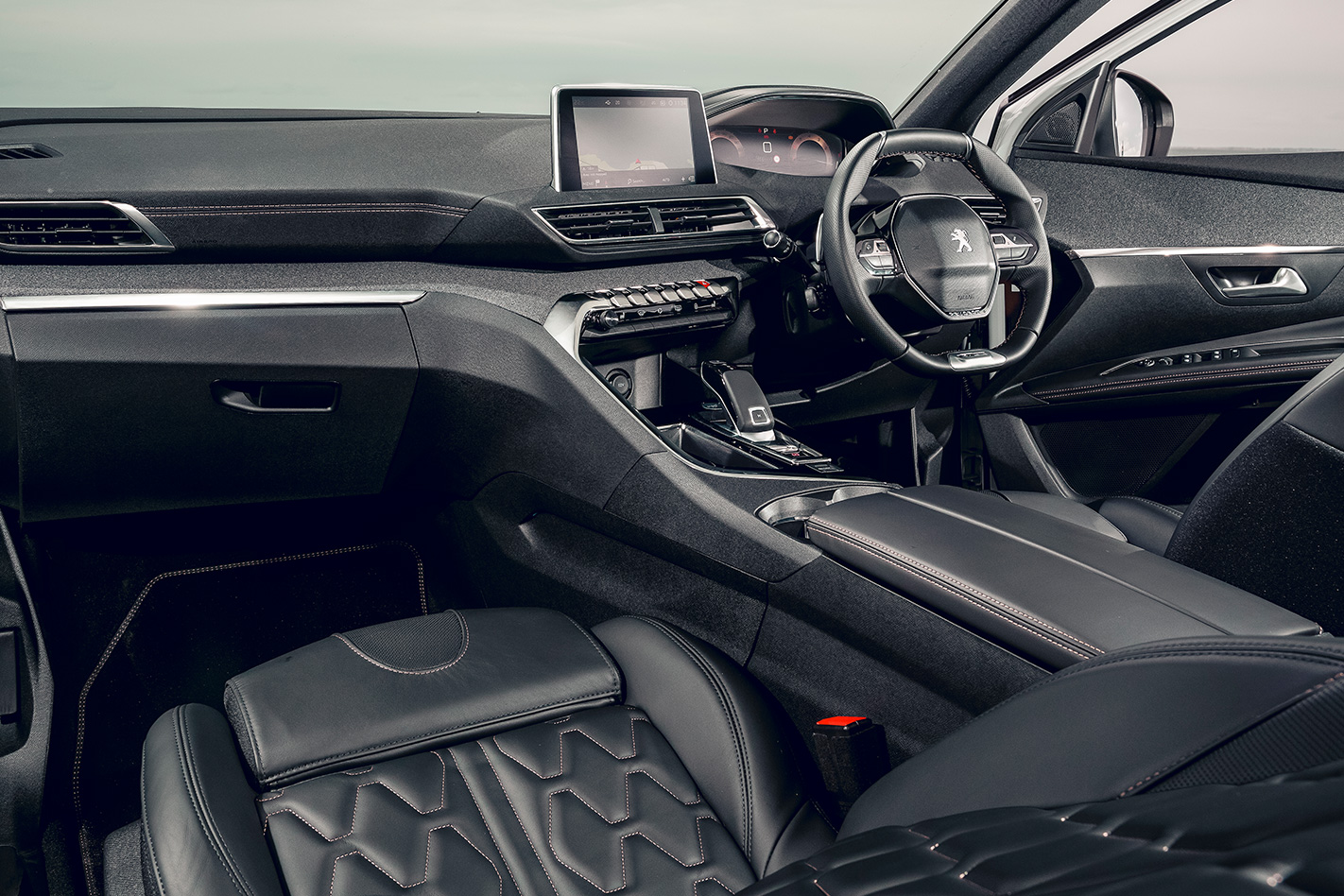
You get a sweep of fabric that runs across the doors and dash, and a liberal slathering of metal finishes that makes both of the others feel sourly utilitarian. If you’d rather your next vehicle purchase wasn’t some sort of suburban box-ticking exercise, the 5008 has appeal.
But its sheer lack of size counts against it as a seven seater. It’s comfortably the worst of this trio at that. Whereas the CX-9 gets cut-outs in the back of its front seats to boost space, the 5008 fits a set of faintly useless hard plastic tables that rob you of the kneeroom it has. Our test car was optioned with a vast panoramic glass roof that kills the car as a viable proposition for anybody much over 180cm, sacrificing 68mm of front headroom (and 20mm in the second row) from the fairly low-set roofline. Yet because it’s the only car here that houses its spare wheel in a basket under the car, there’s room for two soft bags beneath the third row when in use, and additional space if each (11kg) seat is removed.
The 33/33/33 split second row is a neat thing, with each position individually sliding, and the outer two reclining, and unlike the front-wheel-drive Mazda (which shares its sheetmetal with an all-wheel-drive version), the Peugeot’s commitment to front drive means that there’s no transmission tunnel for the middle passenger to contend with.
There’s also a 220V three-pin inverter in the second row, although it takes a little finding. The rearmost pair of seats take a bit of erecting from the flat load floor. First you need to contend with the origami mission of folding flaps and then there’s the rear parcel shelf bar which ends up directly in front of the popped-up seats.
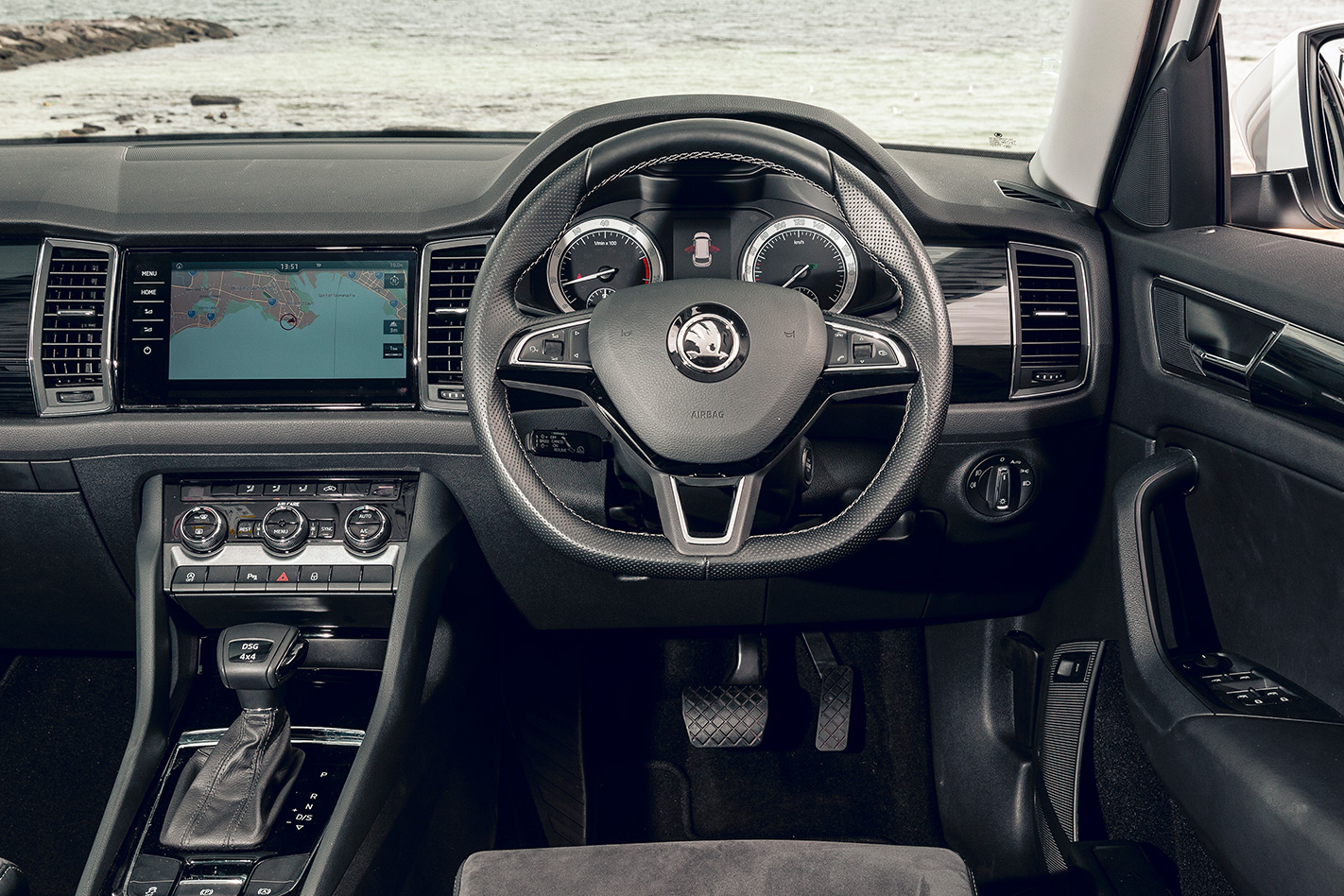
Contrast that with the Skoda, which features a clever rear-seat system and a parcel shelf that stashes beneath the boot floor, snuggled into place by a pair of neatly-packed travel blankets. It’s all encapsulated by Skoda’s ‘Simply Clever’ tagline and, along with the double-deck glovebox, umbrellas in the doors and flipover cubby tidies, actually has some substance. The second row splits 60/40 and both parts slide and recline, but the centre position is hard and the only seat in the house not trimmed in smart suede-cloth upholstery. There’s also less foot space in the Kodiaq, thanks to the front occupants’ underseat drawers.
The Peugeot has much to commend it and while it’s not a great seven-seater, it would be our prime pick for urban style-driven buyers who want something with a bit of space for equipment-heavy hobbies but don’t want the stigma that comes with owning a vanilla soft-roader. It drives well, it’s easily the most economical of this bunch and, above all, it’s fresh, interesting and endearing. Judged on purely pragmatic criteria, the 5008 finishes last here. But if you take into account what it manages to squeeze into its svelte form (it’s 54mm shorter than an Outlander, for example), the Pug’s compactness could be just what inner-city parents crave.
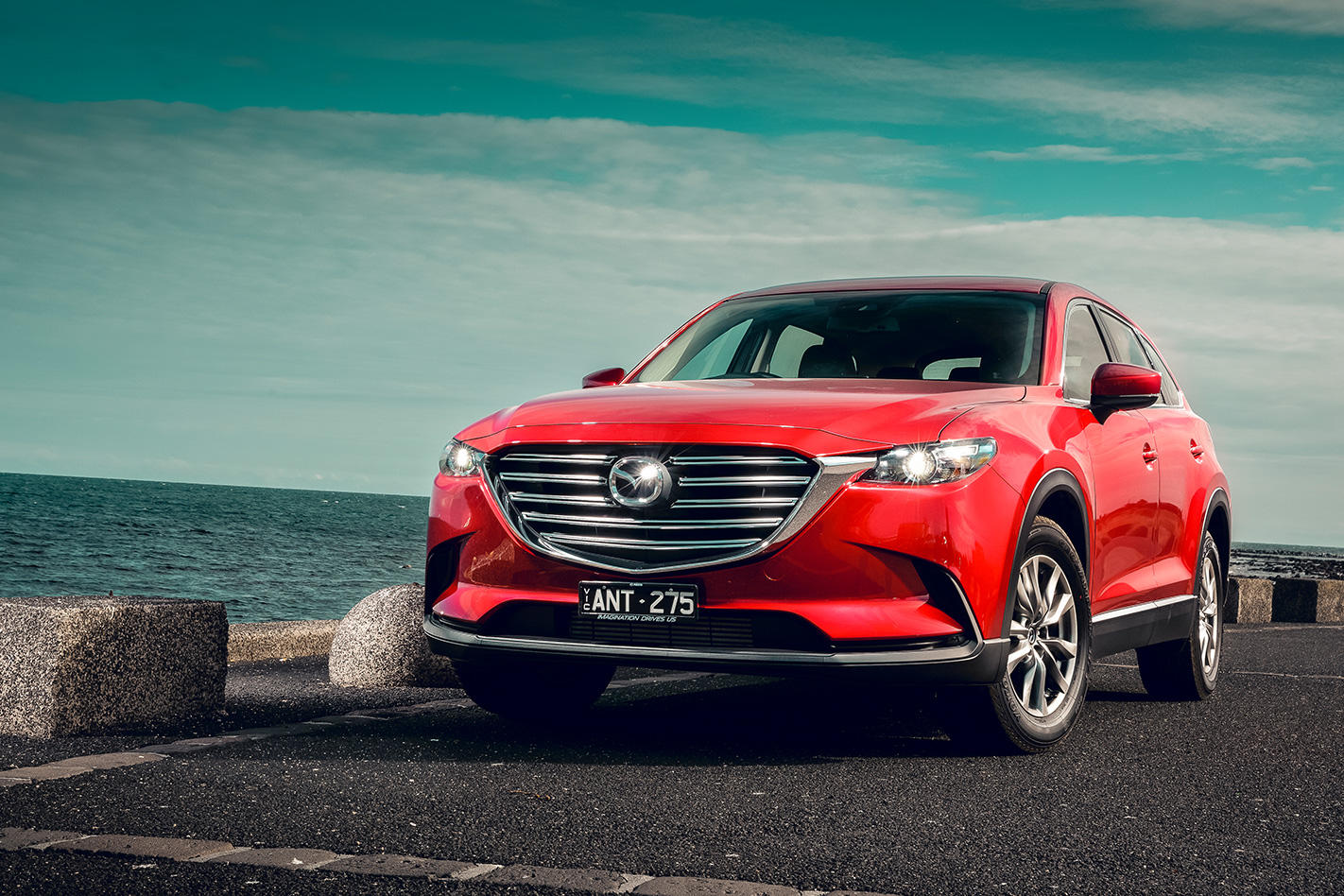
The Skoda has more to it than first meets the eye. All-wheel drive endows it with a level of authenticity, its drivetrain both classy and economical, its interior smart and its ownership credentials burnished by strong manufacturer support. It would be a painless purchase and one that we’d heartily recommend if surprise-and-delight utility stirs your loins.
It doesn’t quite have the chops to topple the Mazda, though. The CX-9 hugely impressed us in 2016 and it’s still the pick of the seven-seat bunch. Bigger, quicker and more comfortable is a formula that is always going to be tough to beat. Back that up with strong equipment, great ride quality and the most family-friendly focus of the three and it gets more of the things that matter right, more often.
The caveat, of course, is its considerable size, but if you can accommodate a CX-9, then it will happily do the same in return. We called this one early, but we called it right. After all, a good big ’un usually beats a good little ’un.
- Introduction: The White Knight
- Update 1: Digital Divide
- Update 2: Smooth Operator
- Update 3: The Drag Queen
- Update 4: Conclusion
Introduction: The White Knight
The key to a long-term relationship, common sense suggests, is picking someone you actually like in the first place.
It doesn’t matter what characteristics pique your heart, that there are positives to focus on is crucial when one of you starts foraging for ear wax in front of the other. Which makes things awkward for our newest garage addition.
We don’t mean to be cynical, but our first couple of dates with Infiniti’s Red Sport offerings didn’t end happily.
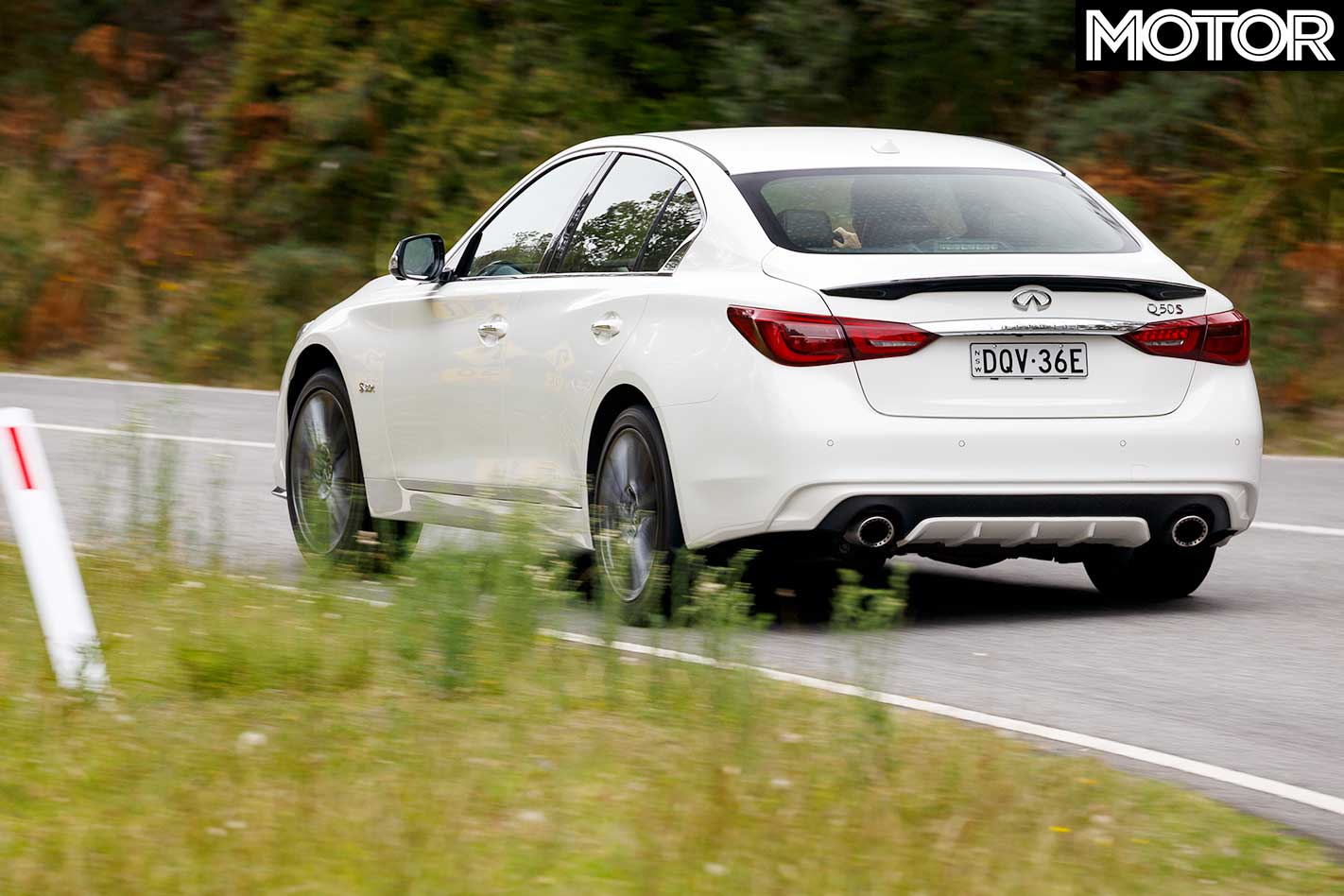
The coupe version was thumped by BMW and Lexus in a three-way stoush, while our first meeting with the four-door Q50 you see here didn’t leave us any more impressed.
Romance once existed. Infiniti’s aggressively styled sedan caught our eye four years ago when flaunted as the Eau Rouge concept. It was a working prototype shoved full of GT-R goodness, specifically its 3.8-litre twin-turbo V6, that promised to pick M3s and C63s from its teeth.
There was all-wheel drive, Sebastien Vettel’s input and 412kW to raise heartbeats. The belief that Infiniti would deliver a genuine right hook to its rivals swelled under Andy Palmer’s leadership, a self-confessed car nut who briefly took charge of the Hong Kong-based firm. But then he left, and the concept was dropped.
In the Eau Rouge’s wake the Red Sport was born. The names sound similar, but we quickly learnt the recipes weren’t.
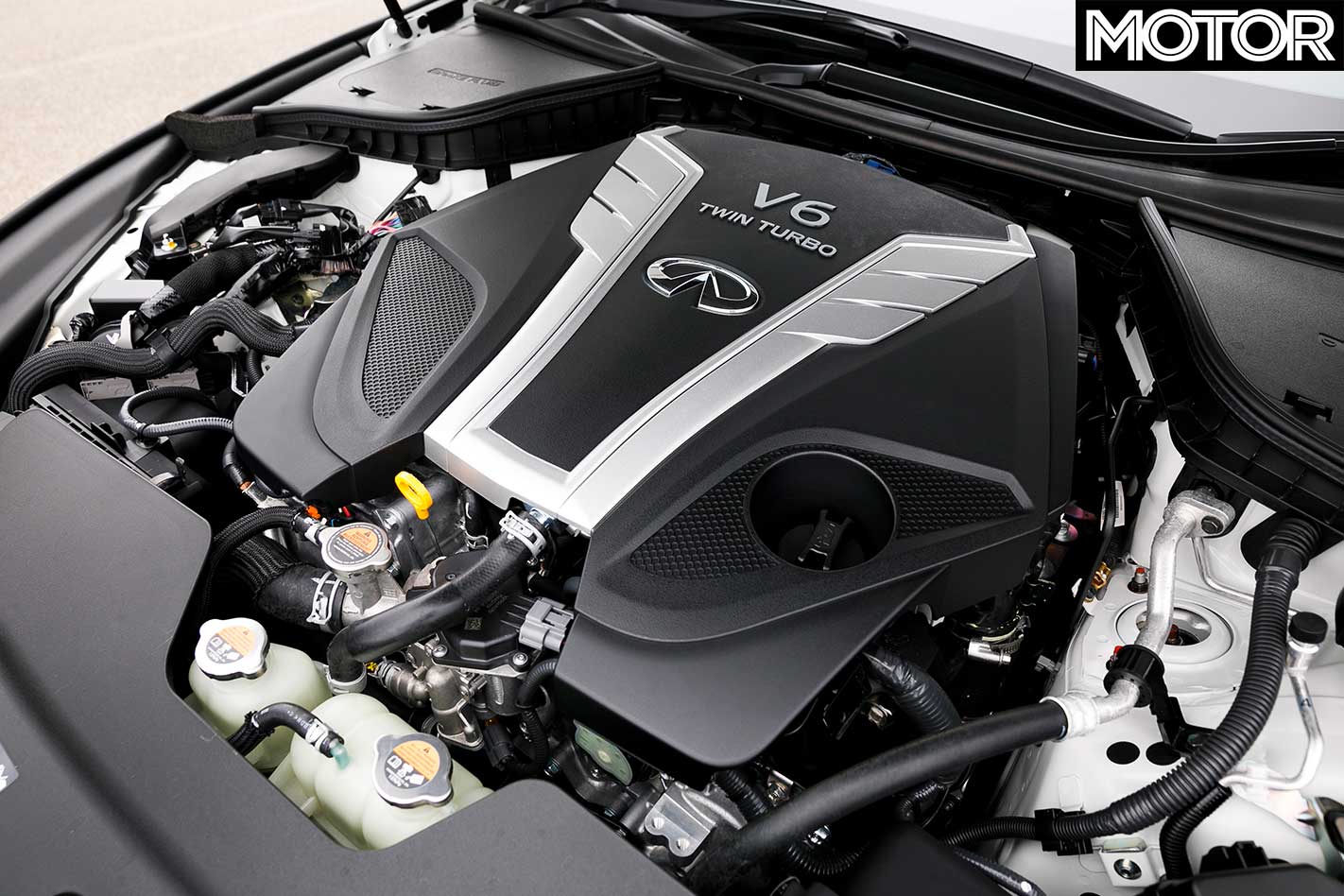
Yes, it had power. And the Red Sport thrust Infiniti’s all new twin-turbo 3.0-litre V6 into the spotlight, replacing the 3.5-litre hybrid powertrain as the burliest offering.
Like the GT-R’s engine, it has coated bores, lightweight internals and debuts air-to-water intercoolers, turbine manifolds moulded to the cylinder heads, and a square 86mm bore-to-stroke ratio. It sends 298kW/475Nm through a seven-speed auto.
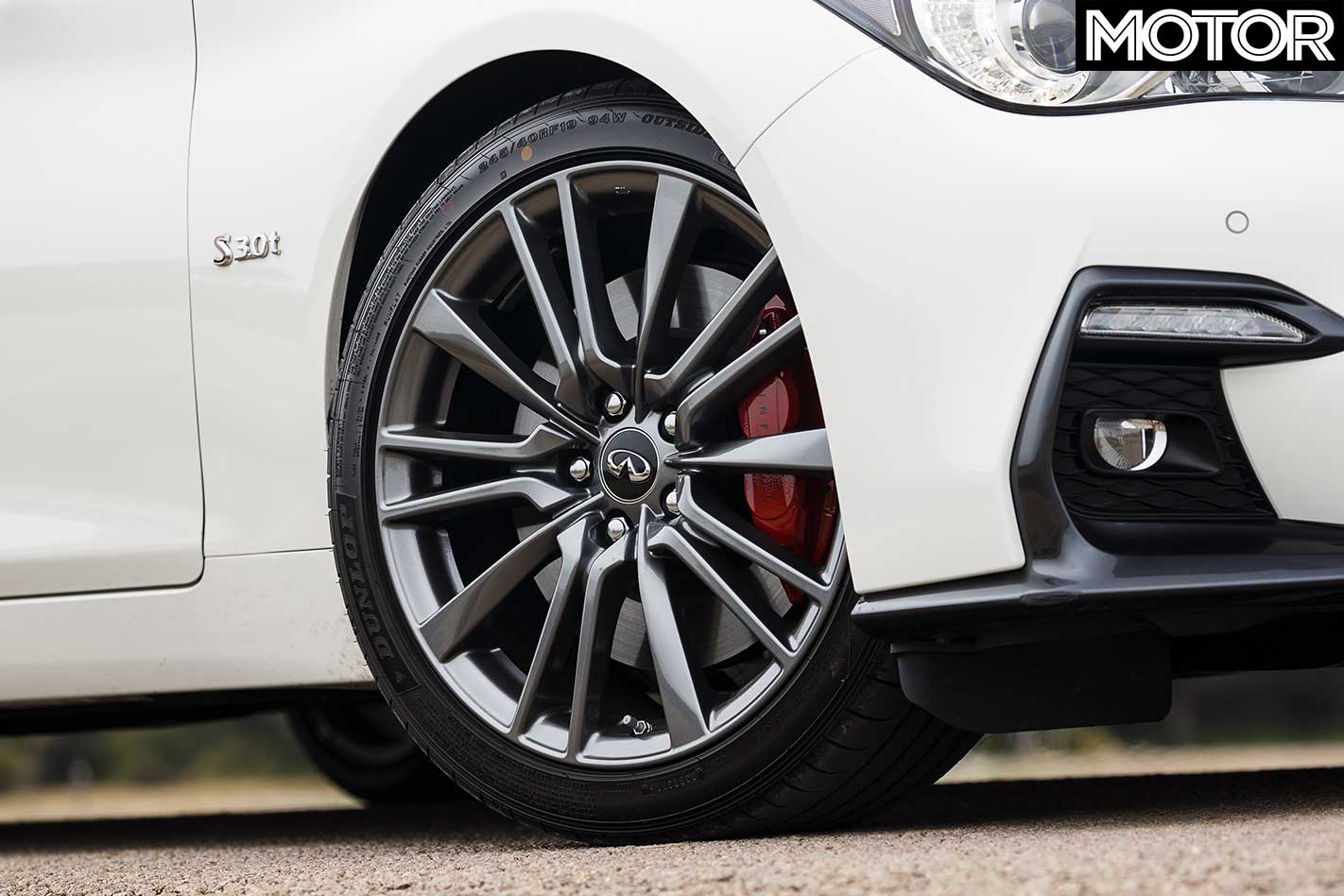
Other markets have the choice of all-wheel drive, but given the lack of snow in Australia, we’ve been dealt rear-drive cars only. Which is where the first of its problems start to surface. That’s a lot of stonk for a pair of 245mm Dunlops sandwiching an open diff. Especially with thrust like this. It arrives like a tidal wave early in the rev-range which can often catch out the rear axle.
There’s spookiness at the limit, too, where its stability system and chassis balance never seem trustworthy. We also suspect ‘run-flat’ Dunlops don’t help. But the biggest problem lies with its steering, the industry’s first by-wire interface.
It’s all very clever, but it given the weirdness of the helm, it seems to fall into the “answers to the questions nobody was asking” category. Maybe we’ll get used to it. We know, there’s all this animosity and yet here we are on the couch, flicking through channels, realising we’re stuck with each other for a while.
Why have we done this? The Q50 has undergone a small refresh that’s worth noting. The interior and exterior have been slightly tweaked. Details introduced on the coupe Q60 Red Sport have been brought across, like the 19-inch wheel design, and its grown side scoops on its chin.
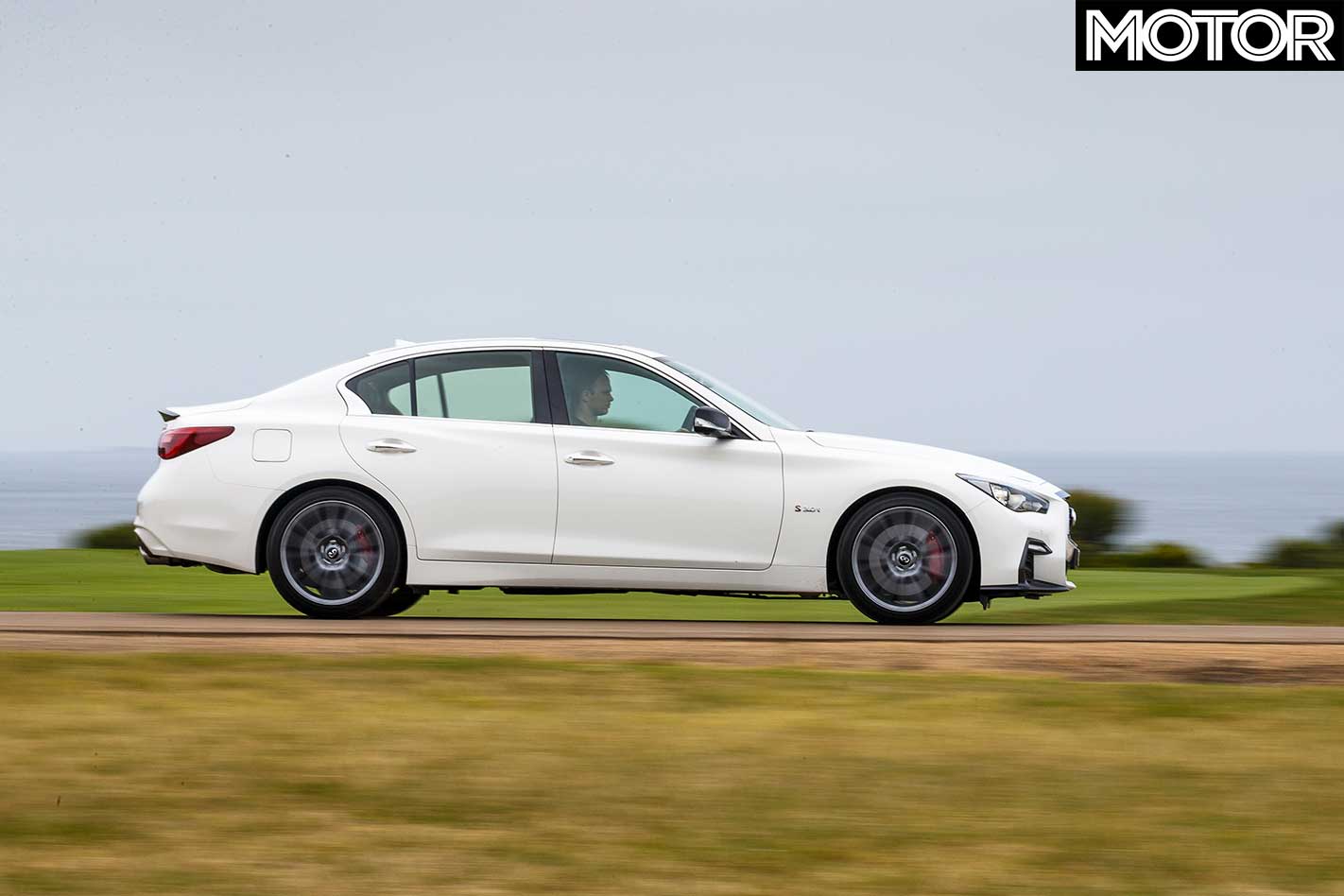
And we do admire the Infiniti at times. While it didn’t arrive in gorgeous Dynamic Sunstone Red, our Majestic White example looks aggressive – one punter even thought it was a Maserati.
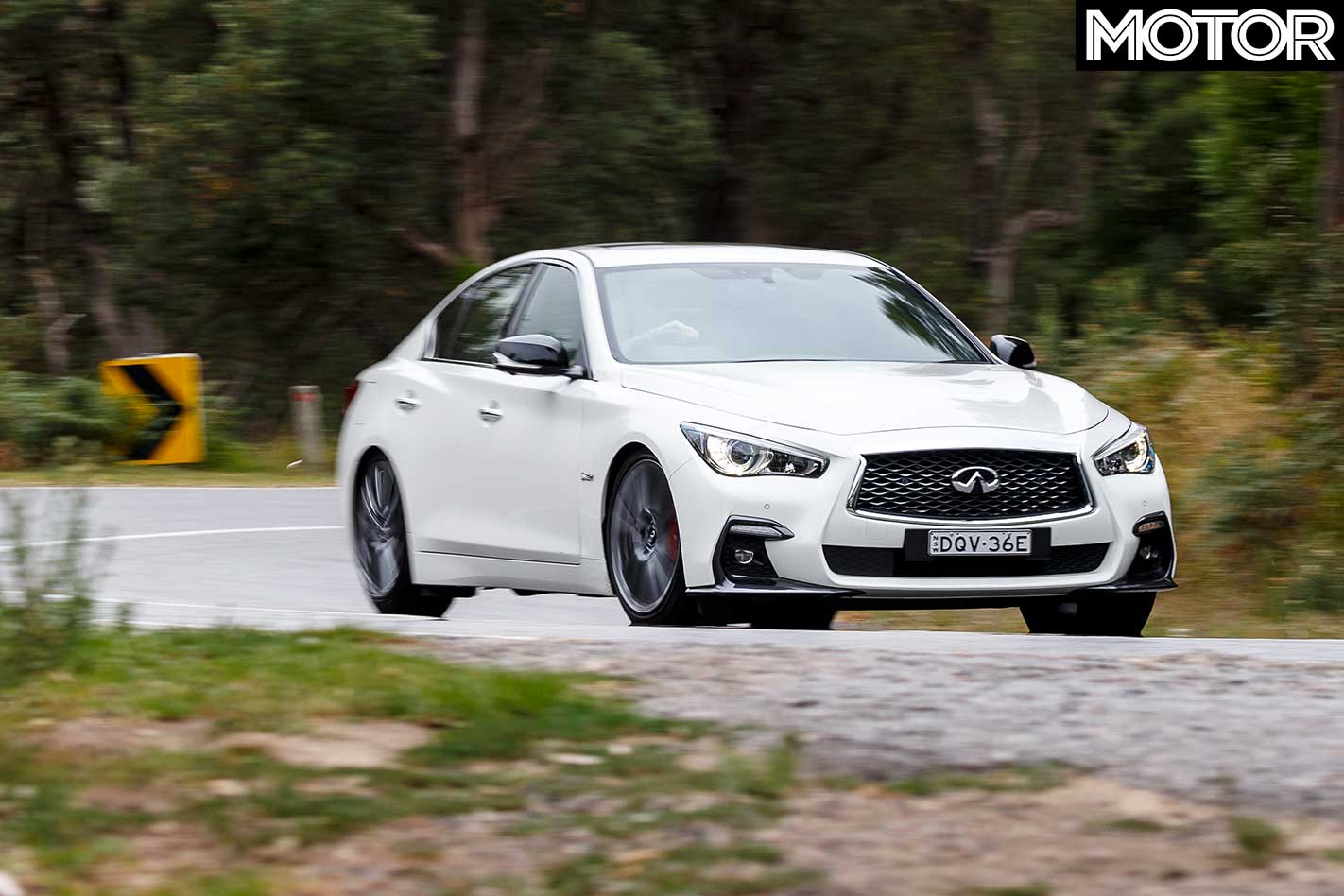
The engine’s strong, and there are glimpses of talent in the bends. The standard specification list is bulging with every safety tech under the sun, along with a decent sound system and fearsome brakes.
So what will we do over the next four months? Naturally, we’ll take an excuse to unleash that V6 properly, and we’ll dissect the ride, handling, and chassis further. Don’t rule out someone testing its practicality, either.
With more reflection, there are some positives. So we’re sticking this one out to try and get to know the Q50 better over the long run. Because everyone deserves a second chance.
Month One
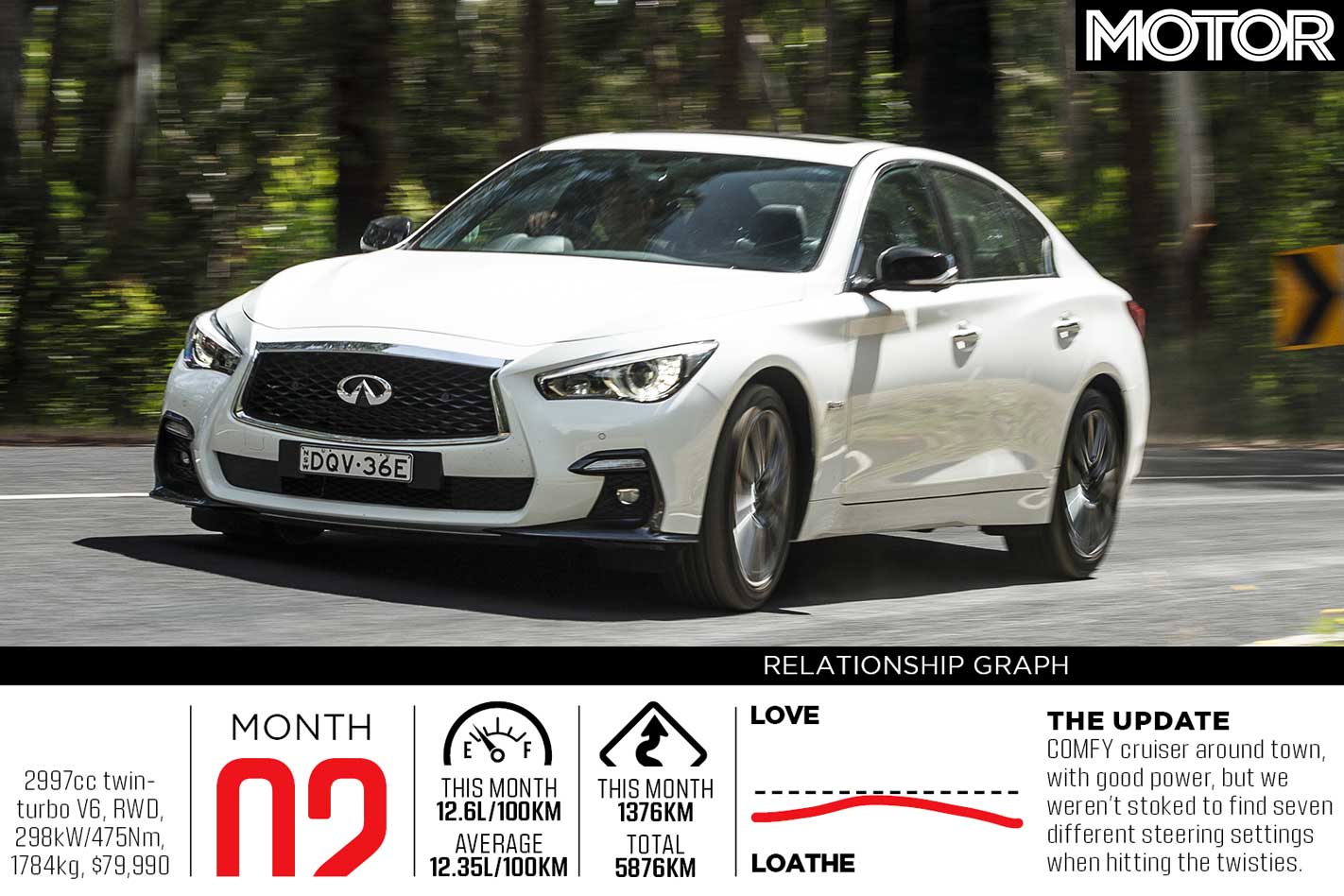
Fuel Consumption this Month: 12.1L/100km Average Fuel Consumption: 12.1L/100km Distance this Month: 730km Total: 4500km
Liked: Muscle-car grunt, executive looks Disliked: Steering feel, weight and feedback
Update 1: Digital Divide
Month two sends the relationship into murky waters as the connection fails
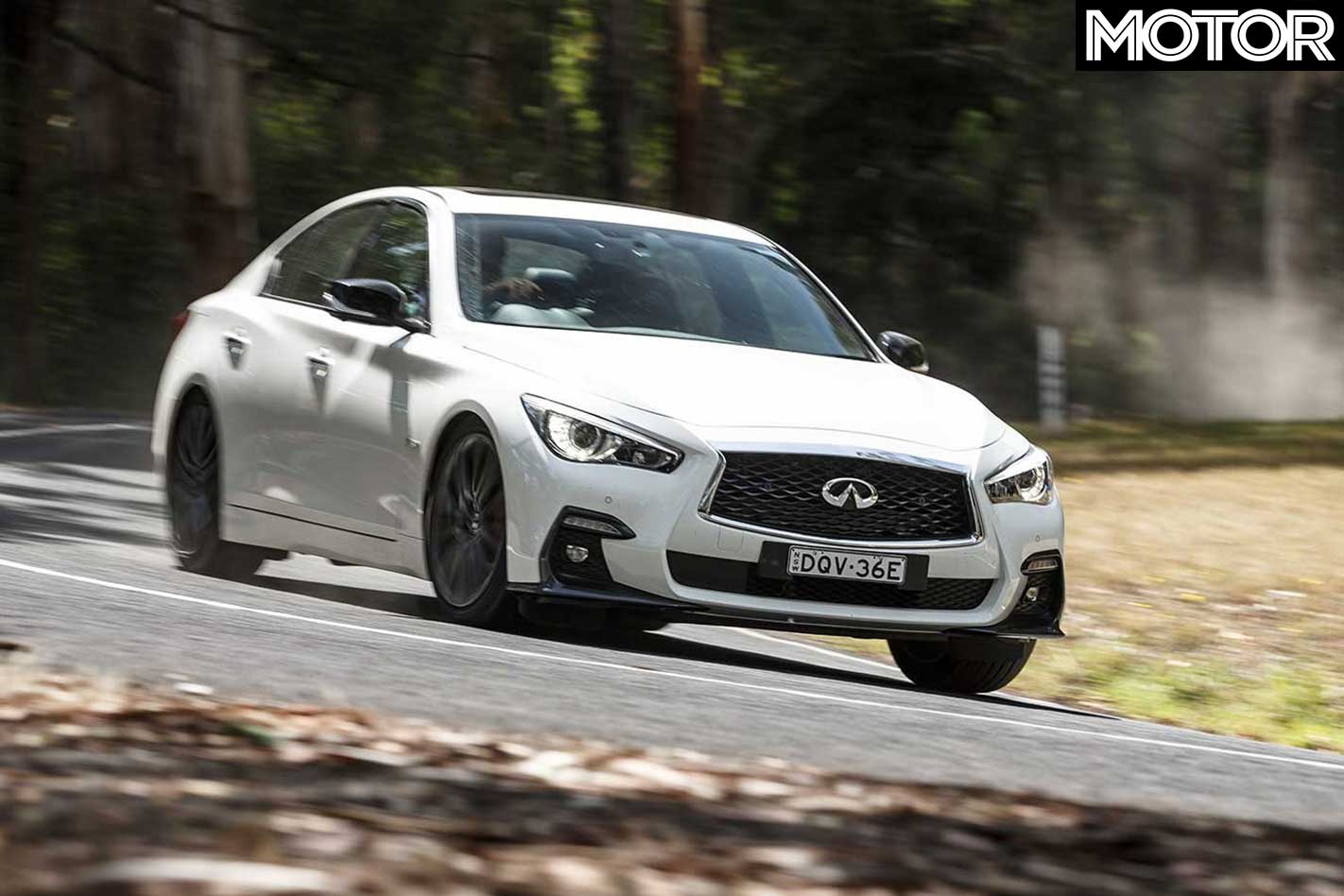
“If it’s good enough for planes, it’s good enough for cars.” This must have been Infiniti’s thoughts when it rubber-stamped Direct Adaptive Steering, the world’s first fly-by-wire system for a road car.
After spending 10 years developing the tech, Infiniti spruiks it removes “unwanted” vibrations, ultimately quickens response times, and allows a wider scope of “feel” and weight.
But are you suspicious a steering rack without a mechanical link might have a worse connection than a Vodafone cell network? We are too. Throttle pedals have never been the same since they went down the digital path.
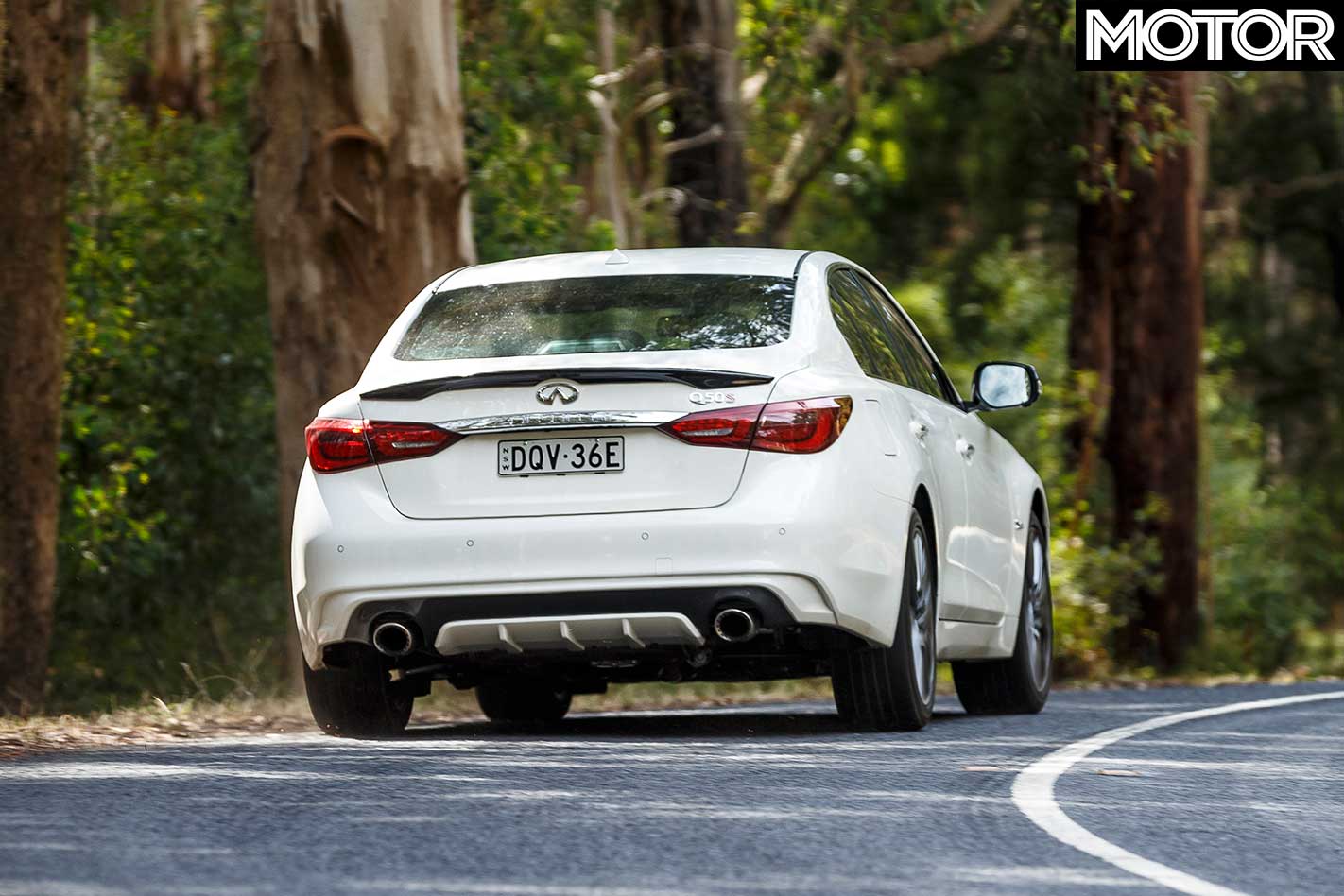
So when Infiniti says it improved the system for 2018 with more “feel and feedback” like a conventional steering system, we chose to investigate the claim on the Reefton Spur, a delicious piece of tarmac that connects the eastern Victorian towns of Warburton and Marysville.
Viewed on a map, it looks like the tracings of a seismograph. A bunch of left and right turns rarely punctuated by a straight. The perfect car for a run at the Spur is something with agility, grip, feedback, and most of all, great steering. That’s because the road often hosts motorcyclists and there’s always a chance you might need to swerve at short notice.
Low on fuel and with that 3.0-litre twin-turbo V6 able to chug juice faster than an Irish football team at a brewery, we tackled the pass in the Q50’s ‘personalised’ driving mode, which allows you to individually adjust the car’s powertrain, steering, adaptive dampers and autonomous tech.
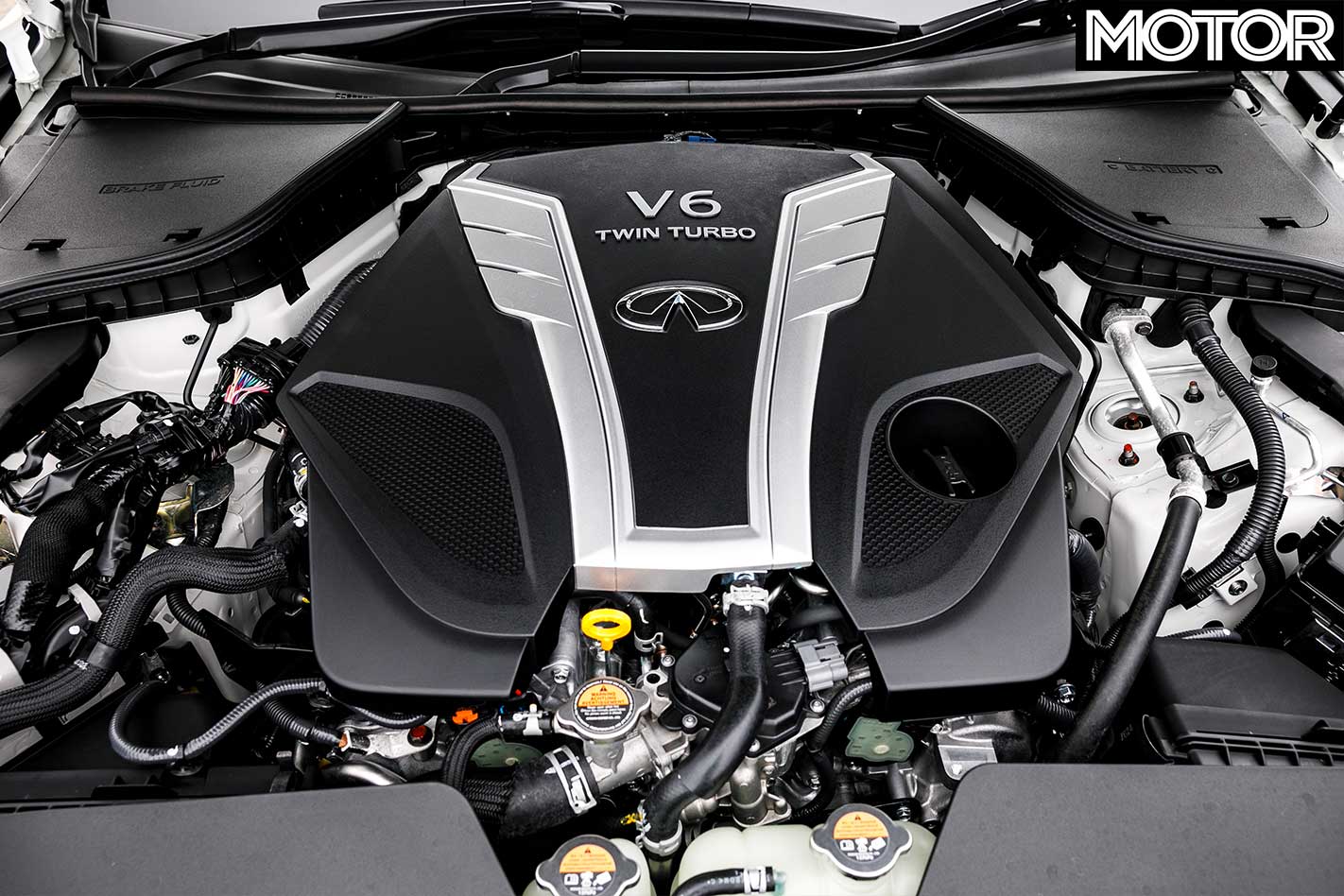
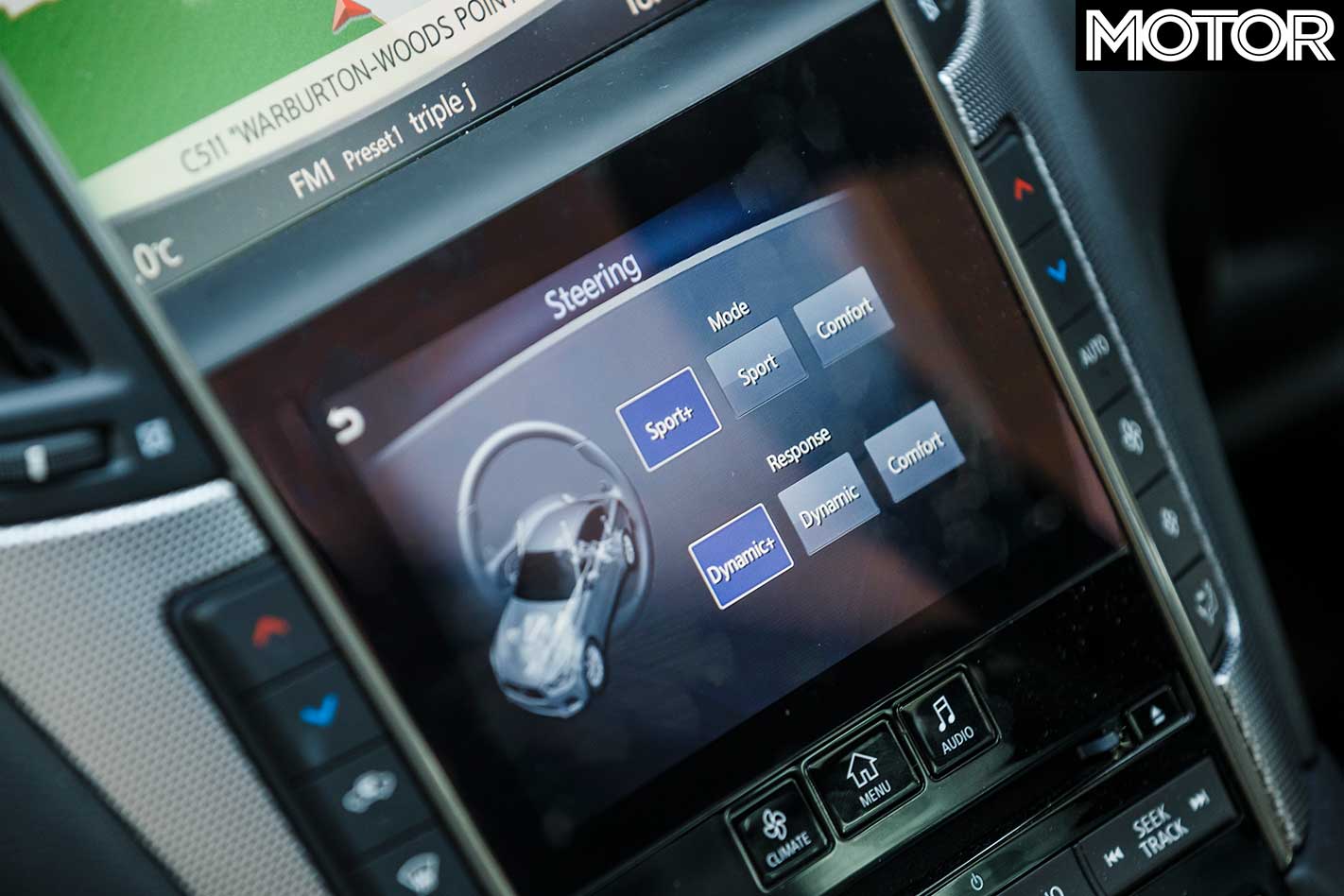
For our purposes, we wound back the powertrain’s response, jacked up the damping, and delved into the myriad steering combinations available only to discover that, in complete overkill, the steering’s sub-menu offers three modes for both the system’s weighting and rack speed.
Things start off not-good in its Comfort weight setting, which frustratingly can only be partnered with a Comfort speed. It’s way too slow; so much so that if you come up on a decreasing-radius bend too quickly, the sudden input of so much lock can spook the car into roll oversteer.
Even if less pitch doesn’t load the front axle as much, and robs the car of initial turn-in, the suspension’s sportier mode does a good job in dissolving body float and reveals a trustier balance of grip.
Response improves slightly just off-centre in Sport and Sport Plus modes, but ultimately the steering actuator does a subpar job at simulating real feedback, failing to give you any idea of how much bite there is across the front axle.
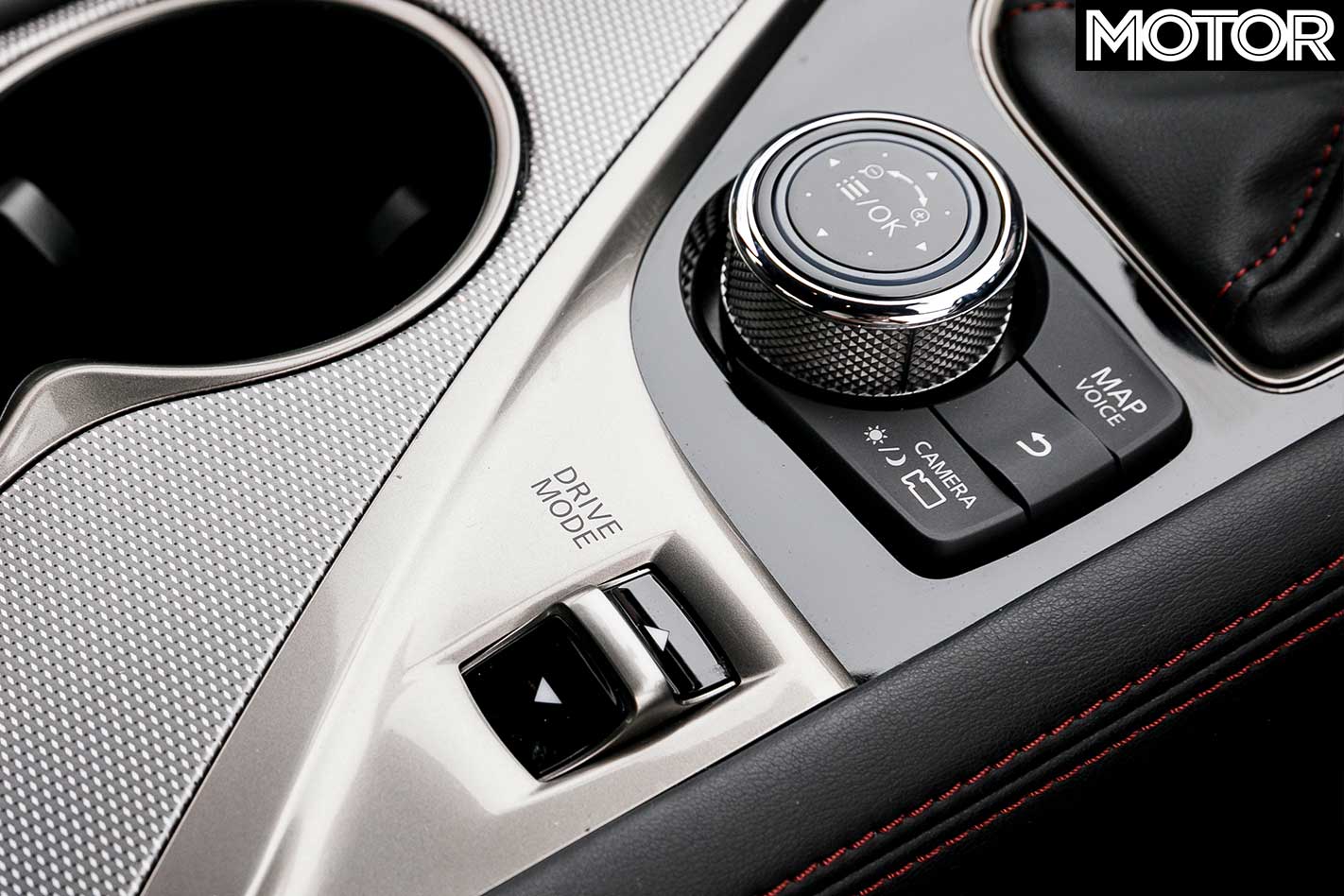
It doesn’t help, either, that the Dunlop Sportmaxx CTT run-flat tyres, at extremely low cornering speeds, squeal louder than pigs watching an abattoir documentary. You spend most of the time managing their purchase. What follows is a game of carrying the brakes to get the front-end to bite to avoid it washing wide, but not slowing too much to kill the car’s momentum.
Ironically, the steering’s most trustworthy setup is found in the ESC’s off setting. You’ll need to tread lightly with the throttle (the rear-end has as little grip as the front) without the safety nets, but the rack is its fastest and lightest – a forbidden pairing in the personalised sub-menus.
It’s a small consolation for a technology that answers a question no one really asked. Okay, cutting it some slack, it does get rid of rack rattle and it might have potential in autonomous safety applications where computers need greater steering control.
But while we suspect the majority of Q50 buyers in China and North America won’t care if their steering rack is turned by a hamster wheel, they might care about the lower levels of response, feel, or feedback compared to a conventional steering rack when it’s needed. Such as in snowing, raining, or overtaking conditions.
Even though the steering weight did feel o-k-a-y at times once the car was loaded, as the system varies the weight according to G-force, it was rare and no use when you don’t feel confident to place the car before a corner. Its weighting felt a touch more realistic around town while at low speeds.
We’d look into using the system’s emergency back-up clutch on the column to engage and disengage on the fly, like when the front wheels hit a bump under lateral load with steering lock. Then again, there’s a reason why we’re only put in charge of keyboards.
Ultimately, though, Infiniti’s goal to bring aviation-style technology to a sports sedan like the Q50 Red Sport seems like an idea that should have stayed high up in the clouds.
2018 Infiniti Q50 Red Sport Pros & Cons
Three things we fell for: 1 – All that torque 2 – Comfy ride 3 – Turns heads
Three things we got sick of: 1 – Steering 2 – Throttle tune 3 – Driving modes
Update 2: Smooth Operator
We find a cruising speed and focus on the cabin of this Japanese luxo-rocket
Aussies are in love according to Francois Bancon, Infiniti’s global product boss.
“For many reasons,” he said to MOTOR at the Melbourne F1, “[Australia] is probably one of the last countries in the world where people love to drive – they love power, they love the ‘primitive’ part of the drive. It’s a significant market, because people love cars.”
We do. And it’s clear Bancon understands Australians also love a bargain. Because the Q50 Red Sport, at $79,990, is priced well clear of anything else with close to 298kW, 475Nm, and a luxury focus. The Jaguar XE S, Audi’s S4, and Mercedes-AMG’s C43 are all around $100K.
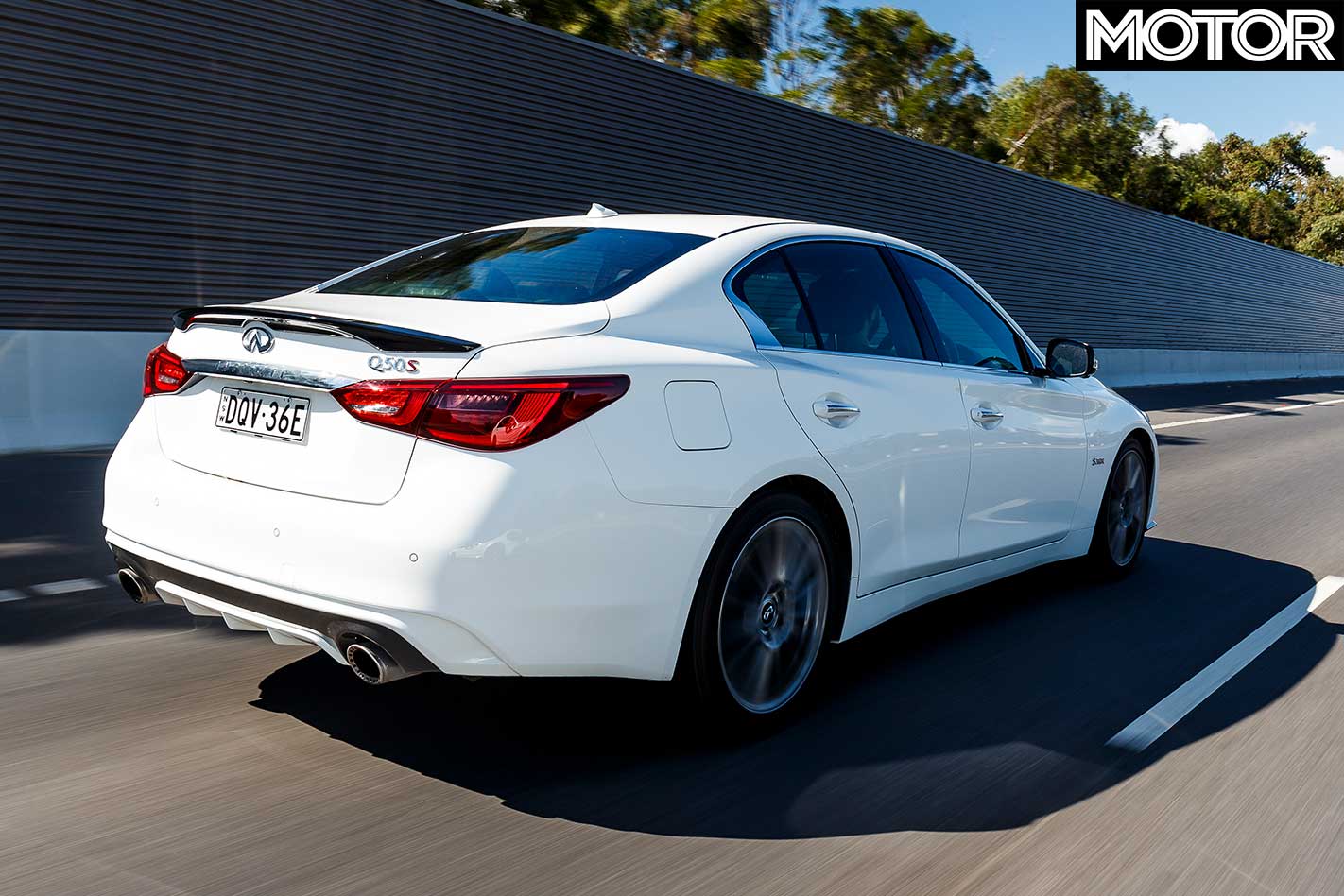
Yet, last month I punted the Infiniti through some corners and I didn’t enjoy the experience. Its steer-by wire steering was vague, its tyres didn’t grip, and its suspension could never keep its weight settled.
There was power, heaps of it, but that doesn’t fully satisfy the ‘primitive’ feeling we crave from fast cars. It left me confused with Bancon’s thorough understanding of our automotive psyche.
It sent me in search of the bright side of this long termer, or some love, so to speak, to cure the blues it gave me in the corners. Some solid highway time was pencilled in as the fix, which would give me time to meditate on driving without throttle steer or trail braking.
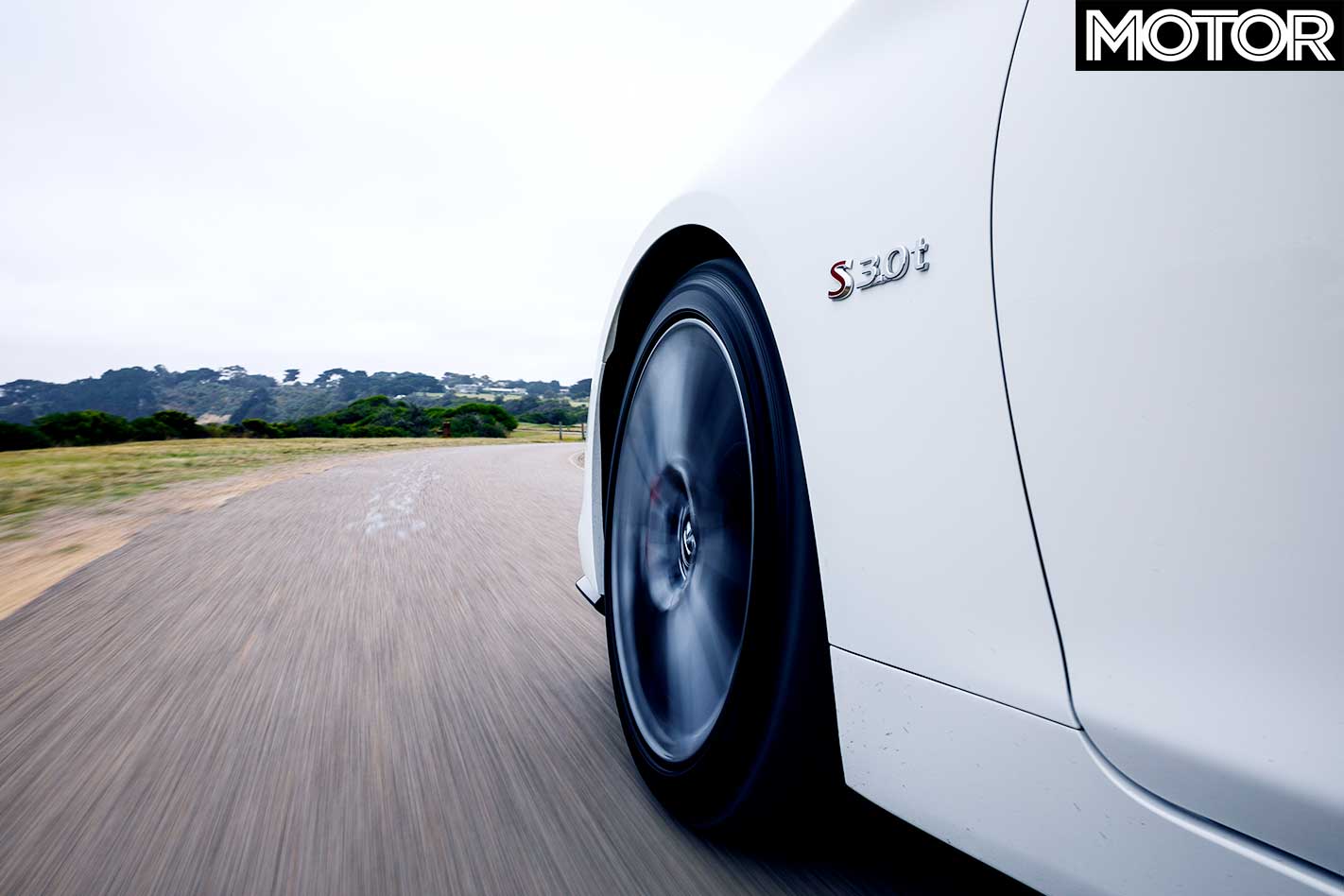
On the highway you feel like you could definitely live with the Infiniti as a day-to-day cruiser. Its ride, for one, is plush with plenty of suspension travel. Yes, a lack of body-control (at least in standard mode) means the car takes a while to settle, but it gives the car’s primary ride more compliance than those Dunlop run-flats deserve.
Brake-pedal feel is good, too; it’s full of feedback and power. Meanwhile, the Infiniti’s headlights are great. The spread of light is long, bright, and low to the ground, perfect for approaching cars without intimidating them.
The Q50’s power is fearsome. That twin-turbo six always seems on call – if you can get the throttle input right – and rushes into its power band almost instantly with minimal lag. In standard mode, 80-120km/h vanishes in 3.2sec.
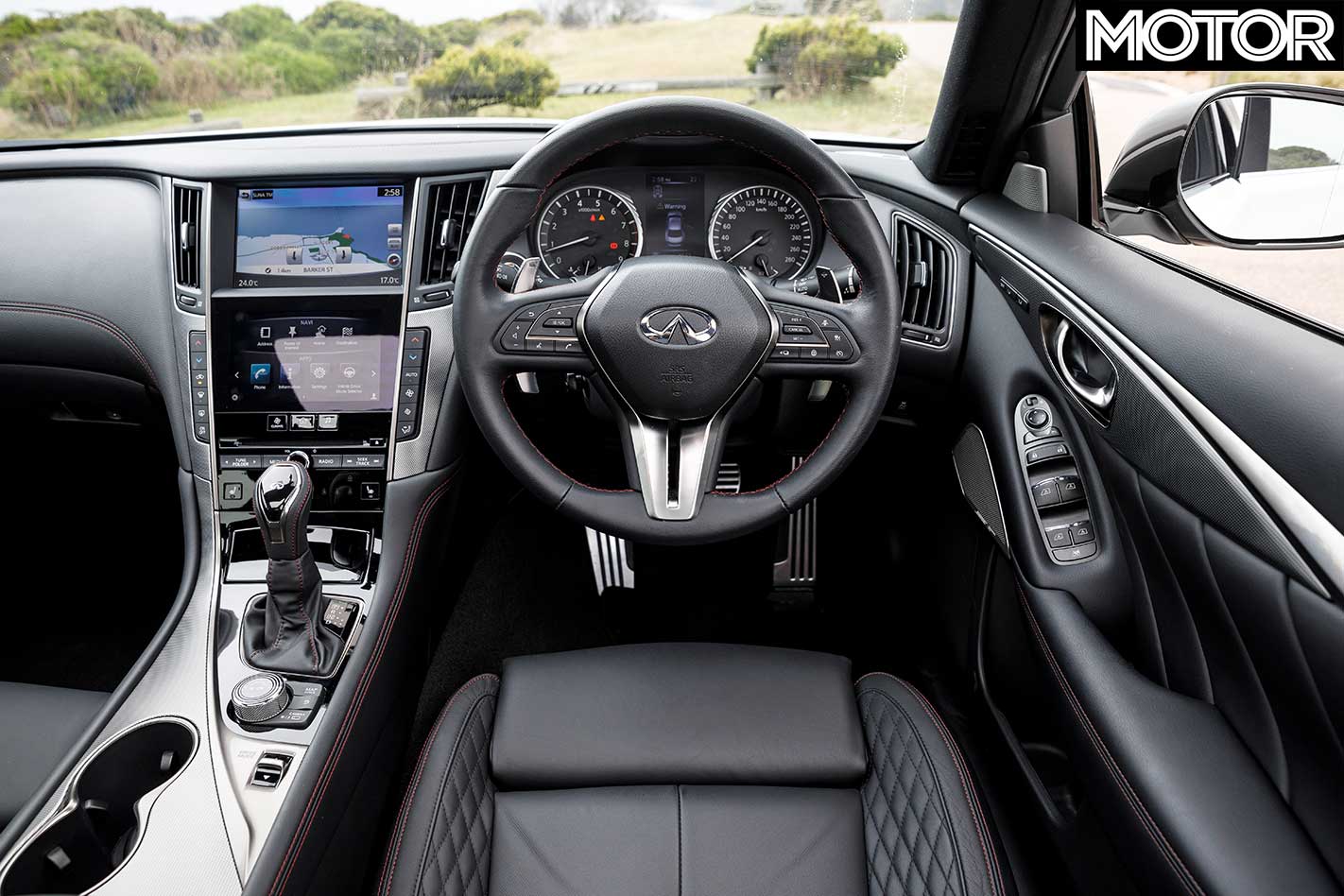
The interior’s a mixed bag. There’s generous leather splashed around, with semi-aniline dead cow under your rump, and metal speaker covers to make it feel fancy enough at this price.
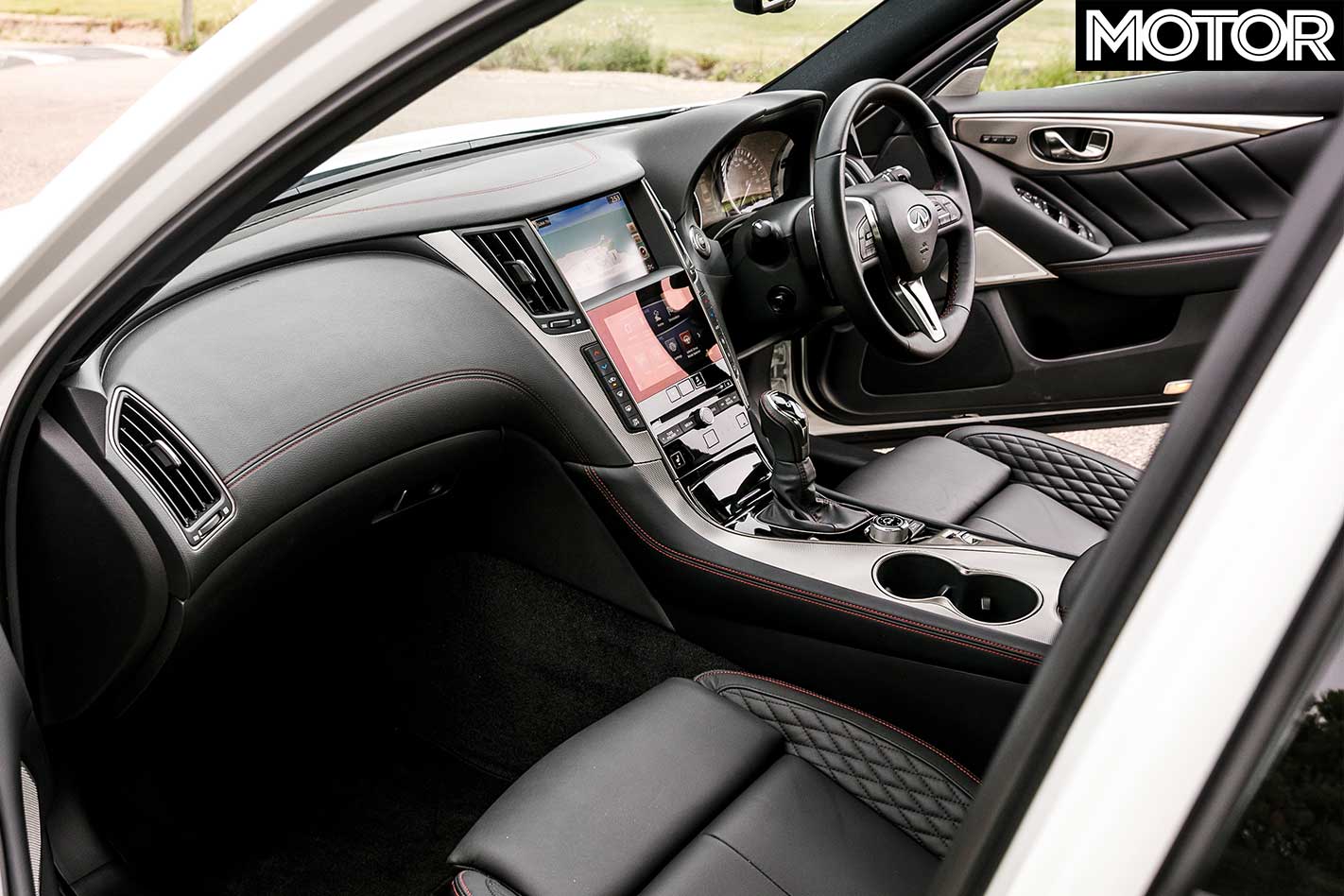
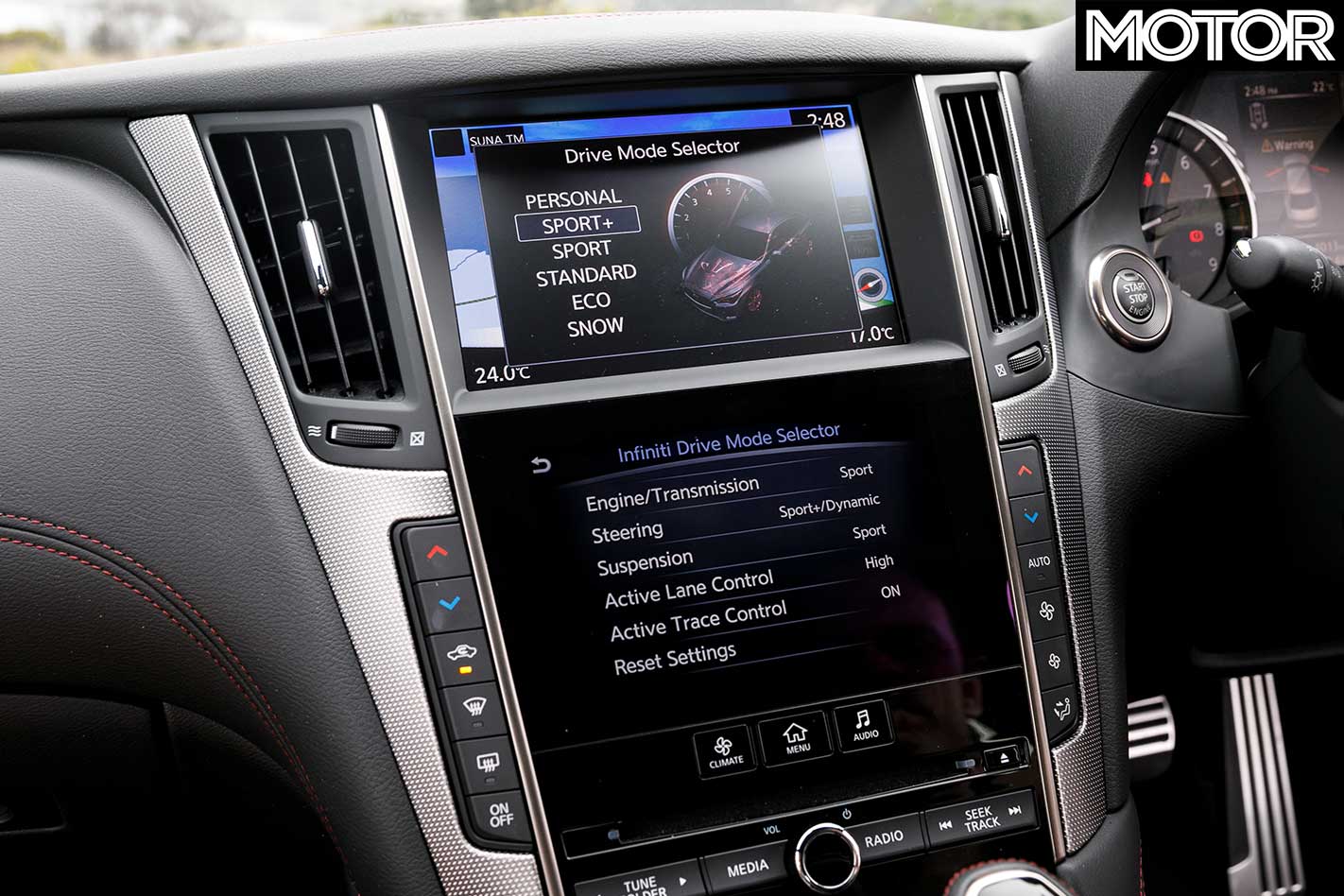
On the other hand, the foot-operated park brake, Windows 2000-esque LCD in the dash and sat-nav, and fat horn button hint the five-year-old interior’s getting on a bit. Ergonomics, however, don’t age. And the Infiniti acquits itself well in this regard. There’s plenty of room between the seat and door for your hands to adjust the controls, while everything is within easy reach and easily spotted.
Functionality is not as simple, though, as it’s difficult to know what controls what. The top-screen seems dedicated to navigation, but will display HVAC stuff. Meanwhile, the bottom screen, seemingly dedicated to everything else, can program sat-nav.
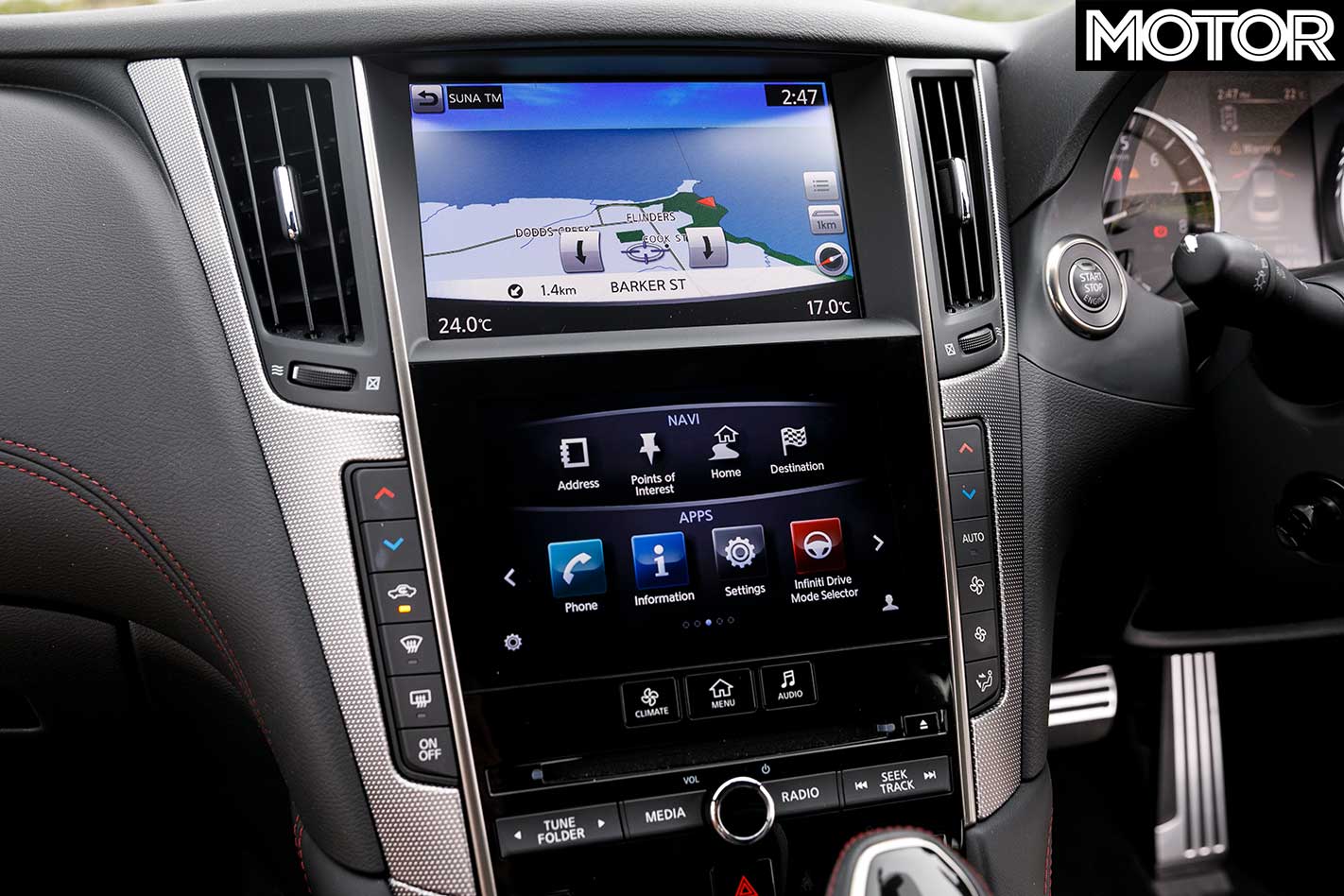
I like that its (adaptive) cruise control displays your set speed on the dash and the central LCD has a digital speed readout. I don’t like that it can hunt around your set velocity and you can’t set cruise if a car’s within the maximum radar distance until you decrease it.
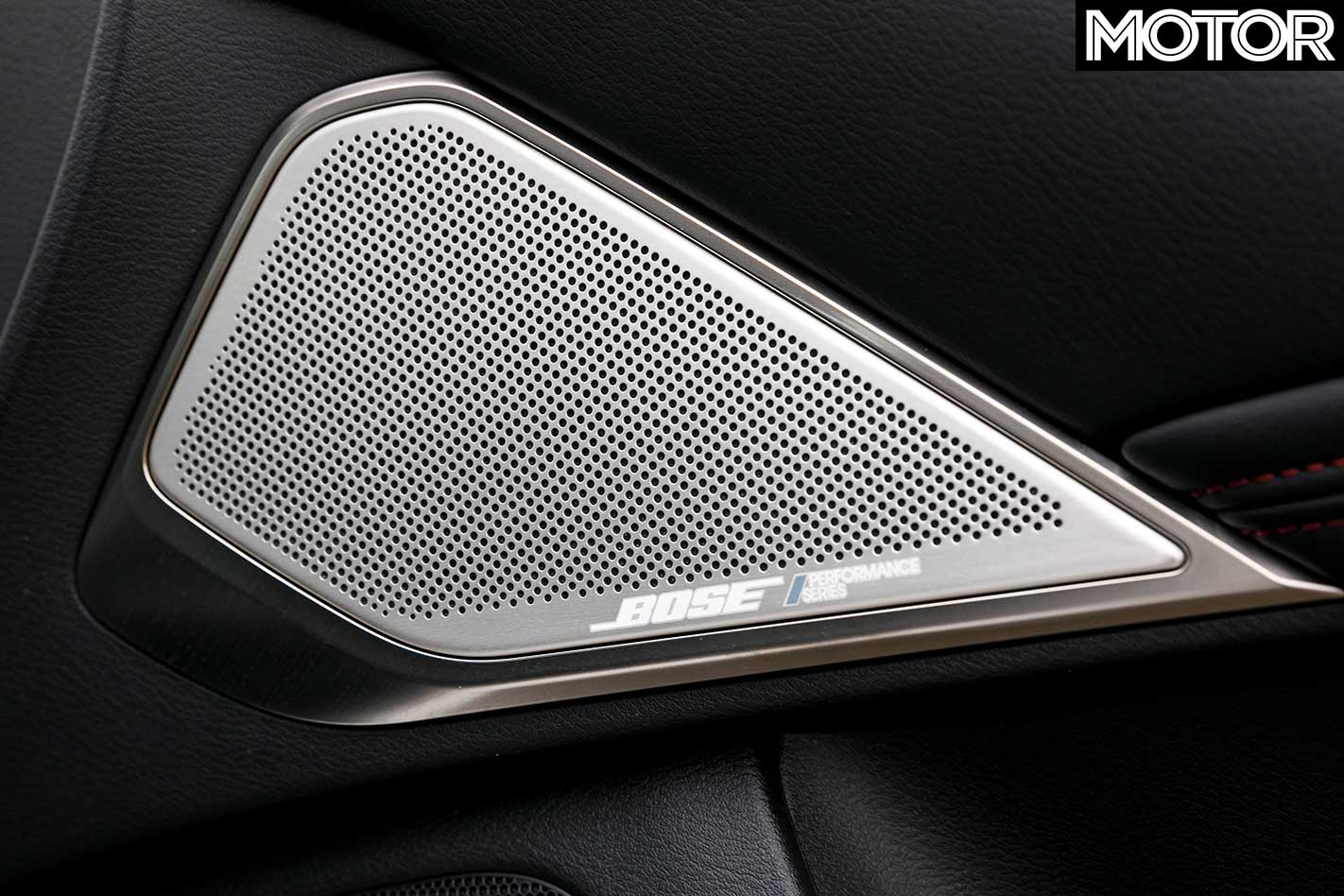
The BOSE sound system packs almost as many features as speakers (16!) and thumps with clarity. It’s not the last word on power, or fullness, but it’s worth a good song. You don’t get any botchy engine noise through the speakers at cruising speeds in standard mode, either. When up-it some colleagues rue the artificial engine note, but I can’t really tell it’s fake. I like it.
Seat-wise the hip-point puts me too close to the roof, and I’m only 178cm, however, the new seat foam is serene. The lack of bolster means they’re big-bloke friendly, too. Which sort of sums up the car’s vibe: it’s a comfy cruiser that’s big on punch, and sprinkled with pinches of luxury.
Next month, it’s time to say goodbye. Before it goes, we’ll be asking the public what they think of our Infiniti at a glance. Let’s see if it can make a lasting mark.
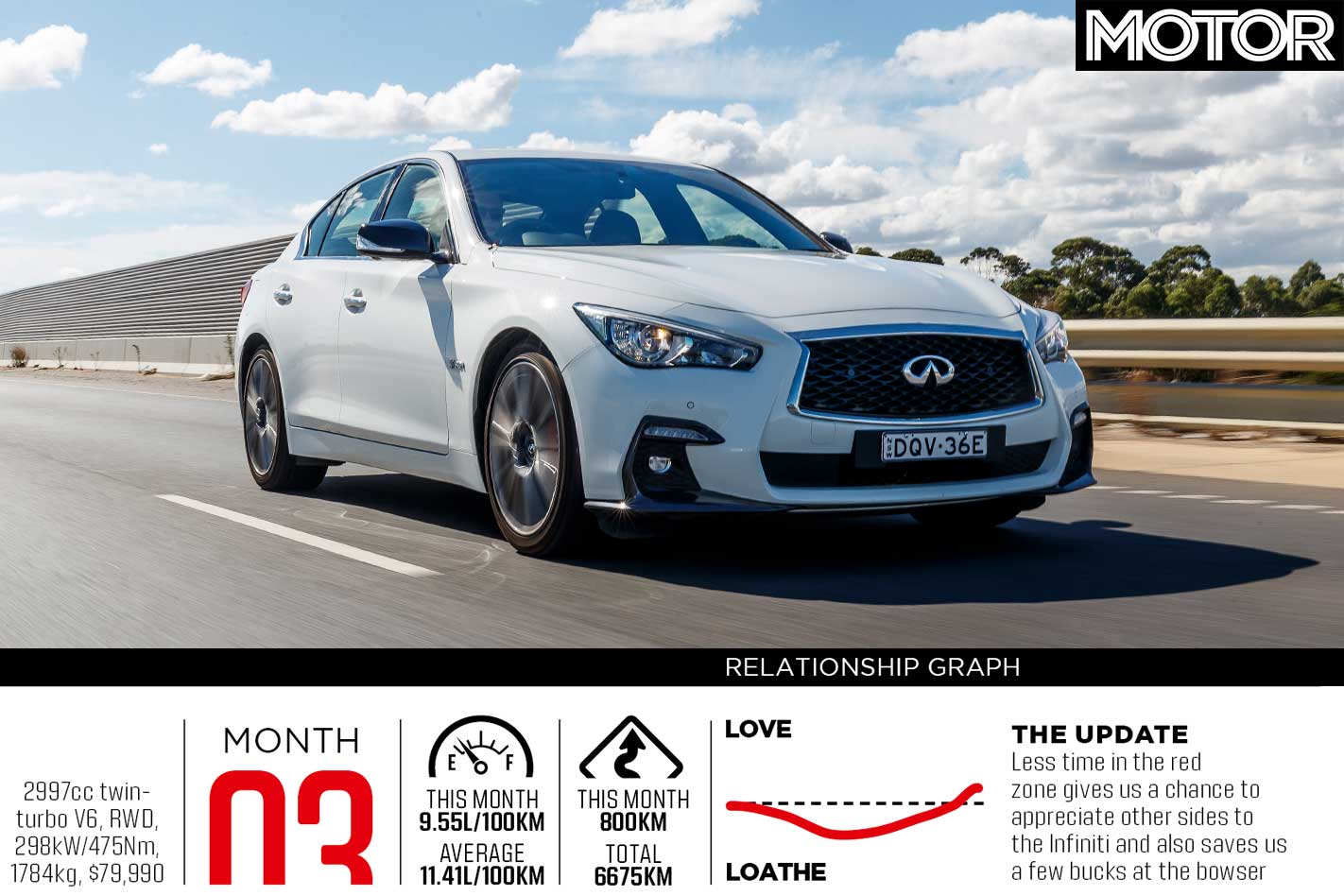
2018 Infiniti Q50 Red Sport Pros & Cons
Three things we fell for: 1 – Plush seats 2 – Gun headlights 3 – Brake feel
Three things we got sick of: 1 – Headroom 2 – Foot brake 3 – Sat-nav graphics
Update 3: The Drag Queen
Uncorking the Infiniti’s brutal twin-turbo V6
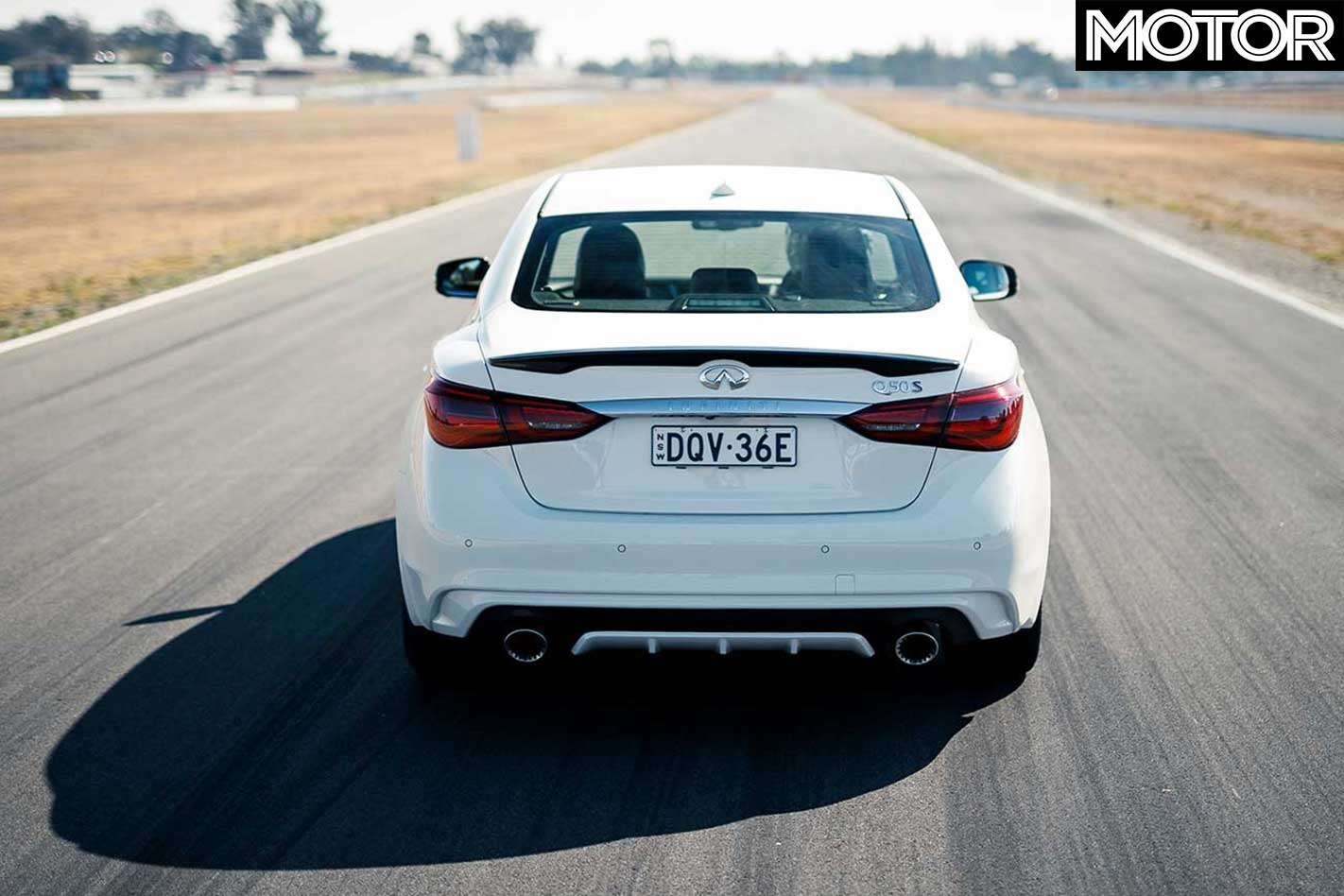
There are some serious rumours circling Nissan that say it’s given a 370Z successor the green light. And if there’s truth to the reports, then the Infiniti Q50 Red Sport is the biggest clue as to how this Mustang-slayer might drive.
That’s because the engine billed for the future Z car is mooted as our Red Sport’s very own 3.0-litre twin-turbo V6, complete with its current 298kW and 475Nm. Z fans might groan louder than pop’s sofa at the idea of a turbocharged Fairlady, but there’s not much they’re going to miss.
During recent testing for Bang For Your Bucks 2018 (coming soon!), we had the opportunity to play with the Infiniti while its testers were taking a tea break. Okay, we know better than anyone how allergic the Infiniti is to corners, but that VR30DTT in its nose deserved a chance to let its horses gallop in a non-policed environment.
With a drag strip laid in the middle of the infield, we took the opportunity to unleash the Q50 Red Sport up its guts a couple times. And boy, it gives nothing away to its naturally aspirated stablemates for response.
Each turbocharger gets its own intercooler. And because their radiator fins are bathed in water, rather than air, they can be placed anywhere without needing to consider incoming airflow – such as the top of the cylinder heads.
With the turbochargers nestled into each side of the 60-degree banked block, the charged air spouted by their compressors only have to make a short trip upwards into the V6’s plasma-coated cylinder bores.
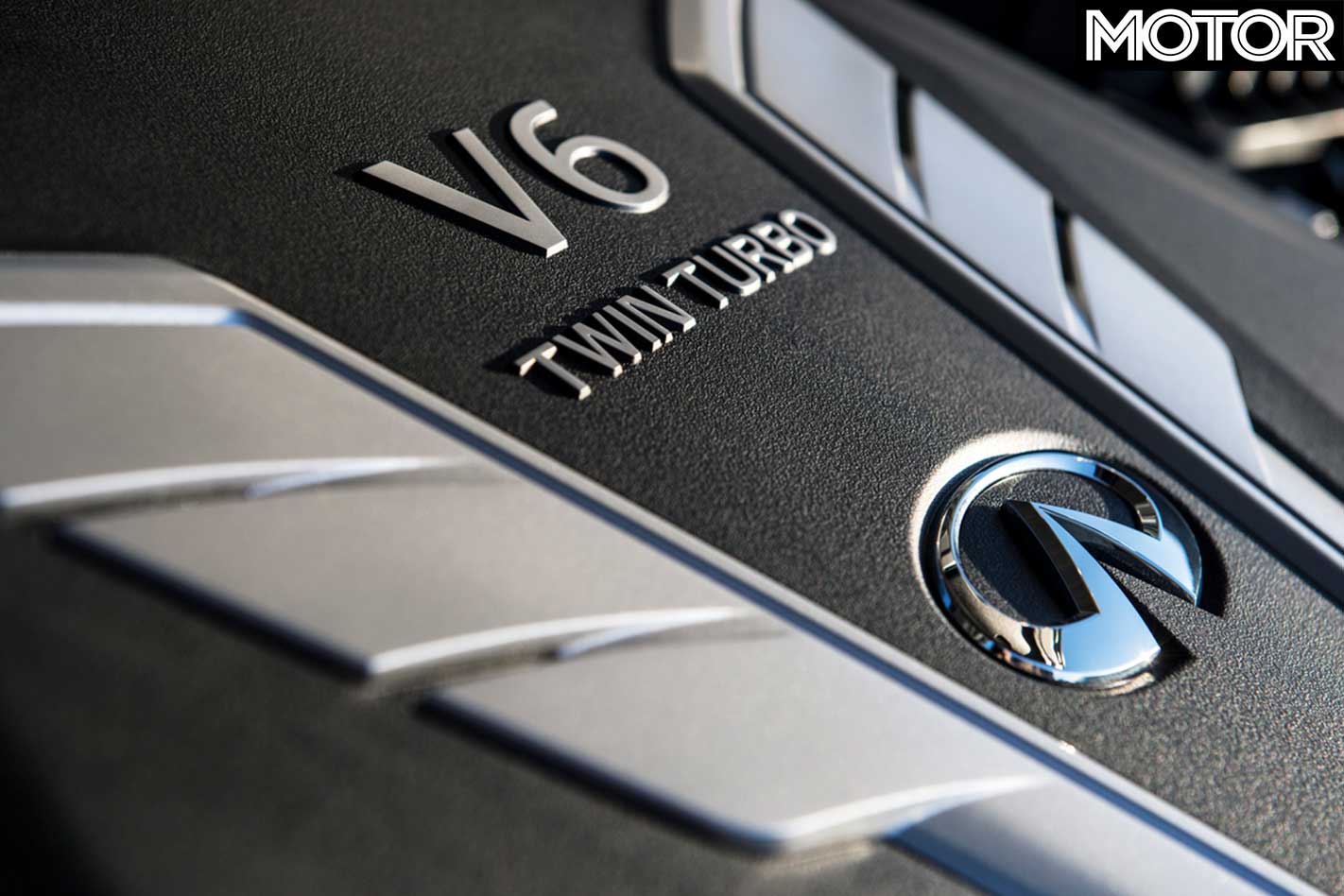
Last month the Infiniti proved it could fire from 80-120km/h in a lazy 3.2 seconds in the car’s Standard drive mode. In the car’s more frenzied Sport Plus mode, though, that figure drops to 2.8. The acceleration obviously isn’t 911 Turbo brutal, but it’s rapid enough to halt your breath if you haven’t uncorked a fast car in a while.
Extending the measurement to 400 metres only reaffirmed how much of a rocket the future Z might be. With a seven-speed automatic that’s brisk, but hardly the last word in speed, the Infiniti’s launch strategy is fairly straight forward. It’ll stall up to around 2700rpm on the brake before it starts to break traction, then when you let go it tears off with a bit of wheelspin. No doubt a result of the engine’s 475Nm from as early as 1700rpm.
This turbo six mightn’t match the brawn of FPV’s late Barra-powered bruisers, but with the Infiniti’s 1784kg kerb weight undercutting those rigs by at least a rugby prop, it makes best use of its healthy power peak. The secret is ‘optical speed sensors’ on the Q50’s turbochargers. They’re claimed to increase the impellers’ maximum speeds to 240,000rpm and power to 298kW.
We once asked Infiniti Australia how they actually work and unlock more power, but we’d need a few more pages to explain it.
Either way, letting the Q50 scamper off the line drops 60km/h in 2.89 seconds, 100km/h in 5.37sec, then the quarter mile in 13.5sec at a recorded 175.22km/h. Quick, but we knew it could go faster.
Next run we reinstate ESP to tame the rear-end and after a soft stall-up 60km/h flashes by in 2.73sec, 100km/h takes 5.12sec, while the quarter mile drops in 13.23sec at 178.km/h. But it still wasn’t getting the best launch. So we switched strategies for the final run, opting to walk it away from the line.
The final run nailed it. It takes 2.5sec to clip 60km/h, 4.9 to 100km/h, and then 13 flat to pass 400m at 179.58km/h. Just a little bit of slip permits the right amount of traction as its rear 245mm Dunlops hook up.
Away from the actual Bang For Your Bucks results (the Infiniti took part in the 15-car strong competition) the Infiniti stacks up as a seriously quick car that’ll scare a few regulars at the local dragway. Roll-out would slash its times into 12-second territory. Pack it into a time machine and deliver it to previous Bang For Your Bucks, and it would even spank a 304kW Holden SS-V Redline Ute or a 345kW Ford Falcon XR8 Sprint.
Combine that punch with its demure looks, and the Q50 Red Sport presents as a genuine sleeper – something we love at MOTOR. But not every road is straight as the ones used here, and next month we’ll be saying goodbye (we delayed it by a month to tell this yarn) and weighing up its strengths and flaws.
Will we ever want it back? Stay tuned for the final verdict.
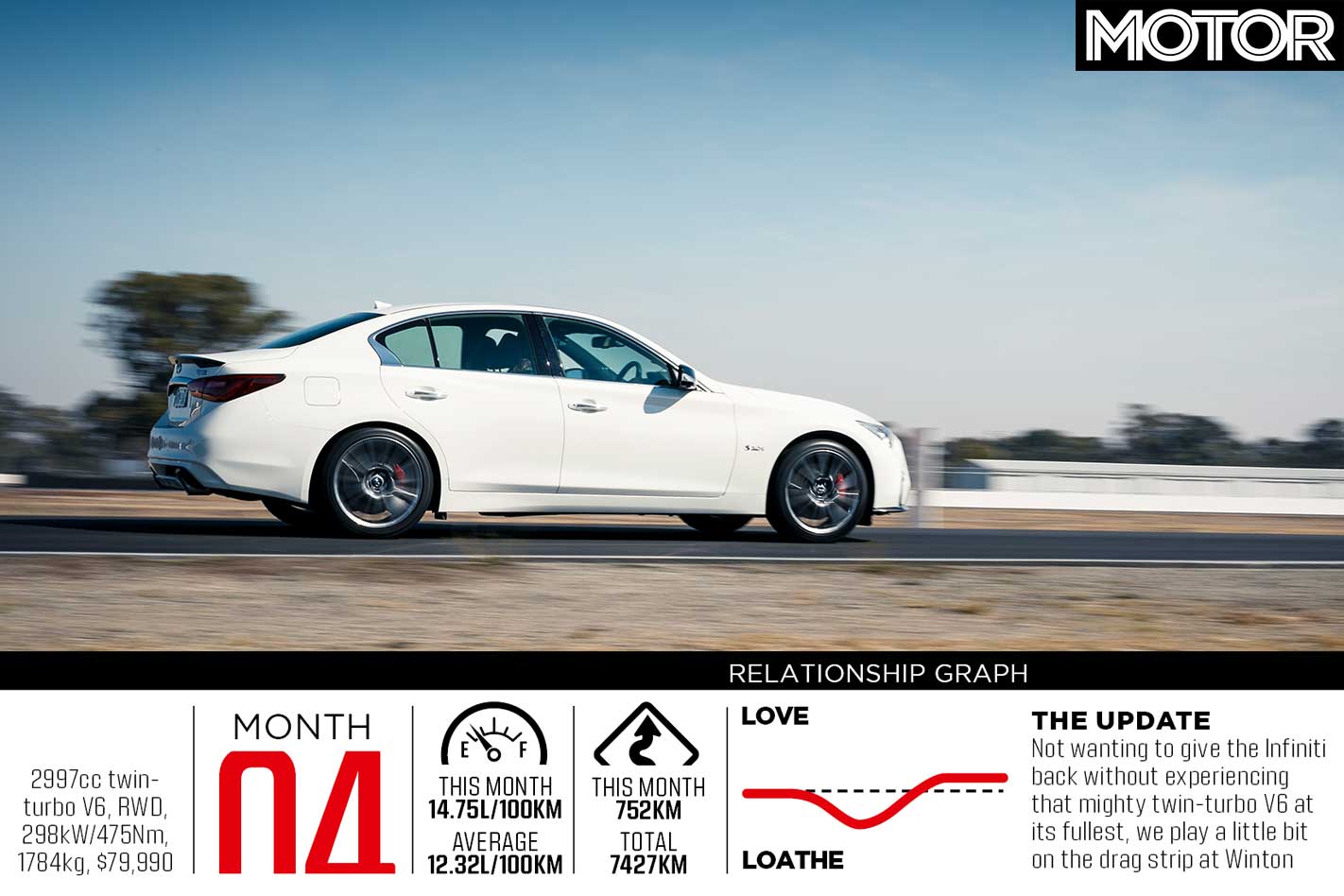
2018 Infiniti Q50 Red Sport Pros & Cons
Three things we fell for: 1 – The acceleration 2 – Heated seats 3 – Good looks
Three things we got sick of: 1 – No steering reach 2 – Thirsty engine 3 – Dated interior
Update 4: Conclusion
Mixed feelings follow our Infiniti out the door
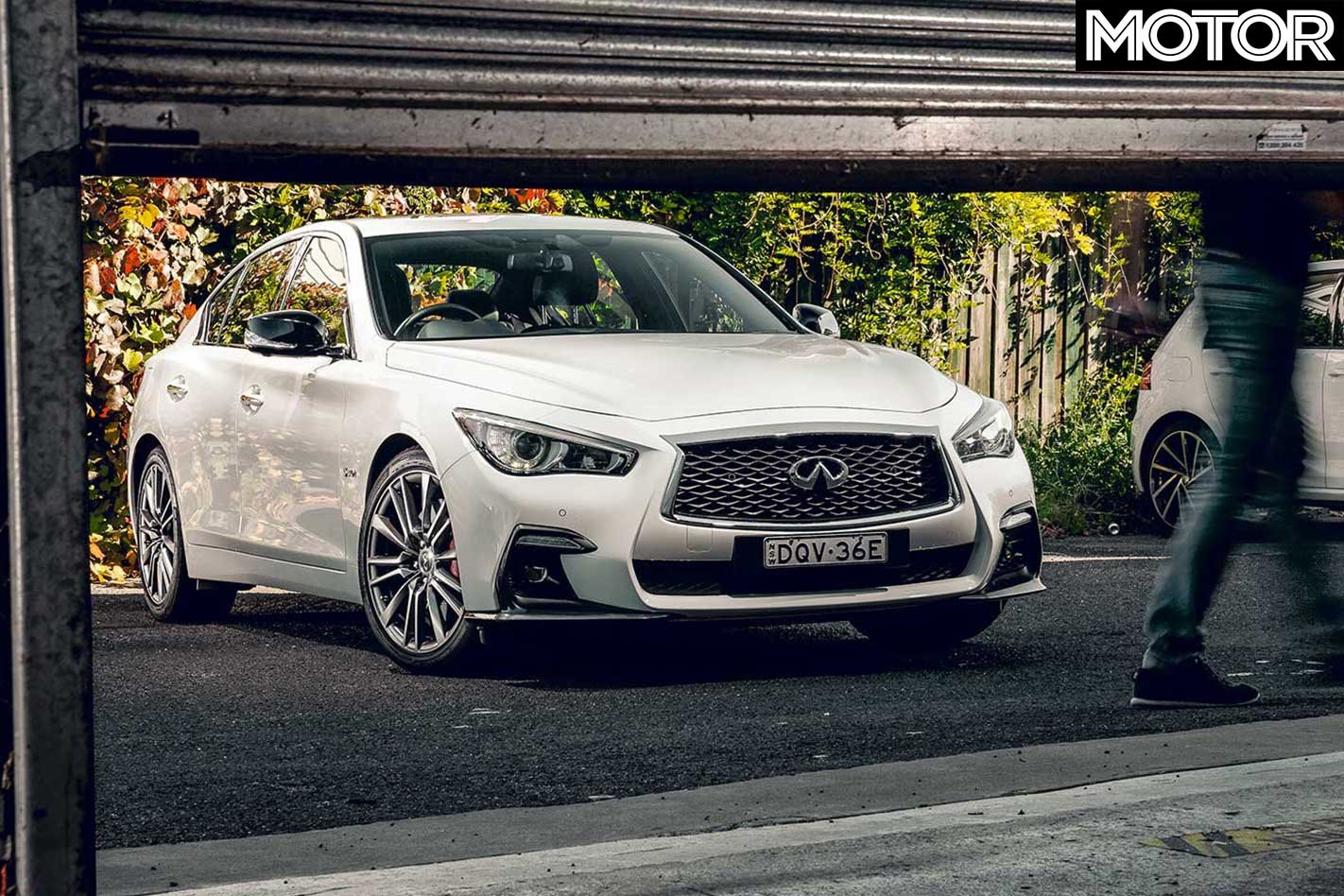
The Infiniti Q50 Red Sport isn’t MOTOR material. That’s the brutal, yet truthful, summation on DQV 36E after five months in our garage.
Sure, it’s a goer. That hulking twin-turbo six powertrain ensured easy sub-5.0sec runs to 100km/h and 12.0sec quarters at Bang For Your Bucks.
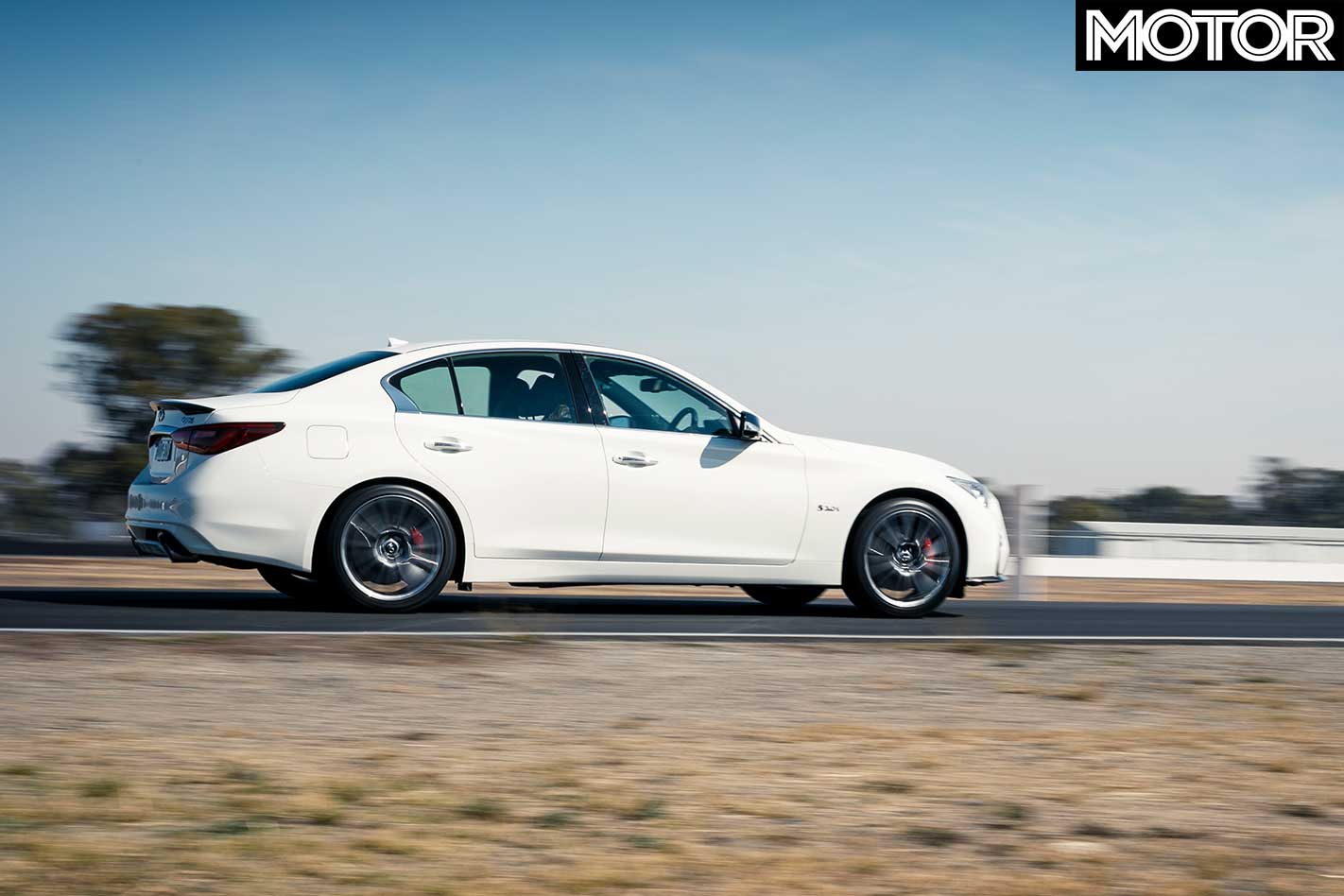
This makes it a weapon from traffic lights. It will lazily squirt ahead of an A45 or RS3 if neither has programmed launch control when the trees flash up in green. But this behaviour quickly works up a thirst.
Our chunk of driving has been commuting to and from work, with racetrack testing, highway driving, and cross-Melbourne runs mixed in along the way. This saw it sink 11.8 litres of fuel per 100km on average, with a peak of 14.75 one month, which is hardly criminal for a powerful twin-turbo V6 and better than what we managed in our resident Ford Focus RS LE.
If you’re watching fuel bills, though, don’t think you can help that with careful throttle inputs. The car’s Eco mode activates a pedal which pushes back against excess pressure, but is annoying and switched off almost immediately. On the other hand, Sport Plus mode holds engine revs way too long while the seven-speed automatic can shift a bit clunkily.
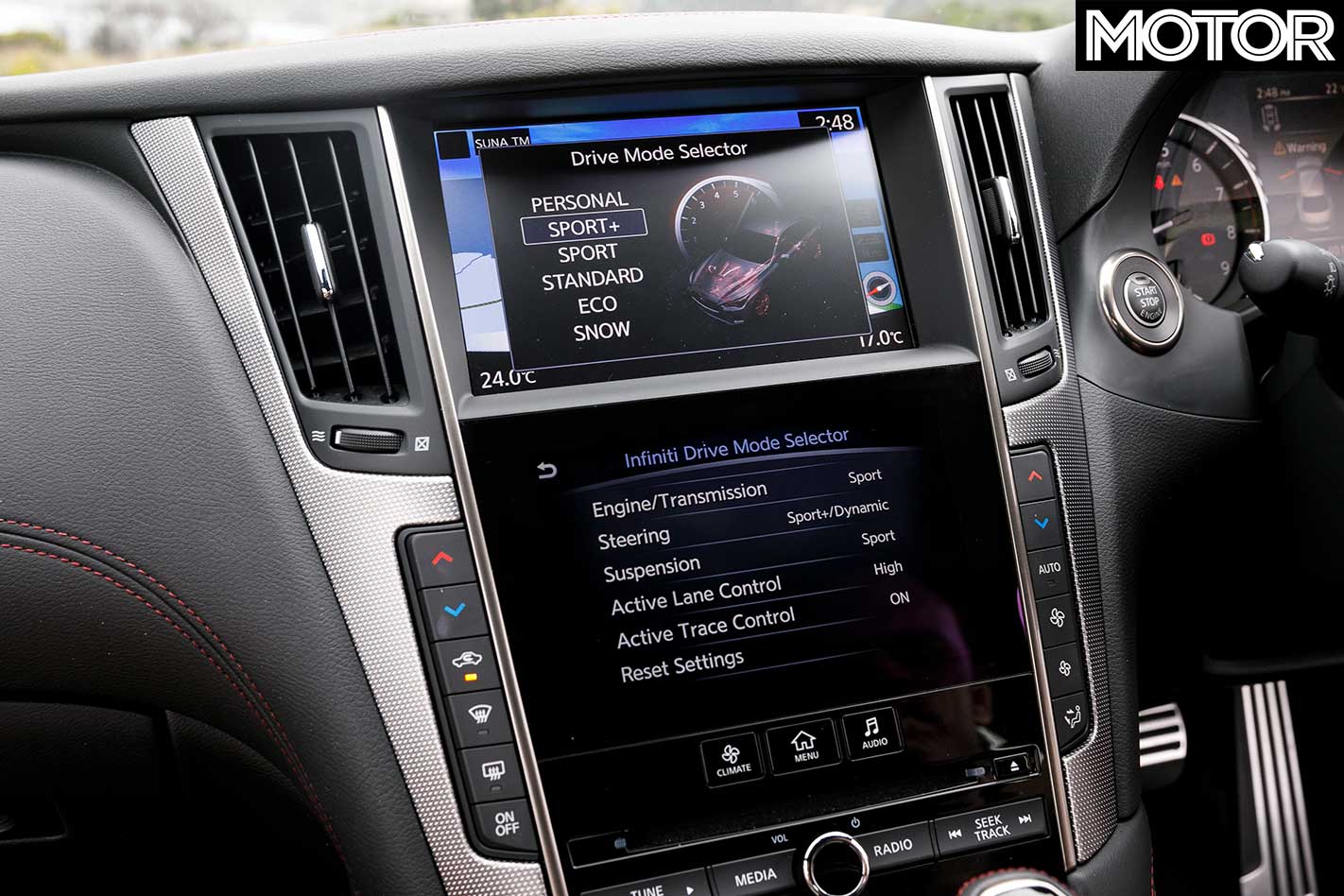
You instead settle for Standard mode and its poor throttle calibration. Here you constantly feather between 10-20 per cent throttle as the powertrain either gives you too much thrust, or too little like it’s developed lethargy.
We’ll happily admit the Q50 is a decent looker in Red Sport form. Even though its Pure White hue sucks the contrast out of its sculpted surfaces while other colours bring them to life.
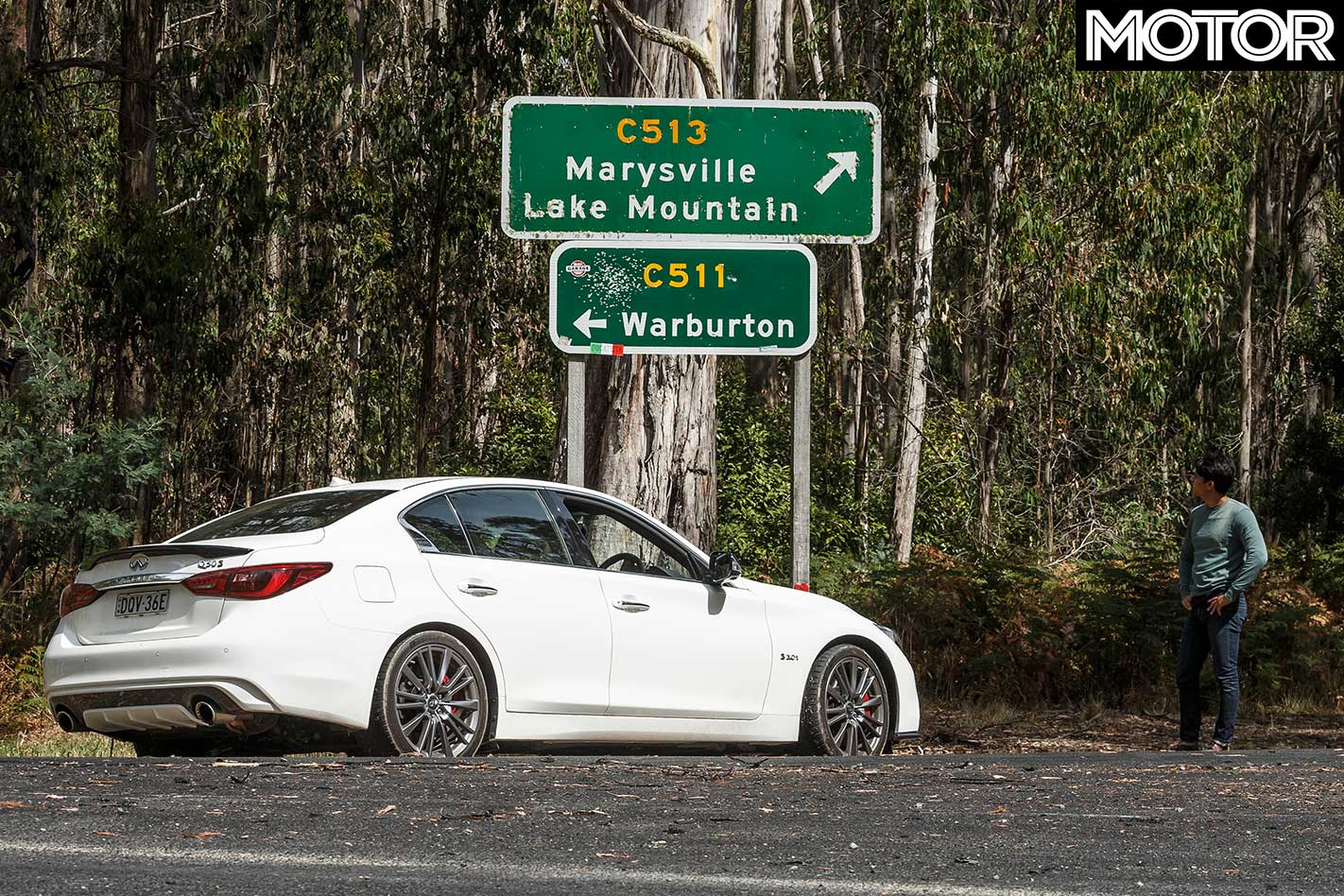
But stay away from corners. The brakes don’t last long against the massive velocities it can reach, as Luffy bravely demonstrated at Winton Raceway. The run-flat tyres aren’t exactly sporting, either, and that steer-by-wire system is worse news than Y2K for keen drivers.
Yes, the steering has been easy enough to live with on Melbourne’s grid-like streets, but it’s hopeless when any precision is required or feedback is wanted. Which is all the time on a racetrack, curving road, or when you need to park in a tight space.
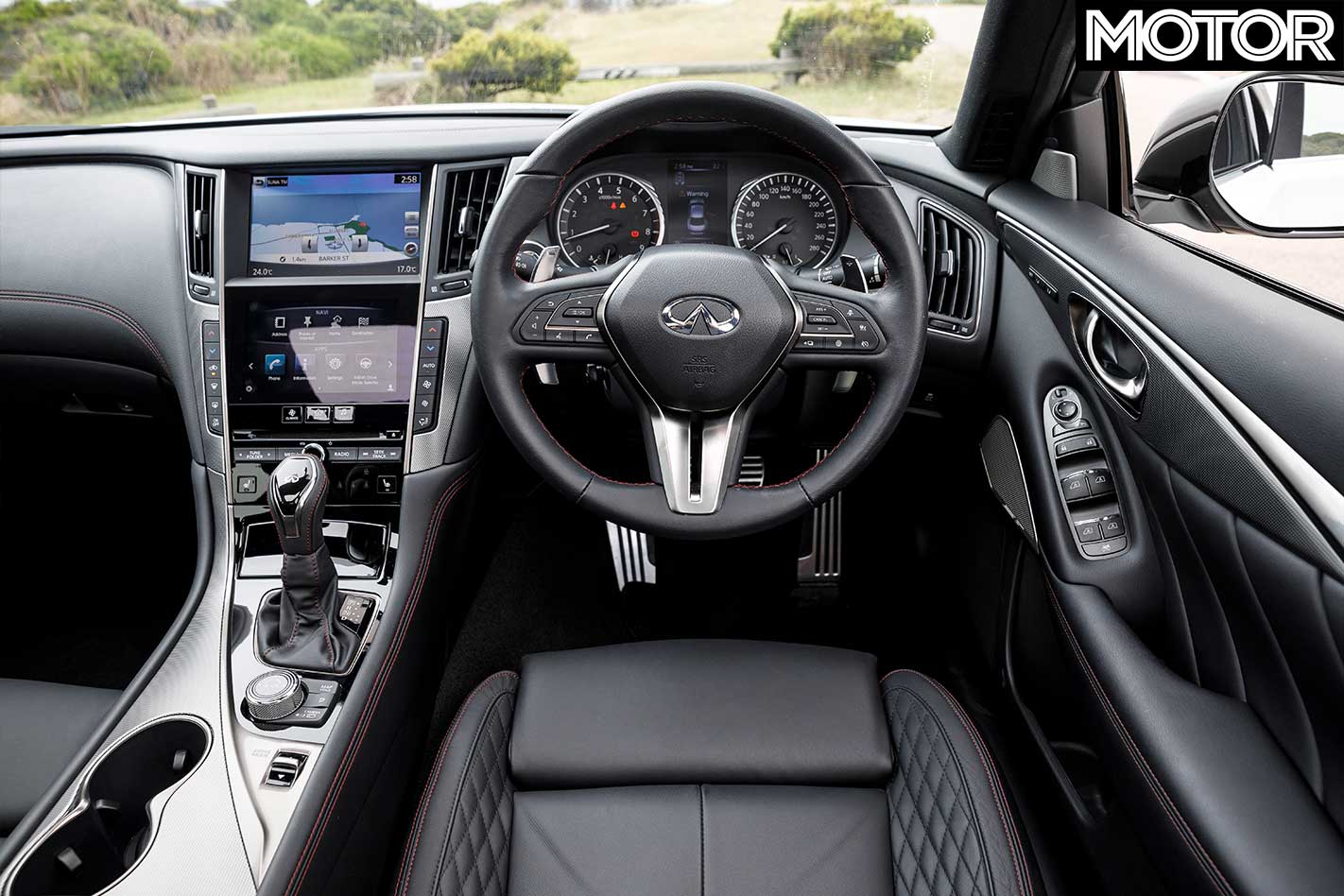
Perhaps more unsettling is how much control the dual-motor steering rack hands to the myriad safety systems. There’s everything from active-lane control that silently adjusts your steering angle in the background at speeds over 70km/h, to activating trace control that does the same for brake pressure (but reduces in Sport mode and turns off completely when ESP is disabled).
The occasional tugging at the wheel feels like you’re in something controlled by Skynet from Terminator, rather than you.
And that’s why this isn’t a MOTOR car. You can sense the Q50 was created to prioritise autonomous technology rather than the needs or wants of the driver. That fearsome engine bolted between its strut towers feels more like an afterthought, fitted because someone could, rather than because they should.
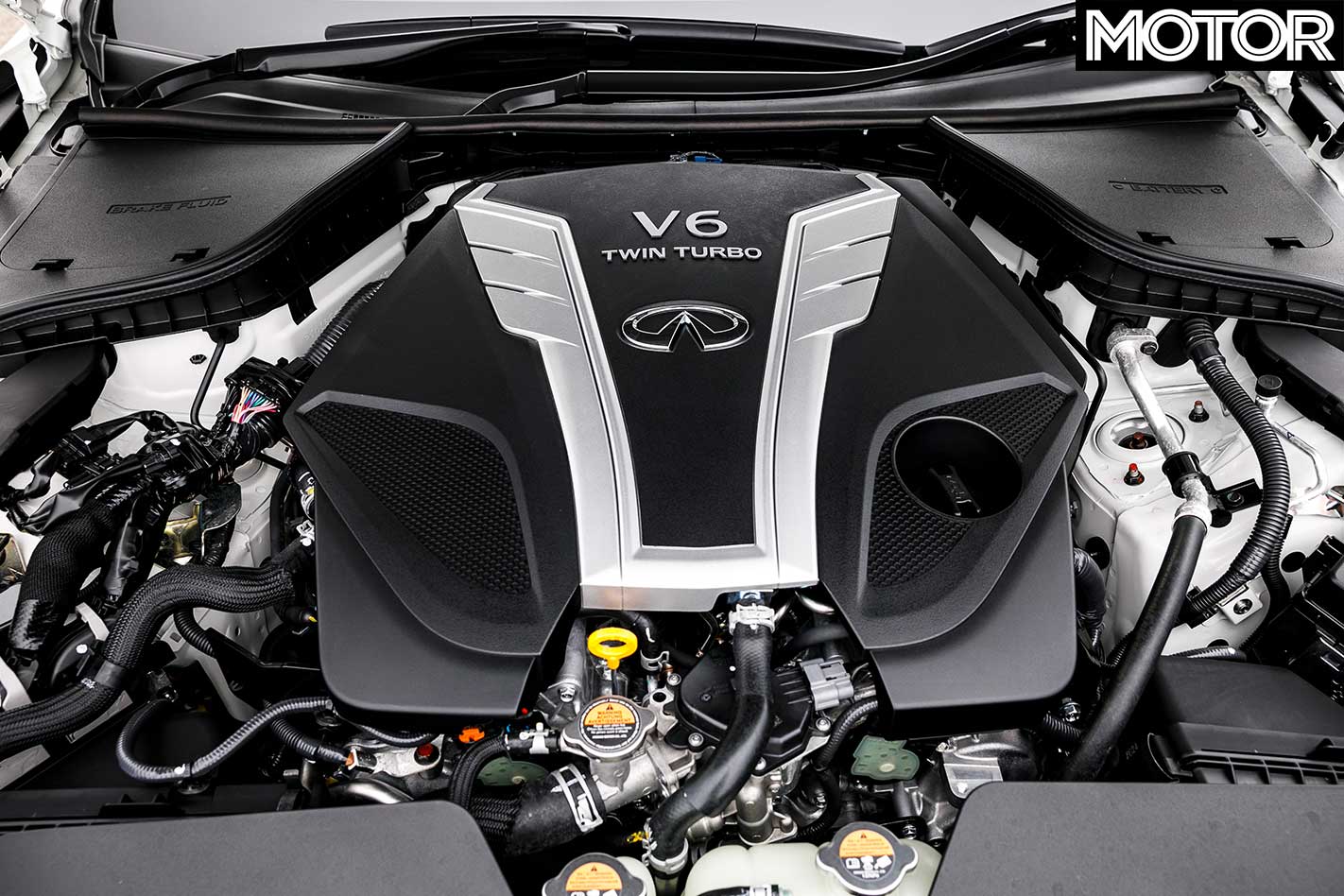
We marvelled at Infiniti’s bravery in handing us the keys to a Q50 Red Sport. We didn’t exactly fawn over it in our first review. Nor did we give its sexier cousin, the Q60, much love in a three-way comparison against chief European rivals.
Frankly, we wouldn’t buy one. A BMW 340i isn’t sparkling with driver connection and it costs $10K more, but it feels so much more resolved and freshly designed – it’s hard to believe the current 3 Series is actually two years older than the Q50.
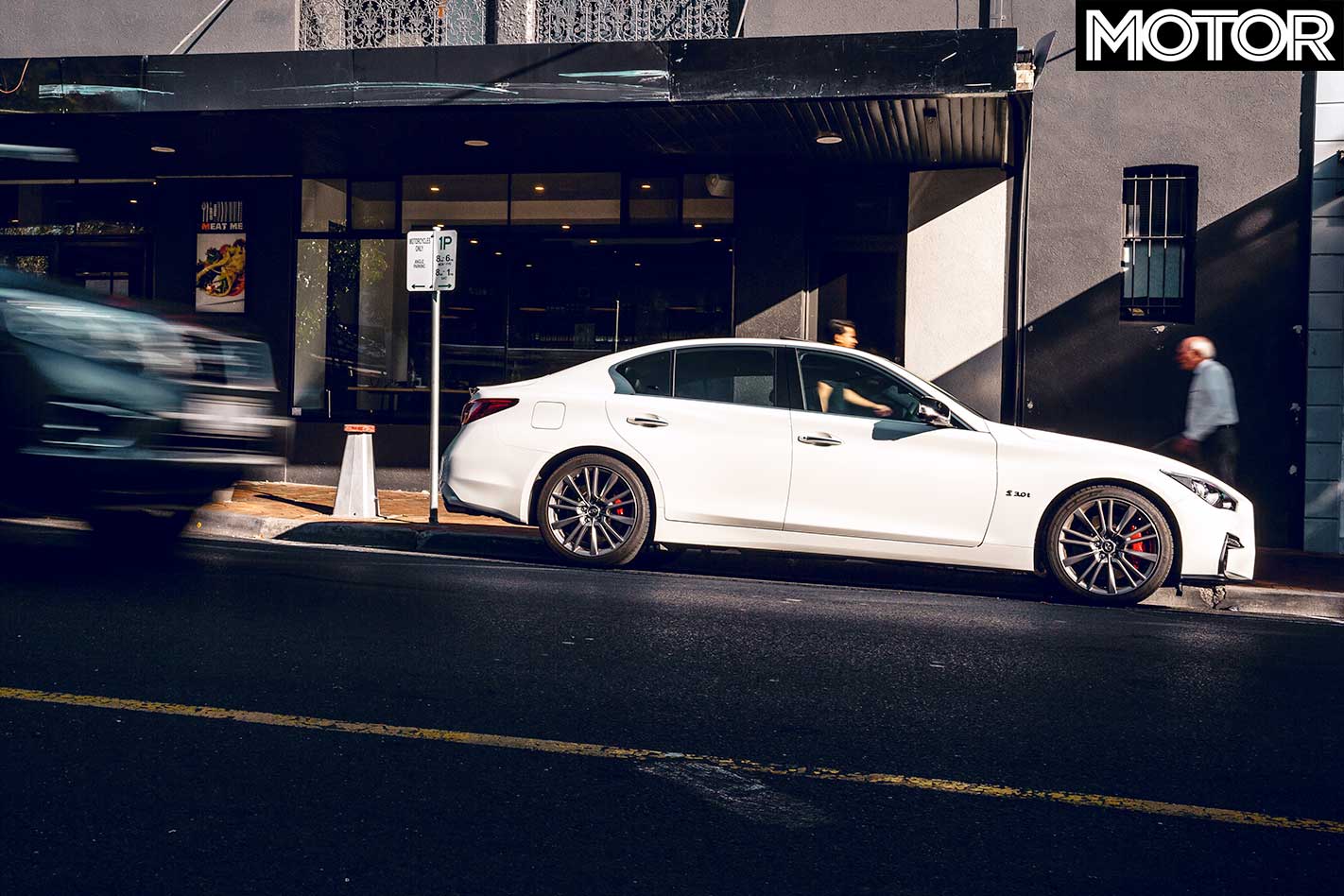
It could ruffle a few feathers at the local drags, but this is not a car that would make us look forward to a weekend fang. We’d wait to see what comes of the rumoured Z replacement and the news it will use this exact twin-turbo six.
If you want a well-priced sedan with cracking power and good safety tech, we’d pocket $20K and look at a Kia Stinger GT. It’s a little bigger, but it’s just as fast, steers better, and champions the driver, rather than the computer, more than the Infiniti.
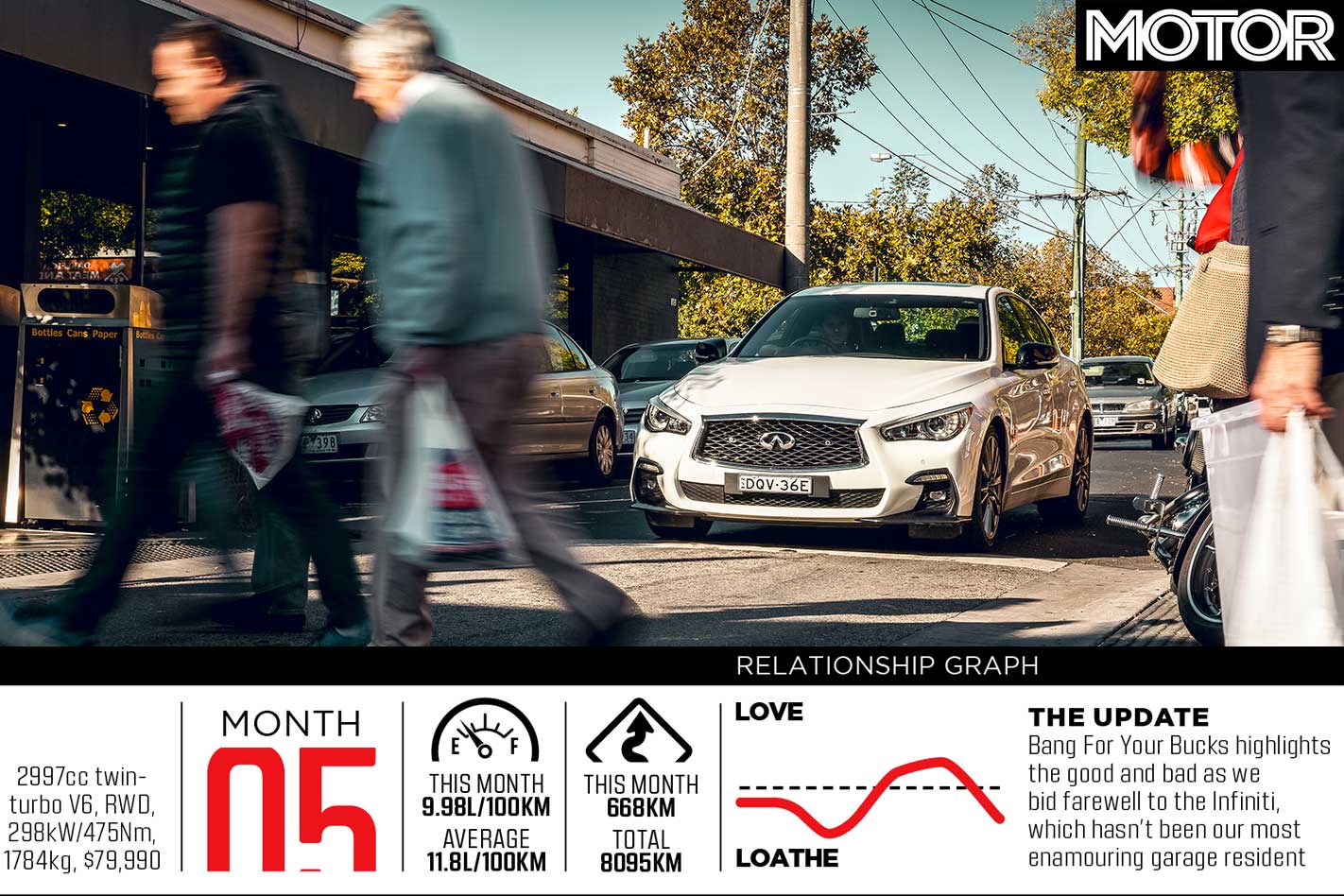
2018 Infiniti Q50 Red Sport Pros & Cons
Three things we fell for: 1 – The grunt 2 – Adaptive cruise 3 – Features
Three things we got sick of: 1 – Headroom 2 – Throttle tune 3 – Steering
The Jimny is one of Suzuki’s most iconic and longest-lived models, yet across the three generations sold here thus far it has retained a formula that is best described as “stubbornly basic”.
A ladder frame chassis, live axles at front and rear, and a proper 4×4 driveline with low-range gearing have been common elements throughout the Jimny’s history. Now, with the Australian arrival of the fourth generation now confirmed for late this year, get set for a Jimny that treads a more modern path.
- UPDATE: 2019 Suzuki Jimny Review
- UPDATE: 2019 Suzuki Jimny Price and Features
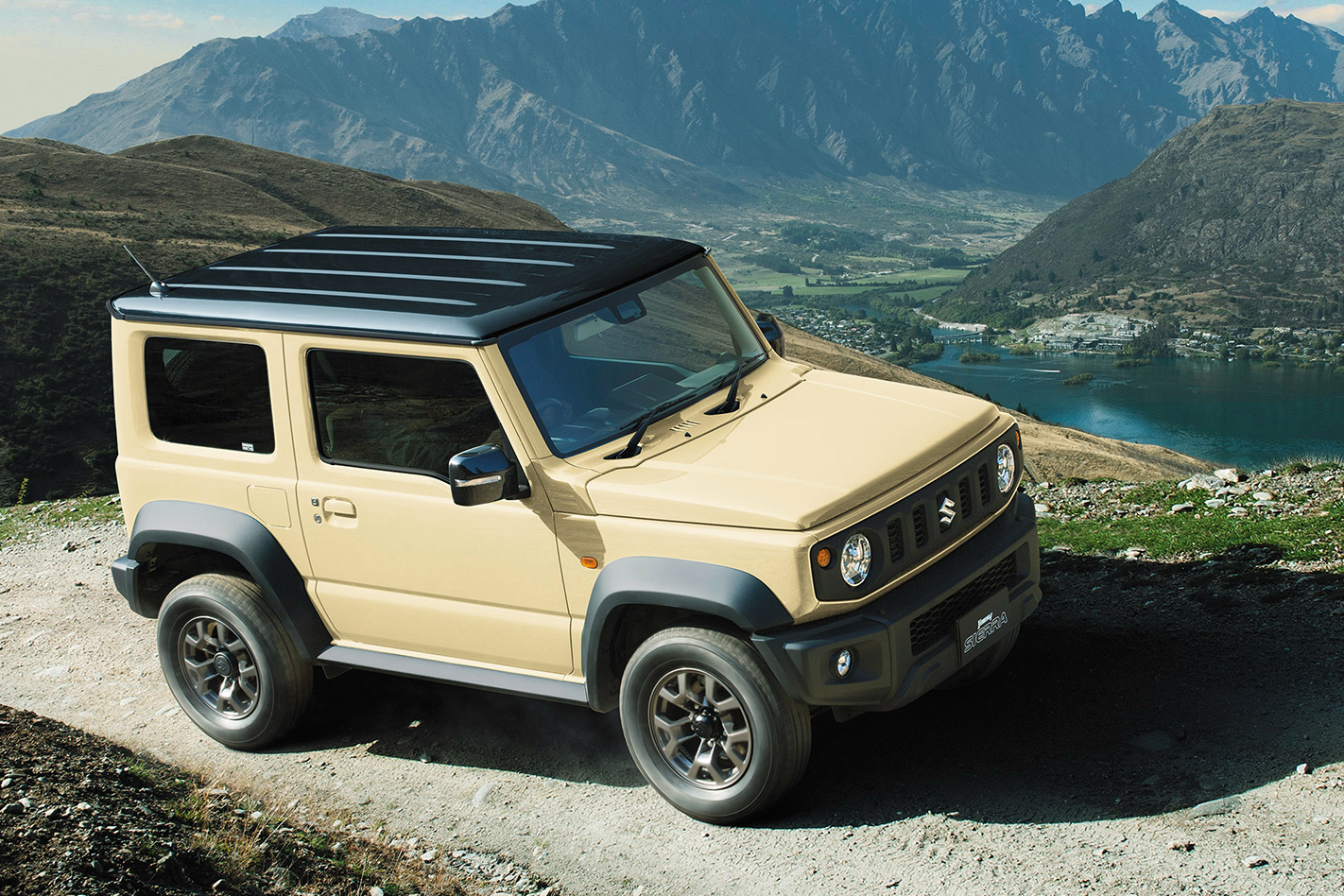
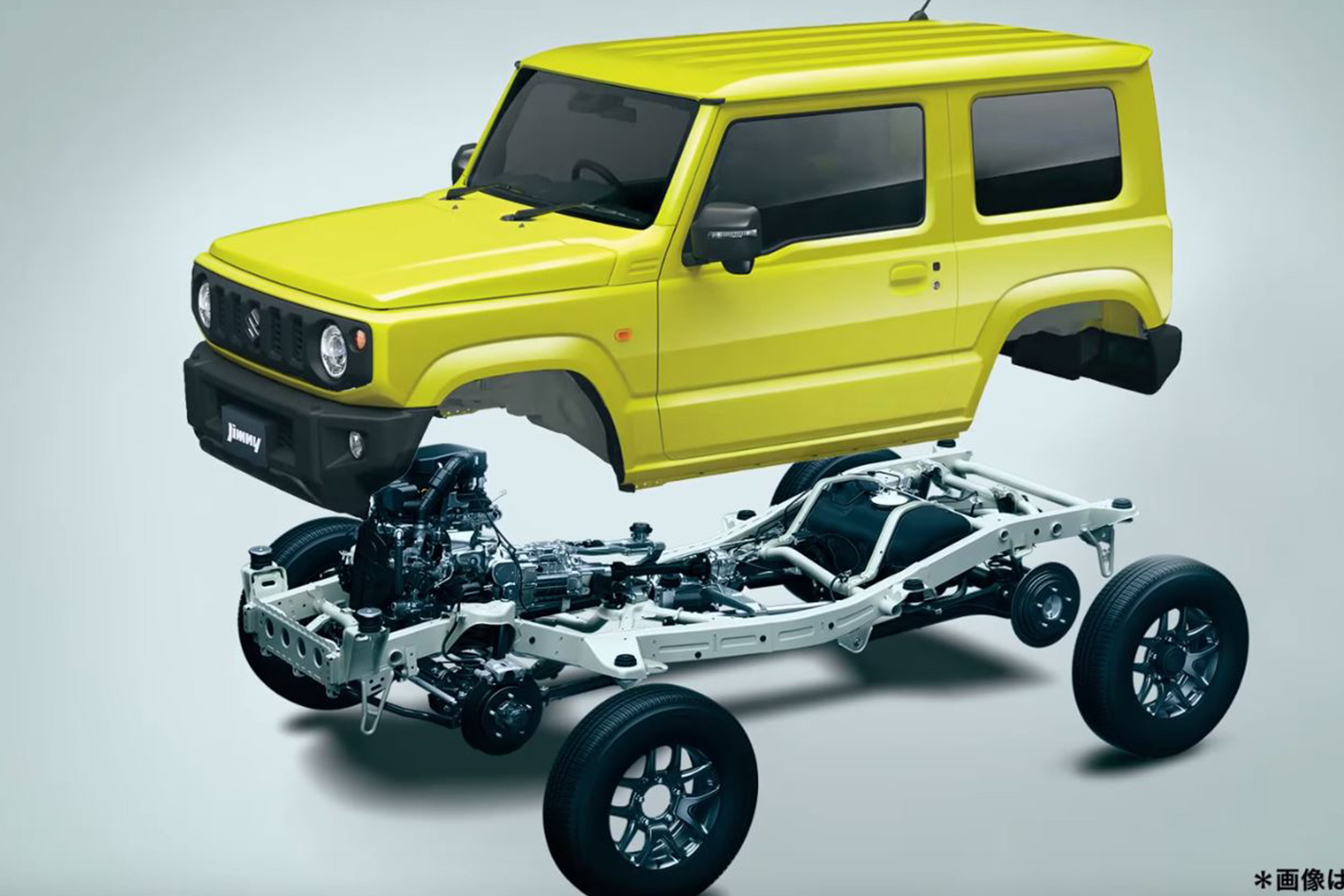
That’s not to say those rugged fourbie underpinnings are on the way out. Not by a long shot. The new Jimny might sit on a brand-new (and more rigid) chassis, but there’s still a three-link live axle at each end and a dual-range transfer case in the middle. It’s one of very few off-roaders to still boast such a configuration.
The real changes occur elsewhere. Some are subtle, like the body mounting bushings that are soft in a vertical direction for better comfort, but stiffer laterally to reduce pitching and rolling of the cabin. Others are more obvious, like how the tail lamps have been relocated to the bumper to enable a 1015mm wide and 850mm tall rear door opening.
There are more dimensional tweaks elsewhere, many of them quite significant. At 3645mm the new Jimny is actually 30mm shorter than the outgoing third-gen model, while at 1645mm it measures 45mm wider. Height is 15mm greater at 1720mm, while the 2250mm wheelbase is identical to the old car. At 1075kg empty, it’s just 10kg heavier than its predecessor.
Off-road credentials also improve. In Japan the new Jimny Sierra (which forms the basis for the Australian-market Jimny) boasts 205mm of ground clearance – a 15mm advantage over the car it replaces. Its approach angle of 36 degrees and departure angle of 50 degrees are 2 and 4 degrees better than before, though the new car’s breakover angle of 28 degrees is a backward step from the current Jimny’s 31 degrees.
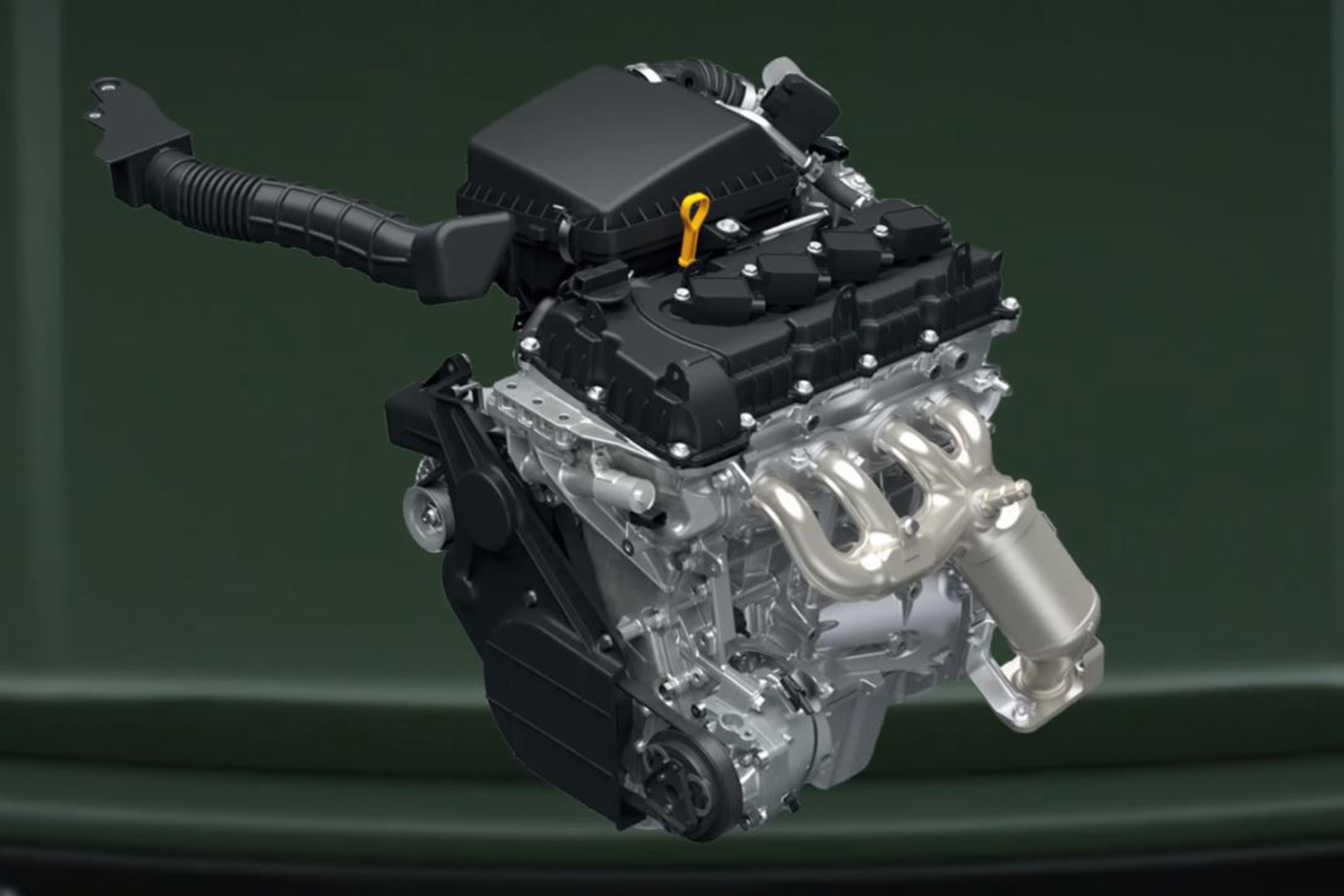
There are gains under the bonnet too. With a 1.5-litre displacement, the 2019 Jimny’s K15B naturally-aspirated four-cylinder has grown in size compared to the third-gen Jimny’s 1.3-litre M13A engine. Its 75kW of power offers 20 percent more urge than the old car’s 62.5kW engine, though it remains hooked up to a comparatively low-tech pair of transmissions: a five-speed manual, or a four-speed automatic. Both gearboxes have been homologated for Australia.
The manual may be lacking a cog relative to most modern three-pedal gearboxes, but the shifter mechanism is now more direct for better shift precision. The automatic’s lock-up torque converter should also improve shift feel and transmit more power to the road, while a steering damper on the front axle reduces vibration and steering wheel shimmy at high speeds to enhance stability. The turning circle remains an ultra-tight 9.8 metres, kerb-to-kerb.
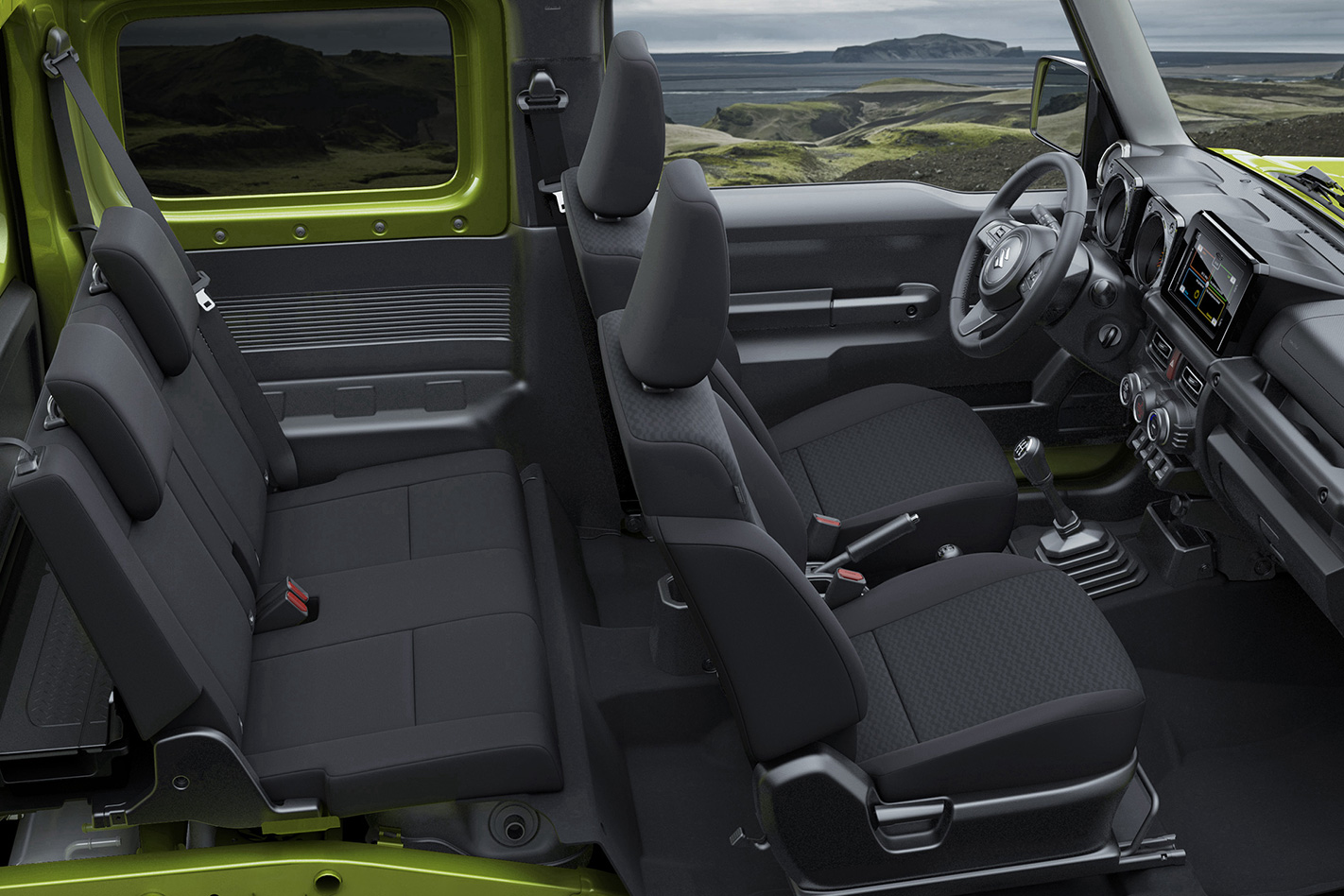
Driver assist features (which in the old car were limited to technology like ‘headlamps’ and ‘rear vision mirrors’) are bulked up, with the new Jimny available with hill hold control, hill descent control, an off-road optimised traction control system (which also works in low range), auto highbeam and autonomous emergency braking.
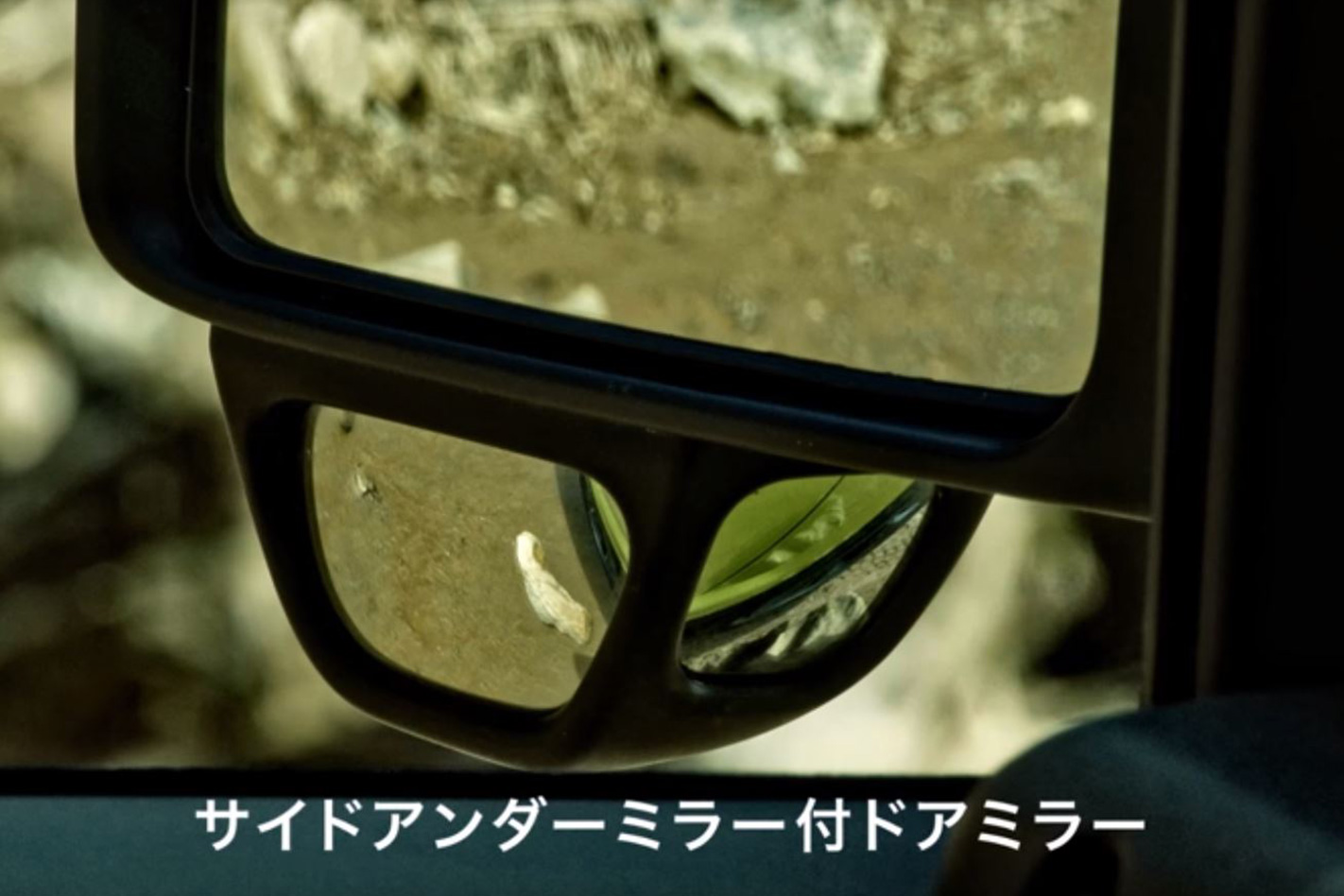
There’s also a refreshingly low-tech feature that should prove handy off-road: a pair of convex mirrors under the passenger wing mirror that give the driver a view of exactly where the front and rear wheels are, without requiring any fancy camera displays. We can only hope that feature is offered in Australia.
Inside there are now six airbags (front, front side and full-length curtain) rather than the old car’s primitive two airbag set-up. That’s vital to the success of the new Jimny in this country, given importation of the old car has been limited to just 100 vehicles per year since 2017 thanks to the absence of side airbag protection. In the last full year before the restriction kicked in, the Jimny sold in excess of 500 cars nation-wide. The year prior, just under 1100 rolled out of Suzuki showrooms.
The steering wheel only adjusts for tilt, but the cabin is now more spacious thanks to the 2019 Jimny’s upright, flat-sided glasshouse. The rear seats fold flush with the boot floor, at long last, and the 1300mm wide boot area can easily accommodate a large golf bag – or, you know, more useful off-road gear. A boot-mounted 12V outlet can power camping fridges and other accessories, and the hard plastic boot floor and folding rear seatback is designed to be durable and easily-cleaned. An under-floor storage bin is also offered.
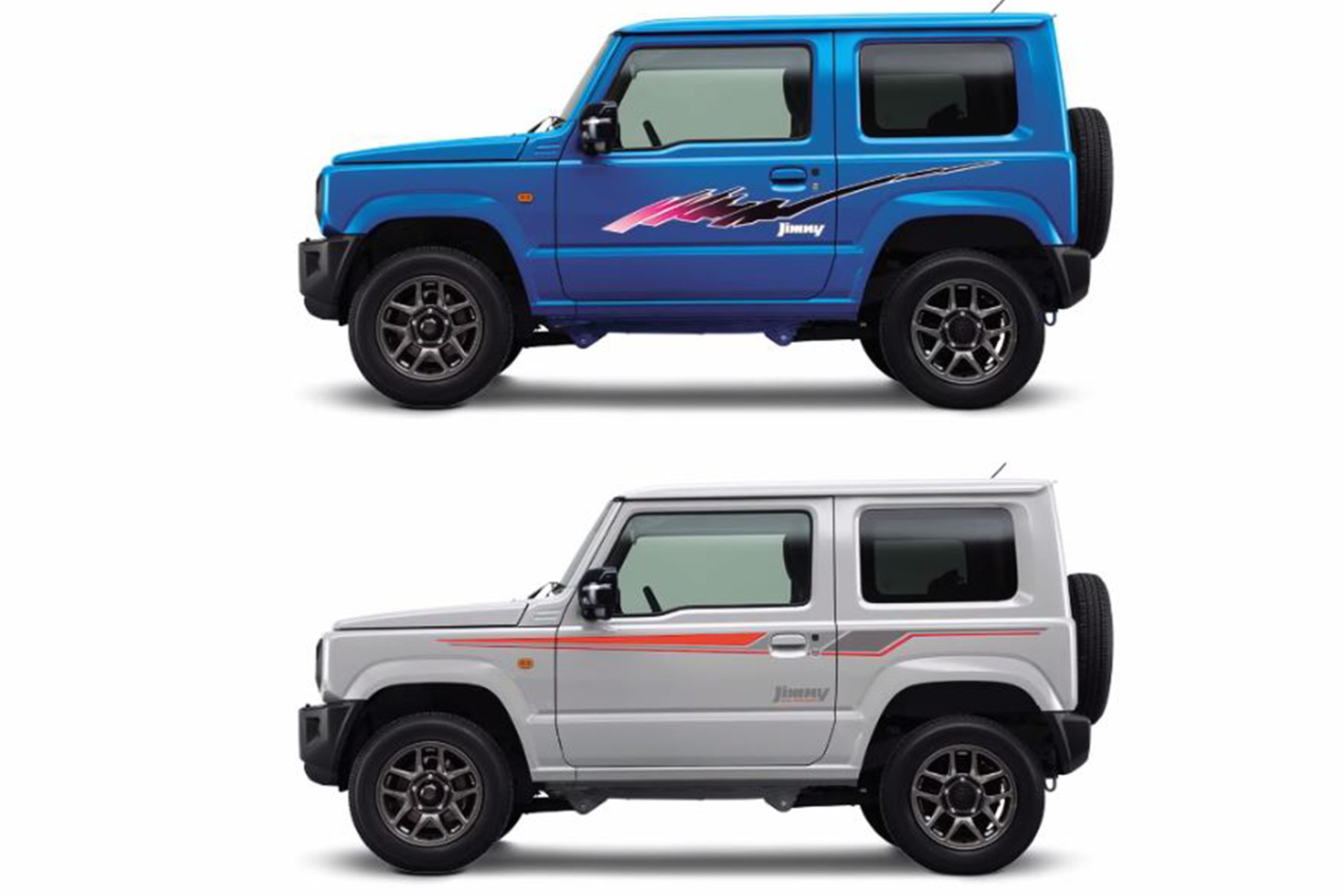
Then there’s the retro-fantastic styling. The public’s reaction to the new Jimny’s boxy homage to classic Jimny styling cues has been almost universally positive, with flattering comparisons to Benz’s G-Wagen also being thrown in the direction of the Jimny Sierra and its flared guards. Suzuki is capitalising on that nostalgia, offering in Japan a bevy of retro-inspired decals and stripe packages. Whether they’ll also make it into the dealer-option brochure of Aus-bound Jimnys has yet to be determined.
Local pricing is another unknown. Speaking with WhichCar earlier this year, Suzuki’s local boss Michael Pachota said he was keen to introduce a two-tier lineup, with an affordable entry model pitched at off-road enthusiasts and a high-feature counterpart sitting above it aimed at city-dwellers. Don’t expect it to be quite as cheap as the current model, which is priced from $21,990 in manual form, but we’d be surprised if the range-topper breached the $30K mark – even in more expensive automatic trim.
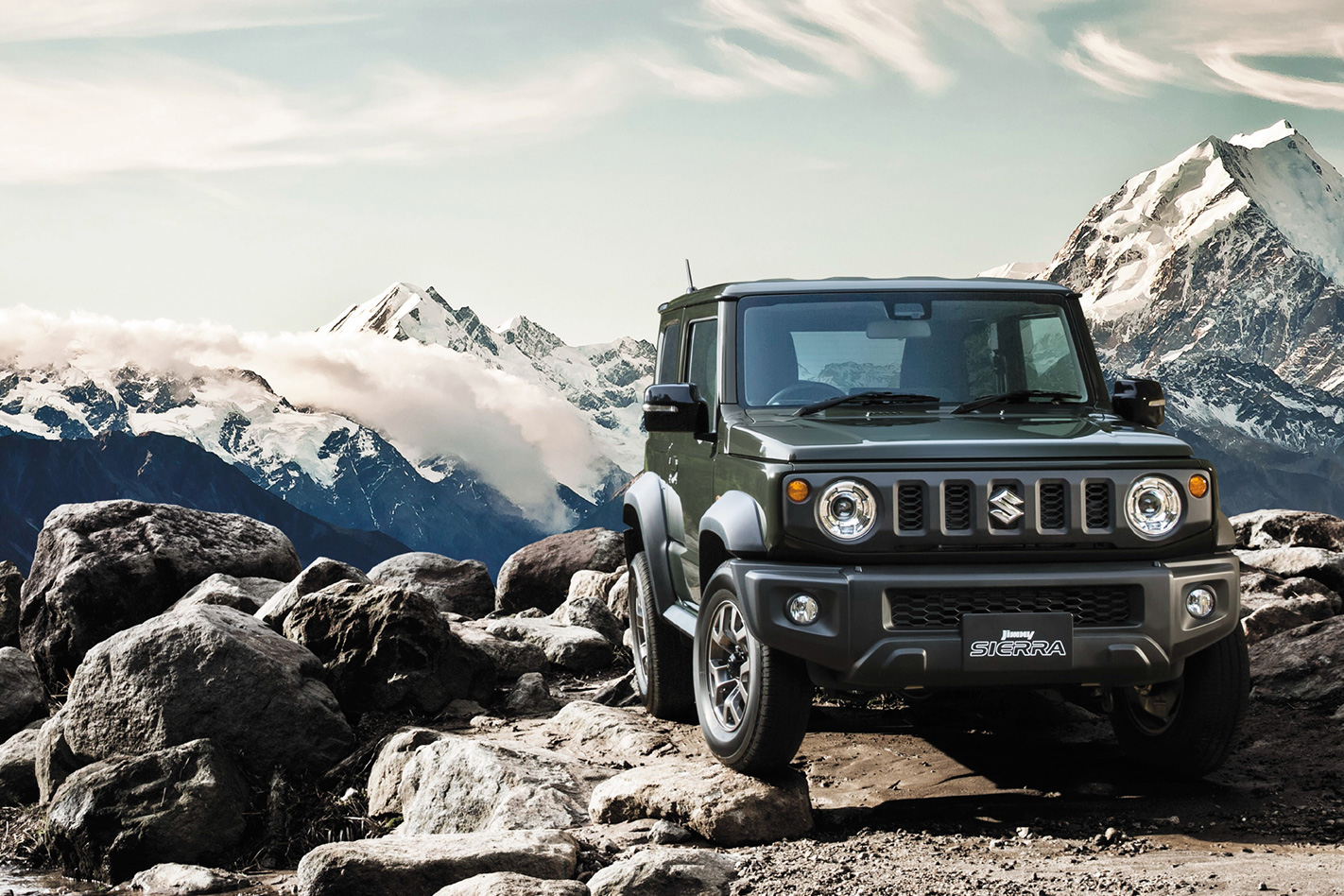
Expect pricing and specifications for the Australian market to firm up over the coming months, ahead of the car’s local arrival at the end of the year and official start of sales in early 2019.
With Santa Fe sales falling at exactly the same rate as Toyota’s Kluger sales are on the rise this year, the arrival of Hyundai’s new-generation Santa Fe couldn’t be better timed. Longer and slightly wider than before, with a 15-percent stronger body and hugely improved interior comfort and quality, the handsome new Santa Fe maintains a relatively familiar model line-up.
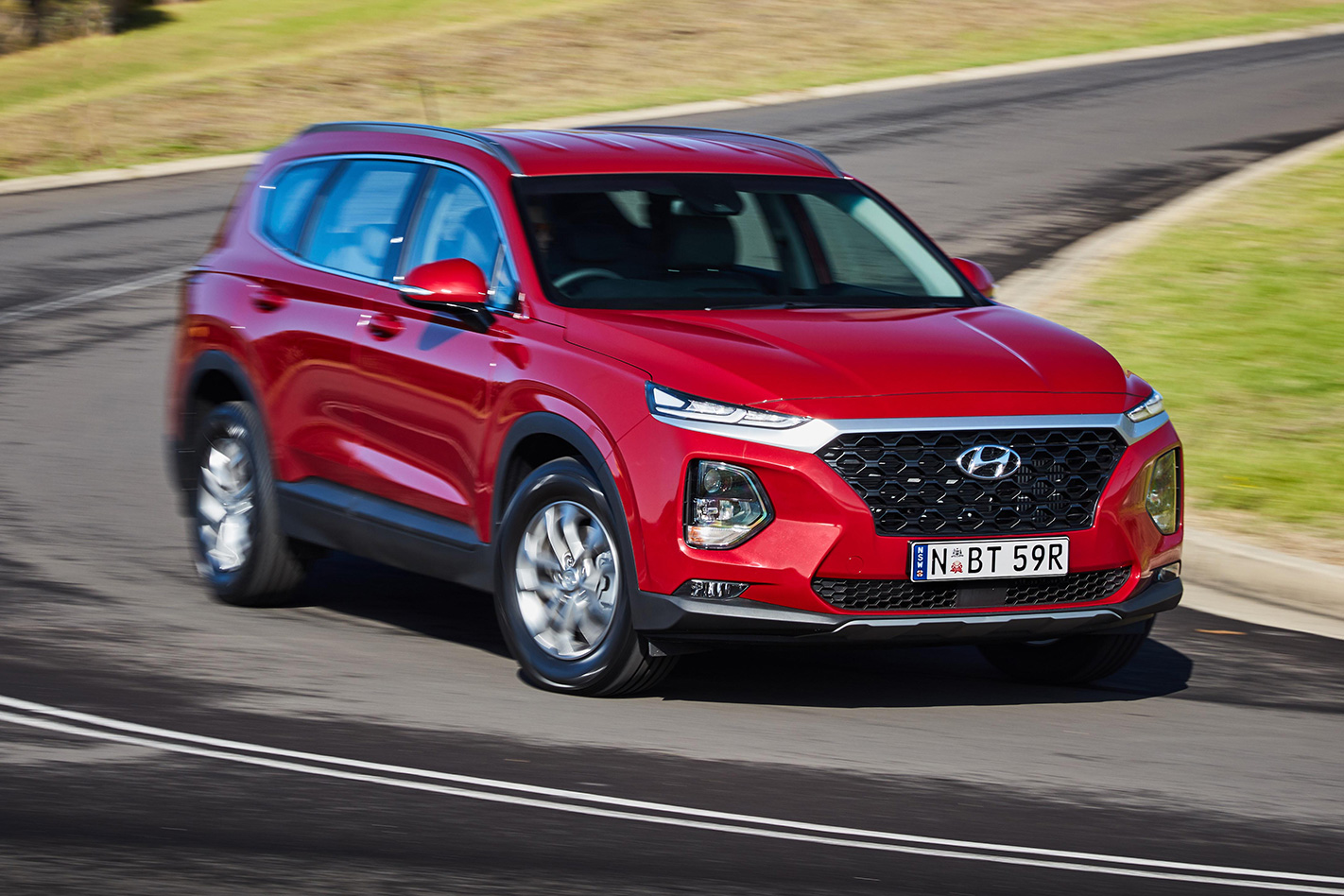
For now, all fourth-gen Santa Fe models are all-wheel drive, though only the entry-level Active will be available with a petrol engine. It’s the 138kW/241Nm 2.4-litre direct-injection four-cylinder matched to a six-speed automatic transmission, as per the base Hyundai Sonata.
A 147kW/440Nm 2.2-litre turbo-diesel four-cylinder engine is optional on the Active (for $3000 more), bringing with it an excellent new eight-speed automatic transmission. Both the mid-spec Santa Fe Elite and top-spec Santa Fe Highlander feature the diesel engine exclusively.
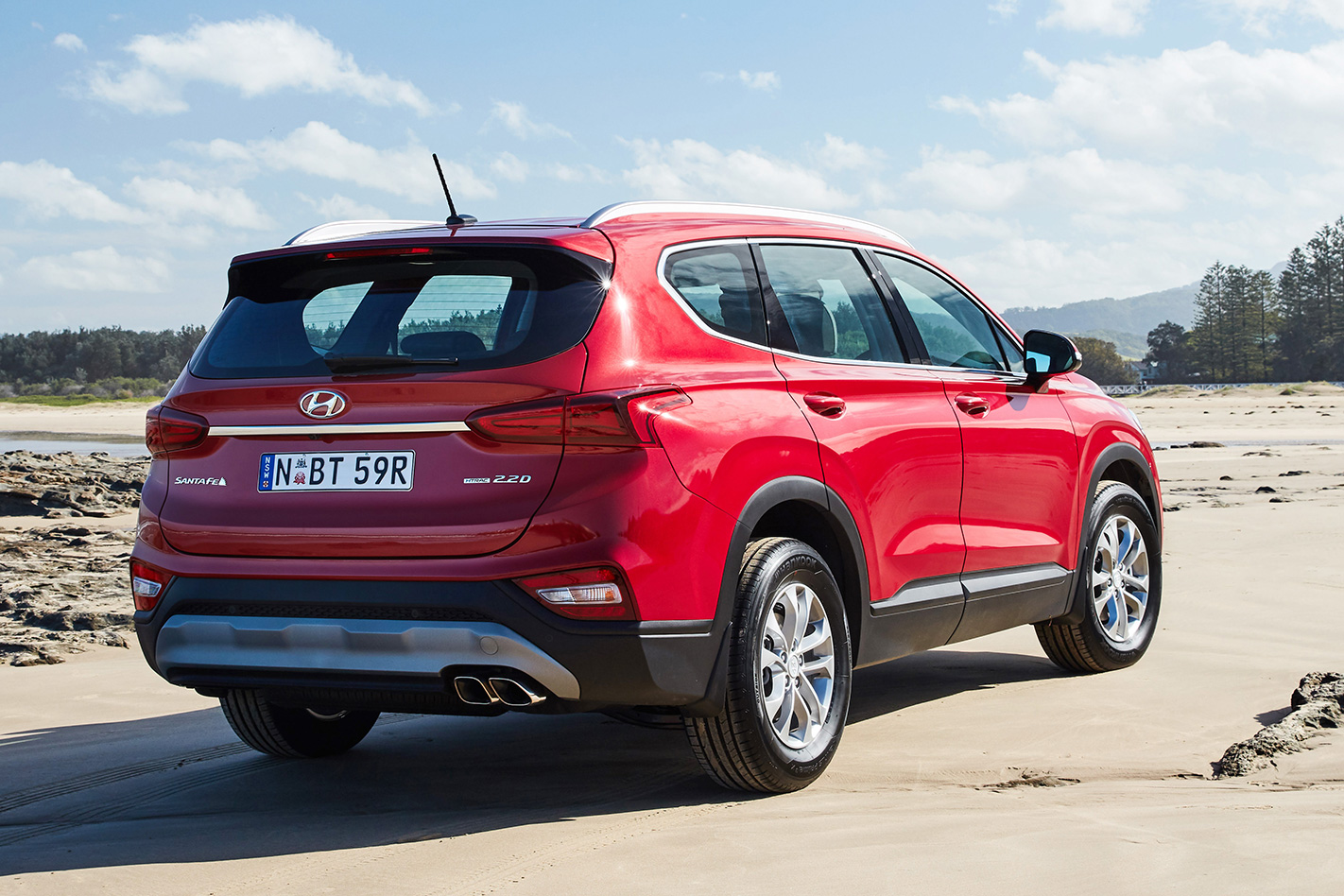
Every 2018 Santa Fe offers these ‘SmartSense’ safety features as standard:
- Forward collision-avoidance assist
- Blind-spot collision-avoidance assist
- Rear cross-traffic collision-avoidance assist
- Lane keep assist
- Driver attention warning
- Automatic high-beam assist
- Adaptive cruise control with ‘stop and go’ feature
The Santa Fe Active kicks off the range ($43,000 recommended retail price, not including on-road costs, or $46,000 as a diesel), just over a grand dearer than the outgoing model. But it brings a wealth of standard equipment:
- 17-inch alloy wheels with 235/65 Hankook Ventus Prime tyres
- Adjustable ‘Drive Mode’ with four settings
- Rear parking sensors
- Rear-view camera with dynamic guide lines
- Hill-start assist
- Auto-on headlights
- LED daytime running lights
- Front and rear fog lights
- Roof rails
- Anti-theft alarm
- Tyre-pressure monitoring system
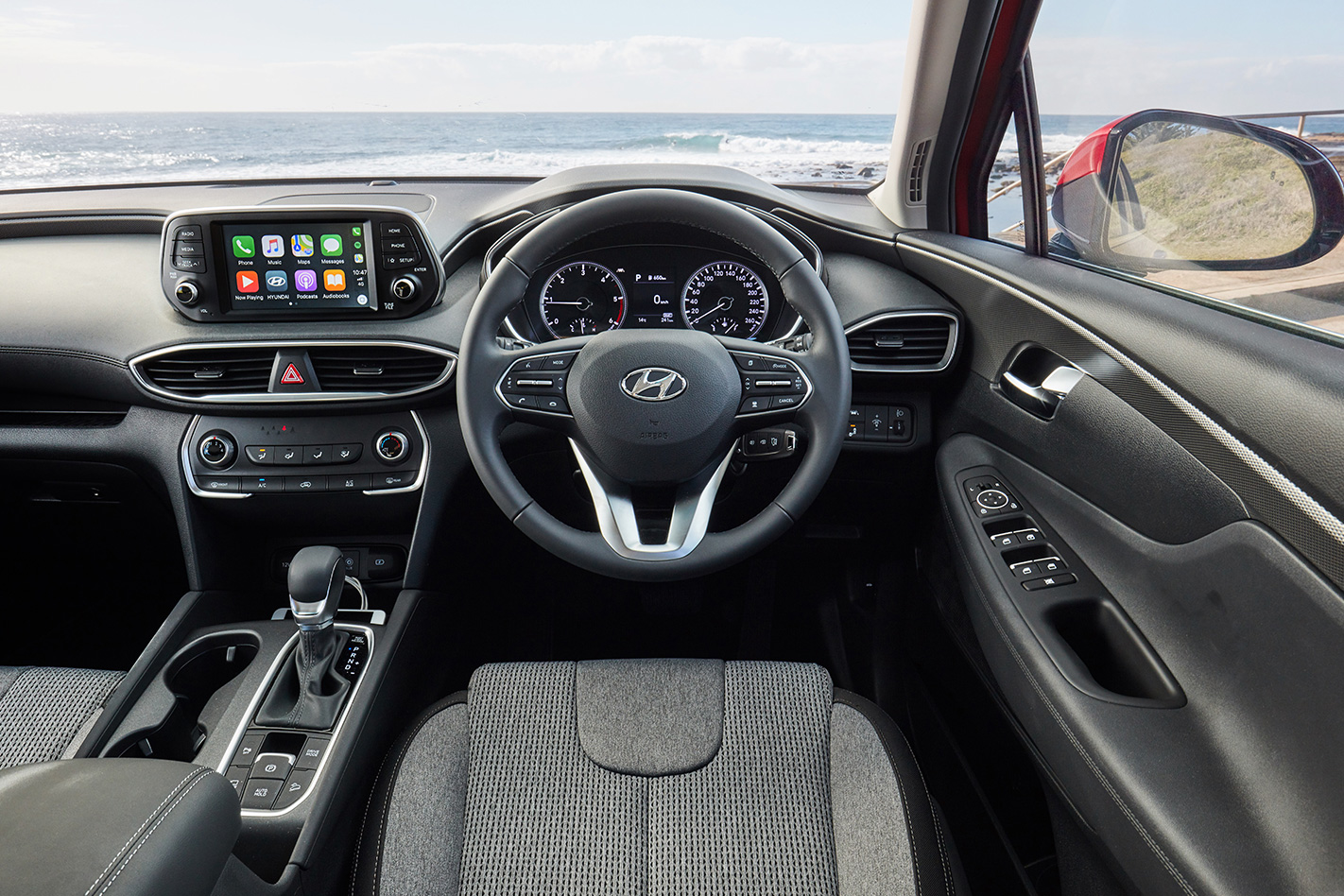
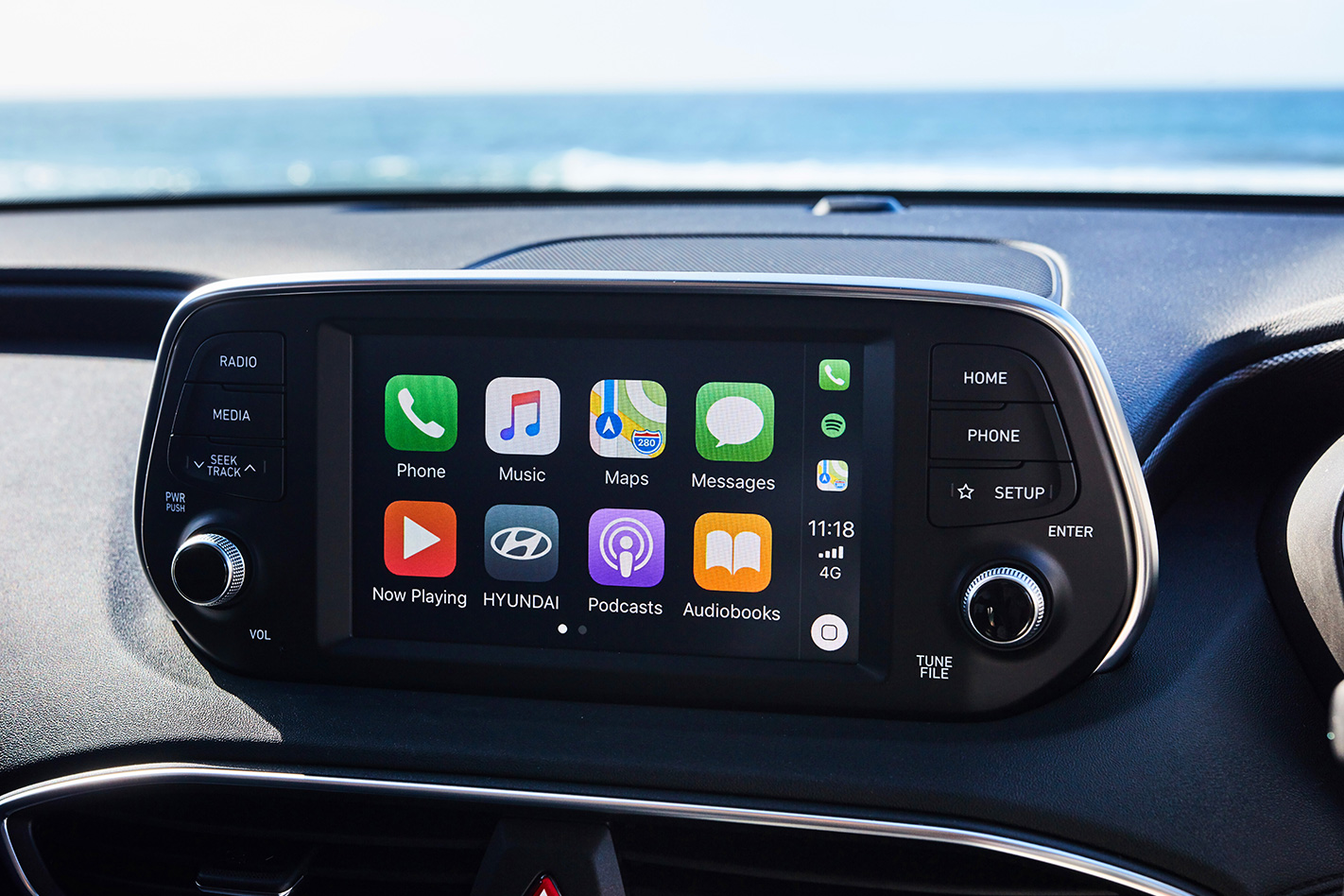
- 7.0-inch touchscreen multimedia system with Apple CarPlay/Android Auto, Bluetooth phone/audio streaming, voice recognition and 6 speakers
- Air conditioning with rear temperature controls
- ‘Walk-in’ electric switch on 2nd-row backrests for one-touch flip-and-slide access to the 3rd row
- ISOFIX outboard seats in 2nd row
- Hyundai Auto Link (a mobile app that enables data access to vehicle functions and condition)
- Leather steering wheel and gearknob
- Height-adjustable driver’s seat with lumbar adjust
- Rear-seat centre armrests
- Cargo compartment floor mat
- Rear luggage net
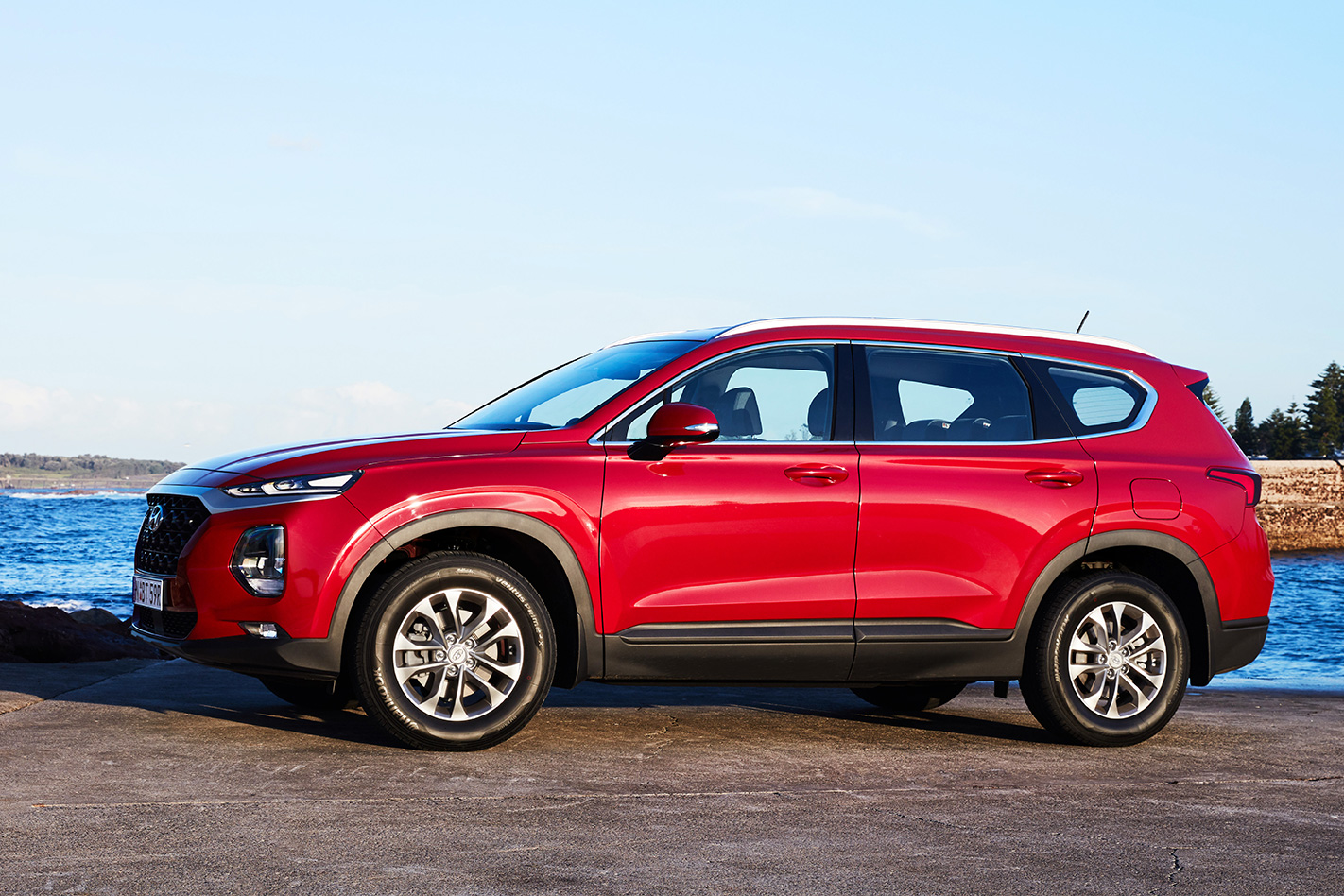
The Santa Fe Elite ($54,000 RRP) builds on the above features by adding:
- 18-inch alloy wheels with Kumho Crugen 235/60 tyres
- Carbon-effect front grille
- Satin-chrome bumper and exterior door finishers (dark chrome on black exterior)
- Front parking sensors
- Rear occupant alert (let’s driver know if there are still passengers in the rear seats when leaving the car)
- 8.0-inch touchscreen multimedia with satellite navigation, live traffic and lifetime map-care plan, DAB+ digital radio and Infinity premium sound with 10 speakers and external amplifier
- Leather upholstery
- Deluxe-cloth pillars, sunvisors and headlining trim
- Keyless entry and push-button start
- Steering-wheel paddle shifters
- 10-way electric driver’s seat and 8-way electric front passenger’s seat
- Dual-zone digital climate control with auto defog function
- Glovebox compartment cooling
- Rain-sensing wipers
- Solar glass with rear privacy tinting
- Rear door-window sunshades
- Electro-chromatic interior rear view mirror
- Electric tailgate
- Electrically folding exterior mirrors with integrated puddle lamps
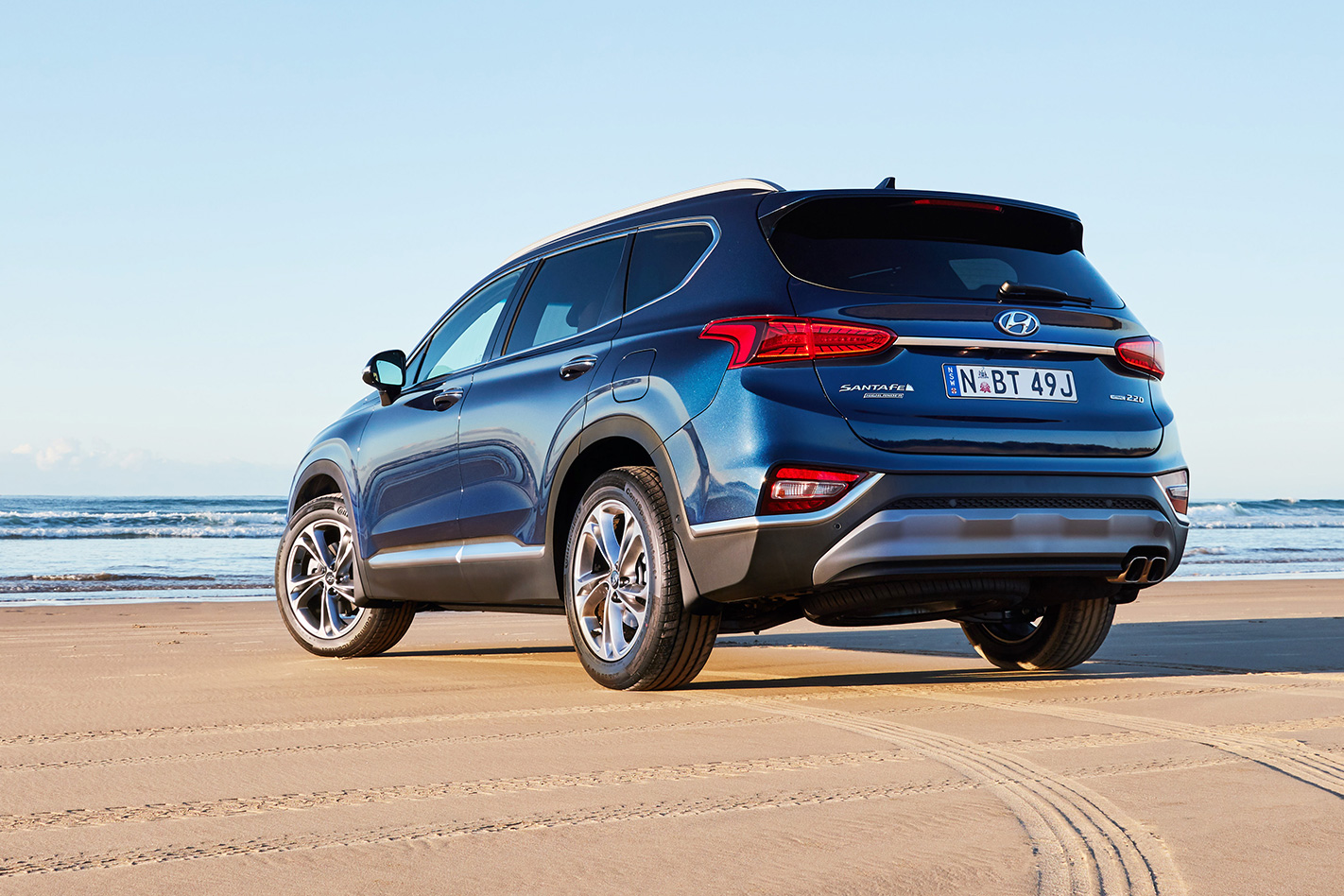
- 19-inch alloy wheels with Continental 235/55 tyres
- Bi-function LED headlights with dynamic bending
- LED tail-lights
- LED front fog lights
- Surround-view parking monitor
- Park Assist – parallel, perpendicular and reverse
- Panoramic glass sunroof
- Integrated memory system for driver’s seat, mirror and head-up-display settings
- 14-way electric driver’s seat with cushion extension
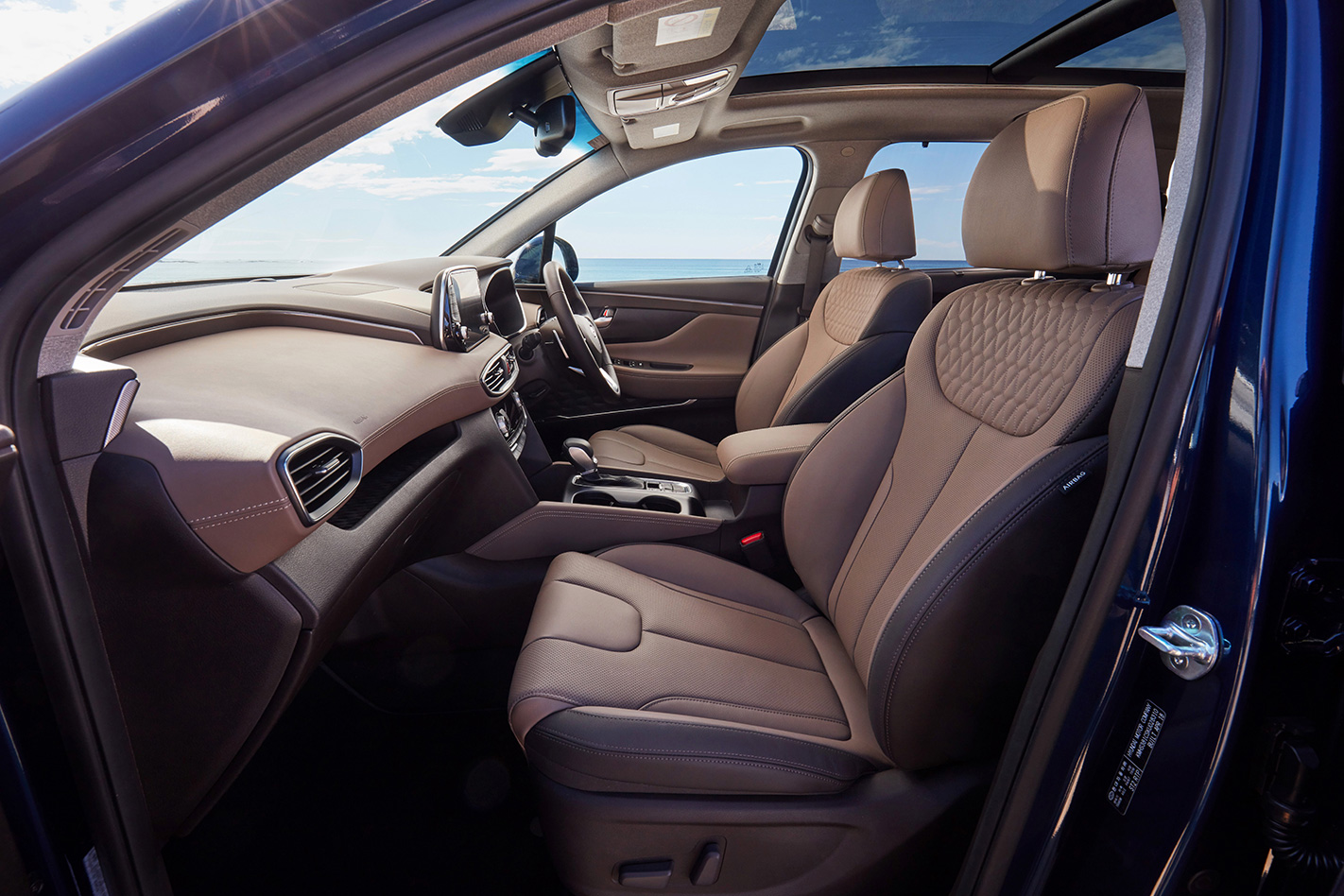
- 7.0-inch TFT ‘supervision’ instrument cluster
- Head-up display
- LED interior lighting
- Heated steering wheel
- Heated/ventilated front seats
- Heated rear outboard seats
- Wireless Qi-standard smartphone charging
- Hyundai Auto Link Premium (adding engine start/stop, door lock/unlock, hazard, hazard and horn, auto temperature and on/off defroster settings)
The sole options are a choice of colour for the leather trim in Elite and Highlander (instead of the standard black interior with carbonfibre-look door and dashboard inserts) and metallic/mica paint ($695).
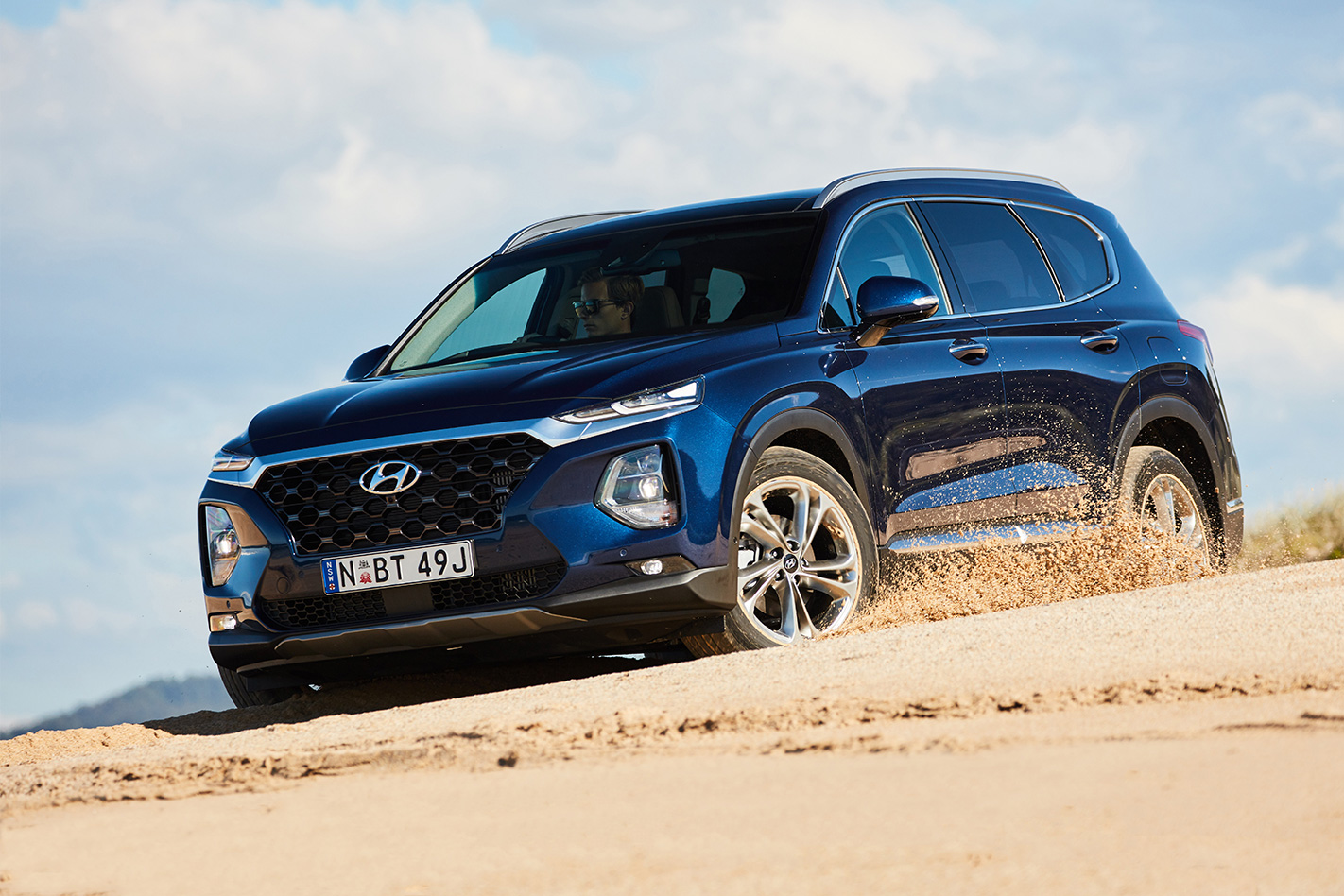
For $295, the Dark Beige interior option adds stone-effect dashboard and door inserts, while the Burgundy option gets wood-effect inserts, plus suede pillars, sunvisors and headlining trim.
Every Santa Fe comes with a five-year/unlimited-kilometre warranty and 12 months roadside assistance. If dealer-serviced by Hyundai, this roadside support plan can extend for up to 10 years or more.
Service intervals are 12 months or 15,000km (whichever comes first). Across 75,000km and five years, the servicing cost of a Santa Fe Active GDi petrol is $1680. The CRDi diesel in Active, Elite and Highlander grades will cost $2095.
Aston Martin’s bespoke personalisation service has revealed two special editions of the DB11 to celebrate the Henley Royal Regatta and Classic Driver.
The first special edition, the Henley Royal Regatta DB11 Volante, will be released to celebrate the ongoing partnership between Aston Martin and the Regatta – founded in 1839.
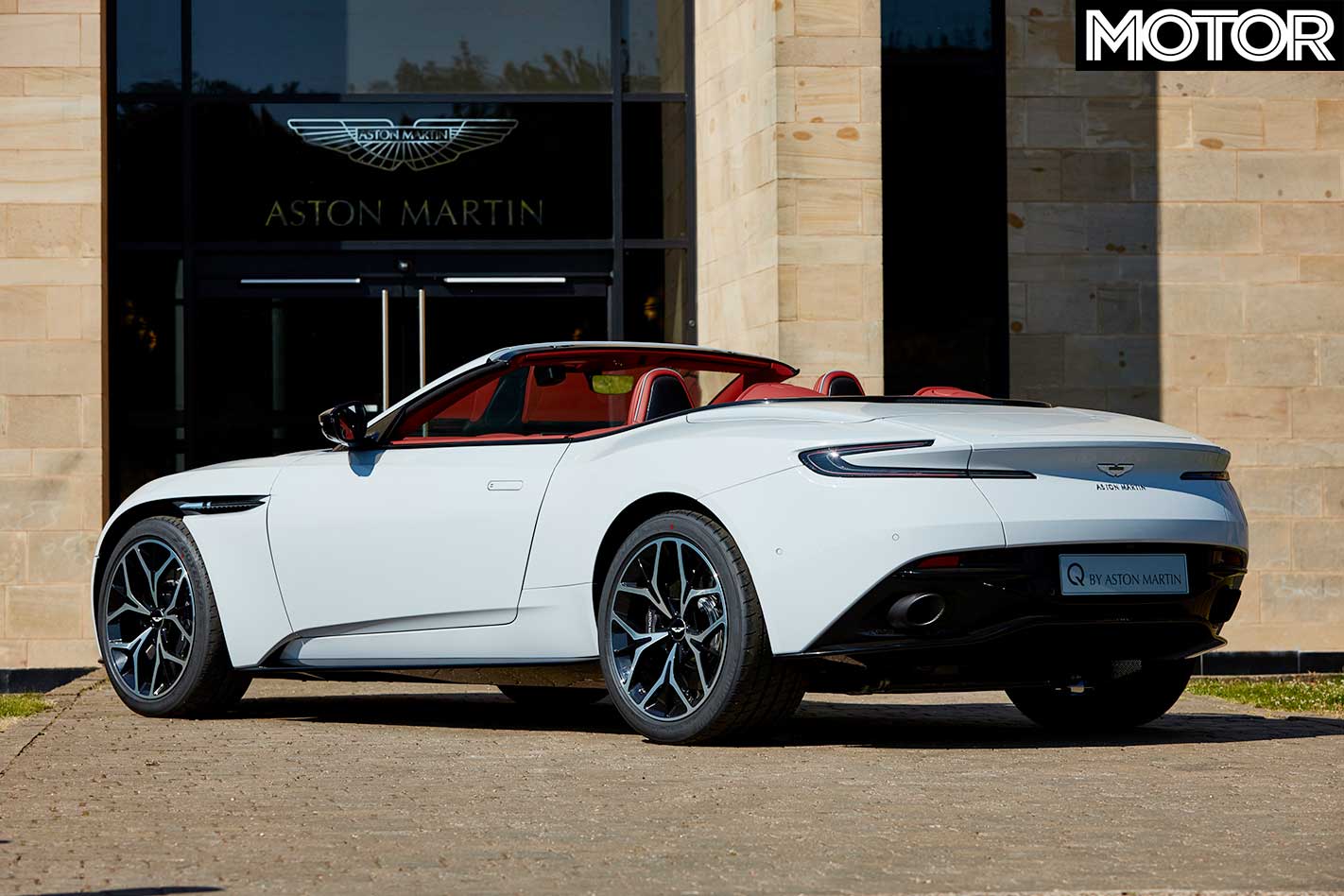
The car will also feature a black soft-top roof, forged gloss black diamond wheels and smoked taillights.
Although there will be significant aesthetic changes to the special edition cars, their engines and performance will be untouched.
The DB11 will likely retain regular power outputs of its twin-turbo V12 which in regular guise produces 447kW. Aston Martin has not specified as to whether engine output has been changed with the special edition models.
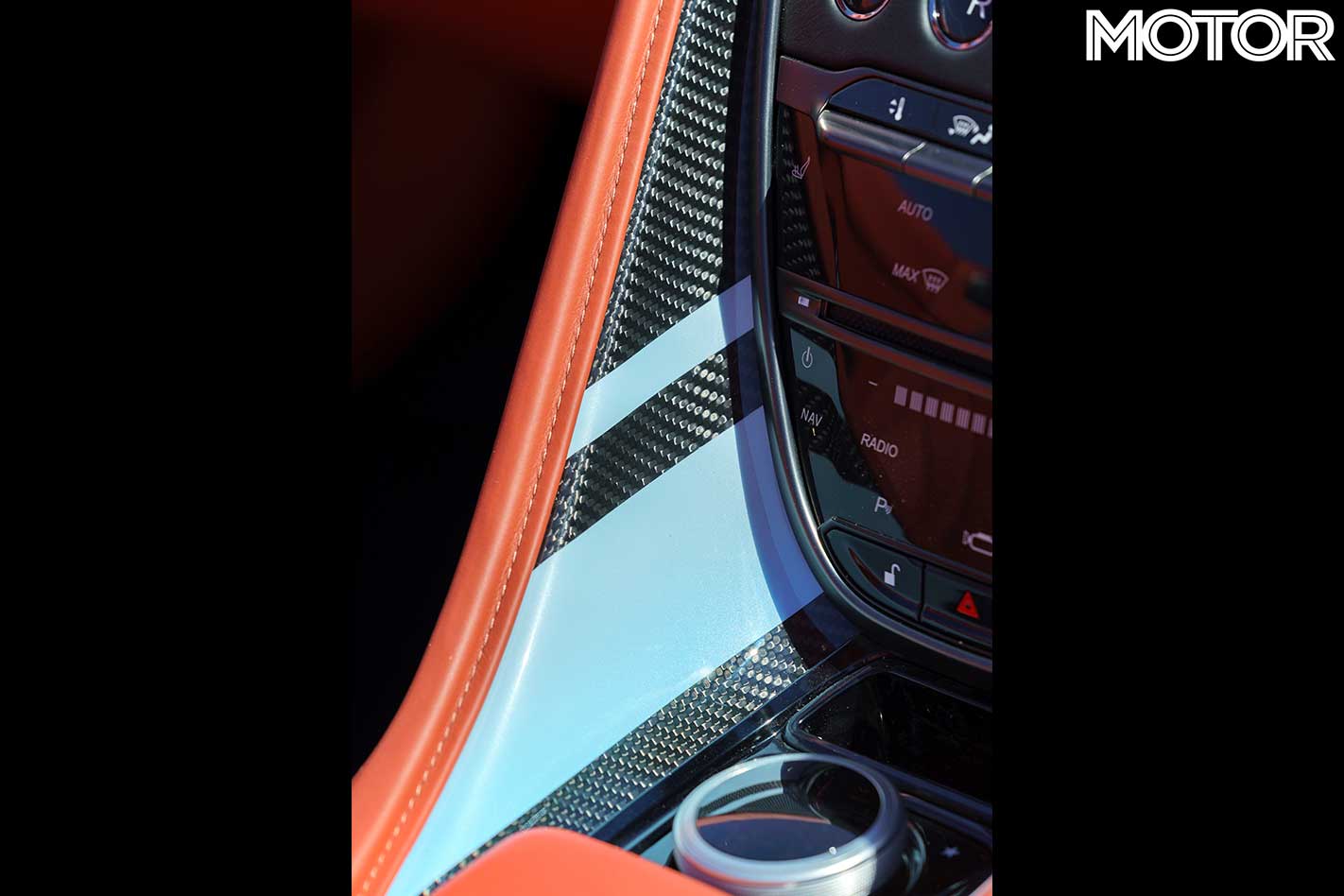
The Volante will be the centrepiece of the Aston Martin display at the Henley Royal Regatta showcasing 105 years of crafting British sports cars.
Only one Volante DB11 will be made and will be priced at $200,000.
The next signature model to be crafted by Aston Martin’s Q department is the DB11 Classic Driver Edition, which celebrates the 20th anniversary the Classic Driver website. This model will be available in both Coupe and Volante styles but only 20 will be made.
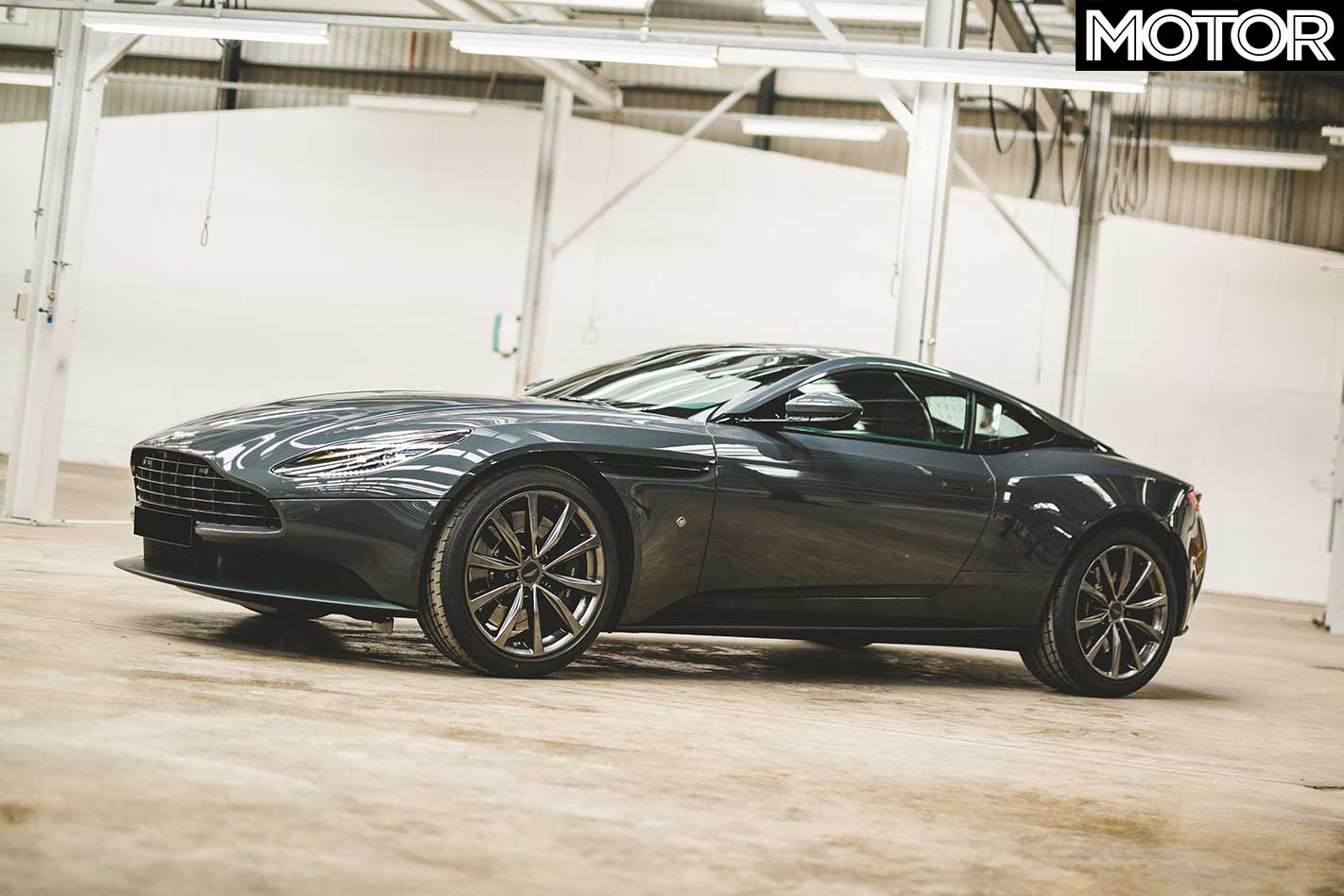
Aesthetic features of the car include a 1960s-inspired charcoal grey paintwork (with an accompanying bespoke name – Classic Driver Grey) and a carbon fibre body pack.
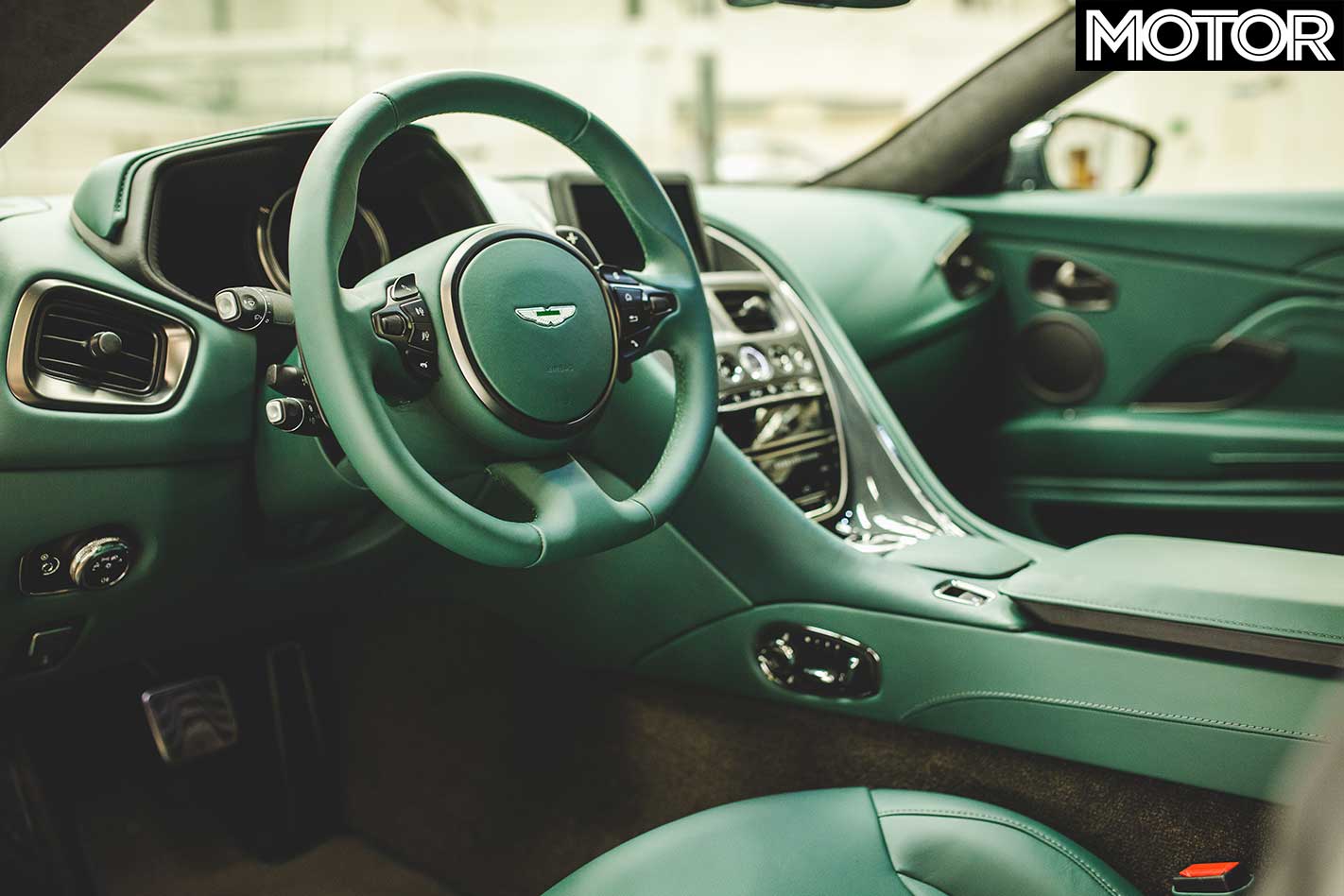
Inside, the interior has been dressed in striking Eifel Green leather with the Classic Driver logo embroidered on the driver and passenger headrests. For the Volante model, the soft-top folding roof will be coloured in Westminster Green. The car will also feature tailored Classic Driver plaques.
Classic Driver’s founder Alexander Knapp Voith opened an Aston Martin and Lagonda dealership back in 1991. Since then, Voith has become a long-time collector of Aston Martin vehicles.
The Classic Driver edition will be priced at USD $274,010 and is available on request.
Kia Australia has confirmed it is both preparing a second sports exhaust system locally, set to be fitted to turbocharged four-cylinder versions of the Stinger, and it has replaced the problematic tyres of the flagship turbo V6 version with new Michelin Pilot Sport 4 rubber.
While an Australian-developed sports exhaust already available on the 272kW/510Nm 3.3-litre Stinger 330S, 330Si and 330GT, MOTOR can exclusively reveal that a similar system is headed for 182kW/353Nm 2.0-litre turbo Stinger 200S, 200Si and 200GT-Line versions.
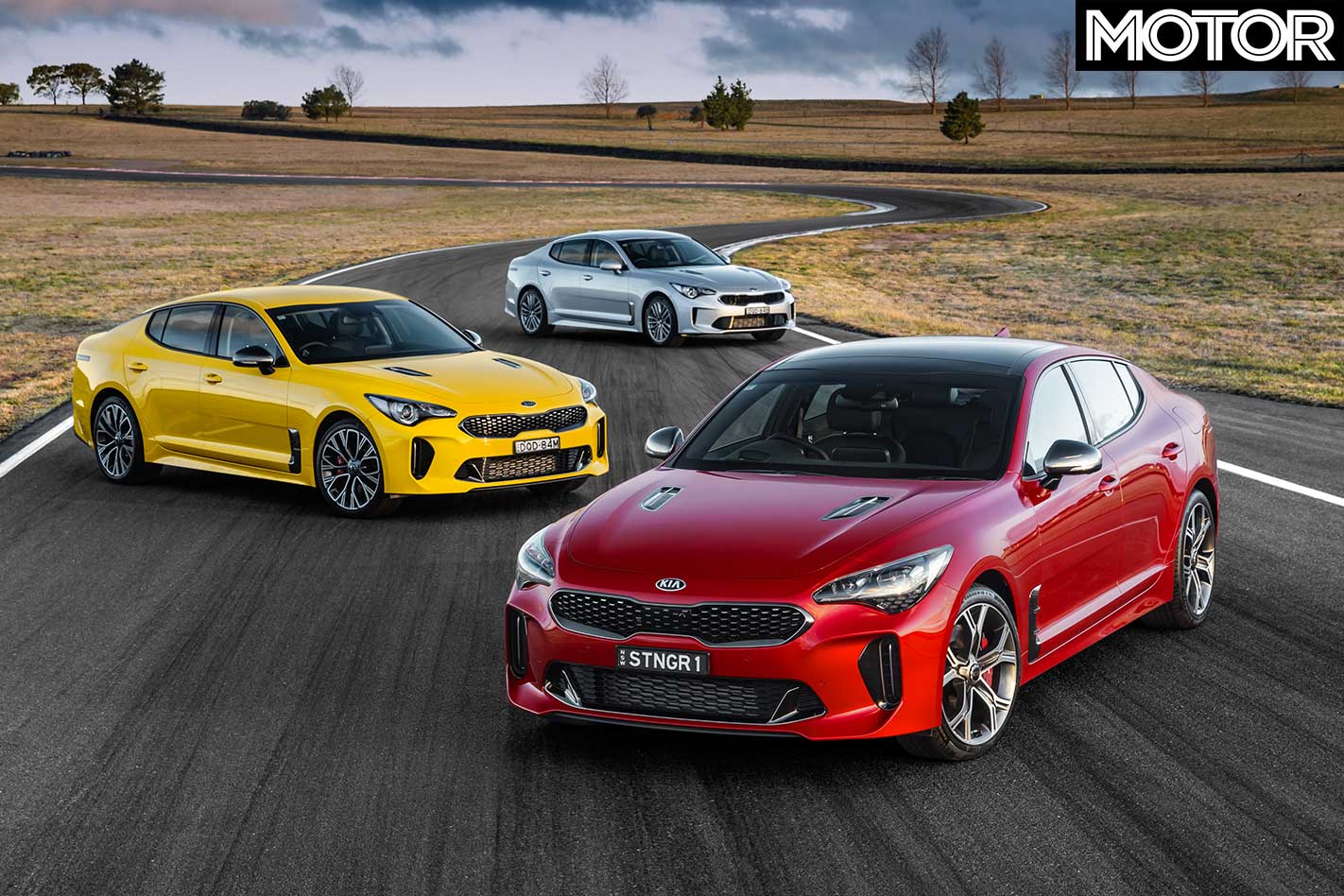
The sports exhaust will be ready for the fourth quarter of 2018, Kia Australia has confirmed, and MOTOR understands that the four-pot versions will utilise the same software and basic design as the V6, while the $2600 surcharge for the latter is likely to be mirrored as well.
Around 90 per cent of buyers currently choose the $59,990 plus on-road costs Stinger 330GT, despite the range kicking off from $45,990 (plus orc) for the Stinger 200S. The premium to move from the 6.0-second 0-100km/h-rated four-cylinder to the 4.9sec 0-100km/h-capable V6 is just $3000, meanwhile, which has proven to be a small jump for buyers.
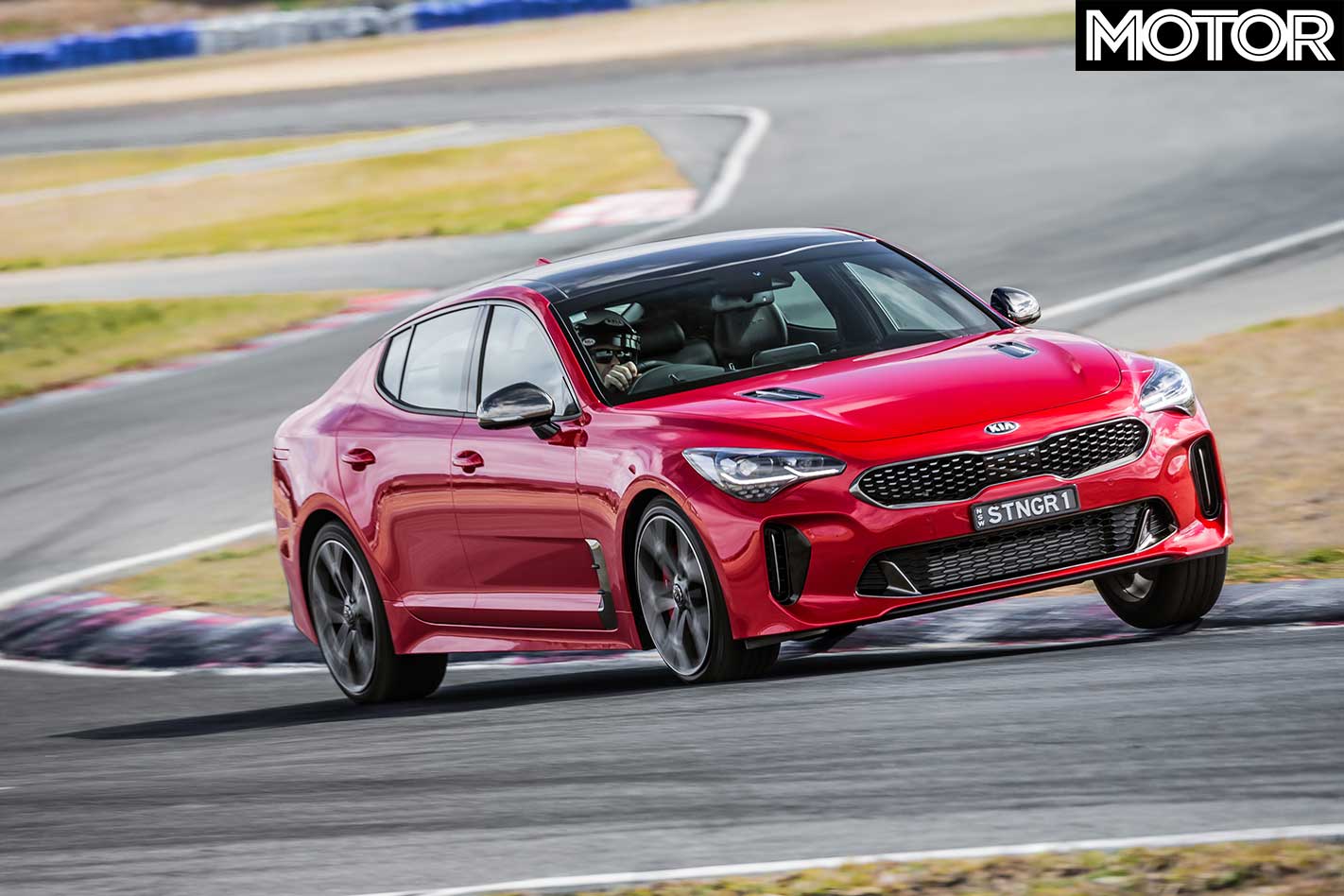
But at 113kg lighter, Graeme Gambold – the Aussie engineer who locally tuned all Stingers – reckons the two-cylinders-short-of-a-six-pack version is actually more agile and sweetly balanced, despite being markedly slower and more industrial-sounding.
However, the local arm of the South Korean brand also upgraded the model grade that the punters are buying, further confirming exclusively to MOTOR that the Stinger GT has flicked its wear-prone Continental ContiSport Contact 5 tyres for Michelin Pilot Sport 4 rubber.
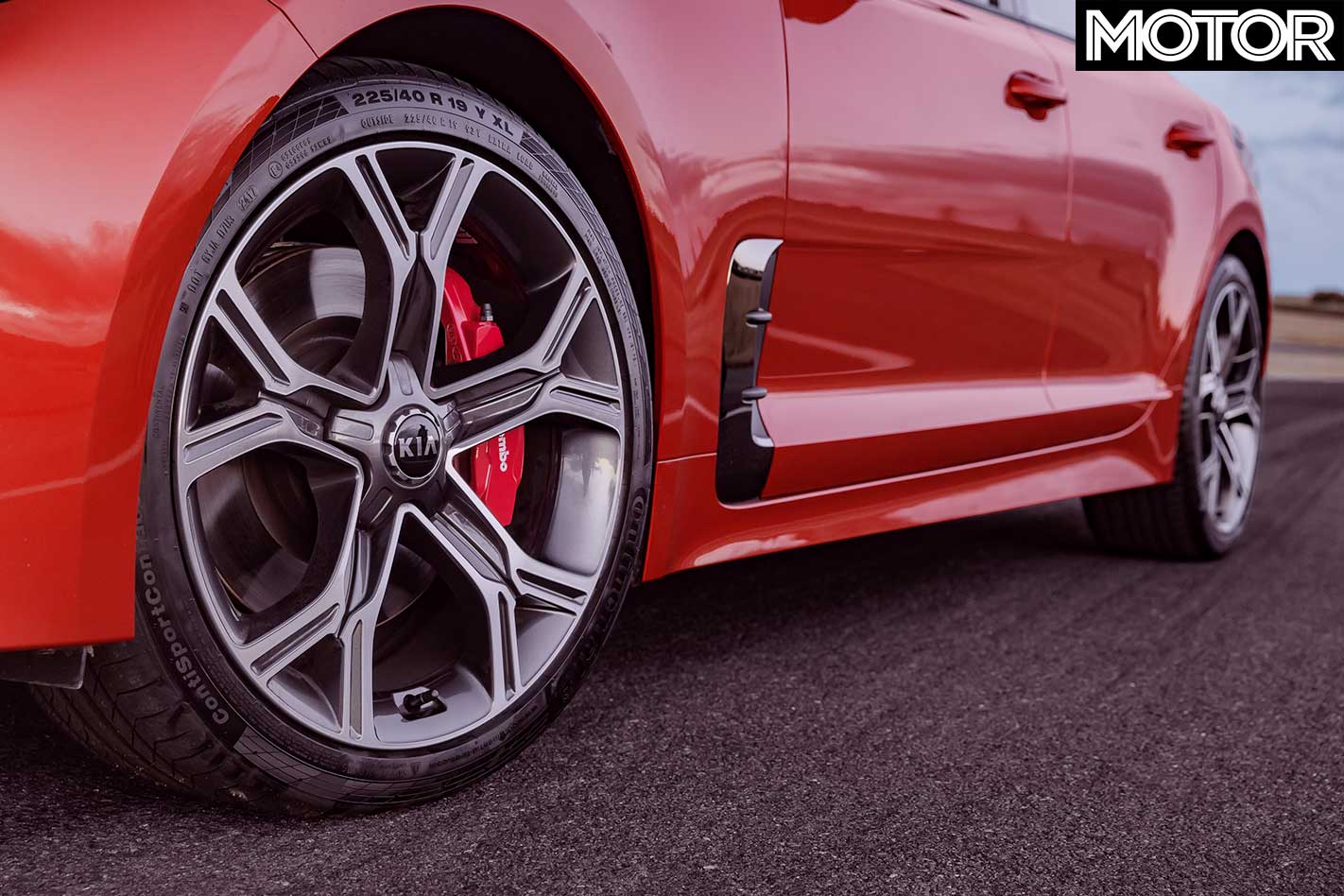
At the local launch of the Stinger last year, Kia Australia ditched the soft-compound Contis for the Michelins only for the Wakefield Park racetrack component of the first media drive. Now, Kia Australia has convinced headquarters to fit the 225mm-wide 40-aspect front/275mm 30-aspect rear rubber as standard here, at no extra cost.
“With Australian owners enjoying a generally more enthusiastic driving style the request was made to KMC [Kia Motor Company] to have the GT cars fitted with what are widely regarded as the more durable Michelin performance tyres,” Kia Australia general manager of media and corporate communications Kevin Hepworth explained.
“The R&D [research and development] team agreed and these tyres are now standard factory fit on the V6 GT.”
THE second-most powerful Mini to ever come to our shores will also be the kindest to the environment. Yep, after months of maybes, the brand’s long-anticipated first plug-in hybrid is finally confirmed for Australia.
Arriving late this year, BMW Australia managing director Marc Werner said the brand would soon “get bullish” on battery-electric vehicles, with Mini’s first segue into the segment coming via a 165kW petrol-electric hybrid Mini Cooper Countryman S E All4.
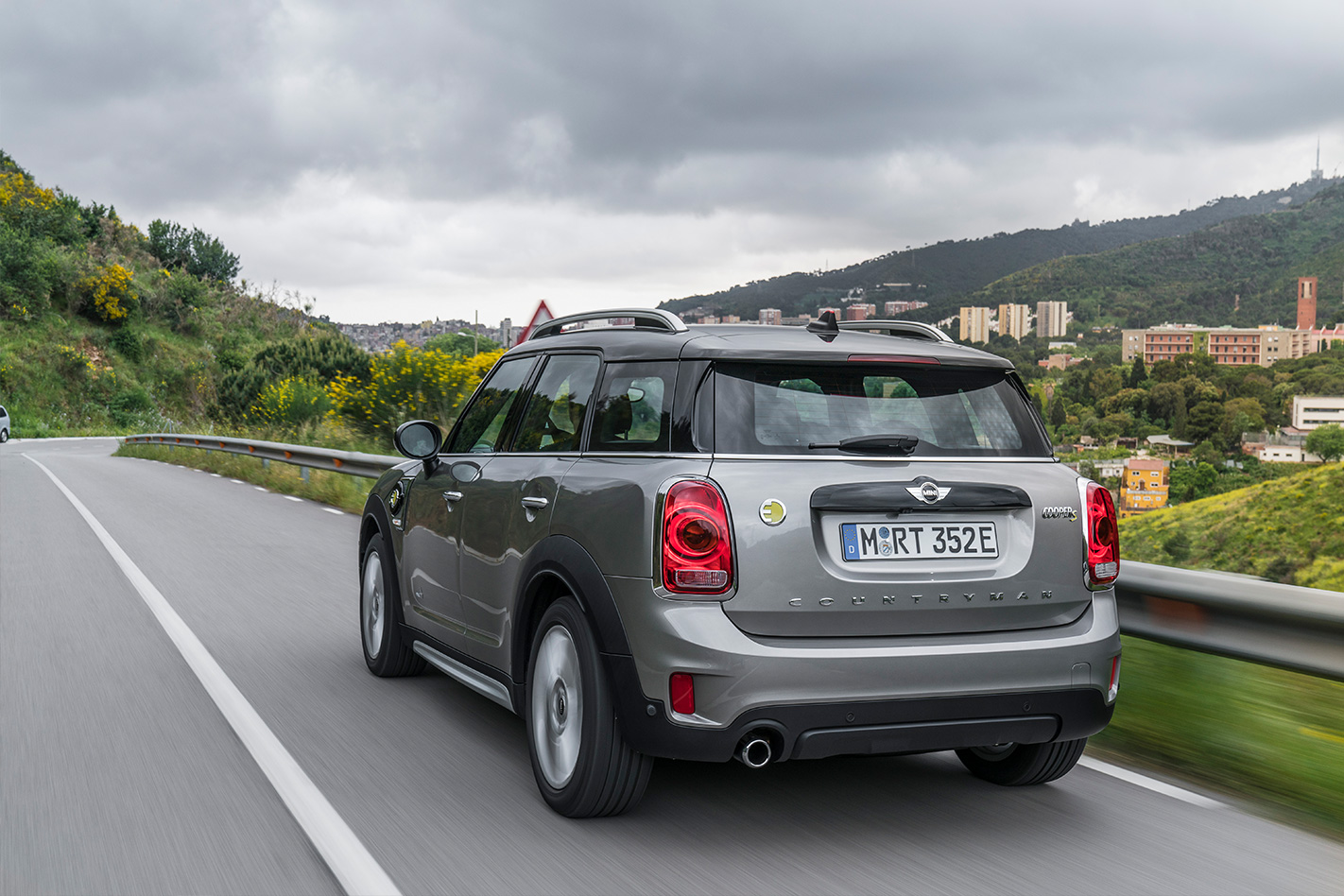
The short-range all-electric, all-wheel-drive hybrid will use Mini’s three-cylinder 1.5-litre engine powering the front wheels, and paired with a 65kW synchronous electric motor driving the rears. In European testing, this is good enough to return an official fuel use average of 2.1L/100km, with emissions of 49g/km – both beat the Toyota Prius hands-down. It has claimed 0-100km/h performance of 6.8sec.
Real-world all-electric range for the Mini’s EV mode is quoted at up to 20km in the US (on paper it’s officially around 40km); for the Prius, it’s zero. BMW Australia has said that local testing is returning between 30 and 35km of pure EV range.
“We have been looking at the MINI plug Hybrid now for some time, and the feedback that we have from our dealers, and our customers, is really positive,” Werner said. “And of course you know that, as part of the BMW Group, we are committed to broadening our range of low-emissions vehicles, so it makes sense for us to bring the vehicle here, and give our customers the opportunity to choose a more environmentally friendly vehicle. .
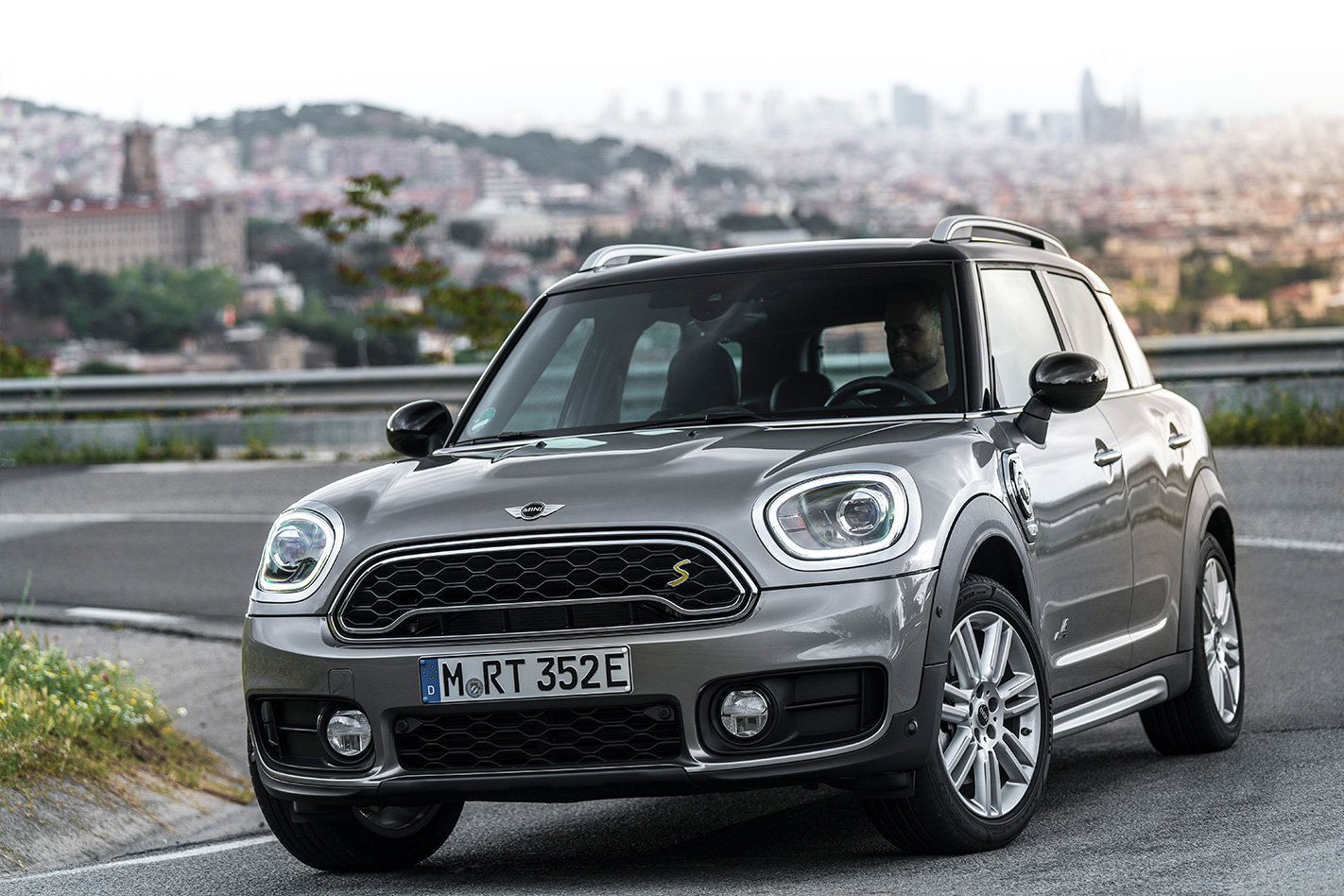
“As for timing, or final details – we’re not quite there yet. But we can say that we are keen to bring the vehicle in, and we will see it here in the first half of 2019.”
The hybrid Countryman will clip along at up to 125km/h on electric power alone. Recharging the lithium-ion batteries via a wall socket will take as little as 2.5 hours, with Mini Australia investigating how it can reduce that time further using three-phase power. Placing the battery pack under the boot floor drops cargo capacity by 45 litres to 405L.
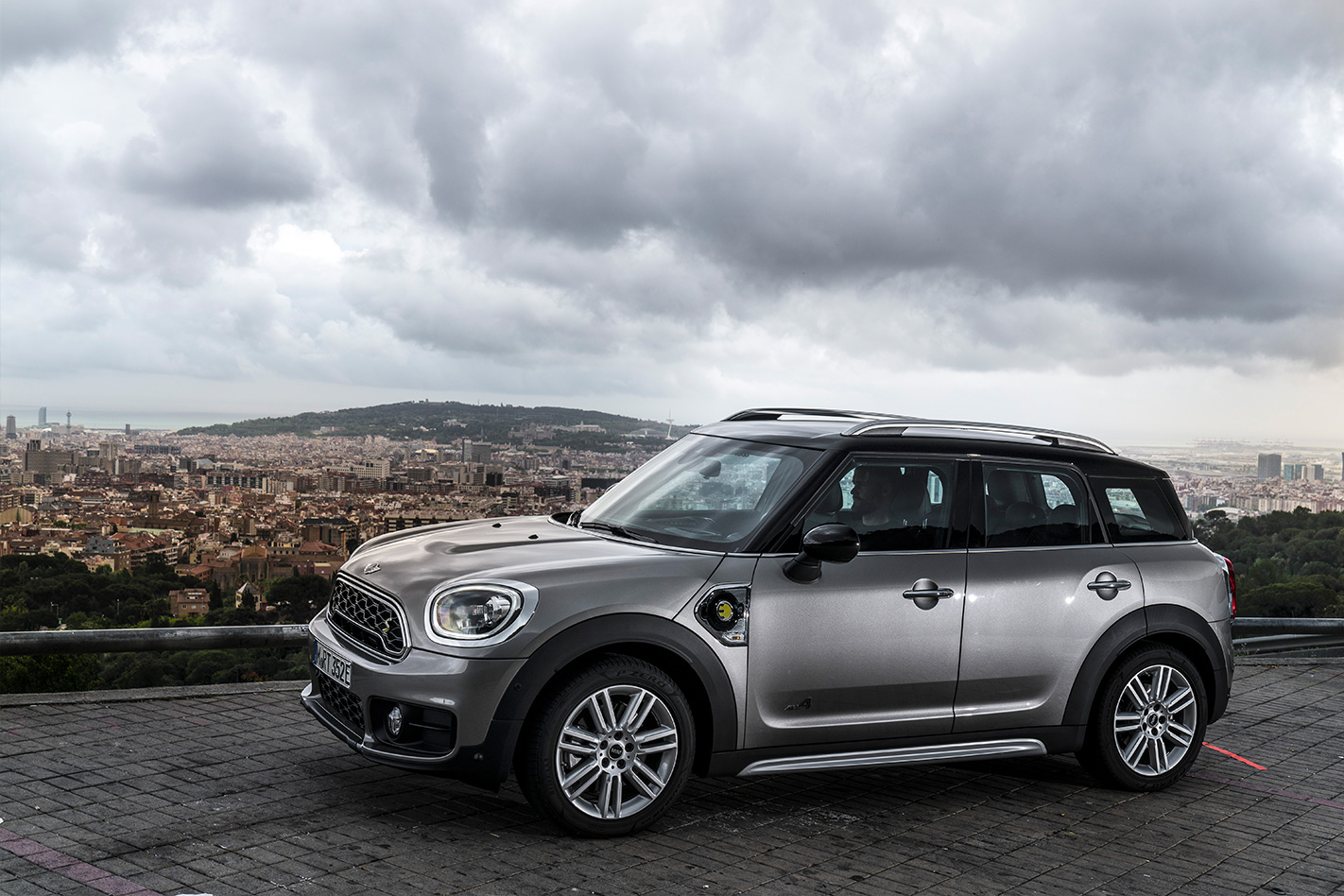
The plug-in Countryman sells in the US for about a 15 percent premium over the Countryman S, which would give it a circa $56,000 starting price by the time it lands here in Australia, the US’s different tax regime and all considered.
AFTER a long and painfully drawn out process, Toyota has finally put a time and place on its unveiling of its new Supra in production form.
A simple tweet from Toyota Europe late last night shared a previously unseen teaser photo of the the road-going car covered in camouflage, along with the promise of its appearance next week at the Goodwood Festival of Speed, though even that part is still frustratingly vague.
It remains unclear whether we’ll get a look at the car sans-camouflage, and whether or not it will be properly trimmed inside, as the car’s production interior is still a mystery.
Beyond that, we’re hoping beyond hope that Toyota will send it up Lord March’s famous driveway to give us a proper dose of its straight-six exhaust note. Whether that happens or not, the Goodwood Festival of Speed is set to be the stage for our best look yet at the upcoming Supra.
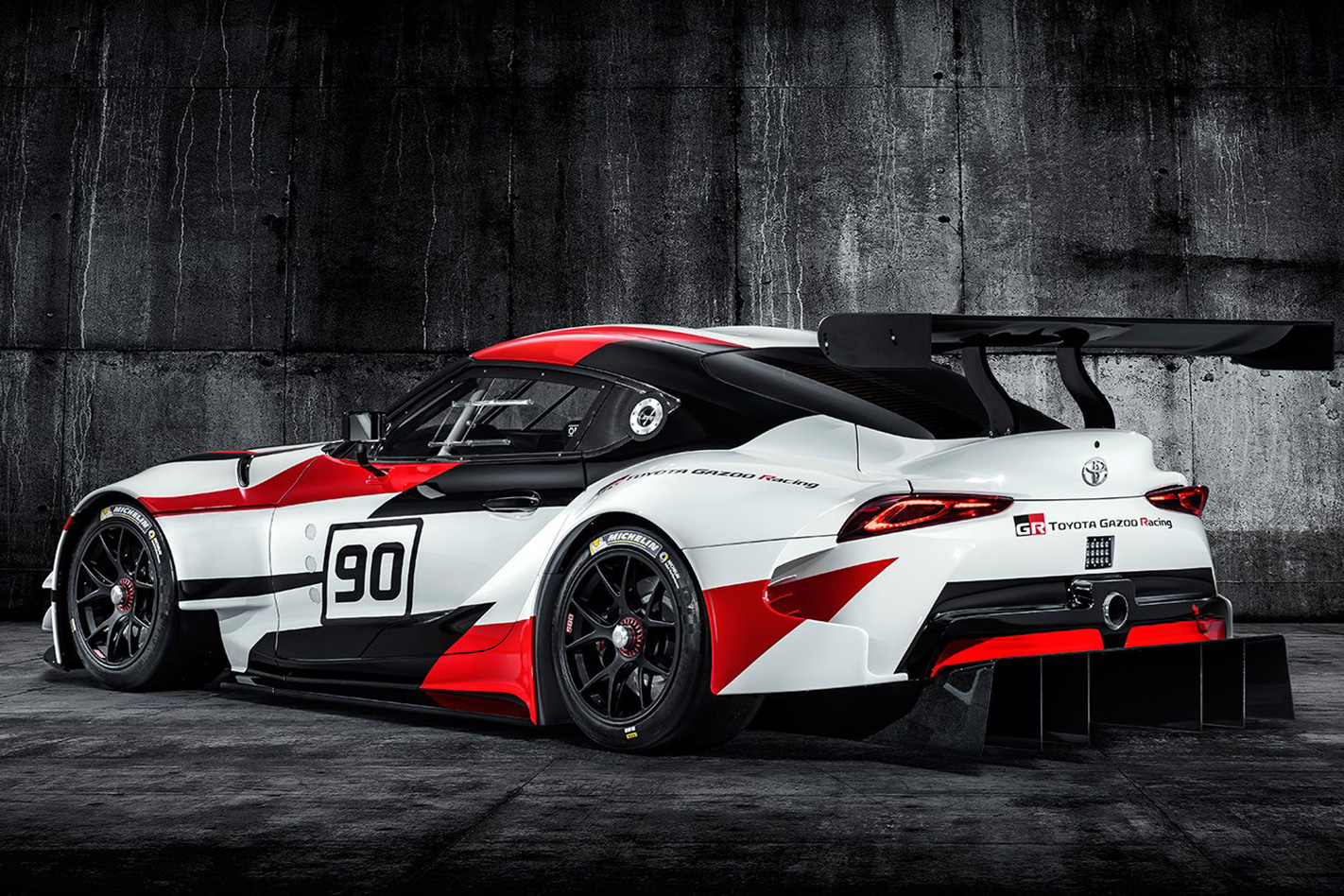
Up until now all we have had to go on are concept cars, spy photos leaked online, and a Supra racing prototype that was revealed at the Geneva motor show earlier in the year.
What we know is that Toyota has worked in conjunction with BMW to engineer the Supra and its Z4 twin, and that the A90 Supra will likely feature a turbocharged six-cylinder engine courtesy of the Bavarians, with the possibility of a more affordable four-cylinder version also on the cards.
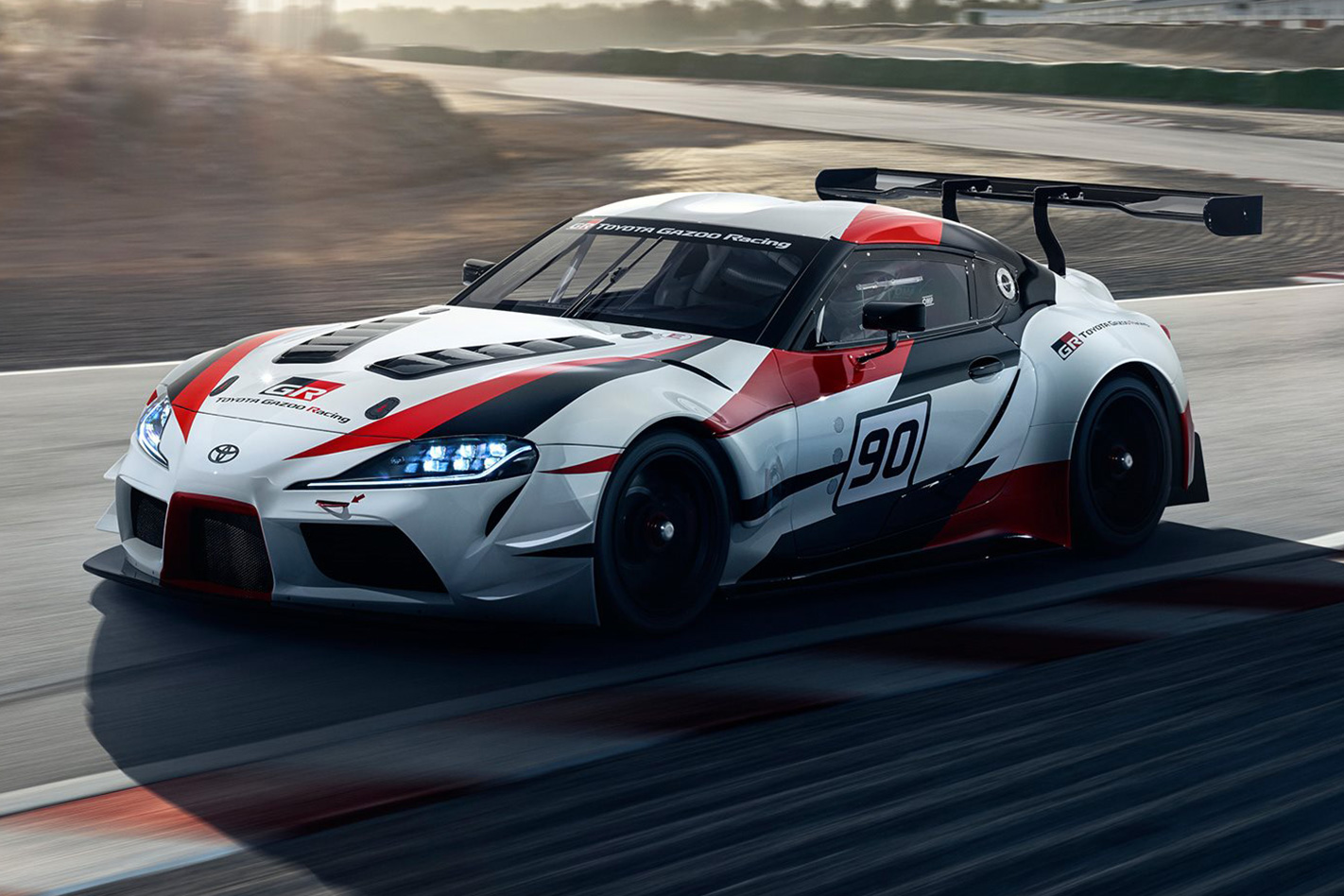
Toyota plans to flesh out a range of Supras, and Tetsuya Tada, the man in charge of its development, has confirmed that Toyota’s in-house performance arm, called Gazoo Racing, will engineer an especially high performance version as well.
Toyota has built an almighty amount of hype around the new Supra’s release, which could only make it harder for the car to live up to expectations. We’re optimistic, and can’t wait for the Goodwood Festival of Speed to start. The action kicks off next week from July 12th to July 15th.
Selecting a winner in any match-up is difficult when the cars are closely matched. But after five days and 1760km in the new BMW Z4 3.0i, facelifted Porsche Boxster 2.7 and the Audi TT quattro Roadster, picking a winner from three so similarly-matched cars was going to be tougher than first thought.
This review was originally published in MOTOR’s May 2003 issue
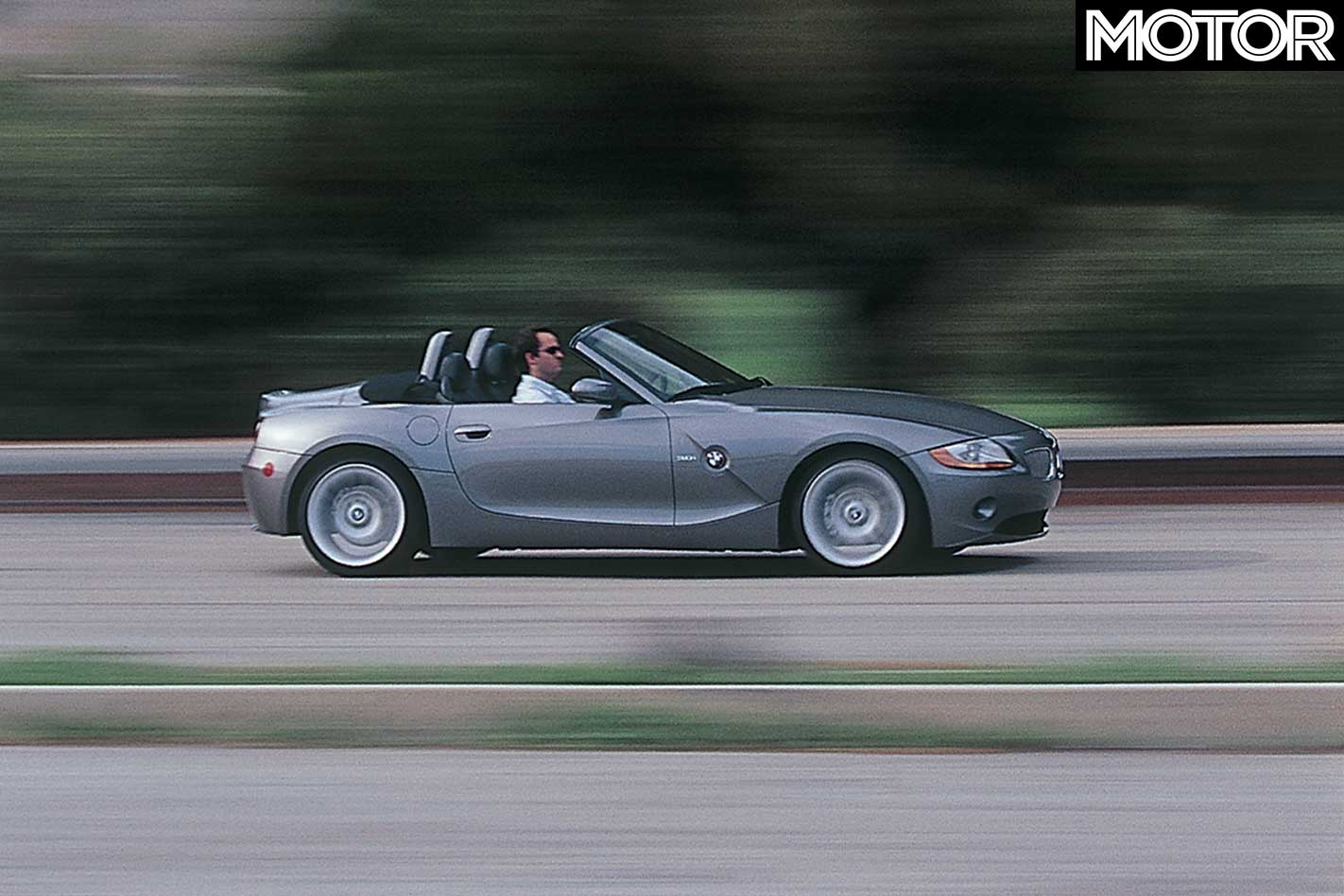
Not on sale locally until June, we picked up our gunmetal-grey BMW Z4 and its rivals in Los Angeles, California. While the Beemer was the visual attention-getter of the group, it immediately lost important points in the ride department, mainly because of the optional sports suspension and the extra-cost 18-inch alloys shod with Bridgestone Potenzas (225/40 front, 255/35 back).
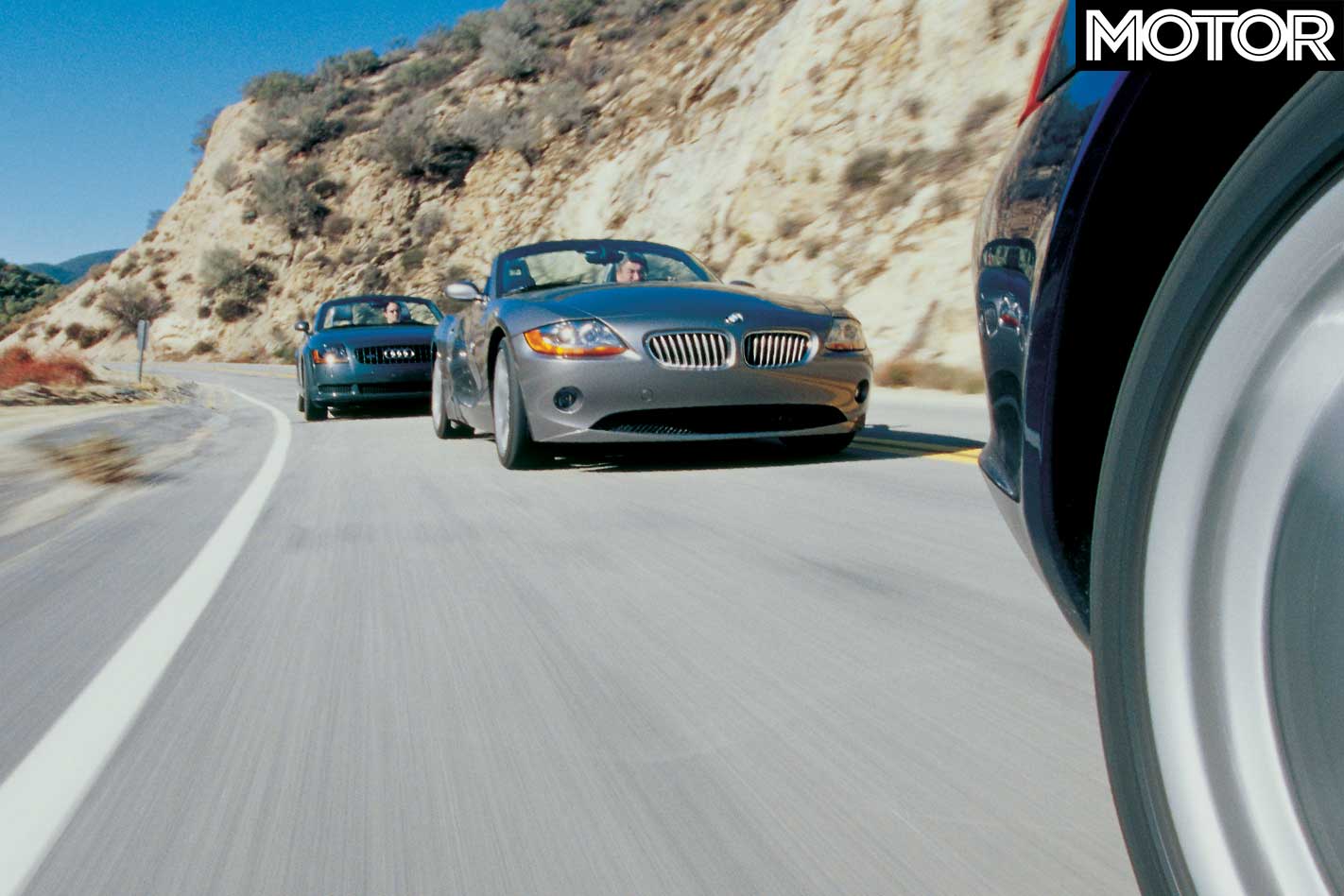
The Boxster ran wider-than-normal 18-inch wheels, but the big Michelin rubber (225/40, 265/35) worked in surprising harmony with the standard suspension tieing it down without shaking its occupants. The Audi was also shod with 18s (four 225/40 Conti SportContacts), in combo with the standard spec springs and shocks. And like the Boxster, it soaked up road irregularities with aplomb.
The specification of our breezy trio is similar in ability yet dramatically different in execution. Audi employs a small displacement 1.8-litre 20-valve turbocharged four-cylinder which delivers 165kW and drives all four wheels.
Porsche relies on a 2.7-litre 24-valve flat-six mounted amidships and churning out 168 kW. BMW has installed its trademark 3.0-litre 24-valve inline six, good for 170kW, aft of the front axle but still up front.
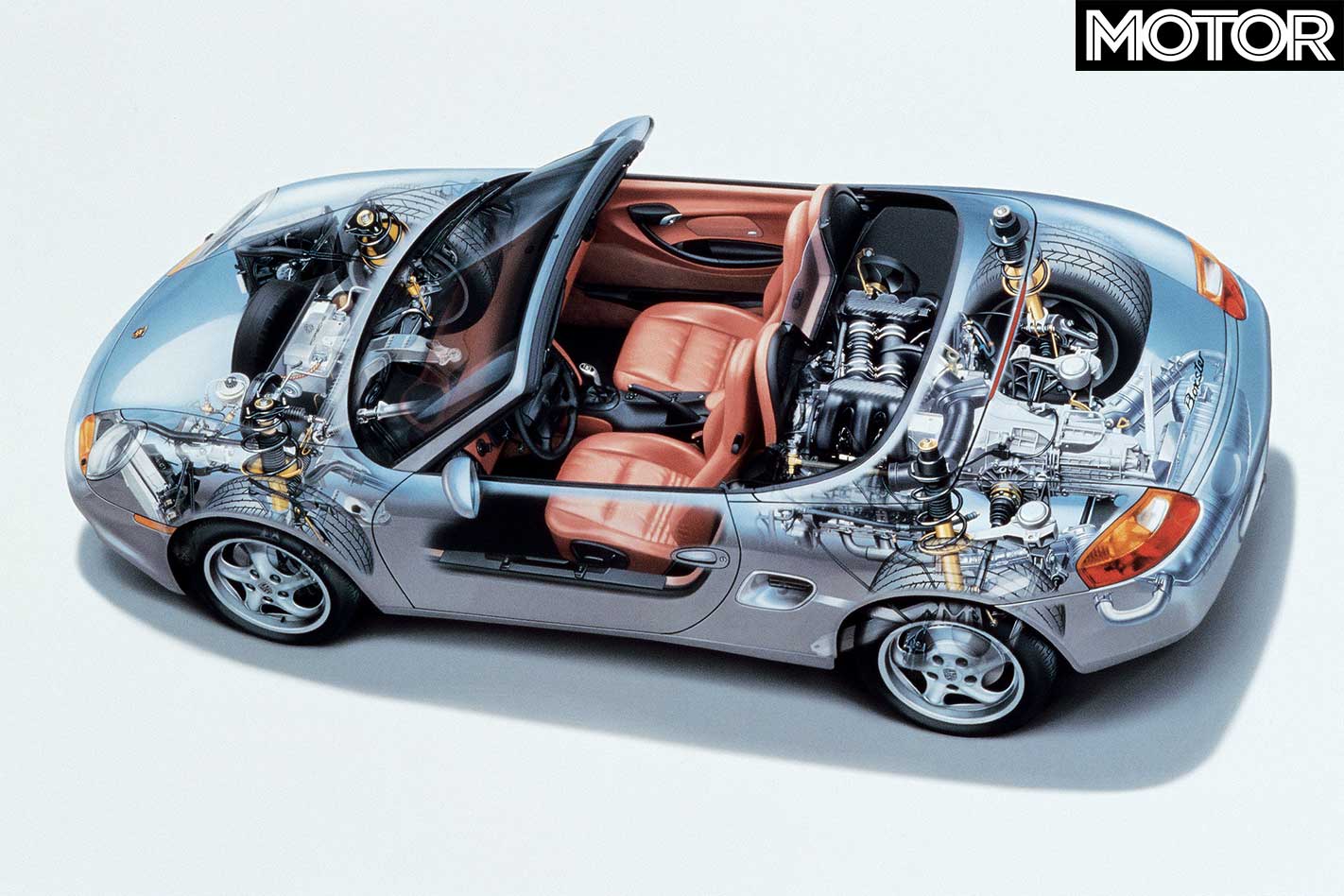
While the TT quattro ($92,850) and the top-notch Z4 ($92,000) offer six gears, the Boxster ($108,500) makes do with five. Although the three engines are only 10 kilowatts apart, slowest to fastest in the 0-100 spans just 0.8 seconds. How come? The weight chart tells it all.
Handicapped by the unique all-wheel-drive system, the Audi tips the scales at 1475 kilos. The BMW weighs only 1365kg, and the Porsche is lighter still at 1275kg. Thanks to its close gearing, the Z4 takes a mere 5.9 seconds to get to 100km/h.
The Porsche’s wider-spread over a broader rev range loses 0.5 sec in the process and although the Audi has that coveted sixth gear, it suffers from turbo lag and drivetrain friction. As a result, it requires a more leisurely 6.7 seconds. But while none holds a clear stopwatch advantage over the other, each has its highlights.
The long-legged, high-revving Boxster builds a small gap above 160km/h, and with a top speed of 253km/h it also is the fastest car in this group but only by a token margin. The 250km/h BMW wins the traffic lights GP by a whisker, but it drops back to the middle of the pack when you enter the crucial 60 to 130km/h bracket.
The 237km/h TT has quantifiably more bottom-end grunt than its rivals, yet through the twisties it’s not so much the engine but the grippy chassis that helps it to stay in touch. As far as the fun factor is concerned, the Audi is admittedly no match for the rear-wheel-drive, opposite-lock faction.
But when a sudden shower sprinkled the road, the quattro system instantly elevated the TT to a plateau of its own. No, it’s not just the superior roadholding and traction that do the trick, the Audi also scores with confidence-inspiring handling at the limit: this car will never play foul.
The Z4 offers a chameleon-like kaleidoscope of abilities thanks two separate dash buttons. One is labelled DTC, the other DSC. Instead of changing the handling from uneventful to tail-happy by completely deactivating stability control (DSC), BMW has created an intermediate mode labelled dynamic traction control (DTC).

It permits a little bit of slip and a little bit of slide, but only under 64km/h and 0.4g. Which is essentially the perfect setting for a series of wet esses where skill level need not be around Schumacher levels to have fun.
Keep the button pressed for a few seconds longer to deactivate the remaining chips and with DSC in the off position, the BMW demands it be handled with care. This, despite the 49.5:50.5 front-to-rear weight distribution, the low centre of gravity and wide track.
The other wizard button is known as FDC, short for a ‘Germanic’ Fahr Dynamic Control. Push it to get a faster kick out of the throttle response and a stiffer calibration of the electric power steering. FDC marks the transition from cruiser to sports car, so you should only select it on the open road where ultra-sharp reflexes are much more welcome than around town.
In theory, the electric power steering combines the best of both worlds: it’s speed-sensitive and adaptive, linear and transparent. As good as it is though, it still falls short of the three-dimensional feedback, the progressive turn-in action and the reassuring directional stability offered by a good hydraulic system.
The Porsche does most things the old-fashioned way. Even its PSM stability control is optional. Like the BMW engine, the six-cylinder boxer has adjustable camshafts to boost low-end torque. The flat-six is (in comparison to its inline contender) short of displacement (by 300cc) and torque (by 260 against 300Nm), but it has a higher rev limit (7000 vs 6500rpm) and it uses less fuel.
Under identical conditions, the Boxster averaged 11.9l/100km and while the TT was only marginally worse (12.0l/100km), the Z4 was the thirstiest of the lot at 13.0l/100km. To compound the thirst, the BMW’s 55 litre tank is also the smallest, followed by the Audi (62 litres) and the Porsche (64).
Although there was seldom a queue for the TT’s keys, the quattro does have some shining moments. Take for instance the interaction between throttle and turbocharger.
Above 1500rpm, the whistle-and-whine sung by the blower signals instant oomph, and when the hammer drops, this car will indeed rocket ahead. On the debit side, the Audi suffers from a low-end throttle response lag, from a rubbery clutch and a notchy six-speed gearbox.
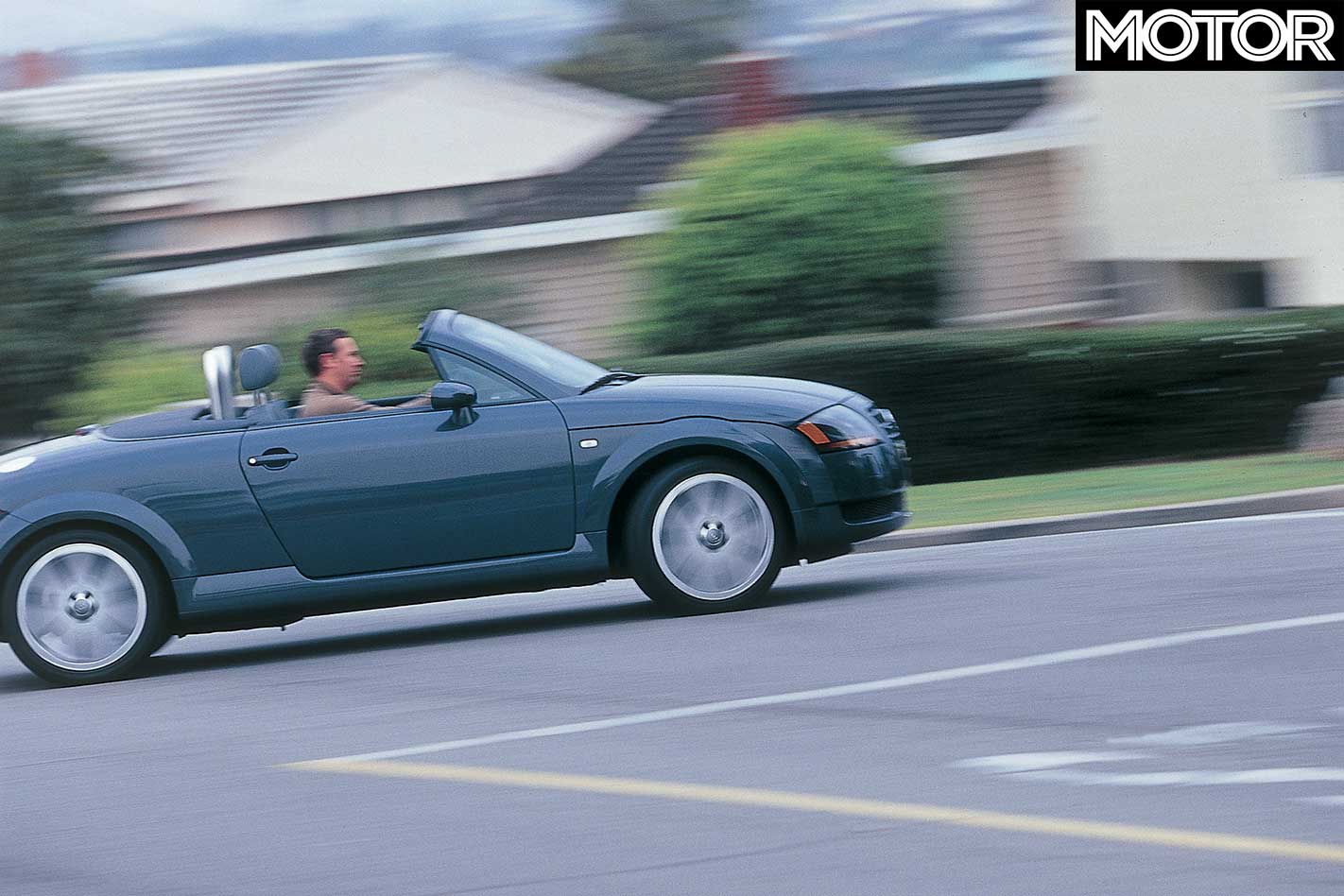
The steering is sufficiently light, direct and precise, but it can never obscure the fact that the other job of the front wheels is to drive. Through tight corners, understeer comes calling and it’s only eased by winding off some lock and letting the chassis settle back into something more neutral.
Although the brakes are attentive and strong, they don’t bite with real vigour. There is no doubt about it: out of these three, the TT displays the least amount of pure sports muscle.
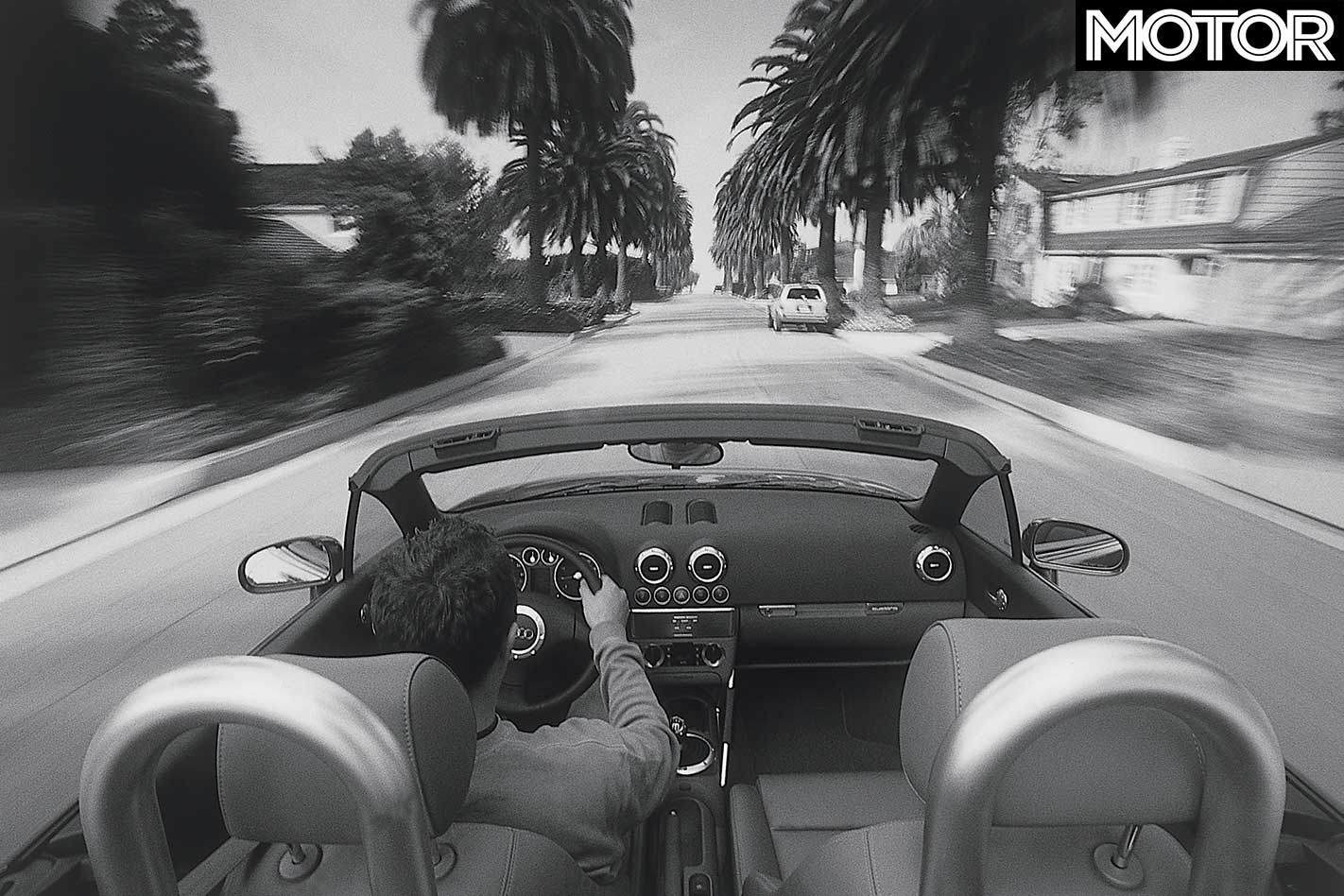
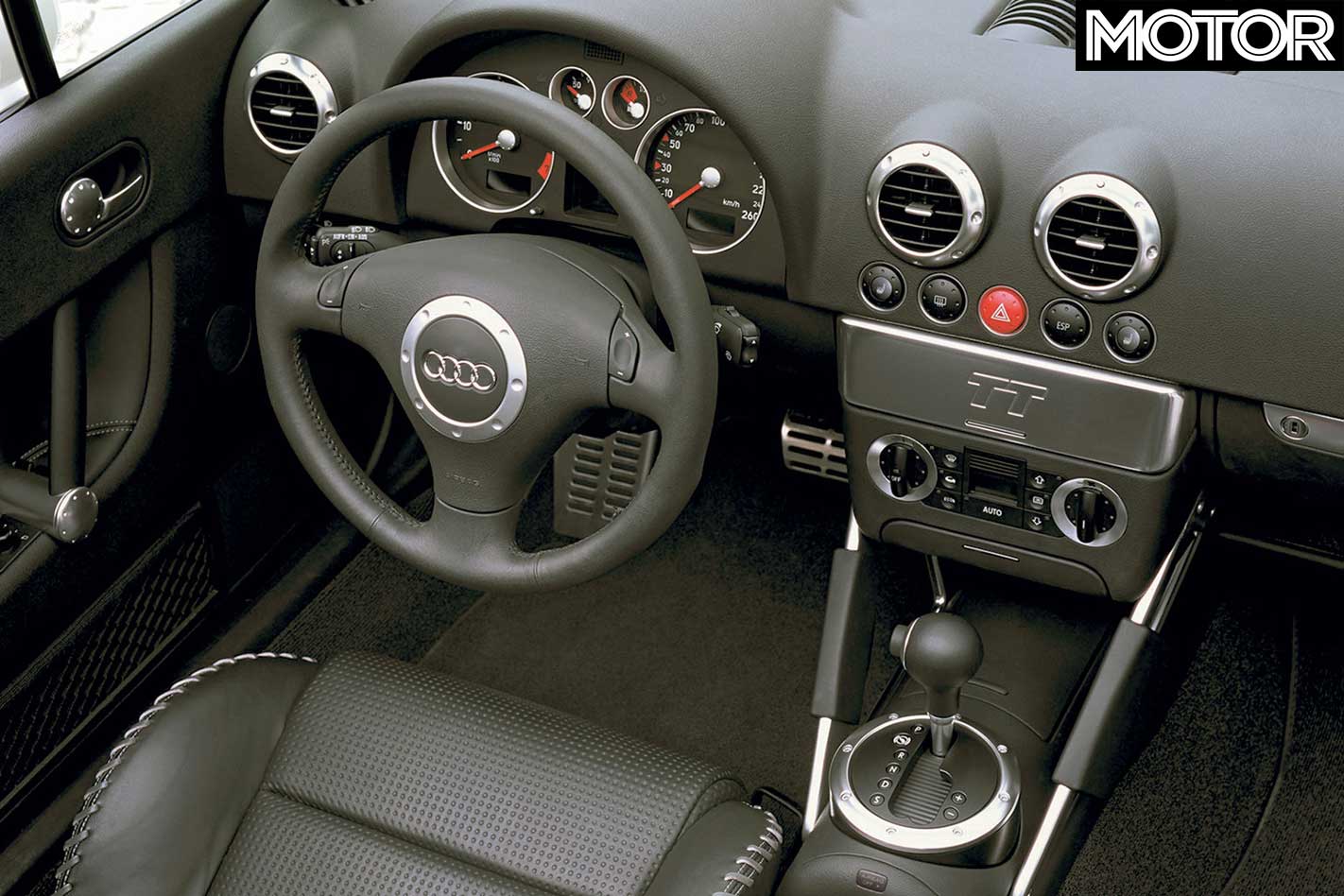
But the Audi has the best fit and finish, the nicest cabin and the highest-quality materials. Its trim is supplied by cows not chemical nerds, its plastics are coloured and grained to perfection, its carpets and aluminium accents are truly worthy of a premium brand, and its cockpit is roomy as well as ergonomically flawless. As far as the driver environment is concerned, the other two roadsters present don’t even come close, period.
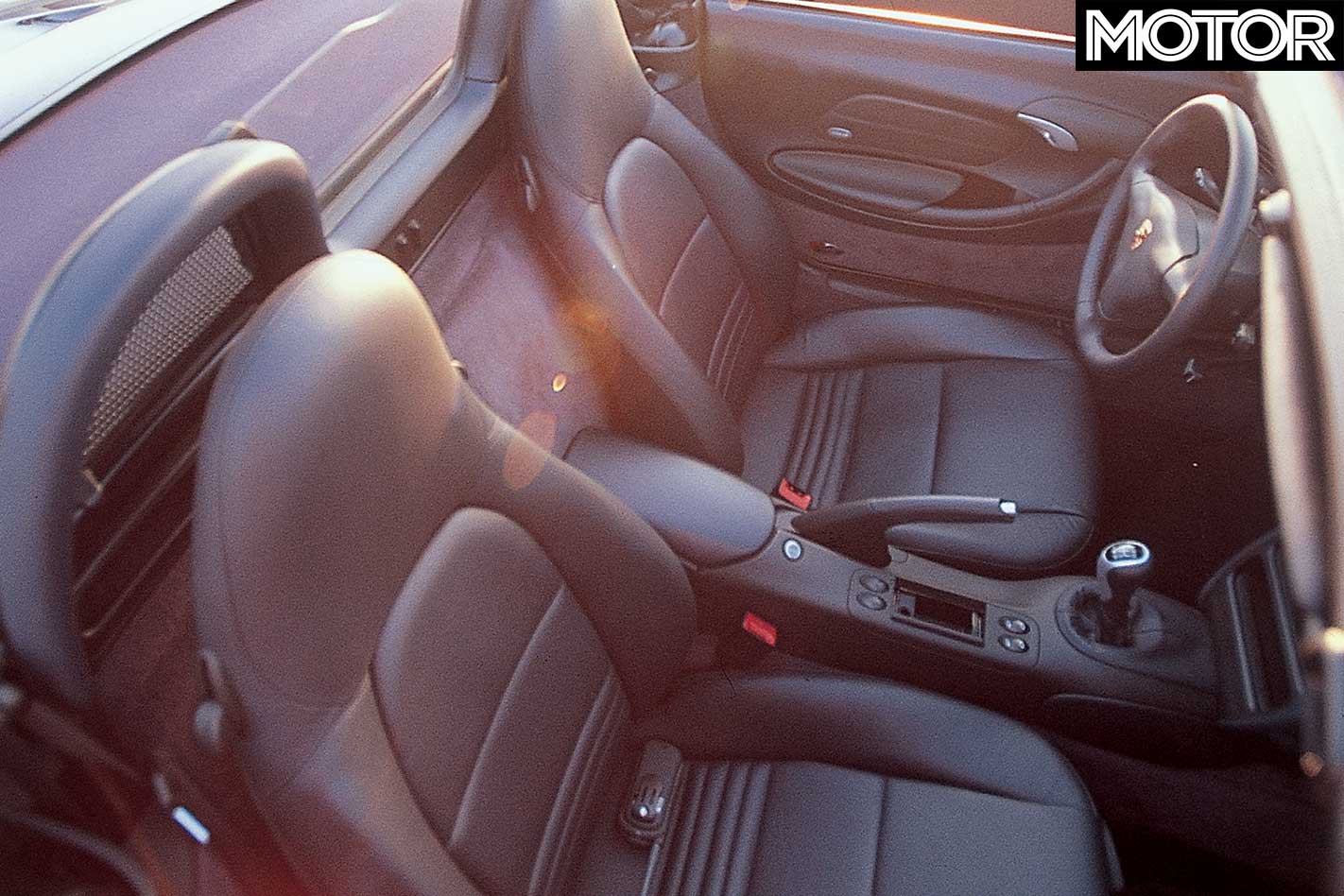
The Boxster may be well put together and its coarse synthetic surfaces may be made to last, but it is obviously short of legroom, the steering column is only adjustable in reach, and the AC panel was borrowed from a long-discontinued generation of Audi saloons. And we’re not done with this one yet.
The instruments are partly obscured, the secondary controls are scattered and tiny, the standard specification barely makes the grade, and there are more blank switches than one can tolerate in this price and this class.
You believe things cannot get worse? Then hop in the Bee-Emm and think again.
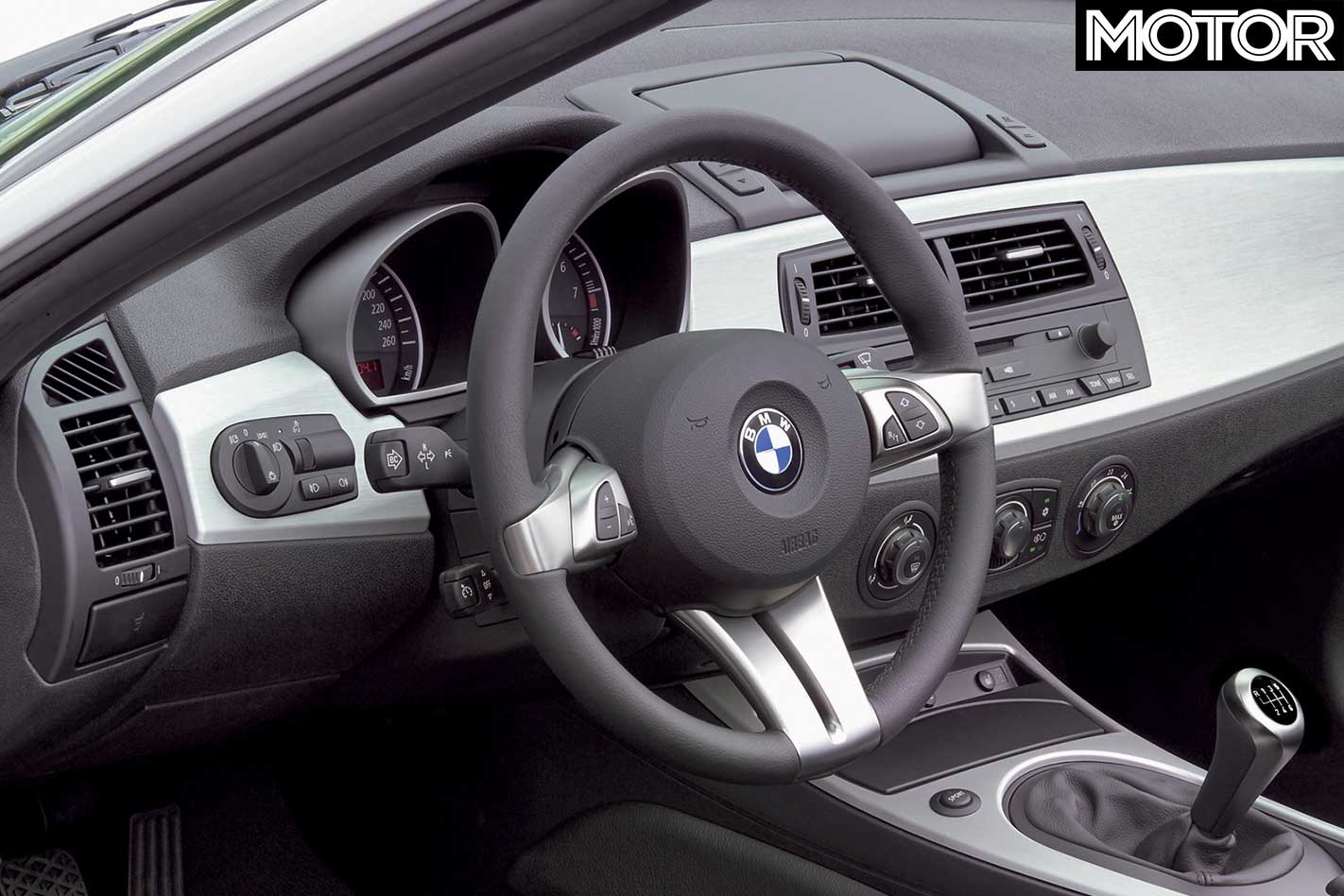
Never mind the curved furniture-style brushed-alloy dashboard which may have been part of a Korean fridge in a previous life.
Never mind the absence of any oddments space. Never mind the out-of-reach position of the minor push-buttons, the cheapo plastics and the occasionally casual build quality. What people will find really irritating is the position of the (left hook) steering wheel, slightly offset and tilted. Expect a mirror image in right hand drive.
The small and poorly legible instruments are also in line for criticism, as is the mediocre visibility and the thinly padded seats which don’t provide enough lateral and lumbar support. The cabin of a sports car developed from scratch should at least get the fundamentals right.
The Porsche, which underwent a minor facelift in mid-2002, now has a heated glass rear window, a proper glovebox and push-button releases for the two luggage compartments.
The roof of the Boxster, which does without a cover panel when open, served as role model for the canvas top of the Z4 and it uses an equally clever accordian linkage. When switching from sun worshipper to shade seeker, its weather shield even outperforms the previous record holder by seven against twelve seconds.
The TT needs 15 seconds to open or close, but the elapsed time doesn’t include fitting the tonneau cover which you stash or clip into place. When not used, it reduces the volume of the boot – which is a bad thing, because the boot of the Audi is already modest. Graced with the lowest loading lip, the Z4 will swallow about 60 per cent more than the TT.
Early in the morning and after dark, with roofs up and the heaters on, each car played its own unmistakable tune. The TT’s tone is a flat, muted brap, with some whistles and flutes from the flow of pressurised air with every upshift.
The sounds of the Boxster are more modern, more mechanical with an ironic smooth/harsh bark that Porsche sixes emit. The Z4 sang a varied tune, a low-down almost-muffled growl, increasing to a heavy metal thrash to its redline, a note so metallically sweet it encourages downshifts and a throttle blip just for the heck of it.
The Audi holds the road like a moving magnet, and its all-weather traction is compelling enough to take on a rack-railway, but unfortunately the TT does not handle as well as it should. There’s too much body roll, too much understeer, too much passivity and not enough feedback. If it’s sure-footedness you’re after, this is the car for you. But if stimulation and satisfaction is what you want, look elsewhere.
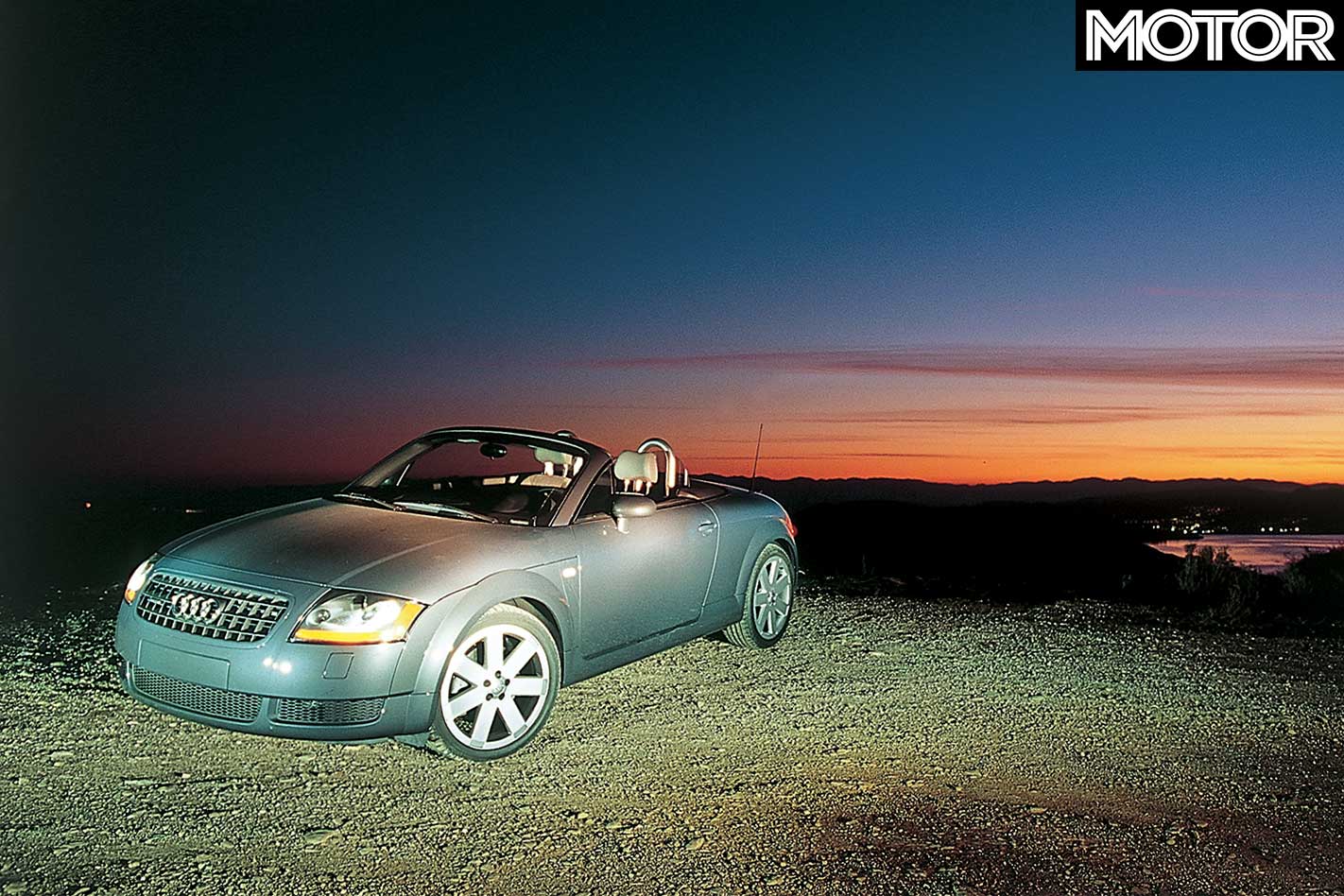
Like the Z4. On dry pavement, it’s an amazingly talented entertainer but at the same time it is also hard work. Especially when fitted with the lowered and stiffened M-Technic suspension, you’re constantly fighting the rear axle, the g-force-defying front axle and the steering which is borderline acceptable in terms of weight and feedback.
A lot fun for an hour or two, but over a long day the BMW threatens to wear you out. It offers zero ride comfort yet calls for 100 per cent attention. Compared to a Z4, the M3 is a softie.
The overall balance that is so nearly right gets spoiled by the calibration of the controls. The throttle response is lightning-quick, the brakes perform at the first dab on the pedal, the gearlever clickety-clicks through the gate, the chassis absorbs cat’s eyes for breakfast and manhole covers for desert. But the steering can’t make up its mind.
It lacks the reassuring stiffness you appreciate at autobahn speeds, it loses interest as you start winding on more lock, and it keeps missing the cue when you want it to turn-in or to self-centre.
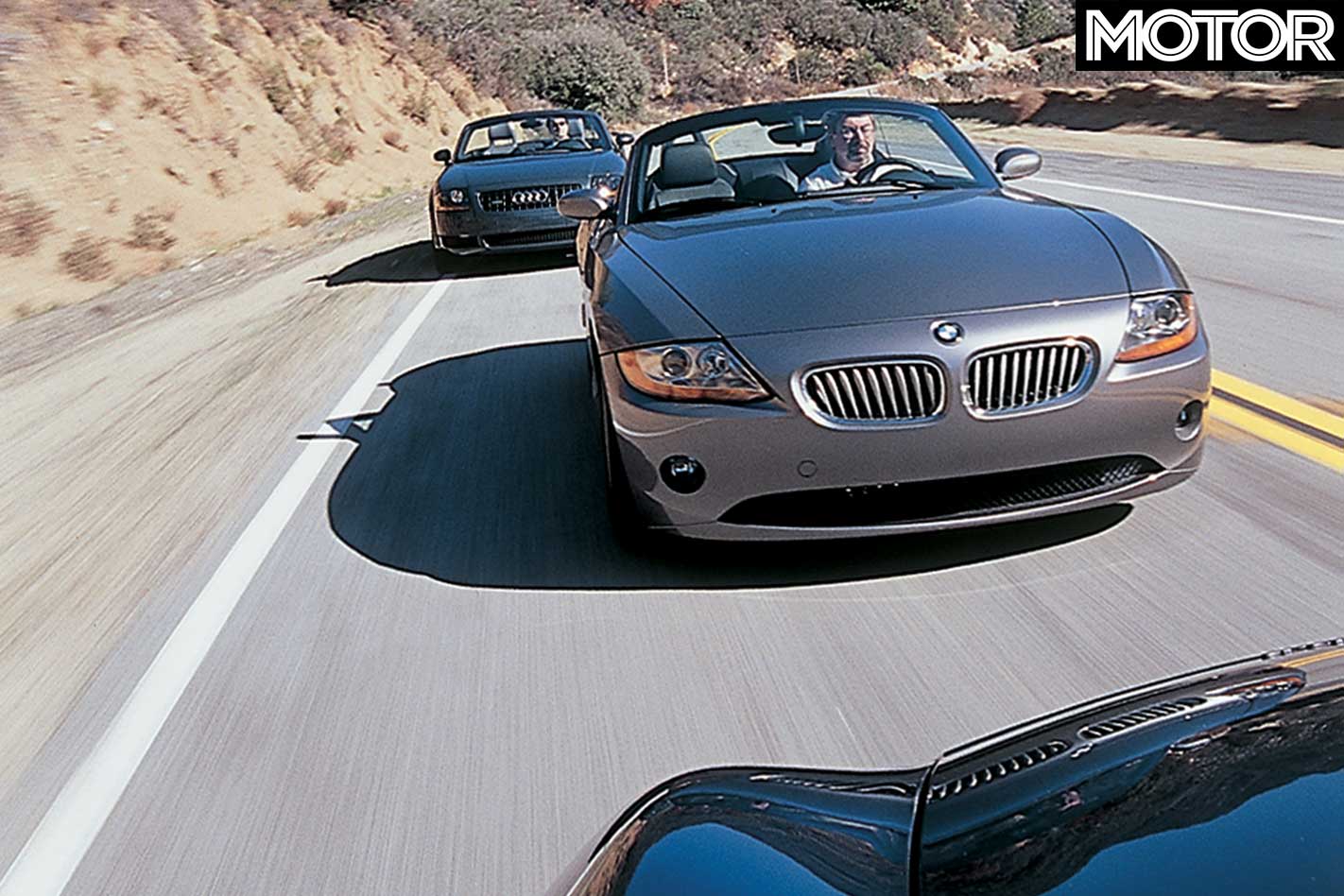
A revised steering software and a more human suspension setting is probably all it takes to fix the Z4. As things stand, however, the Boxster narrowly eclipses the BMW. You see, the Porsche is such a well-balanced machine, quick and benign, committed and coherent, raw-edged and polished, puristic and civilized. It also is an easy car to drive fast, a forgiving car that won’t penalise every mistake.
Go ten-tenths in the Z4 and all the warning lights flash and the chassis is sweating, working overtime. Do the same thing in the Boxster, and it soon becomes clear that high speed and total composure are perfectly compatible elements after all.
The Porsche is not as extroverted as the BMW and not as introverted as the TT. It’s homogenous and creamy, a little toned-down perhaps but no less convincing. If you hate drama, take the Audi. If you love drama, take the Z4. If you couldn’t give a toss about drama, take the Porsche.
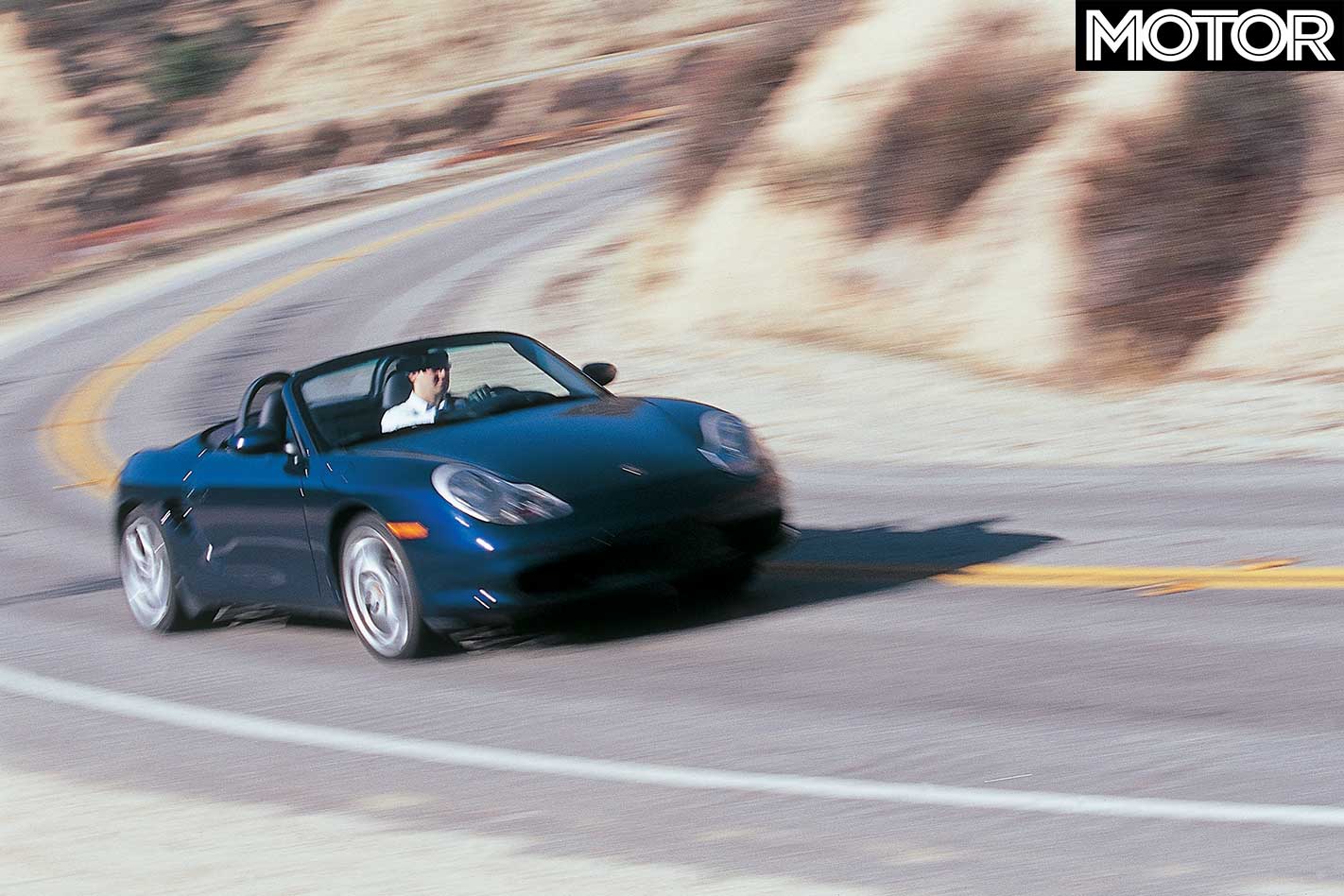
The mid-engined roadster will pump as much adrenaline as you can handle, but at the same time will always deliver in that sublime, telepathic, sweet-mannered, unruffled way, seven days a week, rain or shine, distance no object, any challenge accepted.
Come to think of it, crowning the winner wasn’t so hard after all.
Home Groan ‘Made in Germany’ brings cred. But what if it’s not?
German cars, designed by Germans, built by Germans to be driven bloody quickly on German roads. If this sounds familiar, and contains some of the reasons why you believe the Germans build such cracking fast cars, think again.
BMW’s still a proud Bavarian company. Largely family-owned, it’s a Munich icon. But BMW builds 3-Series models in South Africa and it opened its plant in Spartanburg, South Carolina in 1995 to build the original Z3 (as previewed in the James Bond film Goldeneye).
Spartanburg now churns out the X5 variants and the Z4 for global consumption. Today, around 85,000 cars are produced each year by the 3500-strong work force.
Audi’s TT is built in Györ, Hungary, even though the galvanised steel bodies are stamped, assembled and painted at GHQ in Ingolstadt, Germany. Audi’s also got an enormous plant in China where it builds A6s for fun and profit.
Porsche has stayed true to its roots, sticking to the outer suburbs of Stuttgart, right? Err, no.
It might not have gone as far as to jump continents, but it has built a factory in Leipzig (all right, it’s a joint venture with Volkswagen) to build the Cayenne. It’s still Germany, but it’s in the old East Germany, and to residents of the old West Germany, apparently, that makes a difference.
What about Mercedes-Benz, that unmistakably German brand? Just down the road from BMW’s Spartanburg facility (okay, way down the road), in Tuscaloosa, Alabama, Mercedes-Benz set up shop to build its off-roading M-Class.
Fast Facts
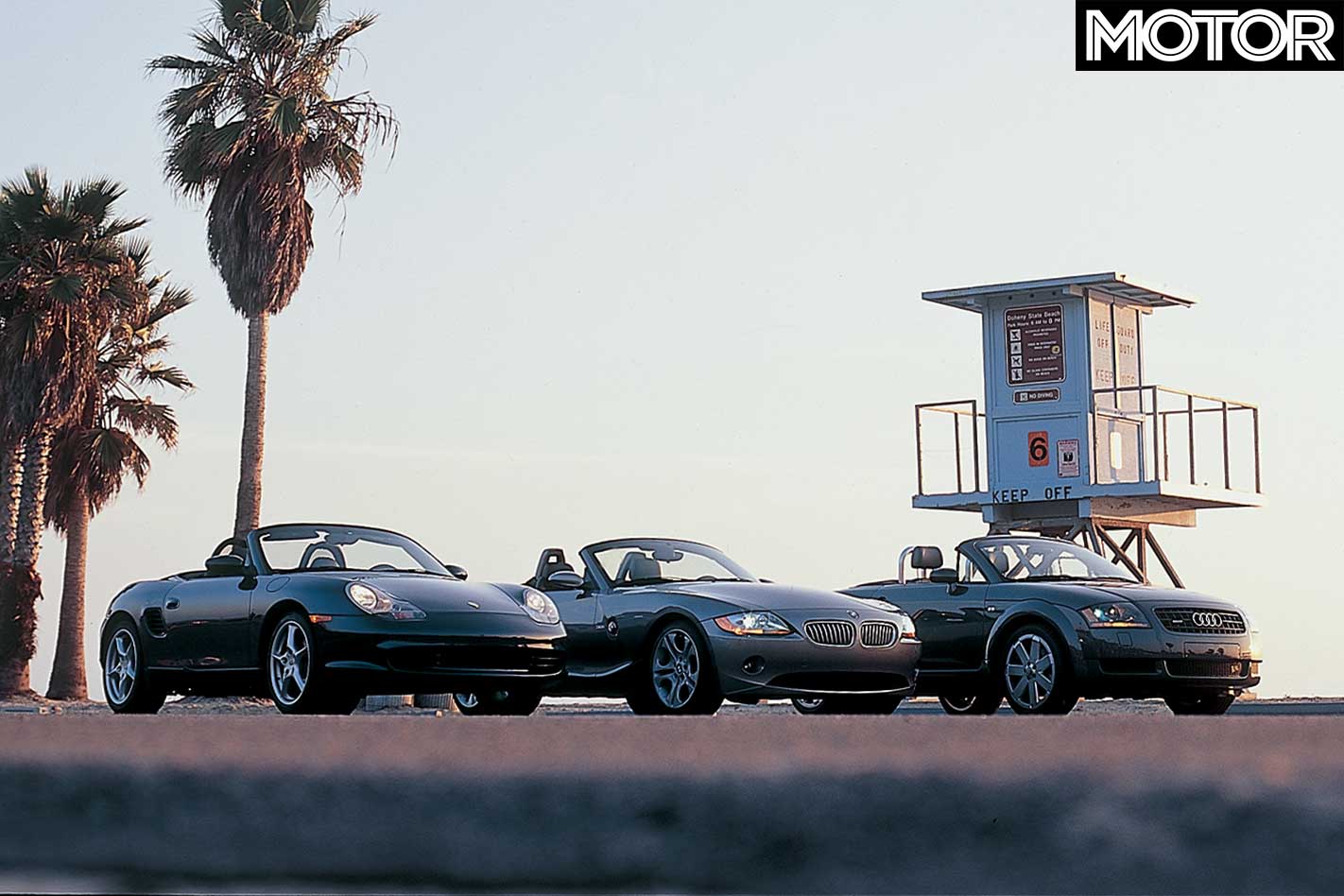
| u00a0 | 2003 Porsche Boxster | 2003 BMW Z4 3.0i | 2003 Audi TT Roadster |
| BODY | 2-door convertible | 2-door convertible | 2-door convertible |
| DRIVE | rear-wheel | rear-wheel | all-wheel |
| ENGINE | mid-mounted 2.7-litre DOHC, 24V flat-six | front-mounted 3.0-litre, DOHC, 24V, inline-six | front-mounted 1.8-litre, DOHC, 20V inline-four, turbo |
| BORE/STROKE | 85.5mm x 78.0mm | 84.0mm x 89.6mm | 81.0mm x 86.4mm |
| COMPRESSION | 11.0:1 | 10.2:1 | 9.0:1 |
| POWER | 168kW @ 6300rpm | 170kW @ 5900rpm | 165kW @ 5900rpm |
| TORQUE | 260Nm @ 4700rpm | 300Nm @ 3500rpm | 280Nm @ 2200rpm |
| WEIGHT | 1275kg | 1365kg | 1475kg |
| POWER/WEIGHT | 132kW/tonne | 125kW/tonne | 112kW/tonne |
| TRANSMISSION | 5-speed manual | 6-speed manual | 6-speed manual |
| SUSPENSION (f) | MacPherson struts, coil springs, anti-roll bar | coil-over struts, coil springs, anti-roll bar | MacPherson struts, coil springs, anti-roll bar |
| SUSPENSION (r) | MacPherson struts, coil springs, anti-roll bar | multi-link, coil springs, anti-roll bar | double wishbones, coil springs, anti-roll bar |
| L/W/H | 4320/1780/1290mm | 4091/1781/1299mm | 4041/1764/1348mm |
| WHEELBASE | 2415mm | 2495mm | 2429mm |
| TRACKS | 1455mm (f); 1528mm (r) | 1473mm (f); 1516mm (r) | 1528mm (f); 1505mm (r) |
| BRAKES (f) | 298mm ventilated discs, four-piston calipers | 300mm ventilated discs, single-piston calipers | 312mm ventilated discs, single-piston calipers |
| BRAKES (r) | 292mm ventilated discs, four-piston calipersu00a0 | 294mm ventilated discs, single-piston calipers | 239mm ventilated discs, single-piston calipers |
| FUEL | 64 litres, PULP | 55 litres, PULP | 62 litres, PULP |
| WHEELS | 18 x 7.5-inch (f); 18 x 9.0-inch (r), alloy | 18 x 8.0-inch (f); 18 x 8.5-inch (r), alloy | 18 x 8.0-inch (f & r), alloy |
| TYRE SIZES | 225/40 ZR18 (f); 265/35 ZR18 (r) | 225/40 ZR18 (f); 245/35 ZR18 (r) | 225/40 ZR18 (f/r) |
| TYRE | Michelin Pilot Sport | Bridgestone Potenza RE040 | Continental SportContact |
| PRICE | $108,500 | $92,000 | $92,850 |
Our 5 Likes & Gripes
Audi TT
1 – All-paw grip inspires confidence… 2 – …but it’s duller than matt black when you’re on it 3 – Interior styling and quality set it apart from nearly everything else on the road 4 – Smarty pants electronics kill a lot of joy 5 – Surfing the fat wave of turbo torque
BMW Z4
1 – Bold styling will turn heads, and it grows on you 2 – Firm ride turns harsh if you option the 18s 3 – Lively handling delivers big thrills… 4 – …but overstep the mark and it could be a big spill 5 – Wail of the fabulous 3.0-litre straight six never gets tiresome
Porsche Boxster
1 – That badge will be enough for many… 2 – …and that is also enough for people to hate you 3 – Sublime, fuss-free performance on any day of the week 4 – Standard equipment is only average for the ask 5 – Flat-six warble is one of the great sounds in cars
