
NSW Police is soon to have 350kW and 637Nm at its disposal in the form of a number of 2018 Chrysler 300 SRT Cores, its new Highway Patrol Command fleet cars.
Joining the American muscle car will be a German executive, albeit in a very basic fleet-trim, the turbo diesel six 2018 BMW 530d.
Though the SRT weighs almost two tonnes, it’s packing a 6.4-litre Hemi V8 which allows it to hit 100km/h from a standstill in 4.68 seconds – a time we’ve clocked during a MOTOR review.
The 3.0-litre inline six turbo diesel engine in the 530d only puts out 195kW, but 620Nm makes for a 0-100km/h sprint in less than 6 seconds.
The SRT is also quicker than the Kia Stinger which had been reportedly considered last year.
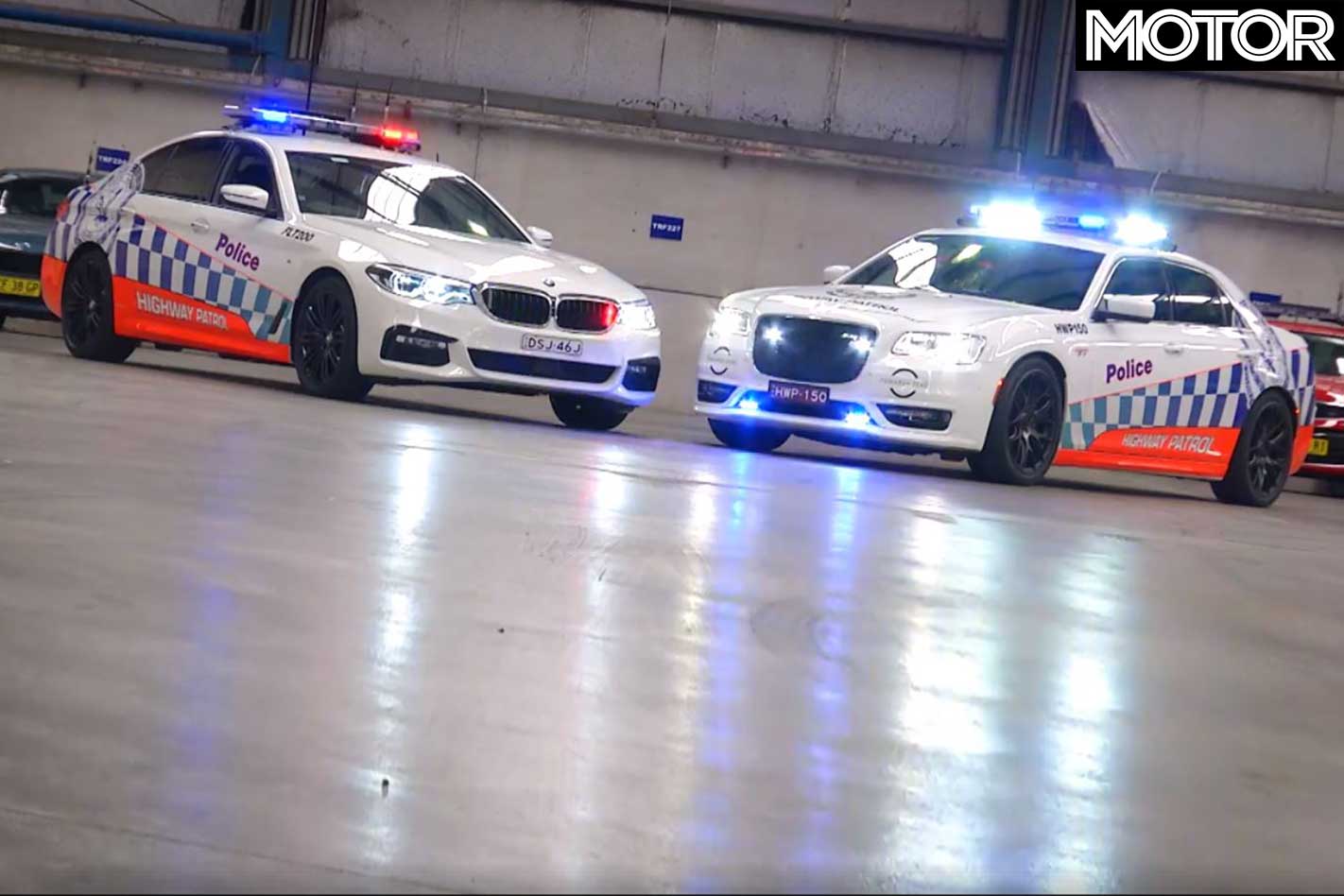
NSW assistant commissioner Michael Corboy says more than a dozen vehicles were considered for the job, but these two took the top places.
“The safety of our police officers and the community they serve is our top priority, and both these vehicles demonstrated the safety levels meeting our requirements,” Corboy says.
“Equally as important, the platform of both vehicles supports the state of the art technology that is key to the government’s focus on reducing the incidents of road trauma across New South Wales.”
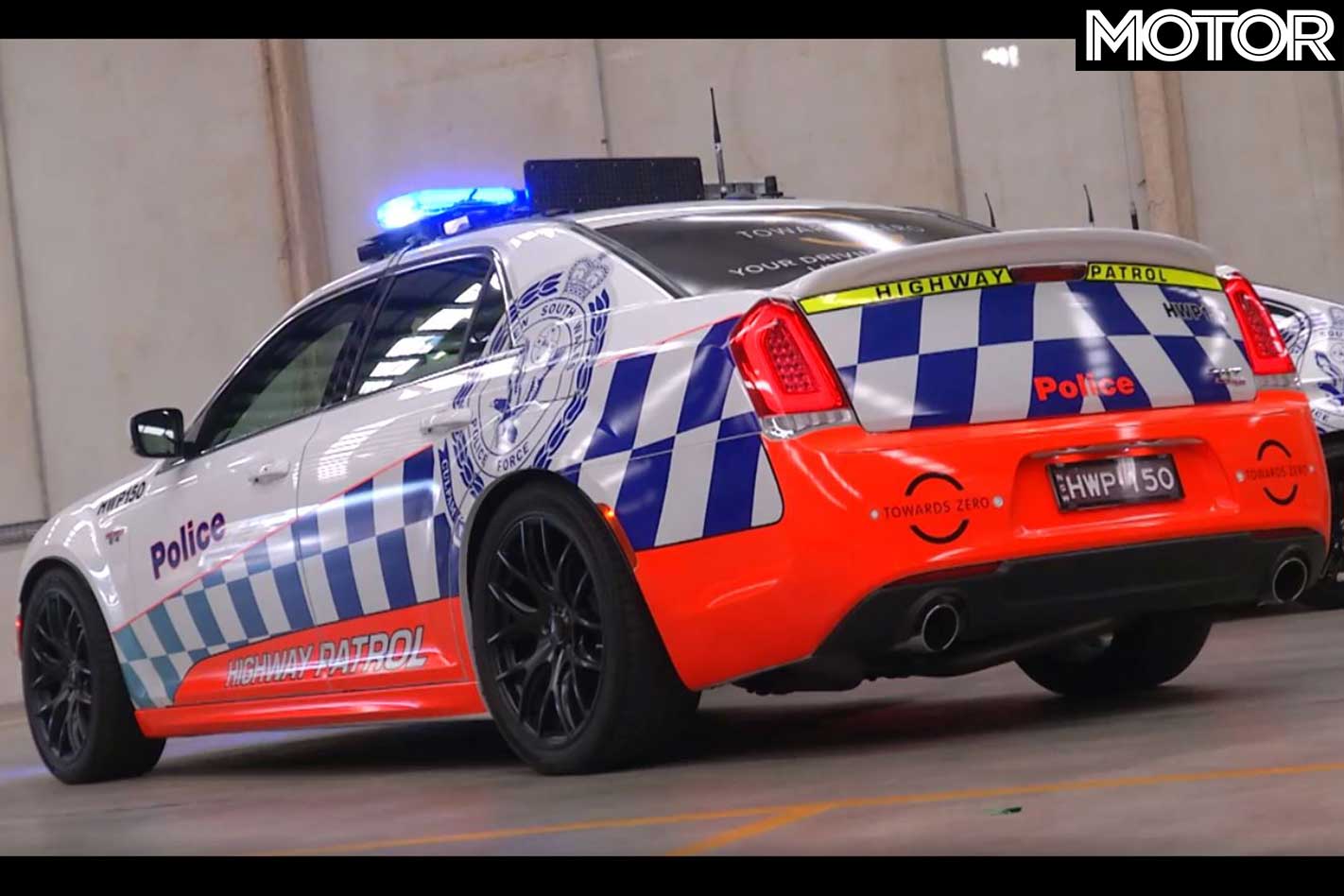
Corboy adds that the vehicles had been tested and passed due to their financial viability as well as having been built for use as police vehicles in other parts of the world.
“NSW Police looked all over the world for replacements for [Commodore and Falcon] which have served this state well over the past 20 or 30 years.
“We expect that the cost of these vehicles over the lifetime of the cars will be on par with our current fleet costs.”
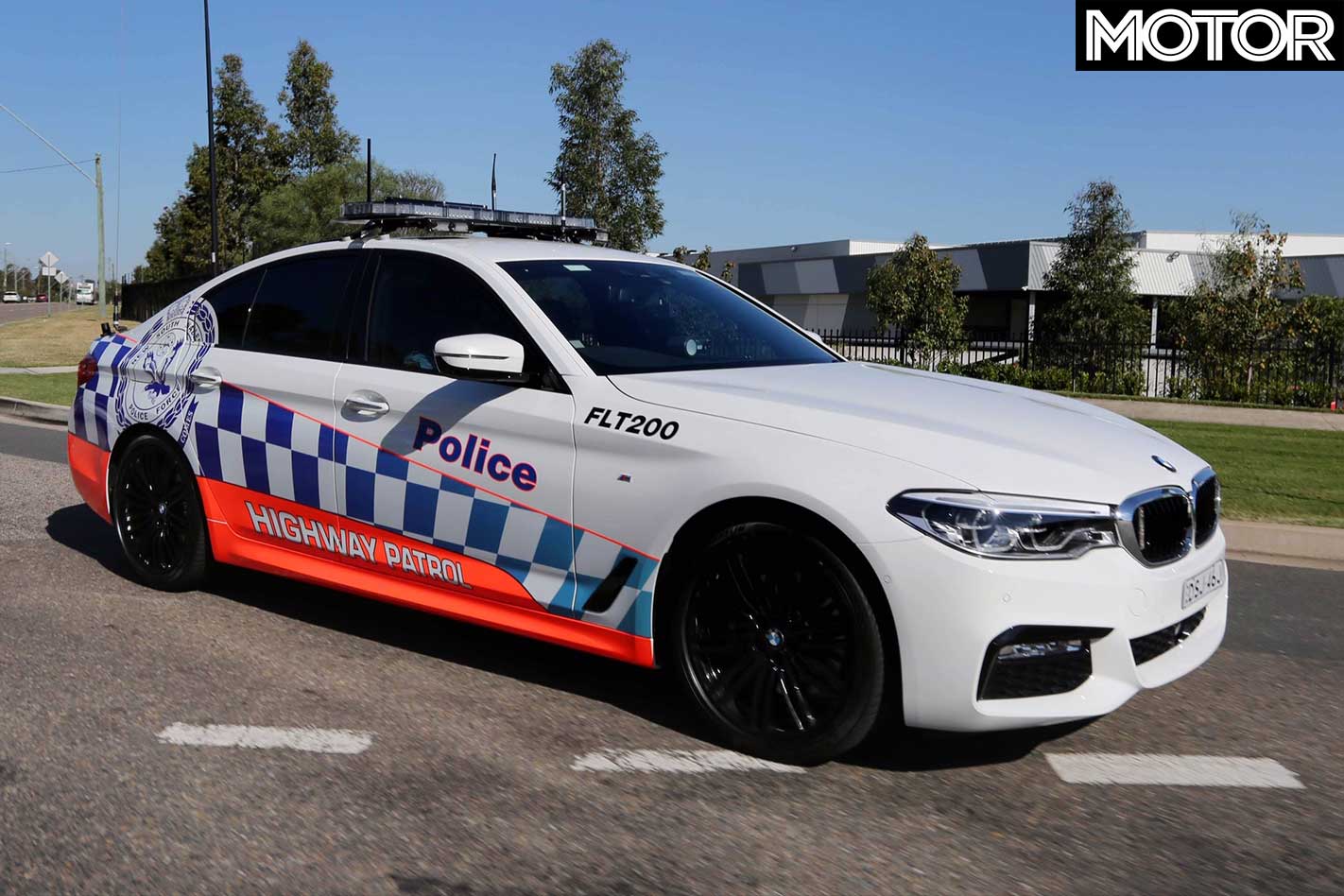
Recently, Victoria Police confirmed it would also be using up to 80 of BMW’s diesel 5 Series to make up a portion of its Highway Patrol fleet.
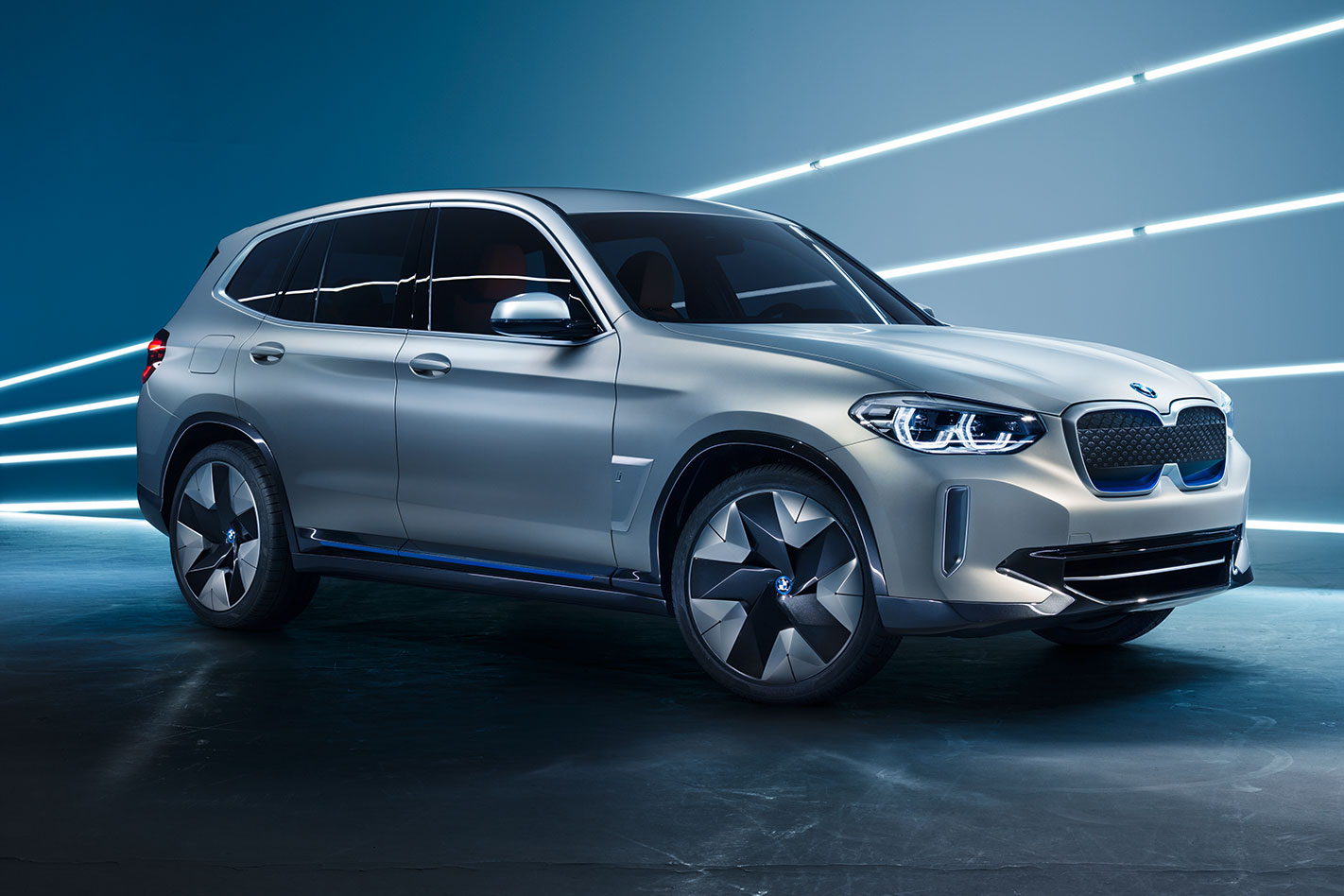
A CONCEPT dubbed the BMW iNEXT has teased what the German luxury car brand claims is the next big step in its move towards the more widespread electrification of its not-too-distant showroom.
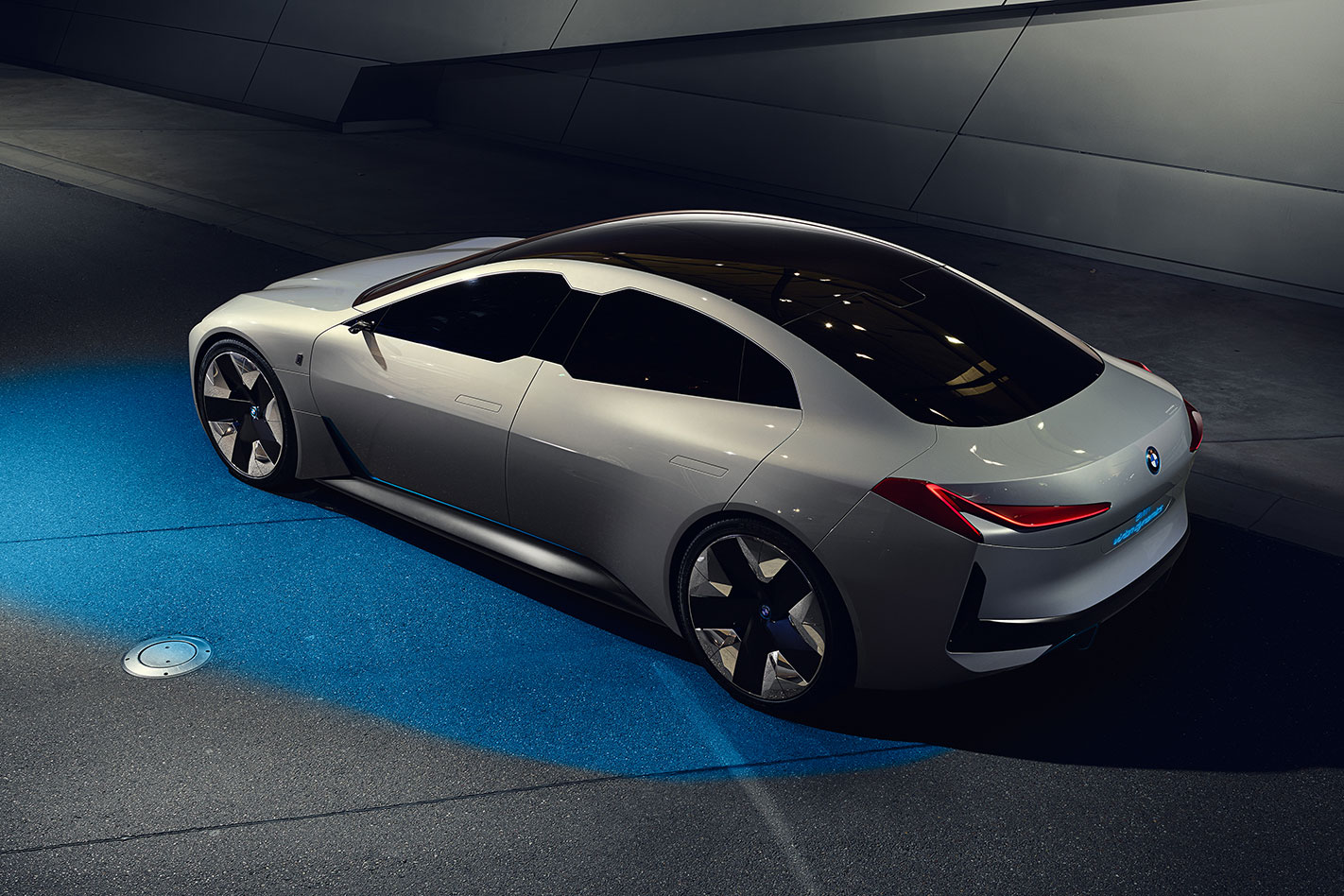
However, we will need a bit of patience to see how this sketch of the new-generation electric car will evolve; BMW flagged it plans to wait until later this year before it officially unveils what it has dubbed a “vision vehicle” combining what BMW chairman Harald Kruger described as “all key technologies for future mobility in one vehicle”. It appears top be an SUV-styled version of a sedan-based concept teased earlier this year (pictured, below).
“For the first time, we are combining all key technologies for future mobility in one vehicle. The iNEXT is fully electric, fully connected and also offers highly automated driving,” he said.
“Today, we gave our shareholders a very first glimpse of the design of the BMW iNEXT. Later this year, we will be presenting the BMW iNEXT as a vision vehicle.”
Few details are evident from the sketch, apart from an aerodynamic, swept coupe-like design that has a low bonnet, laid-back windscreen and squared-off wheel arches similar to those fettled into the BMW X2 compact SUV. There is what appears to be a hidden B-pillar and – in a radical departure for the brand – no Hoffmeister knick on the rear quarter window.
Of note, BMW has said the iNEXT – which BMW said would incorporate all major strategic areas of innovation in a road-ready vehicle when it is launched in 2021 – will be built at its German plant in Dingolfing, southern Bavaria.
The iNEXT is one of a number of electrified vehicles the German brand has flagged it will reveal before 2018 runs out. The cars are believed to be having an official reveal around Germany’s flagship event, the 2018 Frankfurt Motor Show, which starts in late September.
One of these vehicles is believed to be the i4, a Tesla Model 3-fighting sedan based on the BMW i Vision Dynamics concept unveiled at this year’s Geneva Motor Show, and already confirmed for production.
In a few months’ time, BMW will launch a facelifted version of the i8 in Australia, and will expand the range by adding a soft-topped roadster to the hybrid sports coupe’s line-up for the first time.
BMW has also tested the market’s appetite for a performance-fettled version of the carbonfibre-clad i3, with the i3s dropping its ride height, adding aero tweaks and wheel arch extensions, and amped-up performance that officially produces 135kW/270Nm – enough to push the more potent i3 from 0-100km/h in 6.9 seconds, 0.4secs ahead of the more pedestrian version.
Spot the differences. You know the game: two panels of the same image contain tiny differences which make apparently identical frames subtly different. Spot all the changes and win a punch in the face, or something.
This review was originally published in MOTOR’s October 2004 issue
This is the 2004-spec Honda S2000, whose might-miss-them updates may be minor, but are nevertheless most necessary up against Nissan’s 350Z Roadster.
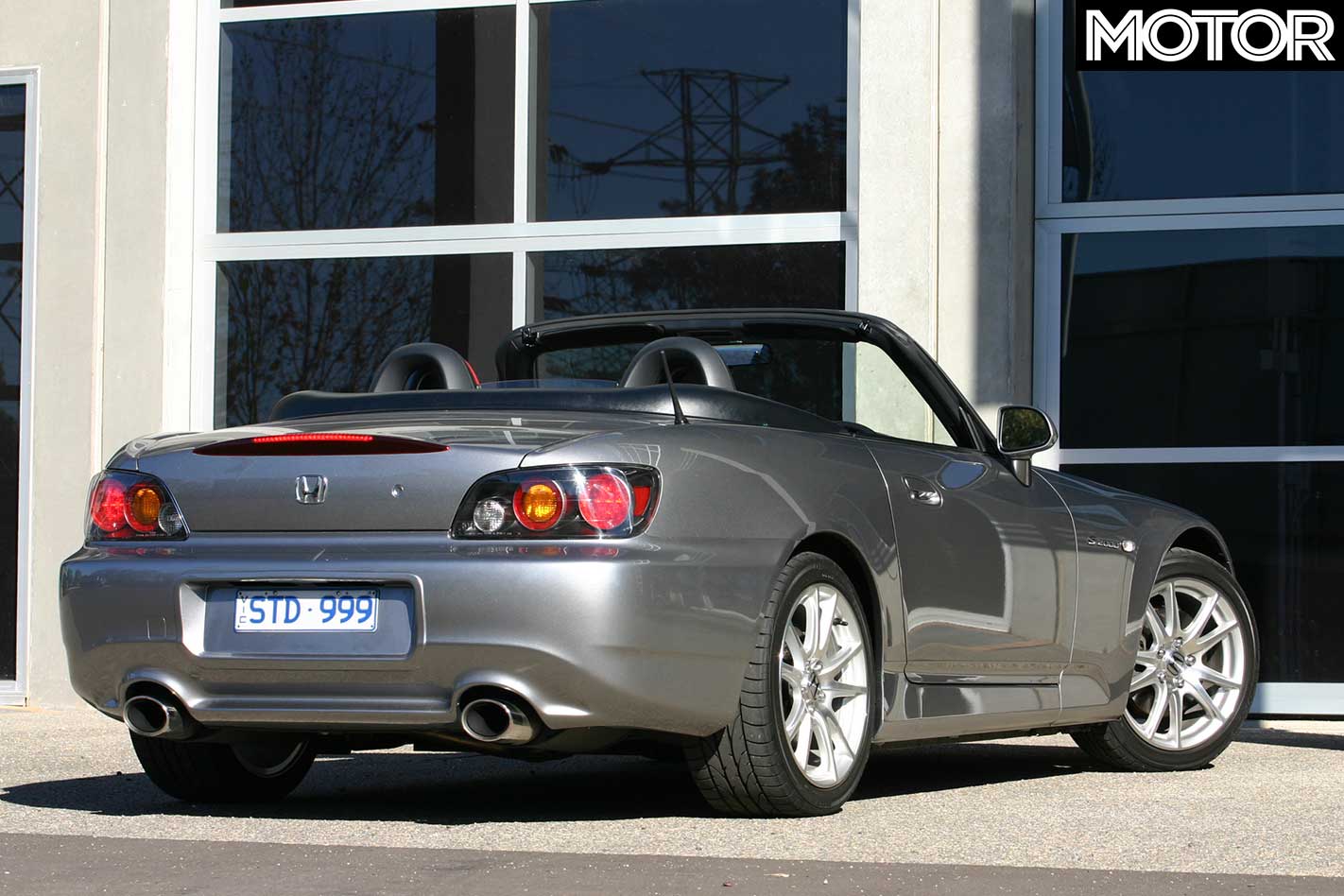
Its tail-lights are new, too, now with an LED design. But the projector beam HID headlights are an easier spot, and modernise the little Honda roadster.
Likewise, the S2000’s wheels, with a new design and up an inch in diameter to 17s. The rubber has grown larger and lower profile with 215/45s up front, versus the previous 205/55s, and 245/40s replacing 225/50s in the rear. Grip, as you’d expect is marginally up, but ride quality is effectively as good, because the change in wheelware also brought about a retune of the suspension.
Underneath are revisions to the suspension geometry, rear sway bar, springs and shocks, all designed to make the twitchy convertible… er, less twitchy.
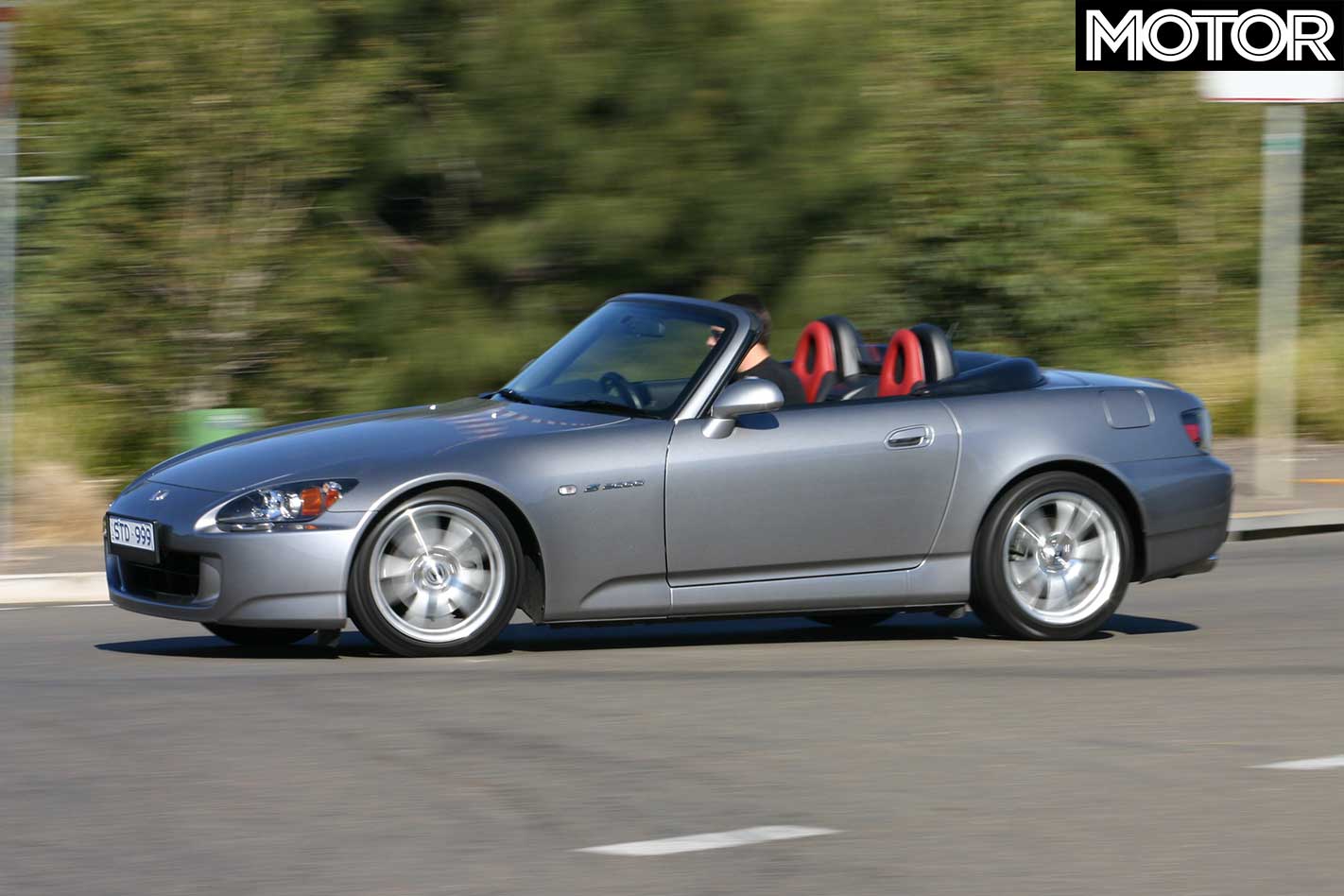
The presence of even more grip, plus a revised electronic power steering system, means there’s marginally sharper turn-in, and the 50:50 weight split gives it a natural tendency to hold a great balance, while its powerful but relatively torque-lacking engine always has a tough time overpowering its rear grip.
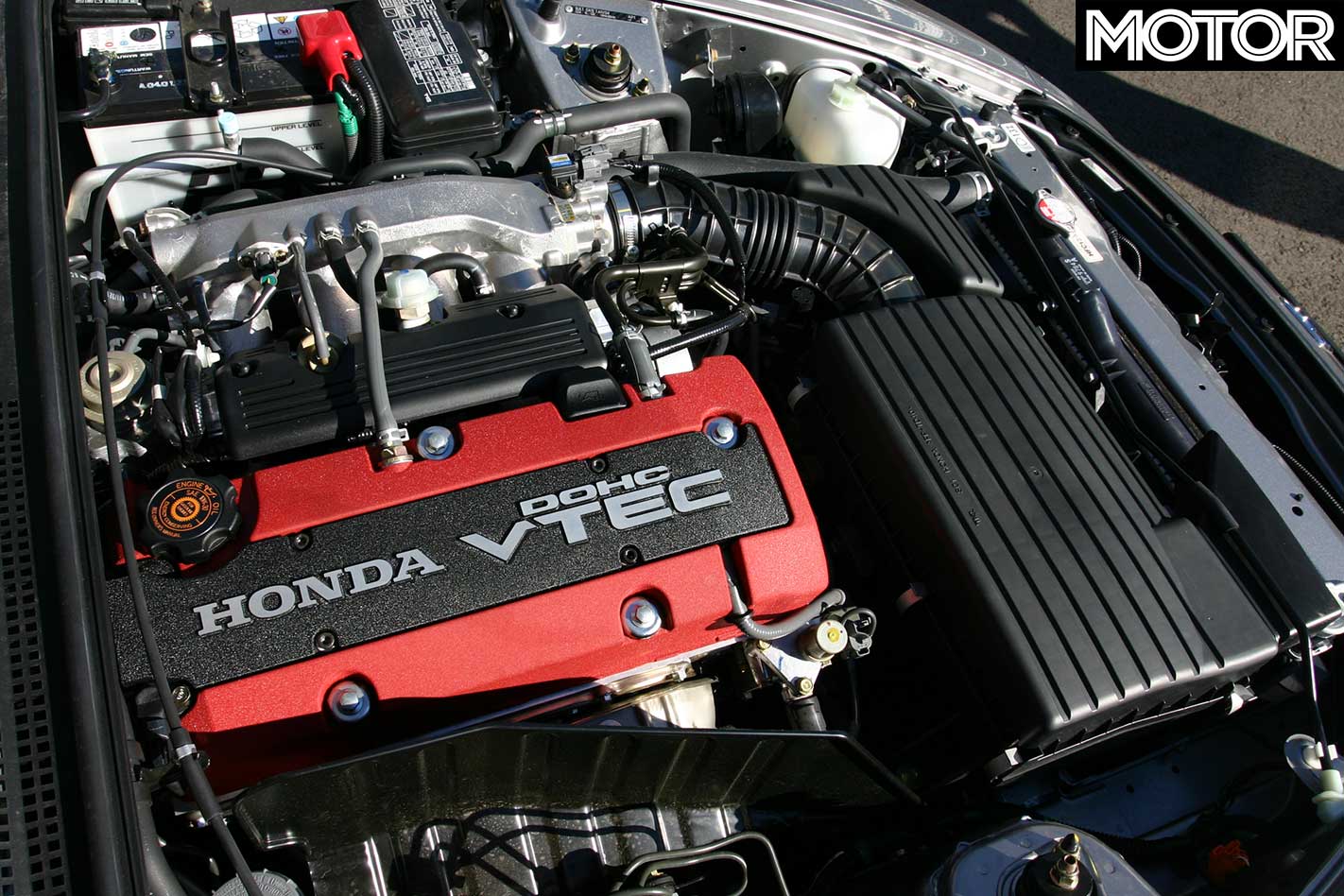
On the engine, there’s nothing new: it’s the same 176kW at 8300rpm, same 9000rpm redline, and the same 208Nm at a highly-strung 7500rpm. And while it’s the most powerful non-turbo 2.0-litre on sale in Oz, it’s also the most efficient engine, with a power-per-litre rating outclassing even Ferrari’s 360 Modena and BMW’s M3 CSL!
Sadly, the USA-spec 2.2-litre engine, with 179kW and 220Nm, remains a USA-spec.
Under brakes, the 2004 model S2000 is a touch better, with harder pad material, a lighter, more compact brake booster and a raised ABS threshold to exploit its wider rubber.
But the interior is where some really smart updates have been made, the most obvious being to its centre console, with a sliding door covering a twin cup holder and a matching silver stereo cover. There’s also a slightly less cramped cabin feel, thanks to some massaging of the footwells, plus redesigned door trims.
In short, the 2004 S2000 is mild and styled with the kind of revisions that make the car that little step better. Game over.
FAST FACTS 2004 Honda S2000 Engine: 2.0-litre DOHC 16-valve four Power: 176kW Weight: 1259kg Drive: rear-wheel Price: $74,990
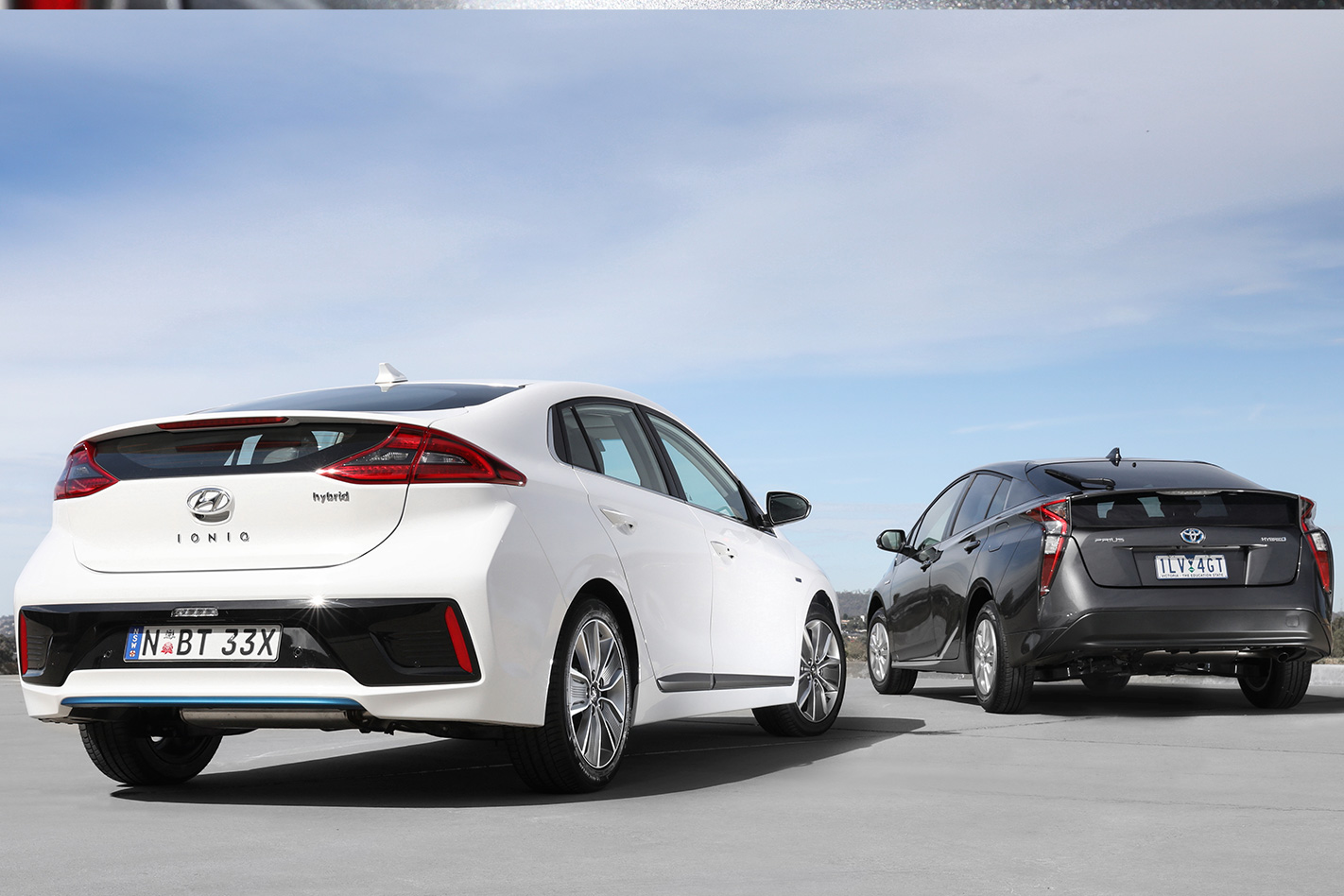
Nearly 20 years has passed since Toyota first introduced it’s hybrid Prius to the world and throughout that time it has enjoyed a relatively competitor-free market. Hyundai is set to change that however with the introduction of the new IONIQ.
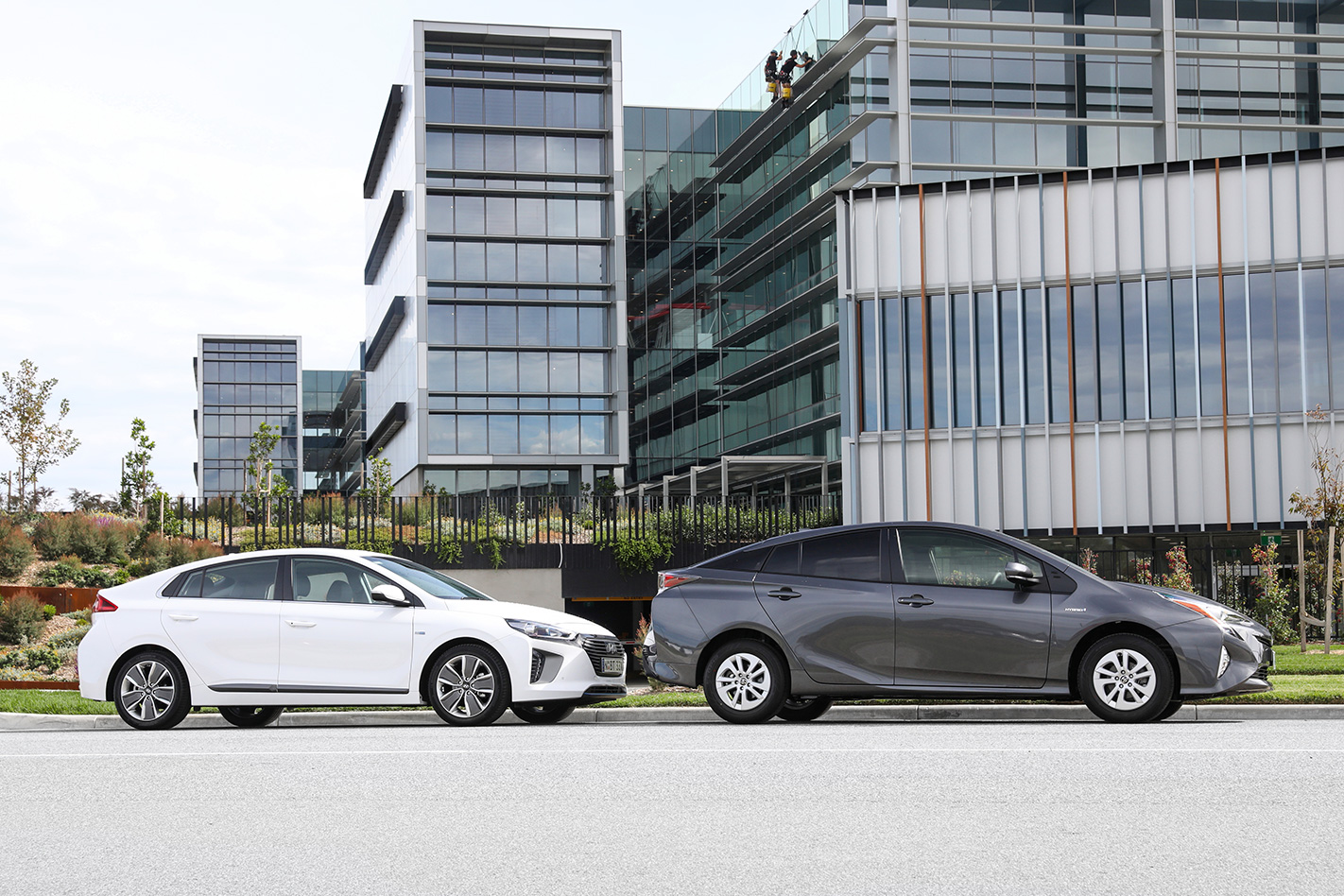
We pit the two against one another in the latest head to head, to find whether Hyundai has stolen the show or Toyota’s Prius remains untouchable.
Price and Equipment – Winner: Hyundai IONIQ
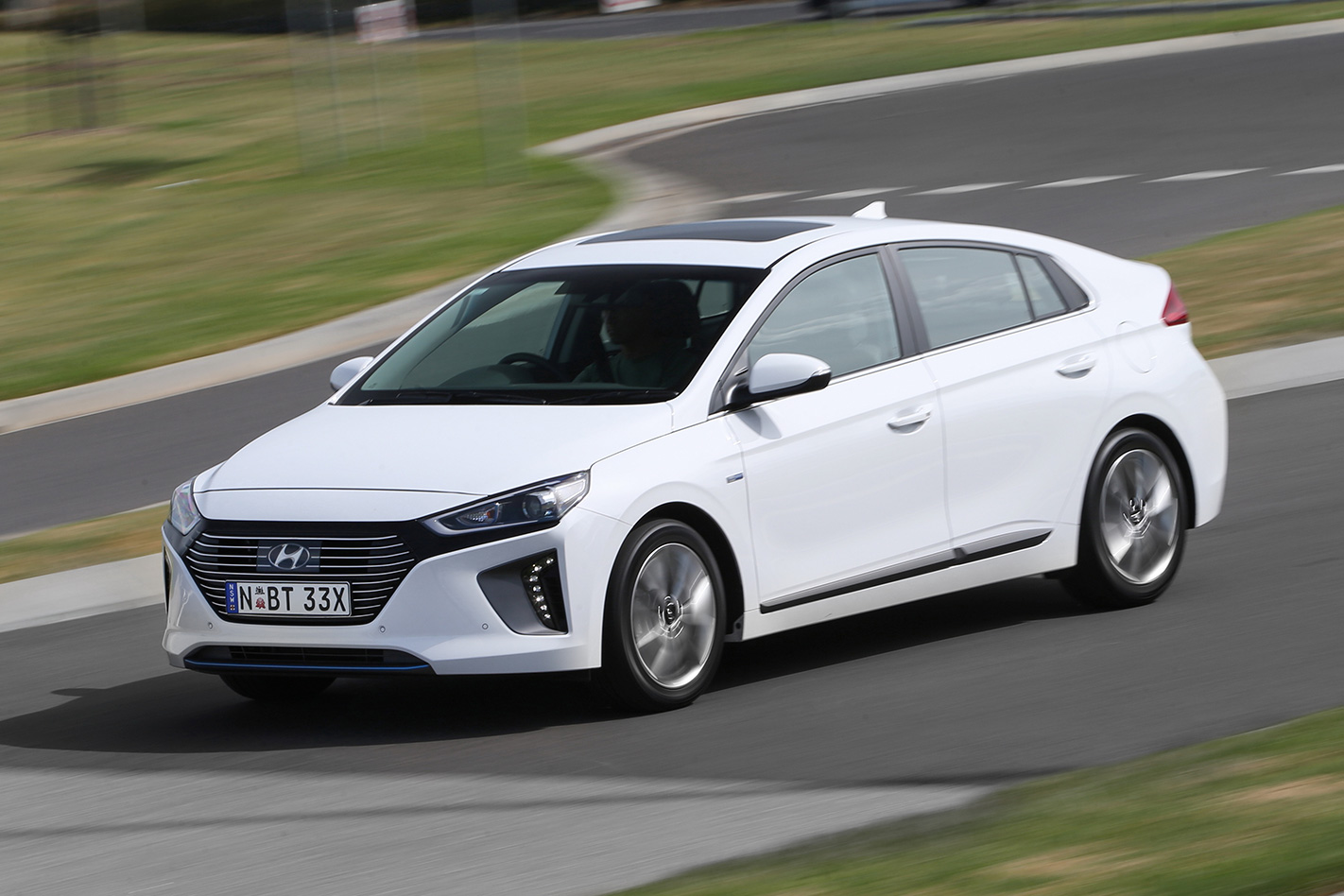
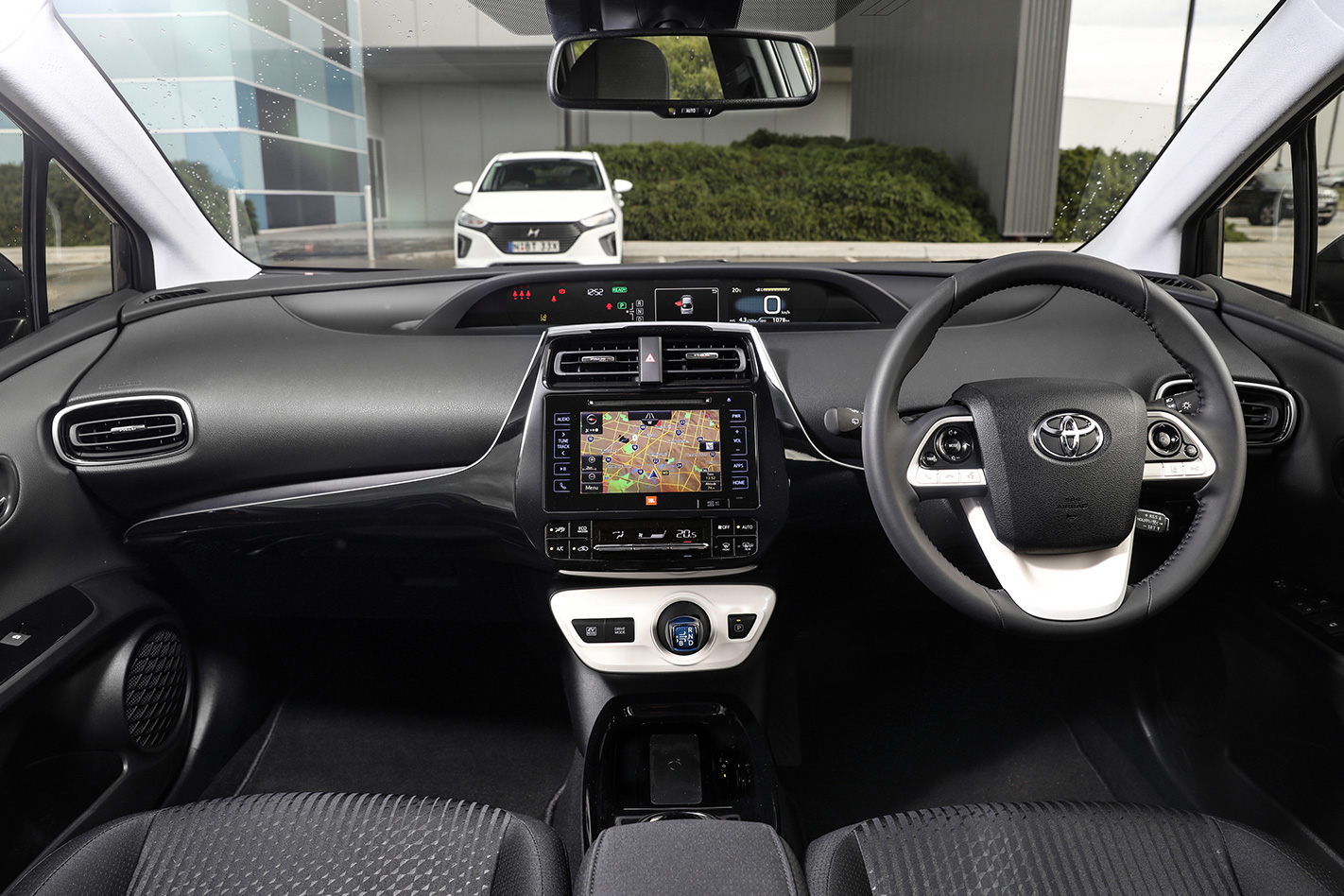
Hyundai IONIQ: Hyundai is yet to release pricing for its IONIQ Hybrid, but expect the range to start below the Prius’s $35K marker. This model is the IONIQ Premium (est $38K), which builds on an impressive equipment list to offer sat-nav, dual-zone climate, rain-sensing wipers and sunroof. An active safety suite is standard too, bundling lane-keep assist, blind-spot detection, active cruise control and AEB.
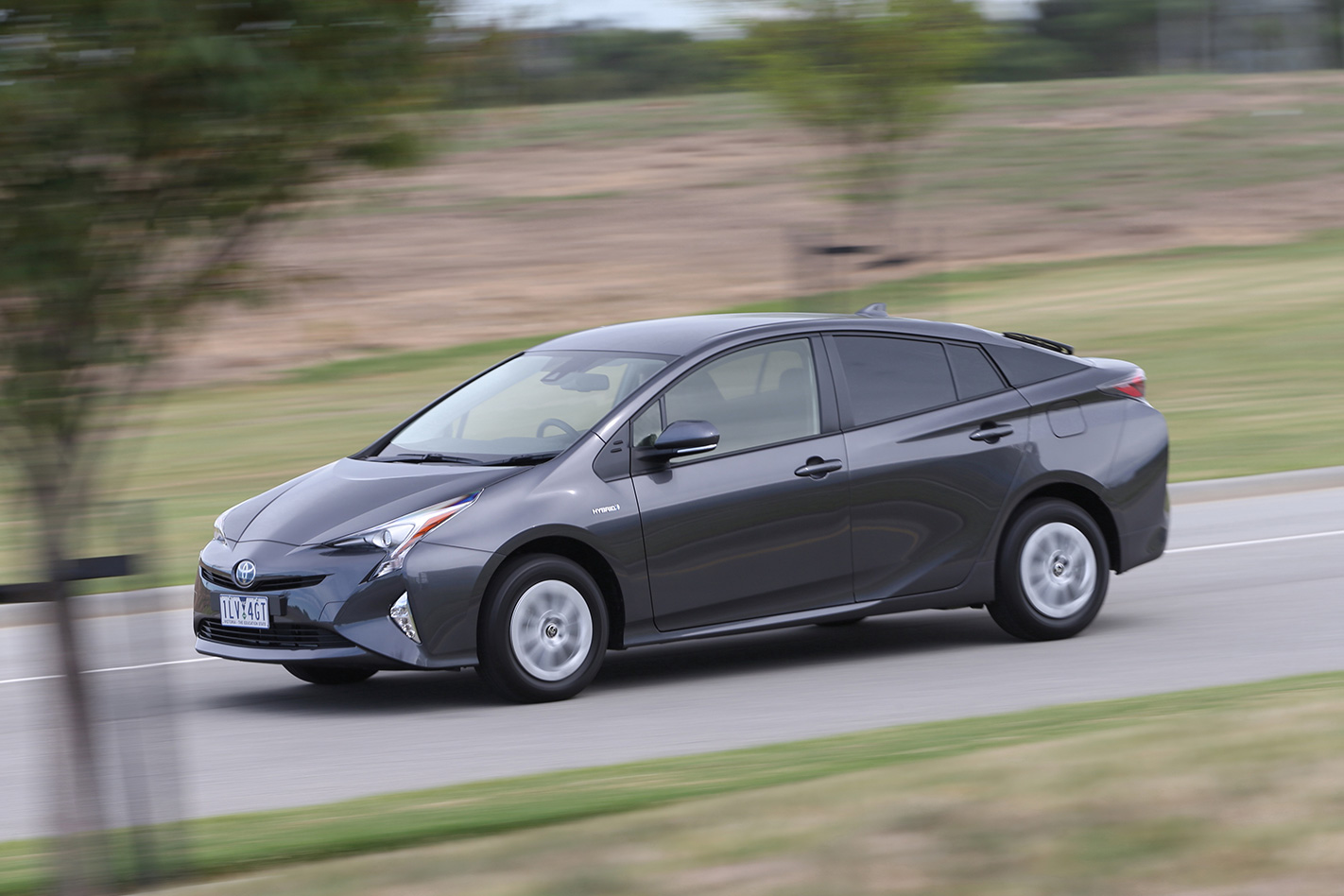
Toyota Prius: The entry-level Prius also has active cruise, AEB and lane-keep assist, though misses out on sat-nav, blind-spot detection and rear-cross traffic alert. To add those you need to cough up $8K extra for the Prius i-Tech variant. It also rolls on smaller 15-inch wheels (IONIQ has 17s) and can be polarising to look at next to the Hyundai’s more conventional styling.
Interior and Connectivity – Winner: Hyundai IONIQ
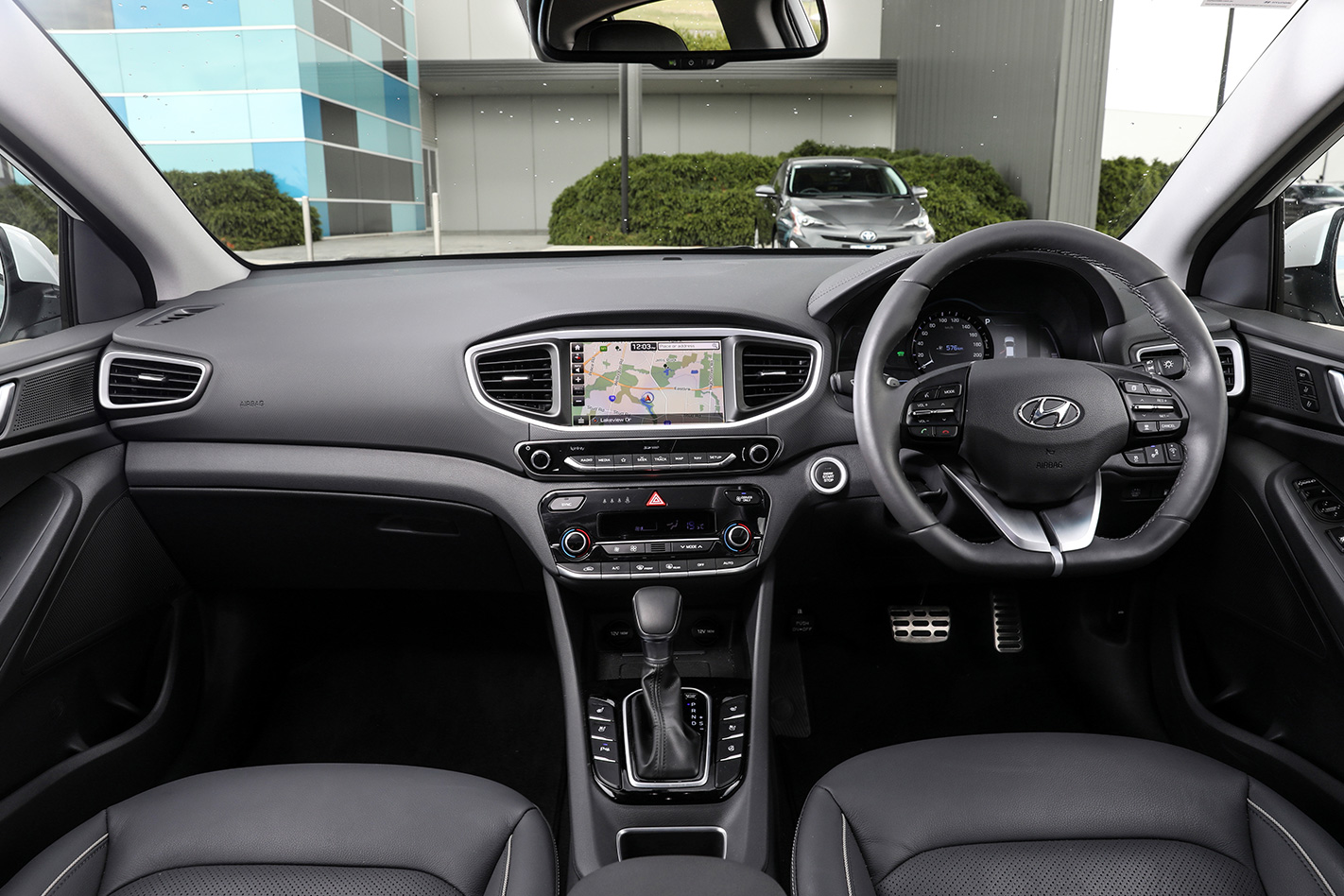
Hyundai IONIQ: IONIQ’s cabin boasts part-leather seats with electric adjustment, while the Prius makes do with manual cloth versions. Cabin is conventionally designed and well connected, with an 8.0-inch touchscreen offering digital radio and Apple CarPlay/Android, all items absent in the Toyota. Infotainment system is intuitive and provides useful info like audible speed camera warnings.
Toyota Prius: The exterior love-or-hate theme continues on the inside with pearl white trims and offset dash cluster that screams ‘I’m different’. It narrowly wins the baggage battle with a 457L boot versus the Ioqni’s 443L, although the Hyundai gains points back by providing a flatter load area with folded seats. A 7.0-inch screen with smartphone connectivity and cordless charging are standard.
Ride and Handling – Winner: Hyundai IONIQ
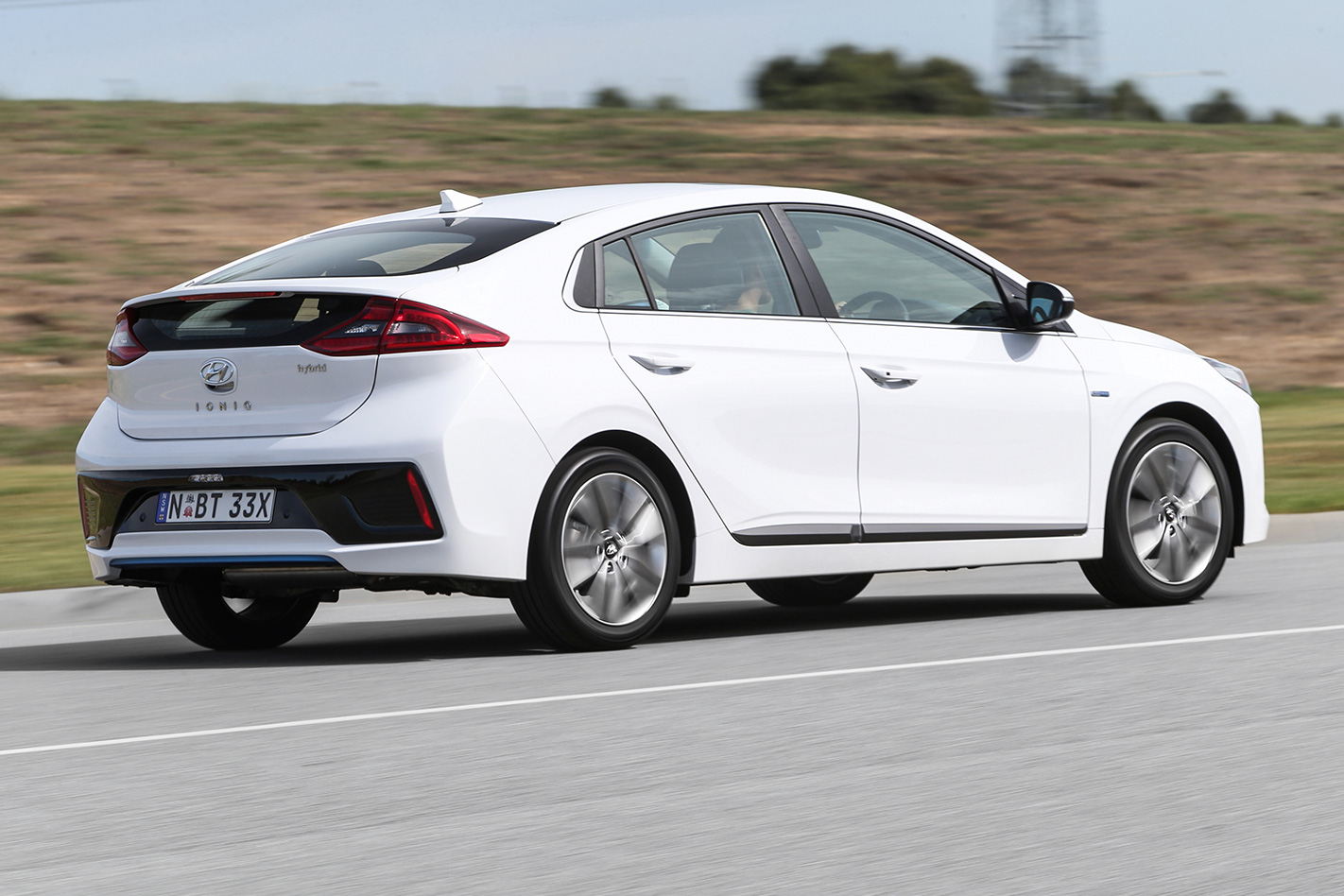
Hyundai IONIQ: Of the two, it’s the Hyundai that offers the most rewarding drive with decent steering feel and stronger road-holding thanks to its larger tyre contact patch. The bigger 17s don’t dramatically compromise ride quality and the IONIQ also feels lighter on its feet during hard cornering. Both cars utilise a suspension set-up comprising struts up front and a multi-link rear.
Toyota Prius: This is the best-handling Prius yet thanks to its new GA-C platform. Improved steering, a lower centre of gravity and greater structural rigidity are all positives, plus the tall-profile tyres ensures the Toyota offers a marginally better ride over surface imperfections. Its regen braking system is more natural to use than the IONIQ’s too. But it feels heavier, despite closely matched kerb weights.
Performance and Economy – Tied
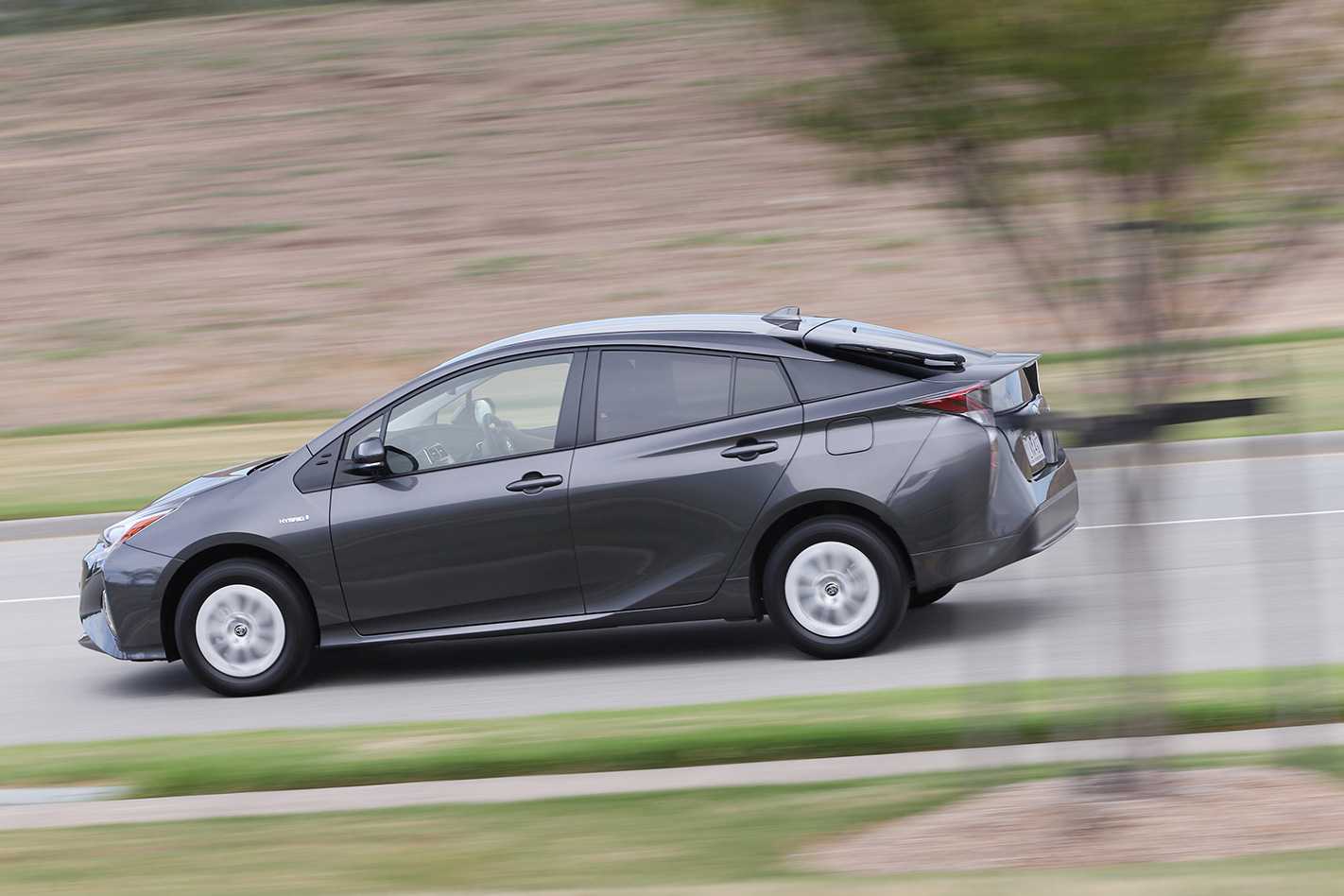
Hyundai IONIQ: With a six-speed dual-clutch versus the Toyota’s continuously variable auto, the Hyundai’s powertrain offers a far more driver-friendly experience. It also has noticeably more grunt in gear thanks to its higher combined torque output figure. Neither car is fast, but the IONIQ is the more driver-centric option with less to get used to over a conventional combustion-only car.
Toyota Prius: Both have decent off-the-mark acceleration thanks to instant electric torque, but the Prius is less eager to enlist the help of petrol power at higher speeds, which likely boosts fuel economy but dents driveability. On paper the Toyota has the more impressive claimed fuel economy, using half a litre less fuel over 100km. Our recent long-term-test Prius averaged 4.8L over four months.
Warranty and Servicing – Winner: Hyundai IONIQ
Hyundai IONIQ: Official word on the IONIQ’s warranty and servicing costs are yet to be revealed but it should mirror what’s offered in the UK, which duplicates the company’s standard five-year, unlimited mileage deal. UK customers also get a 125,000-mile battery guarantee, a number that should translate to a 200,000km equivalent Down Under and prove useful come resale time.
Toyota Prius: The Prius is covered by a three-year warranty which, unlike the Hyundai, is limited to 200,000km. Scheduled servicing of the Prius ranges from $193 to $379 per visit but those costs can be trimmed down to $140 every 10,000km with the Service Advantage plan for a total of $840 over three years, as opposed to $1557 without the optional offer.
Verdict:
Despite the Prius’ multiple generations worth of trial and error, the newcomer Hyundai IONIQ comes away with a convincing win this time thanks to it’s cheaper entry price, drive-ability and better equipped interior.
YOUR brain harbours a bizarre psychological quirk known as the Proust phenomenon. An anatomical anomaly involving the olfactory pathway and its proximity to the amygdala and hippocampus means that a certain smell can trigger a vivid autobiographical memory. And I’ve just experienced it, after opening the door to an old BMW.
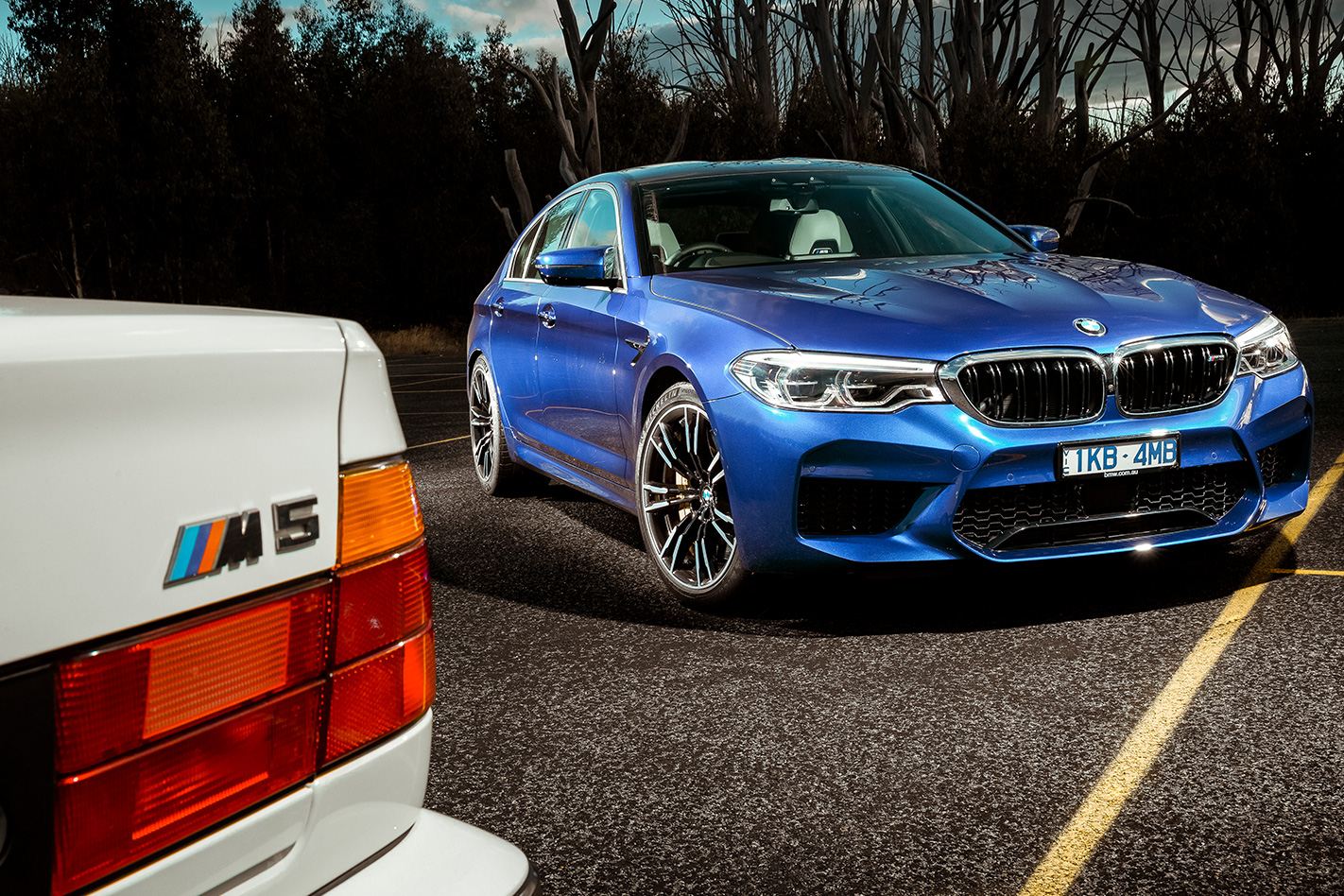
Inhaling a lungful of the gently ageing petrochemicals inside this 1990 M5 feels to me like coming home. I learned how to drive in an Alpine White E34 5 Series similar to this one. It was owned by my dad, and had exactly the same cosily familiar, sun-ripened scent when he bought it as a 10-year-old car. The fact it was second-hand didn’t matter to him. Having it in the garage was the fulfilment of a dream, and I felt like a Saudi prince at 17 with my provisional licence in one hand and the key to the BMW in the other.
This old M5 is supposed to be a sideshow in today’s proceedings; a retro counterpoint to the brand-new F90 M5 we’re about to drive for the first time on Aussie soil. In its day, almost three decades ago, this boxy super sedan was something genuinely fierce. It represented the ultimate tool for moving five people and their luggage quickly and comfortably, and in order to understand what the M5 has become, beginning with the first generation to be officially imported to Australia seems to makes sense.
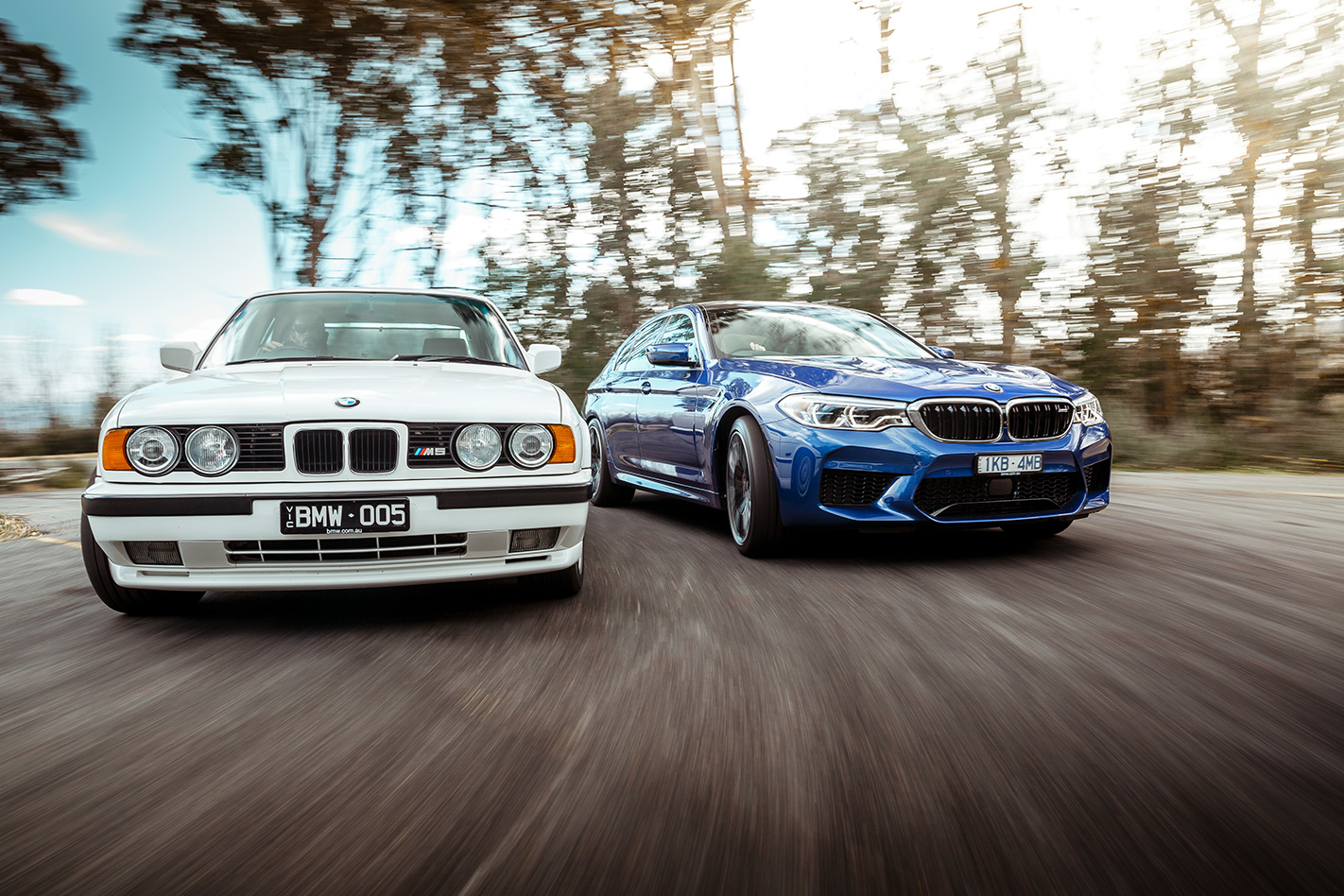
Its starter motor pulses quickly with a hard metallic clatter that vibrates the whole car. The 3.5-litre in-line six turns over more times than any modern engine before it eventually fires, and a lumpy baritone idle resonates from its tailpipes. This race-derived powerplant is a development of the engine found in the back of the legendary BMW M1 supercar. Enthusiasts consider the E34 M5 to be the last proper M car as BMW Motorsport technicians hand-built each one at its Garching facility, independent of the regular production line that has built every M car since.
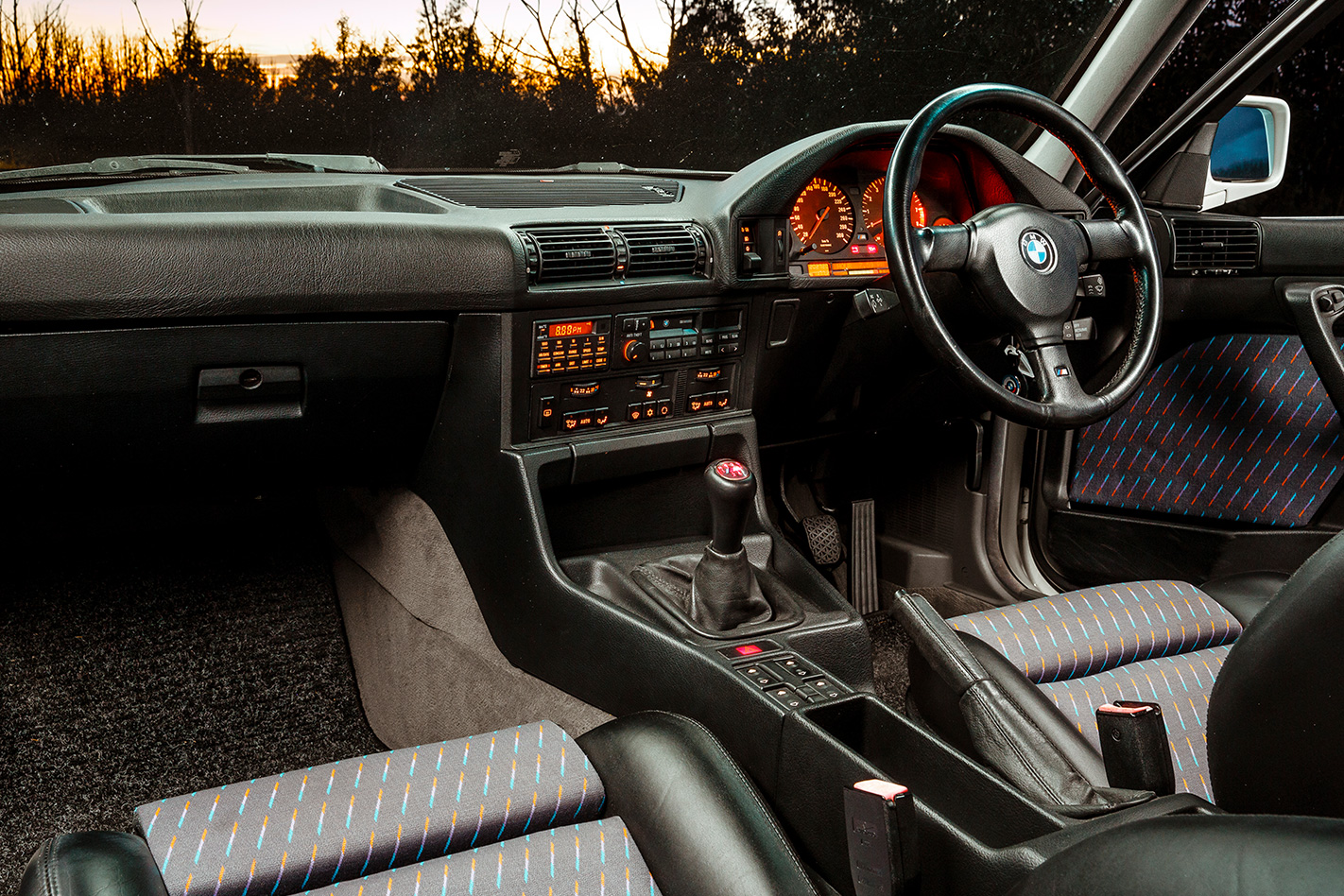
Everything inside the E34 is exactly as I remember it; switchgear that clicks and clacks with an old-school tactility, period fonts and selfishly driver-focused ergonomics. My hands rest in the curves of the flat-faced steering wheel, feet offset beneath it on pedals that sit to the right. The long, light clutch pedal is mounted centrally in the footwell and its friction point grabs high in the release action. There’s a thrill in just making this car move, in the flickering to life of long-dormant muscle memories.
Nothing much happens down low. Opening the throttle via the sticky, floor-hinged pedal is a lesson in delayed gratification. Peak torque of 360Nm arrives at 4750rpm, and you need to work up to a sky-high 6900rpm for the full 232kW to hit. This highly strung worker needs revs.
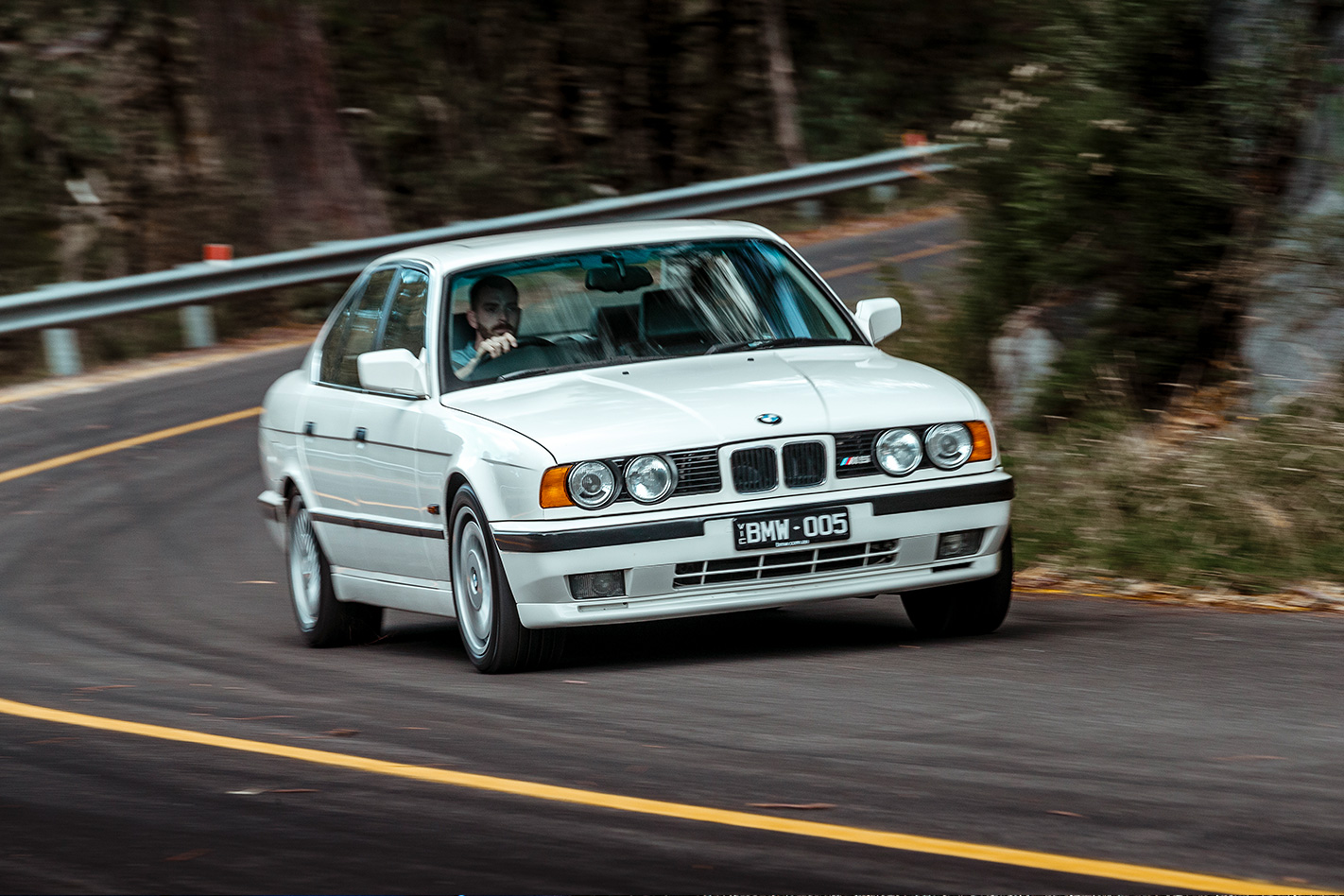
I flatten second gear to the top of its range. Instinct has my left foot and hand ready to shift when there’s another 1000rpm still to climb. The rev-counter puts redline at seven grand, but the needle keeps spinning halfway to eight. Wide open there’s a furious induction hiss from the individual throttle bodies that paints a childlike grin across my face. A modern turbocharged hot hatch would’ve overtaken us by now, but that’s the furthest thing from my mind. Saturating yourself in the M5’s sweet mechanical responses is an utter joy.
But 1990’s finest is about to provide a stark, unbiased reminder of what three decades of progress looks like. Almost 30 years of development have moved the game on to an arena of performance that’s barely recognisable from here.
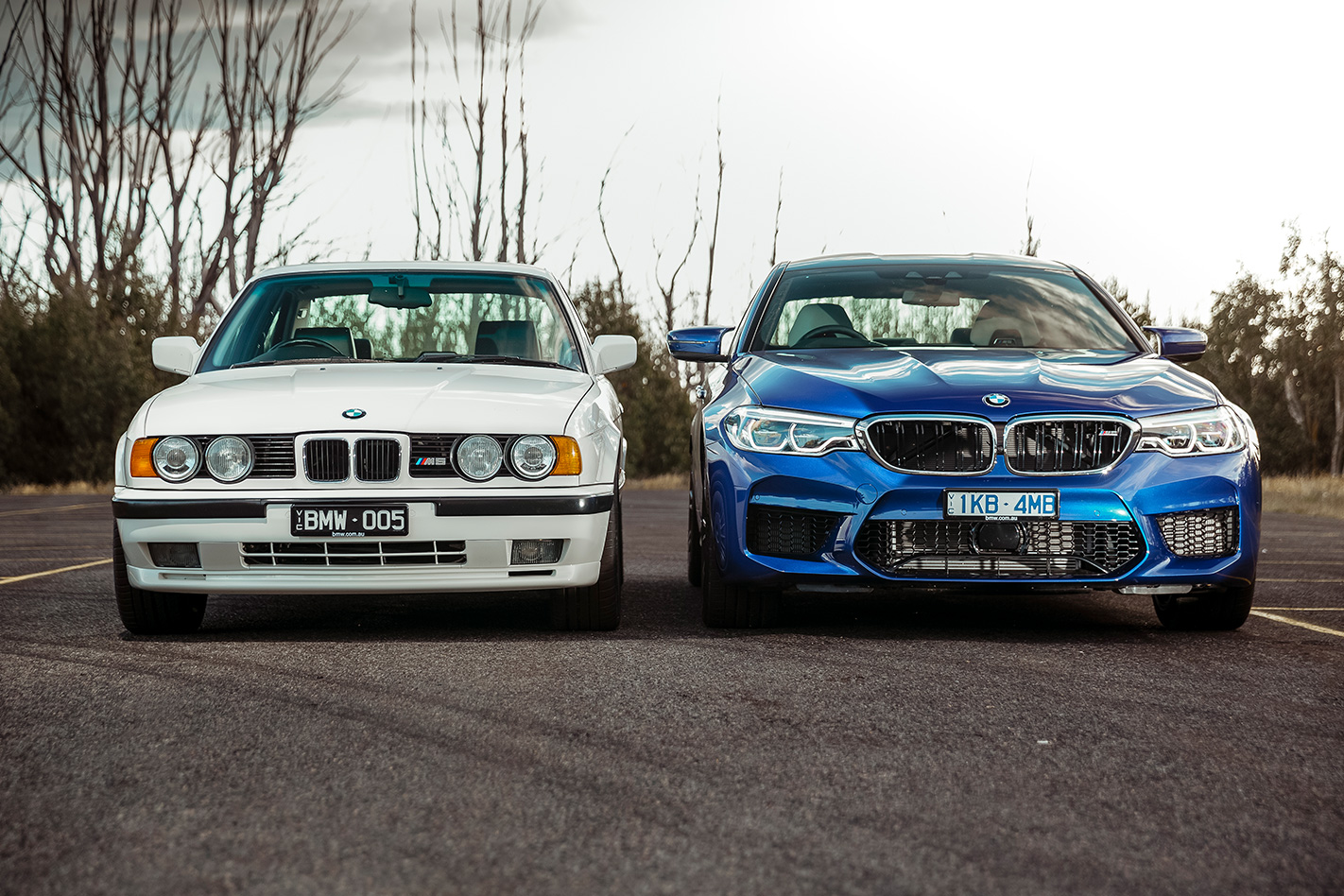
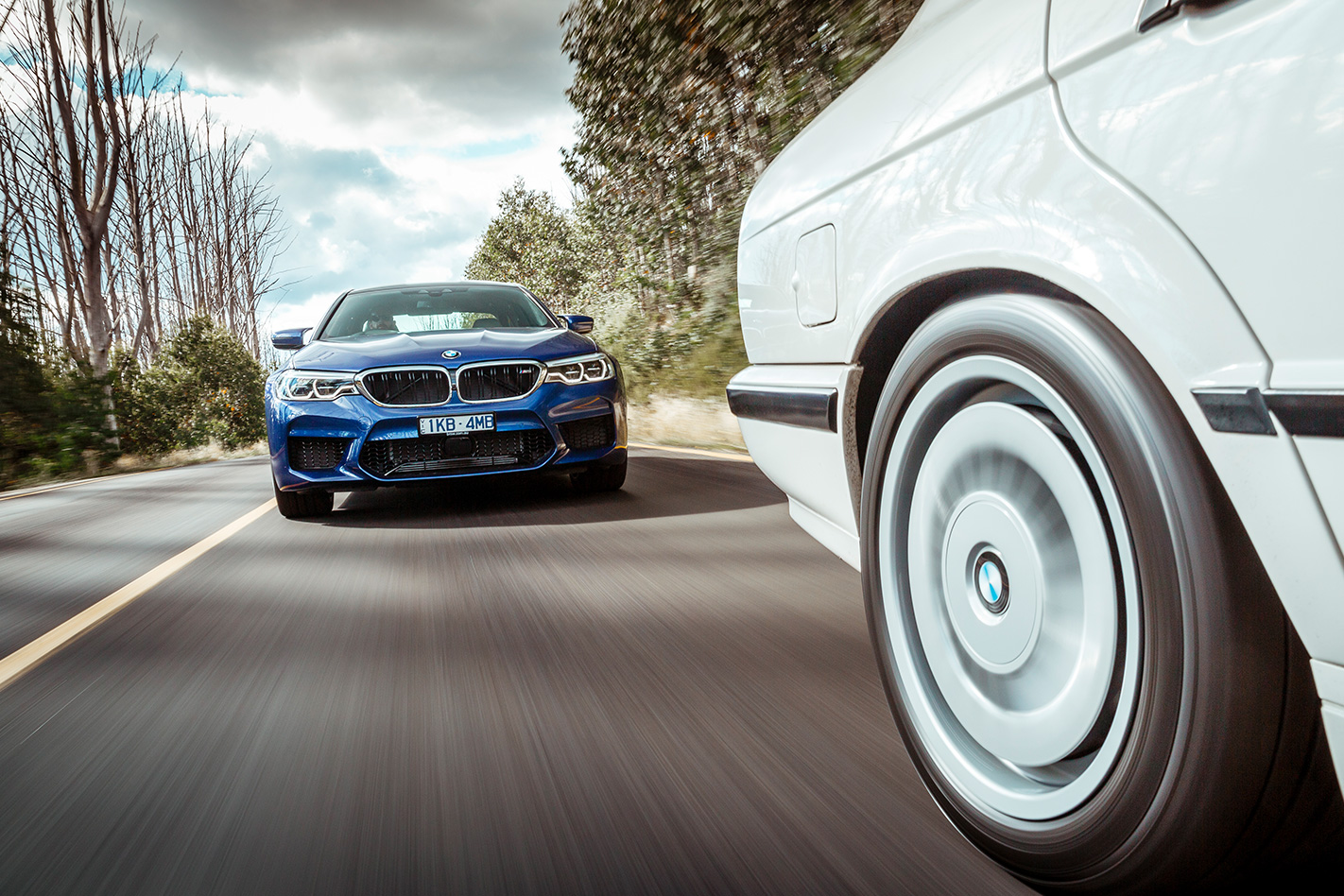
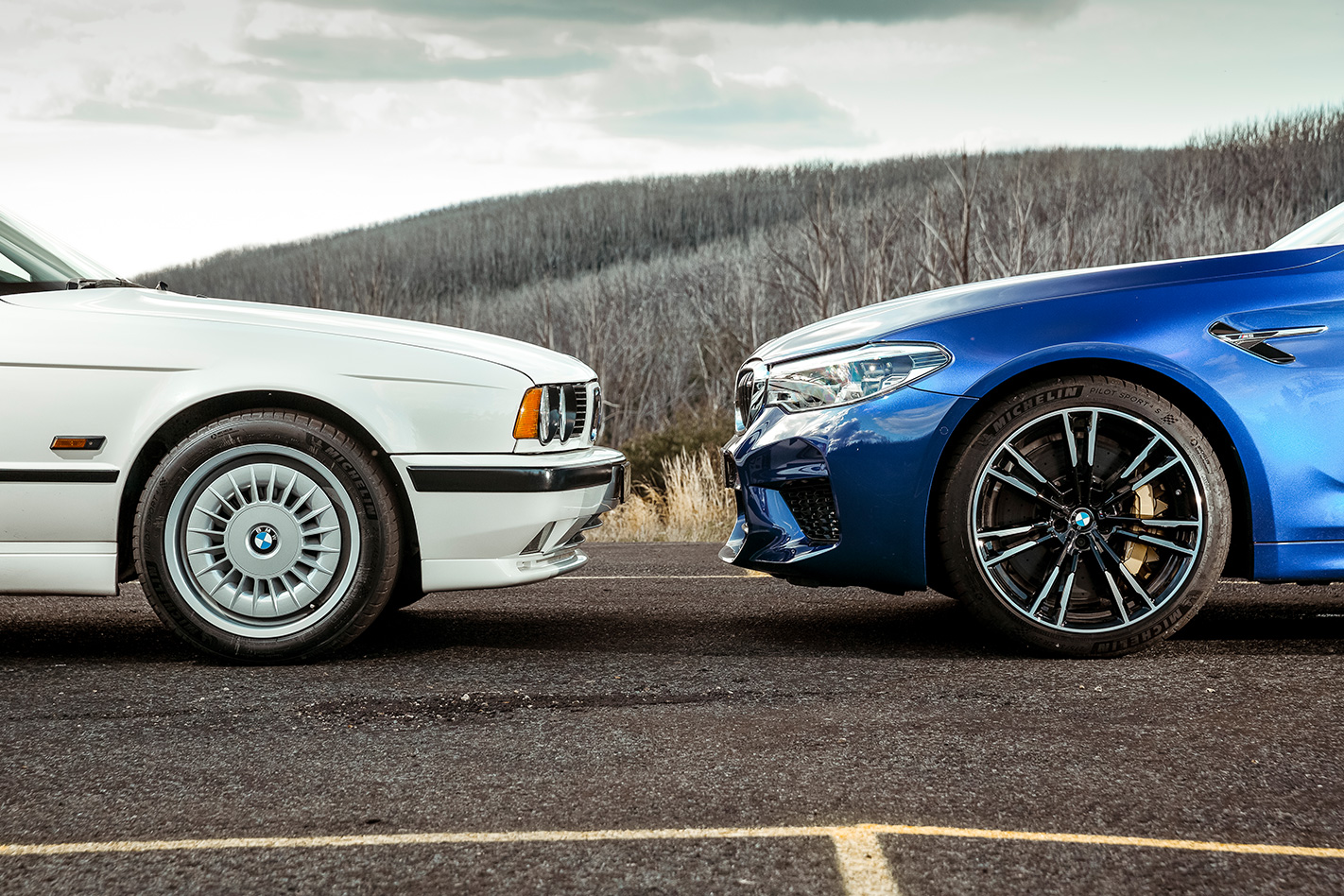
Parked side-by-side, the F90 makes its ancestor look like a delicate scale model. The E34’s 2761mm wheelbase is shorter than that of a current M3, and its overall width narrower than an M2. There’s more fastback rake on the rear glass of the F90, but its three-box proportions are roughly the same. Near-identical chrome window surrounds on both models arc from the wing mirror to the C-pillar’s Hofmeister kink, but that’s about where the carryovers end.
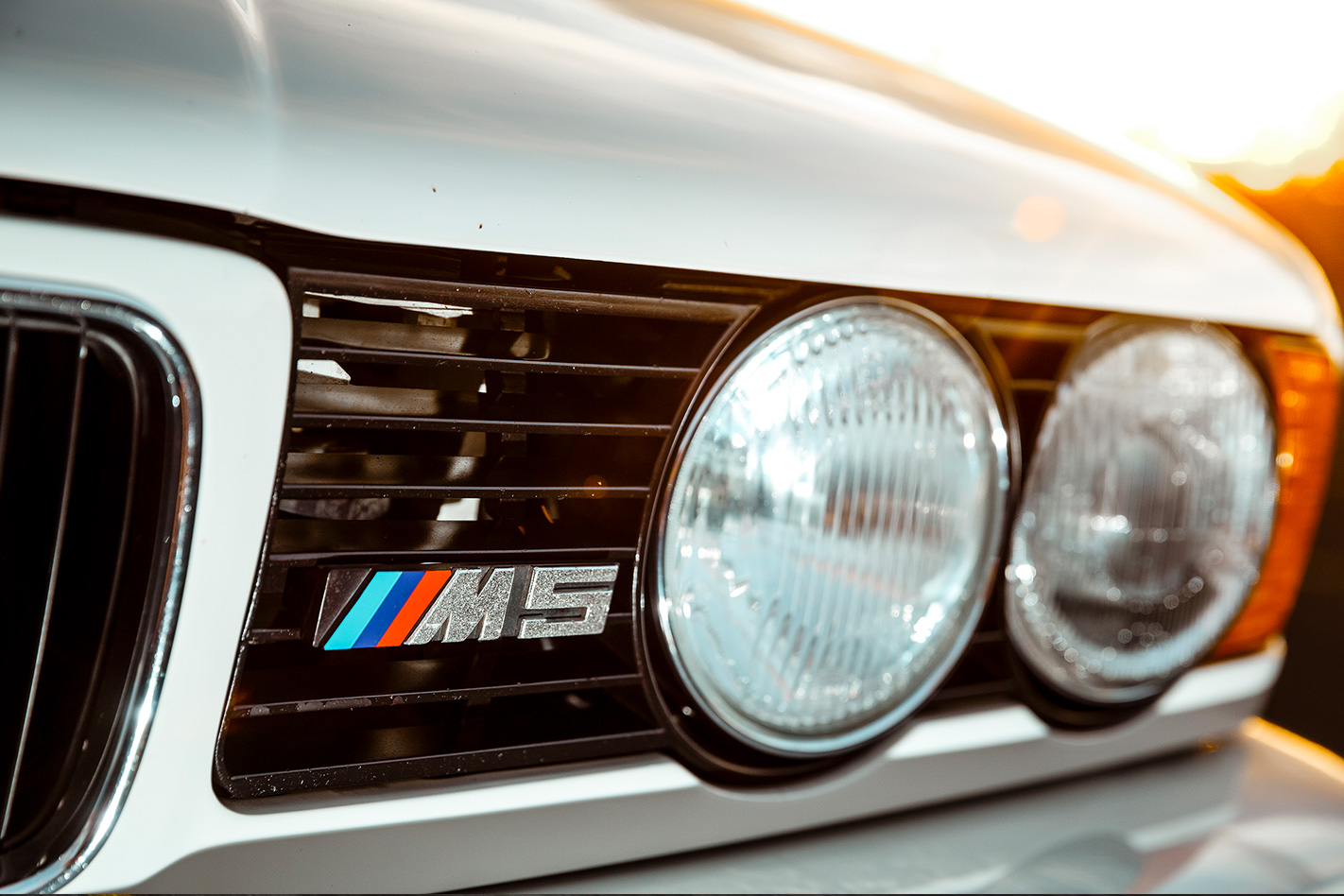
The E34 is categorically plain in this company. It’s quaint to think this unadorned sedan was once the pinnacle of four-door performance; something so intimidating it would sweep a clear path on autobahns. Its once-polarising aero wheel covers, designed to optimise brake cooling, hide 17-inch alloys, now too small for a mid-spec 1 Series.
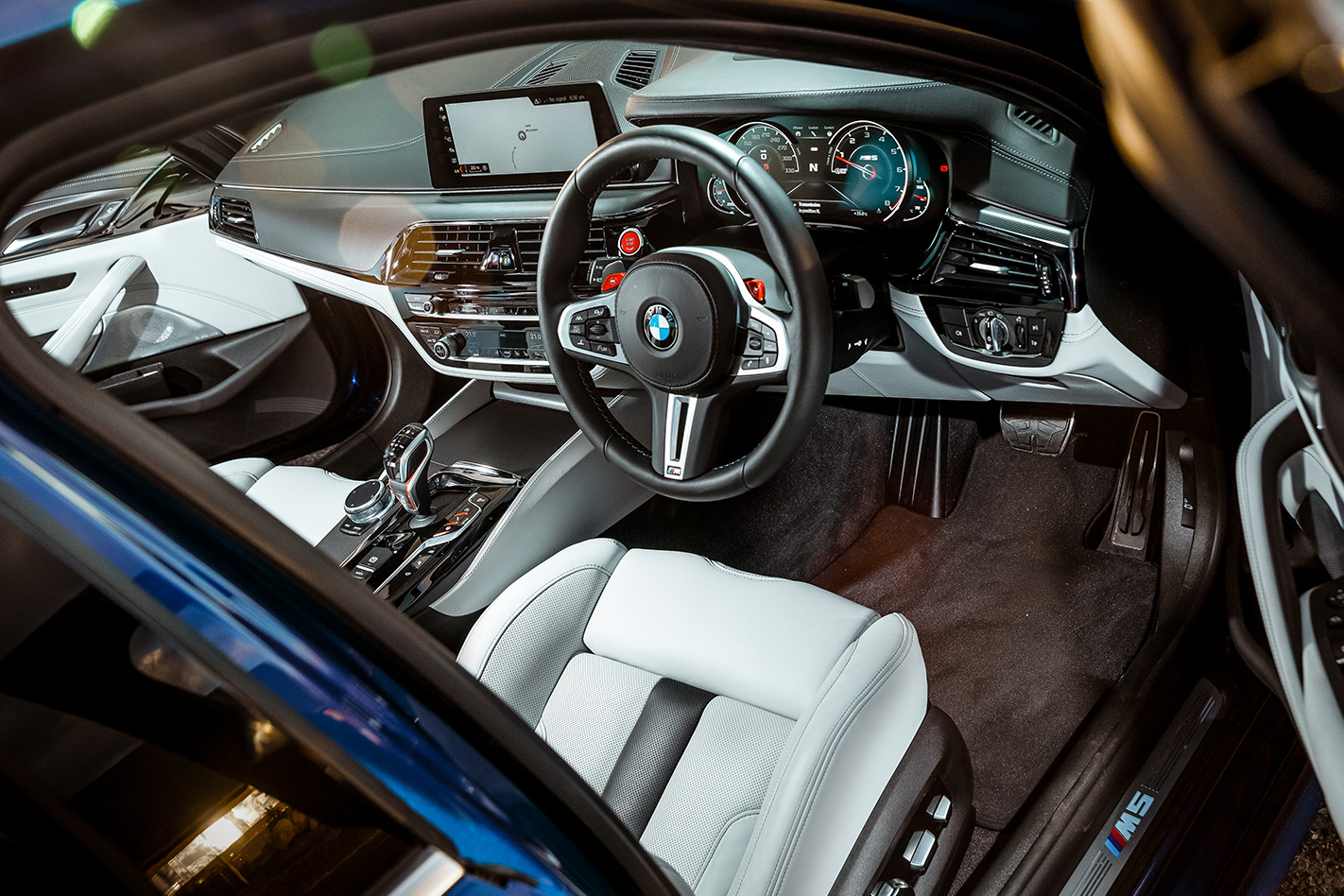
In a similar vein only bumpers and guards have been changed in the shift from current 5 Series to M5, but understated isn’t a great word for the F90. Brutish is perhaps more appropriate. Its aggressive front-end asserts itself with an oversized kidney grille and huge ducts that funnel air through heat exchangers, cooling vents, wind diffusers and other aerodynamic aids that only Formula 1 engineers were thinking about in 1990.
The F90 turns its back on more than 30 years of rear-driven M5 history by adopting a version of M’s xDrive all-wheel-drive system. BMW’s first all-wheel-drive 5 Series was, in fact, an E34 called the 525iX. Additional weight blunted that car’s performance dramatically, but in the F90’s case its 0-100km/h sprint is slashed by a massive 0.8sec over the last-gen F10 M5. It launches to the metric tonne in 3.4sec – an exact match for AMG’s E63 S, though the M5 does it with 9kW and 100Nm less.
Erase the E34’s endearing accessibility from your mind at this point. The F90’s 4.4-litre twin-turbo V8 is barbaric, and devastatingly effective. Outputs increase by 29kW and 70Nm for this generation to intimidating totals of 441kW and 750Nm. Other revisions upped fuel injection pressure to 350 bar, added bigger turbochargers, and lifted the rev limit to 6700rpm.
Key to its accelerative ability is its relatively low mass. At 1855kg the F90 isn’t a featherweight, but it’s 15kg lighter than its predecessor even with the added AWD hardware, and 100kg lighter than an E63 S. Optioning the carbon ceramic braking package fitted to this car ($16,500 for front and rear) slices off a further 23kg of unsprung mass while adding motorsport-grade stopping hardware and glossy gold calipers.
Further weight was stripped using a carbonfibre roof and a lighter bi-modal exhaust system that links the bent eight to quad tailpipes. Tapping the loud button on the centre console opens the channels, then pinning the throttle to the bulkhead triggers an ear-splitting blare of white noise from the back-end that’s loud enough to make pedestrians wince. It’s not a particularly sweet noise, but it’s bloody dramatic.
BMW has discarded the F10’s seven-speed dual-clutch transmission for this generation of M5. Moving to xDrive brings in a model-specific eight-speed torque converter auto and a transmission cooler to ensure consistent performance on track. It’s exceptionally good, and at the rate of acceleration this car is capable of there isn’t a moment to spend missing the homely throw of the E34’s five-speed manual. The F90’s drivetrain is a development of that in the X5 and X6 M, but with a rear-wheel-drive party mode for those brave enough.
By default the car operates in AWD with a relatively even torque split front to rear that focuses on stability, and it’s rock solid without a hint of slip when hustling. Single tap the DSC button to enter M Dynamic Mode. This puts the drivetrain into 4WD Sport, a heavily rear-biased setup that allows for more exploration of the car’s dynamic ability while retaining a moderate safety net. It’s here that the new M5 comes alive.
Exiting tight, low-speed corners with a heavy right foot sets the M5 into mild, graceful powerslides that maintain forward momentum. In faster, open curves it’s harder to adjust the car with the throttle, with the front end preferring to pull the car into line or washing out into understeer if asked to do too much.
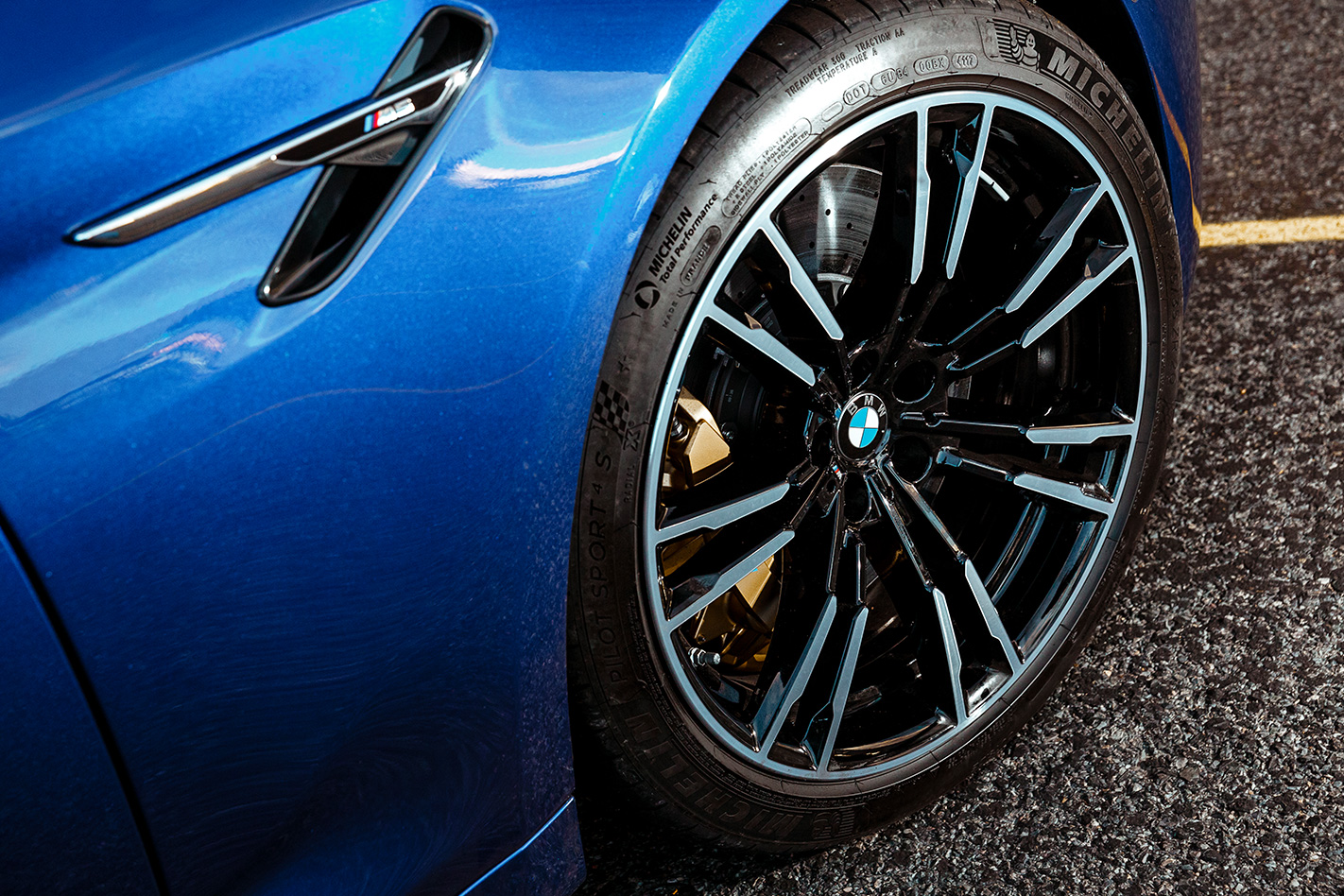
I would hate to be this car’s front tyres. Taking a job away from them and feeding all power to the rears is, in some respects, a bit of a stunt. The F90’s RWD mode is great for big, tyre-frying drifts but it’s effectively a track-only affair. To activate RWD, all stability assistance must be turned off, meaning a circuit is really the only place to exploit it. At vaguely road-legal speeds there’s enough shove on tap to break traction in almost any gear.
Much like the M3, there are no catch-all drive mode options for steering, engine and suspension. Each parameter is set individually between Comfort, Sport and Sport Plus, which makes cycling through the options fiddly at first. In the long run, two user-specified modes linked to a pair of red tabs on the steering wheel take a lot of the button pressing away. You can specify a soft touring setting on one, and a go-fast mode on the other.
Skilful tuning of the sportier set-ups renders an impression of lightness and agility when pressing on. Something this broad and heavy will always be challenged in terms of scalpel-sharp precision, but there’s deftness to the way it changes direction. The quick steering is intuitive, accurate and hugely improved over the F10 M5. Smart engineering and an open front diff means front-end functionality is untainted by the all-wheel-drive system, other than an enormous 12.6m turning circle.
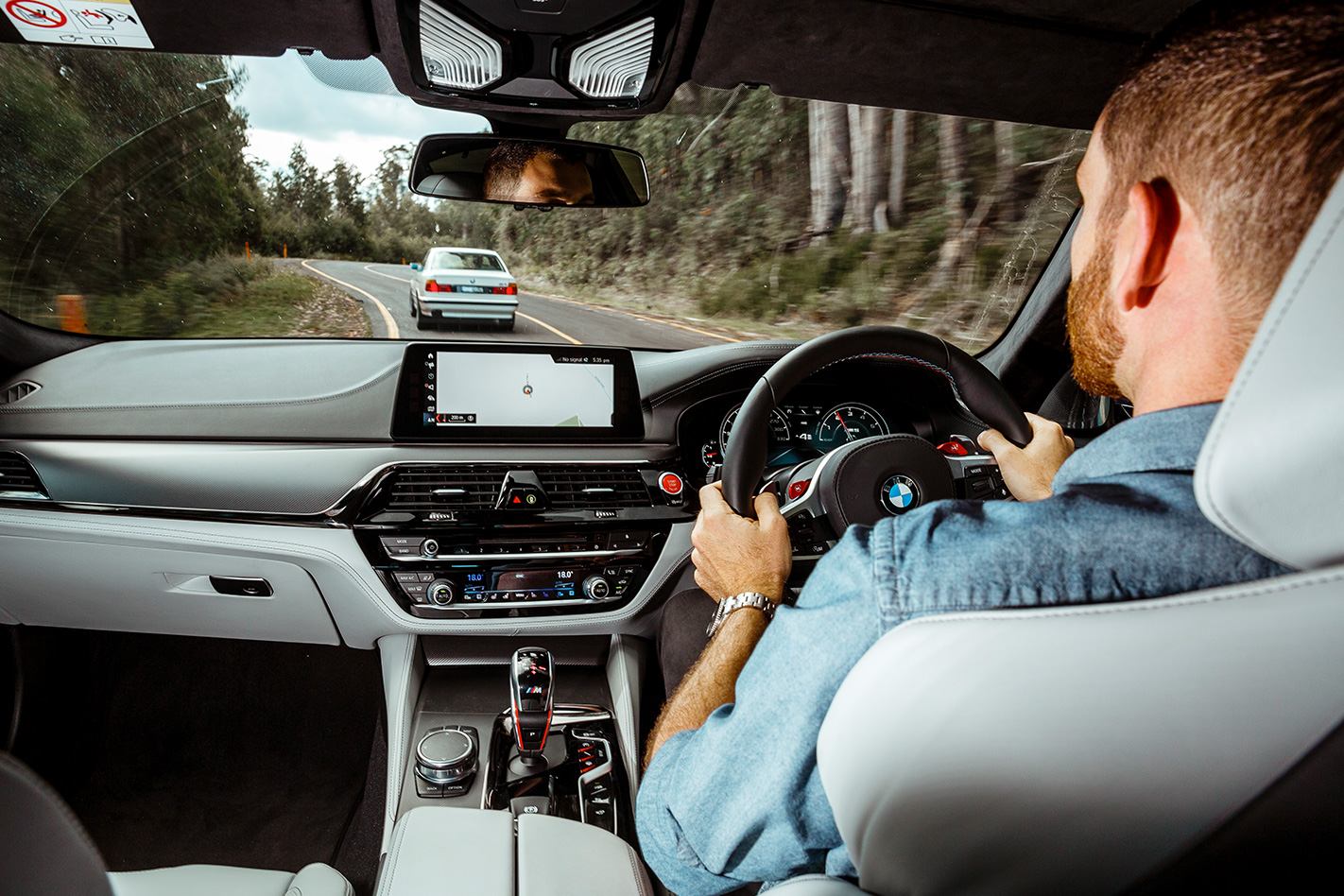
There’s something all of a piece about the way this new M5 operates. The electronics it relies on so heavily seem to function in synchronicity. The F90 has a duality of personality that’s subtly different to the E63 S, which could make it a better long-distance weapon.
Up front the F90’s generous front seats are brilliant. There’s a familiar, rudimentary feel to the architectural dashboard design, but the build quality is exceptional. Illuminated M5 logos on the headrests and door sills, a huge head-up display, and M-stripes on the seatbelts and steering-wheel stitching add a smattering of feel-good.
With the systems dialled down and the exhaust silenced, it’s not an overstatement to call this hushed cabin serene. The M5 doesn’t boast with the histrionics of AMG’s rowdy equivalent, and in some ways that makes it feel like less of an event to drive on first encounter. It’s closer to the spirit of the E34 M5 than I thought it would be, and I suspect it might be a car with enough layers to grow on you over time, rather than losing its sheen.
There will be people who want to burble up and down boulevards and be seen in one of the BMW’s rivals, but the F90 M5 feels like the thinking man’s mega sedan. Its execution is so detailed and thoughtful. There’s no fluff. Everything is as it is because of the deliberate focus on function that BMW M built its reputation on.
Three decades have put us worlds away from the mechanical keenness of 1990’s E34 M5, but the M5 of today is better by every measure. We’ll find out come comparo time whether that’s enough to rule the class. For now it’s sating to know that a whole new generation of kids will soon be climbing into their parents’ F90 M5 and, three decades hence, will surely find 441kW stately and quaint. Ferocity might have a finite shelf life but, right now, it’s hard to believe anyone will ever feel short-changed by BMW’s box-fresh M5.
I like Speedway. But I love small-town, Saturday night speedway.
There are a couple of venues within an hour or so of 13 Struggle Street, and I’m a regular at both of them. You get a nice drive in the bush, a few hours away from the phone and the TV and the best night of entertainment 20 bucks can buy.
One of the main events on the card for a recent Saturday night was a ladies crash and bash. I overheard one group of onlookers professing doubts that a single lady had even ever set foot on this particular venue, but I’m not that uncharitable.
Yet, I did think: Great, this’ll be like watching paint dry. Not that I doubt the driving abilities of the opposite sex (have you met Molly Taylor?) but in my experience, the fairer sex is just too sensible to be tricked into deliberately wrecking their race cars for my titillation. I mean, we ball-bearing versions are only too happy to crash into each other in the name of sport, but women are just smarter than that.
Right? Man, was I wrong.
These dames were feral. They were entirely content – enthusiastic, even – to escort each other into the ditch that separated the track from the infield. Neither were there any qualms about mid-corner touch-ups or serving up a crumpled mudguard down the straight.
And feeding the opposition a big serve of the catch fence? No problems. In fact, you look hungry; have seconds. Now, I know a crash-and-bash is the full-contact form of speedway, but even so… These gals were dead-set radio rental.
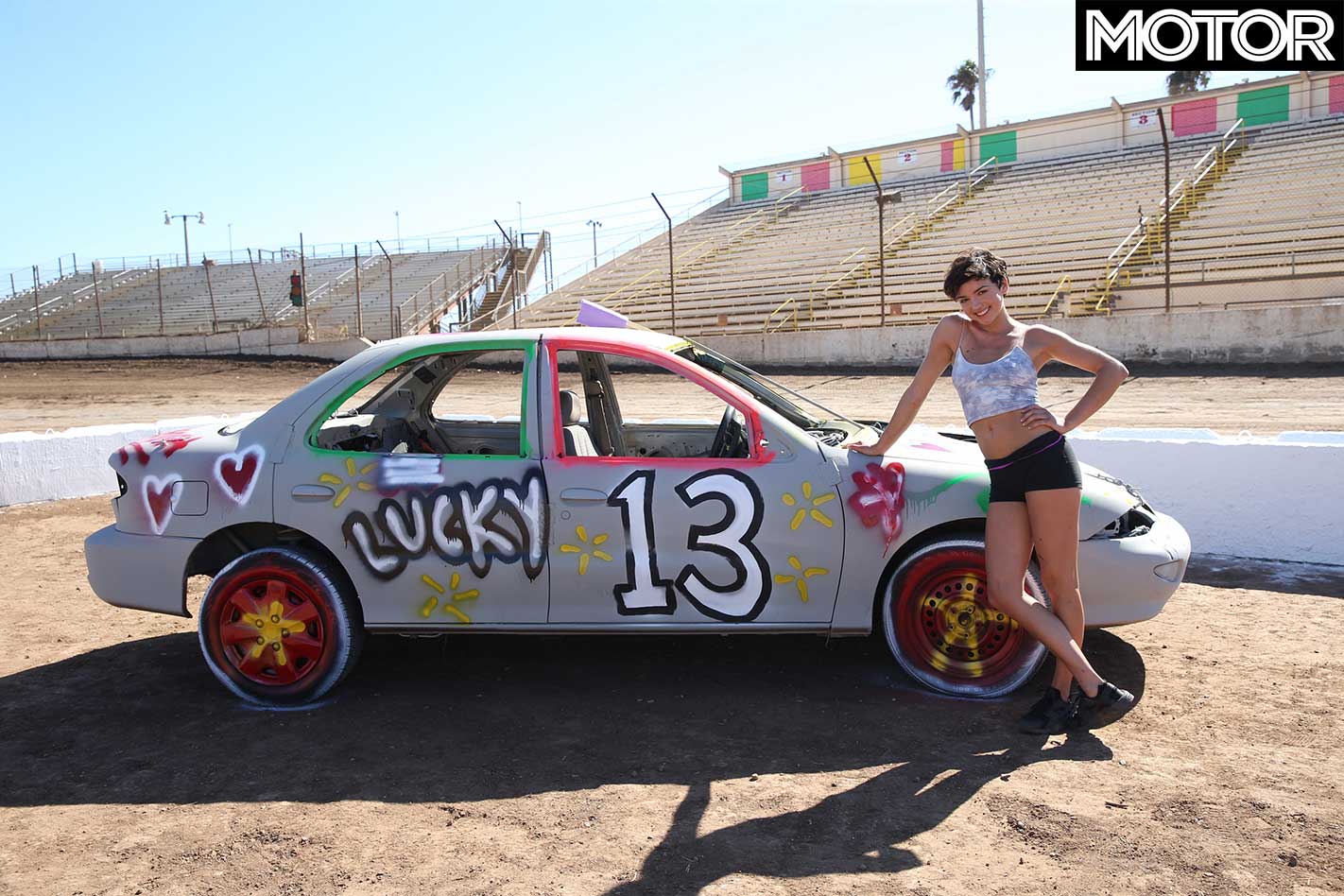
One of the main protagonists was in a Ford Territory which, if you ask me, was taking the soccer-mum thing too far. Of course, I’d never seen a Territory speedway car before, and, to be honest, I kind of had to take it on faith that this had, in fact, once been a combination cup-holder and brat-hauler.
So bashed up was it, the only give-aways were the overall proportions and the profile of the (glassless, natch) rear-side window opening. The front and rear bumper from (what looked like) a Chev C10 or Ford F250 didn’t make a positive ID any easier.
Predictably, the Terry wound up on its lid in the 20-lap feature race but, thankfully, the driver and her passenger were both okay. Sorry? Passenger I hear you ask? Yep, in this brand of crash-and-bash, you’re allowed to take joyriders and, since it’s a 400m dirt oval, they’re not riding along to navigate.
The rest of the night’s card was made up of tiny little, crazy-fast sprint-car looking things with – I think – 600cc motorcycle engines, slightly bigger scale-model sprint-cars complete with carports on the roof, junior-racer Datto 1200s and Corollas with drivers that struggled to see over the wheel, and a range of neck-tatts driving battered six-cylinder Holden and Falcon sedans. And the odd Ford panel-van.
It sounds kind of yokel-fest and, in a way, it is. But that’s the magic of it.
You can relate to the cars, the drivers wander through the crowd on their way to the doughnut truck (although chips-and-gravy from the local cricket-club is the culinary go-to) the machinery is loud and largely hand-painted and you can see the whole track from anywhere, including when you’re queueing at the doughnut truck. And because you’re never more than a few metres from the action, you can see proper detail all night.
Most cars, for instance, have a large red light on the dashboard which alerts the operator to a fall in oil-pressure or a hike in water temp. Most of these lights are glowing angrily from the parade lap onwards, but at least the team management (that’d be dad and Uncle Brodie) can see there’s a problem from their spot on the spectator mound. That’s speedway telemetry, right there.
The highlight for me was the Super Stock feature race over 30 laps. But get this: The first 10 laps were run anti-clockwise, the next 10 clockwise and the last 10 counter again, with yellow (not red!) flags in between to reverse the direction. Imagine trying to explain that race-plan to a Lewis Hamilton. Get into it.
After a brief chat over coffee at its Melbourne HQ, HSV director of sales and marketing Chris Payne asked what we had planned for his Coupe 4.
This feature was originally published in MOTOR’s October 2004 issue
Shooter Brunelli and I exchanged furtive glances, shrugging shoulders. To be honest, we’d only cooked up a half-arsed plan to get us back to Sydney.
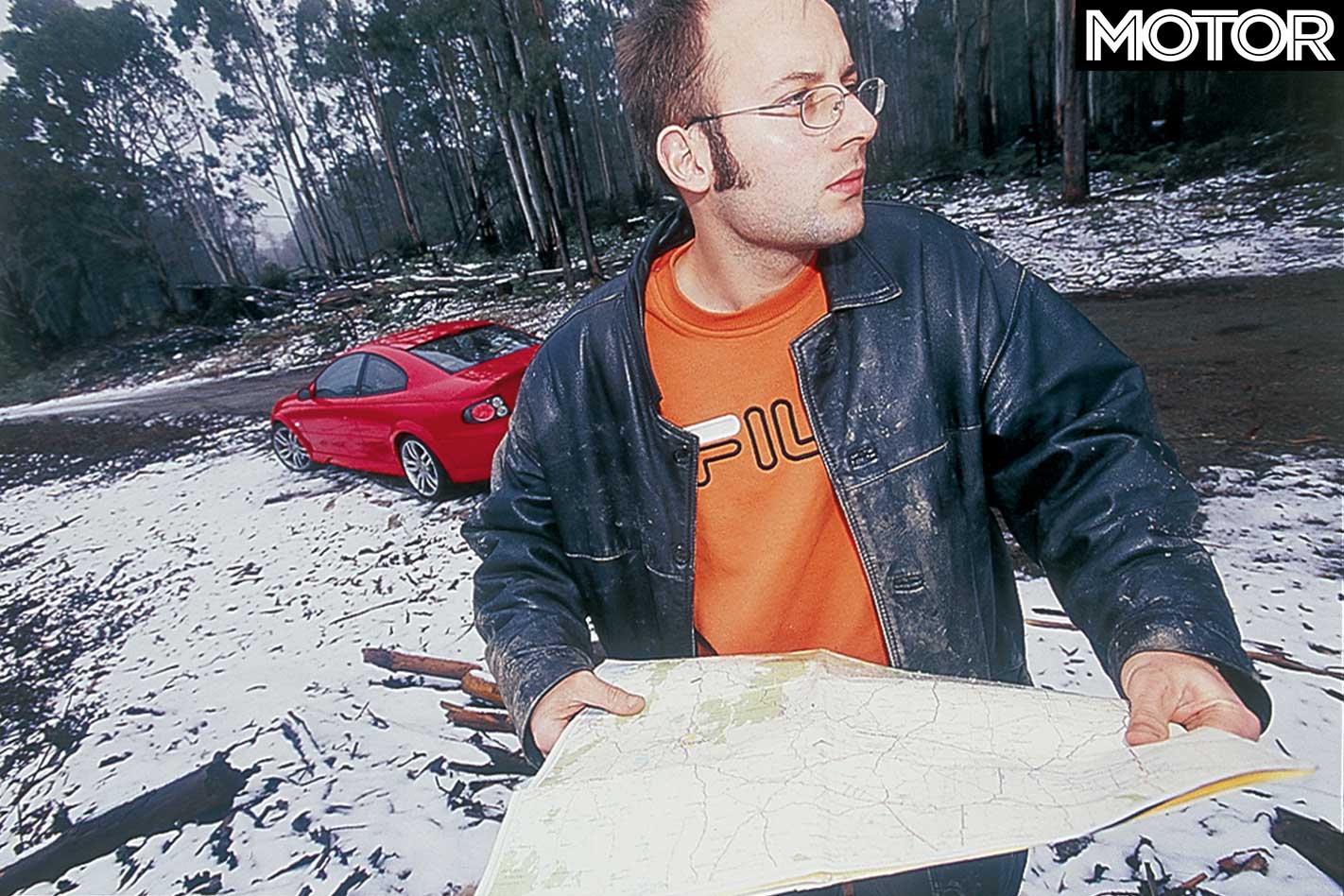
From there, we’d head across country to overnight at Albury on the NSW-Victoria border. Then, tomorrow, we’d criss-cross the Murray before heading toward Tumut, where we might even find some more white stuff. Next, we figured to say g’day to the Dog on the Tuckerbox at Gundagai, and then jump on the Hume for the push back up to Sydney.
If our half-cooked plan worked out, we’d subject the HSV to a comprehensive test of its all-wheel-drive abilities over 1200 kays and across every road and weather condition. Intent outlined and keys in hand, it was time to load up the quad coop and head for the hills.
Finished in Sting Red – the lairiest of the three colours available (silver and black being the others), this is one interesting-looking car. Despite the tacked-on wheelarch flares, necessary to cover the 60mm track increase of its all-wheel-drive system, the Coupe 4 presents a more subtle styling approach for the brand.
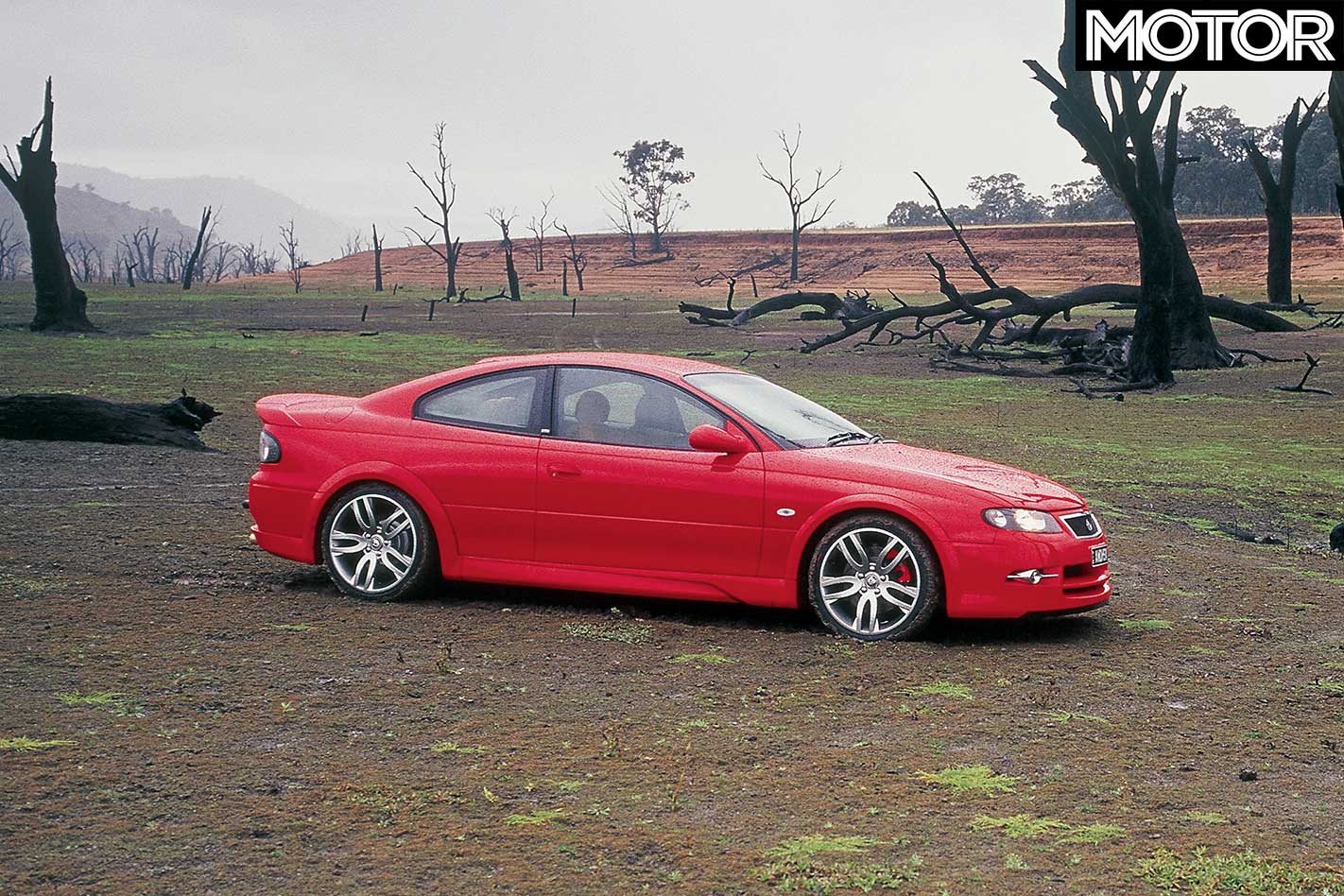
With its chrome grille surround, and using sharper headlights from the Pontiac GTO (also due on the upcoming VZ Monaro), its front end’s flavour is more European than any previous HSV.
This is a deliberate approach, as HSV brass sees the Coupe 4 lining up with Senator and Grange as an exec-express, rather than with its ClubSport R8 and GTS as a boy-racer.
The Coupe 4’s flares dominate the profile of the car and, if anything, make its already enormous 19-inch wheels (a brand new and exclusive design) look even bigger.
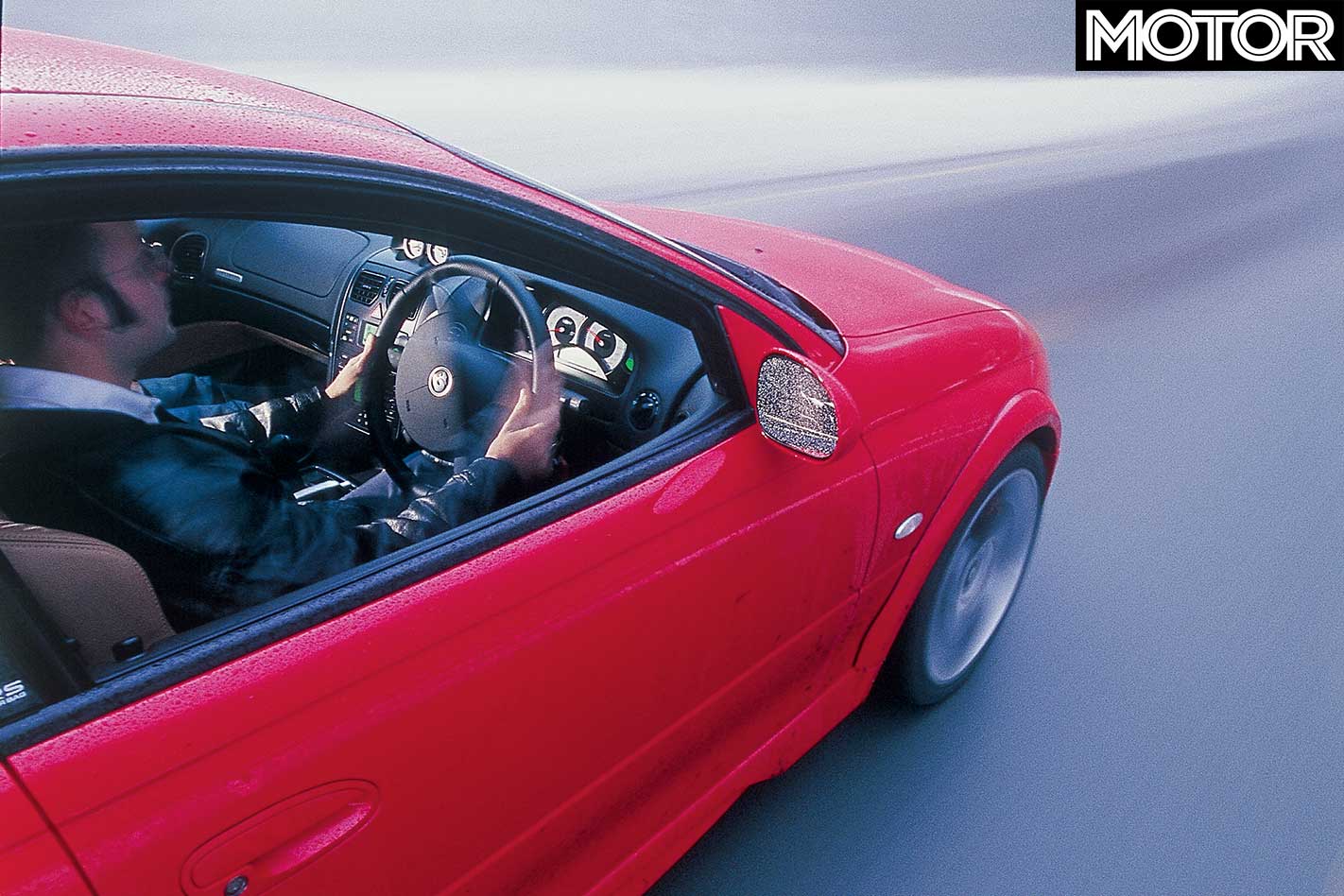
Like all 19-inch-equipped HSVs, this one wears Pirelli rubber, but in a first for the company, the wheel and tyres are different widths front and rear. Its front flares hide 19×8.0-inch rims wrapped in 245/35 ZR19 Italian boots.
Under the rump, the wheels step out an inch in width and the rubber stretches the tape measure to 255/35 ZR19 – that’s the widest rubber to be seen on a standard Aussie performance car!
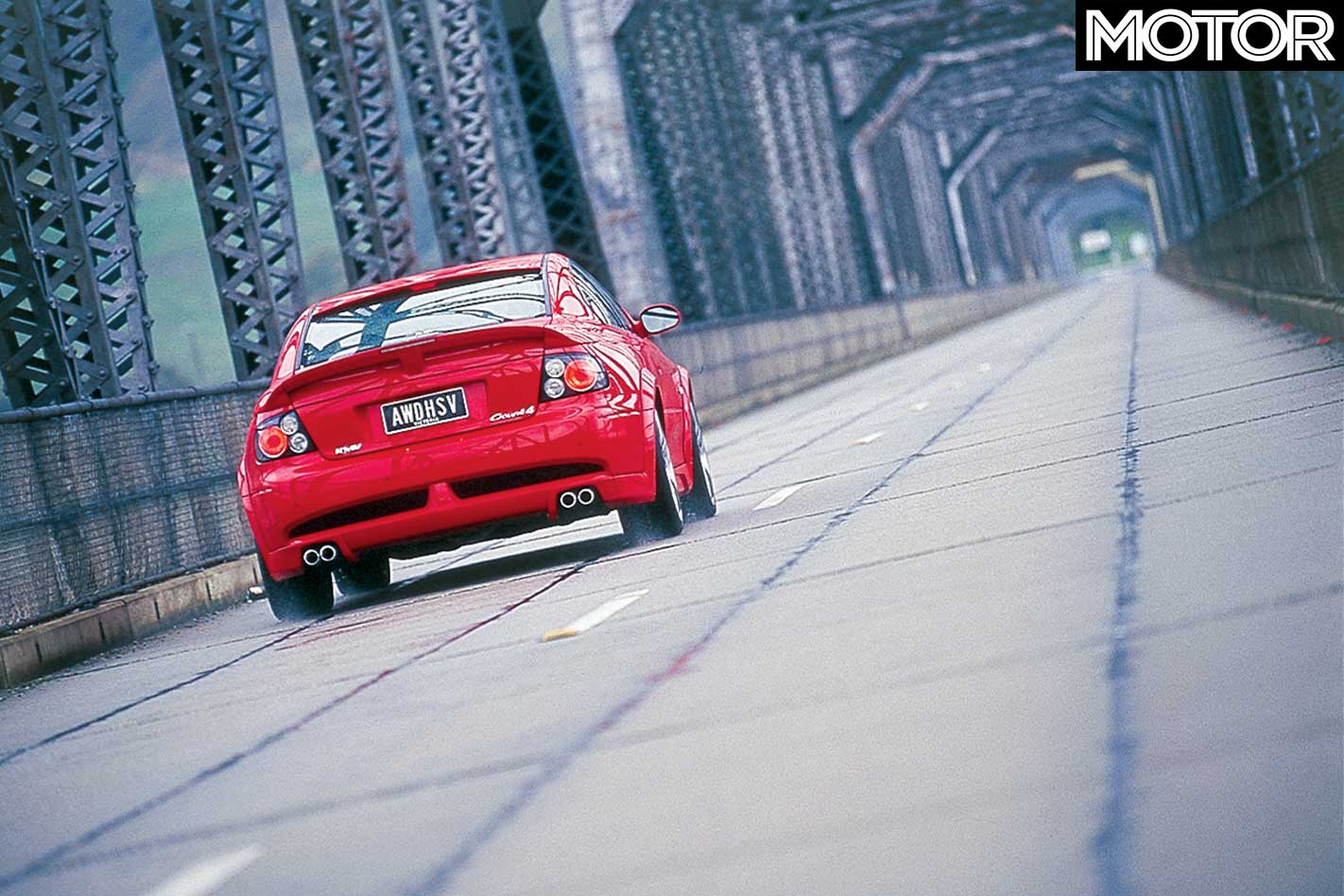
Throwing our gear in the boot, including the usual pile of photographic gear, reveals the enormous reduction in boot space brought about by relocating the fuel tank behind the Coupe 4’s rear seats. The move, first seen on the US-bound batch of GTOs, allows for the fitment of twin exhausts all the way through. It also shifts the fuel filler to higher on the driver-side rear guard.
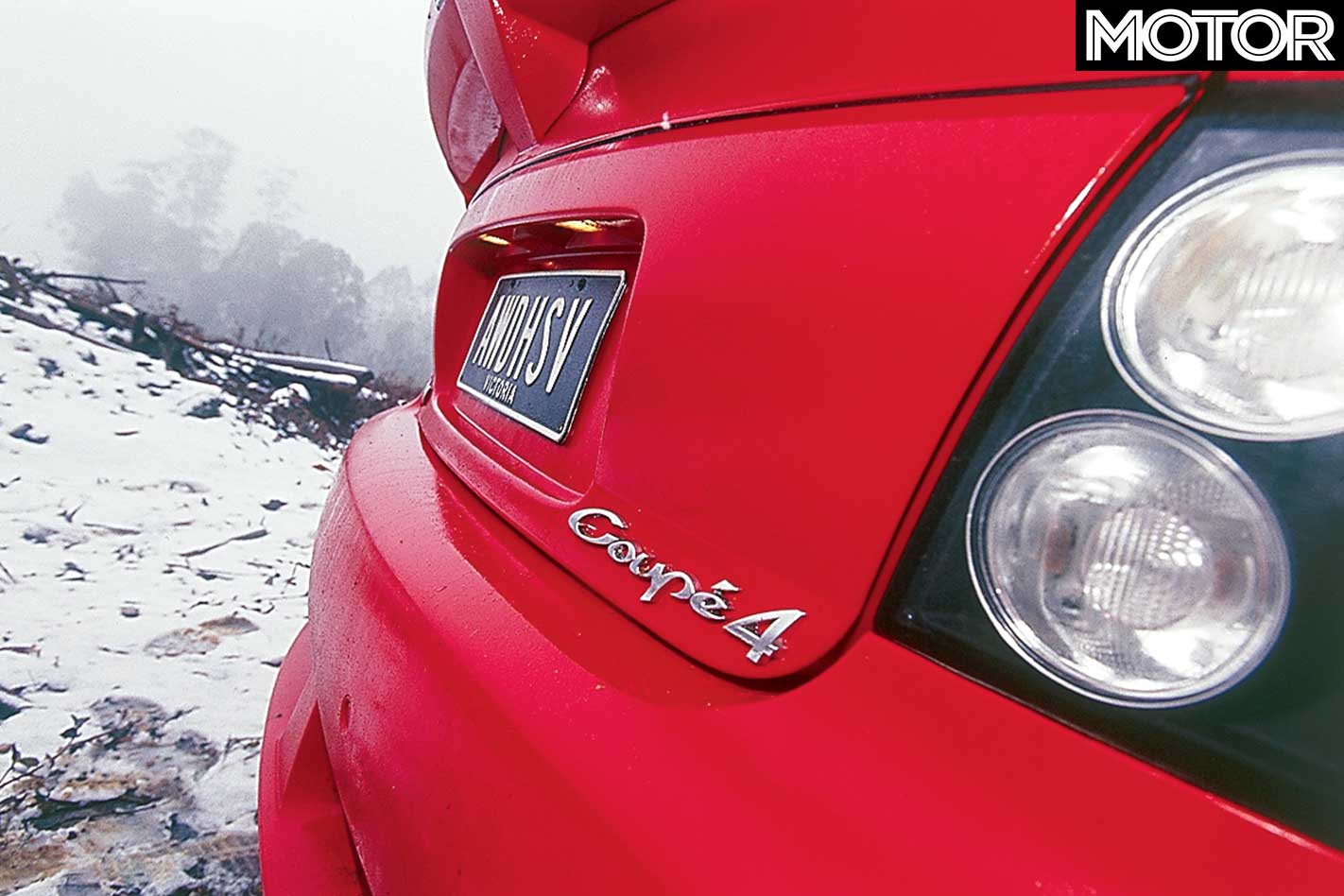
Firing up the Coupe 4, there’s that familiar Gen III rumble, but its twin pipes give it more bass and an added dimension to its wall of noise as revs rise.
With 270kW at 5700rpm and 470Nm at 4000 revs, however, the Coupe 4 drops 15kW and 35Nm on a ClubSport and doesn’t rev as high in the process. Clearing the extra doings of its all-wheel-drive system necessitates the narrower header pipes which bring about those smaller numbers.
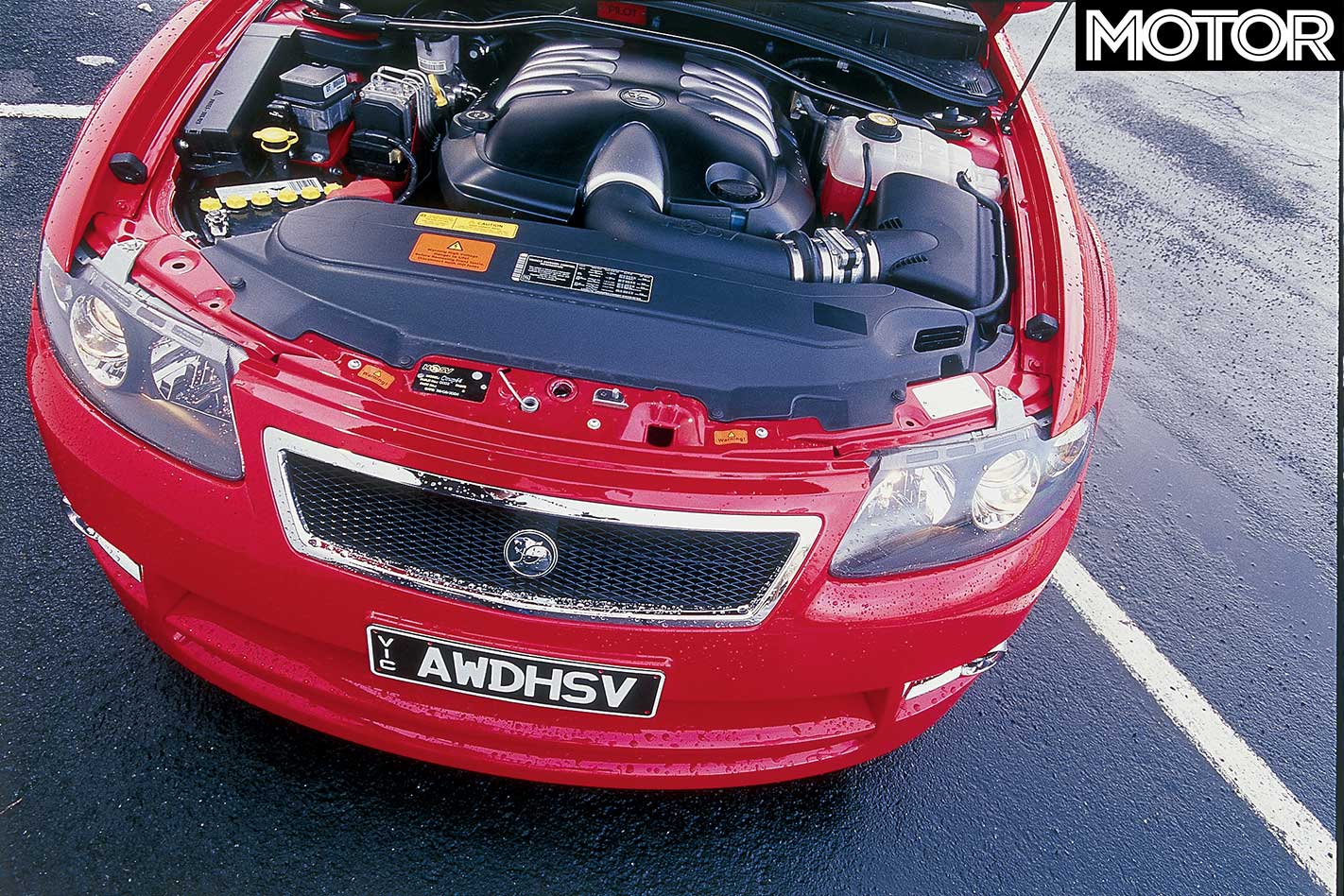
Much has already been written about the Coupe 4’s lower power output, but it probably presents a bigger headache for HSV’s marketing team than its engineers. After all, why would you pay GTS money for a car with less outright grunt than the substantially cheaper ClubSport?
The Coupe 4 is also noticeably doughier off the line, but this has less to do with its engine’s performance than with its increased weight (1830kg to a ClubSport’s 1696kg). Once that initial inertia has been overcome, you’d be hard-pressed to spot any difference.
Still, the Coupe 4 uses it all-paw traction to lay down some decent, if not shattering, performance numbers. But never has it been easier to extract acceleration from an HSV. Simply hold the car on its brakes with your left clog while working the throttle with your right to load up the torque converter. With the revs built up just right, release the anchors and pin the throttle pedal to the firewall.
On damp tarmac, the big HSV fires off the line with barely a slither of wheelspin from those huge rear Pirellis. No need to feather in the power or apply any steering lock, just keep pouring it in and let the all-wheel drive sort it out. Zero to 100km/h flashes up on the Correvit display after 6.7 seconds – a long way outside HSV’s 6.1 second claim for dry tarmac – and even falls behind the 6.6 boast on dirt.
But, before you start howling like buggery and firing off your emails, the rain-slicked surface actually helped prevent its engine bogging down off the line.
Over the rest of the quarter mile, the HSV made up a little, but a 14.74-second time is still the best part of half a second outside the claim. In the pantheon of performance cars built locally, these times rank the Coupe 4 dead last! That’s right, it’s slower than every HSV, save the high-riding Avalanche and XUV; it gets outgunned by Commodores and Monaros, and it gets dusted by all fast Fords, including the less powerful XR6 Turbo.
The drag strip also highlights the Coupe 4’s only other major problem. After a few runs, and the subsequent big stops from a dollar sixty, its brakes quickly go south.
By the third stop, the pedal has gone hard, dropped an inch or two, and all feel has gone out of the window. This is not something you expect from HSV, whose range usually feature tireless brakes. But the Coupe 4 (plus Avalanche and XUV) makes do with the smallest anchors offered on any HSV. Its slotted rotors are a still-chunky 336mm front and 315mm at the rear.
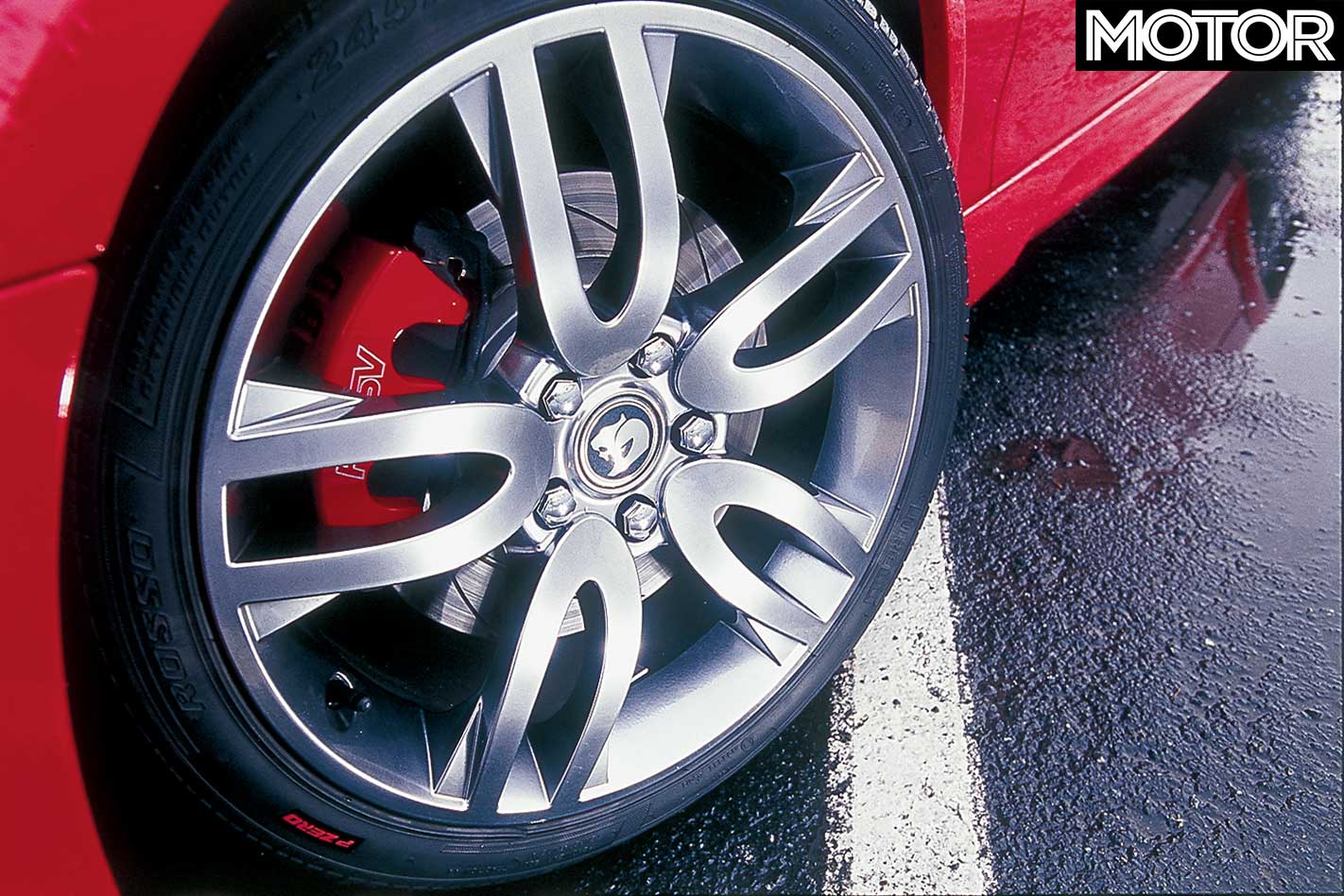
But, thanks to the limited clearance available with the new front hub, its front discs are squeezed by two-piston calipers and its rears by single-piston clamps. On paper, that still sounds ok, but with over 1800kg to haul down, the brakes soon protest.
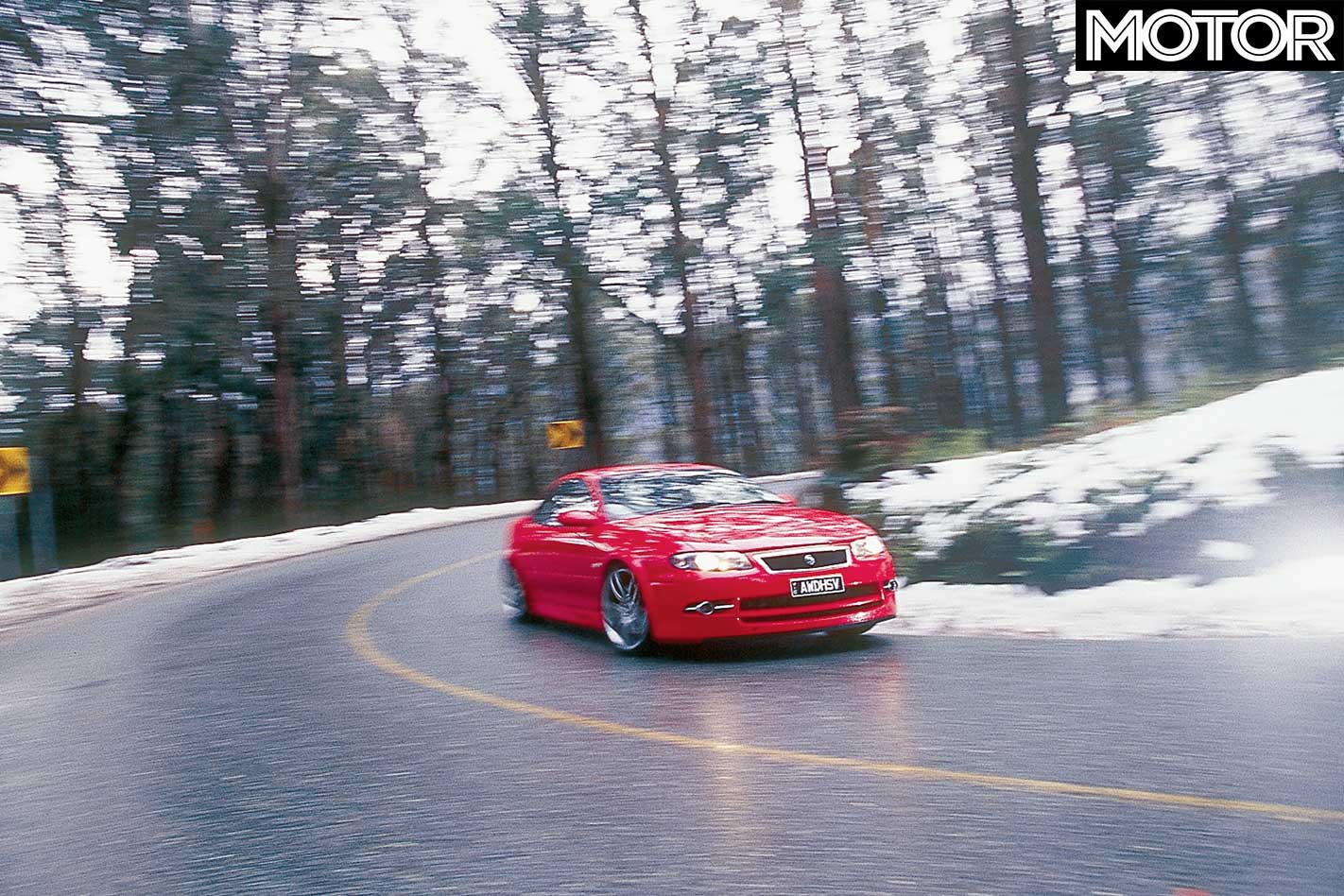
For all this negativity, however, if ever a car can prove that straight-line performance is only one dimension to a car’s overall score, it’s the Coupe 4. On the country road run toward Mansfield at the base of Mount Buller, the rain started to bucket down, but there was never a fear of unprovoked oversteer through the tight, second-gear corners.
Those big-foot Pirellis cut through the standing water, and deliver plenty of grip at either end. The push understeer you usually find in all-wheel-drive cars, especially heavy ones like the Coupe 4, is all but absent. And with a 38:62 torque split there’s enough rear-drive bias to pedal around the understeer if and when it arrives.
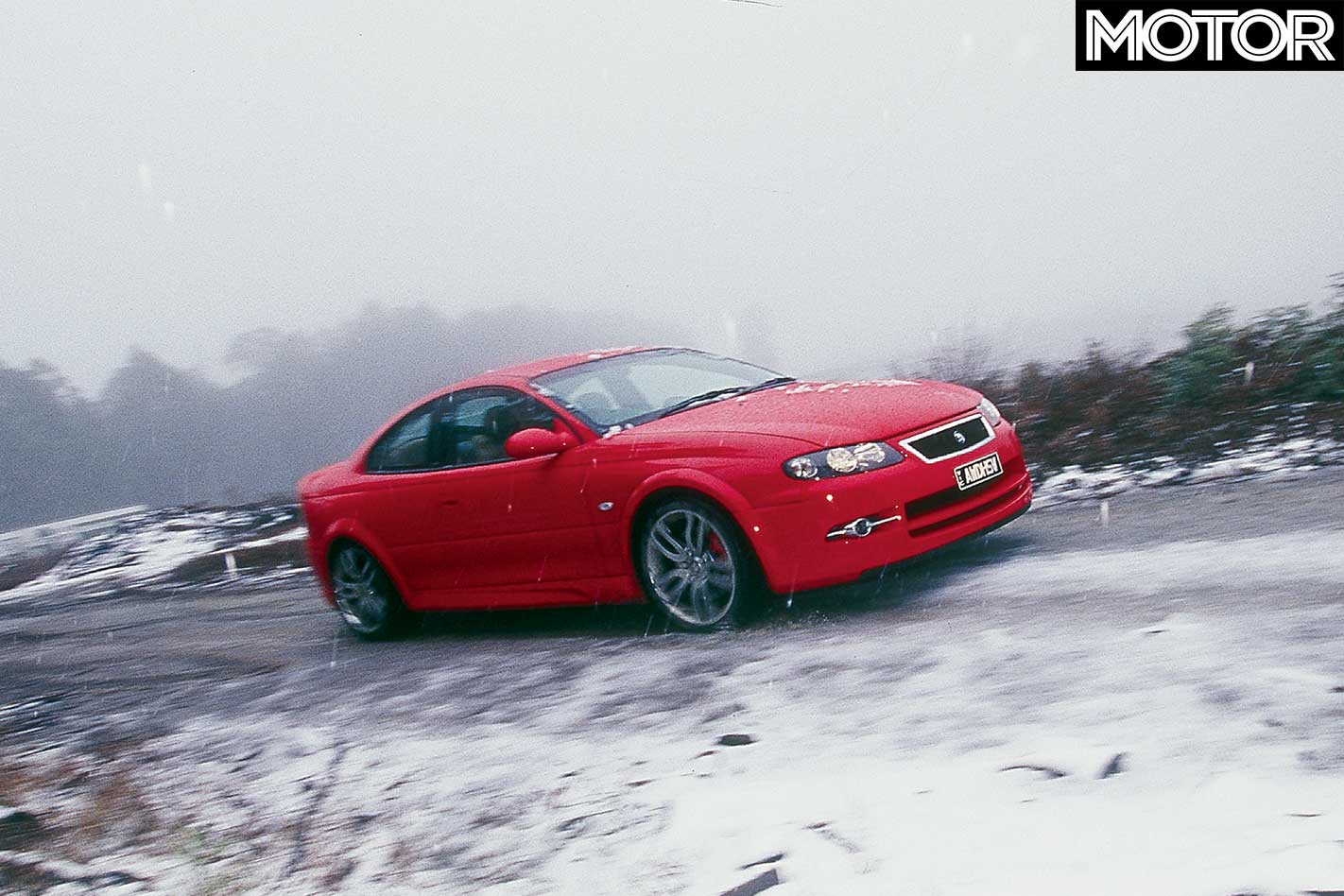
Up the wet, but not icy, slopes to the top of Mount Buller, the Coupe 4 simply carved its chosen line. Admittedly, the two-wheel drives were still getting through without chains, but their drivers lacked the confidence to use more than a sniff of throttle.
The Coupe 4, however, could use full power into and out of corners. With chunky linear ratio steering (also shared with the 2004 GTS) still feeding plenty of info, despite the often dulling effect of AWD, the HSV gives you so many options.
You can drive it slow-in, fast out, and even have a sniff of oversteer on exit – and if you’re having a real go on low-grip surfaces, you can even bring traction control into play. Or you can tip it in quick while still on the brakes and getting its tail involved a bit earlier. Or you can just be smooth and pick up the throttle nice and early.
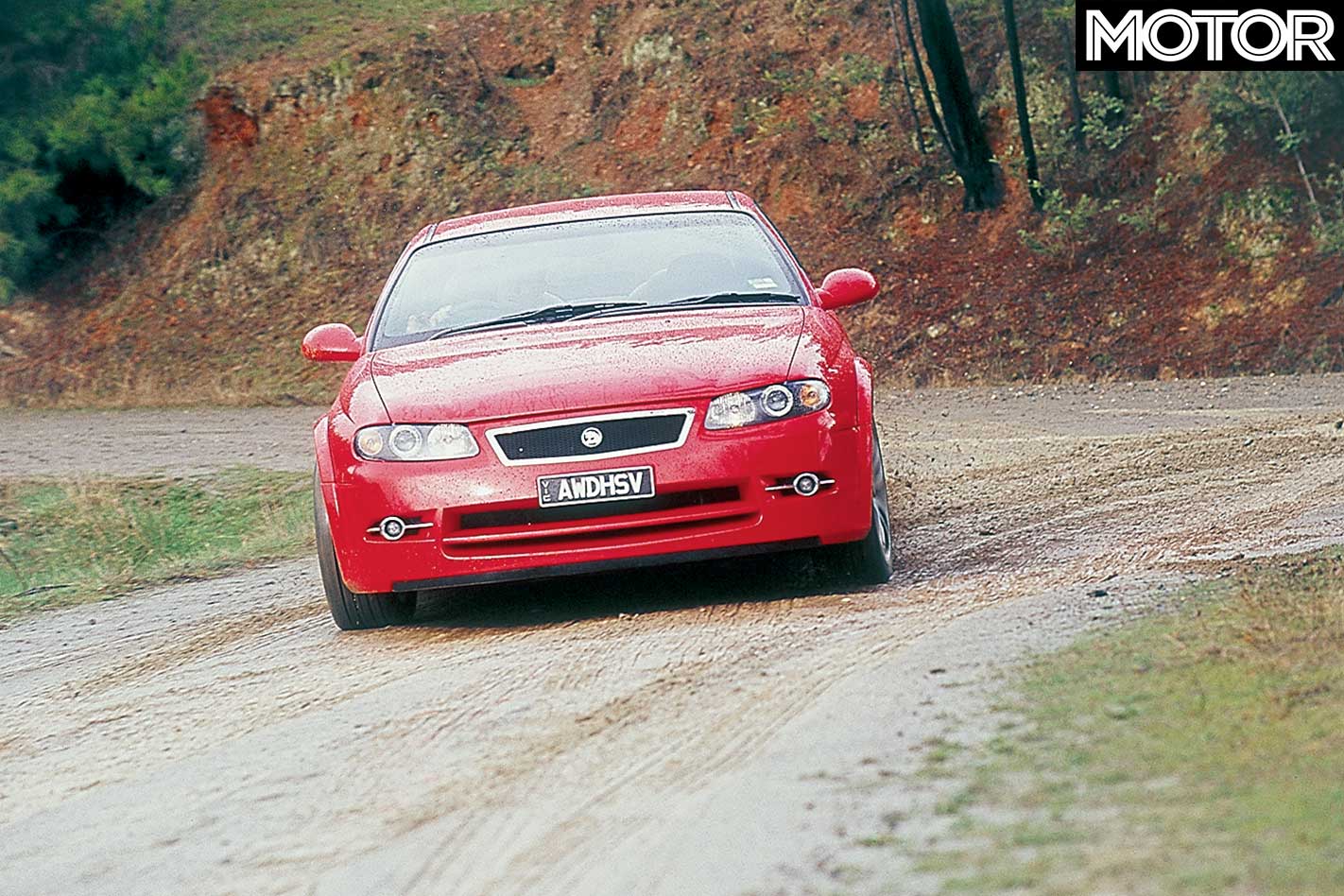
Whichever option you choose, the HSV Coupe 4 is a devastatingly quick way to cover ground, especially in the wet. Only the constant hunting of its four-speed auto dampens the fun on the quick twisties. Best to take manual control and shift between second and third yourself.
On day two, after our little ‘incident’ (see bottom), we joined the Hume after some more cross-country running.
Despite feeling stiffer in the rear than a Clubbie or GTS, the Coupe 4’s ride quality over typical Aussie roads is superb. There’s an initial compliance that you don’t expect with a car running 19-inch rubber, and vertical travel is well-controlled, so the big girl never gets floaty. And that extra weight also keeps it settled over bumps.
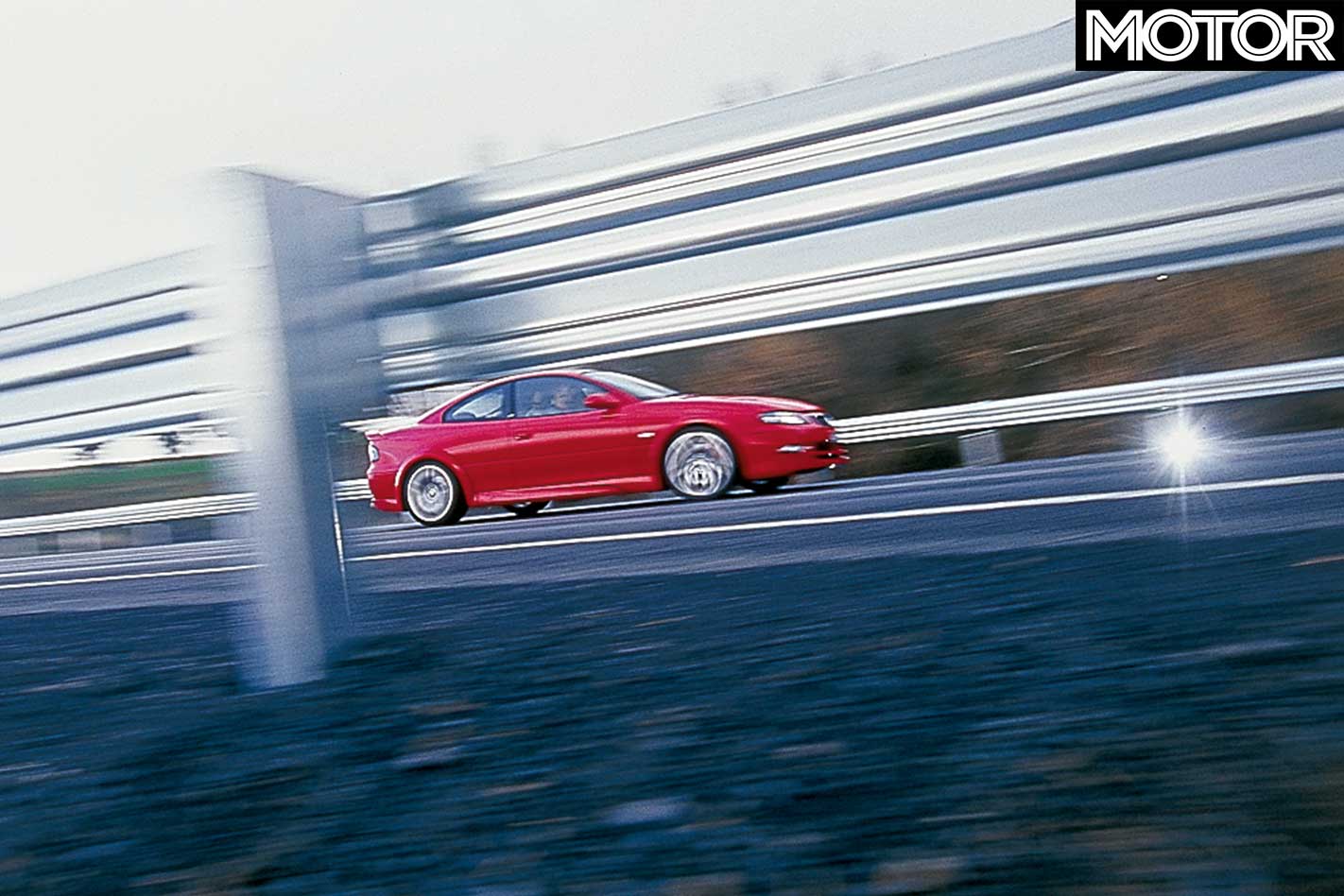
Once on the Hume, the Coupe 4 maintained an effortless pace all the way to Sydney.
Just like the HSV GTS sedan and Coupe, the Coupe 4 will not be an off-the-peg buy. Only 100 examples will be built for 2004, all autos, as that’s the only ’box engineered for the AWD set-up. HSV claims a strong order bank and keen interest in the quad-drive Coupe, but this year’s market response will determine how many get built next year.
At $89,950, and cheaper than HSV’s foreshadowed $95k, it’s likely the Coupe 4 will be special-order only, just like the GTS pair.
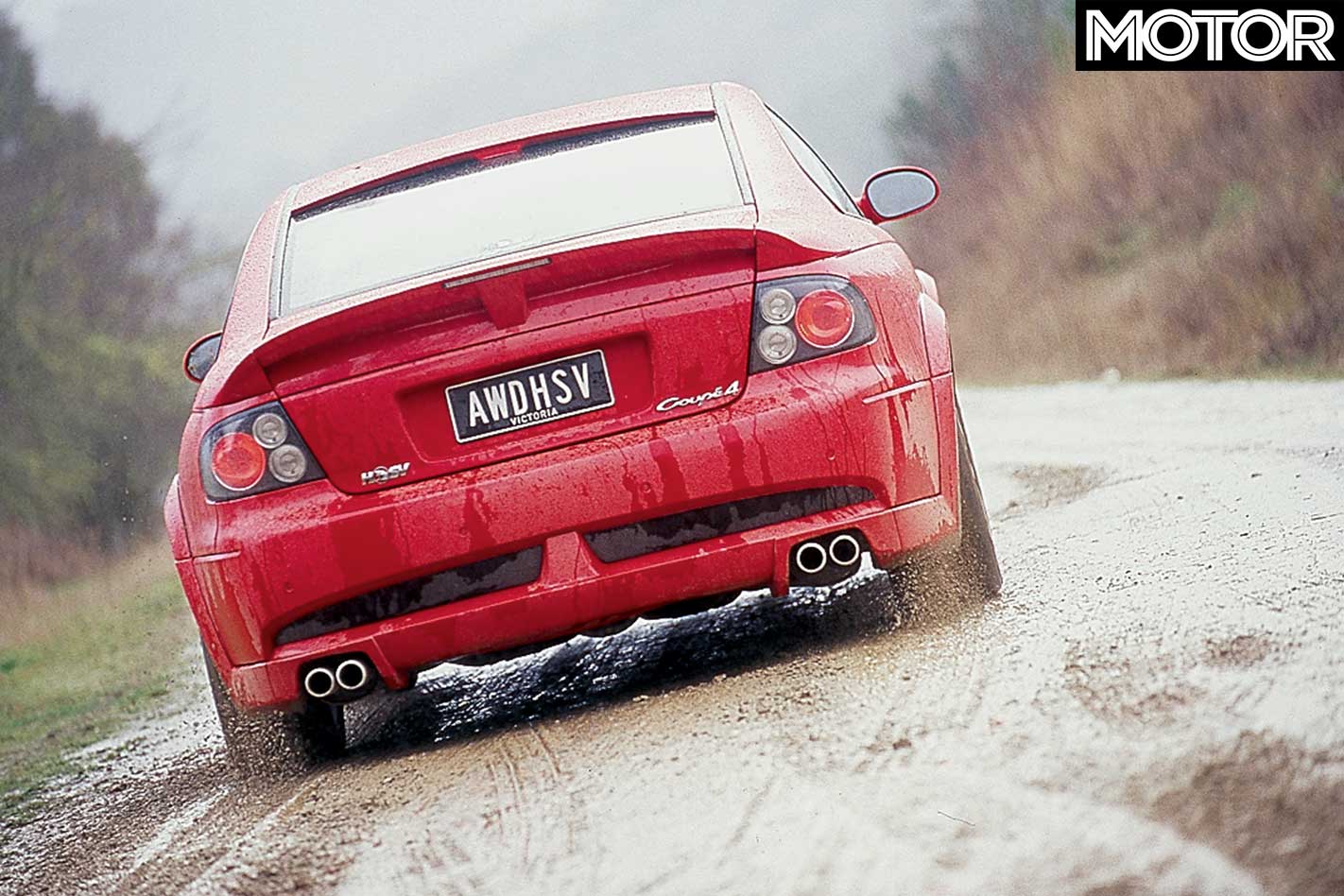
At this trip’s beginning, I admit to being a bit cynical about the Coupe 4. For one, I didn’t understand the appeal of a car that’s slowest in the range, but second-most expensive. I also feared HSV was looking too far outside the square and away from what it does best.
Over 1200 traction-packed kays later, its breadth of ability has peeled away my cynicism. It may lack the raw punch of other models in the marque’s range, but the Coupe 4 is one hell of a mile-eater. It represents a small shift in thinking for HSV, without diluting the core appeal of its brand.
Five HSV Coupe 4 facts – Only available in red, silver or black – This pilot-build car was missing switch for foggies – It’s 35kg heavier than LWB Grange… – But beats Elise Sport 111 on weight-to-power – Used 18.2l/100km over the 1200km trip
FAST FACTS 2004 HSV Coupe 4
BODY: 2-door coupe DRIVE: AWD ENGINE: front-mounted 5.7-litre, 16-valve pushrod V8 POWER: 280kW @ 7400rpm TORQUE: 475Nm @ 4000rpm COMPRESSION RATIO: 10.1:1 BORE X STROKE: 99.0mm x 92.0mm WEIGHT: 1830kg POWER-to-WEIGHT: 153kW/tonne SPECIFIC POWER: 47.4kW/litre 0-100KM/H: 6.73sec (tested) 0-400M: 14.74 @ 160.8km/h (tested) TRANSMISSION: four-speed automatic SUSPENSION: MacPherson struts, coil springs, anti-roll bar (f); multi-link, coil springs, anti-roll bar (r) L/W/H: 4789/1840/1397mm WHEELBASE: 2788mm TRACK: 1618mm (f); 1623mm (r) FUEL: 70 litres, PULP BRAKES: 336mm ventilated & grooved discs, two-piston calipers (f); 315mm ventilated & grooved discs, single-piston calipers (r), ABS WHEELS: 19 x 8.0-inch (f); 19 x 9.0-inch (r), alloy TYRES: Pirelli P-Zero, 245/35 ZR19 (f); 255/35 ZR 19 (r) PRICE: $89,950
Coupe 4 Rivals
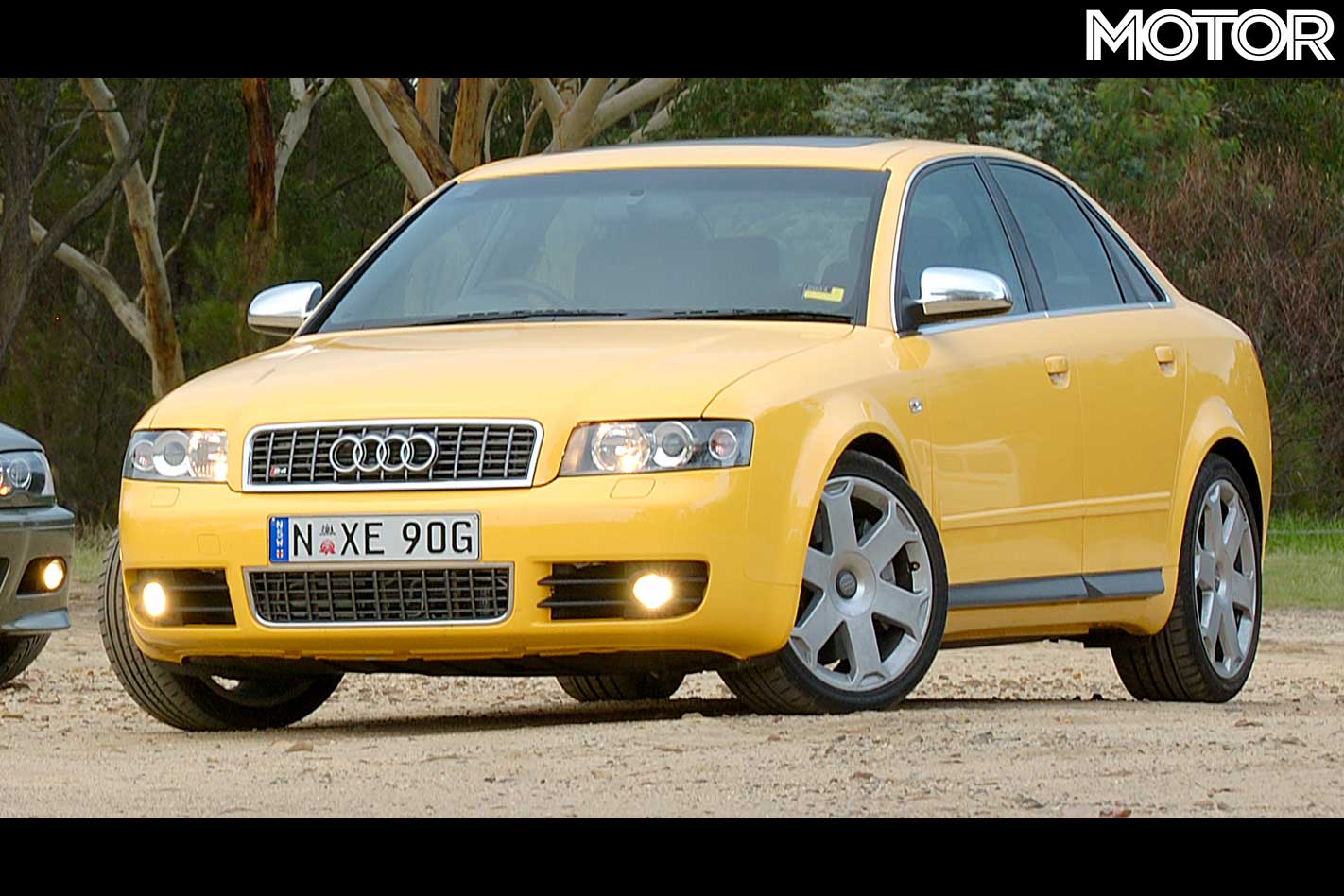
Audi S4 Probably the closest in philosophy to the Coupe 4, S4 packs a 253kW V8 and drives all four wheels through a choice of auto or manual ’boxes. Priced from $130k
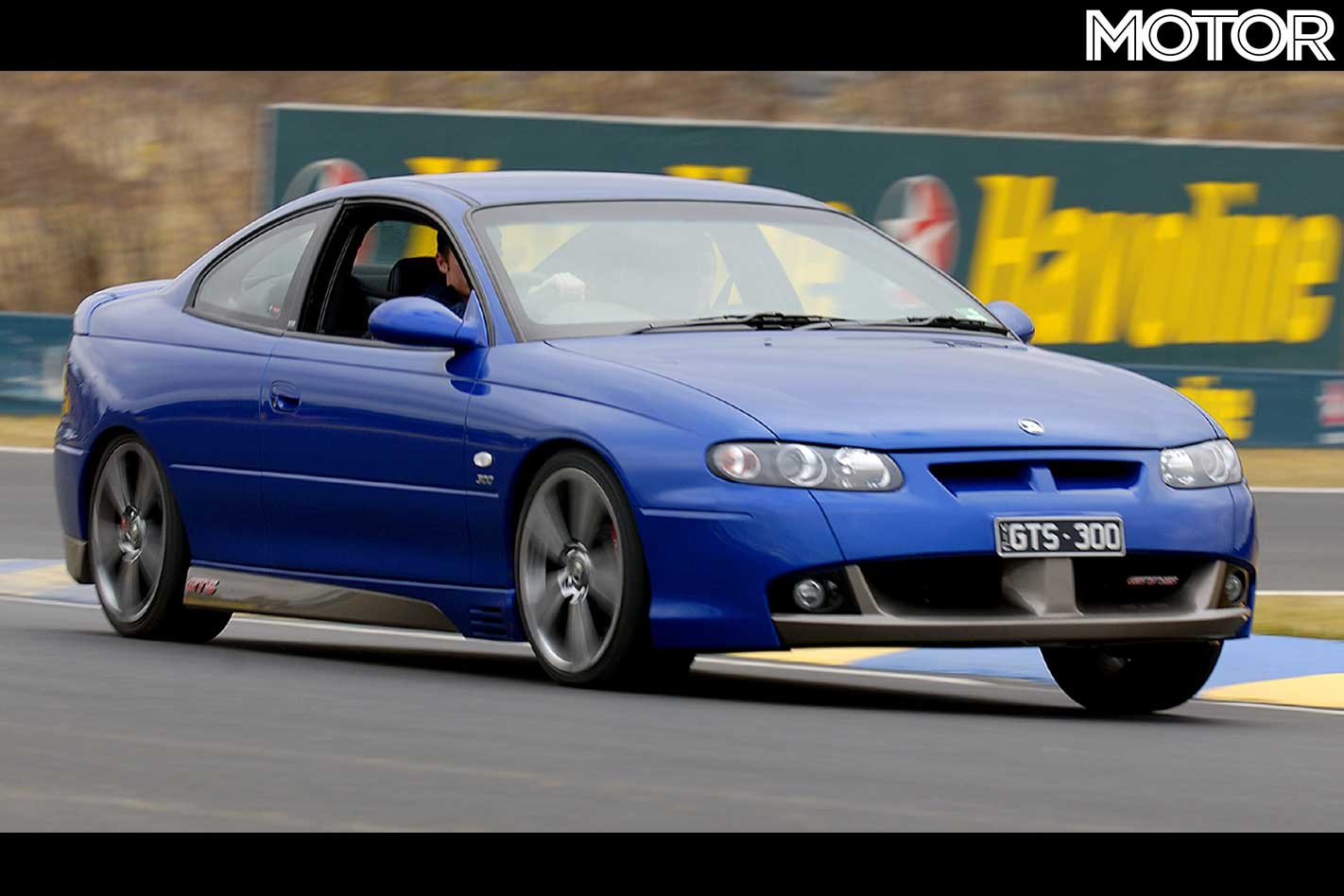
HSV GTS Coupe The most likely competitor comes from within, in the form of GTO or GTS Coupes. At $89,950, Coupe 4 splits the $76k GTO and $98,500 GTS Coupe, but with less grunt
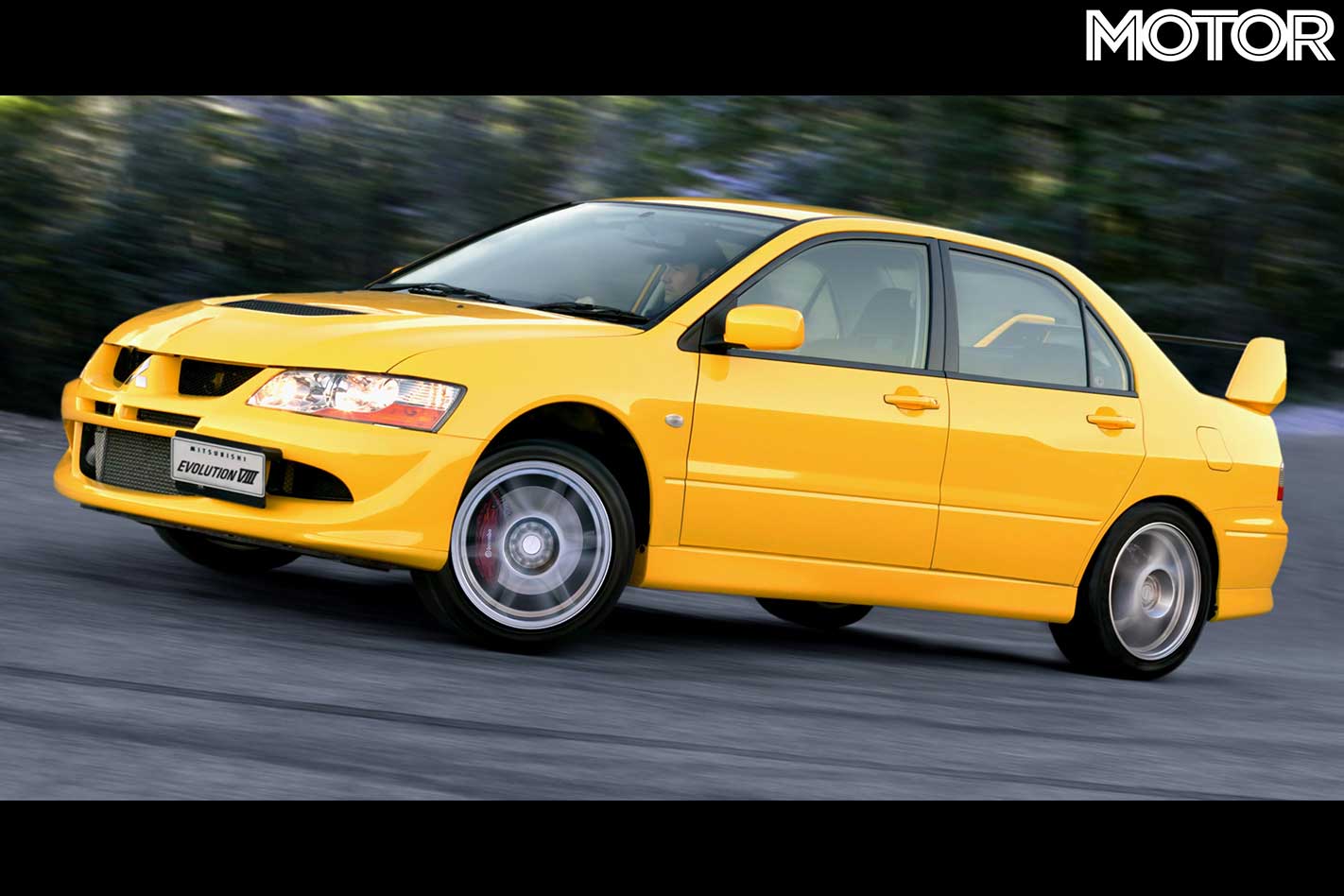
Mitsubishi Lancer Evolution VIII The current king of all-paw performance, but a bit lairy and not a direct rival for the Coupe 4. At $62,000, the EVO undercuts the HSV and is a more focused performer
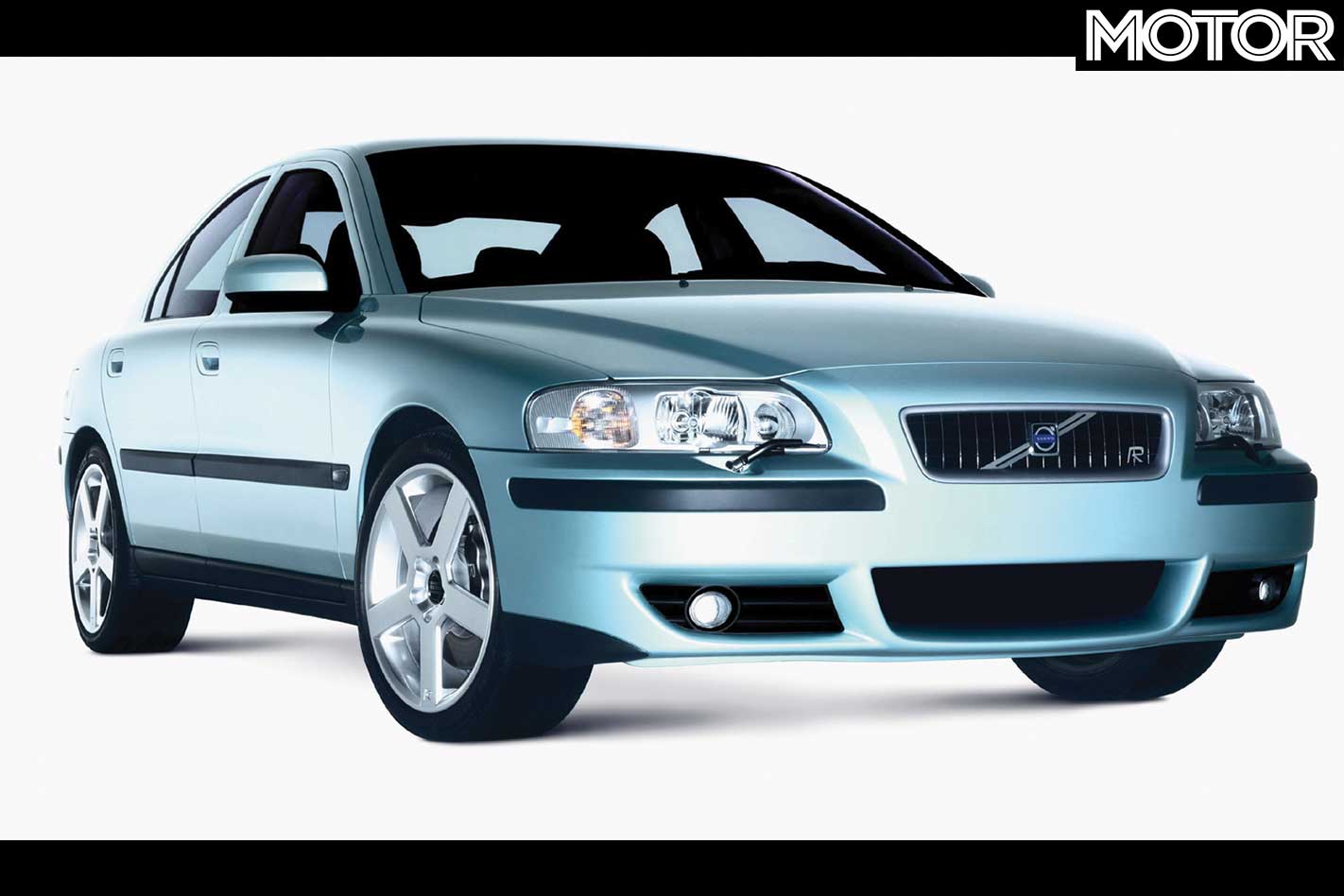
Volvo S60R HSV and Volvo mentioned in the same breath? The $98k S60R is just $10k pricier and packs a similar punch, thanks to lighter weight and a lively 220kW turbo five-potter
RSPCA Rescues big dumb animals
We’d slithered our way to the very edge of the Murray River for what was going to be a killer static shot, and now we sat cocooned in the tan leather cockpit of the HSV Coupe 4 waiting for the teeming rain to ease long enough for snapper Brunelli to brave the elements and fire off a few frames.
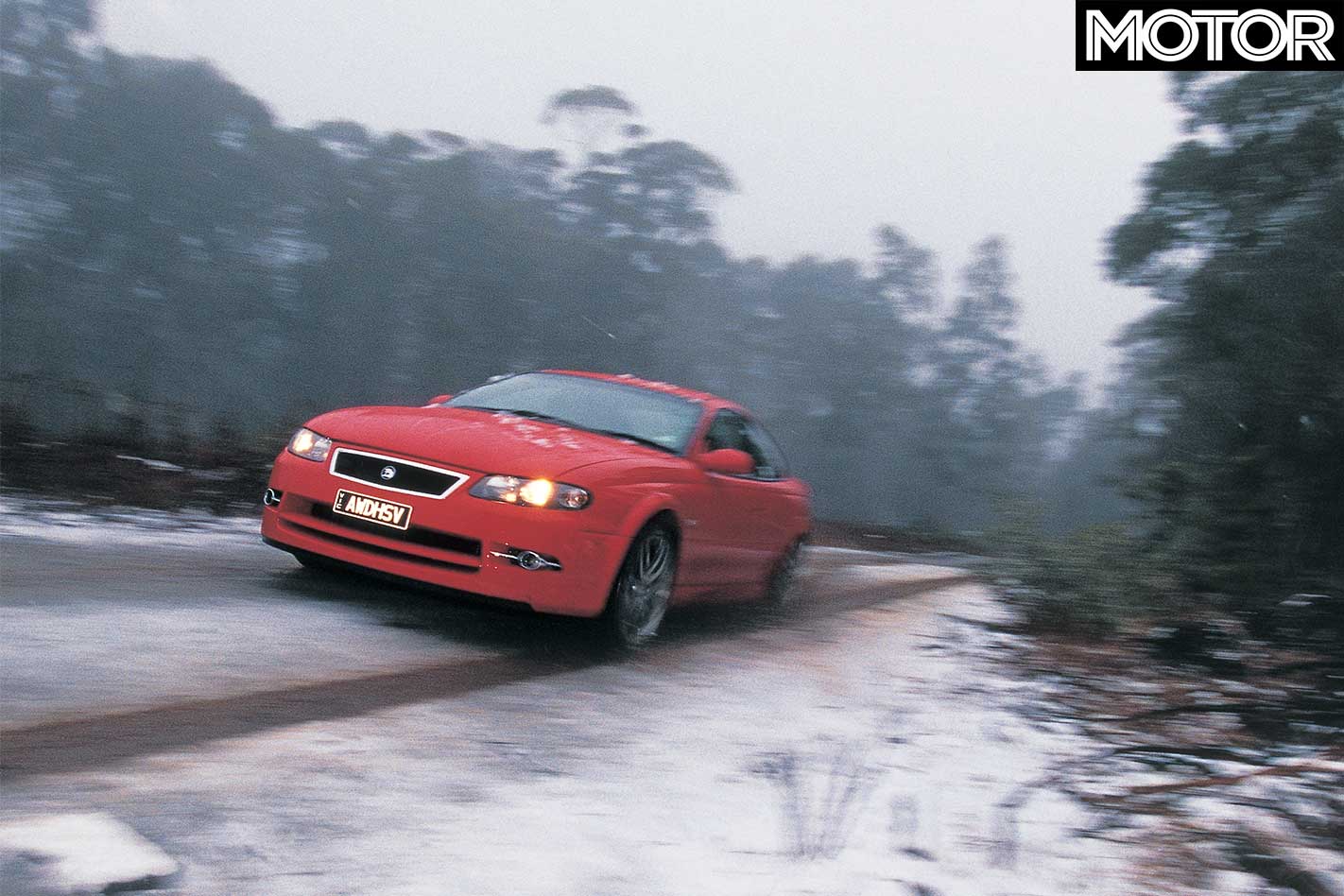
With profanities a-plenty and a whole load of wheelspin, we were on our way, only for Brunelli to change the plan. Ever keen for the great shot, Cristian suggested I back it up and snap the Coupe 4 into “a rally drift.” Why not?
With no forward momentum and not much in the way of sideways action, the big coupe ground to a halt in the swamp and promptly sank to its sills. Successive half-arsed attempts to get the Coupe 4 out only succeeded in burying it further.
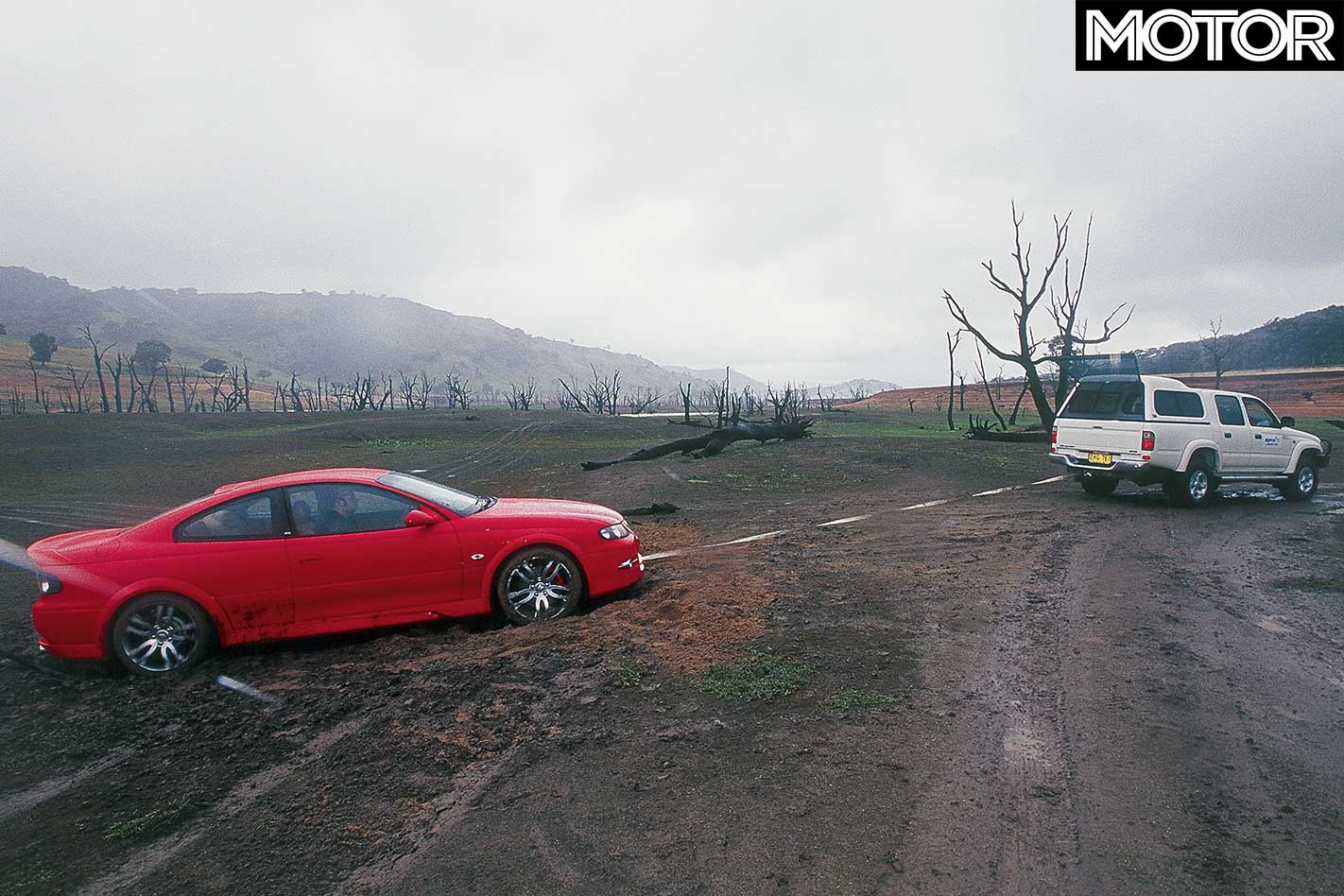
Admitting defeat, we staggered to the main road through the blinding rain and waited for help to drive by, only for the first car to swerve onto the wrong side of the road to avoid our abject pleas for assistance.
Thankfully, Lionel Smith from the local RSPCA stopped soon after and took pity on us. He’d already rescued an injured joey that morning, so saving two further bedraggled animals was all in day’s work for Lionel. Even so, his 4X4 HiLux struggled on the sticky mud.
TIPPING your hard-earned into a hot hatch has never made more sense than it does today. Not only does the segment now offer a broad range of vehicles that are practical and easy to live with day-to-day, a circa $50,000 bit of kit can pack the kind of punch that not too long ago was only available in serious sports cars.
But with so much choice available and stiff competition keeping quality, power and performance standards high, where do you start when it comes to picking a pocket rocket?
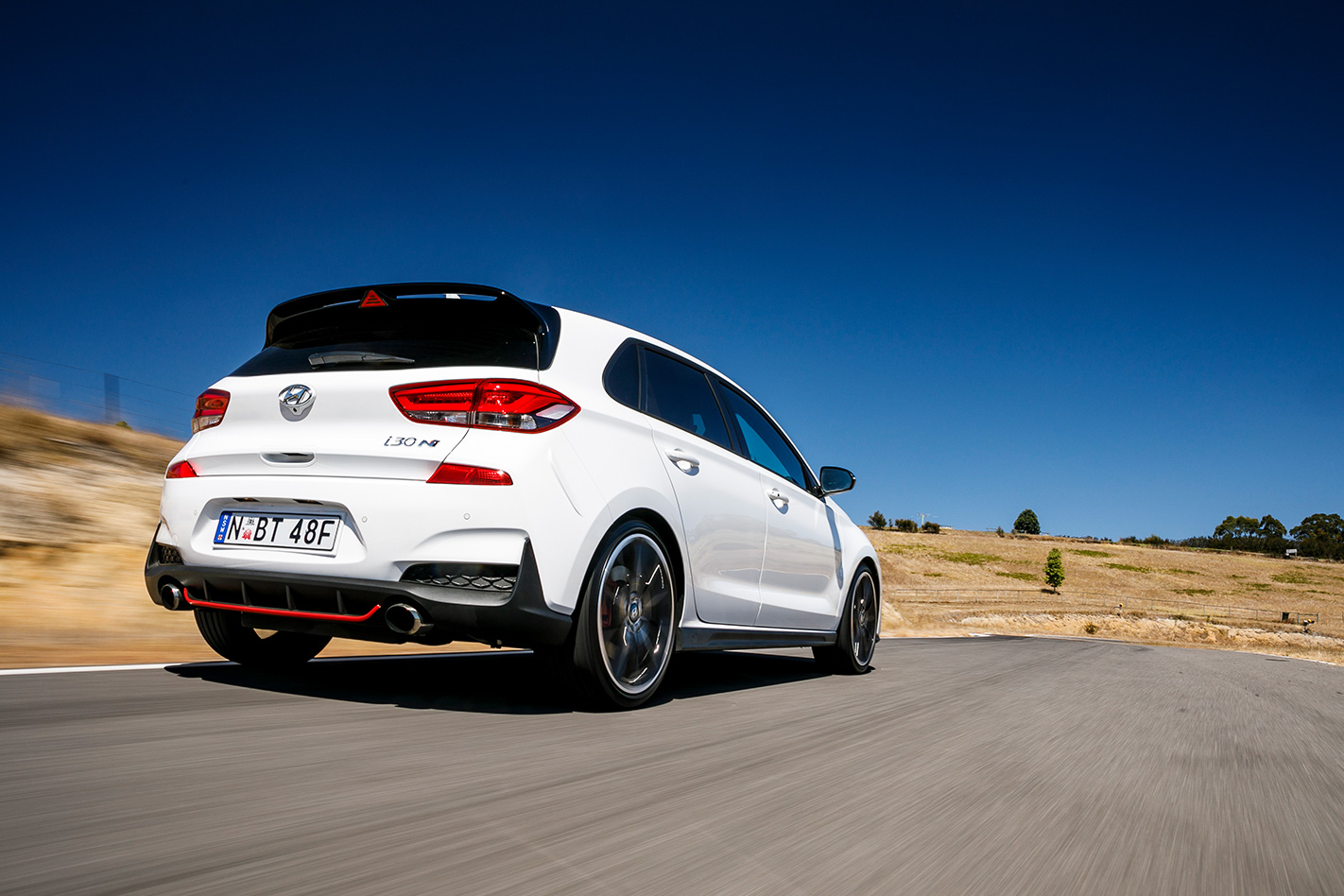
We assembled 12 contenders – the BMW 125i, Ford Focus ST, Honda Civic Type R, Hyundai i30 N, Mini Cooper JCW, Peugeot 308 GTi, Renault Clio RS220, Skoda Octavia RS245, Subaru WRX, Subaru WRX STi, Volkswagen Golf GTI and the Volkswagen Golf R – for a blast around Gippsland’s Bryant Park hill climb track. It allowed us to gauge how each one stacks up at a tight, demanding circuit that favours cars with a lightweight, forgiving chassis and tractable power.
Seasoned race ace Renato Loberto was our ultra-consistent pilot for tracking down the fastest times, while I cut a few laps to see how each car fared in the hands of a mere mortal.
This comparison coincides with the arrival of Hyundai’s foray into the hot hatch world, the i30 N, which has already raised eyebrows among enthusiasts. We certainly wouldn’t be the first to mention the savage Honda Civic Type R in the same breath – the unofficial king of the hot hatches, but for how long?
While the battle for front-dragger supremacy was raging, the rest of the pack fell into line after waging smaller battles, with surprising outcomes all of their own. Settle in, click “play” and watch as 12 feisty machines that won’t break the bank sort out their place in the top-shelf performance hierarchy.
Hot Hatch Megatest Contenders
12th, Score 6/10: Mini Cooper S JCW
11th, Score 6.5/10: BMW 125i
10th, Score 6.5/10: Subaru WRX Premium
9th, Score 7/10: Subaru WRX STI
8th, Score 7/10: Skoda Octavia RS245
7th, Score: 7.5/10: Ford Focus ST
6th, Score: 7.5/10: Renault Clio RS220 Trophy
5th, Score: 8/10: Volkswagen Golf GTI Original
4th, Score: 8.5/10: Volkswagen Golf R Grid
3rd, Score: 8.5/10: Peugeot 308 GTi 270
2nd, Score: 9/10: Honda Civic Type R
Winner, Score: 9/10: Hyundai i30 N
Here it is folks, the last Aussie-built Holden Commodore V8.
Yep, the production car that provides the silhouette is sourced from Germany in front-or all-wheel drive and powered by a four-cylinder or V6 engine, but the ZB Commodore that hits Australian racetracks in the Supercars championship is still a locally built, rear-drive V8 … the only hurdle is this one will set you back $645,000.
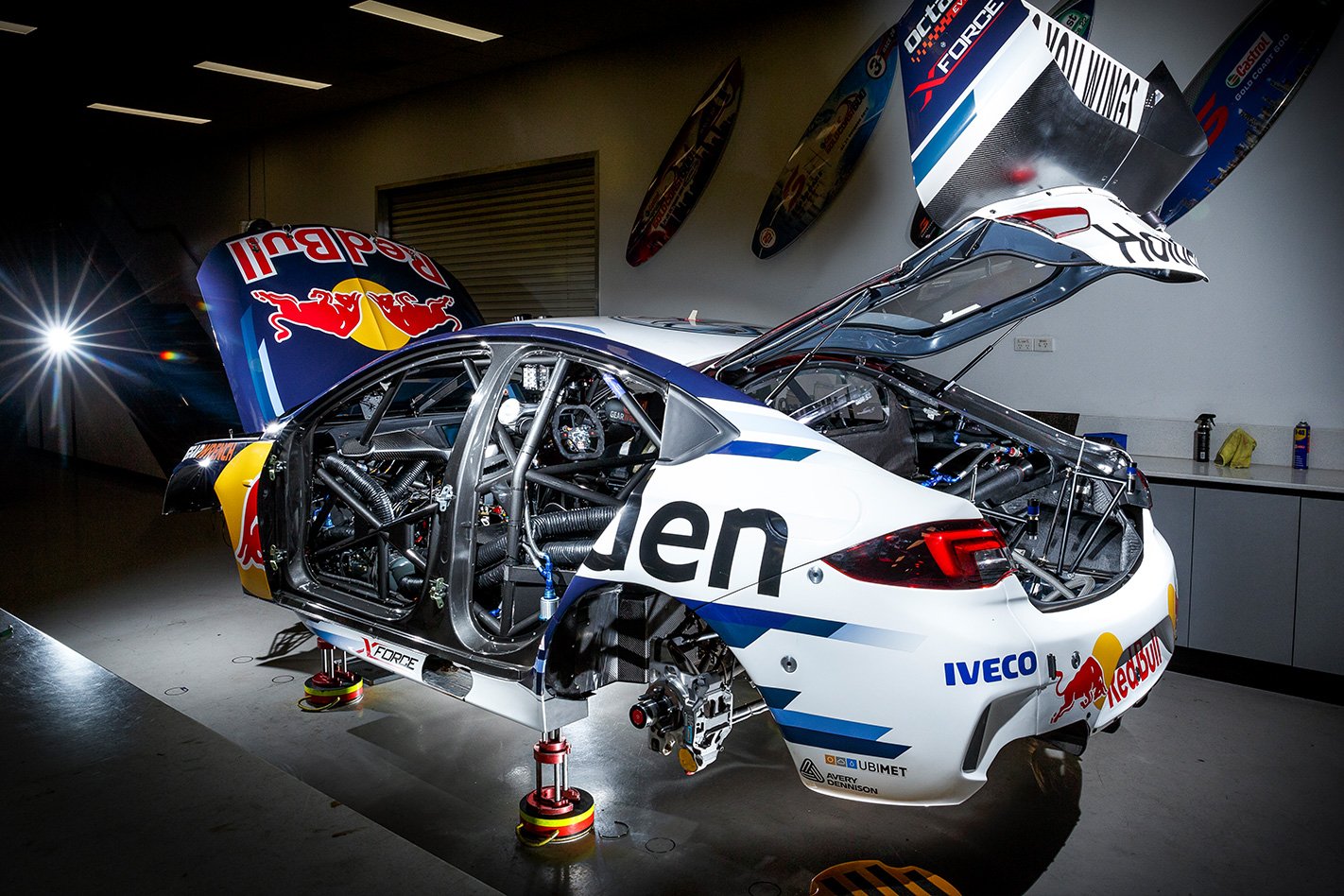
From the chassis up, this is an Australian car full of local engineering know-how and craftsmanship, just like its predecessors. Yet it breaks new ground because it’s based on an import while sticking resolutely to the local tradition and rulebook.
But as of next year, that local identity will be eroded significantly. The Chevrolet V8 engine that’s been developed under the bonnet of Holden touring cars since 1994 will be replaced by a twin-turbocharged V6.
Like the car, the new engine is being developed on Holden’s behalf by Triple Eight Race Engineering (T8) in Brisbane.
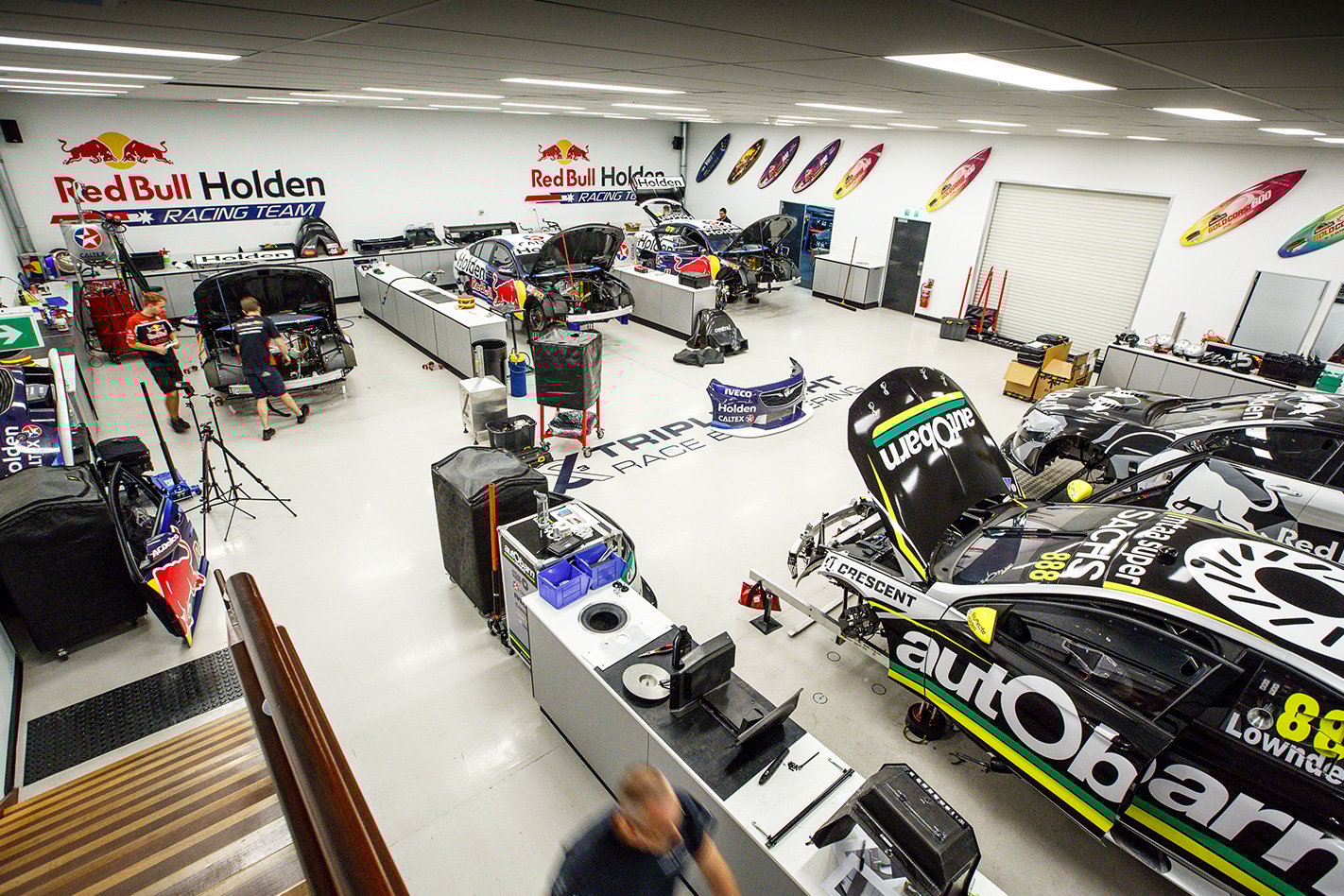
Since swapping from Ford in 2010, T8 has been Holden’s most successful team in Supercars racing, so much so that last year it levered the Holden Racing Team name and factory-team status away from Walkinshaw Racing simply on the basis of sheer weight of results.
While it ran three VFII Commodores in the 2017 Supercars championship for Jamie Whincup, Shane van Gisbergen and Craig Lowndes and supported several customer entries, T8 was also developing the new generation Supercar and its engine for Holden.
Not only was T8 competitive on the track, Whincup won his seventh championship, it also had the new car out and running in September and homologated its vital aero package in November. That’s impressive.
Yes, there have been setbacks. The V6 engine was originally intended to debut in 2018, but because of development issues will now only be seen in wildcard outings. Spare parts have also proved a challenge for T8 to manufacture in bulk and on-time.
But all 14 Commodore ZBs entered for the opening round of the championship made it to Adelaide for an auspicious debut, taking five out of six podium spots over two 250km races. Leading the way was T8’s van Gisbergen, with two poles and two race wins in his Red Bull Commodore.
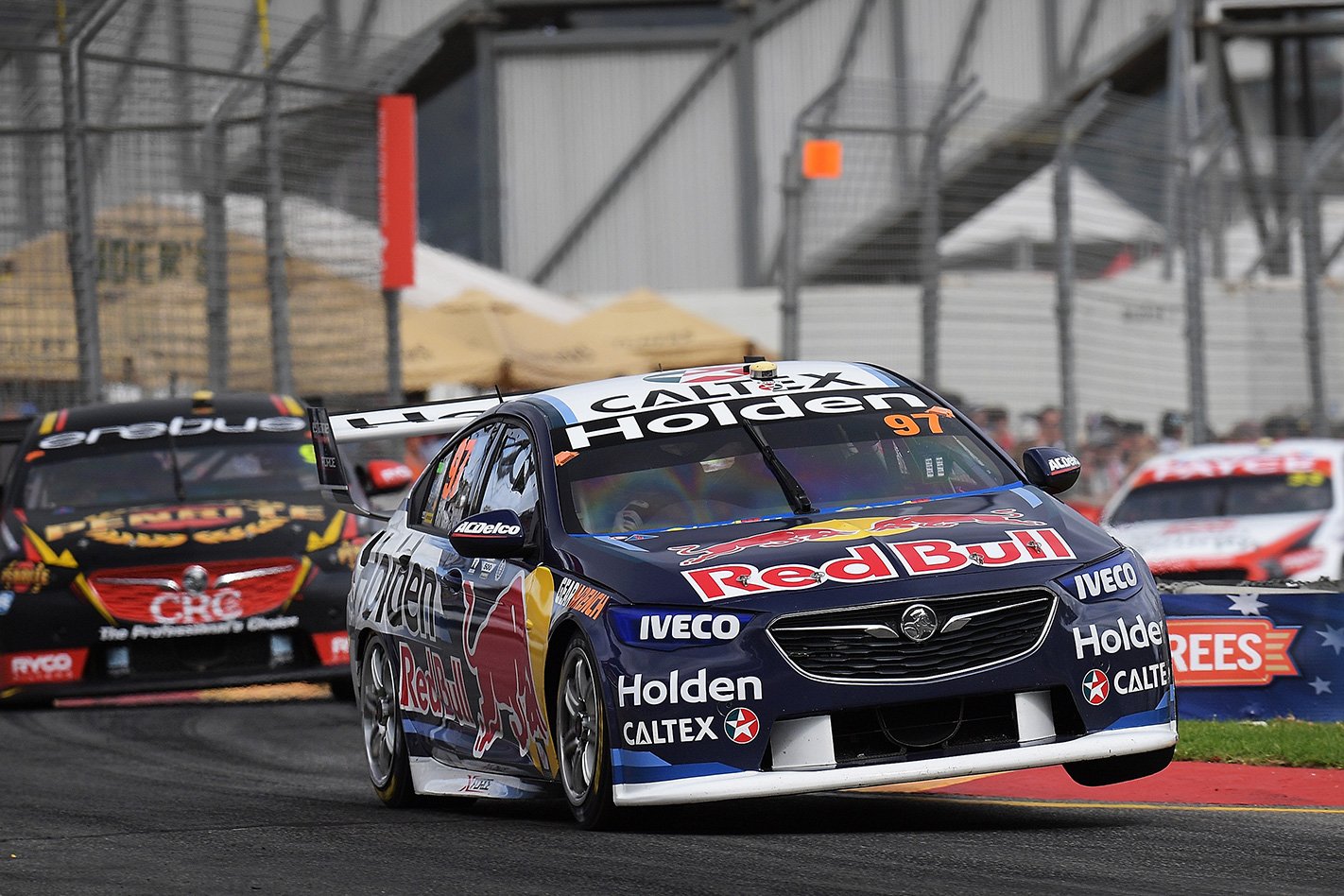
A great way to start the farewell tour. Let’s find out what it takes to build the last great Aussie V8.
Chassis and body
Be they ZB Commodore, Ford Falcon FG X or Nissan Altima, all Supercars are based on the same chromoly control spaceframe. The bodies have to be moulded to fit the 2822mm wheelbase, the defined engine location, suspension points, front undertray position and rollcage. Not the other way around.
The evolutionary nature of Supercars tech regs means much of ZB is carry-over from VF II and simply bolts straight in. Items as disparate as the pedal box, brakes, multi-link independent rear suspension and Albins transaxle are identical across the field. These days, the biggest area of technical design freedom is the double wishbone front suspension. There is tremendous focus on hub design. Triple Eight is up to Mk10.
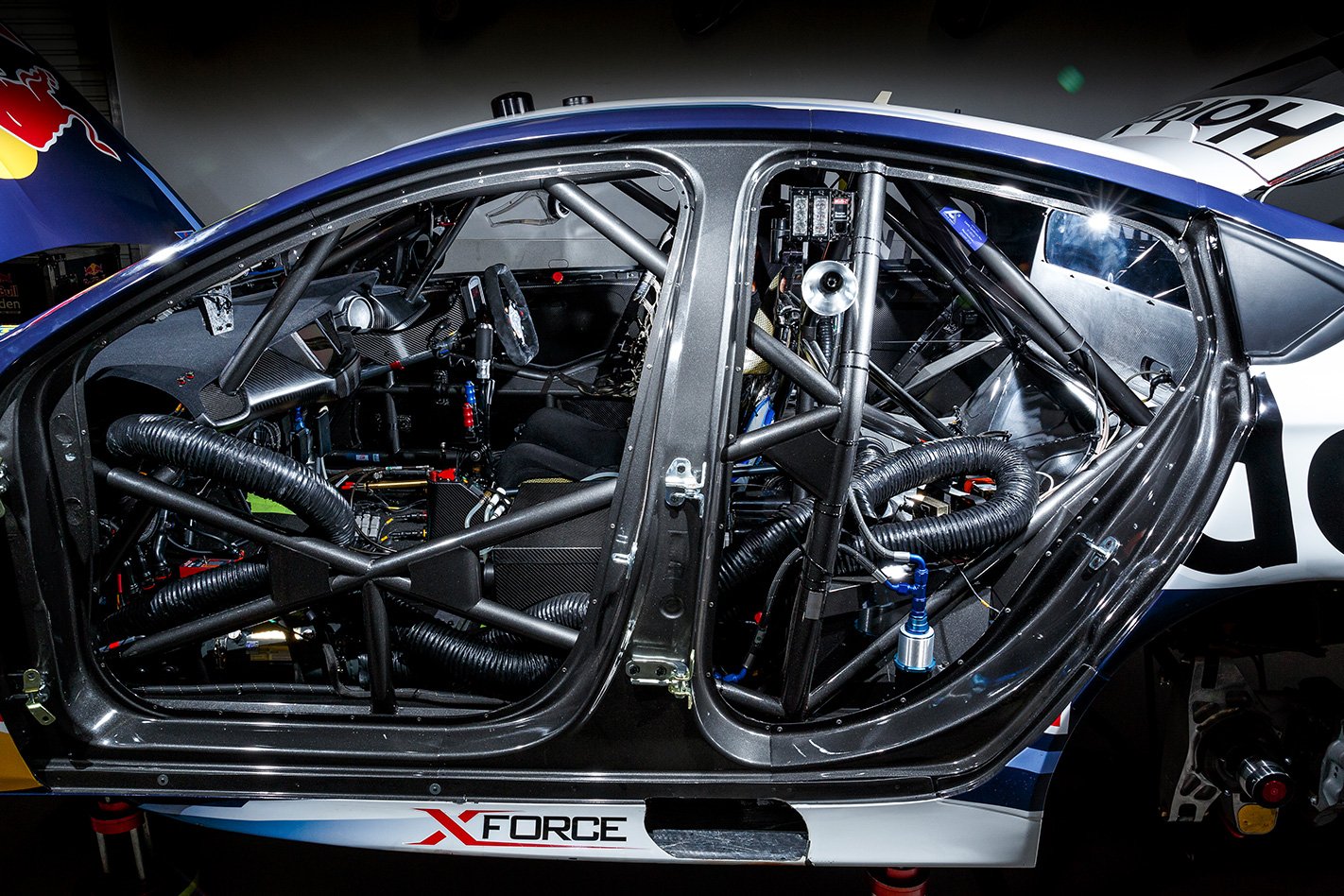
Long before project manager (and T8 head designer and Whincup’s race engineer) David Cauchi and aerodynamacist Florian Hoefflin and their team physically laid eyes on an Insignia/Commodore, they were working in the digital space using Computer Aided Design (CAD) to reshape and mould body panels to fit the chassis.
In the end, despite the road car’s wheelbase being almost identical with the Supercar at 2829mm, 130mm was sucked from the length of the rear door and the roof.
“You are cutting or shrinking or growing the car so the rollcage is contained in the roof without popping through,” says Cauchi.
Birth of a Hatch
The ZB Commodore is unique in this category because it is a liftback. Every previous Supercar has been a four-door sedan with a separate boot containing the fuel fillers and fuel system.
To create a safety cell for the driver, T8 mounted a polycarbonate windscreen on the control chassis rear firewall. When a ZB driver looks in his rearview mirror he is now peering through two screens.
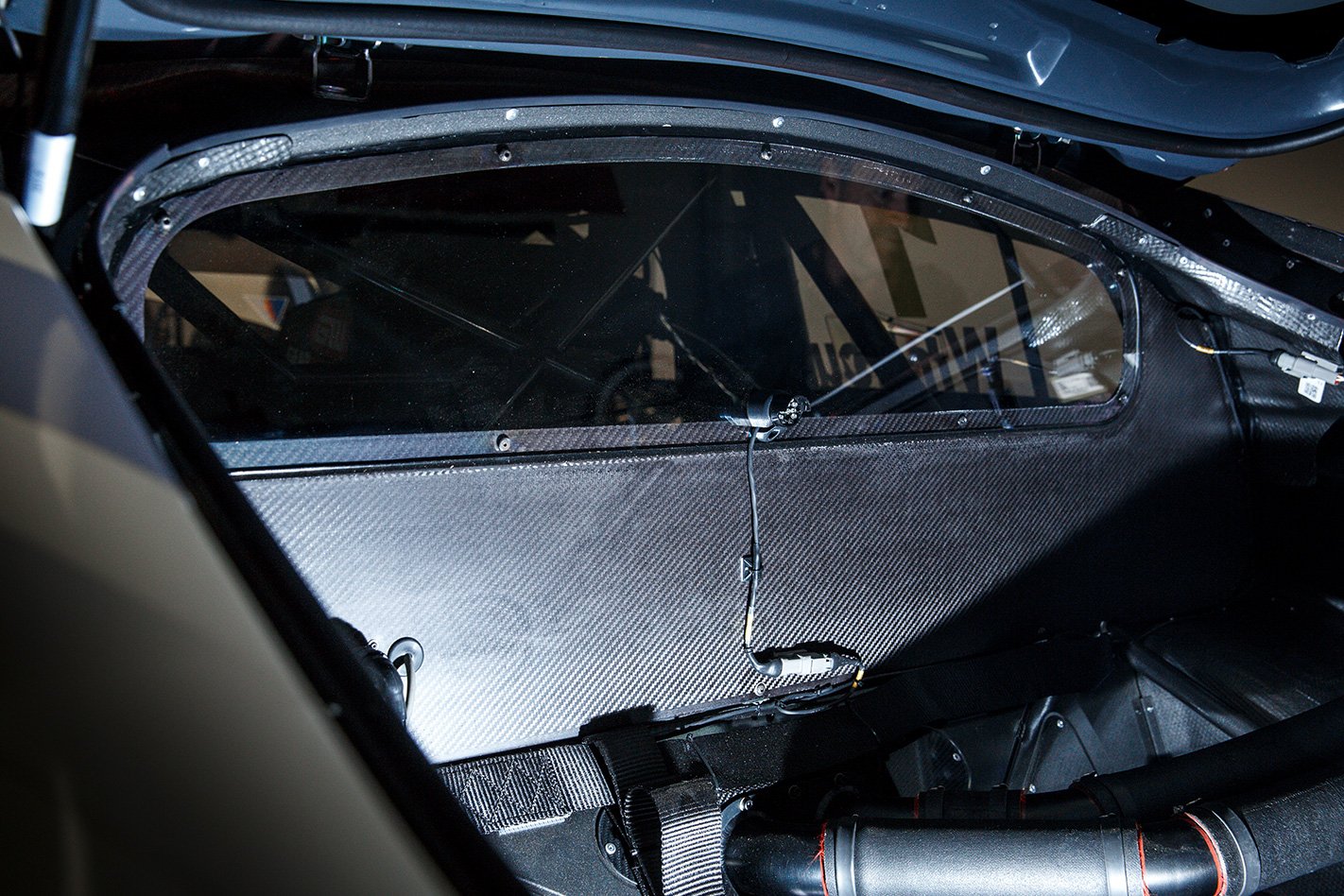
“Even in a big rear impact where the tailgate gets partially or completely dislodged from the car, the driver’s compartment stays sealed,” explains Cauchi.
“One of our initial concerns was the vision out the back of the car would be reduced, but the drivers actually say it’s better. I think it’s because of how open the boot now is. There is a little bit of sheetmetal we have had to replace or move and that’s probably enhanced the vison a little.”
Body materials
The only exterior panel of the ZB racer that is original material and size is the aluminium bonnet. Every other panel has been modified in some way and is now made from composite material. For added strength, the driver’s door is made from ballistic grade Kevlar.
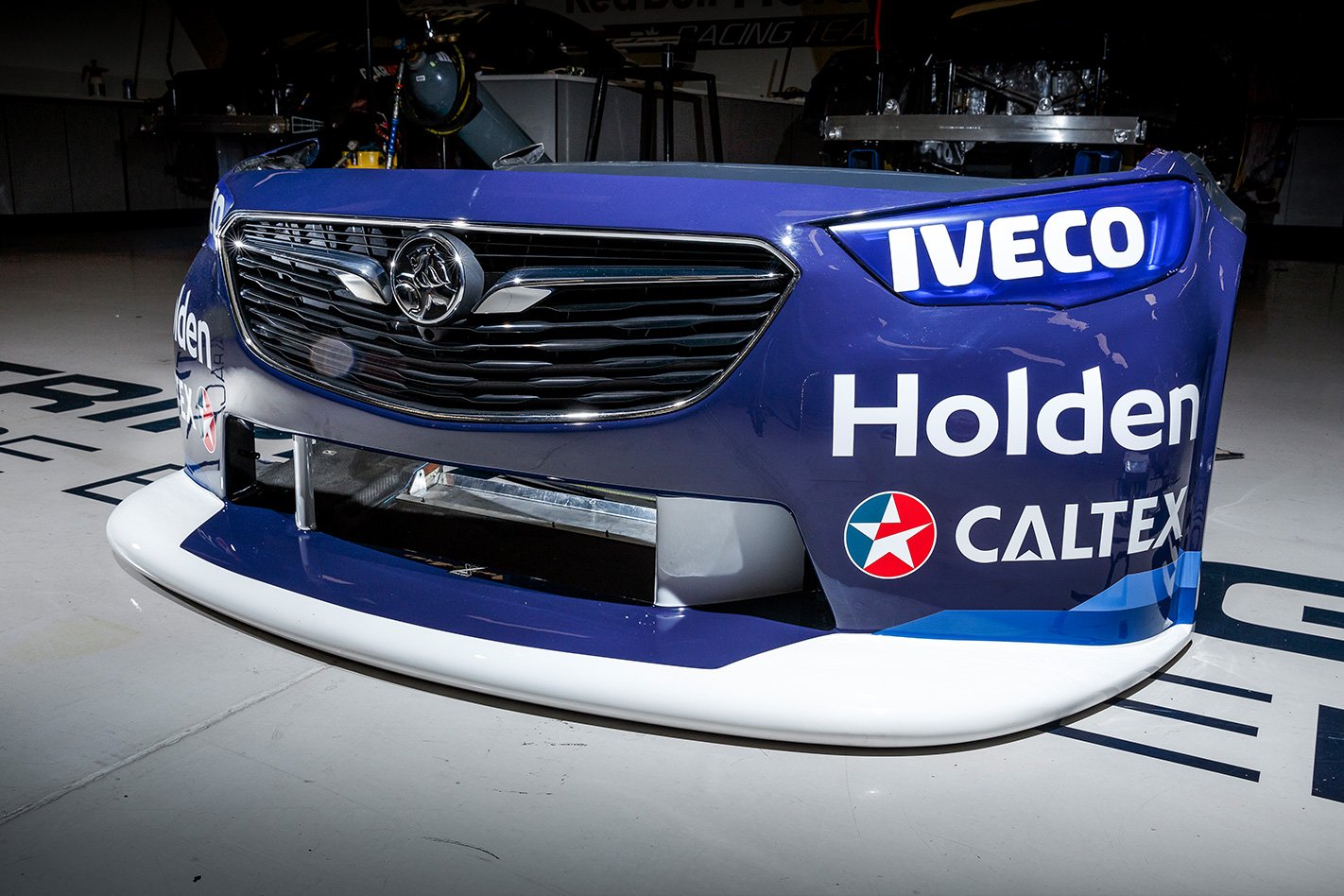
This is the first time the roof and tailgate assembly of a Supercar have been made from carbonfibre, something that had the Ford and Nissan teams grumbling in Adelaide because of potential advantage of a lower centre of gravity.
T8 went this route because getting production parts from the plant in Germany – especially once ownership of Opel traded from GM to PSA – was impossible. It even bought panels from a Vauxhall dealer in England during the development phase because it couldn’t get them from the Russelsheim factory.
Under the skin it’s much the same story. Door frames, side pressings and some infill parts that connect the panels to the chassis are sourced from Germany, but much more is designed in-house than when Holden teams were supplied ‘spoils’ off the Commodore line at Elizabeth. Says Cauchi: “We’re still a little bit reliant [on the factory for parts], but probably only [to the tune of] 20 to 30 percent, whereas we used to be 50 to 60 percent reliant.”
Aerodynamics
Supercars differs from many big-league motor racing categories because downforce is limited to about 310 kilograms spread across the front and rear axles. This limit – and equalised drag – is enforced by Supercars via an aerodynamic parity test.
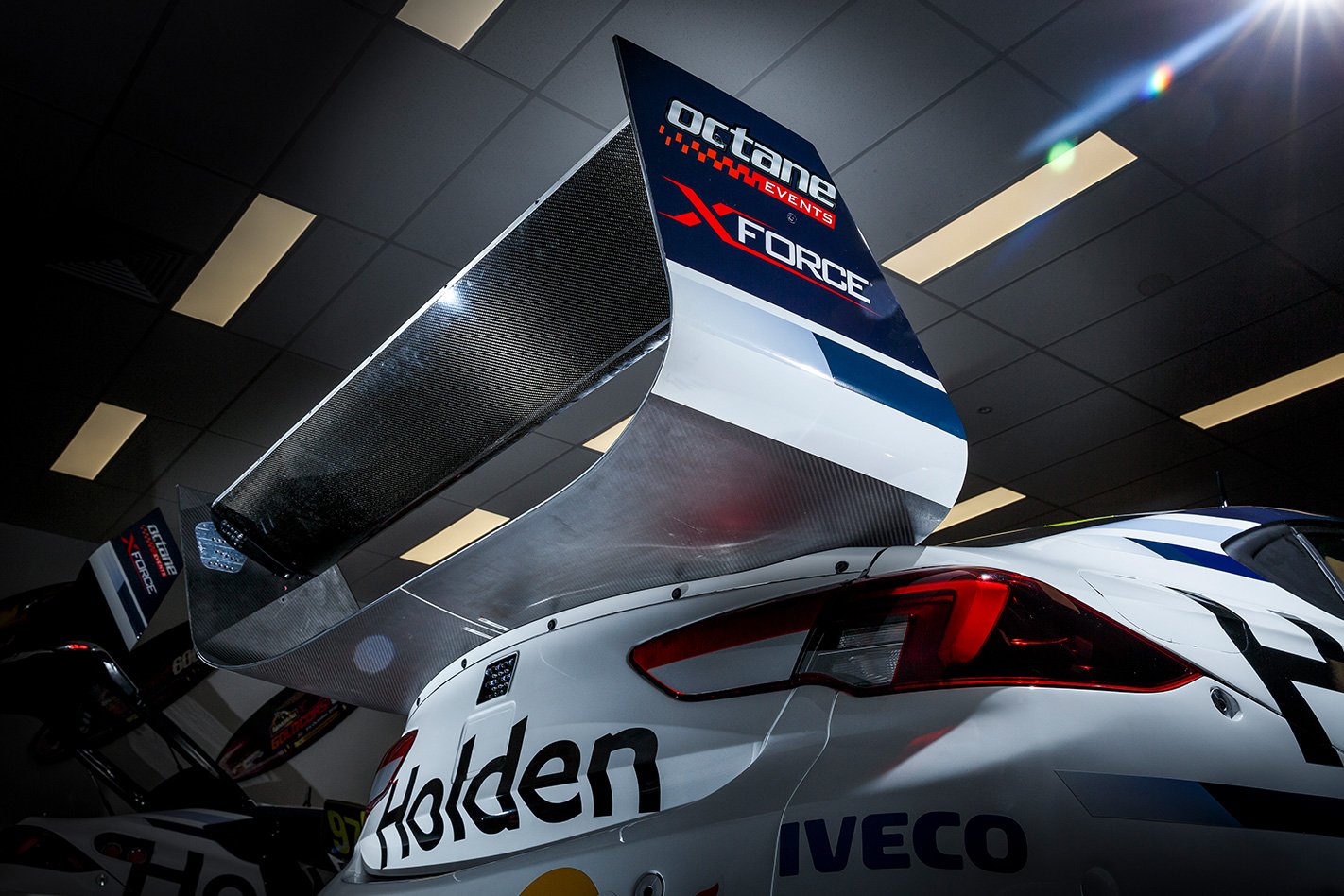
For ZB, T8 decided it wanted more downforce on the rear axle than the VFII to cure that car’s tendency to oversteer into corners. The trade-off would be less downforce on the front and more corner-entry understeer, but the team was confident it could cure that mechanically via a revision of the front suspension geometry.
Wind tunnel testing is banned in Supercars, so T8 forged a relationship with Wirth Research, a UK-based aerodynamic consultancy with expertise in Computational Fluid Dynamics (CFD).
“With aerodynamics it’s a lot harder to visualise what’s going on than for most other mechanical things, but CFD basically allows engineers to see the things you can’t see,” explains Cauchi.
What they saw when the aero package from VFII was transferred straight to ZB was an even greater downforce load on the front axle – the opposite of what they wanted. “We went through lots of iterations looking for solutions,” recalls Cauchi. “There were no preconceptions and nothing was sacred.”
The side skirt and rear diffuser design were quickly locked away, leaving T8 and Wirth to focus on the front splitter, rear wing position and those oversize endplates. Negating the ZB’s natural forward aero balance was a challenge, something accentuated by the shallow tailgate angle and short rear deck. That’s why there’s such a long plate hanging off the back of the ZB on which to mount the wing.
Up front, aero modifications are only allowed below the bumper line, so within those confines the key change was an aggressive step shaped into the cheek just in front of the wheelarch. That change delivers a little more (compensating) front downforce, but also costs some drag.
It’s the rear that attracts all the attention, though. “The interaction of the deck and the rear wing is quite important,” confirms Cauchi. “That determines how well the wing does or doesn’t work. “Whether it’s right or wrong; well, I’ll tell you in 12 months’ time…”
Cockpit
The office of a Supercar is a busy place.
The driver nestles into a Racetech 9129 carbon racing seat and is secured by an OMP six-point harness. Fresh air, drink tubes and comms inputs are all plugged into the helmet. Cool suit piping is attached to the race suit. The Sparco steering wheel skeleton houses a T8-designed electronics module that includes a comms button, headlight flasher, wiper, pitlane limiter, line-locker handbrake, drink activator, alarm acknowledgement, a Motec dash with pages of readouts and shift lights.
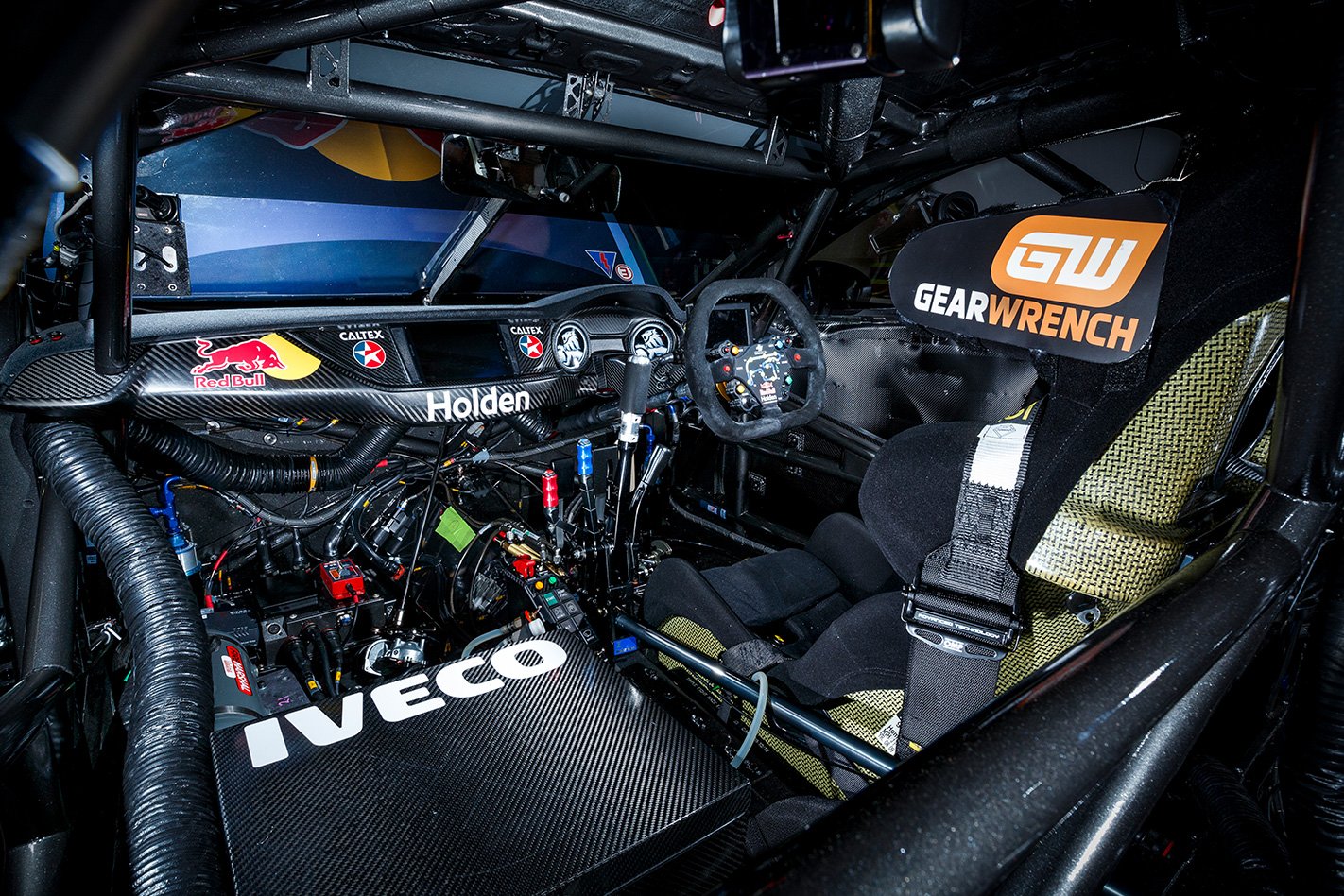
The sequential shifter is to the driver’s left along with anti-roll bar adjusters, brake bias adjuster and a carbon-fibre panel including ignition, fire bomb, fuel pump switches and more.
While much of that is carry-over, the top of the ZB road car’s dashboard is replicated in carbon-fibre and includes a rotating screen for advertising logos.
A new generation wiring loom also goes into the ZB, placing it lower in the car and reducing the number of connectors.
“Everything is made very specifically for these cars,” says Cauchi. “This is a controlled and affordable form of racing but there’s still enough intricacies for engineers to sink their teeth into.”
But it’s the new twin turbocharged 3.6-litre V6 that’s the future. Based on the LF4.R twin turbo V6 developed by GM Racing North America for Cadillac’s ATS-V.R GT3 racer, it’s local debut has been delayed because of cooling issues.
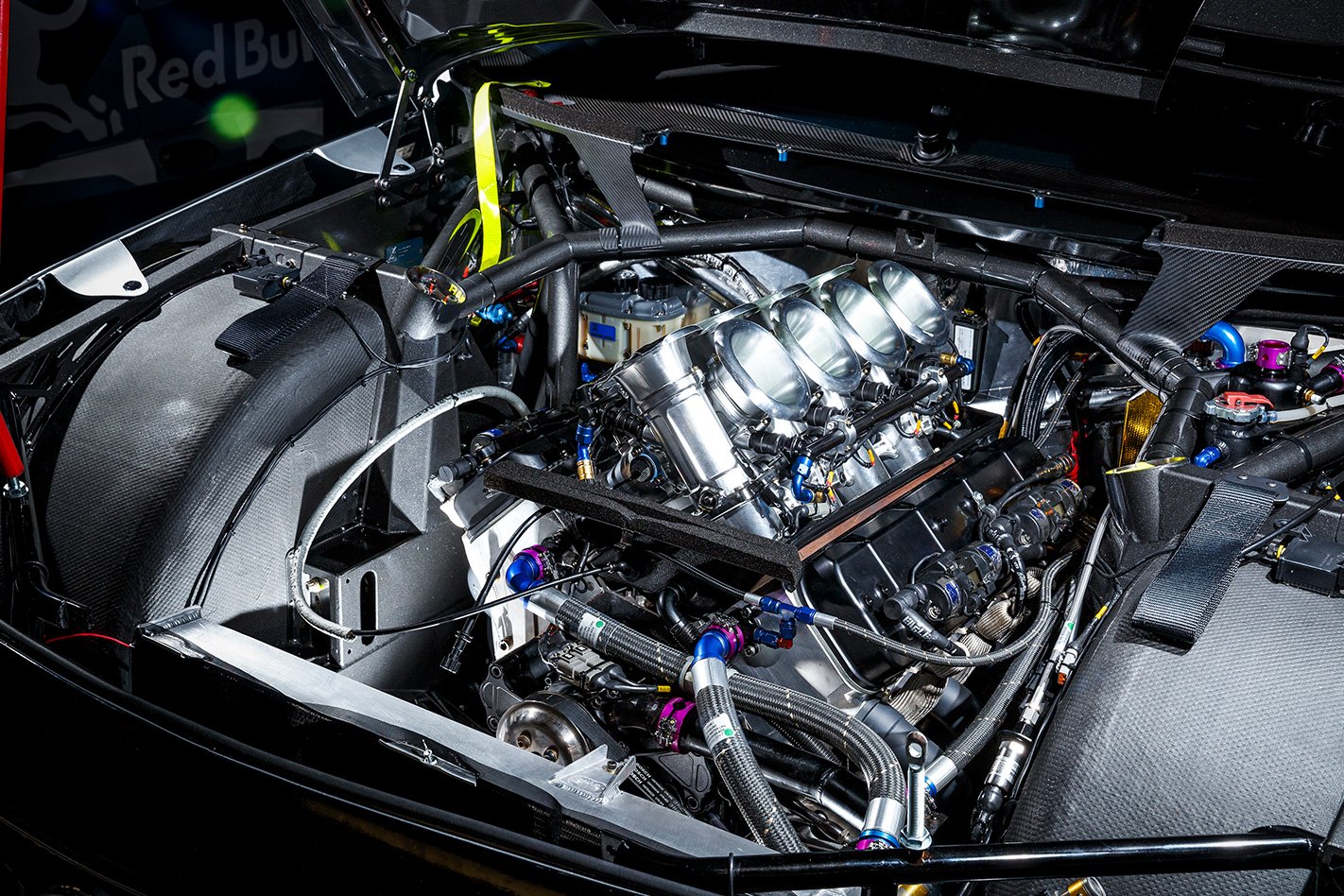
In US-spec with a lower power output, the engine retains the road car’s integrated exhaust manifold. That’s great if you want to heat the engine up quickly to combat emissions, but no good for a Supercar that must operate in winter chill and summer heat. So T8 has bitten the bullet and is developing a conventional three-port external exhaust manifold.
IF YOUR idea of off-roading is bumping along at 5km/h with a spotter walking in front, Ford’s Ranger Raptor is likely to come as a bit of a culture shock. “We’ve designed this vehicle to go up to 170km/h or thereabouts off road,” says Damien Ross, the Chief Program Engineer for the Raptor.
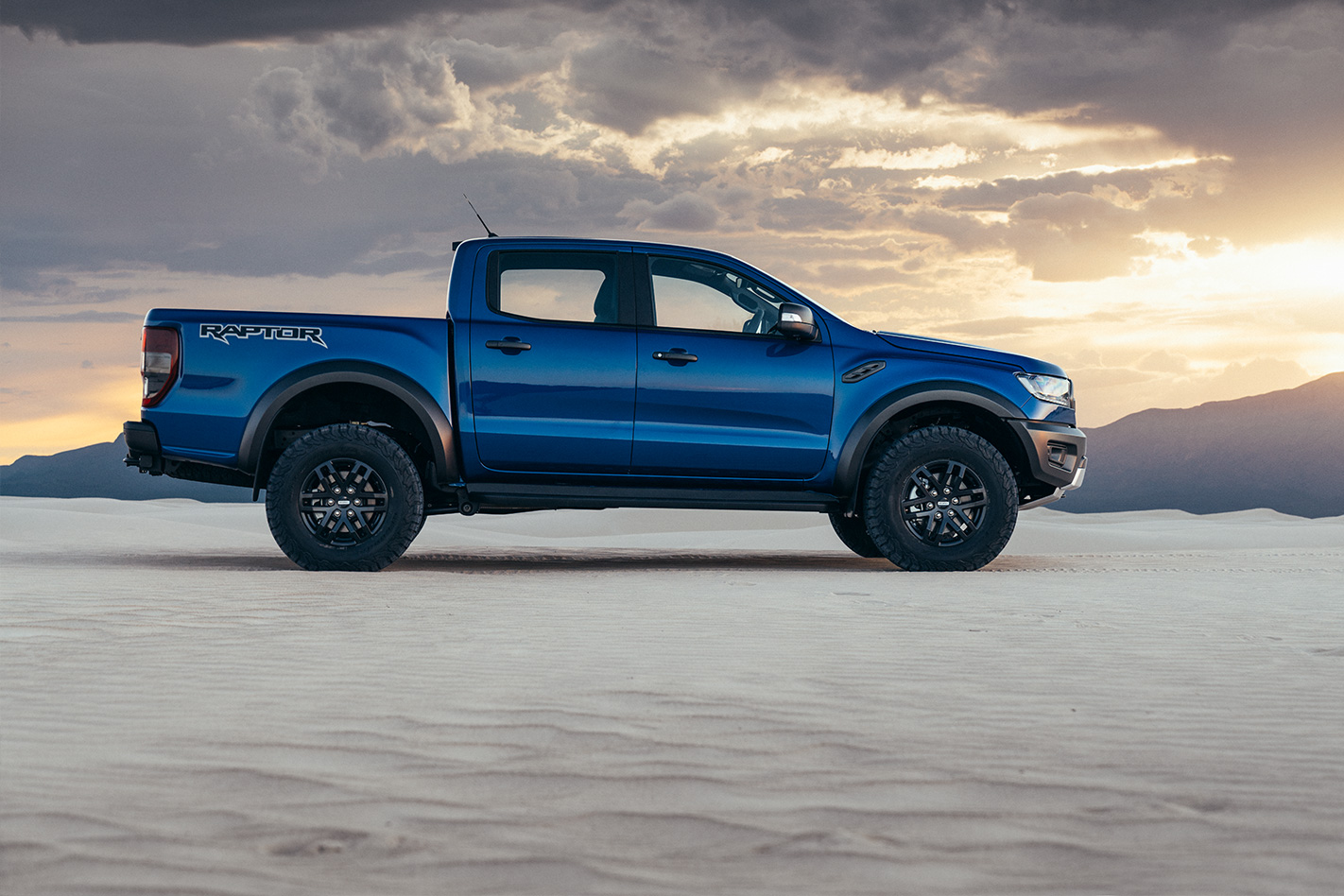
Taking that as a key design parameter for the Raptor, everything has been worked back from there: engine, suspension, brakes, and body have all had the essence of Dakar truck-style capability worked into them.
The arrival of the Ranger Raptor couldn’t have been better timed. Although there has been rumblings about tightening domestic tax loopholes that have undoubtedly boosted sales of dual-cab utes, manufacturers have realised that there’s headroom in this market for premium products. While most of the high-end models centre around equipment upgrades, nothing has been quite so fundamentally re-engineered for purpose as the Ranger Raptor.
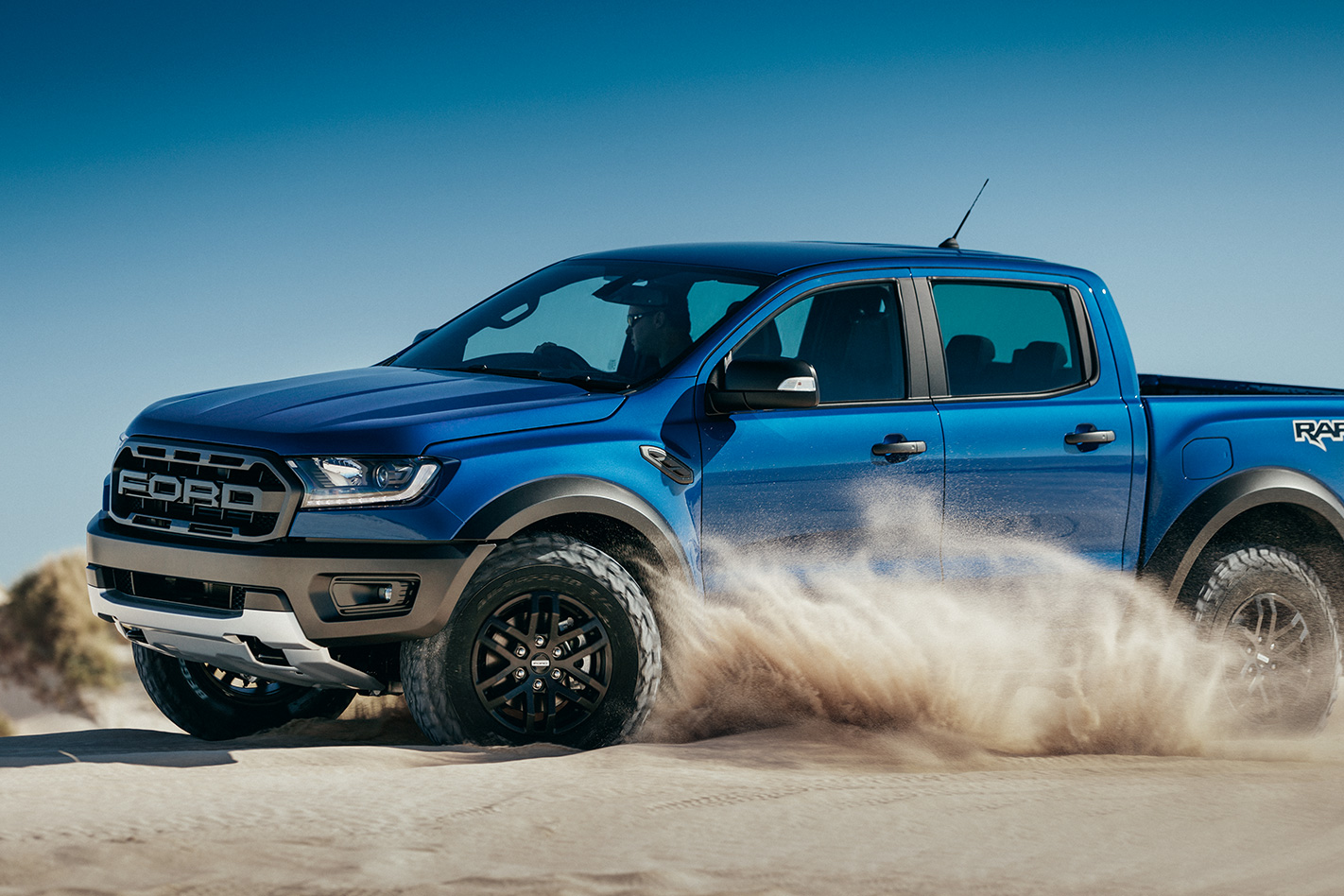
The suspension is markedly different to the leaf-sprung rear of the standard Ranger. “At the rear, we’ve redesigned the frame to take a Watts link suspension,” says Ross. “We’ve also added suspension A-arms to give us a wider track [by 150mm] and changed the height of the vehicle as well.” The added 56mm of ride height combines with a 32.5-degree approach angle, ramp-over and departure angles of 24 degrees, and the fitment of 23mm-thick steel bash plate to give the Raptor the ability to tackle almost any yump unscathed.
It’s far from a direct port of the Everest rear end, though. “Obviously the Everest has a Watts link suspension. To a certain extent, Watts link – like leaf springs – is a very basic set-up, but we’ve gone for outboard shocks, and then we’ve had to make sure everything has the strength,” he continues.
The Fox shocks are custom-tuned units tailored to the demands of high-speed off-road driving.“They’re the shocks that go into the American F-150, and [Fox] are our partner for this program too,” says Ross.
“They’re very capable shocks with bypass technology that allows us to create much more capability in damping [at] different vehicle speeds – different off-road speeds as well as on-road speeds.
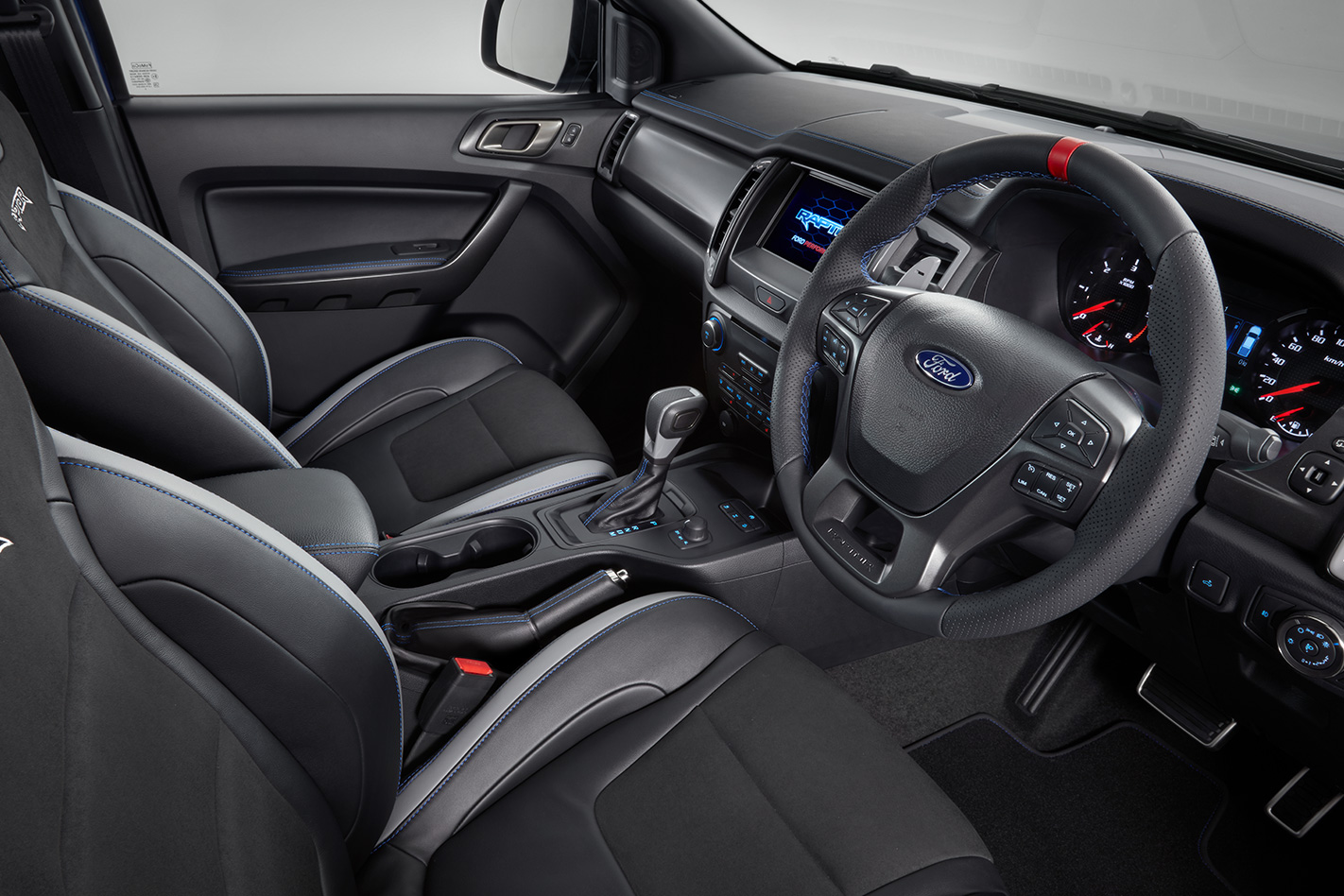
“You get a limousine-type ride on-road that we haven’t had before in our trucks.”
With 236mm of front suspension travel (an additional 32 percent over a Ranger Wildtrak) and a massive 290mm at the rear (22 percent more), there’s huge compliance. And the Fox shocks, with 46.6mm pistons and remote reservoirs, offer a stack of options to Ford’s chassis engineers.
The chassis has been strengthened with increased bracing and stiffness. High-strength steels have also been added to key points in the frame so it can better cope with high-speed off-road impacts. Ford reckons the Raptor’s side rails can now withstand an extra G of vertical impact.
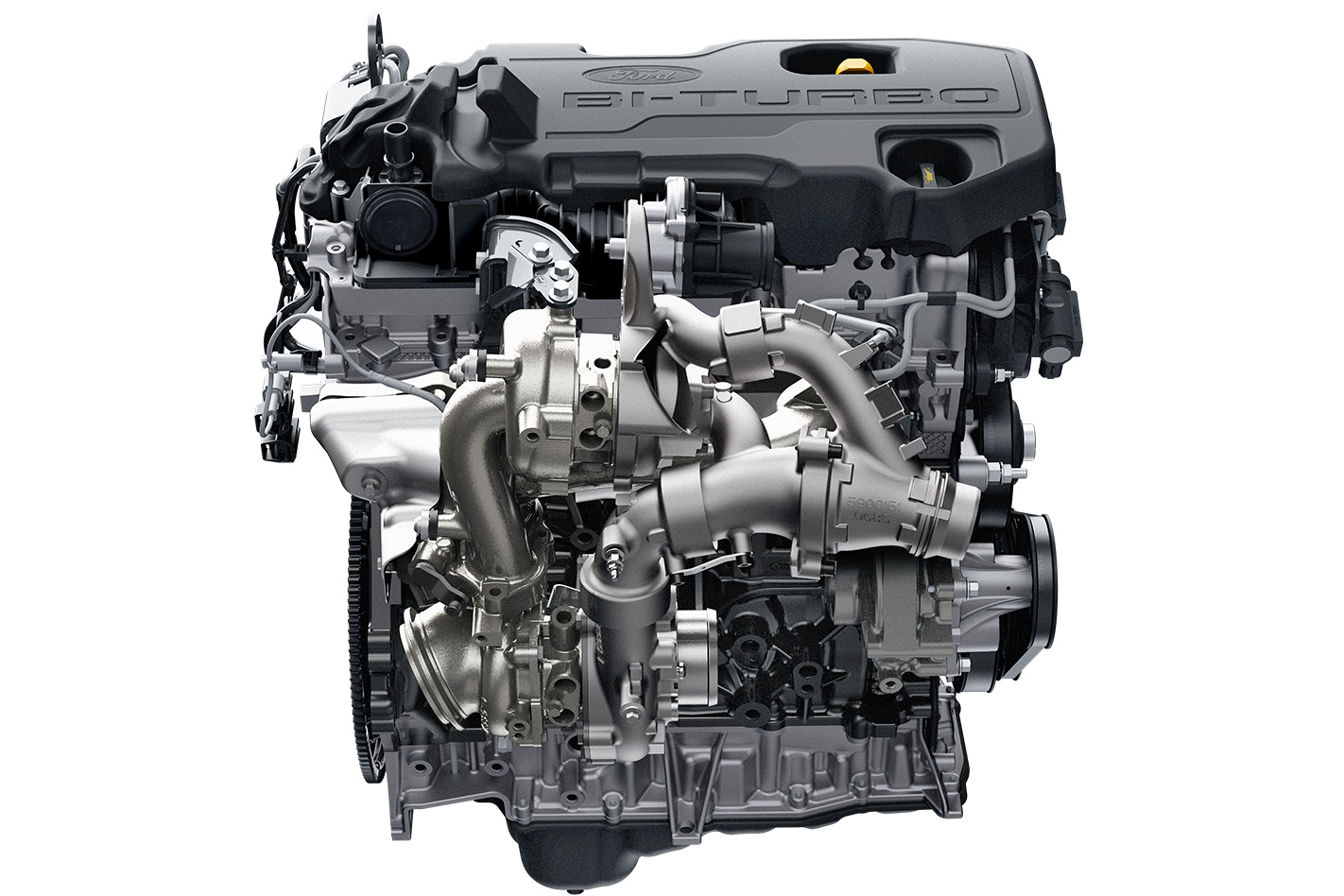
The vented disc brakes have also been upgraded to cope with the higher demands, with huge 332x32mm rotors up front and 332×24 rear discs replacing the stock Ranger’s drums. The transmission is Ford’s new 10-speed torque-converter automatic that’s been calibrated for the Raptor, dialling into the torque characteristics of the biturbo diesel for fast launch capability. Huge 285/70R17 BF Goodrich All Terrain TA Comp tyres are complemented by a specially reinforced spare tyre mounting point.
“Obviously we’ve optimised all the shift patterns for on-road. With the Terrain Mode Management system, you can select Baja mode which modifies the braking and traction-control systems, and also [allows] a little bit of oversteer. It gives a more fun element for the enthusiast. It also marries in a different shift schedule with the transmission that helps you get a more aggressive response.”
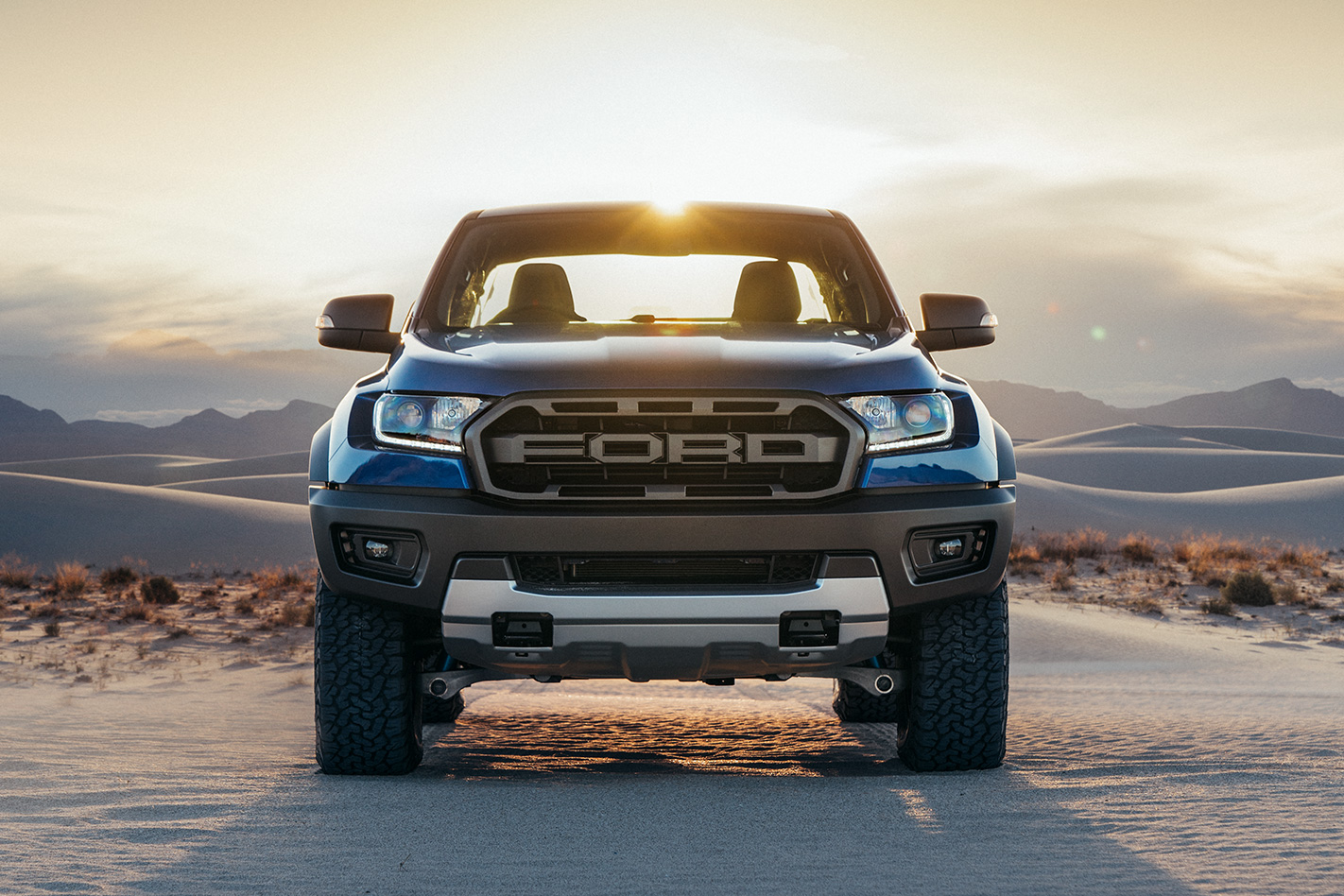
As well as Baja mode, the Terrain Management System also offers Grass/Gravel/Snow mode, a Mud/Sand setting and Rock mode.
The first Ford Performance product developed in the Asia Pacific region, Australia has been the engineering home for the Ranger Raptor’s development program. “The Raptor’s been all around Australia and we know Australia is one of the toughest places in the world. We’ve also tested it in the US in the same desert that the F-150 goes over as well as our normal test locations in North America and Europe,” says Ross.
“If we cover off Australia, it gives us confidence that we’ve covered off most other locations.”
